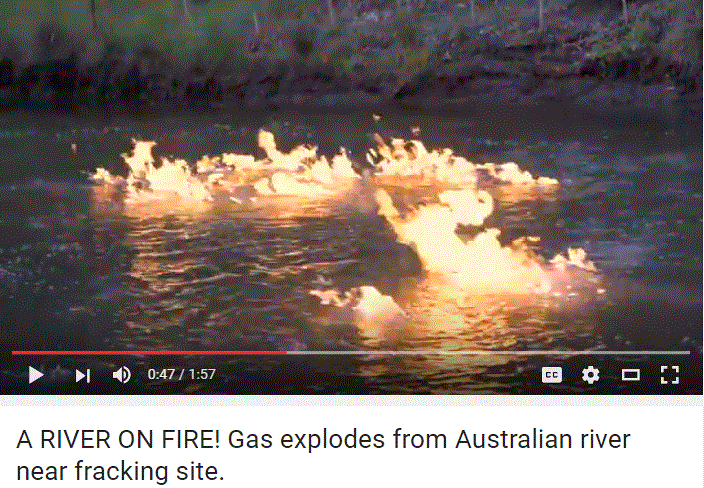
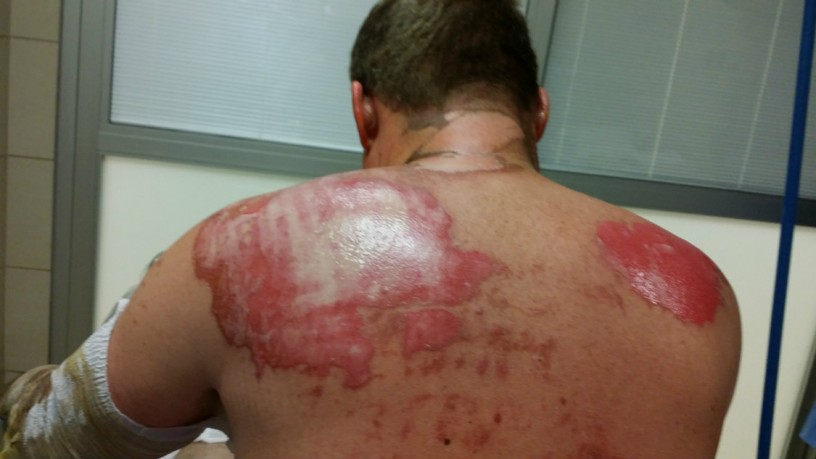
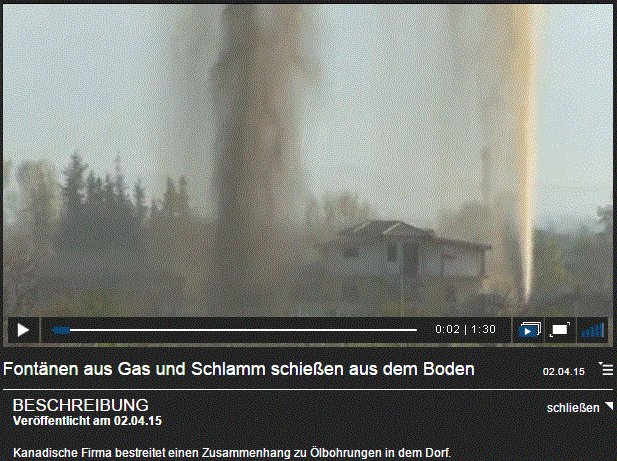
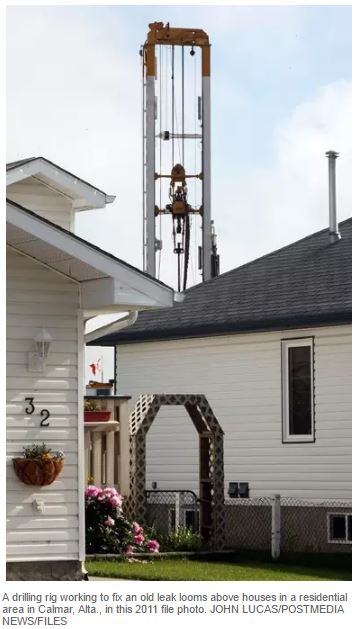
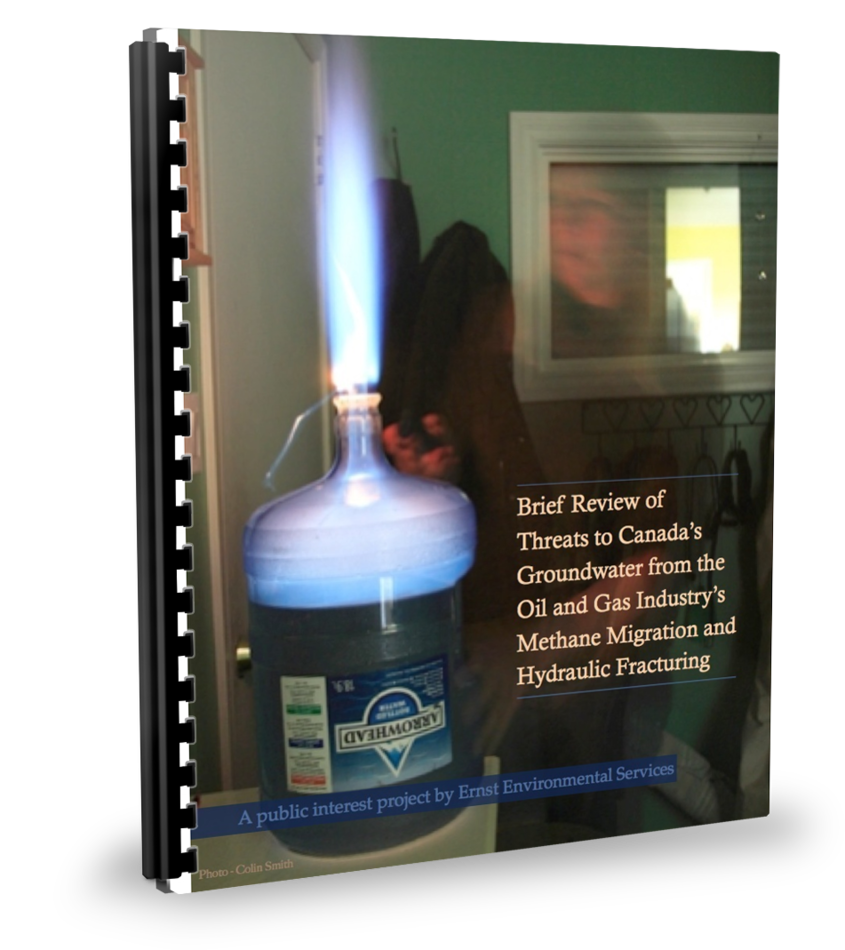
Oil & gas wells leaking and killing people across Canada with frac’ers eager to contaminate more and more communities. After Mark Carney, a Harper Con, became PM, he deregulated the deadly industry to please Trump and Separatist Alberta, and he’s been busy taking our rights away, notably from Indigenous peoples. Carney pimping LNG and gas-fuelled AI will result in massive increase in frac’ing and methane contaminating homes and water, killing more innocent Canadians (the AI data centres will contaminate water with toxic PFAS and in some communities run the supply dry). What if industry’s leaking wells fuel wildfires?
Une autre raison pour laquelle nous avons été sages de nous battre contre les puits de gaz de schiste. Dans le sud-ouest de l’Ontario, de vieux puits qui ont plus de 125 ans créent des problèmes et causent des pertes de vies.
En plus des puits fracturés, il y en a des centaines de ces vieux puits au Québec….
Another reason we were wise to fight against shale gas wells. In southwestern Ontario, old wells that are more than 125 years old create problems and cause loss of life.
In addition to the fractured wells, there are hundreds of these old wells in Quebec….
“In the resulting rush of fortune-seekers, thousands of wells were drilled. As many as 50,000 wells may have been drilled in Ontario, although records are available for only 20,000.”
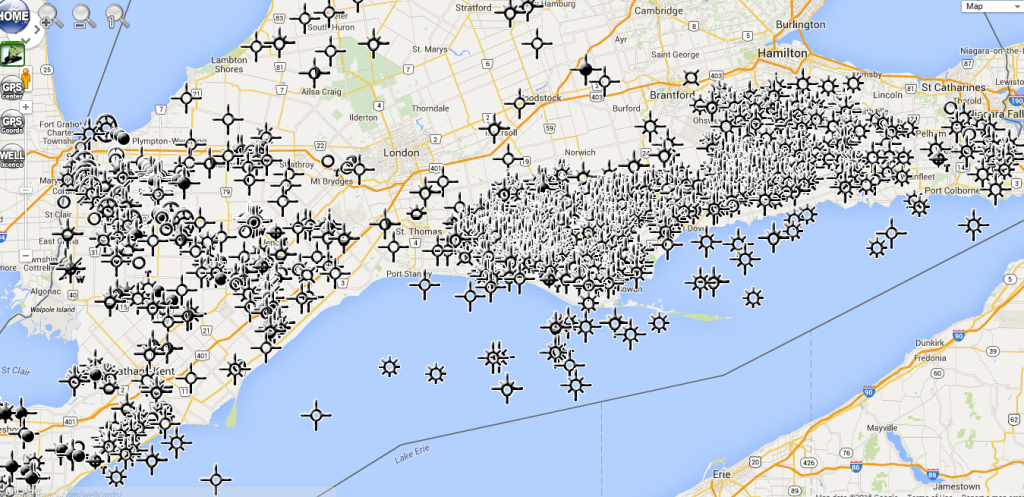
Map of some of the Ontario energy wells (many of them leaking and or abandoned, including deadly sour gas) as of April 5, 2015. 3,600 of these have been frac’d as of that date (how many more since?) while Ontario gov’t lies publicly, claiming there has been/is no frac’ing there:
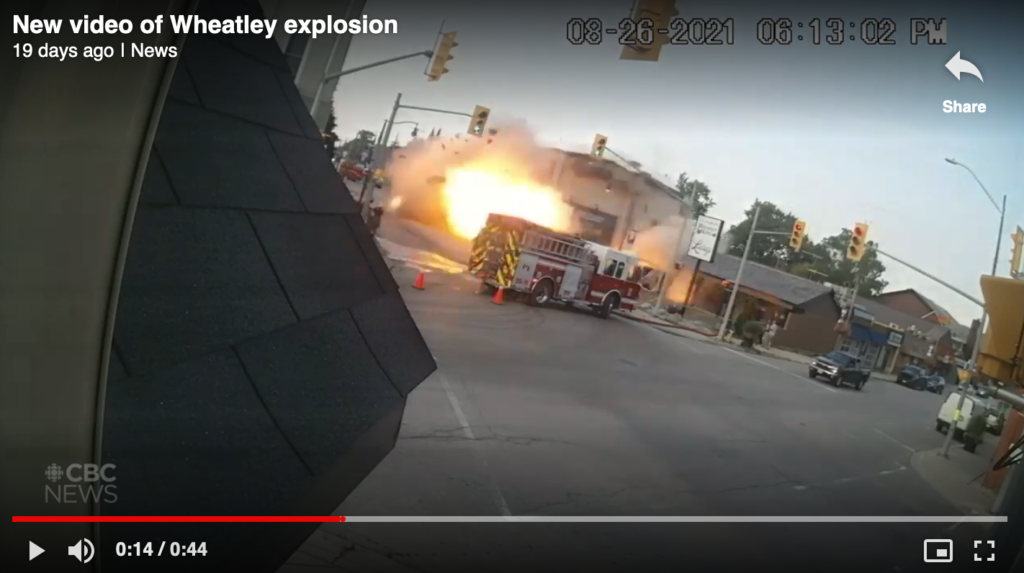
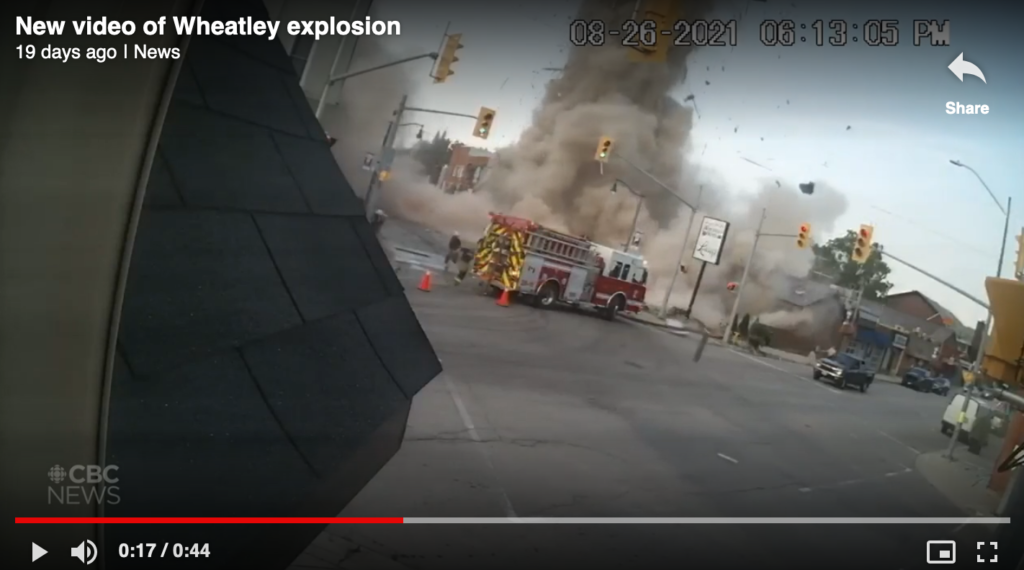
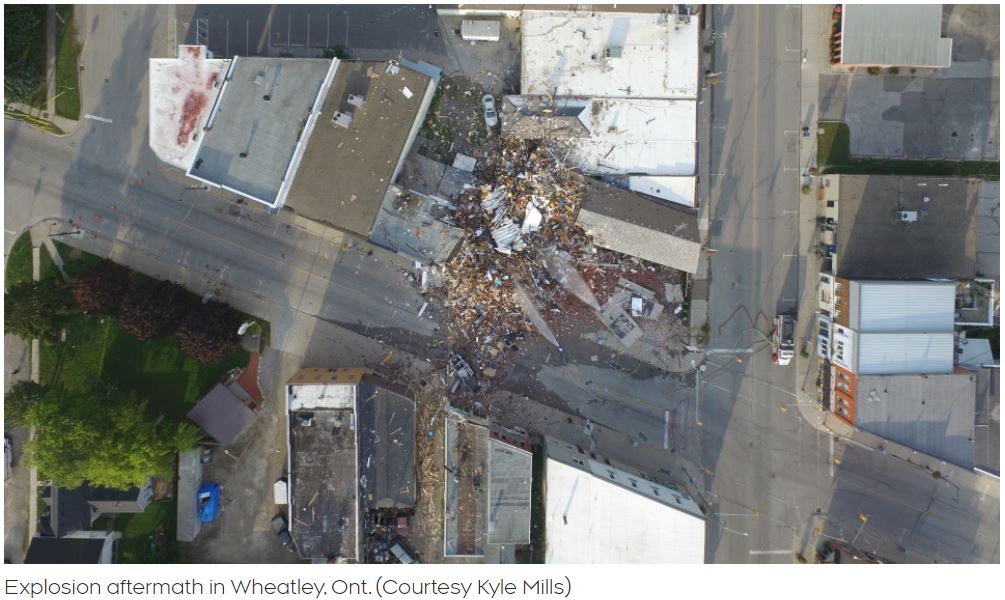
Downtown Wheatley, Ont., eight months after the explosion in Aug. 2021 that injured 20, destroyed much of the town’s core and forced an evacuation lasting over a year for some residents. Photo by: Colin Graf / Canada’s National Observer
In June 2022, Shawn Seguin climbed down a ladder into a water well on his property near the town of Caledonia, Ont., to try and purify the sulphur-laden water flowing to his family’s garden pond. He never came out.
Seguin, a father of two, “didn’t have a chance,” according to geoscientist Stewart Hamilton, who investigated the incident for the victim’s family. The culprit was the highly poisonous hydrogen sulphide (H2S) gas, known for its rotten egg odour.
When Hamilton and his investigators lifted the well lid, the air inside was measured at 120 times the lower lethal threshold, an “unprecedented” level for water wells in Ontario, according to their report. While no gas wells are recorded close by, chemical analysis of the water in the fatal well suggests one or more legacy gas wells is impacting the groundwater, the report claims. Ontario has 20,000 wells, perhaps more, with no records for them, so there could very easily be one near Shawn’s well!
The dangers were judged so high that Hamilton and colleagues called on Ontario’s Ministry of the Environment, Conservation and Parks (MECP) after the death to immediately warn residents and contractors working near the town — between the city of Hamilton and Lake Erie — of the “extreme risks” from H2S gas to anyone using groundwater in enclosed spaces.
“Unless residents in the affected area are aware of this highly unusual risk, similar accidents may occur in future,” the report reads.
But the warnings haven’t been heard everywhere.
In September 2025, 15-year-old James Aaron Brown died after being exposed to H2S gas in an underground water tank on a farm near the town of Parkhill, Ont., northwest of London. Several weeks later, a dairy farmer who owned the farm where the accident happened was charged with criminal negligence causing death. Police said the teen was employed on the farm. The case is still before the courts.
After maintaining their privacy for four years, Seguin’s wife, Summer, and his sister, Richelle, are breaking their silence in hopes of preventing future tragedies. That takes much courage, thank you and Brava!
Almost unnoticed, people are dying in explosions and accidents across southwestern Ontario linked to invisible toxic gas leaking from long-buried wells. A series of deaths linked to some of the 27,000 legacy gas wells that lie beneath the landscape of southwestern Ontario — including Seguin, Brown, and a retired couple who perished when their cottage exploded near a leaking well site — are probable victims of the unseen gases from these orphan gas wells, some dating back over a century.
Province puts onus on individuals
Not long after her husband’s death, Summer had phone calls from a local plumber and a contractor about risks from gas in their work. While still dealing with her grief, she then found herself worrying about her neighbours’ safety as well.
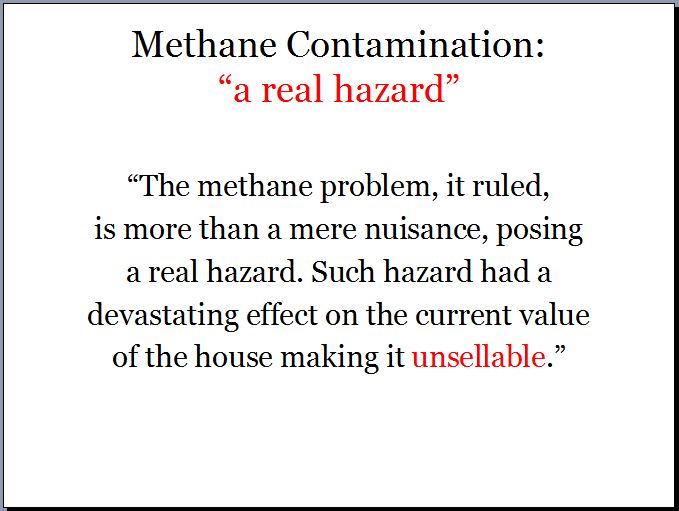
“I was growing more and more concerned about my neighbours not going into their wells to fix things. Shawn wasn’t the only one doing this,” Summer explained in an interview. While MECP regulations allow only licensed well technicians to work in water wells, that doesn’t stop rural people from going down to do inspections, Richelle added. I checked on my well all the time, and before it got contaminated by Encana/Ovintiv, I shock chlorinated it regularly, always by myself. For a few years after it was contaminated I still shock chlorinated it because I did not know this: methane contaminated water also causes cancer risks if chlorinated because the mix creates trihalomethane, never mind explosion/asphyixation risk killing you and your loved ones. I only learned of the trihalomethane harm after Alberta Environment shut down the Hamlet of Rosebud’s water because after Encana illegally frac’d our aquifers, the trihalomethane sky rocketed in the hamlet water. The County had to change how it treated the contaminated water. Insanely, Encana was not fined, not punished in any way, not ordered to repair the damage it had done to our aquifers because the regulator blamed me and biogenic methane (but the company was intentionally frac’ing for biogenic methane, I did not frac the aquifers, and my historic water well records said “Gas Present: No.”). The regulators and gov’t only punished me.
“Every country person checks out their wells. It’s a very, very common practice,” Richelle said.
Summer received an order from the MECP to decommission the water wells only a month after Shawn died. They were given less than four months to hire a contractor to do the work. The tight deadline was horrible for the family to deal with during their grief, Richelle recalls. and, what does the family now do for water supply?
“After everything that had happened to my family, I had to dig into all this well stuff too,” Summer recalls. She agreed to get the work done, but tried in the process, unsuccessfully, to make a deal with the ministry: for the government to commit to warning neighbours directly about dangers in local wells in return for her cooperation.
“You hear about every little thing on the news, but when something this catastrophic happens to a local business owner, father, son, husband, it feels like his story has been forgotten or hidden and nothing has been spoken about,” says Summer. “I would hate for something like this to happen to anyone else.”
In frustration, the sisters-in-law next hired a safety consultant and launched an advocacy campaign at their own expense to try and force authorities to get the word out. Their efforts led to new warnings on the local public health unit’s website about well gas. The MECP also sent a warning notice to well drillers — more than a year after Shawn’s death — about well gas in general, “as a result of an incident that occurred in southern Ontario.”
Still, to this day, they haven’t seen any sign that either the Natural Resources or Environment ministry have communicated directly with local residents. “I’ve seen zero indication they have told owners to have a gas meter,” if they are entering a well, says Richelle. gas meters will rarely save your life, if the beeper goes off, it’s usually too late, and boom, you’re dead or badly burned like Cody Murray, Bruce Jack and industry water testers.
“Have all of these wells been abandoned [permanently sealed]? That’s what needs to be done,” says Summer. “They’re leaking into our water wells.”Yes! That is what absolutely needs to be done, but no gov’t in Canada has the balls to make industry clean up and fix their leaks. New wells leak worse than old ones, so the problem is magnifying daily, with our regulators doing nothing, but deregulate to let the criminal, sometimes killer companies, make more money while they leak more toxic gases.
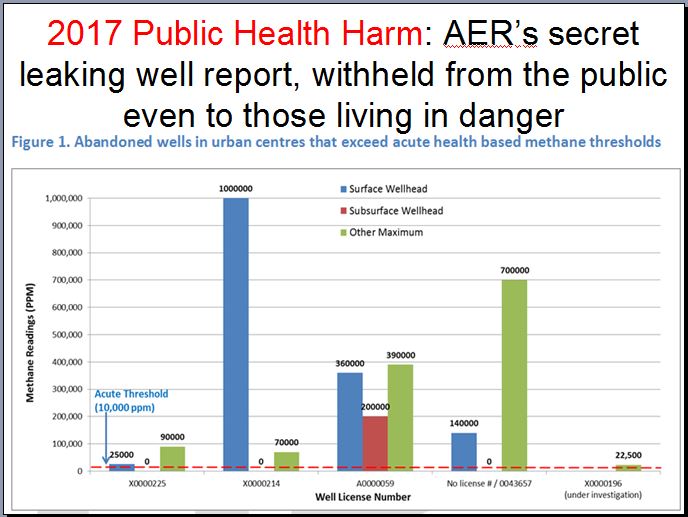
That job is nothing short of gigantic. Ontario’s Oil, Gas and Salt Resources library shows locations and histories of over 27,000 wells. More than 9,000 of these are unplugged or plugged prior to 1970, using outdated, degrading materials that are leaking subsurface gas, according to a 2022 report by Ontario’s auditor-general. Less than one in five has been inspected since 2006.and, there are no locations or recordsa for about 20,000 wells
The province says it’s making progress. Ontario has plugged 471 wells at a cost of $46 million, a recent MNRF news release states, at an average cost of nearly $100,000 per well. The MNRF is devoting $6 million to the well-plugging program in 2026, meaning that if the previous figures hold, the province can plug around 61 or 62 wells out of the 9,000 leaky sites identified by the auditor-general.
But that average cost can be deceptive, says Maurice Dusseault, professor emeritus of geological engineering at the University of Waterloo. Sometimes, a well turns up that is extremely difficult to plug and “soaks up money like a sponge soaks up water,” he tells CNO.
Not only does the province need to plug wells faster, but the government also needs to lift the burden of responsibility from property owners, say critics from both the political left and right.
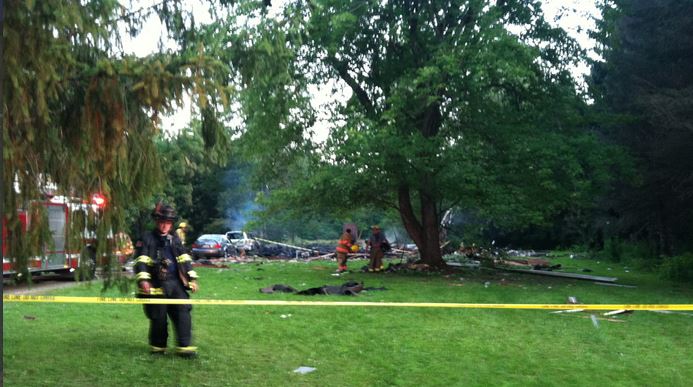
Debris was thrown over 40 metres when an explosion killed retired couple Dave and Diane Nadalin at their small Lake Erie beach house in July 2020. Photo courtesy: Office of Ontario Fire Marshal
While owners who find a legacy well on their land can apply for provincial money, plugging it remains their responsibility and they are not guaranteed funding. That has to change, says local Member of Provincial Parliament (MPP) Bobbi Ann Brady.
Brady, a former PC government MPP who broke with Doug Ford’s party, says many people in her area buy land already punctured by gas wells, and the province “needs to take a leadership role in this situation and set an example,” she says. Her opinion is echoed by Sandy Shaw, an NDP MPP whose riding borders Brady’s.
“The old legislation applied when gas wells were active … and they were providing jobs and profits to the community. Change is needed because people are getting stuck with properties, assuming a risk that should never have been theirs in the first place, and the government is prepared to turn their backs on these people and say, ‘Sorry, you’re responsible. We’re off the hook.’”
Deaths part of a decades-long, deadly, destructive pattern
Digging through old records, news reports and documents shows that the four deaths are only the most tragic events in a series of explosions, leaks and close calls that have threatened Ontario residents dating back decades.
The best known — and most violent — was the explosion in the town of Wheatley on the Lake Erie shore, not far from Windsor, in Aug. 2021 that injured 20, destroyed much of the town’s core and forced an evacuation lasting over a year for some residents. Buried wells acted as conduits for gas to leak into the basement of the building where the explosion originated.
The province eventually paid over $30 million to make the site safe and to compensate property owners.
While the Wheatley event has been documented and researched in detail, mystery hangs over another nearby blast a year earlier. That explosion killed retired couple Dave and Diane Nadalin at their small Lake Erie beach house only a few kilometres from Wheatley. Their residence exploded in July 2020 with such force that debris was thrown over 40 metres.
Investigators with the Office of the Ontario Fire Marshal reported methane gas was leaking from an old well site at the edge of the Nadalins’ property. Tests following the explosion showed a match between gas samples from the basement and from the old well’s vent pipe, 33 metres away. In the end, investigators avoided a firm conclusion about the explosion’s cause.Of course they did, that’s what most often happens, and in Canada, even if company documents prove the crime, regulators bend over backwards to protect the law violating polluter.
Other incidents have created chaos, danger or disruption over the last 35 years in the two regions of Ontario prone to gas well leaks: the Essex and Kent County region near the west end of Lake Erie and in the Norfolk and Haldimand County area, closer to the lake’s eastern end. They include:
A gas geyser that sprung from the ground at a golf course in 2016 near the shore of Lake Huron, close to Sarnia, shutting the course down for a month
The largest evacuation due to underground gas in Ontario was in the town of Jarvis, still further east, in 1991. An explosion and fire sent resident Judy Leng to hospital with serious burns when her water pump started emitting gas. About 1,200 residents were forced out of their homes for four days.
Judy Leng was burned in the Jarvis explosion in 1991. She is pictured outside her home built to replace the one destroyed in the explosion. Photo by: Colin Graf / Canada’s National Observer
Summer remembers the day her husband died — the pickups arriving with volunteer firefighters trying to get Shawn out of the well, the emergency helicopter taking him to hospital, the discussions about lack of oxygen and possible brain damage, followed the next day by the condolences.
She still wonders why the Ontario government is spending millions on equipment for first responders to handle dangerous wells, but doesn’t seem to be spending anything on a coordinated information campaign to inform rural residents across this region of the province.
“Why does nobody know about this?” she asks. “The word has not gone out.”I believe it’s because governments in Canada are owned and bossed around by oil and gas companies, banks, and the fucking rich that invest in those, like Mark Carney. The companies do not ever want to pay to clean up their toxic shit, or fix their leaks because that takes away from profits and all they exist for is to rape earth, communities, families, and make money. If people know they are living in danger in their own homes, they might protest and demand proper repair paid for by the industry and it’s wealthy shareholders, not paid for by taxpayers, which is nearly always the case.
Fuck you, greed addict ex CEO of Encana, illegal aquifer frac’er, during your rule the company broke the law, again and again and again, not Trudeau. You fucking cowardly inhumane rude cons, always blaming someone or something else for your endless fuck ups; Danielle Smith does it too. PS Mark Carney is a Harper con, he’s not a liberal.
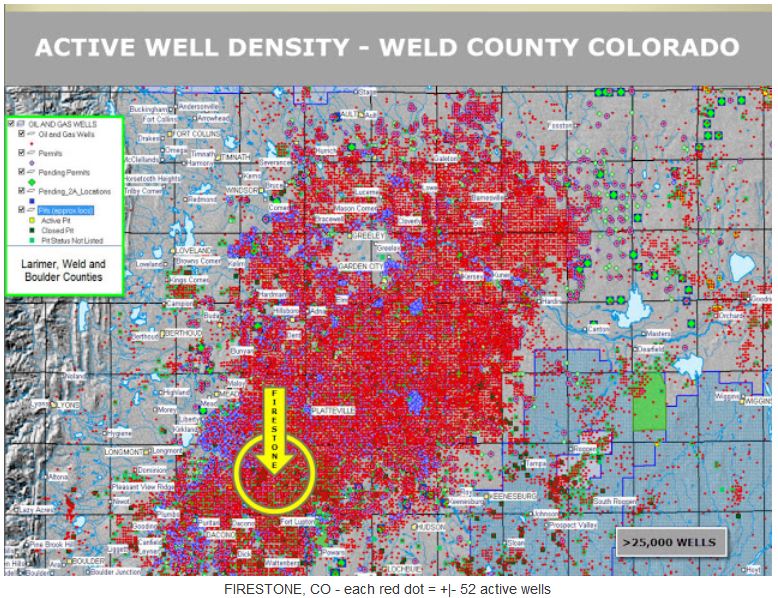
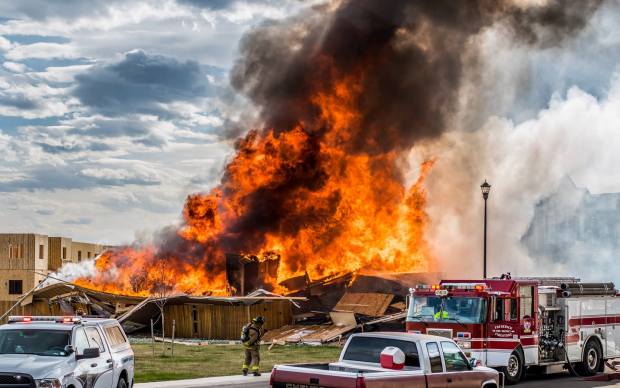
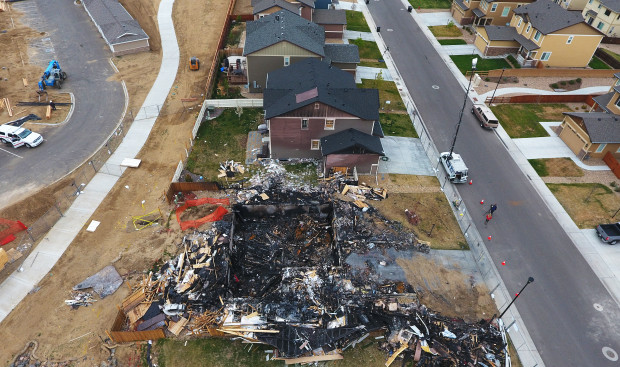
A home explosion in Firestone Monday, April 17, 2017 killed two and sent two people to the hospital. Dennis Herrera/ Special to The Denver PostFIRESTONE, CO – APRIL 27: Crews continue to investigate a fatal house explosion on April 27, 2017 in Firestone, Colorado. Anadarko Petroleum plans to shut down 3,000 wells in northeastern Colorado after the fatal explosion. (Photo by RJ Sangosti/The Denver Post)
Looking at maps of the area and areas where ‘fracking’ has taken place, it appears that this is very close to where fracking was done by the Mooncor Oil & Gas company and Dundee Energy Ltd. Weird how no one has mentioned that.
As natural gas production has shifted further from deep prolific gas reservoirs to shale gas, several questions are being addressed regarding fracturing technologies and the fate of chemical additives. A less investigated issue is the unexpected increase in produced hydrogen sulfide (H2S) from hot shale gas reservoirs. Understanding the source of H2S in shale reservoirs and managing low-levels of recovered elemental sulfur affects plans for future treatment, corrosion mitigation, and fracture fluid formulations. In this work we demonstrate that some typical ingredients of hydraulic fracturing fluids are not as kinetically stable as one might expect. Surfactants and biocides such as sodium dodecyl sulfate and glutaraldehyde are shown to undergo hydrolysis and thermochemical sulfate reduction reactions under moderate reservoir conditions, with H2S as the final product accompanied with long chain alcohols and hydrogen sulfate as long-lived intermediate species.
This finding suggests that fracture fluid additives can be responsible for the delayed production of natural reservoir H2S.
Oil field reservoir souring is defined as occurring when increasing concentrations of H2S are observed in production fluids. This is a relatively well-known problem in the contemporary oil industry. …
The general causes of souring are geomechanical (fracturing and intrusion into another formation), thermochemical (e.g., mineral dissolution), biogenic (sulfur-reducing bacteria activity), or combinations thereof.
In all cases, the causes of excessive H2S production in previously nonsour environments are primarily anthropogenic and caused by certain operational practices.
Calgary-based Mooncor Oil & Gas Corp. wants to develop a resource in Ontario that has been largely overlooked by its rivals: shale gas. … It has already locked up nearly 23,000 acres (9.30776 hecatres) of land inLambton and Kent counties and is preparing to spin off a separate company called DRGN Resources that will focus its efforts on both conventional and unconventional gas drilling. … What about Ontario’s own shale resources? “The question obviously comes up,” said Terry Carter, petroleum resources geologist with Ontario’s Ministry of Natural Resources. … Carter said the Marcellus zone doesn’t offer much in Ontario. “Almost all of it is beneath Lake Erie,” he said. “Kettle Point and Blue Mountain would appear to have better potential.” Both have what Carter described as biogenic gas, created when bacteria in fresh water come in contact with organic-rich bedrock. The bacteria eat the organic material and produce methane. “The natural gas is being produced in real time, just like in a landfill site”
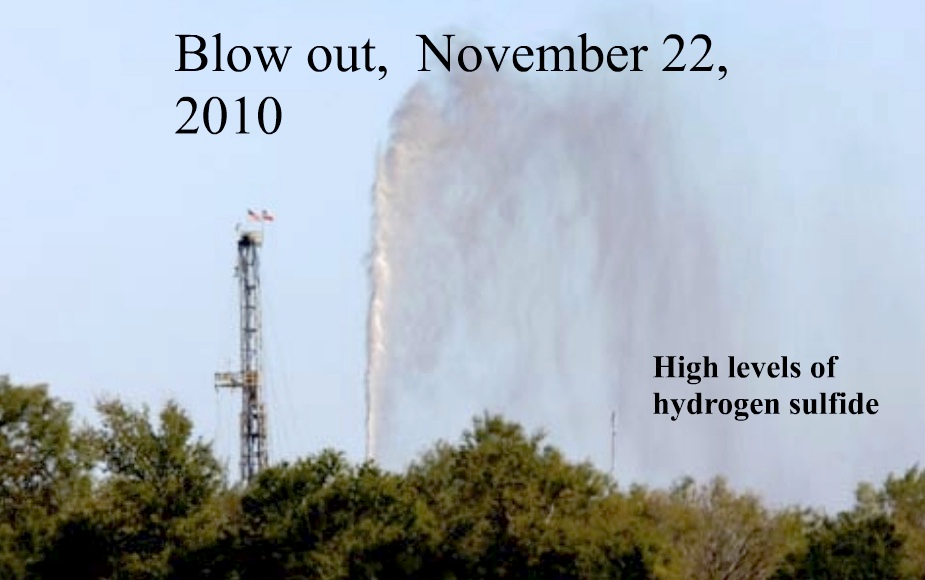
The Corpus Christi drilling company that’s struggling to cap a spewing well in Frio County said the well was abandoned years ago and wasn’t shown on any official state well maps. … VirTex said on Nov. 14 it had completed drilling a well just outside Pearsall city limits when a geyser of water and gases began spewing from an old well nearby. The white plume erupting from the well contained natural gases, including hydrogen sulfide, a toxic gas that can cause illness or death if inhaled in sufficient concentrations.
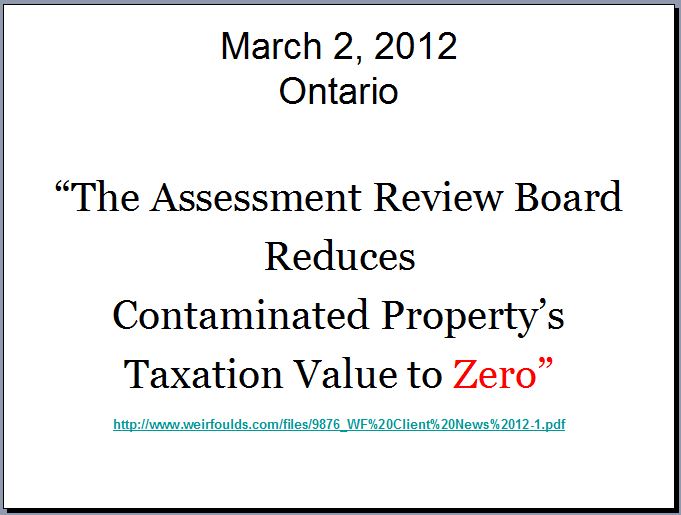
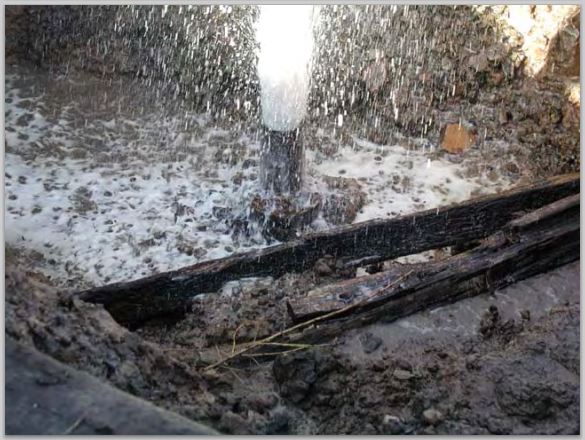
2006: Encana/Ovintiv illegally frac’s my community’s drinking water aquifers, covered up by AER, Alberta Gov’t, Alberta Health, Alberta Environment. My water after Encana’s illegal fracs (historic water well records for my well state “Gas Present: NO“; I’m still hauling alternate safe water, a single senior in “prosperous” Alberta):
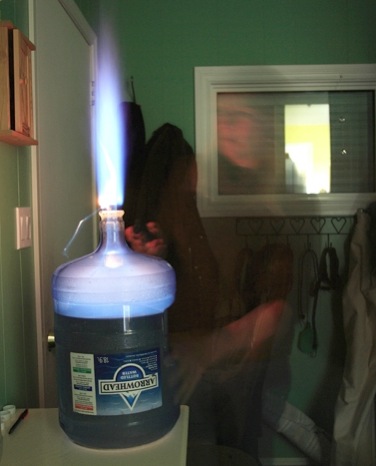
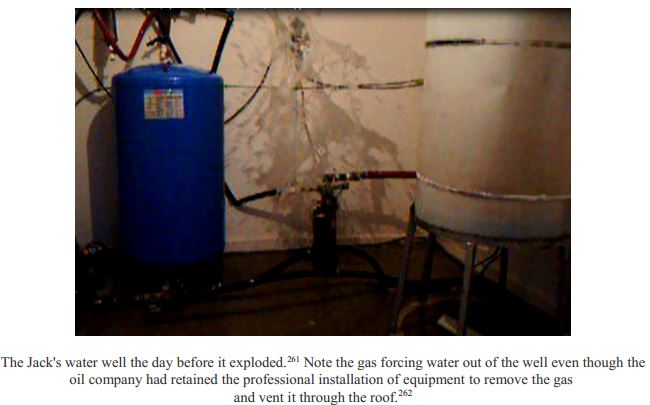
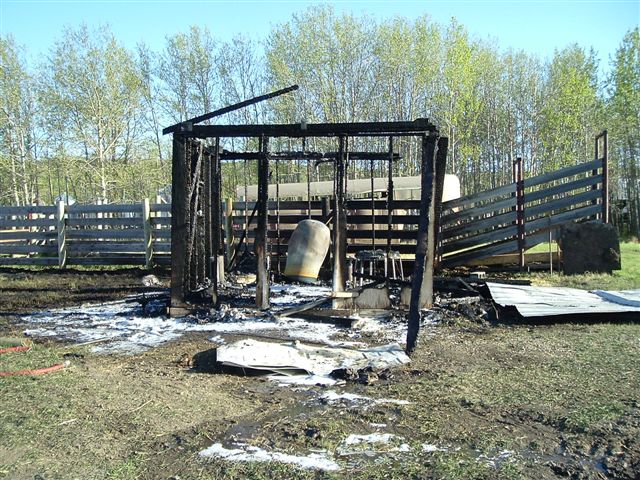
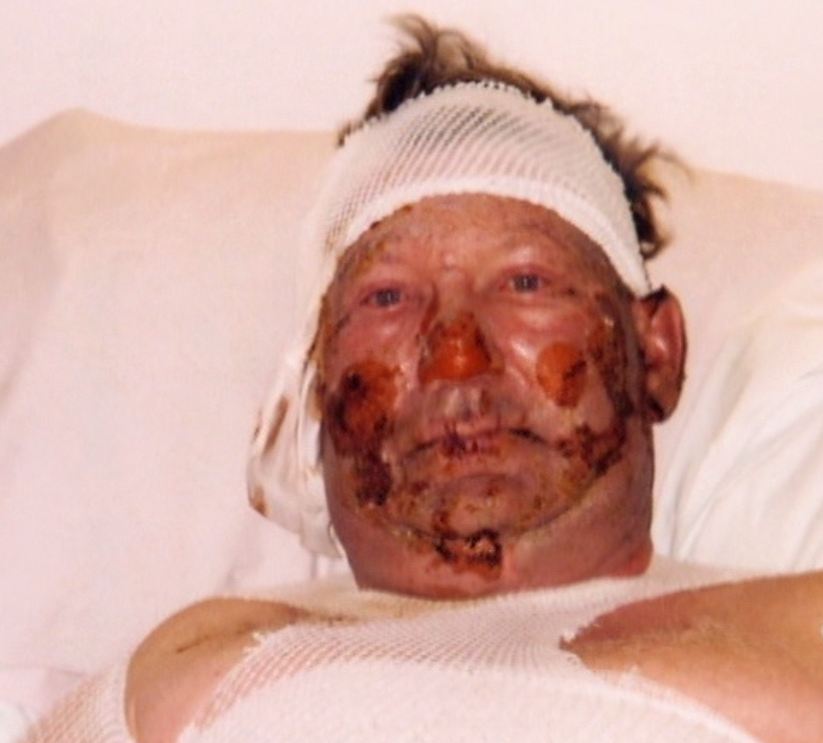
Bruce Jack and two industry gas-in-water testers were seriously injured when Jack’s methane and ethane contaminated water well explodes (after the water regulator advised Jack to install professional venting to “remove” the gas and make the water “safe.”)
The COGCC staff hand-delivered a Notice of Alleged Violation (“NOAV”) to EnCana on April 23, 2004. …The NOAV cited Rule 209., failure to prevent the contamination of fresh water by gas….
The COGCC staff hand-delivered a Notice of Alleged Violation (“NOAV”) to EnCana on April 23, 2004. …The NOAV cited Rule 209., failure to prevent the contamination of fresh water by gas….
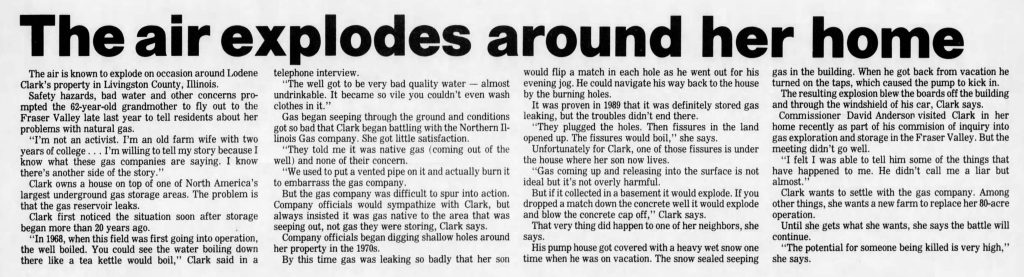
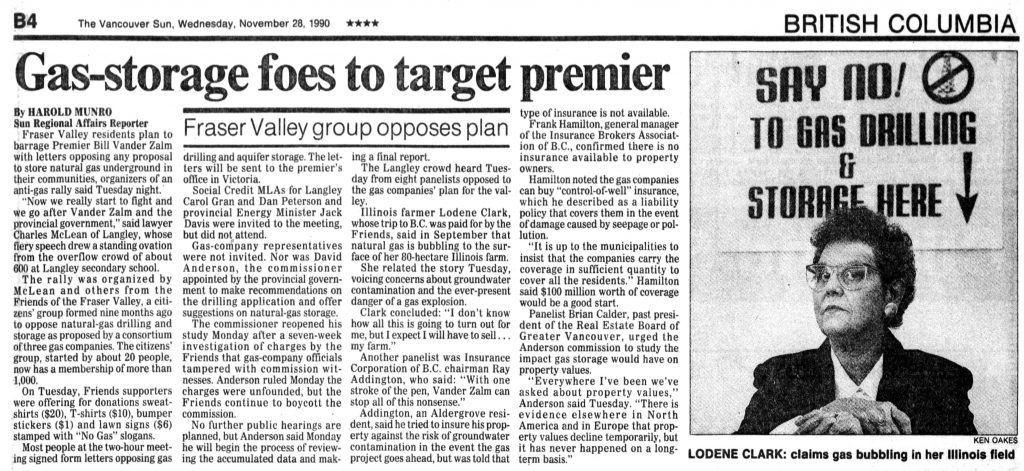
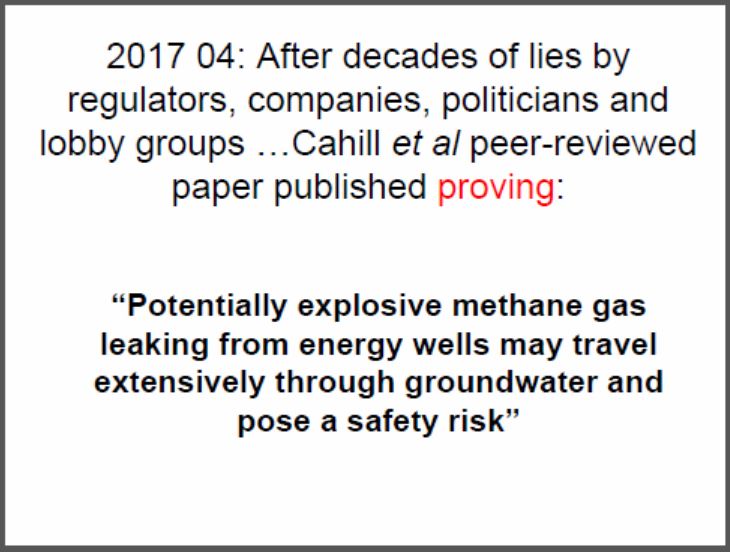
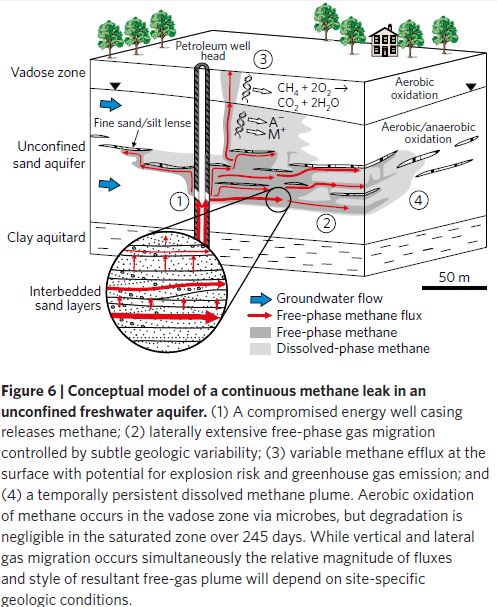
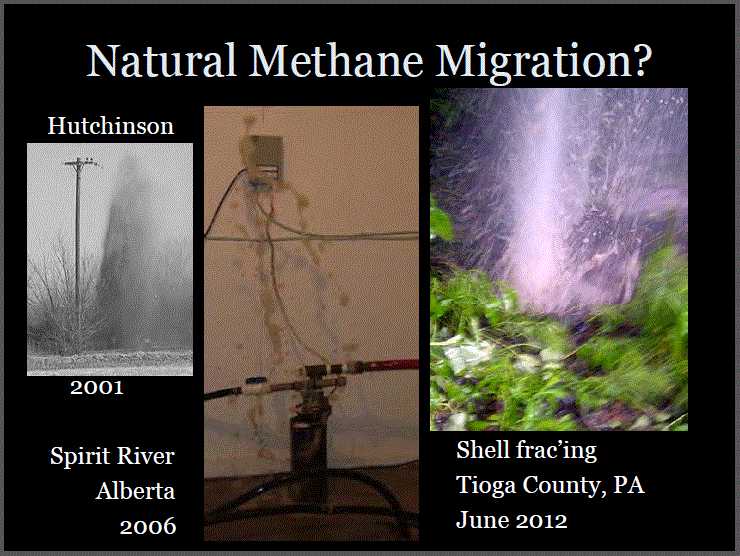
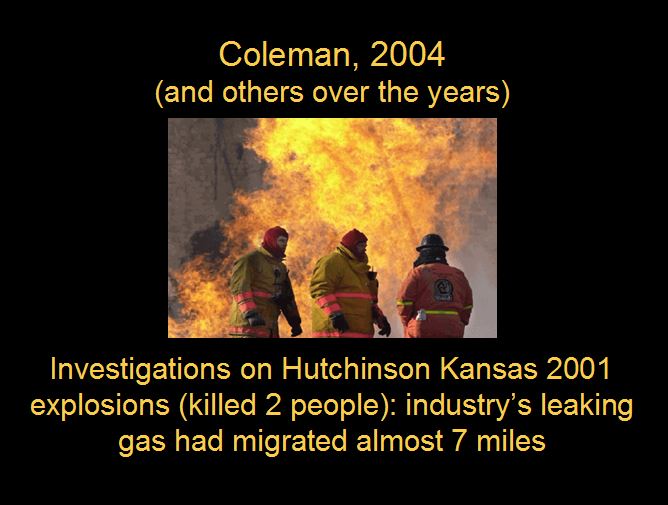
2004: Industry’s leaking gas migrated almost seven miles, killing two people in their home
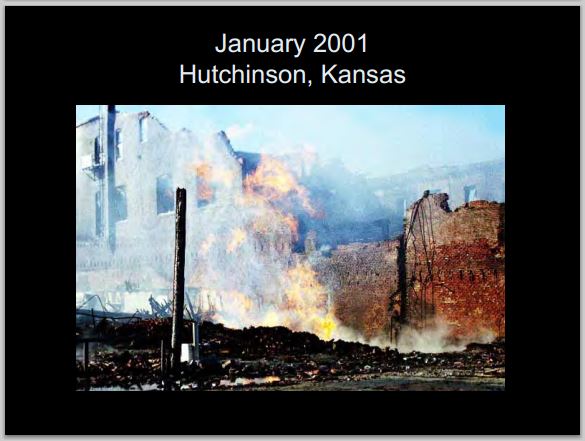
2001: Industry’s leaking gas in Hutchinson Kansas:
“In the resulting rush of fortune-seekers, thousands of wells were drilled. As many as 50,000 wells may have been drilled in Ontario, although records are available for only 20,000.”
This website stores cookies on your computer. These cookies are used to provide a more personalized experience and to track your whereabouts around our website in compliance with the European General Data Protection Regulation. If you decide to to opt-out of any future tracking, a cookie will be setup in your browser to remember this choice for one year.

 Ontario has 20,000 wells, perhaps more, with no records for them, so there could very easily be one near Shawn’s well!