2025: James Bolt: Still trying to get a class action on the explosion
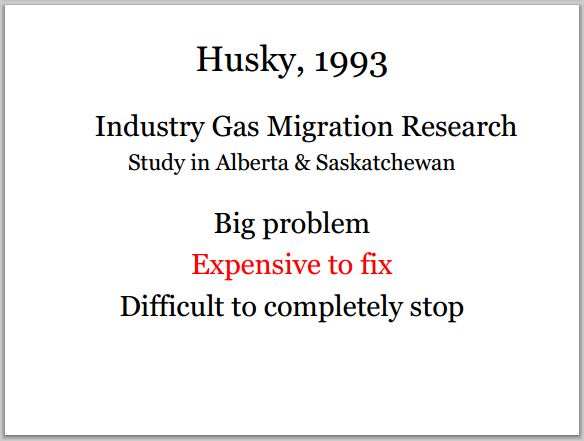
1993: Years of industry’s research on the oil and gas industry’s serious leaking wellbore problems and consequential mega gas migration problems:
Big Problem
Expensive to fix
Difficult to completely stop
1999: Petroleum Resources Centre (Ministry of Natural Resources):
“In the resulting rush of fortune-seekers, thousands of wells were drilled. As many as 50,000 wells may have been drilled in Ontario, although records are available for only 20,000.”
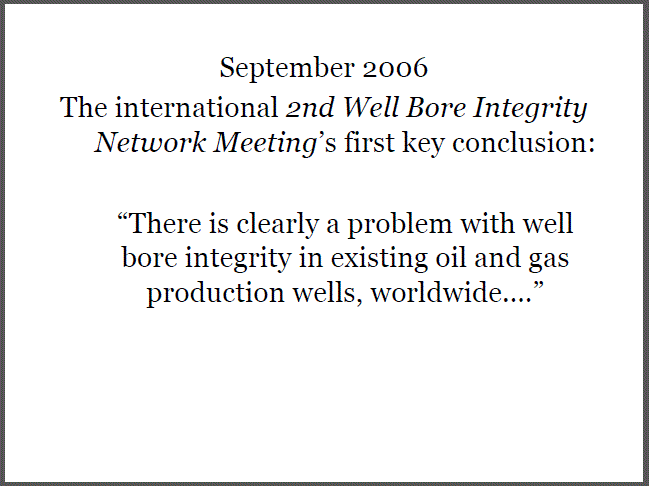
2006: The life threatening, climate-destroying methane leaking wellbore problem is world wide. The oil and gas industry knows this, so do our “regulators.”
2011: Understanding the Souring at Bakken Oil Reservoirs
Oil field reservoir souring is defined as occurring when increasing concentrations of H2S are observed in production fluids. This is a relatively well-known problem in the contemporary oil industry. …
The general causes of souring are geomechanical (fracturing and intrusion into another formation), thermochemical (e.g., mineral dissolution), biogenic (sulfur-reducing bacteria activity), or combinations thereof.
In all cases, the causes of excessive H2S production in previously nonsour environments are primarily anthropogenic and caused by certain operational practices.
2012: Despite regulations, gas wells leak, especially as they get older
One in 20 wells will leak immediately, and the numbers rise dramatically as wells age, said Cornell University Professor Dr. Anthony Ingraffea. … According to an article titled “Shale Gas — A business plan very much in the red,” by Professor Marc Durand, a geologist at the University of Quebec,
all the hundreds of thousands of wells drilled in the North American Shale will deteriorate. They are lying in brine 70 times saltier than sea water that has been laced with a host of chemicals.
Thousands of miles of horizontally drilled well casings and the surrounding cement are compromised by having been shot through with holes from the perforating gun used in the fracking process. Steel corrodes, cement shrinks and cracks: nothing lasts forever. The wells are designed for a working life of three to five years, the time it takes to harvest the gas while it flows at a fast enough rate to be profitable. Twenty to 50 years after they cease production, many of the wells will have eroded enough to provide a highway between the shale layer and the surface. Here’s the kicker: Fracking only gets the 20 percent of the gas that has seeped into the spaces that naturally occur in the shale. The remaining 80 percent is within the rock itself, and it will continue to slowly leach out into a shale formation that has been opened by fracking fluid, said Durand. What will be the effect of hundreds of thousands of deteriorating wells trickling methane and toxins into our air, land and water for thousands of years? The gas industry doesn’t ask this question because once it has the gas, it pumps some cement down the hole and it falls to the taxpayers to find the long-term answer. Durand makes the point that the costs to a community of dealing with methane migration over time will far exceed the income generated during the brief boom.
2014: Hydraulic Fracturing Additives and the Delayed Onset of Hydrogen Sulfide in Shale Gas
As natural gas production has shifted further from deep prolific gas reservoirs to shale gas, several questions are being addressed regarding fracturing technologies and the fate of chemical additives. A less investigated issue is the unexpected increase in produced hydrogen sulfide (H2S) from hot shale gas reservoirs. Understanding the source of H2S in shale reservoirs and managing low-levels of recovered elemental sulfur affects plans for future treatment, corrosion mitigation, and fracture fluid formulations. In this work we demonstrate that some typical ingredients of hydraulic fracturing fluids are not as kinetically stable as one might expect. Surfactants and biocides such as sodium dodecyl sulfate and glutaraldehyde are shown to undergo hydrolysis and thermochemical sulfate reduction reactions under moderate reservoir conditions, with H2S as the final product accompanied with long chain alcohols and hydrogen sulfate as long-lived intermediate species.
This finding suggests that fracture fluid additives can be responsible for the delayed production of natural reservoir H2S.
2014: Canada’s National Pollutant Release Inventory [NPRI] Oil and Gas Sector Review; Chemicals injected and fugitive or venting emissions (e.g. H2S) by oil and gas industry exempt from reporting Thanks Steve Harper for enabling deadly polluters and helping them keep secret how they are sickening (by the time you smell sour gas, it’s too late, damages to brain have been done) and killing Canadians.
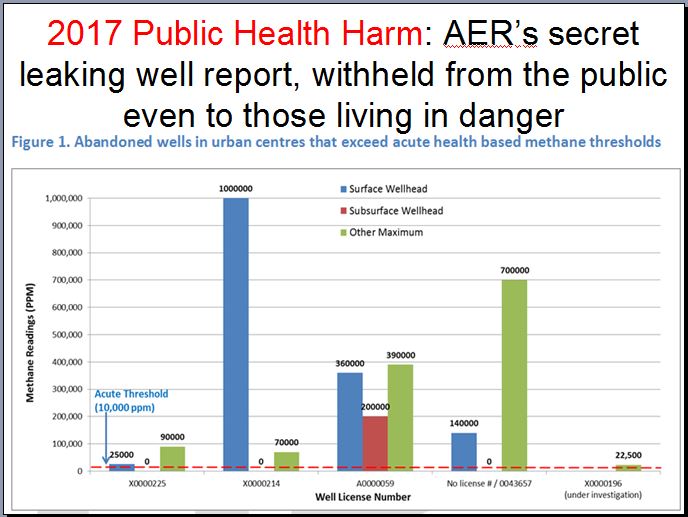
2017: To Honour the Fallen on Remembrance Day: Make public AER’s secret “D79 Abandoned Well Methane Toxicity Preliminary Assessment” & Appendix 2 by Alberta Health, Admitting “Acute-Life threatening” risks & “Neurological effects”Note the doted red line, “Acute Threshold,” in graph below, just for sweet methane, imagine where the red dotted line would be for soured leakers:
2021: Many oil and gas industry leaks and explosions in the cross references in this post: Frac’ing Ontario? Wheatley (thermogenic corrosive) sour gas explosion injures 20, destroys two buildings, more, many families displaced. Still leaking, area remains at risk of more explosions like Hutchinson Kansas where two were killed in their home from industry’s leaking gas migrating 7 miles. Chatham-Kent top administrator, Don Shropshire: “Our area has hundreds, if not thousands of abandoned gas wells. They stretch from Niagara Peninsula to Windsor.” Also exploded from industry’s gas 85 years ago. The community must be relocated. But, where?
Evacuations in Wheatley by Chatham Voice, June 26, 2025
An evacuation is underway in parts of Wheatley after a strange odour was detected.
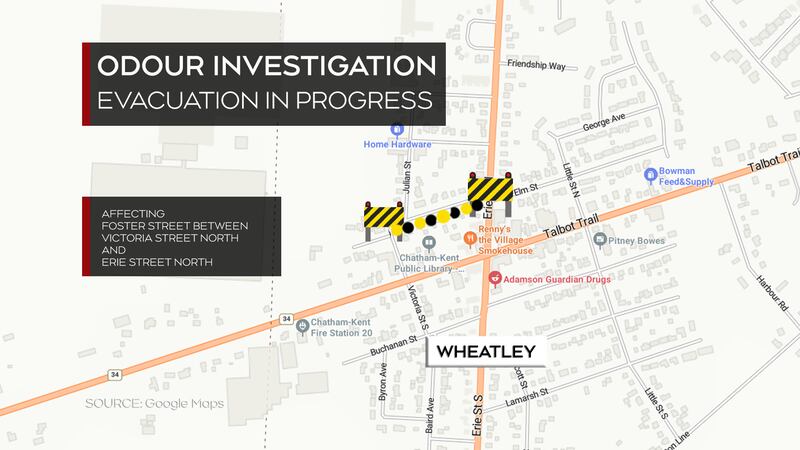
According to Chatham-Kent police, all residents on Foster Street between Erie Street North and Victoria Street North are being evacuated to ensure their safety.
The Wheatley Arena is serving as a temporary shelter for the displaced residents.
The public is being asked to stay away from the area until further notice.
Emergency crews are investigating the odour. More details as they become available.
Earlier in the week, new equipment was installed to monitor wells in downtown Wheatley.
That process will last for approximately six months.I bet it will take a few years, and after they “fix” the leak, it will leak again and again and again.
Wheatley suffered a catastrophic gas explosion in August of 2021 that ripped apart several buildings in the downtown core.
Investigation into Wheatley gas odour confirms it’s hydrogen sulfide byKate Otterbein and Travis Fortnum, June 26, 2025, CTV News
RAW: Wheatley gas odour investigation and evacuation
Portion of Wheatley evacuated
A portion of Wheatley has been evacuated by emergency services due to a gas odour investigation.
The gas leak has been confirmed to be hydrogen sulfide, the same gas responsible for the 2021 explosion.
The affected area is Foster Street between Victoria Street North and Erie Street North. Around 6:30 p.m. on Thursday, the affected area was expanded to anyone within 100 metres. That means about 60 residents displaced.
The evacuation is a precaution to ensure the safety of everyone in the area. A temporary shelter has been put up at the arena on Erie Street North for those who are displaced.
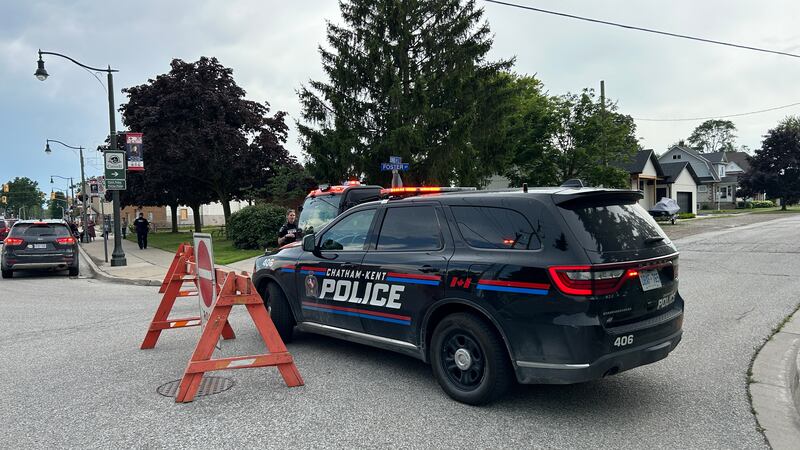
Emergency services are on scene and the public is told to stay away from the area until further notice. They were initially called at 1:45 p.m.
“When we arrived on scene, we found an area at the back of the library that was bubbling with water and gas coming up, which we confirmed is hydrogen sulfide,” said CK Fire Chief, Chris Case.
The investigation is centered around the area near the library on Talbot Street.
The Hazmat team from Windsor, scientists from the University of Windsor, Entegrus, and Enbridge officials are all on scene, according to fire officials and the Chatham-Kent Public Library.
1 of 5
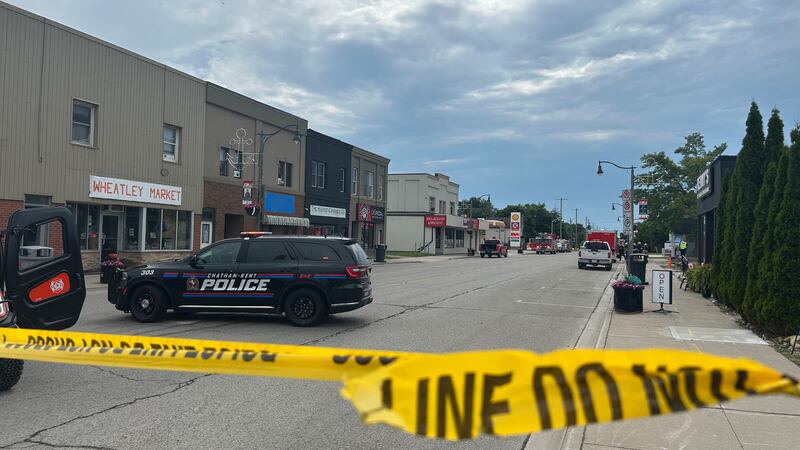
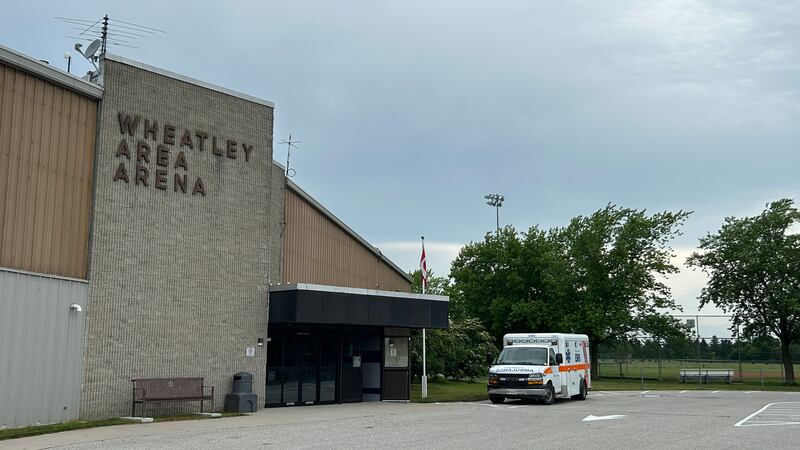

This comes just weeks after plans were released to revitalize the downtown, four years after the explosion.
“We appreciate everybody’s cooperation,” Case continued.
“It’s the last thing we want to see. We know this is a terrible thing to happen again. However, all the agencies are here working, so we just ask for your cooperation while we try and work out what’s going on and try and get the best result we can.”
‘Here we go again’
For residents like Becky Lamb, whose home backs directly onto the area under investigation, the reappearance of hydrogen sulfide is more than unsettling — it’s triggering.
Lamb said the moment she heard there was a gas smell, she called her husband from work and told him to pack a bag.
“Something’s going on,” she told him.
She said the odour brought back visceral memories of 2021.

“It’s like a wave. Back to what we smelled before,” she said. “We were just getting comfortable again … it’s heartbreaking.”
Though no explosion occurred this time, Lamb said the anxiety has returned just as sharply, “Here we go again. Like we’re going to lose it all again.”
She said neighbours are checking in on one another — but even that doesn’t ease the fear. Lamb’s family was out of their home for more than two years after the 2021 blast.
Now, they’re once again bracing for the unknown.
“My husband said he’ll never go through it again. And I said to him on the way here we [have to] stay strong together,” she said. “We [have to] get through this. And we will get through this, but it’s like, again?”
Portion of Wheatley, Ont., evacuated for gas leak 4 years after gas explosion rocked town, Variety of first responders, experts and government teams on site or enroute by CBC News, Jun 26, 2025

More residents of Wheatley, Ont., have now been evacuated from their homes after first responders found hydrogen sulfide gas “bubbling” in the area near the community’s library.
In a statement released Thursday evening, the Municipality of Chatham-Kent said the evacuation zone had been expanded beyond Foster Street to include all residents within 100 metres of the site, for a total of 60 homes. An evacuation centre has been established.
“The evacuation site, located at 196 Erie St. N, will be open to affected residents for the duration of the evacuation. No timeframe has yet been established,” the municipality said in a statement.
Chatham-Kent’s fire chief reported on social media Thursday afternoon that crews responded around 1:45 p.m. to reports of “a strong smell of gas.”
“When we arrived, we found an area at the back of the library that is bubbling with water and gas coming up, which we confirmed is hydrogen sulfide,” said Chief Chris Case on X.
Teams on site now include Chatham-Kent first responders, as well as employment and social services, victims services and local utilities.

The municipality also noted a hazardous materials team from Windsor and geological scientists from the University of Windsor are attending, as are representatives from the ministries of environment, natural resources and emergency preparedness.
Parts of downtown Wheatley were levelled in 2021 when an abandoned gas well exploded injuring 20 people.
Last October, town officials announced that the well, at 17 Talbot St. E., had been drilled, cased and cemented, and a monitoring well established in 2021 had stopped venting gas, including hydrogen sulfide.
‘A terrible thing to happen again’
When authorities let a criminal industry frac communities to hell, destroy the crap rock, or frac for sour gas or oil, or sour formation by frac’ing with bacteria laden surface water, terrible keeps on coming and will never stop.
The officials said at the time they were “optimistic” that gas emission issues in the area may be resolved.
“We know this is a terrible thing to happen again, however all the agencies are here working so we just ask for your co-operation while we try and work out what’s going on and try and get the best result we can,” Case said on Thursday.
Hydrogen sulfide is a colourless gas with a characteristic rotten egg smell that can be released from wastewater treatment systems, oil and gas facilities, livestock operations, pulp and paper mills and mining operations, according to information on the Health Canada website.
Downtown Wheatley gas explosion from summer 2021:

Duration 0:44Video from security camera footage shows the power of the blast in downtown Wheatley last summer. Submitted by John Urban.
It can also be released from inactive oil and gas wells.And active wells, and leaking pipelines, and fracs can release it from the subsurface far from oil and gas wells, and it can be released from formations underground soured by frac’ers and water injected for enhanced oil recovery
Natural sources include volcanoes, hot springs, petroleum crude oil deposits, decomposing plants and animals and normal bodily functions.
One gas technician whose business was affected by the 2021 explosion said the situation is “a little unnerving.”
Doug Walker, who owns Walker Tetra Mechanical, lost a van in the explosion in 2021.
‘A little concerned’
He said he had enough equipment on his truck on Thursday to get him through Friday’s jobs.
But if the incident proves to be serious, “then I’m right back to where we started again.”
“I don’t even want to think about it,” he said. “I don’t want to think about it. I really don’t.”
Area resident Al Ringrose said Thursday’s incident also had him feeling “a little concerned.”

“We were evacuated for a couple of years,” he said. “We thought we had everything taken care of now, and yeah, so it looks like there’s still issues.”
Another resident, Jeff Edwards, said he didn’t know what to expect after first responders ordered him to leave the area Thursday.
He left his apartment above the Dollar Haven and Discount store Thursday without even bringing his pills, he said.
“I got food up there too,” said Edwards, who is from the area but wasn’t living there in the aftermath of the 2021 explosion.
“I had chicken out for supper, but I don’t think it’s going to be very good if it lasts too long.”
- Wheatley residents and businesses remain in limbo one year following town centre explosion
- Some Wheatley businesses and residents to return to properties as evacuation zone near explosion site reduced
Walker said he first noticed the smell of gas while unloading two of his trucks on Thursday.
“Everybody was coming out of their stores saying that we could smell … something,” he said.
He began checking gas metres but couldn’t see a problem, so he called 911.
“None of us want to go through this again, ever, ever,” he said, referring to the 2021 explosion.
Police are urging the public to stay away from the area until further notice.
Mike Harris, Ontario’s Minister of Natural Resources, is scheduled to be in Wheatley for a 10 a.m. news conference on Friday.
Evacuation in Wheatley confirmed to be caused by hydrogen sulfide gas leak by Meagan Delaurier, June 26, 2025, AM800
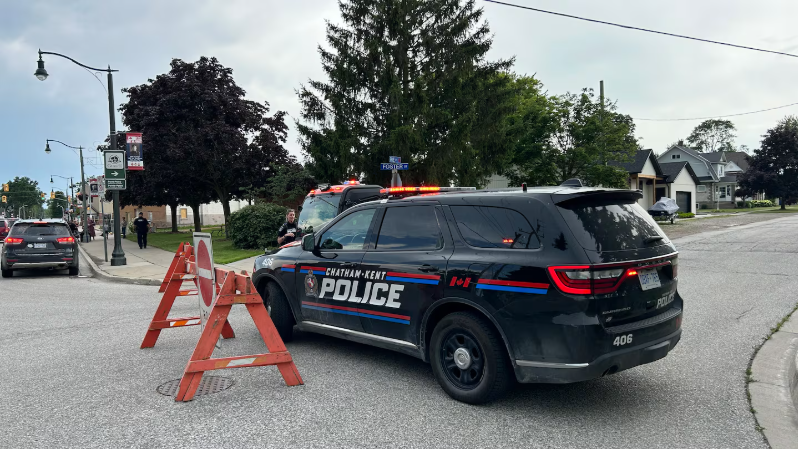
The cause of an evacuation in Wheatley has been determined to be from a gas that caused an explosion in the town nearly four years ago.
Residents were evacuated from their homes early Thursday afternoon for an odour investigation specifically affecting the downtown core.
On Thursday evening, Chatham-Kent officials confirmed a hydrogen sulfide gas leak which was originally located at the back of the Wheatley Public Library branch on Talbot Road West.
The evacuation zone has since grown, and all residents within 100 meters of the site have been temporarily evacuated from the area while crews are on site conducting an investigation. According to Chatham officials, a total of 60 residences have been evacuated.
An evacuation centre has been established at the Wheatley Arena, which is located at 196 Erie Street North, and it will be open to affected residents for the duration of the evacuation.
No timeframe has been established and residents are being asked to avoid downtown Wheatley for the time being.
Power had been temporarily disconnected at the request of emergency services for safety reasons. Entegrus posted to social media on Thursday evening that they were working to restore power to those outside of the evacuation zone, and to the Wheatley Arena.
A number of emergency services are on scene, including Chatham-Kent Fire, Chatham Police, Chatham EMS, Windsor Hazmat, as well as the Ministry of Natural Resources, the Ministry of Environment, geological scientists from University of Windsor, among others.
Hydrogen sulfide is the same gas responsible for an explosion that occurred in August 2021 where two buildings were destroyed and several others were damaged. Multiple people were injured following the explosion.
Updates will be provided as they become available.
Refer also to:
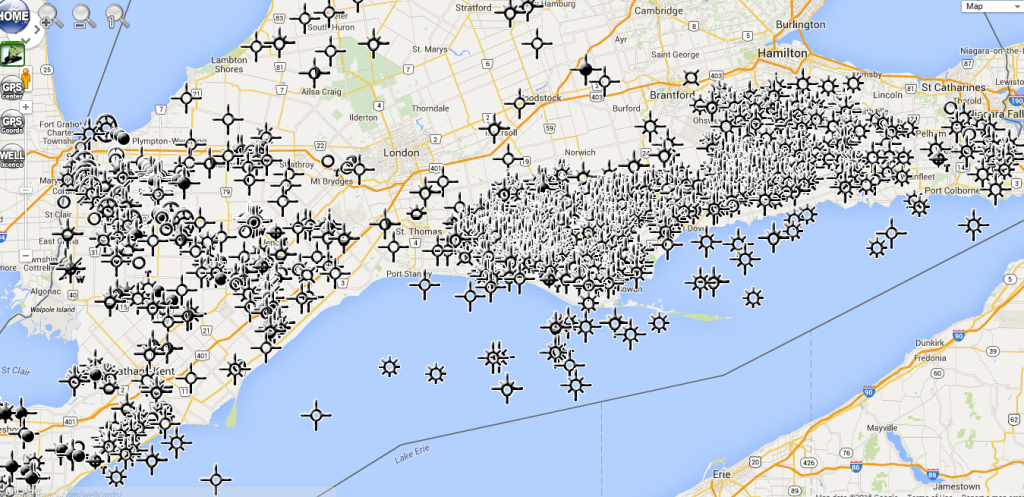
Snap taken 2015 of some oil and gas wells in Ontario. Many of them are sour, and many of them are leaking. Add hydraulic fracturing of new or old wells to the mix, we get deadly living.
How many more wells are there now?