U.S. start-up teams up with Canadian producer to launch carbon capture study in Alberta’s oil sands by Emma Graney, Energy reporter, Dec 15, 2025, The Globe and Mail
A Boston-based start-up, whose technology can cut the cost of carbon capture in half, is targeting Alberta’s oil sands, launching an engineering study for a commercial-scale project with an unnamed Canadian producer. Why the hell unnamed?
Mantel Capture Inc.’s foray into the oil and gas sector comes at a time of renewed interest in carbon capture and storage. The technology received a significant boost under the energy accord signed last month bydreadful Canada-betraying Ottawa and Alberta that included a plan for construction of the Pathways Project. The massive CCS effort would create a 400-kilometre pipeline to transport deadly CO2, much too dangerous for such a stupid massive pipeline which fossil fuel polluters will use to inject for more fossil fuel extraction carbon emissions to an underground storage hubthat will assuredly leak. The accord aims to have the project built by 2040.Might not be any humans left alive on earth by then, we are fast polluting ourselves out of existence, and frac’ing is madly permanently removing vital water, including in extreme drought stricken areas like Alberta
Mantel chief executive officer Cameron Halliday said while federal and provincial policy changes are still in flux, “they’re all pointing in the right direction, which is that carbon capture is the pragmatic solution people can align on and rally around.”You lie like Trump! Carbon Capture is a con job which steals money from the citizenry to give to the rich to lie and pretend they are reducing pollution, when all they are doing is using our money to increase pollution! Worst scam ever by humans, was religion. Then, frac’ing and carbon capture (which is basically a form of frac’ing).

Mantel already has a demonstration CCS project at Kruger Inc.’s Wayagamack pulp and paper mill in Quebec, whichaims to capture 2,000 tonnes of carbon dioxide each year. The company’s new partnership in the oil and gas sector is a significant step-up in scale, designed to capture roughly 60,000 tonnes of CO2 annually.They’re both bound to fail, that’s a given. But why the hell is a fucking American company experimenting with people’s lives in Quebec too!? And regardless, research has shown that the tiny bits of promises captured carbon are nowhere near required mitigation, and for disgustingly excessive cost. I think carbon capture is an intentional money laundering operation – steal from the people to give to rich polluters.
While that represents only a fraction of the 70 megatonnes of emissions produced by Alberta’s oil sands each year, it would, if successful, demonstrate how CCS could be used in the sector.
Traditional carbon capture consumes large amounts of energy in the form of steam, making them expensive to run. But Mantel’s CCS technology instead creates steam as an end-product, which can then be used in on-site industrial processes.
Along with capturing carbon, the oil sands project aims to generate 150,000 tonnes of high-pressure steam per year.
Mr. Halliday was tight-lipped about the name of its oil producer partner, but confirmed it is a steam-assisted gravity drainage (SAG-D) operator in the Cold Lake basin, which is roughly 300 kilometres northeast of Edmonton. (The vast majority of oil sands production comes from the Athabasca basin, which is more than 400 kilometres north of Cold Lake, near Fort McMurray.)
Most oil sands are buried too deep below the surface for open pit mining, and use techniques like SAG-D to extract crude. Those sites use steam to heat and thin the heavy oil so it can flow into a well and be pumped out.
“That’s one of the reasons we’re super-excited about this project, because these folks use steam directly,” Mr. Halliday said.
Instead of CCS being a waste management tool to reduce emissions, he said, “we can start to be value creators.” That makes the economics of CCS more compelling – and, ultimately, more investable, he said.So really, yours Mrl Halliday, is just another con job, to take public money to produce more fucking polluting tarshit like this:
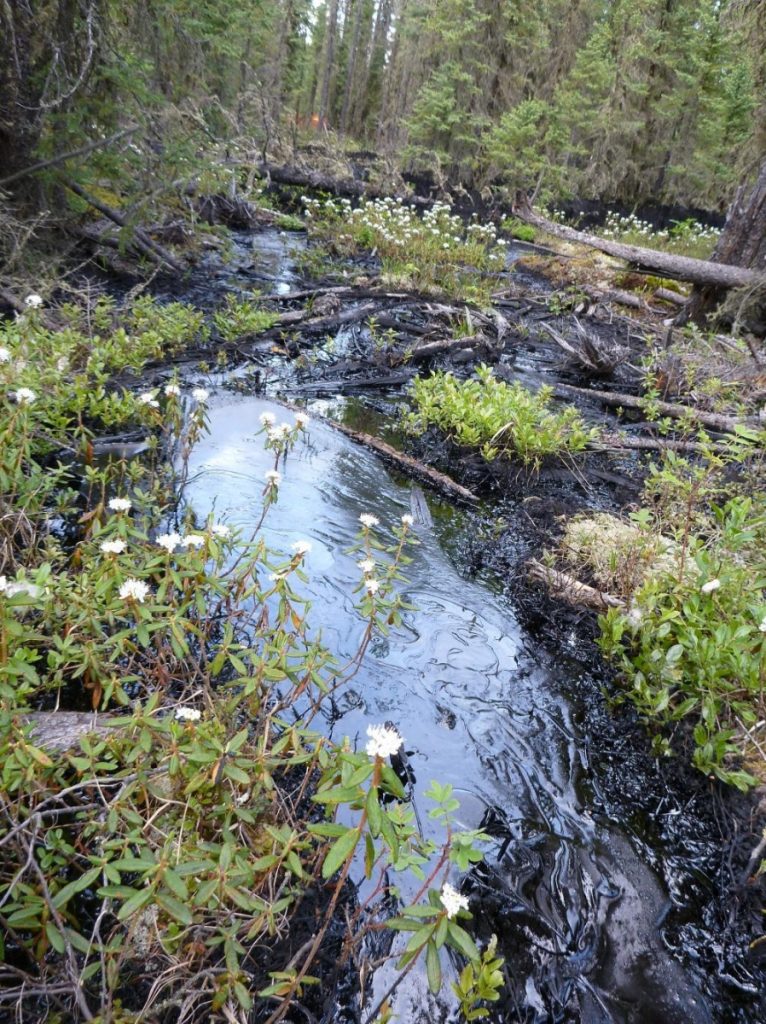
Steam frac’d bitumen (aka tarshit) that leaked to surface and contaminated groundwater
Clean Prosperity,This NGO was created by and or is heavily financed by IVEY fdn (Refer below for the dirty shit on it). It’s impossible to create clean prosperty, a propagandizing synergy group to keep lying to Canadians while enabling polluting life threatening pollution by fossil fuel companies a climate policy think tank, has said the memorandum of understanding struckbetween Alberta and Ottawa earlier this month has the potential to attract more than $90-billion in low-carbon capital investment to the province, the vast majority of which would be in the CCS space.Fuck, what a lying pollution enabling shit show the globe and mail is. Nothing CCS is low carbon! IT INCREASES CARBON
But to get there, projects have to be financially attractive and in a policy environment that encourages investment, Mr. Halliday said.Translation: Make ordinary Canadians pay for polluters to put lives and communities at risk with CCS, which is used to not reduced pollution, but to produce more toxic tarshit, and more pollution and more carbon.
Unlike the United States or Europe – which mostly use only incentives or penalties, respectively – Canada takes “both a carrot and a stick” approach that couples a CCS investment tax credit with a price on carbon to motivate companies to reduce their emissions.CCS does NOT reduce emissions!!! FFS!
“Then it’s on the technology providers and the projects to be able to deliver something that actually makes sense. What we’re able to do is, by and large, cut the cost by about 50 per cent. That’s a radical changebut will not reduce pollution!.”
While Mantel’s partner for the venture is not one of the companies involved in the Pathways project, Mr. Halliday said his company is already working with other oil sands producers.
Pathways Alliance CO2 fraudsters are: Canadian Natural Resources, Cenovus Energy, Imperial Oil, Suncor Energy and ConocoPhillips
The ultimate goal is to provide CCS technology to sites that are further north, leveraging the Pathways project to decarbonize the oil sands, he said.It is as impossible to create clean prosperity as it is to decarbonize tarshit, or any fossil fuel like frac’d LNG

“The vast majority of Canada’s CO2 emissions are coming from these industries. It would be a massive win to be able to do that in a way that doesn’t break the bank.”And in a NON fraudulent way with NON Nazi USA companies
Mr. Halliday said the project is being supported in part by Alberta Innovates, a Crown corporation that provides funding for research, innovation and entrepreneurship across various economic sectors.Theres’s nothing positive about Alberta Innovates, it’s a corrupt pro-pollution, pro harm, agency that serves rich polluters and frac’ers not Alberta or Albertans. I have direct evidence of the fucking Innovates gang covering up drinking water contamination by Encana/Ovintiv, and MGV then Quicksilver
Alberta-basedbut mostly foreign owned, largely Nazi American oil and gas companies are particularly sophisticated on the vile fraud of CCS, he said, owing to the deep technical expertise they have developed over years of trying to find the best and cheapest way to keep polluting instead of emissions-reducing solutions for industry.
Mantel’s oil sands engineering-design study will likely be finished toward the end of 2026, Mr. Halliday said, with project execution roughly two years after a final investment decision.
Albertans at risk of paying oil sands reclamation costs, Auditor-General says by Emma Graney, Energy reporter, Dec 11, 2025, The Globe and Mail

Albertans risk being on the hook for billions of dollars’ worth of cleanup of the oil sands under current rules that govern security payments for the massive mining operations, according to a new report from the province’s Auditor-General.
The fundsheld through the Mine Financial Security Program amounted to just $1.8-billion as of September. Meanwhile there is an estimated reclamation liability of $51.9-billion, the Office of the Auditor-General found in a report released Thursday. That amount represents the potential cost to clean up mines at the ends of their lives.
But the province said it won’t pursue what it called a “flawed recommendation” by Auditor-General Doug Wylie to revisit how asset values are calculated under the MFSP. Instead, a statement from the office of Environment Minister Rebecca Schulz said that the program is “stronger than ever.”
The MFSP is administered by the Alberta Energy Regulator using policy guidance from the Environment Ministry. The AER collects funds from oil sands and coal mine owners as security to ensure that the companies can cover the cost of cleaning up their messes, rather than foisting the bill onto taxpayers.
But in his latest report, Mr. Wylie said that the way that the program calculates the value of assets risks overstating their economic worth, and therefore the companies’ ability to cover cleanup costs.
“If MFSP assets are overstated, operators might not pay the necessary security, leaving Albertans at risk of bearing the financial costs of oil sands mine reclamation or the mines being unreclaimed,” he wrote.
The government rejigged the MFSP last year in response to earlier investigations by the Auditor-General’s office. Under the changes, companies will no longer be able to use off-site mine reserves as collateral to backstop reclamation responsibilities and the valuation of some oil reserves was adjusted to better ensure companies can cover future cleanup costs.
But critics argue the MFSP remains flawed for various reasons, including that it doesn’t require operators to post full security until six years before the end of mine life, even when assets risk losing value.
Where mines in other jurisdictions often require full security to cover a project’s eventual cleanup costs, that’s not the case for the oil sands under the MFSP, Eric Leonty, assistant auditor-general, said in an interview Thursday.
The calculation under the MFSP should ensure the fund’s assets are sufficient to cover the liabilities over the long term and are “as reflective of reality as possible,” he said. But as it stands, “there’s a greater risk that you might need more security; that if those asset values are overstated, it’s less likely that you’re collecting and getting security when you need it.”
In his Thursday report, Mr. Wylie repeated an earlier recommendation that the Environment Ministry make changes to asset calculations used by the program.
“The risk of overstatement remains high,” Mr. Wiley wrote. While the ministry argues that formulas used by the MFSP “are reasonable and that the MFSP is functioning as intended,” he added, “we found no evidence to support these claims.”
Ms. Schulz’s office responded that the program’s calculations “make sure that Albertans are protected at all times.”
“The OAG is recommending an approach that is different from how assets are calculated in any other industry. It would make the program less effective and more volatile, without increasing protection for taxpayers.”
Andrew Leach, an energy and environmental economist at the University of Alberta, said the problems with the MFSP run far deeper than just how the value of mining assets are calculated.
“It allows companies to use the value of Crown resources as security against a future liability to the Crown. That’s completely backwards,” Prof. Leach said.
The way the MFSP is set up means that the government will come asking companies for a security deposit well into the future, he said, “when they get much closer to bankruptcy.”
“That should raise red flags,” he said.
The MFSP was at the heart of a lawsuit launched by the Athabasca Chipewyan First Nation in April. The community argued that the province had failed to address a host of fundamental flaws in the program, thus undermining the eventual cleanup of oil sands sites and putting the environment at risk.
Athabasca Chipewyan argued in its lawsuit that the MFSP is “grossly inadequate for achieving its intended purpose.” The claims have not been proven in court.
Refer also to: