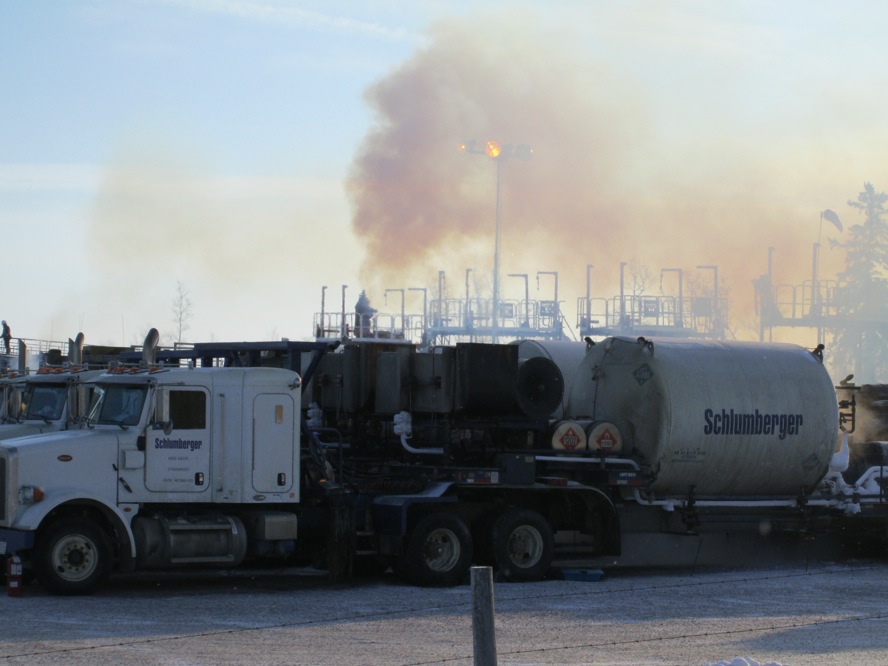
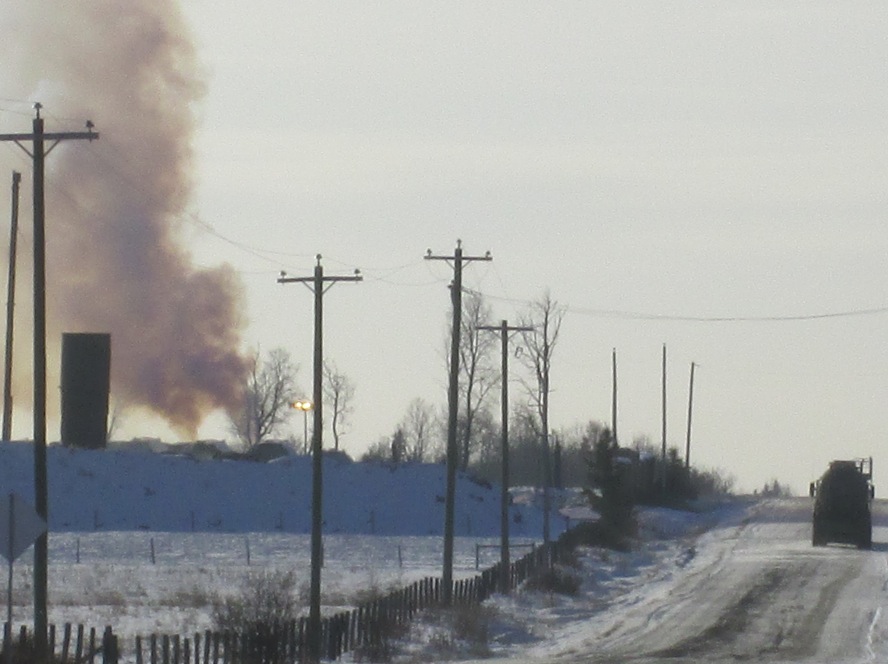
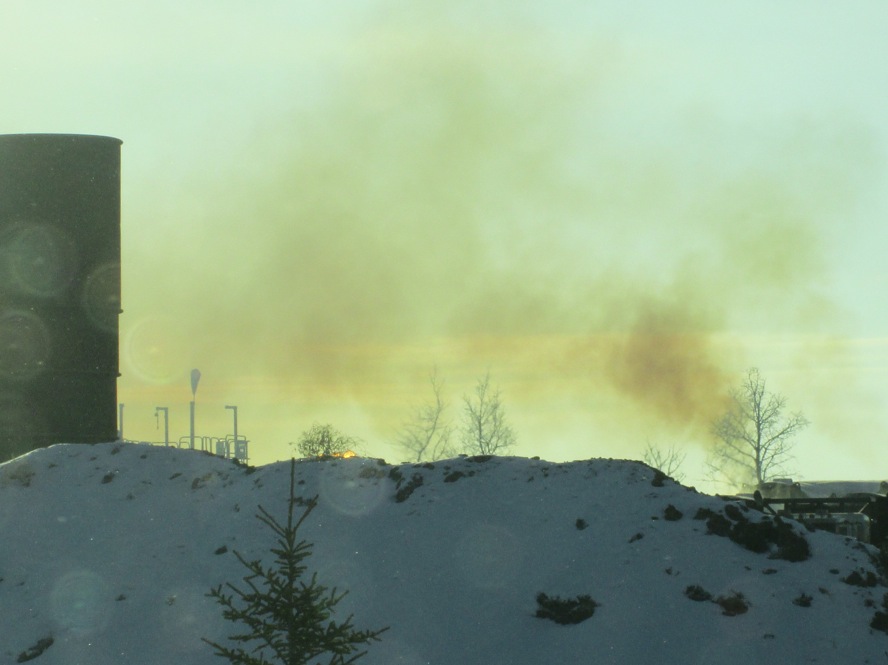
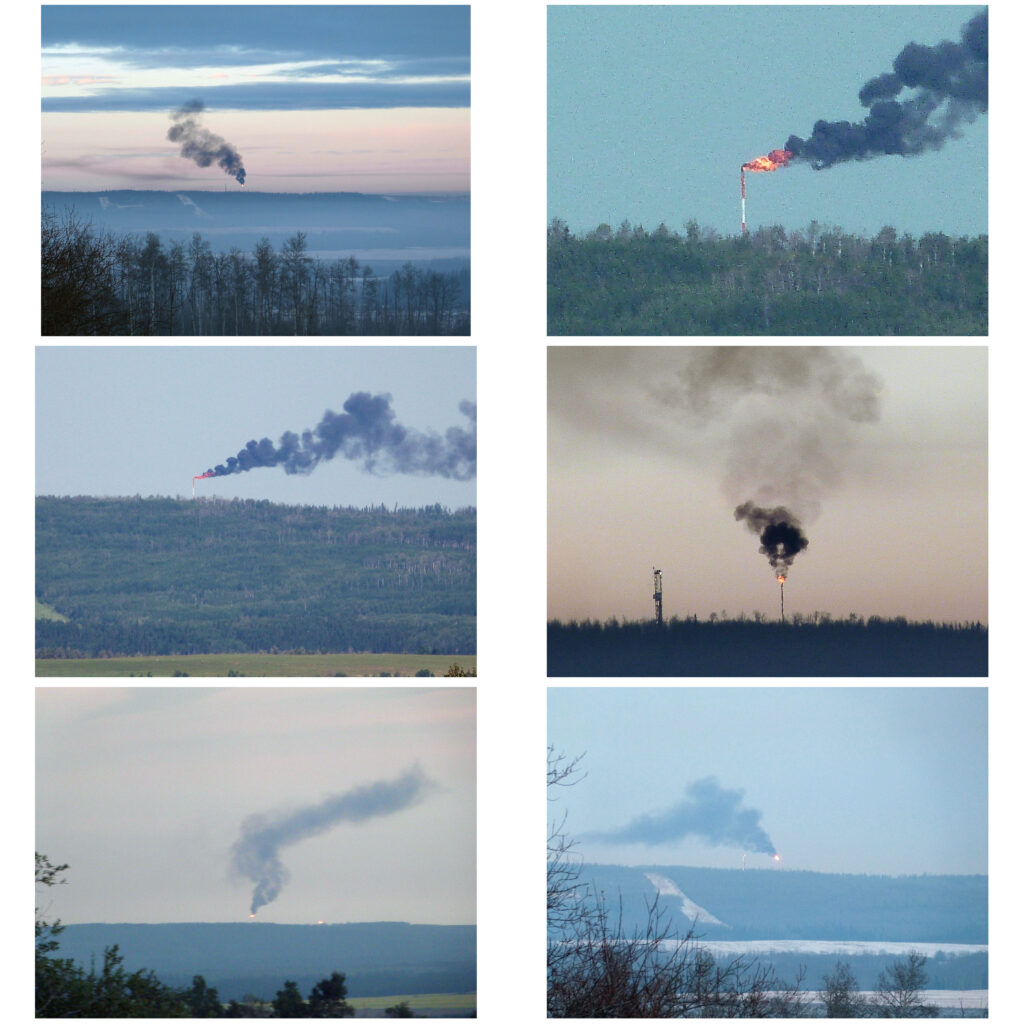
Above photos of frac’ing in Alberta; below frac flares in NEBC including by Encana/Ovintiv
Climate change is making heat waves worse. A new study shows how specific companies are fuelling the problem, Attributing heat waves directly to carbon majors could influence climate litigation by Inayat Singh and Anand Ram, CBC News, Sep 10, 2025
The increasing role of carbon emissions in causing heat waves, floods, droughts and other extreme weather is becoming clearer, thanks to the growing field of climate attribution studies.
This research shows how much more likely — and severe — a particular weather disaster was because of climate change.
A new study by climate researchers in Europe and the U.S. and published in the journal Nature has taken this analysis further, by linking the deadliest type of disaster — heat waves — directly to major fossil fuel companies and their products.
The study looked at major heat waves that happened between 2000 and 2023, and the role of “carbon majors.” These include state-owned companies (such as Gazprom in Russia or Saudi Aramco), investor-owned private companies (Shell, BP, ExxonMobil or even Canadian companies such as Suncor and Cenovus) and nation-states that produce fossil fuels such as coal (India, the former Soviet Union).
The study drew on previous research detailing the lifetime carbon emissions of these carbon majors, and other studies that show how carbon emissions make heat waves worse. They then connected those two strands to estimate how the emissions of a specific carbon major impacted the severity and likelihood of a particular heat wave.
The study found that climate change made the median intensity of heat waves globally between 2010 and 2019 about 1.68 C hotter, and 0.47 C of that was due to just 14 of the largest carbon majors.
The study goes into granular detail, with data for each one of the 180 carbon majors and their specific contribution to each of the 213 heat waves studied.
The detail even shows the impact of smaller companies — for example, the smallest carbon major by emissions, a Russian coal company, made 16 heat waves more than 10,000 times likely — meaning the heat waves would have been virtually impossible without the emissions of that carbon major.
“I was surprised that even the smallest carbon majors were actually very substantially contributing to the probability of the heat waves,” said Yann Quilcaille, a climate scientist at ETH Zürich, who led the study.
The research is a new frontier in assigning moral and legal responsibility for climate change to fossil fuel companies, experts say, with significant ramifications for climate litigation and advocates worldwide.
The study doesn’t quantify the damage caused by each company — that depends on more factors than the intensity of a heat wave, such as emergency preparedness or the use of air conditioners. But experts say it could still be used to eventually calculate the monetary damage and the liability of specific companies.
It comes as companies and countries retool their climate policies in the wake of a U.S. administration that’s reversing climate policies and promoting fossil fuels.
 Fraudster Harper Con Carney’s (I reject him as my PM!) Canada has in recent months turned away from several key climate policies, such as the consumer carbon tax and a planned electric vehicle sales mandate.
Prime Minister Mark Carney is yet to announce what will replace these policies to help Canada meet its emissions goals, but he has pushed for more resource development criminally misusing threats by Nazi Trump and pretending he’s as a way of countering a difficult economic and trade situation.
What are the legal consequences for fossil fuel companies?
In July, the International Court of Justice, the UN’s top court, issued an advisory opinion saying countries suffering from climate disasters could seek reparations from countries emitting the most carbon and contributing to the problem. The court’s ruling was seen as a precedent that people in local courts around the world could draw on as they use legal cases to spur climate action.
Jessica Wentz, senior fellow at the Sabin Center for Climate Change Law at Columbia University, says this latest attribution research builds on the ICJ’s opinion, and further helps people who want to sue companies — especially by establishing their standing in making a case.
“Initially when a plaintiff needs to show that they have standing in a case, they have to allege that they have an injury that is traceable to the defendant’s conduct,” she said. The new study will help make that link, she says, although she acknowledges there’s still a long way to go until courts actually find companies financially liable.
“The methodologies that underpin these types of findings can also be used in more fungible ways to look at not only the contributions of the carbon majors, but presumably you could use a similar approach to start looking at government,” Wentz said.
In Canada, two prominent cases brought by young people are making their way through the system. Both claim that government inaction on climate change is violating the rights of Canadians. A case against the Ontario government is ongoing, while a case against the federal government could be headed to a trial.
Naomi Oreskes, professor of the history of science at Harvard University, is one of the world’s leading researchers on climate misinformation. She says the study could be a huge help for people affected by climate change — who may have few resources — to seek redress.
“Let’s say you’re a farmer and your livestock died in the [2021 North American] heat dome. You as an individual farmer don’t have the capacity to prove that that heat wave was caused by climate change,” she said.
“But now you don’t have to because in fact, the scientists have done that work.”
Oreskes called the study’s findings “powerful and persuasive” at showing just how much the emissions of carbon majors have contributed to the heat problem.
“These corporations, they produce these [fossil fuel] products … we know that they also in many cases misrepresented what they knew and they have fought policy to mitigate climate change,” Oreskes said, referring to previous research from her and other experts showing major oil companies knew about the impacts of carbon emissions and the dangers of global warming decades before countries starting enacting climate policies.
“Some corporations have played a kind of leading role in producing these products that have led to this damage … I wouldn’t say they bear all of the responsibility, but they certainly own the lion’s share of the responsibility, and this paper is a kind of quantitative assessment of how big that lion’s share actually is,” she said.
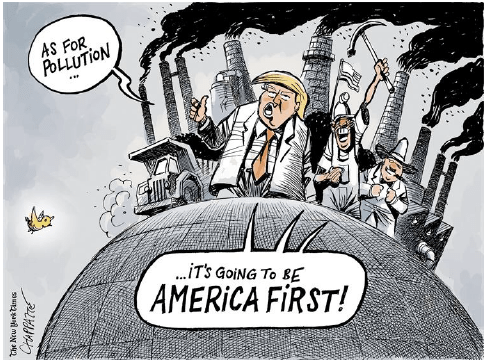
And there are our filthy greedy corrupt politicos, Harper Con Carney included – he’s a polluter worshipper and gives polluters the public’s money to help them polluter more, like giving $100M to fucking USA AI companies (massively energy wasting for shit propaganda and lies) and $billions to polluters for carbon capture which has been proven to increase carbon and other fossil fuel pollution (eg methane) not decrease it!:
CBC reached out to several carbon majors mentioned in the study, but they either declined to comment or didn’t respond by publication time.
Refer also to:
2025: Smoke from Canada’s wildfires killed nine-year-old Carter Vigh – and 82,000 others around the world
… Prof Cathryn Tonne, an environmental epidemiologist at the Barcelona Institute for Global Health (ISGlobal), who was not involved in the study, said the research was important but the death toll was probably conservative.
“This analysis assumes wildfire PM2.5 has the same toxicity as PM2.5 from all sources in its estimate of deaths due to exposure over the course of a year,” said Tonne, who published a study last month suggesting short-term exposure to wildfire smoke was deadlier than previously thought. “This is likely an underestimate as there is growing evidence that wildfire PM2.5 is more toxic than PM2.5 from all sources.”
Wildfires in North America and Europe are breaking records as a blanket of fossil fuel pollution has smothered the Earth, heating the planet and drying out plant matter on which blazes feed. The plumes of smoke have devastating impacts on the body that often go unattributed. …