@akjackson.bsky.social:
I went to a week long workshop many years ago devoted to geophysical methods for verifying that injected and captured CO2 remains captured. I came away with a very pessimistic view of the whole process. The geology and physics are difficult, the economics impossible.
A prudent planetary limit for geologic carbon storage by Matthew J. Gidden, Siddharth Joshi, John J. Armitage, Alina-Berenice Christ, Miranda Boettcher, Elina Brutschin, Alexandre C. Köberle, Keywan Riahi, Hans Joachim Schellnhuber, Carl-Friedrich Schleussner & Joeri Rogelj, Sept 3, 2025, Nature volume 645, pages 124–132 (2025)
Abstract
Geologically storing carbon is a key strategy for abating emissions from fossil fuels and durably removing carbon dioxide (CO2) from the atmosphere1,2. However, the storage potential is not unlimited3,4. Here we establish a prudent planetary limit of around 1,460 (1,290–2,710) Gt of CO2 storage through a risk-based, spatially explicit analysis of carbon storage in sedimentary basins. We show that only stringent near-term gross emissions reductions can lower the risk of breaching this limit before the year 2200. Fully using geologic storage for carbon removal caps the possible global temperature reduction to 0.7 °C (0.35–1.2 °C, including storage estimate and climate response uncertainty). The countries most robust to our risk assessment are current large-scale extractors of fossil resources. Treating carbon storage as a limited intergenerational resource has deep implications for national mitigation strategies and policy and requires making explicit decisions on priorities for storage use. …
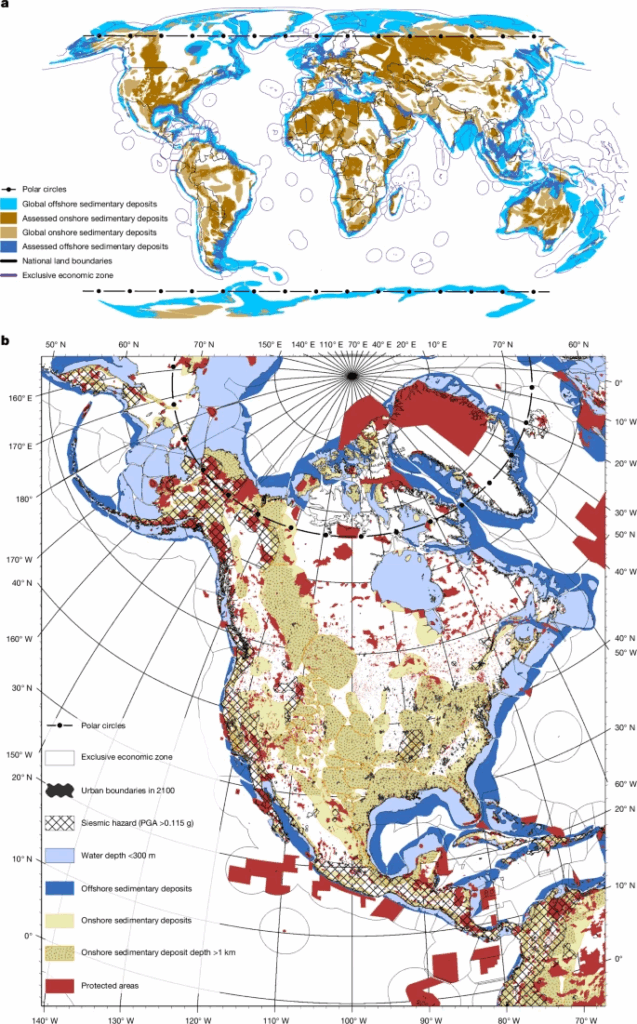
a, Onshore (brown) and offshore (blue) sedimentary basins, including national terrestrial and maritime borders (that is, EEZs). Basin colours vary according to technical carbon-storage potential (lighter) and the assessed prudent carbon-storage potential (darker). b, The North American continent, including all exclusion layers (Supplementary Table 1). The prudent limit is estimated by accounting for the full storage technical potential, removing all precautionary exclusion layers and summing up available carbon storage from the basins that remain (yellow dotted and light blue areas). PGA, peak ground acceleration. a,b, Sources: Esri, GEBCO, NOAA, National Geographic, DeLorme, HERE, Geonames.org and other contributors.
…
CO2 that escapes to the surface can pose a threat to shallow groundwater reservoirs by lowering the pH of the groundwater through the formation of carbonic acid. This might have several secondary effects, for example, the mobilization of toxic metals, sulfate or chloride33, which may contain impurities of other gases, such as hydrogen sulfide, sulfur dioxide or nitrogen dioxide, which increase the effect of toxic metal mobilization34. …
Safe underground carbon storage would only reduce warming by 0.7°C, analysis finds by International Institute for Applied Systems Analysis, Sept 3, 2025, Phys.org
For the first time, a study maps safe areas that can practically be used for underground carbon storage, and estimates that using them all would only cut warming by 0.7°C.
 I think much more effective carbon mitigation is to dramatically lower human baby making and criminalize hydraulic fracturing! Who in their right mind anyways wants to bring a child into this toxic abusive world fast running out of safe drinking water, only to suffer horrifically because of what global warming brings, most likely starve and or die from extreme heat, and cumulatively suffer with the toxic chemicals everywhere on earth, and in every body part of every being? New review: What’s destroying life on earth? Human overpopulation. Having 1 less child is 50 times more effective in reducing individual carbon footprints than other actions.
The result is almost ten times lower than previous estimates of around 6°C, which considered the total global potential for geological storage, including in risky zonesnotably all and any areas hydraulically fractured or where industry injects fluids for enhanced oil recovery, and or where industry wastes are stored in injection wells!, where storing carbon could trigger earthquakes and contaminate drinking water supplies. The researchers say the study shows that geological storage is a scarce, finite resource, and warn that countries must use it in a highly targeted way.
Storing carbon deep underground has been presented as an almost limitless solution to the climate crisis. The study led by IIASA researchers, in collaboration with an international team of colleagues, and published in Nature, shows that the reality is far more limited than previously thought. The team has estimated a prudent global limit of around 1,460 billion tons of carbon dioxide (CO2) that can be safely stored in geologic formations—an amount almost ten times smaller than estimates proposed by industry that have not considered risks to people and the environment.
Carbon storage is widely seen as essential for achieving climate goals, whether by capturing emissions from factories and power plants or removing CO2 from the atmosphere. According to lead author Matthew Gidden, a senior researcher in the IIASA Energy, Climate, and Environment Program and at the Center for Global Sustainability at the University of Maryland, U.S., the study’s findings highlight the need for caution:
“With this study, we can conclude that carbon storage should be treated as an exhaustible, intergenerational resource, requiring responsible managementRare in the human species. Hard choices must be made about which countries, which sectors, and even which generations are able to utilize it. It’s critical that countries make clear in their climate action plans how they plan to use carbon storage in order to collectively achieve long-term climate goals while minimizing harm to human health, biodiversity, and sustainable development.”
The researchers first analyzed total global geological storage by mapping sedimentary basins—underground rock formations where layers of sand, mud, and other materials have built up over millions of years. These basins are prime locations for both fossil fuel deposits and potential carbon storage.But, most of them have been carpet bombed by shoddy leaking oil, gas, and waste injection wells, and worse, repeatedly frac’d, rendering the subsurface useless for CCS. But, because polluters are greedy cheap fuckers, and their enabling politicians are too, they want their CCS near their pollution, as well as most being lazy and lacking in critical thinking and imagination, CCS infrastructure is inappropriately being built, costing taxpayers billions of their dollars, in areas too dangerous for sequestering carbon for any reasonable length of time.
The team assessed their suitability for carbon storage by considering risks such as CO2 leaking back into the atmosphere, the possibility of triggering earthquakes like hydraulic fracturing and waste injection cause frequently causing more damage to the subsurface and more leaks in oil and gas wells, and CCS wellsduring the storage process, contamination of groundwater supplies, and proximity to population centers or protected areas. Sites that were too close to the surface to store carbon reliably, too far underground, or at ocean depths that make storage too expensive and risky, were also ruled out.
When these factors are taken into account, the global storage capacity shrinks dramatically from industry estimates of around 14,000 gigatons.
The team also examined what these storage limits mean for the planet’s ability to cool down after overshooting temperature goals, finding that if the total available geological storage capacity would be exclusively used for CO2 removal and no further emissions would be produced by other activities at that point, a maximum 0.7°C warming reversal would be possible before available safe storage sites would be exhausted.
Larger engineering and industry estimates have suggested much deeper temperature drawdowns of 5°C to 6°C—and even higher in some studies—but those assessments failed to factor in risks to people and the environment and allow for much more extensive and riskier storage potential.
The authors emphasize that such comparisons highlight the stark difference between what is technically possible and what can be safely achieved.
They also caution that removing carbon may not reduce warming in the same way that emitting it causes warming, and that the climate system might not return to its earlier state even if global temperatures are brought back down.
“This study should be a game-changer for carbon storage. It can no longer be considered an unlimited solution to bring our climate back to a safe level. Instead, geological storage space needs to be thought of as a scarce resource that should be managed responsibly to allow a safe climate future for humanity. It should be used to halt and reverse global warming and not be wasted on offsetting ongoing and avoidable CO2 pollution from fossil electricity production or outdated combustion engines,” explains co-author Joeri Rogelj, Director of Research at the Grantham Institute and PM senior research scholar at IIASA.
Fossil fuel-producing countries such as the United States, Russia, China, Brazil and Australia have the most potential safe storage, as disused mines are the most efficient type of geological storage.
The countries with the lowest risks include Saudi Arabia, the Democratic Republic of the Congo and Kazakhstan, while countries that see large decreases in potential storage space due to high risks include India, Norway, Canada and countries in the European Union. About 70% of all storage is onshore, with the remaining 30% at offshore sites.
“There are still many unknowns around geological carbon storage. The technology has been around for close to 30 years, but it still hasn’t been scaled to the levels needed to bring warming down. Identifying storage sites is a laborious process that needs to characterize very local geological properties to understand how much storage is actually possible. Previous research identified sites that can carry serious risks to humans and the environment and make rosy assumptions about how much carbon can be stored there. Our study asks and answers the opposite question: How much of the storage is actually safe and realistic to use?” Gidden says.
The team’s work also highlights questions of fairness and responsibility. Countries with the largest fossil fuel industries often have the greatest storage potential, but also bear the greatest historical responsibility for emissions.
“This is not just a technical issue. it is about justice across generations and across nations. Countries that have historically contributed the most to emissions also have the most practical storage space available and must show leadership in using this resource responsibly. Decisions today will determine whether storage is used wisely or wasted,” notes co-author Siddharth Joshi, research scholar in the Integrated Assessment and Climate Change Research Group at IIASA.
By showing that carbon storage is a finite global resource, the study calls for international cooperation and careful planning. The authors identify that some scenarios used to guide policymaking assessed by the IPCC would breach this global limit before 2100, and project that almost all scenarios would do so by 2200, highlighting the difficult tradeoffs facing energy and climate planners. Policymakers will need to decide how to balance the competing demands of ongoing fossil fuel use with the need to remove carbon from the atmosphere to protect future generations.
“Carbon storage is often portrayed as a way out of the climate crisis. Our findings make clear that it is a limited tool. With current trends suggesting warming up to 3°C this century, using all of the safe geological storage wouldn’t even get us back to 2°C. Our study is a call for nations serious about meeting the Paris Agreement—they need to be clear, prudent, and practical about how they plan to use carbon storage to do so.
“Used strategically in conjunction with fast and deep emissions reductions, it will help us meet climate goals. But used carelessly while allowing fossil fuels to continue to proliferate, it could close off options for future generations,” says Gidden.
The authors highlight that while carbon storage remains an important part of climate solutions, it should be treated like any scarce resource—with transparency, fairness, and a long-term vision.
The team has developed an interactive website that allows policymakers, researchers, and the public to explore the findings in detail. The platform provides country-level visualizations of safe, practical carbon storage potential, helping users understand the tradeoffs and risks involved in different regions. This tool is designed to support evidence-based decision-making and international cooperation on the prudent use of geological storage.
More information: A prudent planetary limit for geologic carbon storage, Nature (2025). DOI: 10.1038/s41586-025-09423-y
Refer also to:
Currently publicly available here: https://ags.aer.ca/publication/spe-092.
In case AER removes the report from public access (as occurs too often after I go public with damning data/reports/papers), I uploaded it to my website.
From Page 88:
Figure 59 shows the extent of the Acheson original Blairmore T and subsequent St. Albert-Big Lake Ostracod A pools, and of the Strathfield (undefined) gas reservoir in the context of lithofacies changes in the Lower Mannville Basal Quartz and Ellerslie formations. When approval was granted for acid gas injection at Acheson, the regulatory agency required the operator to file annually with EUB and each other operator in the Acheson Blairmore T and St. Albert-Big Lake Ostracod A pools progress reports that “shall include the impact of acid gas injection on the performance of offsetting producing wells”. In March 2004 the operator at Acheson reported that CO2 was detected in 2003 in well 10-22-53-26W4 in the St. Albert-Big Lake Ostracod A pool, located at 3,625 m north from the acid-gas injection well. No H2S has been detected in the produced gas. Since at Acheson the average composition of the acid gas is 87% CO2 and 11% H2S (Table 14), with H2S being denser and more viscous than CO2, it is expected that CO2 would show first at a producing well. In addition, diagenetic processes within the reservoir could have reduced the H2S concentration in the injected acid gas as a result of pyrite precipitation, if an iron source was available. The issue was brought to EUB’s attention and was heading to a hearing, but the operator at Acheson has indicated to the regulatory agency that it has initiated an Appropriate Dispute Resolution process  Anyone participating in AER’s ADR must sign a gag order as the first part of the regulator’s super secret evil “resolution” process with the operator of the offset producing well to address the issue of CO2 breakthrough, and that this situation “will be addressed pursuant to the terms of the Mediated Settlement Agreement”.
This case shows that, after 13 years of injection, CO2 has migrated northward a distance of [nearly 4 km] mostly under the combined drive of injection and production. The drive into the St. Albert-Big Lake Ostracod A gas pool has increased lately with the large spike in gas production from this pool (Figure 57b). There are five producing wells much closer to the acid-gas injection well (Figure 59) that did not report CO2 breakthrough, but these wells are owned by the same operator that operated until recently the Acheson acid-gas injection site. If acid gas broke through at any of these wells, it is most likely that the operator just stripped the acid gas from the sour reservoir gas and re-injected it, as the produced gas in this area is sour to begin with. Understanding the migration path and fate of the injected acid gas at Acheson requires a separate study that is beyond the scope of this report.
Below from the Abstract:
Lateral migration within the gas reservoir has been recorded in 2003 at Acheson, where, after 13 years of injection, CO2 has been detected at an offset producing well at 3,625 m distance in the same gas pool. However, migration within the same unit, particularly in a gas reservoir, is expected and its occurrence should not come as a surprise. …
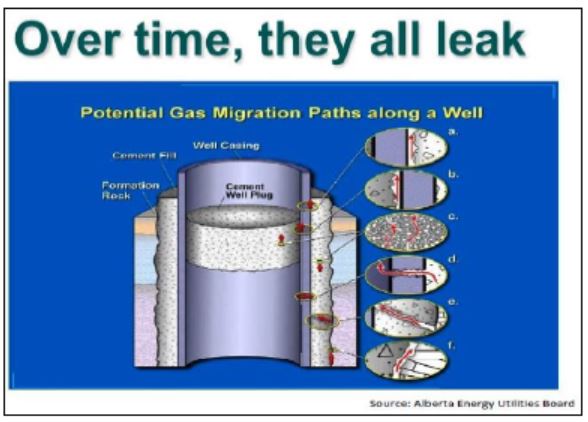
….the possibility for upward leakage of acid gas exists along wells that were improperly completed and/or abandoned, or along wells whose cement and/or tubing have degraded or may degrade in the future as a result of chemical reactions with formation brine and/or acid gas. A review of the status and age of wells that penetrate the respective injection unit at each site shows that most wells were drilled in the 1950s and 1960s, and that the majority of wells are abandoned. …