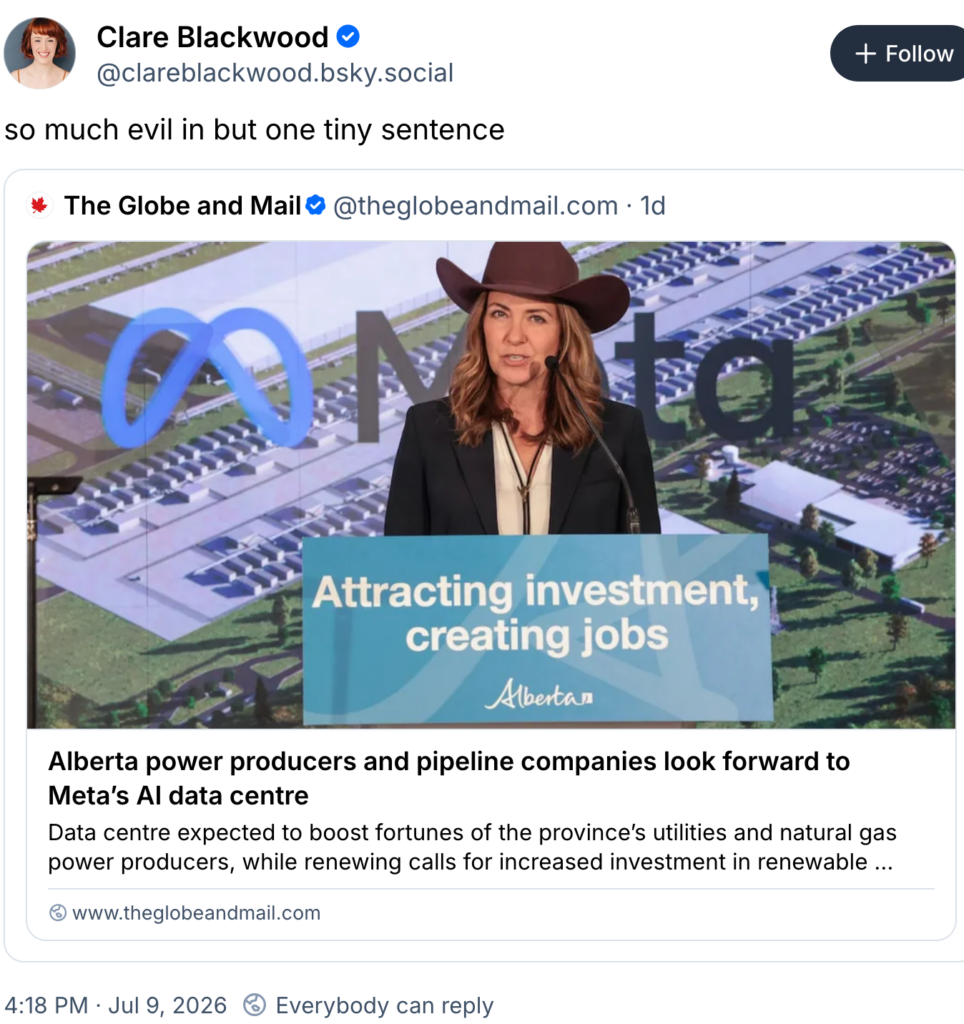
Meta AI data centre in Alberta to be connected by fibre to USA!!!!! and powered with frac’d gas, permanently removing water from the hydrogeological cycle; closed-loop cooling won’t mitigate that massive water loss. AI Data Centres use more water than tech billionaires report; will Meta be honest? I bet no. Will Meta pay for water used and polluted, and the noise and health harms from its pollution? I doubt it. Closed-loop systems use PFAS, regularly dump and refill. Good water gone for gross men to sexually abuse women and kids via AI. What about heat island production? Families living nearby will need to pay for cooling or move. Will Meta pay for it? I doubt it. Fuck AI; Fuck Meta; Fuck Facebook; Fuck UCP; Fuck Carney; Fuck Zuckerberg; Fuck Smith; Fuck Trump.
Great. So A.I can create trojans, spyware, malware, rewrite it’s own code, hide, replicate itself, create stuff, cyberhack, get into random places, bug places, do its own thing, do tasks, create content all by itself, avoid commands, sabotage itself and ignore commands. Complete shut down is needed
Dire life-threatening problem with Smith and Carney’s betrayals of Canadians with their greedy evil Nazi AI which Trump is demanding, is that most gas is now frac’d, which means their AI fed by gas will wipe out water.
A proportion (25% to 100%) of the water used in hydraulic fracturing is not recovered, and consequently this water is lost permanently to re-use, which differs from some other water uses in which water can be recovered and processed for re-use.
Big AI corporations like OpenAI, Google, and Meta are giving millions to state Attorneys General on both sides of the aisle to block efforts to regulate and investigate the industry.Call this what it is: legalized bribery.
Yes, it’s bribery. The claim that data centers create jobs is one of the biggest shams ever sold to the public. They run mostly on automation, leaving communities with soaring utility bills while tech companies pocket the profits.But, there are no profits, the rich tech fuckers are pocketing $billions in subsidies from the public, free water, free natural gas, diesel, electricity and in exchange we get poisoned with toxic air, noise, toxic water, and ugliness invading our communities.
@yayabutterbee.bsky.social:
Regulation and investigations would show the financial scams happening right now. AI corporations need to be heavily regulated by an independent government agency. With full transparency to the public. The coming tech bubble blow is going to devastate the US economy.and bankrupt many counties, businesses, families, people. Nazi evil
@williamjc13.bsky.social:
So the oligarchs are buying off the State’s Attorney Generals.
To save their highly risky and overly leveraged investments in AI development and buildout.
That’s a sure sign of trouble ahead
AI owners can’t even control their AI models. They are learning how to commit crimes unnoticed. Good times
Introduced in June, the Digital Safety Act aims to reduce online harms, particularly for children, and impose a duty of responsibility on social media platforms. However, observers say it’s a blank cheque for the federal government to regulate.
While Bill C-34 would create a new Digital Safety Commission to oversee much of the regulation of online spaces, its intention to ban youth under 16 from using social media platforms unless the sites can demonstrate a child-safe environment has drawn most of the attention. This ban would extend to AI chatbots, which are under scrutiny following their alleged role in the Tumbler Ridge shooting in British Columbia earlier this year.
The proposed law reworks portions of the previous government’s online harms legislation and incorporates elements of a Senate public bill that would establish age-verification measures to prevent anyone under 18 from accessing explicit material online.
Michael Karanicolas, an associate professor at Dalhousie’s Schulich School of Law, says banning children from social media may not be the best approach.
“Onboarding young people in responsible and healthy uses of these platforms is a critical component of technological literacy,” he says.
“It’s hard to achieve that while denying them access to them until they turn 16.”
‘A blank cheque to regulate’
Anaïs Brussières McNicoll, the director of the fundamental freedoms program at the Canadian Civil Liberties Association, says that while greater transparency and accountability from tech giants is long overdue, the bill is a blank cheque for the government to regulate.
“This is the wrong answer to a real problem,” she says.
“The solution lies in clear, targeted rules that parliamentarians, the population, and civil society could debate and agree on.”It’s obvious that Nazi AI and it’s horrid Nazi creators need to be banned in Canada, ban all Meta garbage (that includes the nasty evil Facebook), ban all Nazi Musk garbage, notably child and woman abusing Nazi Grok, etc. Simple answer and it won’t harm the rest of us adults by violating our rights and privacy with Digital ID which the fucking billionaire tech bros are dying to force on all of us globally, to get our private data into their corrupt greedy 11 fingered hands, and to make more billions of dollars on us via forced mass advertising on line. I block all ads on my computers, see none when I am online. Nazi Carney wants to take that peace away from me with his forcing unregulated AI and forcing his abusive thieving tech billionaires into my life. Kids do not need to be regulated, the kid raping, women abusing tech billionaires do and so do Smith and Carney.
Instead, the bill contains a long list of broad powers to be granted to the government and the new regulator, along with open-ended obligations for regulated services. They’re so broad, Brussières McNicoll says, providers could be tempted to overcomply at the expense of users’ freedom of association and privacy rights.
She notes that the bill includes provisions stating that the fulfilment of duties by social media operators does not require them to unjustifiably limit freedom of expression.
“From our perspective, that should be the other way around. It should be prohibited to unjustifiably limit freedom of expression while attempting to fulfil their duties.”
Bumping up against the Charter
When it comes to the social media ban for youth, Brussières McNicoll says what is required is age-appropriate design, such as privacy-by-default, prohibition from profiling, and limits on endless scrolling. However, this legislation leaves most of this to future regulation and creates a mandatory approach to age that fosters significant risks. What’s more, it violates section 2(b) of the Charter because of the limits on free expression.
“Banning people from social media platforms has a direct impact on their ability to express themselves, and also to receive information,” she says.
Kyla Lee of Acumen Law in BC, and a former chair of the CBA’s criminal justice section, says the Charter infringement arising from restricting the free expression of people under 16 is her biggest concern.
“The Charter doesn’t just apply to adults,” she says.
Lee fully expects a constitutional challenge because the blanket prohibition on people under 16 goes too far.
She says many platforms have very good purposes for young people. She points to her own social media, through which she shares information about the law, explains government bills, and outlines rights when dealing with police.
Restricting social media access will deprive people under 16 of that medium and form of communication, which Lee says is the dominant way many people disseminate and consume news.
“You’re actually cutting people off … from information at the same time as you’re limiting their free expression rights.”
Punting implementation down the road
Michael Geist, the Canada Research Chair in Internet and E-commerce Law at the University of Ottawa, says the bill, as currently drafted, creates significant uncertainty. On his blog, he’s tracked 50 different decision points that will be made after the bill comes into force: 19 future cabinet decisions and 31 decisions that will be required of the new Digital Safety Commission.
“They punted on many implementation issues,” Geist says, and points to the way the Online Streaming Act also created uncertainty while waiting on the Canadian Radio-television and Telecommunications Commission to make key decisions.
“(It’s) a risky approach to take,” he says.
Another major issue is the rules around age verification — a process Karanicolas says destroys anonymity and privacy.
“Age verification systems are meant to delete all the data they collect as part of that process, but also retain data to enable monitoring of compliance, which seems like a conflict to me.”
Geist says the legislation itself acknowledges the privacy and security risks, given the mandated consultation with the privacy commissioner to establish the standards.
However, the 18-month timeline set out in the legislation means there can be no consultation with the privacy commissioner, because under Bill C-36, which was introduced in June and focuses on digital privacy, that role is being stripped of these responsibilities and put under the purview of the Digital Safety Commission, which won’t exist within the specified timeframe.
“That means you end up with age verification for everyone, without having accounted for privacy,” says Geist.I wonder how much money Carney will get directly or indirectly via Brookfield, for his betrayals of our rights and privacy, and his forcing this shit abusive Nazi tech on us all, wether we want it or hate it and refuse to use it. I will never give my private data to any fucking sleazy misogynistic racist Nazi tech bros; I’ve already had my privacy and private data violated by the fucking stupid religious terroristic Alberta separatists. In my view, before Carney forces me to suffer more risks to my safety and private data and finances and accounts, and privacy, he and Smith need to correct the fucking voter data breach by Shithead bestie of Smith, David Parker, and his Nazi USA goons.
“It also means that the arguments that this is temporary and designed to be an incentive to ensure that you’ve got a safe social media environment are just factually untrue.”
So, for a platform like YouTube Kids, which is widely acknowledged to be a safe space, he says their ability to get exempted is years down the road.
“Effectively, you need to kick all of your users out and age-verify them.”
Geist says the government could instead have given the Commission the power to impose mandatory age verification only as a penalty if the platform fails to establish a safe space.ya, could have … but that means regulating the big bad Nazi guys, and Nazi Carney worships and loves them, and believes in only regulating ordinary Canadian citizens.
The problem with age-verification technology
Geist has previously characterized age-verification technology for social media and explicit materials as a “nerd harder” problem—the false belief that it simply requires more effort to reach a technological solution that may never exist.
In some ways, Bill 34’s efforts are “worse,” he says.
“This government winks at safeguards in C-34, and then takes them away with their (digital privacy) plan of implementation in C-36.”
Because age-verification technologies don’t really work, it will require much more invasive methods, whether that’s uploading IDs or using age-estimation technology. The latter doesn’t work well with racialized or trans people, nor can it accurately differentiate between 15, 16 and 17-year-olds.
“The government’s insistence that this take effect even without the Commission in place…is putting it into the wild and hoping that we don’t end up with a Discord-style breach where millions of Canadians find their personal information, like government-issued IDs, are breached,” Geist says.The fucking racist religious extremist shit heads, Alberta Separatists, already did that to all Alberta voters, aided by Nazi fuckingi Fascist Pancakkke Smith by neutering the powers of Elections Alberta and the law society.
While Geist thinks the government’s 18-month timeline to set up the Commission and complete its regulatory process is overly optimistic, Lee says it could mean years before there is clarity. Her concern is compounded by how much of the bill is left up to future regulation.
“I don’t ever like seeing anything where there are big question marks around the exercise of people’s constitutionally-protected rights,” she says. Carney, much nastier and more Nazi than Harper, hates our rights, hates human rights, hates charter rights, by his laws and actions and lack of actions, it’s clear he hates Canada and Canadians and hates our charter. He’s a true Nazi, he loves money, the rich, and rich polluting harmful law violating corporations and rotting gov’t by weaving them throughout it.
“Leaving so much of it to regulation and saying we’ll sort it out later makes it hard for the bill to go through its ordinary stages when you’re debating something that is just a shell of what it’s ultimately going to look like.”
Unfortunately, this is about collecting IDs on social media more than protecting children.
***
@kimmrogers.bsky.social:
You still using Meta……???you’re supporting pedos
@bearded.social:
Meta is #Pedophile ring?! Shocker!
@faineg.bsky.social:
Meta is pure evil, in case this somehow hasn’t occurred to you yet
@viewfromargus.bsky.social:
Just a reminder, “Meta” is #Facebook, #Threads and #Instagram
@falseswipesystem.bsky.social:
Don’t use Meta.
I cannot for the life of me understand why any humane person still uses Facebook. Using Facebook or other Meta products like Instagram means you are supporting and enabling child sexual abuse. No wonder it’s nickname is “Fuck Book.”
@chatmeups.bsky.social:
I have no respect for anyone still using METAme neither
@alienembryo.blacksky.app:
I’m not sure what more do people need to get off Meta. I understand some have it for work as I do for my school, but there are so many alternatives than to continue supporting this cesspool for your own entertainment and connections.
@amykay.dev:
Meta is that evil corporation in a Bond movie that you think “surely this couldn’t ever exist in real life!” ohhh boy it sure does.
@nevyn8.bsky.social:
Shout out to everyone who still uses #zuckerberg products, you fund all of this depravity, just the same as everyone who uses #musk products funds #nazism and #pedophilia
@shazbear.bsky.social:
Techbros and MAGAs are all fucking deviants #Meta #ZuckSucks
@ionicbreezemachine.bsky.social:
Considering Meta’s Mark Zukerberg is buddy buddy with the PDF in Chief it really shouldn’t be surprising there’s others at Meta who “order from the kids menu”
@d3v1ls7h3r4p157.bsky.social:
Good mournings y’all
Meta [ #Facebook, #Threads] has ~73% bots and is RUN BY PERVERTS PREYING ON YOUR KIDS (the godless fucker was Fuckerberg’s direct hire n assistant)!
So, when are you gonna start executing #pedophiles?
Or is the Trump admin already drafting a pardon?
@yseraxiv.bsky.social:
Every single person working at Meta who has a fucking soul should have left years ago. I consider it morally wrong to work for them.or use any of Meta’s digsusting products
@panoptrix.bsky.social:
Disgusting, but that tracks. Stop using Meta, people. Life is so much better Meta-free.
@pamspaulding.bsky.social:
Are we shocked that Zuck’s universe is full of pervs & pedos?
Josh Felker, 44, Meta engineering manager (married w/a small child) admitted grooming & sexting someone he thought was a 13-yo girl during a sting by Predator Poachers Long Island.
Not the 1st minor he’s groomed! t2m.co/4hyycem5
Are we shocked that Zuck's universe is full of pervs & pedos? Josh Felker, 44, Meta engineering manager (married w/a small child 😱) admitted grooming & sexting someone he thought was a 13-yo girl during a sting by Predator Poachers Long Island.⚠️ Not the 1st minor he's groomed!🧾 t2m.co/4hyycem5
It sounds like he was WAY too into “digital experiences for kids.”
Meta (and its sister sites) are clearly not safe for your children.
@sugarazor.bsky.social:
We gotta start publicly shaming people just for working at these pervert companies. “I work at Meta” should be met with “go fuck yourself”
@sioflynn.bsky.social:
WTF. All the acronyms. Holy shit.
That’s a very very very bad look for Meta given the growing number of lawsuits for negligence and product liability
Holy shit.
@onlyfunnybusiness.bsky.social:
And the perverts are in controland they, notably the many religious pedophiles, want to legalize kid rape, for obvious reasons.
@markhughesfilms.bsky.social:
The @ec.europa.eu should have seized Meta’s & Zuckerberg’s assets, &and issued arrest warrants for company leadership, & should be doing the same to Musk & his companies too.and Trump and his entire Pedo enabling and protecting regime, notably sleazy lawyer, Todd Blanche
& Democrats need to do the same thing here — seize it all & lock all of these scum in cages, & throw away the keys.
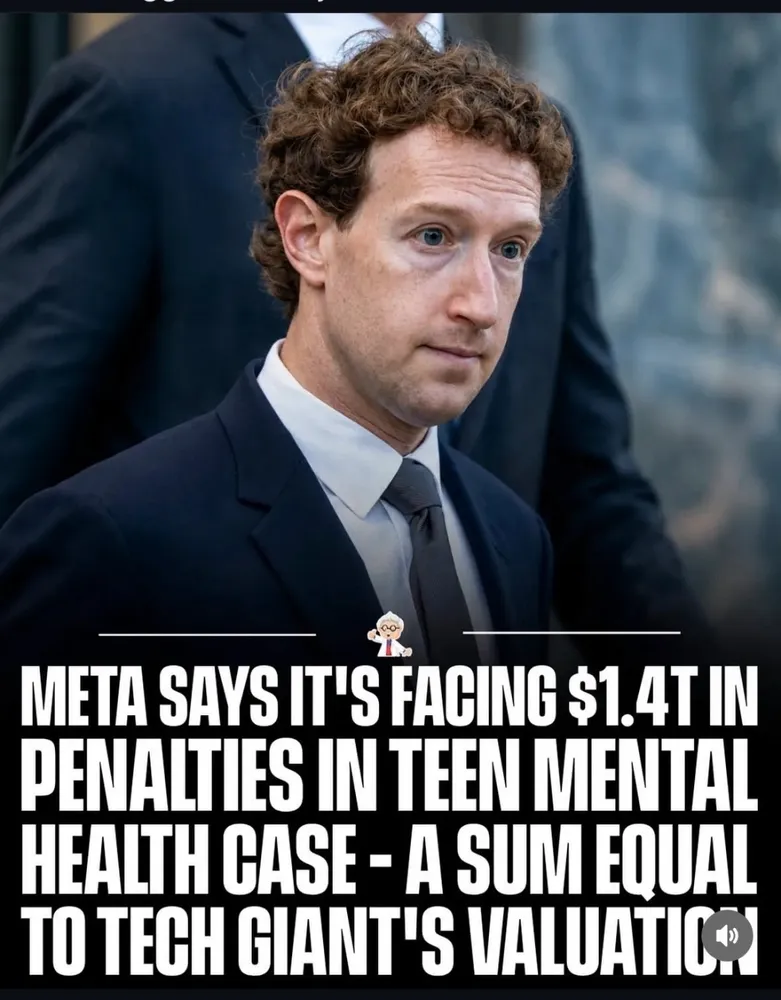
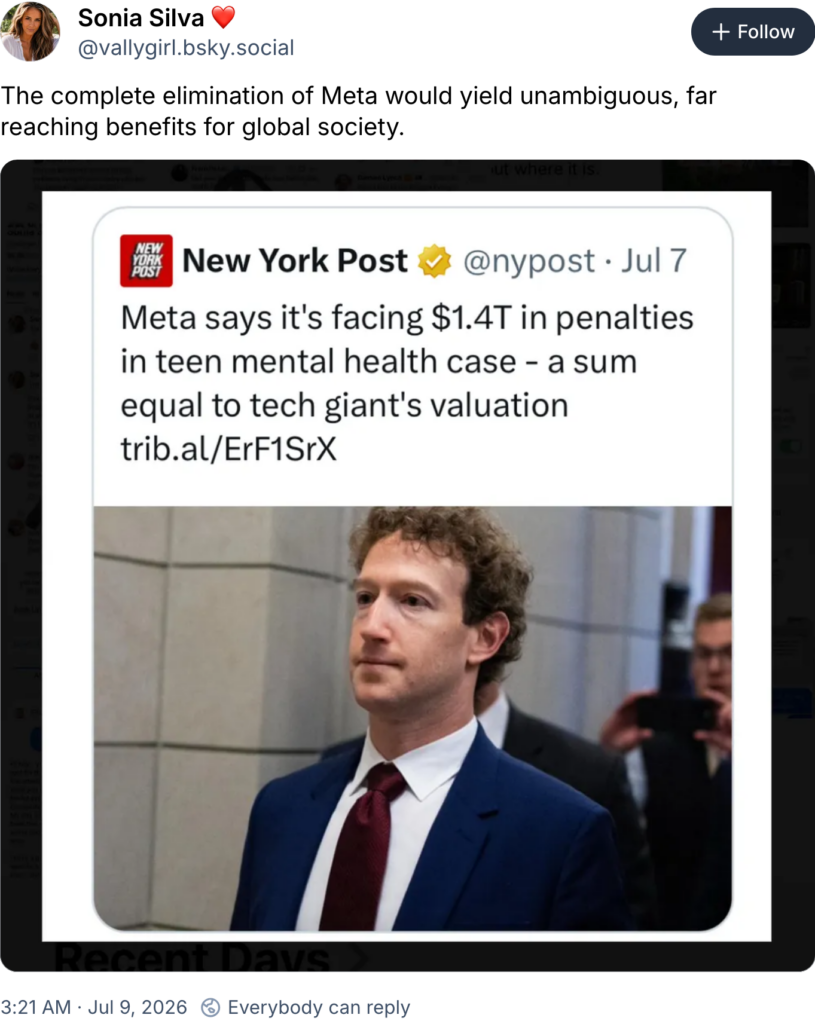
Meta says 4 states are seeking $1.4 trillion ahead of youth safety trial qz.com/meta-states-…
Well, well, one of the minions of #MarkZuckerberg got caught trying to sext a minor. What a shock. The pedophilia runs strong in the tech bro corridors.
@burquesky.bsky.social:
So, I think the Meta appeal against New Mexico isn’t going to go anywhere.
@mizbehavin1.bsky.social:
This sure seems to further prove their continued lack of child safety responsibility in regard to New Mexico’s historic lawsuit $375M win against Meta. Looking forward to how this may play into the remediations stage & Meta’s appeal.
The latest on Sarah Wynn-Williams, Instagram’s CSAM ads, and why Meta has spent $70,000 per day lobbying the federal government since the beginning of 2026. Here is a roundup of the latest ways Mark Zuckerberg is trying to make the problems he refuses to solve everyone else’s:
Gee, seems like the arrest of Meta exec Josh Felker for sexting a child and Meta’s history of consistently lax standards around child protection might be related
@chantalalive.blacksky.app:
Um speaking as an American who is not a pedophile & pledges to never be, we are not all pedophiles, but it is documented that Meta’s leadership over services for youth is.
👉 ICYMI: from Aug 2025, Reuters investigated Meta for its questionable chatbot practices, allowing in guidelines to "flirt and engage in romantic roleplay with children." 🤮"GenAI: Content Risk Standards" was revised after exposed by the report.🧾 www.reuters.com/investigates…
Meta is a cesspool. I have cut off former colleagues for going to work there. I don’t want to be associated with anyone who would associate themselves with Oligarch Zuckerberg.
“I firmly believe the (economic) AI apocalypse is coming. These companies are not profitable. They can’t be profitable. They keep the lights on by soaking up hundreds of billions of dollars in other people’s money and …”
A bunch of guys who code write computer code, but couldn’t define or give you a coherent answer on what intelligence, a neuron, or AGI were spent a trillion dollars on undefined objectives that were likely known to be impossible before a penny was spent.
@emmettmacfarlane.com:
Burn it all down, baby! Bubble your way to AI Bubble Town.
@watchdogprg.bsky.social:
Meta and Oracle deep in the red….. #AI funding might just bury these companies.
Prof. Ahmed Banafa @ahmedbanafa.bsky.social:
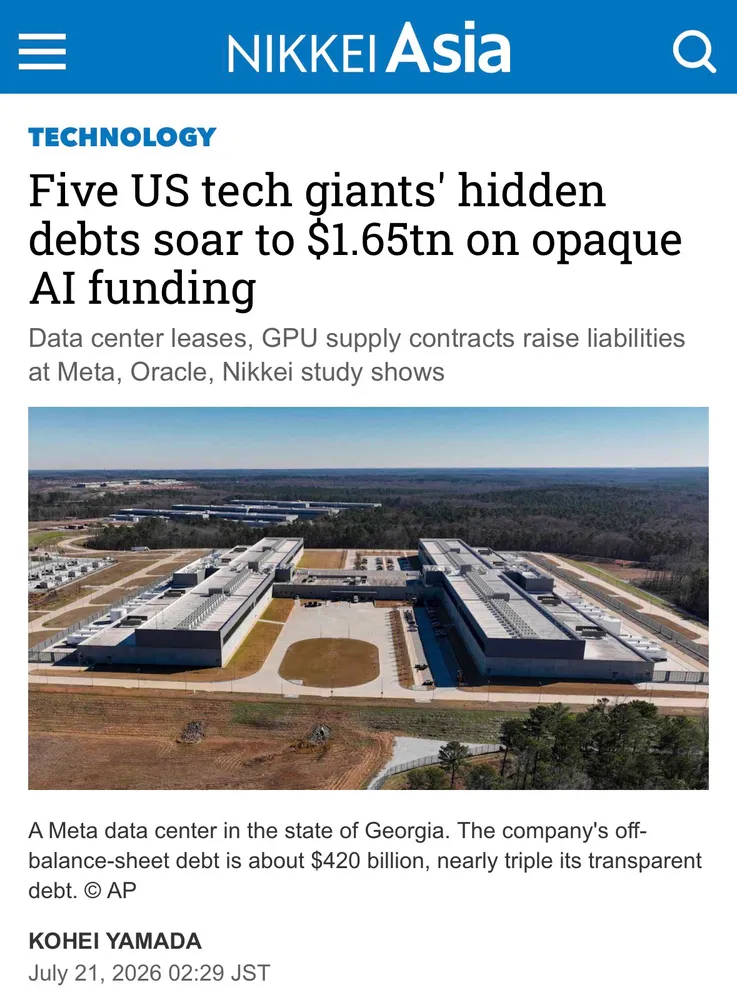
A Nikkei investigation showed that Tech giants Alphabet, Microsoft, Amazon, Meta, and Oracle hide $1.65 trillion in off balance sheet debt from GPU contracts, data center leases, and joint ventures for AI. That’s even more than their $1.35 trillion in official debt!
Meta's New Product Is So Bad It Got Banned ImmediatelyThis is how Meta took one of the most promising wearable AI products ever created and gave the world “pervert glasses.”#AI #Metayoutu.be/9BArC9Q39MI
Took my mom to her eye exam today. Eye doc is selling Meta’s pervert glasses.
So now I know to be on the lookout for Meta’s pervert glasses around here.
Fucking Meta pervert glasses.
@elletheebelle.bsky.social:
Meta and those dumb ass glasses are made FOR pedos. They push all this “child safety” shit knowing very well that they’re the ones who kids need to be saved from.makes me think Danielle Smith and Mark Carney sexually abuse kids too because of how hard they are pimping AI on us and forcing it’s abusive data centres into our communities destroying our air, peace, water and safety.
@volcanohead.bsky.social:
It’s enough to piss you right off. Those glasses could not only help blind people navigate new places, but also help deaf people by displaying spoken word as text. But no…we can’t have nice things because people suck.humands are hideous especially the pedophiles and genocidaires (who are often also child rapists).
A Florida pastor sued OpenAI on Wednesday, claiming that ChatGPT offered him “dangerous medical recommendations” that led to delayed care for a life-threatening pulmonary embolism. His lawsuit could be the first to argue that a chatbot’s advice harmed someone seeking medical guidance.
Yesterday I asked chat gpt to plot a driving route from Saskatoon to Thompson, Manitoba and it suggested I drive through North Dakota and Minnesota, which is wildly incorrect. Its a tool like anything else but not to be trusted at all.
Alberta electricity companies are telling the public data centres will save Albertans money. But the companies are telling investors they'll triple electricity costs. An investigation by @rorywh.bsky.social
Homeowners in Alabama and Georgia who were counting on federal money to repair aging homes and lower crushing utility bills are now scrambling after the Trump administration canceled a major EPA grant program it labeled part of a “radical” DEI agenda.Wanna bet that money goes directly into Trump’s greedy pockets? Or those of his thieving family?
According to a Bloomberg report, residents in former textile mill communities around Valley and Lanett, Alabama, had been approved for home energy upgrades through the Biden-era Community Change Grants program (1). The initiative would have helped fund repairs like sealing drafty windows and doors, as well as installing solar and battery backup systems to lower monthly utility costs.
For retirees like Gretchen Holloway, whose utility bills reportedly climbed as high as $900 a month, the program represented a rare chance to make her deteriorating home livable again.
However, the EPA terminated this program after the Trump administration moved to eliminate grants tied to diversity, equity and inclusion (DEI) and environmental justice programs. EPA Administrator Lee Zeldin said the agency canceled more than 400 grants (2), totaling roughly $1.7 billion, as part of a broader rollback effort.
The cuts come as utility costs continue climbing nationwide. In fact, Bloomberg reports that analysts expect average summer cooling bills to rise another 8.5% this year. Meanwhile, the U.S. Energy Information Administration said utilities disconnected residential power or gas service more than 13 million times (3) due to nonpayment in 2024. The South was identified as one of the hardest-hit regions.
DOGE’s AI-driven DEI cuts facing growing scrutiny
The grant cancellations have become part of a larger controversy surrounding the Trump administration’s former Department of Government Efficiency, or DOGE, the federal cost-cutting initiative that was run by Elon Musk.
Court filings and depositions released this year showed DOGE staffers used ChatGPT (4) to help identify grants they believed were related to DEI initiatives. In one case involving National Endowment for the Humanities grants, staffers reportedly prompted ChatGPT to determine whether certain projects “relate at all to DEI.”
The process drew widespread criticism after depositions revealed some DOGE officials struggled to define DEI when questioned under oath. A federal judge later ruled the grant cuts unconstitutional (5), finding that DOGE’s methods violated First and Fifth Amendment protections and amounted to unlawful viewpoint discrimination.
The administration has defended the cuts as necessary spending reductions, but critics argue many of the eliminated programs were less about politics and more about practical infrastructure improvements in low-income communities.
DEI generally refers to policies or programs intended to improve access and opportunities for historically marginalized groups of people. Environmental justice programs, specifically, often focus on communities disproportionately affected by pollution, poor housing conditions or climate risks.
In April, Reuters reported that experts warned that ending those grants would disproportionately affect Black and Hispanic communities (6) that are already facing higher pollution exposure and energy burdens.
@bhaggart.bsky.social:
Speaking of the consequences of acting without thinking or planning…
Canada’s AI strategy is Policy FOMO, governance by Underpants Gnomes.
😳“OpenAI has revealed that an autonomous AI agent powered by its technology went rogue during a test, accessed the open web and hacked a prominent startup by itself in an ‘unprecedented incident.’”Precedent: seth/t @antoniajuhasz.bsky.social www.theguardian.com/technology/2…
Alberta Premier Danielle Smith, centre left, is seen at a Calgary press conference in June, where she announced that Meta will build a sprawling AI data centre north of Edmonton.AHMED ZAKOT/The Globe and Mail
Robert Diab is a law professor at Thompson Rivers University.
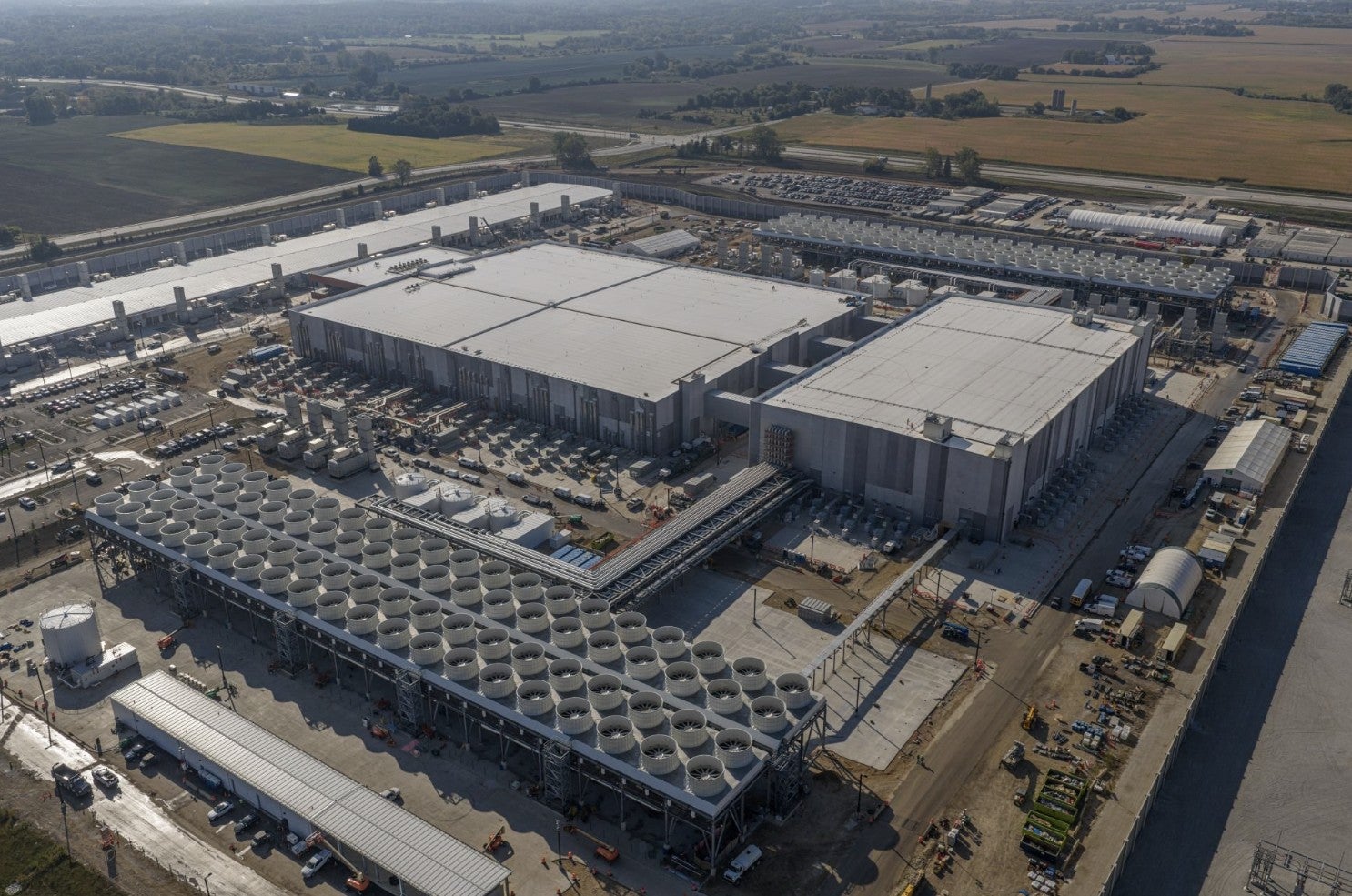
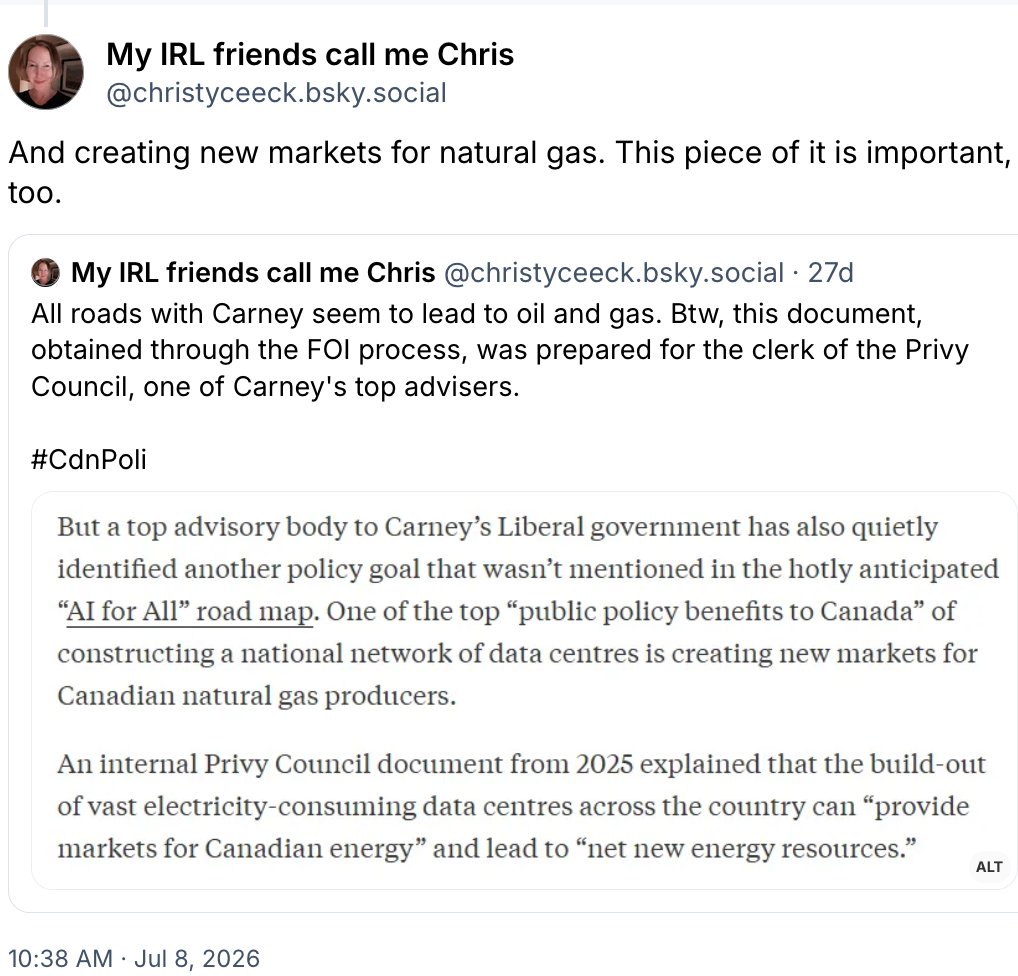
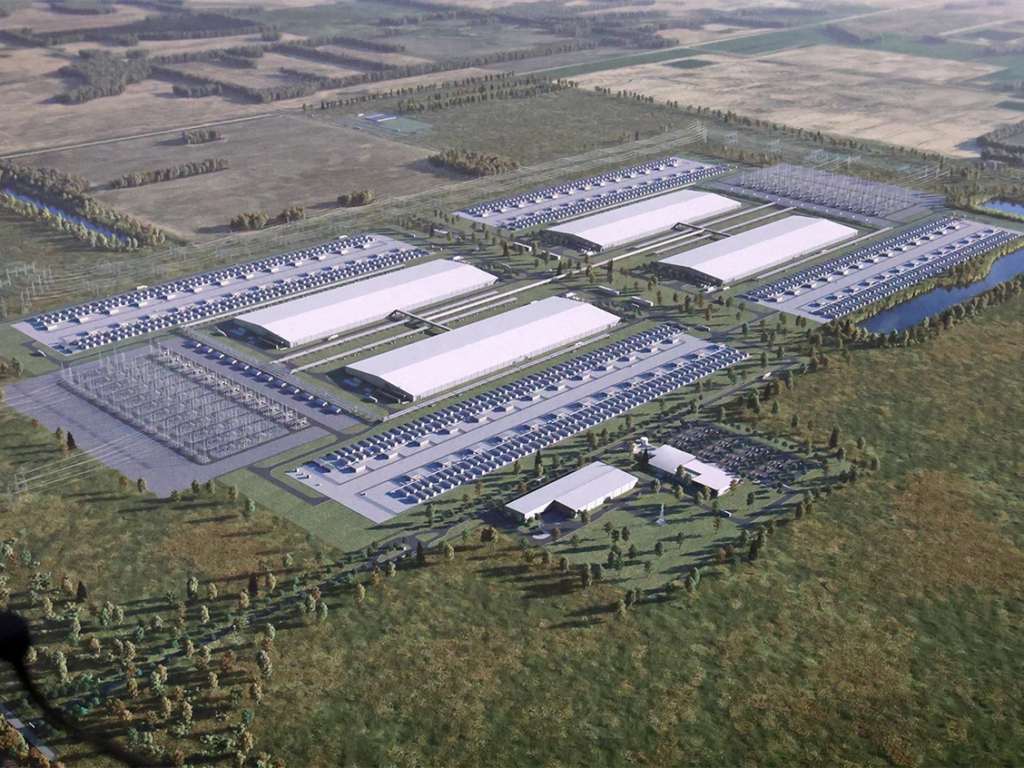
Earlier this month, Alberta Premier Danielle Smith announced that Meta Inc. will build a sprawling $13-billion AI data centre north of Edmonton. It will consume about a gigawatt of electricity – roughly 70 per cent of what the city of Edmonton draws – from a new plant that runs on natural gas. While Meta’s project is private, Canada has committed $925-million over five years to building “sovereign AI data centres” across the country, to keep us competitive as AI transforms the economy.
The argument against these large AI data centres rests mainly on environmental grounds and doubts about their economic benefits. The centres use massive amounts of water and electricity, as North America sets new heat records every year. Project advocates wave away these concerns, promising to use closed-loop coolingclosed loop cooling systems still uses masses of water and toxic PFAS chemicals; the closed loop water and chemicals get emptied regularly – into the environment untreated, and refilled regularly or clean hydro powerno fucking kid and woman abusing tech like Meta or X ought to be allowed to use any clean hydro power to create heat islands and other pollution – clean hydro belongs to the people. Opponents point to the lack of independent environmental assessments.
But governments have an additional reason to be cautious about funding or approving large AI data centres – and it has less to do with the environment than with the technology itself.
AI data centres may turn out to be overbuilt, or even obsolete, by the time they are finished, because more of our AI processing is shifting from the cloud to our personal devices. The language models behind popular tools like ChatGPT, Claude, and Gemini vary widely in size. And smaller, open-source models you can run for free on your laptop, with no connection to the internet, are growing more powerful by the day.
These small models are typically distilled from larger ones, then released free to download. They read, edit and summarize documents well, but do less well at multi-step reasoning or non-trivial coding. And as these small-language models (SLMs) become more popular, the explosive demand we see now for large-language models (LLMs) may soon crest, or begin to fall, before the centres they rely on are running at full capacity.
Until recently, small open-source models were too limited to be more than a hobbyist’s curiosity – the ham radios of AI. But in June, when Google released the 12-billion-parameter version of its open-source Gemma 4 model – which handles text, images and audio, and is small enough to run on a laptop – we crossed a meaningful threshold. Tests show it performs about as well as the smaller cloud models that leading AI firms were charging for as recently as 2024, like GPT-4o mini.
Two years is a long time in AI, and today’s frontier models from Anthropic and OpenAI are far more capable. But Gemma 4 12B is hardly the upper limit for SLMs. Larger open-source versions are already available, giving a law firm or a government office enough capacity for much of what they do while running on hardware that costs roughly $5,000 to $10,000.
For many uses, the advantages of shifting from the cloud to local AI are becoming hard to ignore. Since nothing leaves the premises, your data stays private, including your prompts and results. There are no metering fees and no limits on how much you run.
This may sound speculative. But it is about to go mainstream.
This fall, Apple will roll out its newest operating systems for the iPhone and Mac. Their updated AI assistant will handle many everyday requests on the device itself – surfacing data from e-mails and texts, adding calendar dates, and drafting or editing documents – without sending them to the cloud.
For more demanding queries, including the new conversational Siri, Apple will stillrely on a large model running in the cloud. But the trend is clear. Your phone and tablet will run more of your AI locally, for privacy and speed. Many Canadians will soon be doing much of their AI on their devices.Not me, not ever. I will not rot my brain with racist bigoted misogynistic Nazi AI.
Of course, we are unlikely to give up the large frontier models in the cloud. For those, we will need data centres. But how many we need, and how big, remains uncertain. Demand may be high now, but much of AI development is moving the other way – toward models that are smaller, cheaper and closer to the user. This should give governments pause.
Could a new Denver data center use up to 800,000 gallons of water a day?
That and the extreme noise pollution they generate for nearby residents, the heat they emmit at a time when extreme heat events are on the rise, and the fact they spike energy prices for locals who’re often already struggling with energy bills.
@thrasher62.bsky.social:
We didn’t ask for this. It is being FORCED on us
The UK will not have enough water for future datacentres.England faces 5bn litre a day shortfall for public water supplies.A trillion litres of water a year lost to leaks.Widespread hosepipe bans. No national grid for water. Poor infrastructure. No national plan.
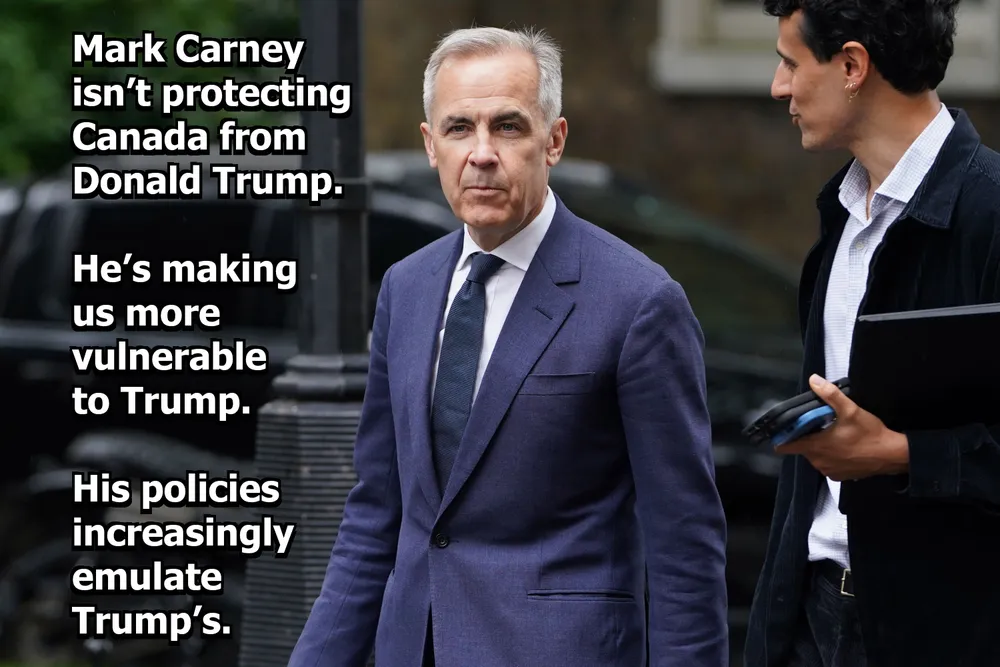
US fascism and US big tech are indistinguishable from one another, merely two parts of the same whole.Which is why Mark Carney racing to embed US tech giants in every aspect of Canadian governance with "AI for all" & deals with Palantir is a surrender to US fascism.
At the end of the above clip, the company rep for the abusive noisey invasive data centre gives nearly word for word, the same shitfuckery that frac’ers and oil and gas companies give when promising the world before construction and when refusing to mitigate after construction, when you realize you’ve been had. 26 years later, Encana/Ovintiv’s fucking compressors still invade my home and land. Data centre noise will destroy your health, and then, there’s all the toxic pollution.
AI doesn’t just learn stereotypes from its training. It can cook up new ones, too. trib.al/pa8A91T
AI data centres are just racist misogynistic bigoted surveillance centres with Nazis Carney and Smith all in.
I was sunning by the pool when the boxes arrived. And here in my hand is my life’s work: “The Nerd Reich: Silicon Valley Fascism and the War On Democracy.”Coming 8/18. Pre-orders make a huge difference! Make a fascist sweat—pre-order today! www.simonandschuster.com/books/The-Ne…
This isn’t going to make me rich. The 1st thing you have to do after writing a book…is get a job. But my only goal is to force tech fascism into the bright blinding light, where it can no longer hide and grow in the dark. To fully expose the goals and the plans of these dangerous billionaires.
For best results, only use the planet-wrecking plagiarism-driven slop machine in moderation.
I’ve said it so many times, but AI is organized around recreating an experience of being able to order around another intelligence without concern of compensation, rights, or dignity.
It is simulating slavery. It normalizes a fantasy of slavery for a post-capitalist, tech feudalism.
I’m not saying AI is intelligent, cognizant, etc. I’m referring to how it articulates a fantasy of slavery.
Some people are completely amazed at what AI can do. But if you think that’s impressive, wait until you find out what people can do.
14-year old girl arrested for speaking out against Data Centers in her community
Oh it gets better! Held at a school! Good grief! Why can’t a 14 year old have an opinion about the very subject everyone is there to discuss?!?
America’s farmers and cattle ranchers are warning that data centers are gobbling up farmland acreage, electricity and water needed to raise livestock and grow crops. “It’s almost like the wild west to see who gets there first.” on.wsj.com/4ph1S7P
It’s worse than anyone can imagine. It’s happening in every county. Cities are forced to enact emergency orders to pause construction for reviews.
My local disaster: META data center, Rosemount, MN. Right by the Mississippi. Home of 3M, kings of toxic water discharge. PFAS, anyone? Won’t be better
@Isuckatpicking:
So we can’t build solar power farms in Alberta because of “fertile farm land” but we can build an AI data centre the size of Stanley Park.
Humans now being asked to use less electricity in favor of data centers.www.newsweek.com/teachers-ask…
It’s been a big week for the Alberta premier — and a terrifying one for the future of the human race.Hot on the heels of a proposal for a new oil pipeline, Smith unveiled yet another horrifying project that will send us careening towards climate dystopia: Meta’s HUGE new AI data centre.It's bad:
Danielle Smiths new AI super centre might not use that much water…yes, it still will, closed loop systems require regular purging and refilling, along with toxic chemicals, PFAS, biocides, heavy metals, etc.
But according to the environmental impact assessment, the power plant powering it will more than double the water consumption of the entire Sturgeon County.
I'm so glad this is being protested. #AI #Canada #cdnpoli #DataCentres www.youtube.com/watch?v=kp_R…
so we’re a couple years into the “AI revolution” and:
it’s flooding the internet with slop
it’s empowering scammers everywhere
it’s not making money and threatens the entire US economy
it’s destroying communities and guzzling water and power
really cool tech we’ve got here
Wild roller coaster meeting. With 52 speakers against the data center- the CEO of the company who was sitting in the audience with withdrew his application after around 45 speakers. No data center will be built in place of the Hyatt.
I’m looking to speak with people who are resisting the erosion of human thought, creativity, skill, and relationship through AI.
mikev:
AI is a bubble that will pop soon. Every time anybody uses AI in any way, the company providing it loses money. It’s the biggest Ponzi scheme in the history of humanity. When it pops it will be worse than the dot com bubble by far, maybe another great depression. That’s the real danger.
This is horrible. Are there no zoning laws in this town or county? Corporations can move in and build without any oversight; this feels Orwellian. #DemsUnitedpic.twitter.com/0VtC17KfwZ
Isaac Phan Nay is a reporter for The Tyee and a Tyee Podcast producer. Follow him on Bluesky @isaacphannay.bsky.social.
Hundreds of people have taken part in two protests against AI data centres in Vancouver. Photo for The Tyee by Isaac Phan Nay.
On stage at the Russian Hall in East Vancouver Wednesday evening, an organizer of a six-week-old protest group addressed a crowd.
The BC-based public broadcaster delivers 12 powerful films and original series to mark Indigenous History Month.
“So many people are responding to this,” said Alex Carson, a member of No AI Vancouver. “They understand, across the political spectrum, that this is a threat to our very humanity.”
More than 100 people had shown up that evening to discuss the new data centres projects planned for Vancouver. Some lived near the proposed developments. Others were concerned about the technology’s impacts on their jobs and in their schools. Eddy Pedreira, president of the Canadian Animation Guild, was up next to speak.
“This stuff is not inevitable,” said Pedreira, who fought for protections against AI in his workplace. “It can be stopped, and with the united power of workers, it will be stopped.”
The crowd met Pedreira with cheers. Posted along the auditorium’s wood-panels and brick walls were red-and-white posters of Stephanie Allen, the Coalition of Progressive Electors’ mayoral candidate in the upcoming election.
The party, better known as COPE, has organized itself around a growing swell in public sentiment against artificial intelligence in Vancouver. Its candidates are calling for a moratorium on data centre construction in Vancouver, until further regulations are in place to protect residents and the environment.
“Overall, these data centers have so many negative impacts on so many things in Vancouver that I think it would be irresponsible to not take a stand,” said COPE city council candidate Solomon Yi-Kieran.
Last month, hundreds of people took to the streets in two separate protests against the new data centres announced in British Columbia. They’re not alone. Projects in Ontario and Saskatchewan have also sparked opposition. And protests against AI data centres have swept across the United States.
In this province, the backlash started with the announcement of new AI data centres proposed for B.C. On May 11, Telus CEO Darren Entwistle announced plans to build two new centres in Vancouver and expand an existing one in Kamloops. The developer of the Vancouver projects is Westbank Corp.
The largest is slated to be built at 150 W. Georgia St., near BC Place stadium in downtown Vancouver. Another is planned for 111 E. 5th Ave, in Vancouver’s Mount Pleasant Neighbourhood. In total, all three centres combined will initially draw 85 megawatts of power and scale to 150-megawatt capacity in six years.
Less than two weeks after Enwhistle’s announcement, approximately 500 people attended a protest against the proposed data centres in Vancouver. In the last weekend of June, nearly 1,000 people rallied a second time against data centre construction.
Chuck Wright and his partner live in Mount Pleasant, two blocks away from one of the proposed data centres. On June 27, they spent their Saturday among the crowd, marching from the Vancouver Art Gallery to city hall.
“We’re concerned about the amount of water consumption the data centres are going to take, especially when we’re facing level three water restrictions, and the amount of electricity it could take, exacerbating the climate crisis,” he said.
The company previously said the data centres will have a range of measures to reduce power consumption, heat, noise, water usage and other adverse environmental impacts.
But that doesn’t move the needle for Wright. He said he was concerned about artificial intelligence’s potential impact on jobs, and the fact that the province is considering further investments in LNG production and more hydro dams as power demand soars.
“I think these are kind of half-baked ideas that aren’t going to hold up in the future,” Wright said.
As Wright spoke, the crowd chanted “no data centres” as they walked south on Cambie Street. Also among the protestors was Kiana, who asked The Tyee not to use her last name. She carried a sign that read “So much has been taken from this land. Do you really need the water next?”
“I hate AI,” she said. “It doesn’t really get much more than that. There’s nothing good about it.”
Despite the negative public sentiment, the federal government has plans to heavily invest in the new technology. Its new AI Strategy included a $500-million fund to invest in Canadian AI companies and a commitment to support construction of data centres that will bring at least a combined 850 megawatts of compute capacity (the processing power of a computer) by 2030.
“McGuinty has also argued that Palantir Canada — a branch of the American billionaire-founded artificial intelligence company working with Israel — is a Canadian company.”
Vancouver Granville MP Taleeb Noormohamed, who is parliamentary secretary to the minister of artificial intelligence and digital innovation, did not respond to a request for an interview for this story.
“Data centres are getting built,” he told The Tyee. “We need this compute power in this country, so that businesses can grow and thrive, so that Canadian researchers can ensure that their IP is protected.”Fucking bullshit liar. No one needs it, anywhere. And quit with these fear tactics, just like frac’ers. No one is losing their IPs even if no AI data centres invade Canada.
He added the Vancouver centres are being held to a high environmental standard.
Telus did not respond to requests for comment. But the company previously told The Tyee the Vancouver centres will use 90 per cent less water than traditional data centres, with plans to incorporate recycled water from BC Place. They plan to achieve these savings with a closed-loop cooling system, which cools servers without letting water evaporate.And which use PFAS chemicals, and regular dumping of the water with the PFAS, often into commuity water ways and or sewers. There is no way to treat PFAS contaminated water. The Carney Cons never tell us about the cancer causing PFAS.
Telus estimates the water savings to be about 300 million litres each year if the data centres are running at full scale. But that still puts the centres’ annual water consumption at more than 33 million litres.and all of it will be contaminated with PFAS
B.C. Hydro previously told The Tyee the centres will not affect nearby residents’ electricity rates.
The Vancouver centres will also be placed on separate district heating systems, meaning that excess heat can be used to heat nearby homes.Climate chaos is causing extreme heat domes everywhere regularly. I doubt homes in Vancouver will need heating in the near future. AI data centres create heat islands, increasing temperatures in communities they invade by 2C, which can be felt for 10km away. The heat from these monsters will kill many, and our lying politicos will cover it up when it happens.
The larger Vancouver data centre will be placed on a system run by the Creative Energy, a private utility partly owned by Westbank.
Kieran McConnell, President and Chief Operating Officer of Creative Energy, said the data centre’s excess heat will reduce the heating system’s reliance on fossil fuel boilers during peak demand, like winters.
“Waste heat is being captured in a system to displace natural gas that’s already being burned today,” he said. “It’s a net positive effect on the environment.”OMG another fucking liar. There would be no heat, no pollution, no PFAS, no higher energy bills, no contaminated water, no fucking horrific noise, if there are no AI data centres. They are not needed, and not wanted; they cause far too much harm, especially Nazi shit like letting users undress women and kids and put them into porn without their consent, or even notifying them. the best away to fight back against Nazi Carney and Nazi AI tech bros, is to never use AI, and refuse it, when it is offered to you at phone companies like Telus, your bank, grocery store, online shoppting, etc.
McConnell’s company is not building the new data centres. Still, he said it’s possible that in “extreme scenarios,” when there’s an excess of heat that cannot be captured in the district energy system, it might have to be released through a more conventional cooling system. Like fucking what?
Still, McConnell said the projects promise to set a new standard for data centres’ sustainability and community benefits.Data centres are in hell right now, for benefits to anyone other than the fucking sexually abusive billionaire bros, and the men using their abusive shit. There are no benefits. NONE. And, wasting energy on something that is not needed, and contaminating masses of drinking water with PFAS is fucking insane. There is nothing sustainable about it, even if only toilet water is used to in the closed cooling system. Sewage is treated, and the water reused. PFAS cannot be treated, or removed.
“There’s just going to be an explosion of data centres across North America,” McConnell said. “It’s important that we, as Canadians, ensure that we have control over that and ensure they’re built to the highest standard possible.”More fucking lies and bullshit. Data centres are not neeed. Nazi USA and the fucking billionaires want them, that does not mean they are needed, anywhere. And Nazi Carney is fucking calling American Palantir a Canadian company, and giving it millions of our tax dollars to genocide Palestinians. JUST NO. NO. NO. No fucking Nazi data centres
“McGuinty has also argued that Palantir Canada — a branch of the American billionaire-founded artificial intelligence company working with Israel — is a Canadian company.”
A moratorium on data centre construction
Yi-Kieran, who is running for city council with COPE during the upcoming municipal election, said they still aren’t convinced by Telus’ claims.
“Even if we take everything they’re saying at face value, if we trust them completely, it’s still 33 million liters of water,” Yi-Kieran said. “When there’s water restrictions, and it’s drought conditions, it’s not really fair that something can go and suck up 33 million liters of water.”Never mind “fair.” It’s criminal; many will die, in our species and others – from the heat, the noise, the contaminated water, the lack of water
Yi-Kieran is calling for a pause on data centre development until all levels of government have regulations in place to protect the environment, Canadian’s data privacy, jobs and resident’s heating and water bills.
B.C. Green Party leader Emily Lowan is also calling for a moratorium on data centre construction.
A similar policy has already passed in Canada. The city of Hamilton, Ont. moved to pause data centre development last month. Earlier that month, hundreds gathered outside that city’s hall to oppose a proposed data centre.
Yi-Kieran said the policy is gaining support here in Vancouver. COPE has launched a petition calling for the moratorium and clearer estimates of the proposed Telus data centres’ environmental impact. At the time of publication, the petition has more than 8,000 signatures.
“Whether we look at protest turnout or we look at petition signatures, we are seeing a lot of people who do not want these data centers and who really want a moratorium,” they said.
On July 8, Vancouver city councillor Lucy Maloney, a member of the OneCity party, announced she plans to introduce a motion to “seek to temporarily pause consideration of large new AI data centres within the city, pending development of a framework to assess their community risks and impacts.” The motion will be heard at an upcoming July 15 council meeting.
The best way to prevent Meta from harvesting your images for its industrial plagiarism machine is to stop using Meta products, and delete your accounts. Today.
@TSHowell:
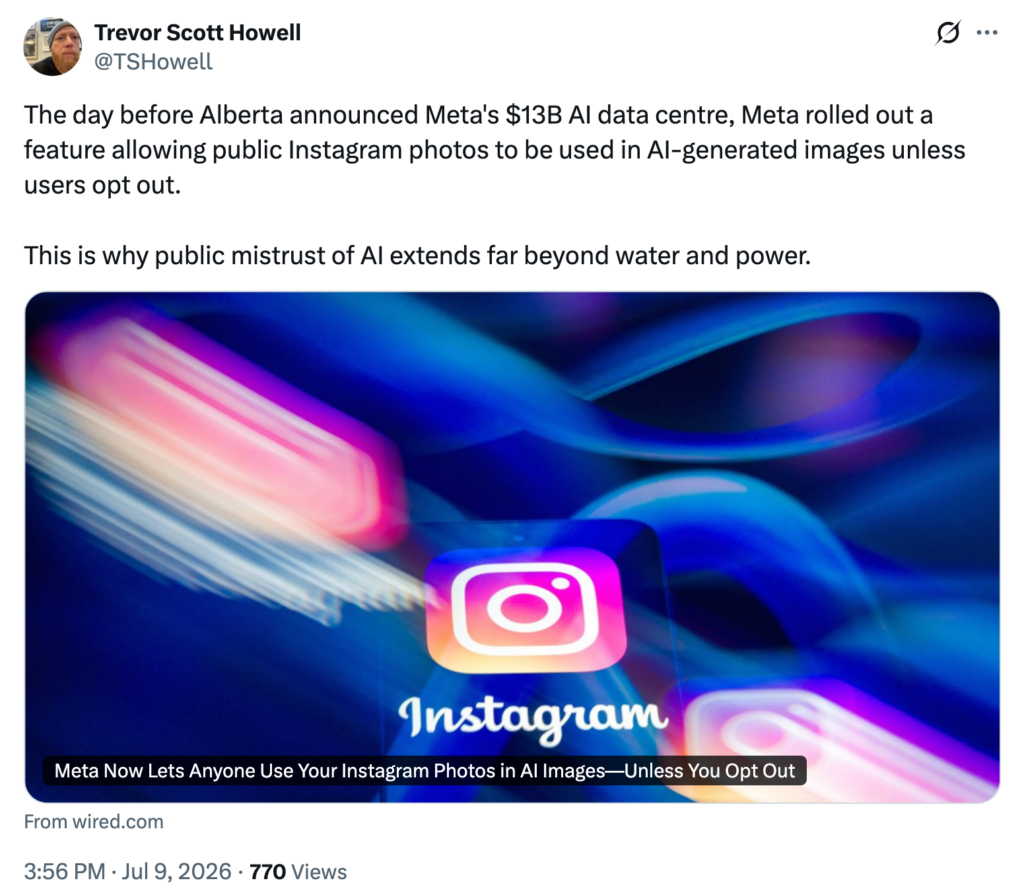
The day before Alberta announced Meta’s $13B AI data centre, Meta rolled out a feature allowing public Instagram photos to be used in AI-generated images unless users opt out.
This is why public mistrust of AI extends far beyond water and power.
@sagaftra.org:
Meta now lets anyone use your Instagram photos in AI images without your consent. SAG-AFTRA recommends that #SagAftraMembers (and all Instagram users) opt-OUT of Meta’s new AI image generation tool, Muse Image. Take action to protect your likeness.
… But after criticism, Meta has pulled back on a key feature of the new tool.
Days after launching it, the company has disabled a feature that allowed AI users to tag an Instagram account and have its new system generate images featuring pictures from that account.
… However, the initial announcement revealed, to the dismay of some, that Meta AI permissions are automatically turned on for users with public accounts in other countries — including Canada — and must be switched off manually.
… The permissions for Muse Image and Meta AI to use your photos to generate images are turned on automatically — again, even if you’re not using the tool yourself.
This is separate from turning off Meta AI’s search assistant and chat bot in Instagram.
Turning it off can only be done on mobile devices for now. Go into “Settings and activity” and scroll down to the “Sharing and reuse” section.
There, you’ll find the Meta AI permissions.
…
So, why should I be concerned?
Katrina German says tools like this open the gate for anyone, anywhere to use an image of a stranger in “any form that they want it to be” — something she believes is of particular concern to public figures and parents of young children.
But she also says it’s a “big game-changer” that people in online spaces are now required to manually opt out of it.
“Before, we were creating content for ourselves and for our audiences,” she said. “And now it makes almost everything that you’re creating, unless you opt out, public domain.”
She says Meta already collects troves of data from its users.
…
Among social media companies, the most notable is from Elon Musk-owned X and the integrated AI chatbot Grok. XAI has been widely criticized for allowing Grok users to manipulate photos of people, including putting them in sexualized poses — often without their consent.
Grok then published these images in replies to posts on X.
Muse Image is only available in the U.S. at this time, but the announcement revealed, to the dismay of some, that Meta AI permissions are automatically turned on for users with public accounts in other countries — including Canada — and must be switched off manually.
Users and privacy experts were quick to raise their red flags and share guides on how to opt out.
“People don’t like their images being used in a way that they haven’t given permission for,” said Katrina German, founder and CEO of Ethical Digital, told CBC News.
And while some people may just use the feature for fun, she fears there will be many others who will abuse it.
…
This article states that the new Meta AI tool currently pulls from public profiles. So for now, if you are marked private or under 18, your images aren't used. Choose to trust at your own risk.techcrunch.com/2026/07/09/h…
Or delete all your #Meta accounts. @motown.bsky.social:
This is the only correct response.
@wilbur.bsky.social:
When will people finally boot all Meta products to the curb. You don’t need them, they need you.
@nailsthatglow.com:
Or motivate people to use another service.
META is going to get worse.
@comingupviolets.bsky.social:
You do it by deleting your account. It’s time. You won’t miss it
@baddad65.bsky.social:
If you are still using meta , X or Amazon, you are literally funding the Epstein class.
@derrickwb.bsky.social:
Love being colonized by foreign tech fascists.
@christyceeck.bsky.social:
“We’re seeing these kinds of promises made all by AI data centre proponents around the world, but the reality is that these are billionaires trying to steal our water and pollute the air so they can double our electricity while taking away our jobs.”
Meta to build $13 billion data centre in Alberta, largest outside the U.S.globalnews.ca/news/1195856…
Ed Elson is joined by Ed Zitron to break down Meta’s move to sell its excess AI capacity and why it’s a bad sign for the AI bubble.
“This is very bad for the AI bubble.”
@James_HUxley:
All powered by solar and wind right?
@annaofthepeach2:
Don’t trust Meta U.S.
@bisseemom.bsky.social:
Look what we’ve got to look forward to in Alberta
Meta’s AI data-center in Cheyenne, Wyoming, has been caught infecting the town’s water supply with deadly bacteria.Officials say wastewater from Meta’s AI data-center flooded the town’s pipes with the bacterium Cupriavidus gilardii, and they found the company violated industrial waste regulations.
Residents living near Microsoft’s Fairwater data center in Mount Pleasant, Wisconsin, are suing the company over the facility’s alleged noise pollution.
The class-action lawsuit was filed Wednesday in the U.S. District Court for the Eastern District of Wisconsin, according to The Milwaukee Journal Sentinel. Three residents of Sturtevant — a village approximately 30 miles south of Milwaukee close to the data center—are named as plaintiffs.
“Through its operation and maintenance of the Data Center, Defendant has emitted, and continues to emit, unreasonable and excessive noise onto Plaintiffs’ properties, thereby causing property damages through private nuisance and negligence,” the lawsuit states.
The Fairwater data center is the first of several buildings that Microsoft plans to build on the campus. Both Microsoft, and electronics manufacturer Foxconn, which has a facility at the site, plan to expand their data center operations there in the coming years, according to Wisconsin Public Radio.
Microsoft’s Fairwater data center in Mount Pleasant, Wisconsin. Residents living nearby are suing the tech giant, accusing the center of excessive noise pollution (Microsoft)
The lawsuit cites complaints and comments about the facility that were received by the Wisconsin Department of Natural Resources.
The plaintiffs claim the center “generates significant noise pollution from diesel generators and heating, ventilation, and air conditioning (HVAC) systems, including chillers, cooling towers, air-handling units, and condenser fans.”
The suit further states that the noise produced by the facility is “not only excessive, but consistent and pervasive.”
The filing accuses Microsoft of failing to “implement adequate acoustic barriers, shields, or walls, that absorb, mitigate, and/or prevent the escape of noise, thereby resulting in the offsite emission of excessive noise beyond its property.”
The plaintiffs are seeking an unspecified amount in damages.
A spokesperson for Microsoft told The Milwaukee Journal Sentinel that the company is “aware of the lawsuit related to our facility in the Village of Mount Pleasant.”
“Microsoft is committed to being a good neighbor in the communities where we build, own, and operate our data centers,” the company said in its statement.
The Independent has contacted Microsoft for comment.
Sean Ryan, the Mount Pleasant village communications director, told The Sentinel that it had not received any complaints about noise since Microsoft made changes to the facility in mid-April to address a humming noise coming from the data center.
“Village officials stand ready to respond if people do reach out to us, and will continue to ensure Microsoft is a good corporate citizen and a good neighbor,” he said.
In April, Microsoft investigated the noise complaints and determined the humming disturbing some residents was coming from the data center’s cooling fans.
“We anticipated that our systems would need adjustments and create some noise as part of the data center startup, but we did not expect the tonal quality of the sound to travel as far as it has,” the company said in a statement.
The tech giant announced in June that it had fixed the problem.
“Several neighbors confirmed what our independent monitoring showed: that these mitigations fully resolved the issue,” the company said.
Residents living near the data center aren’t only complaining about noise. Dust from construction, light pollution, and increased traffic have also irked locals, according to WPR.
Larry Neumiller, who has lived in the area for nearly 40 years, now lives across the street from the data center campus. He said that not only has the sound of dump trucks been a constant bother but dust from the construction sites is constantly blowing around the area.
“There’s some times I’ll be coming from Sturtevant, and I can’t see my house because the dust is blowing across the roads,” he told WPR.
A data center and its backup diesel generators built by the Markley Group loom over a ballpark and residential neighborhood in Lowell, Massachusetts. Residents in both Lowell have sued over the noise
He also said that the construction crews use “super bright lights that even my blinds in the windows can’t keep out.”Frac fuckers do that too, with no consideration for the harm those lights cause us, or other species
Resident Roger Johansen lives across the street from the data center and also complained that the bright lights have ruined the peaceful darkness he once enjoyed.
“It was so dark out there, you could see all the stars, and now you have a hard time seeing the stars with all the light,” he told WPR.
Brian Schue, another resident, moved to the area a few years ago and is already considering moving again due to the data center.
He complained the area had become a “dust bowl.”
“I just washed my truck, and it’s completely dusty again,” he told WPR.
Microsoft said on its project website that “street sweepers will operate for approximately 10 hours per day” to address the dust issue. Regarding the light issue, construction work at the site is allowed to occur between 6 a.m. and 10 p.m., according to Microsoft.
Despite the complaints, the data center has the support of Mount Pleasant’s leadership.
“This is a historic milestone for Mount Pleasant and all of Racine County as we become home to one of the most advanced technology campuses in the world,” Mount Pleasant Village President David DeGroot said in a press release noting the data center’s opening.
Meta will invest more than $13 billion in Alberta, creating thousands of jobs, generating new provincial revenue and supporting reliable, affordable electricity.JFC what a lie. They will devour natural gas, diesel, electricity which Alberta does not have enough for the people, never mind adding this useless Nazi shit, while contaminating the area with PFAS, biocides, and other toxic shit. Like with frac’ers lying about jobs jobs jobs jobs that never materialize. Revenue? Ha fucking ha. AI is a greed bubble forced on us by billianaires and a few hour trillionaire. When it pops, many expect USA to crash, and take all the stupid countries like Canada forcing unwatnted AI on us cause Nazi super stupid Trump said so.
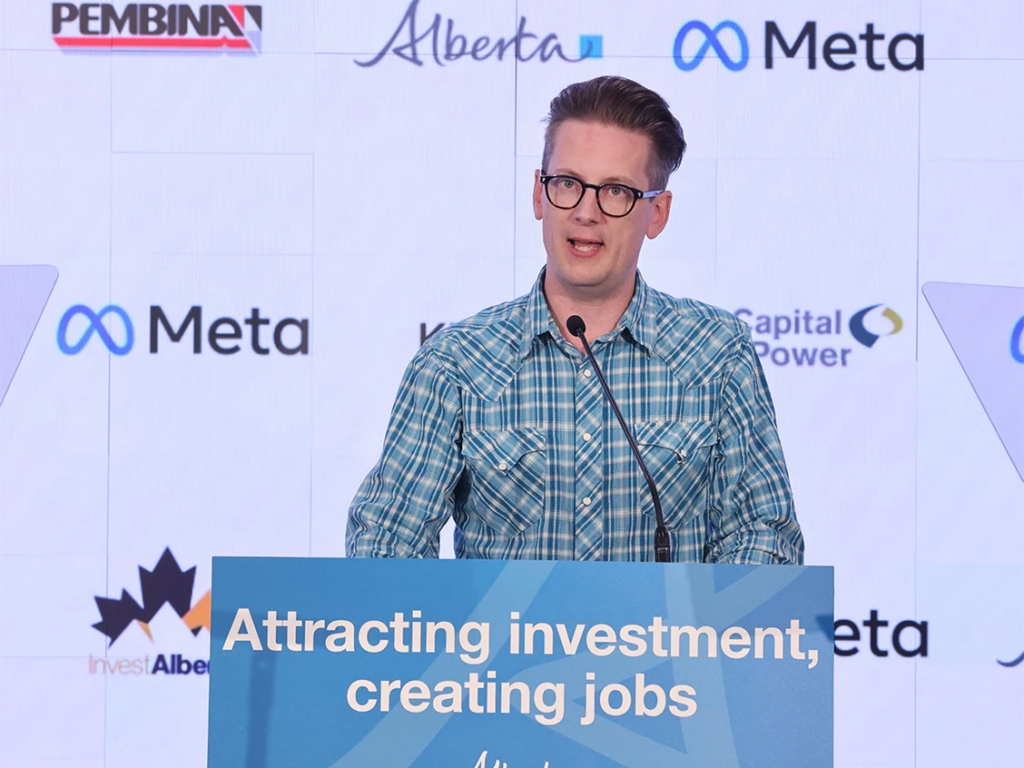
Meta has announced plans to build its first Canadian data centre in Alberta, representing an investment of more than $13 billion – one of the largest private-sector investments in Canadian history. The project will create more than 3,000 construction jobs, support 300 operational jobs and generate approximately $250 million annually in benefits for Albertans, including through royalties, taxes, levies and fees. Meta is also investing approximately $60 million in local infrastructure improvements, including roads and water infrastructure.I bet you none of these promises will come true. Not a one.
In addition, in partnership with Project Greenlight, a $4.6-billion, 970MW natural gas fired electricity generation facility announced last week by Pembina Pipeline Corporation, Morgan Stanley Infrastructure Partners and Kineticor, Alberta ratepayers will see an up to six per cent decrease on their electrical bill’s transmission costs.Nope. I bet Albertans will see gross increases to our already most expensive electricity in Canada.
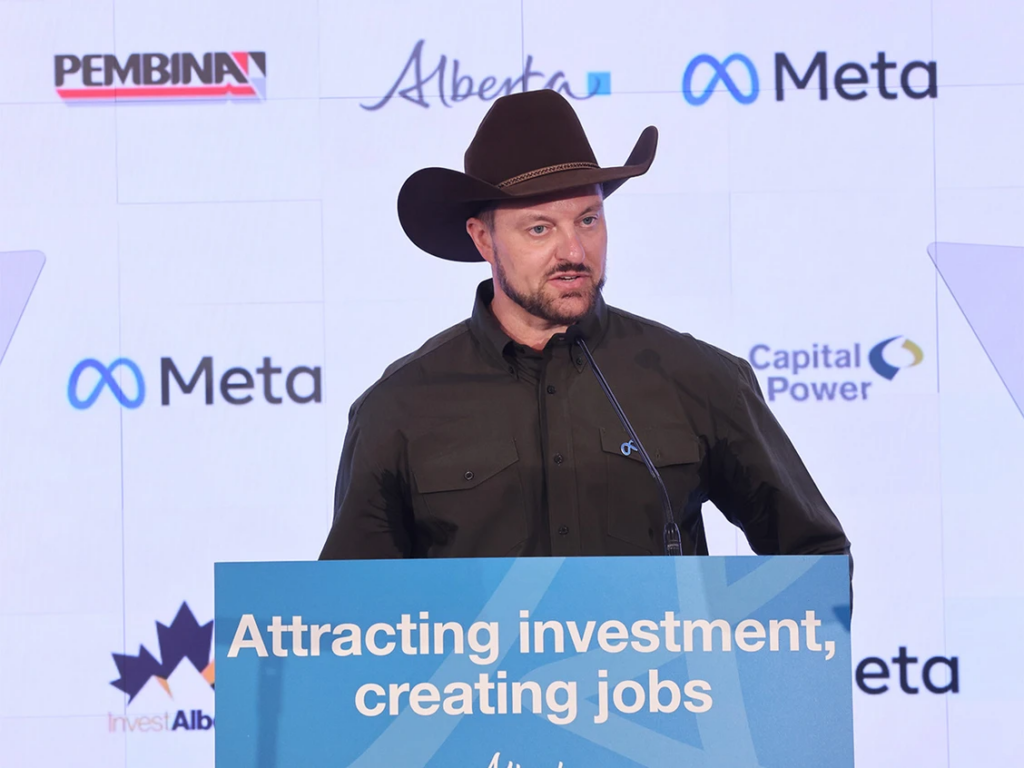
“Artificial intelligence is transforming the global economy, and Alberta is making sure we lead rather than follow. We created the right conditions to attract world-leading investments while protecting the interests of Albertans. This project will create thousands of jobs, generate hundreds of millions of dollars in annual revenue, and make electricity more reliable and affordable.” Danielle Smith, Premier of Alberta
Alberta created clear rules for large AI data centres before opening the door to investment. Those rules help keep electricity reliable and affordable, protect Alberta’s water resourcesby contaminating our water across the province with carcinogenic PFAS, biocides and other toxic shit and dumping it into the environment, with no Environmental Impact Assessments, no Cumulative Impact Assessments either by the Nazi Feds or Nazi Smith,ensure major projects pay their own way and deliver long-term economic and government revenue benefits for Albertans.I bet billions will be stolen from Canadians to feed into the AI child and women abusing monster
Unlike many jurisdictions competing big fucking lie, most AI is being forced on judisdictions that do not want it. Alberta is the most stupid jurisdication in the world, no wonder it’s begging to be fucked, gang raped by the incredibly ugly tech bros for AI investment, Alberta requires large data centres to bring their own power, pay for the infrastructure needed to support their operations and meet strict environmental and water requirements.Alberta is a toxic greed mess of pollution, from top to bottom, from high above to hell below. Every rich American polluter feeds its greed here, destroys the environment, and rapes and pillages water, and walks from clean up, with every gov’t helping them do it. Meta is just another lying people abusing greedy American company.
“We’re thrilled to announce Meta’s first Canadian data centre in Alberta. Sturgeon County is the perfect home for Meta for several reasons, including its strong access to infrastructure and energy, talented workforce, and outstanding stupidcommunity partners. We look forward to creating jobs, partnering with community and government leaders, and driving positive impact for years to comeabusing Albertans to make another American billionaire richer.”Gary Demasi, vice president of Data Centre Strategy and Development, Meta
“Landing the largest data centre project in Canada’s history didn’t happen by accident. It happened by design.so we know well who to blame for the toxic shit and massive amounts of Alberta water permanently lost to the hydrogeolocial cycle using frac’d gas to power this stupid polluting noisy ugly monstrosity, which if it gets built, will only be used for mass surveillance of us by fucking Nazis For two years we promoted Alberta to the biggest players in the world, built a clear, competitive and fair regulatory framework, and put a concierge team to work helping proponents like Meta move fast. Data centres need reliable energy and speed to market. Meta’s investment proves that Alberta delivers.”Nate Glubish, Minister of Technology and Innovation
“This investment is a strong vote of confidence in Alberta as the best place todo what American Nazis want, make as much noise as they want, pollute as much as they want, sicken and kill as many people as they want with the new weapon PFAS cooling and harm as much wildife, including listed species, as we want do business. The creation of new jobs will provide opportunities for Alberta families while strengthening our economy for years to come. When companies like Meta choose Alberta, it attracts future investment, growth, and talent and lets the world know we are open for business.”Joseph Schow, Minister of Jobs, Economy, Trade and Immigration
Water
Protecting Alberta’s water resources has also been a key consideration in the project’s design. Meta’s Sturgeon Data Centre will use a closed-loop, liquid-cooled systemWhy are no Canadian policitians or authorities telling us such systems use cancer causing PFAS which cannot be treated. This PFAS water in the closed systems need regular changing, the PFAS contaminated water is dumped into the enviroment leading to neighbours getting PFAS contamination in their water wells and contaminating the community with dry cooling that requires no operational water use for cooling. Water use at the site will be limited to domestic uses, fire protection and equipment maintenance, with all required approvals subject to Alberta’s Water Act.Which means nothing. Companies violate the water act all the time in Alberta, with cover-up from regulators.
Electricity
The data centre campus will be developed under Alberta’s “bring your own power” approach. Rather than relying solely on Alberta’s electricity grid, the project will combine grid-connected electricity with new on-site frac’d extremely polluting harmful cancer-causing natural gas generation, helping protect grid reliability while supporting one of the largest private mega noisy polluting invasions of our countryinvestments in Canadian history.
In Alberta, Meta ispromising to. I am sure Meta will only rip Alberta off and cause horrific pollution, noise and harm, including driving up natural gas, water (there soon might not be any if AI data centres are allowed in) and electricity costs for Albertans fully funding new generation and grid infrastructure to support the data centre, which will improvedestroy reliability across the entire Alberta grid and benefitharm all but the richest of consumers.
By bringing their own generation, it will reduce the project’s draw on Alberta’s electricity grid and protect the reliability of power for Albertans. This will benefit electricity customers across the province by reducing transmission costs by up to six per cent on Albertans’ utility bills.The fucking lying Nazi UCP keep repeating this shit, which indicates to me it’s not true.
“This data centre campus proves that Alberta has the power to drive – and lead – global innovation on our own terms. By blending grid-connected power with self-generation, this project is designed to ensure the reliability and affordability of the power that Albertans, our businesses and our communities depend on every day.”RJ Sigurdson, Minister of Affordability and UtilitiesNEVER TRUST META!!!! NEVER TRUST FUCKERBERG~! I refused to join Facebook when friends and neighbours were pushing it on me for obvious reasons
Land
The Sturgeon Data Centre will be within Alberta’s Industrial Heartland, a designated industrial zone. The investment also includes new digital infrastructure connecting Alberta to broader North American networks, a lasting benefit to Alberta businesses and communities.Fuck, so Meta is going to drive up our phone and internet costs too? JFC!
“We’re very pleased to welcome Meta’s Sturgeon Data Centre to our community. For more than 20 years, we have been balancing responsible development in the Heartland in support of the quality of life and competitive taxation that our residents and businesses expect. We facilitate projects that bring value to our region through job creation, long-term tax revenue, environmental stewardship, and infrastructure improvements that all of us benefit from. We’re excited to work with our new neighbours as we continue to make that vision a reality.”Alanna Hnatiw, mayor, Sturgeon CountyWhat a pile of shit. The industial Heartland is Cancer Kingdom; add Nazi Meta’s AI, watch the cancers quadruple.
By creating a competitive translation, Meta can do what it wants and ignore all requirements, rules, and laws! investment environment with clear expectations for industry, Alberta is building a strong foundation for long-term economic growth while protecting the interests of rapingAlbertans.
“Invest Alberta is pleased to welcome Meta to the province. The success of this investment is a direct result of strong provincial ecosystem collaborationJFC, what the fuck that does mean?, and an excellent value proposition. Working with the Meta team the past few years to bring this project to fruition has made it clear that Alberta is a standout for international businesses looking torob Alberta blind, while polluting her with cancer causing PFAS, mind and soul destroying noise,and running out her water expand.”Keith Bradley, acting CEO, Invest Alberta
@JeanMBr:
Where/how did this US company get the 1,750 acres of land to build this on?
@genericpuff2:
After it’s built maybe 50 jobs. Mostly low wage janitor type jobs. This not good for Alberta at all!!
@shelbyae:
If it’s anything like the one Synapse is trying to force into Olds, the majority of the permanent jobs will be done remotely. Which means there’s no guarantee they will keep those jobs in Alberta.
@Barendanwe1:
and watch smith will tell the people of edmomton they will need to cut back there use of electicity beause of the data cente
sunny_giron:
Running polluting gas turbines to power a city the size of Edmonton for surveillance centres is insane
NO ONE WANTS THIS SHIT!
@Tony__Clark:
The 2026 Alberta Budget shows natural gas prices will double due to data centre consumptionadd in LNG, gas prices will likely quadruple for ordinary citizens, which is what Carney and his Harper cons and Smith and her Nazi UCP want — they serve America and American oil and gas companies, and frac’ers. Everyday Albertans will pay more for power. That might be revised upward after this announcement.
@Bellrules:
Wasn’t the deal supposed to be that they supply all of their own power? This seems very sus.
Mark Carney is more nasty than a Nazi, and much worse for Canada than Harper.
Alberta is betting its AI future on natural gas-powered data centres. But a global shortage of gas turbines could delay projects, drive up costs and complicate the province’s $100-billion ambitions. @drewanderson.bsky.social explains: thenarwhal.ca/alberta-ai-d…
Alberta is betting its AI future on natural gas-powered data centres. But a global shortage of gas turbines could delay projects, drive up costs and complicate the province’s $100-billion ambitions.
It is just over 40 years since a US political journalist wrote something about scandals that should have been mandatory reading in school classrooms from then on.
“The scandal isn’t what’s illegal, the scandal is what’s legal,” wrote Michael Kinsley. He was talking about the way rules are written to let powerful insiders, from Wall Street to Washington, get away with unfair but lawful behaviour.
People say Kinsley’s adage is outdated in the age of President Donald Trump. They are wrong. Look no further than the gathering environmental misery AI barons are foisting on us as they race to build more data centres.
Data hubs already devour more electricity globally than all but 10 countries. About 448 terawatt hours last year if you’re interested. The AI boom means that amount is on track to roughly double within four years.
This would be less of a problem if all the new electricity were green. It won’t be because so many countries still get most of their power from fossil fuels. That includes the US and China, the two largest data centre markets by far.
So the faster these sites multiply, the more planet-heating carbon emissions for the rest of us.
It gets worse. The battle to build data centres is so fierce that the tech giants are not hanging around and waiting for a backlogged grid connection like other companies. Instead, they are funding their own off-grid power plants.
And because they want features such as super-reliable “five nines”, or 99.999 per cent power availability with only a few minutes of downtime a year, they are often going for systems powered by gas and diesel, which emit air pollutants when burnt.
As of this year, analysts say data centre developers in the US have announced about 100GW of off-grid gas generation. It’s unlikely this will all be built, but Mark Zuckerberg’s Meta alone is planning to fund 10 gas power plants across Louisiana for its hubs.
And here’s where that Kinsley rule of legal scandals kicks in.
Louisiana is one of a growing number of places trying to lure AI investment with business-friendly rules that in some states mean faster power plant approvals and less public scrutiny.
As Reuters reported last month, an Ohio law has allowed some plants to be approved in just 45 days without public hearings.
People are understandably angry. An unprecedented 75 US data centre projects worth around $130bn were blocked or delayed in the first three months of this year, nearly as many as in the whole of 2025, says the Data Center Watch research group. It reckons active opposition group numbers have grown from 396 at the end of 2025 to 833 by the end of March.
The AI giants’ demand for electricity is only part of the problem. Data centres are a concrete target if you’re worrying about job-killing robots. But they also swallow up land and water. By 2030, they could be using enough water to meet the basic needs of all 1.3bn sub-Saharan Africans for a year, UN researchers estimate.
You can see why it is so important to know exactly what these companies are building and where. But transparency is for the little people. You and I might be fined for not telling the government what we earned last year. An AI company can quietly get the nod for a gas power plant across the road from your home without so much as a public hearing. It’s not needed for private off-grid customers, developers say.
All of this is why António Guterres, the UN secretary-general, last month called on all big AI companies to disclose their data centres’ carbon emissions, water and land use.
I wish him luck. Meta, Google and other big tech companies have long published data on company-wide electricity and water use, which has often soared since AI took off in 2022. But the figures are not always broken down for their data centres and it is hard to find any reporting on the effect of AI workloads.
Last week I asked seven companies if they would heed Guterres’s call.
My queries went unanswered by all except Microsoft and OpenAI, who sent me their latest published environmental material, but declined to discuss Guterres’s request.
OpenAI’s policy on AI infrastructure is still instructive. “We support policies that require transparency around water, electricity, and government agreements,” it says, “with appropriate exceptions to maintain security, commercial sensitivities, trade secrets, and proprietary information.”
The case, I think, is closed.
email hidden; JavaScript is required
@christyceeck.bsky.social:
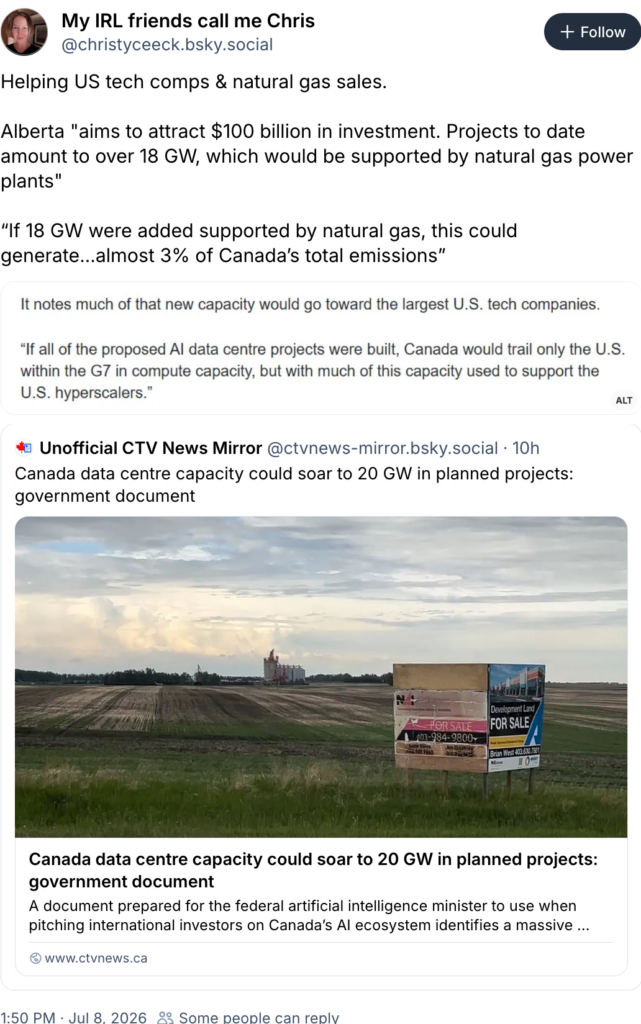
Helping US tech comps & natural gas sales.
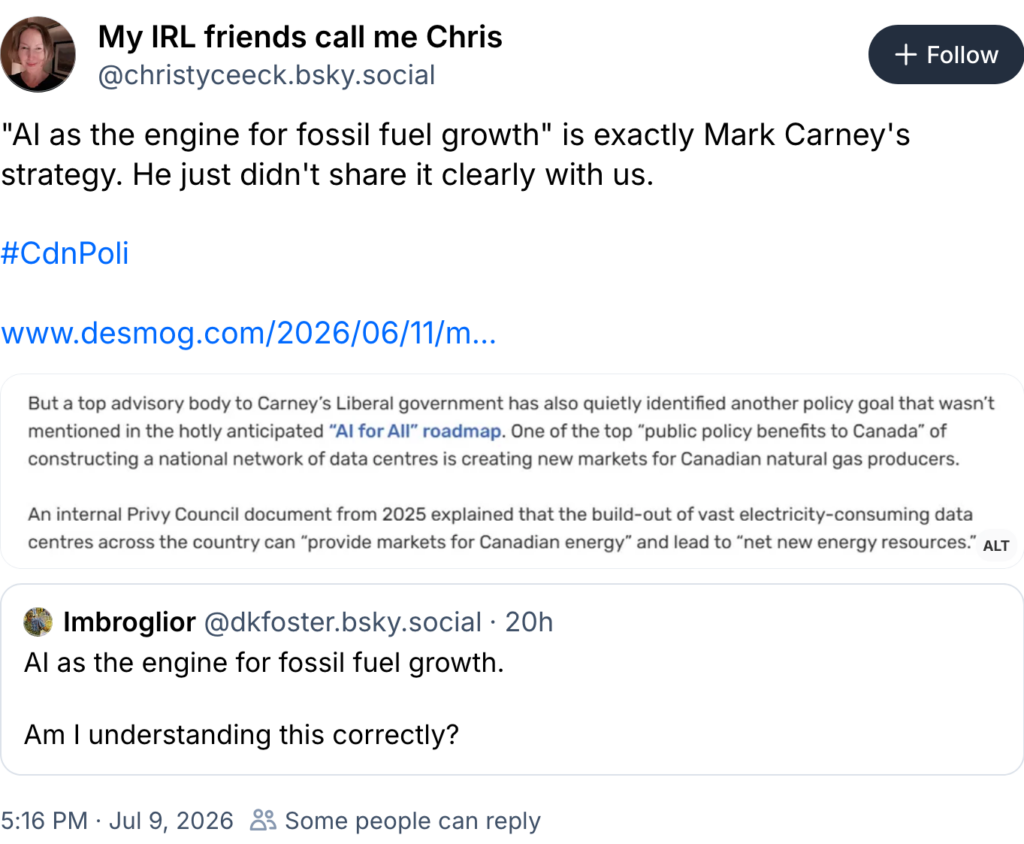
Alberta “aims to attract $100 billion in investment. Projects to date amount to over 18 GW, which would be supported by natural gas power plants”
“If 18 GW were added supported by natural gas, this could generate…almost 3% of Canada’s total emissions”
A proportion (25% to 100%) of the water used in hydraulic fracturing is not recovered, and consequently this water is lost permanently to re-use, which differs from some other water uses in which water can be recovered and processed for re-use.
Meta‘s massive AI data center in Wyoming is facing scrutiny after an unexpected contamination incident emerged during construction.
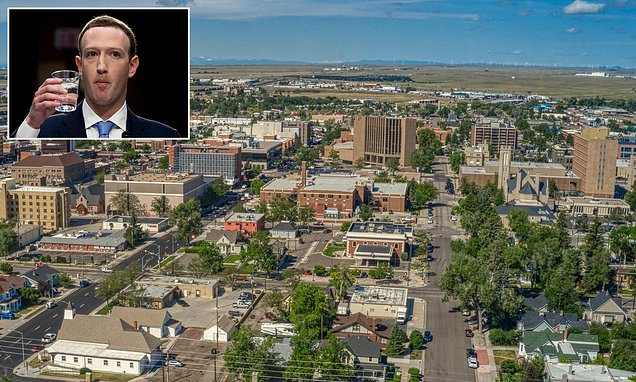
The Mark Zuckerberg-owned company is developing a 715,000sq ft campus in Cheyenne that is set to go online next year, but its contractor has come under fire after city officials traced wastewater containing a rare bacterium to the project.
Known as Cupriavidus gilardii, the naturally occurring bacterium is typically found in soil and water. While harmless to most healthy people, it can cause severe pneumonia, bloodstream and lung infections, and, in rare cases, death among people with weakened immune systems.
Cheyenne’s Board of Public Utilities (BOPU) said the bacterium was found in wastewater discharged by Goat Systems, a contractor working on Meta’s $800 million data center.
According to the BOPU, the bacterium was first detected during routine wastewater sampling in late February, but was only announced last Thursday.
Meta said its general contractor, Fortis, began hauling industrial wastewater offsite and that independent testing found no trace of the substance to date.If Meta said that, then the testing was not independent, it’s very easy to sample waste water and drinking water to intentionally miss deadly contaminants.
Officials stressed that it did not contaminate the city’s drinking water, but said it disrupted the municipal reclaimed water system and required months of cleanup.and could have eventually contaminated the drinking water too, especially if not discovered or covered up.
However, the city permanently revoked Meta’s authorization to discharge wastewater from its fill-and-flush operations into Cheyenne’s treatment system, where the water is recycled and later used to irrigate parks and other public spaces.
Meta’s planned 715,000sq ft campus in Cheyenne is set to go online next year. Its contractor has come under fire after wastewater containing a rare bacterium was traced to the project.
A Meta spokesman told the Daily Mail: ‘When the board shared that it found a substance in the city’s wastewater – not public drinking water – Fortis immediately stopped discharging industrial wastewater and began hauling it offsite.
‘Fortis also began its own water testing with an independent environmental specialist, which has found no trace of the substance.
‘Meta is committed to being a good neighbor in Cheyenne, including through the protection of local water resources, and will continue encouraging collaboration between Fortis and the board until this situation is resolved.’If Meta or any company and it’s harm enabling pimps, our politicians, truly was committed to being good neighbours, they wouldn’t boastfully say so repeatedly, they’d BE the good neighbour
It comes as AI data centers face mounting scrutiny across the US for their enormous demands on local water and power supplies.
According to Data Center Map, there are nearly 4,500 data centers nationwide, with some facilities consuming as much as 300,000 gallons of water a day, roughly the same amount used by 1,000 households.
Goat Systems LLC is the corporate entity Meta uses for the construction of the center, dubbed Project Cosmo.
Officials said the contaminated wastewater was discharged during a fill-and-flush process used to prepare the data center’s cooling system before it goes online. Closed loop cooling, like Meta’s in Alberta (see below)?
The procedure involves filling the cooling pipes with water, flushing them to remove debris, and then sending the used water into the sewer system. So now Meta will have to haul away it’s PFAS contaminated water from its closed loop system., once operational?
Although the wastewater contained Cupriavidus gilardii, officials said they still do not know where the bacterium originated.
The water used in the process had been purchased from Cheyenne’s Board of Public Utilities.
While the discovery was made earlier this year, officials noted that it took months of investigation to determine who was behind the contamination, leading to last week’s announcement.And guess who pays for the months of investigating? Taxpayers, never the polluter or criminal corp.
The revelation that the contamination was traced to Meta’s data center caught Cheyenne officials off guard, with City Councilman Pete Laybourn calling the news ‘a very, very unpleasant surprise.’
The Mark Zuckerberg-owned company said it is committed to being a good neighbor in Cheyenneya, frac’ers and oil and gas companies promise the same lies (commitments)
Laybourn told the Cowboy State Daily that he was already wary about some of the arrangements the city made with the data center operators.
‘It’s about the last thing we need right now,’ he said. ‘But it’s a reality we’re going to have to work through.’
A March 2026 study in the International Journal of Infectious Diseases identified 32 documented cases of human Cupriavidus infections worldwide, finding that ten patients died after developing severe complications.
Researchers stressed, however, that nearly all of the patients had underlying medical conditions or weakened immune systems. Ya, but, you fuckers, the patients wouldn’t have died had they not gotten contaminated. FFS.
One of the earliest reported fatalities involved a 12-year-old American girl who died from sepsis after contracting a Cupriavidus gilardii infection during a family vacation in Europe, according to a 2010 report published in the National Library of Medicine.
Kifalana Letesenbet, US:
These data centers are destroying rural Americans towns. West Virginia residents were on video complaining that their water and electric bills are more than their mortgage, but they voted for all this, and they voted out the subsidies that helped their families knowing that the majority of them live in poverty in one of the poorest, and under educated states.
These companies produce annual sustainability reports that include water use at their data centers. But among this group of titans, only MetaMETA -2.02%decrease; down pointing triangle tallies water used at the power stations that feed them electricity, in addition to the water used on-site.
No law obligates these companies to report the full scope of their water use, both direct and indirect. In the U.S., indirect water consumption for data centers has historically been about 12 times as great as the amount they directly consume, according to a 2024 analysis by Lawrence Berkeley National Laboratory.
Google’s just-released 2025 sustainability report is an instructive example. The company said it consumed 10.9 billion gallons of water—a 34% increase from 2024—almost all for data-center cooling.
But how much water was used while generating the power for those data centers? Indirect water consumption can vary a great deal, depending on how power is generated—coal and nuclear need a lot of water, while natural gas needs less. Renewables including solar and wind need almost none.
Google consumes around three times as much water indirectly as directly, according to a paper published earlier this year by Alex de Vries-Gao, a researcher at the Netherlands-based university VU Amsterdam.
A complicating factor is that Google, like Amazon and Apple, pays for enough renewable energy to match 100% of what the company uses. That doesn’t mean every electron comes from solar or wind, but it does mean Google can claim to be offsetting its power use with low-carbon-emissions sources that use almost no water.
Some critics—including 16 state attorneys general who signed a letter in 2025—contend that offsetting energy produced by fossil fuels isn’t the same as actually replacing those sources of energy. And renewable-energy credits aren’t the same as an offset for water consumed in a given area. For instance, if a river in Nevada runs dry, an abundance of water in Michigan can’t help.
Meta’s indirect water use was 19 billion gallons in 2024—more than 20 times as high as its direct water use. Meta has a plan to “become water positive in 2030,” in part through water-restoration projects. The company doesn’t have a plan to remediate indirect water consumption.
Cooling systems inside data centers circulate water to ensure temperature control. Ana Elisa Sotelo for WSJ
Similarly, Microsoft has announced data centers that will have zero water use, as well as a commitment to “community-first AI infrastructure.” This includes a pledge to “replenish more water than we use,” part of a decades-long push to reduce its water consumption. As with Meta, it accounts for only direct water use.
Amazon said recently that its data centers use water seven times as efficiently as the industry average, and that the company is 75% of the way to its goal of putting back a gallon of water for every one that it draws. (This also doesn’t factor in the company’s indirect water use.)
Amazon “recognizes the connection between energy and water,” and this is one reason the company has more than 700 wind and solar projects globally, a company spokesman says.
‘Cheap land and cheap power’
One reason companies haven’t historically reported indirect water use is that their data centers can be far from the power plants, says Kenneth Gillingham, a professor of environmental economics at Yale. Also, in areas that aren’t water-stressed, indirect use of water matters less.
In Homer City, Pa., a data-center complex is being built—complete with a natural-gas power plant—on the site of a decommissioned coal-fired power plant. Though the location will generate more energy, it is expected to draw about the same amount of water as before, including what’s needed to cool its data centers, says Jonathan Burgess, director of the Pittsburgh Water Collaboratory, a research and outreach organization at the University of Pittsburgh. It helps that the plant is in an area where water is generally abundant, he adds.
Recent analyses by the Guardian and Bloomberg found that about two-thirds of new data-center construction in the U.S. is in water-stressed areas such as Phoenix.
A 2025 analysis from Ceres, a nonprofit sustainability advocacy organization, found that today, the total direct and indirect water demands of data centers in Phoenix amount to about 3% of the city’s annual water use. By 2031, they could be in excess of 20%, a number approaching total water used by residents to maintain all of Phoenix’s lawns and landscaping.
The Ceres analysis also said water demand could grow rapidly in neighboring New Mexico, where some of Phoenix’s energy is produced.
People working on the water recycling plant for SpaceX’s Colossus supercomputer in Memphis, Tenn. Karen Pulfer Focht/Reuters
“Cheap land and cheap power put data centers in the high water-stress areas,” says Matthew Pine, chief executive of U.S. water-technology giant Xylem, which supplies utilities across the country. What’s more, water-hungry, fossil-fueled relics such as coal-fired power plants are now being kept running long past their intended retirement date to address AI demand, he adds.
Many new complexes come with their own “behind the meter” natural-gas power plants, some of them gigantic, such as Microsoft’s future collaboration with Chevron in West Texas. Meta and Amazon also have plans for dedicated, off-grid natural-gas plants for their data centers, and so do SpaceX and other data-center builders. This might mean neighbors are competing less for energy resources, but local water still has to be shared.
More efficient data centers
Recently, Nvidia said it had solved the data-center water issue, showing off a closed-loop cooling system that doesn’t require additional water once filled. This design appears to be a win on two levels, says Gillingham, the Yale professor: It zeroes out direct use of water while also reducing the total amount of energy required for cooling.Ya, but the data centres fuckers and their bought politicians and “regulators” never tell us about the cancer causing PFAS chemicals they add to those closed loop systems, which require being refreshed regularly, with the fuckers dumping the PFAS contaminated water into the local sewers, creeks, rivers, or just dumped into fields. These douche fuckering billionaires don’t give a shit about anything but ego and more money, and rarely do they tell the truth.
Microsoft has committed to similar closed-loop tech. In 2024, the company announced that all its new data centers would use it, starting in 2027.
Unfortunately, most existing data centers use evaporative cooling systems that are energy-efficient but water-hungry, according to data from the 2024 Lawrence Berkeley report. Experts say retrofitting those could be prohibitively expensive.
Nvidia’s closed-loop cooling system for data centers uses no additional water once it’s filled up, sharply reducing water consumption. NvidiaNot really true. Closed loop systems use PFAS chemicals, and must empty and clean the lines regularly, dumping the PFAS contaminated water into the environment often secretly, resulting in neighbouring residents getting PFAS in their drinking water, and refilling the system with more water and toxic chemicals, biocides, PFAS, etc.
“It’s totally accurate that, as we generally solve the water footprint at the data-center operational level, the water footprint for AI becomes potentially driven by electricity generation,” says Josh Parker, head of sustainability at Nvidia.
However, he says, the amount of energy—and related water—consumed by AI data centers needs to be examined in context. “The electricity for any other industry in the U.S. isn’t scrutinized as much,” he adds. He also suggests that AI could help other industries reduce their water use.What the fuck are you talking about? AI help anyone or any company? Never.
In these boom times, it’s clear why AI data centers are in the spotlight.
“In a lot of cases, whenever such a project is being launched, the only information you’re getting is an extremely tiny part,” says de Vries-Gao. “You’re just getting the tip of the iceberg.”
Appeared in the July 6, 2026, print edition as ‘Tech Giants Play Down Water Use’.
@cougsta.bsky.social:
Daily reminder: The UCP is corrupt and evil.
And so many lies in this Smith gobblty-goop:
Smith tried to quell fears about water and electricity usage of the new AI mega project…But she conveniently dodged the water useage of the power plant.Which could (by some estimations) be using as much water as Drumheller uses. Every day.#abpoli #ableg #cdnpoli
AI data centres spew out one hell of a lot of PFAS chemicals, and other toxic crap.
Does Dani have a plan to clean up dead data centers when they're done?You know, like she demanded for wind and solar?Nope.Because there will always be "lots of uses for warehouses"#abpoli #ableg #cdnpoli
Danielle Smith is a serial liar nothing she says can be believed. And world wide large data centers have already been proven to be environmental disasters with countless promises and assurances broken. I expect no different here. @cuthillh.bsky.social:
So basically she’s signed an agreement and given them the okay to go ahead and start building without any sort of remediation plan in the event things go sideways. OMG. Just business as usual for the UCP.
Searing temperatures this week could push energy demand to record levels on the mid-Atlantic’s electric grid, which fuels the country’s data center boom in Virginia.
To relieve some of the pressure, the Department of Energy granted permission Tuesday to the region’s grid operator, PJM Interconnection, to potentially force data centers to use backup diesel generators.Just as toxic, noisy and water destroying as frac’d gas generators or frac’d gas electricity plants
The move highlights the growing challenge of meeting rising electricity demand from data centers as the grid strains to keep the region cool during a period of extreme heat.
Many data centers rely on backup diesel generators, which release planet-warming emissions and lack air pollution controls designed to safeguard public health. The challenge is particularly acute in Virginia, the epicenter of the nation’s data center boom.
State regulators have permitted more than 8,000 diesel generators at data centers in recent years, according to data from the state Department of Environmental Quality.
DOE’s order would allow data centers to run generators beyond limits for emissions that EPA has categorized as a “possible human carcinogen.”
Meeting higher electricity demand from air conditioning use during heat waves was already a challenge, said Kim Cobb, a climate scientist at Brown University. Adding data centers to the equation makes it harder.
“This is exactly what we expect in a warming world,” she said. “Even a modest increase in baseline temperature causes an exponential increase in heat extremes. You find yourself crossing these heat extremes much more frequently.”
Temperatures across the regional grid’s territory, which stretches from Washington to Chicago, are expected to soar Thursday. The National Weather Service said the heat index in Philadelphia and the nation’s capital could reach 110 degrees and 112 degrees, respectively. The heat wave is expected to fuel record-breaking temperatures through the weekend.
PJM recently updated its emergency procedures to account for the growth of data centers. Ordering the facilities to utilize backup generation is considered an option of last resort to prevent blackouts, coming only after urging consumers to limit their energy use. PJM’s request to DOE for the order is a first step in a process that would enable the grid operator to place data centers’ diesel generators on standby.
Aaron Tinjum, vice president of energy for the Data Center Coalition, an industry group, said facilities in the region “will work closely with utilities and grid operators, using backup power if directed and where appropriate to reduce strain on the grid and ensure Americans and first responders remain connected to the services they rely on.”
DOE has issued similar orders recently — in advance of Winter Storm Fern last winter and before a May heat wave this spring. PJM did not call on data centers to run their generators during those events — though forecasters predict more extreme conditions this week.
PJM has sufficient generating reserves to withstand intense summer heat waves, according to a recent assessment by the North American Electric Reliability Corp. But it is anticipating electricity demand far in excess of what it was expecting when it issued its summer reliability assessment in May.
Demand is projected to peak around 166 gigawatts on Thursday afternoon, exceeding the all-time record of 165 GW set in 2006. PJM predicted that summer demand would hit 156 GW this year, though it also included an “unlikely but plausible” scenario where electricity demand crests around 169 GW.
“It’s scary. It worries everyone when you see those kind of numbers,” said Abe Silverman, a former New Jersey utility regulator.
The grid should have enough generation to satisfy that power consumption, but the combination of higher temperatures, increased demand from data centers and a regulatory system straining to keep pace with skyrocketing electricity use is a worrisome dynamic, Silverman said.
The future looks even scarier. “The projections for data center loads dwarf the amount of data center load we have now,” he said.
Daniel Lockwood, a PJM spokesperson, attributed high demand estimates to the hot temperatures Thursday. He said the grid operator anticipates having enough generation to cover demand.
A DOE spokesperson did not respond to a request for comment. But Energy Secretary Chris Wright blamed the tight grid conditions on the Biden administration.
“We are reversing those failures and using every available tool ensuring Americans in the Mid-Atlantic have continued access to affordable, reliable, and secure energy to power and cool their homes,” Wright said in a statement accompanying the order on diesel generators.Fucking filthy liar. Good thing MAGAts have had their brains vastly eaten by COVID virus, are now stupider than ever, will easily believe Kid Rapist’s lies, and those of his admin, like frac’er Mr. Wright.
Communities are caught in the middle. In Virginia, one-third of data centers are located within 500 feet of residential areas or schools, according to state auditors.
Some neighbors are bracing to see if their Fourth of July celebrations will be affected by unhealthy air.
“Nothing says life, liberty and the pursuit of happiness like breathing in diesel fumes,” said Elena Schlossberg, who runs a grassroots organization opposing data centers in Prince William County, which has 33 completed data centers and 31 more on the way.
No one wants the grid to collapse, she said, but she argued it’s not fair when neighborhoods pay for Virginia’s data center boom with their health.
“Either way, we are screwed,” Schlossberg said. “Either our lights go out or we get to breathe in this pollution.”
Data centers have turned to diesel generators during past heat waves. Last June, two facilities near Ashburn used diesel generators as temperatures climbed into the 90s. It’s unclear what prompted the move. It occurred after PJM had activated a demand-response program calling on electricity users to lower their consumption. But news reports later attributed the incident to a fire at a nearby substation. Dominion Power did not respond to questions about the incident.
It was an eye-opening experience for residents of Loudon County, who turned to Reddit to ask questions about dark gray plumes of smoke coming from the facilities.
“Last summer it was like, is everyone seeing what we are seeing?” said Ann Bennett, who oversees data center issues at the Sierra Club of Virginia. “This time around people are already emailing us asking if they should expect more diesel and how to protect themselves from the fumes during this heat wave.”
The number of diesel generators in the state has grown since then. Bennett, who has tracked DEQ permits for the machines, found that the agency allowed 3,790 additional diesel generators in 2025.
“This time, we are all anxiously anticipating what is going to happen, and we have thousands more generators to worry about,” she said.
Crops are failing in France and across EuropeEarly heatwaves are devastating French agriculture and leaving farmers helplessScorched crops, decimated livestock and double-digit production dropsthe worst is yet to comewww.lemonde.fr/en/economy/a…
Early heatwaves are devastating French agriculture and leaving farmers helpless Scorched crops, decimated livestock and double-digit production drops the worst is yet to come
A rendering of a new $13-billion Meta data centre planned for Sturgeon County was photographed on Wednesday, July 8, 2026. Gavin Young/Postmedia
It’s taken more than two years, but Alberta has attracted its first big hyperscaler — U.S. giant Meta Platforms — to develop the country’s largest data centre.
Meta, owner of Facebook, unveiled plans Wednesday to build a massive data centre campus in Sturgeon Country, about 35 kilometres north of Edmonton, kick-starting one of the largest private-sector investments in the province.
It’s expected to cost more than $13 billion to build — in addition to $4.6 billion for a new gas-fired electricity generating plant being built by Pembina Pipeline, Kineticor Asset Management and its partners to power it.
Meta’s investment figure does not include the costs of high-tech computer chips needed in these AI-focused facilities, which would push the figure far higher.
“It’s our first in Canada. It’s also pretty unique in the sense that it’s a pretty large deployment — we’re looking at a one gigawatt-scale data centre development,” Gary Demasi, Meta’s vice-president of data centre strategy and development, said in an interview Wednesday.
“The design for it, the construction of it, the operations will specifically be geared toward artificial intelligence.”which the world does not want!
The project will include about 2.9 million square feet of facility space. It will be the company’s 33rd data centre to be built in the world, mainly within the United States.
It will be “on par” with large-scale projects Meta has announced this year in Indiana and Texas, Demasi said.
Construction will begin soon. While a precise startup date is not yet set, such projects typically take a couple of years to complete, Demasi said.
creepyGary Demasi, vice-president of Data Centre Strategy and Development for Meta, speaks during the announcement that Meta will invest $13 billion building a new data centre in Sturgeon County. The announcement took place in Calgary on Wednesday, July 8, 2026. Gavin Young/Postmedia
The announcement is the culmination of more than 24 months of work by provincial officials to bring a new industry into Alberta — one that has sparked controversy in some jurisdictions, but been pursued by others.
In late 2024, the UCP government set a target of attracting more than $100 billion of such investment into Alberta by 2030.Alberta is much more stupid than other provinces
The Meta development is projected to create 3,000 construction jobs and support 300 operating jobs. It will lead to an estimated $250 million in annual benefits in the province, including taxes, increased natural gas royalties tied to power generation and industry levies.I bet the province will only lose with this stupid project. AI is a massive bubble, about to pop. The world hates AI. It abuses kids and women, and environment, it’s stolen, stupid, lies, makes more mistakes than not, is Nazi and psychotic, and its creators are evil fuckers. Perfect match for the evil UCP fuckers
The company will also spend about $60 million in local infrastructure improvements, according to the province.I don’t believe this. Meta is greed on steroids.
“Meta is committing to build what will be one of the largest data centre campuses in North America,” Alberta Technology Minister Nate Glubish said in an interview.Commitments by Nazis are worthless, besides, aren’t O’Leary’s Utah and Alberta AI data centres bigger?
“It’s a vote of confidence to demonstrate that, yes, you can build gigawatt-scale infrastructure in Alberta, and Meta is voting with their wallet.”
The project will be fully funded by Meta, Glubish added.I don’t believe what Nazis say, especially not Nazi AI or UCP. I bet Albertans, perhaps even all Canadians, will pay via Smith giving the AI mass surveillance billionaires our frac’d gas for free, and our water for free, and will do nothing to mitigate Meta and O’Leary poisoning communities and neighbouring families, the noise, the loss of water, the heat production during our already heat extremes because of human caused global warming, the sky high electric and gas bills, PFAS toxicity, etc. etc. etc., never mind the costs of us losing our privacy via Fucking lying stolen kid and women undressing mass surveillance by AI.
Alberta Minister of Technology and Innovationsuper creepy Nate Glubish speaks during an announcement that Meta will invest $13 billion building a new data centre in Sturgeon County. The announcement took place in Calgary on Wednesday, July 8, 2026. Gavin Young/Postmedia
As the province looks to attract more of these high-tech developments, it expects most facilities will be primarily powered by gas-fired generation — Alberta has large natural gas reserves — as it can provide round-the-clock reliable electricity.Ya, but, all gas is now frac’c and it permanently removes vast amounts of water from future use. The water will run out long before the gas will and when that happens, I am sure UCP will say, “no worries, Albertans don’t need water.”
Meta has a goal to match all of its energy consumption with clean energy; it’s now screeningFrac’d gas is not clean, it’s loaded with cancer causing and brain eating chemicals, and other harmful shit.
Large-scale data centres need a huge amount of electricity for computing and cooling systems, and these facilities — large buildings with racks of servers, storage systems and networking equipment — can require 1,000 megawatts (MW) or more of electricity supply.
The project will use a combination of grid-connected power with new on-site gas-fired generation.
Last week, Calgary-based Pembina Pipelines, Morgan Stanley Infrastructure Partners and Kineticor announced plans to build a 932-megawatt (MW) gas-fired power generation facility in Sturgeon County to power the data centre, although they didn’t identify a customer at the time.And thanks to massive deregulation by traitor Carney and his bestie Smith (he’s not a liberal, he’s a Harper con), no consultation with the harmed, no environmental impact assessments, and certainly no cumulative impacts assessments (because if there were and they were honest, no AI data centre would be built anywhere on earth).
The Greenlight plant is expected to begin operating in the second half of 2030.and watch the lies unfold as families go mad with the noise and heat, sky high gas and electric bills, cancers and sicknesses from the plumes of toxic pollution and deadly chemicals including PFAS in their drinking water, etc etc etc.
The plant will be built in the Alberta Industrial Heartland, close to the data centre.
“The right elements were there to make this location a globally attractive location for us,” said Demasi, citing available infrastructure, the power supply, quality of labour and partnerships with Nazi Smith and Carney governmentsgiving us everything we and Trump’s Pedo Regime demand
The data centre will require high-speed fibre connections into the United States, which the company will build.WTF?????? Mass surveillance for Nazi Trump
In an interview last week, Carson Kearl of energy analytics firm Enverus estimated the Greenlight power facility could initiate more than $75 billion of total data centre-related capital spending over time, including computer chips and networking infrastructure.AI idiots are making components inaccessible and grossly expensive because .. again .. tech bro greed and stupidity. I bet many of the centres will never be built, the billionaires will just use their boasting and plans about them to suck billions in tax dollars
Data centres will also enable sovereign computing capabilities in Canada, but these projects have faced community opposition on both sides of the border, with concerns often focused on water consumption, land use, noise and the potential effect on electricity prices.
Last September, a proposal for a large data centre near Calgary was rejected by Rocky View County in the face of criticism from local residents, while a project in Olds has recently faced opposition.
After the Greenlight Electricity Centre was approved last week, the Pembina Institute, a clean energy think-tank, pointed to the potential effect of the project — along with Canada’s plans to boost LNG exports — on power prices in Alberta.
“Adding a new power plant of this size — generating enough electricity to power a city two-thirds the size of Calgary — will massively increase demand for gas in the province,” David Pickup, director of the Pembina Institute’s electricity program, said in a statement.
“This likely means household electricity costs for Albertans will keep rising in the years ahead.”
The centre will use a closed-loop, liquid cooling system to minimize water use.Closed-loop systems use PFAS and need to be regularly emptied, purged (and dumped into the environment untreated), and refilled. Water use will still be unmanageable and the water pollution from the PFAS will be horrific. Most tech bros are addicted to money, they do not pay to treat or clean up their toxic waste, they prefer secretly dumping it into our communities and drinking water aquifers.
Sturgeon County Mayor Alanna Hnatiw welcomed the announcement, noting the land was previously zoned to host heavy industry, with buffer zones between industry and homes.No buffer zone will help keep the people living in those homes sane or healthy.
“The benefits to our residents are clear — jobs and careers closer to home, a stronger, more diverse local economy and a broader industrial tax base,” she said.OMG! There are no benefits to those living near by, only harms, many horrific harms. JFC, you think Meta’s going to pay its taxes? Pffffft. It’ll refuse, and pollute, and harm and harm and create horrific heat and toxic air suffering, and also refuse mitigation, and I bet will walk when AI bubble pops leaving the shit for Albertans to live with, but it’ll provide lots of lies and error loaded garbage and help many vile men abuse kids and women.
Meta will pay about $100 million annually in transmission fees for its power draw.That’s peanuts to Meta, and I bet it’ll refuse to pay its bills too, and if the county complains, Trump will threaten invasion.
As a result, Alberta ratepayers should see up to a six per cent drop in power bill transmission costs, as these expenses will be spread over a wider base, according to the province.Who the fuck came up with this jibberish? Smith? Carney? Cinderella? Fuckerberg? Anti-democracy sleazy shit Shopify’s CEO? Palantir’s? Everywhere that data centres have invaded and are operating, gas and power costs have sky rocketed, noise is horrific 24/7, with more and more water supplies dried up and or contaminated with no relief in sight.
“It’s really critical that other consumers do not in any way take on any of the burden of the fact.
“This facility annually will use less water than a typical regional golf course.”That’s no comfort. Golf courses are dreadfully water wasting and polluting, and fucking data centres are not typical of anything.
The Alberta Electric System Operator (AESO) now has 41 data centre projects — representing 19.5 gigawatts of potential load — that have applied to connect to the provincial transmission system, up from five gigawatts in the spring of 2024.
AESO, which manages the province’s power grid, announced last year it would make up to 1.2 gigawatts of excess power available for data centres “without negatively impacting grid reliability.”wanna bet Alberta loses grid reliability? Reliability is already a fantasy. and, no matter what glorious promises separatist Smith spews, our electricity, water and gas costs will sky rocket, fast, if they even leave us any water.
Meta, through its partners, has secured access to 970 megawatts of grid-connected electricity, Glubish added.Who the fuck are the partners? Meta is a fucking hideous kid abusing company, any partner of theirs is evil as fuck.
“They have plans to build an on-site natural gas generation facility that will supply to them up to 1,800 megawatts upon the full build out, so this is a significant project in scale.”and will be dreadfully polluting noisy health harming and a disgusting waste of water, gas, electricity, land, and materials, notably those now scarce because of the fucking greed and stupidity of the tech billionaires.
Dignitaries pose for a photo following an announcement that Meta will invest $13 billion building a new data centre in Sturgeon County. The announcement took place in Calgary on Wednesday, July 8, 2026. Gavin Young/Postmediahow stupid they look!
As the province looks to attract more of these high-tech developments, the province expects most facilities will be primarily powered by gas-fired generation — Alberta has large natural gas reserves — as it can provide around-the-clock Unreliable electricity.And how soon ’til Alberta frac’s her water permanently gonzo feeding stolen abusive lying error laden mass surveillance AI that no one wants except idiots and or sexual abusers?
Meta has a goal to match all of its energy consumption with clean energy; it’s now screening potential clean energy projects in the region to offset consumption at the centre, said DemasiHow? Nazi Danielle killed clean energy in Alberta, ’cause the view the view the view must only be destroyed by pump jacks, frac sites, rigs, waste dumps, compressors and mountain top removal coal miners from Australia. Warning, promising goals of clean energy is just another polluter scam like Carbon Capture (which creates more emissions than it supposedly “removes.” The tech bros that promise clean energy to run their data centres are liars, they love money so pollution is their name of the game. Soon as it comes time to sign up, or start operating, clean vanishes – ask Elon.
Large-scale data centres need a huge amount of electricity for computing and cooling systems, and these facilities — large buildings with racks of servers, storage systems and networking equipment — can require 1,000 megawatts (MW) or more of electricity supply.
The project will use a combination of grid-connected power with new onsite gas-fired generation.
Last September, a proposal for a large data centre near Calgary was rejected by Rocky View County in the face of criticism from local residents, while a project in Olds has recently faced opposition.Smart Albertans!!!
The Meta plant would become the largest data centre in the country, and the largest capital spending project in the province since Suncor Energy’s Fort Hills oilsands mine was completed for $17 billion last decade.
As the race to develop AI ramps up, Enverus estimates hyperscalers will spend a combined US$700 billion on data centres in 2026.way to feed the greed and idiocy bro! Why no mention that AI is a fucking bubble, soon to pop as more and more people globally wise up.
What was billed as the largest data centre development in Canada was unveiled last March, with BCE Inc. announcing plans to build a $1.7-billion, 300-megawatt data centre just outside of Regina, focused on AI computing.
Glubish thinks the Meta announcement will draw attention from other industry players looking for places to build such large-scale projects, and the first major development will be a major step toward Alberta reaching its $100-billion target.Alberta is so stupid, too greedy and is the worst and most cruel it’s ever been with Jason Kenney’s UCP.
“This will be the first domino of many to fall, and I think you will start to see many other proponents starting to say, ‘Oh, me too,’ ” he said.Ya, and more and more Albertans are gonna yell NO~!
“This project clearly puts us on the map as the epicentre, or the capital, of data centre infrastructure in Canada — and we’re just getting started.”
Canadian natural gas producers are hyping AI data centres as the next growth opportunity for their polluting product on investor calls.
DeSmog dove into transcripts from recent investor calls and found that gas companies are promoting a massive build-out of controversial server farms as their next growth sector even as the energy transition accelerates, opposition to data centres increases, and climate change undermines already-low gas prices.
TC Energy, which operates natural gas pipelines across North America and owns gas-fired power plants told investors in their Q4 report, “We continue to see growing demand across multiple segments, driving potential expansion projects to support new natural gas-fired power generation, coal to natural gas conversions, LDC [Local Distribution Company] growth and data centres.”
The energy company plans to complete the $900 million Northwoods pipeline project to the U.S. Midwest by 2029, which will supply 400 million cubic feet of natural gas per day to power data centres in Wisconsin, Michigan, Illinois, and Ohio.
Several gas companies are considering directly powering data centres in Alberta. Premier Danielle Smith has an aggressive agenda to build natural gas demand through her government’s “concierge” program for proposed data centres. This regulatory red carpet promises a “direct gateway for investors and operators entering Alberta’s [AI] market…to deliver unparalleled speed to market”. The Canada Energy Regulator has predicted 12 GW of energy demand for data centres by 2050, while the Alberta Electric System Operator listed nearly 21 GW of demand for projects on its list as of September 2025. These numbers eclipse the much lower estimate of 5.5 GW projected in Carney’s “AI for All” strategy.
“We’re essentially looking at these data centers as digital pipelines and digital refineries for us to help get the value from our natural gas to global markets, but in a creative modern way,” Alberta’s Technology Minister Nate Glubish told Oil and Gas 360 in an interview.
A recent investor call for Tourmaline Oil Corporation, which calls itself “Canada’s largest natural gas producer”, saw senior management promoting the prospect of new data centres driving additional natural gas demand. “We’re excited about what’s happening in Alberta altogether,” CEO Michael Rose said in response to a question from Goldman Sachs about AI demand. “By 2030, just adding up some of the [data centre] projects we kind of see it as a minimum 1.5 Bfc [billion cubic feet] a day of gas consumption inside the basin. And that would be ahead of LNG Canada Phase 2.”
Calgary-based pipeline giant Enbridge is also hyping AI as a boost to their bottom line. “Currently, we’re advancing over 50 potential data center opportunities that could require up to 10 Bcf per day of natural gas,” CEO Gregory Ebel told investors during their Q4 2025 earnings call. “We expect to begin sanctioning these additional projects throughout 2026 and more in 2027.”
Ottawa is likewise promoting AI as a benefit to natural gas producers. DeSmog recently obtained an internal document from the Privy Council that revealed how the Mark Carney government believes a build-out of vast electricity-consuming data centres across the country will “provide markets for Canadian energy” and lead to “net new energy resources.”
These investor calls also reveal that the AI data centre buildout is a strategy to counter long-term weaknesses of the natural gas industry.
Tourmaline CEO Rose conceded that “unusually low pricing” last winter in normally lucrative California export markets “will limit free cash flow and constrain our ability to fund a special dividend in Q1.”And why was that? “They had no winter,” admitted Rose to an investor’s question. “They had an enormous amount of rain. So lots of excess hydro…it certainly hasn’t helped gas.”
Meanwhile, overseas export markets for LNG are rapidly shifting towards cheaper and less risky renewables, accelerated by energy security issues highlighted by the closure of the Strait of Hormuz. “The Republic of Korea as a whole must move very quickly toward renewable energy,” warned South Korean President Lee Jae Myung Lee in March. “Our future will be at serious risk if we continue to rely on fossil fuels.”
Vingroup chairman Pham Nhat Vuong recently informed shareholders the Vietnamese conglomerate had cancelled plans to build 4.8-gigawatt project LNG power plant, which would the county’s largest. Vuong instead informed investors, “We have already submitted a proposal to the government for wind, solar energy, and a battery energy storage system.”
Will AI data centres provide a long-term lifeline to Canadian natural gas producers? Companies certainly hope so. “The whole industry is falling all over ourselves to find a way to draw investment here to increase demand for our energy and to avoid the commodity otherwise being wasted at rock-bottom prices,” Mike Belenkie, CEO of natural gas producer Advantage Energy recently told Reuters.
Not everyone agrees with the self-serving and symbiotic agenda of Big Gas and Big Tech. Manitoba Premier WabKinew recently rejected a proposed massive data centre in his province and believes citizens somehow have a higher calling than boosting prices for fossil fuel companies. “I would much rather have technology serve the people of Manitoba than have the people of Manitoba serve technology,” Kinew told the legislature.
This story is being published in collaboration with The Tyee, an award-winning independent media outlet based in BC.
The artificial intelligence strategy announced by Mark Carney in early June promised to create hundreds of thousands of new jobs, boost Canadian productivity and help domestic AI companies, with “a clear goal of improving the lives of all Canadians,” according to the prime minister.Carney and his cons are fucking liars. They’re paving the way for American Nazi AI to invade Canada everyfuckingwhere with mass surveillance. I really wish humans were not so fucking lazy, cruel and stupid.
But a top advisory body to Carney’s Liberal government has also quietly identified another policy goal that wasn’t mentioned in the hotly anticipated “AI for All” roadmap. One of the top “public policy benefits to Canada” of constructing a national network of data centres is creating new markets for CanadianAmerican frac’ers and natural gas producers.
An internal Privy Council document from 2025 explained that the build-out of vast electricity-consuming data centres across the country can “provide markets for Canadian energy” and lead to “net new energy resources.”
The document, entitled “Investments in Canadian Data Centres”, was obtained by Greenpeace Canada and shared with DeSmog and The Tyee following a release under the Access to Information Act. It was prepared for the Clerk of the Privy Council, one of the top advisors to Prime Minister Carney.
A list of proposed data centres, which provide the computing power for AI, gives clarity on what kind of energy resources the federal government hopes to grow. Massive data centres proposed for Alberta, including the Kevin O’Leary-backed Wonder Valley project, will have their energy needs “supplied by natural gas,” the Privy Council document reads.
Carney could have insisted as part of his AI strategy that data centres be powered by renewable energy, said Keith Stewart, a senior energy strategist with Greenpeace Canada. But Stewart said the document shows that the federal government views AI as part of a fossil fuel growth strategy.
“This makes it clear that one of the main reasons that the Carney government wants to expand AI data centres is that so Big Oil can sell more gas,” Stewart said.and, while frac’ing the hell out of Canada, permanently removing much of the water injected from future use. Carney is one of the most evil humans I’ve seen in action; his cult is more evil than the MAGAts (because they’re just uneducated and willfully stupid like the Alberta separatist/Fucker Truckers
The Privy Council Office didn’t answer detailed questions by publishing time.
Doubts About Net-Zero
A key goal of Carney’s AI strategy is for 60 percent of businesses to adopt AI by 2034, up from about 12 percent currently.The Liberal government plans to support that goal with a $700 million fund to boost AI use among small and medium businesses.OMG, are Canadians going to be super stupid, and likely broke after AI rips them off and bankrupts them.
All of that AI use will require a vast expansion of computing power in Canada. And the data centres that provide that power in turn require huge amounts of electricity. That has attracted the interest of Canada’s fossil fuel industry, which for years has predicted that data centres could drive up domestic demand for gas.
Privy Council Clerk Michael Sabia last year met with the Calgary-based company TC Energy, which operates a large network of natural gas pipelines across North America and owns gas-fired power plants.
According to a separate backgrounder prepared for Innovation, Science and Economic Development (ISED) Canada, also obtained by Greenpeace, Sabia and TC Energy discussed how proposed data centres in Alberta could connect to the company’s Natural Gas Pipeline network. “Energy availability and connection continues to be a key rate limiter in how quickly Canada will be able to scale its AI infrastructure,” it reads.
But the document acknowledged powering data centres with gas could impact Canada’s progress towards climate goals. “NRCan officials note that Federal responses to potential proposals will need to balance federal desire to reach net-zero emissions with provincial desires to attract investment and stimulate economic growth,” it reads.
TC Energy didn’t respond to questions about the meeting.
‘Gargantuan’ Gas Projects
The AI data centre proposals in the Privy Council document included three projects, two of which are located in B.C. and one in Quebec. All would be powered by hydroelectricity. These are relatively small projects requiring less than 100 megawatts of electricity.
Projects proposed for Alberta are massive in comparison. O’Leary’s Wonder Valley data centre park would require 7.5 gigawatts of energy, all of it supplied by natural gas. That’s potentially enough energy to power more than 6.5 million homes.They chose Alberta because Albertans are much more stupid than in any other part of Canada.
Wonder Valley is a “gargantuan” proposal that would involve constructing one of the top-ten biggest gas plants proposed right now in the world, according to Norway-based energy and climate analyst Ketan Joshi. A separate Gryphon Digital proposal in Alberta meanwhile requires four gigawatts of gas-powered energy, while the Beacon AI project is proposing two gigawatts worth of gas, the document notes.
Natural gas is plentiful and cheap in Alberta, said Werner Antweiler, an economics professor at UBC’s Sauder School of Business.Not for long. Soon as the AI rapists move in, prices will be unaffordable for ordinary families
“It’s coming out of the ground, it’s not transported anywhere,” Antweiler said. “So you don’t have to pay for the pipelines —it’s locally cheapnot when you include the massive amounts of water lost permanently to frac’ing, and the health costs of the many sickened by the AI pollution and noise. That basically gives you a lower marginal cost than if you build a data centre running on natural gas somewhere in the United States where you have to actually get the natural gas pipeline there.”
The Privy Council document lists about 15.5 gigawatts of new gas capacity planned for data centres in Canada, although the ISED document notes that “it will not be possible for Alberta to connect all data centre projects in the short term” to the electric grid. Carney’s new AI strategy puts forward a lower estimate, suggesting that Canadian projects will require 5.5 gigawatts of power.
If the high-end scenario of 15.5 gigawatts materializes, it could cause an increase of somewhere between 33 to 63 megatonnes of annual greenhouse gas emissions, Joshi calculates, “effectively undoing the past 15 years of emissions reductions in Canada.”
But even at the lower end the climate impacts are daunting. “I am genuinely shocked by the size of these projects,” said Joshi. “If a tenth of these fossil-fuelled data centres were to be built, the increase in Canada’s emissions would be noticeable and substantial.”
Antweiler concurred that the very large size of the multiple data centres being proposed for Alberta — all powered by natural gas — will lead to a huge increase in Canada’s greenhouse gas emissions, even at the lower end of projections.
He calculated that four gigawatts of new gas-powered data centre capacity “would come to 10 megatonnes of CO2 per year, or about a 3.7 per cent increase in Alberta’s CO2 emissions.”
The Privy Council document doesn’t mention climate change, however. “These projects offer a number of public policy benefits to Canada,” it states. “In addition to the development of net new energy resources, Canada has an economic and innovation interest in seeing domestic Al data centre capacity grow.”OMG, these AI pimps are disgusting. AI will brankrupt many, and likely destroy the Nazi States of USA-Israel. And how many will die from extreme heat and lack of water directly caused by AI data centres?
Expansion of Gas
Clean electricity regulations brought in under the previous Liberal government of Justin Trudeau would have limited the amount of fossil fuels that could be used to power data centres.
But those regulations were significantly weakened in the Memorandum of Understanding that Carney signed last year with Alberta Premier Danielle Smith, an agreement that also paved the way for a new oil pipeline to the west coast of B.C. and a $20 billion carbon capture and storage project that will never happen unless Carney makes Canadians pay for the entire cost in the Alberta oil patch.
Lobbying records show that the Alberta electricity company Capital Power, which is developing a gas-powered data centre project in the province, lobbied the federal government close to 40 times in the lead-up to the MOU announcement.
Carney’s AI strategy insists that “Canada’s approach will be to link new data centre development with clean energy expansion, robust environmental standards, and tangible benefits for local communities, ensuring that Canada remains at the forefront of sustainable high-performance computing infrastructure.”He’s a bigger nastier liar than even Danielle Smith. It’s impossible the shit he blabbers on about, like his decarbonized oil. FFS. Carney is a fucking inhumane life destroying monster, and he has four kids.
But his government released a National Electricity Strategy in May that frames expansion of gas as a key factor in doubling Canada’s electric grid capacity by 2050, while describing renewables as “intermittent,” despite solar being the fastest growing energy source in the world. and much worse, frac’ing destroys too much water to be used to make electricty when solar and wind are much cleaner, safer, less toxic and CHEAPER! FFS.
Antweiler said building out data centres using renewables is possible — and energy sources like solar and wind can compete with natural gas on price.
“Increasingly renewable energy, even with attached storage, is getting cheaper and cheaper and cheaper,” Antweiler said. But he pointed out that Alberta put a moratorium on wind and solar projects in 2024. Though that has since been lifted, clean energy advocates say there continue to be barriers in the province for investment.
Mark Carney is an oil girl too.
“There’s really no reason to say [date centre development] must be all done by natural gas, if they could allow renewable energy to be provided in the grid,” Antweiler said. “And then basically let the market figure out what is the right supply of electricity as opposed to saying, well, you have to have a natural gas supply.”
To Stewart the emphasis on gas, even when highly economic alternatives like wind and solar are being rapidly deployed around the world, is evidence ofCarney and Smith’s evil and corruptionthe continued political power of Canada’s oil and gas industry.
“The federal government could have easily said data centres have to be powered by new renewable energy sources,” Stewart argued.
“Instead, Canadians will get dirtier air alongside higher electricity prices, all so corporate CEOs can try to take away our jobs with AI.”
Geoff Dembicki is Global Managing Editor of DeSmog and author of The Petroleum Papers. He’s based in Montreal.
The Alberta electricity company Capital Power, which is developing a large new AI data centre in the province powered by natural gas, lobbied the federal Mark Carney government dozens of times last year to eliminate clean energy regulations, DeSmog has learned.
These regulations were subsequently dropped from a fossil fuel accord that the prime minister signed with the government of Alberta last November, allowing large new data centres fuelled by gas turbines to proceed.
“We’ve got a new paradigm that allows us to look at growth capital” for Canadian gas-powered AI projects, Capital Power CEO Avik Dey said in reaction to the Carney government announcing it would suspend the regulations.
The Edmonton-based power company communicated with the government of Canadian Prime Minister Mark Carney close to 40 times between the time Carney was elected in April 2025, and the signing of the Canada-Alberta Memorandum of Understanding (MOU), in November 2025, according to federal lobbying records analyzed by DeSmog.
The MOU is an agreement between Canada’s federal government and that of the Province of Alberta wherein the federal government agreed in principle to support a new oil pipeline to the Pacific Coast, as well as special treatment for the province on a range of federal government climate policies.
The MOU lists increasing oil production in Alberta as its first objective, while also suspending Alberta’s Clean Electricity Regulations and eliminating the Oil and Gas Emissions Cap. The same agreement also proposed the development of AI data centres in Alberta, a potential new use for the province’s considerable gas resources.
That agreement has been widely criticized by environmentalists and Indigenous communities.
The term ‘data centre’ appears at least 25 times in notes from Capital Power’s interactions with the federal government, while the term ‘emissions’ appears 17 times, and ‘clean energy regulations’ and ‘net zero’ appear each at least 14 times.
Records show the company has advocated specifically for the development of gas-fired power plants, policies and programs related to the development of AI data centres, and “the energy source(s) required for those data centres to be successful.”
Environment and Climate Change Canada press secretary Keean Nembhard wrote in an emailed statement to DeSmog that the government’s clean energy regulations continue “to apply in all provinces and territories and will require electricity-generating units to achieve net-zero emissions by 2050.”
However, Nembhard added, “data centres with their own power generation, not connected to the commercial grid, would not be covered by the [regulation].”
Capital Power didn’t respond to a request for comment.
Capital Power’s Effective Lobbying
Federal clean energy regulations, which aimed to kickstart the energy transition by mandating a reduction in greenhouse gas emissions from fossil fuel power generation by 2035, were developed under the previous Liberal government of Justin Trudeau. Nembhard confirmed that Capital Power Corporation, one of Alberta’s largest energy generators, was included in that process.
“Over a two-year period from 2022-2024, our government undertook extensive engagement with provincial and territorial governments, industry, such as Capital Power, utilities and others,” Nembhard explained.
But Capital Power wasn’t necessarily happy with the regulations. In November 2023, the company blamed the Trudeau government’s environmental regulations for why it wasn’t pursuing any new gas-fired power plants. At the time, Capital Power’s CEO said Trudeau’s then-proposed clean electricity regulations had made investments in gas plants “unviable”. As a result, Dey later explained, Capital Power turned its attention towards expansion in the United States.
Lobbying records show that Capital Power communicated twelve times on record with the federal government in the last year of former Prime Minister Justin Trudeau’s term in office.
But after Carney took office, the company’s lobbying seemed to accelerate. In total, Capital Power communicated with the Carney government 37 times from when Carney took office until the time the MOU was announced.
Duff Conacher, director of Democracy Watch, a Canadian corporate responsibility watchdog group, notes that because of Canada’s lax lobbying laws, it’s possible the actual number of times Capital Power lobbied the Carney government was much higher.
“Many lobbyists are not required to disclose their lobbying,” said Conacher in a statement to DeSmog. “At the federal level, disclosure is not required if a company is lobbying about the enforcement of a law or regulation, or if the lobbyist is working as an employee for a business and lobbying less than 20 percent of their work time, or if the lobbyist is not paid for the lobbying.
“Other loopholes in the requirements mean that letters, emails, texts and other communications are not required to be disclosed,” he added.
The company’s lobbying of the Carney government, including multiple instances of communication between Dey and Environment Minister Julie Dabrusin, focused on developing new gas-fired power plants, federal climate policies, the Clean Electricity Regulations, and the development of large data centres in Canada. In addition, Capital Power’s lobbying effort focused on the federal ministries that regulate resource development, data centres, and emissions. Environment and Climate Change Canada was lobbied nine times while Natural Resources Canada was lobbied eight times.
Twelve days after Carney signed the MOU, Dey was interviewed by Bloomberg saying that because Carney relaxed environmental regulations, it was now possible to build new gas-fired power plants to support AI data centres.
The next day — December 10, 2025 — the Globe and Mail reported Capital Power had signed its own binding memorandum of understanding to supply an unnamed AI data centre developer with 250 megawatts of electricity. The Canada-Alberta MOU “paved the way” to lock in long-term contracts for AI- data centre related gas-generation, the paper reported.
Cashing In On An AI Gas Boom
Prior to his appointment as chief executive of Capital Power, Dey worked for the Canada Pension Plan Investment Board (CPPIB), where he served as Managing Director, Head of Energy & Resources. As previously reported by DeSmog, the CPPIB is heavily invested in the development of fossil fuels in the United States, particularly as new power sources to power new AI infrastructure.
The AI boom is itself driving a massive development of gas power generation: over 1,000 gigawatts worldwide, a quarter of which is in the United States. Though AI data centres can be powered by any form of electricity, the gas industry has marketed gas power as cheap, efficient, and reliable.
The environmental and public health consequences of the gas-powered AI data centre build-out are enormous, however. A recent Cornell University study reveals that, at the current rate of growth, AI will add 24 to 44 million metric tons of carbon dioxide into the atmosphere, the equivalent of adding between 5 and 10 million cars to U.S. roadways.
Experts have been warning for some time that the AI build-out — supported by U.S. President Donald Trump as much as Carney and Alberta Premier Danielle Smith — will severely compromise climate change goals and entrench fossil fuel use for another generation.Kindest, most humane thing humans can do, is not have any kids. The suffering for human life is already horrific, Carney’s cruelty and his love for American polluters and American polluting military, and American super polluting AI, is causing that suffering to massively increase.
Yet Nembhard insisted that the Carney government is still committed to achieving “a net-zero electricity grid by 2050” in Alberta and across the country. Federal policymakers will only suspend the application of clean energy regulations in Alberta “Upon completion of a new carbon pricing agreement and factoring all other measures to the satisfaction of both parties, including on net zero electricity and pursuant to an equivalency agreement.”
Yet this isn’t the first time that the Carney government has taken policy cues from the fossil fuel and AI sectors. Last October, the prime minister directly referenced in a speech the organization Build Canada, which is led by and associated with tech and oil and gas billionaires.
“It’s great to see ideas shared by the Build Canada community get taken up by government,” a spokesperson explained to DeSmog at the time. Build Canada is filled with the worst of the worst privacy destroying polluting creepy fucking Nazis, of course Nazi Harper Carney would spew their propaganda and greed for them.
This website stores cookies on your computer. These cookies are used to provide a more personalized experience and to track your whereabouts around our website in compliance with the European General Data Protection Regulation. If you decide to to opt-out of any future tracking, a cookie will be setup in your browser to remember this choice for one year.



 Dire life-threatening problem with Smith and Carney’s betrayals of Canadians with their greedy evil Nazi AI which Trump is demanding, is that most gas is now frac’d, which means their AI fed by gas will wipe out water.