@collapse2050.bsky.social:
Over the next few years, many will be shocked by the depravity of friends, family and colleagues as they desperately try to save their own skin.
Pitt MC:
I hope the [Pittsburgh Gazette] follows up when all this falls flat. If your business model involves chasing taxpayer subsidies from state to state and country to country, it is not going to sustain itself.

@brianplatt.bsky.social:
Just announced: Mark Carney will meet with Donald Trump in Washington on Tuesday for a “working visit.” It’s their third in-person meeting, after they met in June at G7 summit and in May at White House.
@tryangregory.bsky.social responding to Brian Platt:
Brace for more concessions.
@mikevlasic.bsky.social:
I cringe every time he goes down there. He’ll offer up more & it won’t make any difference to Assolini. It’s become so embarrassing. It horrifies more than embarrasses me. In my experience, most humans, notably Canadians, are greedy selfish chickenshits but Carney made it clear before the election he’s an eager Zionistiche Nazi; since the election, he’s given Trump everything he demands. Traitor.
I’ve given up hoping he’ll ever stand up to them.
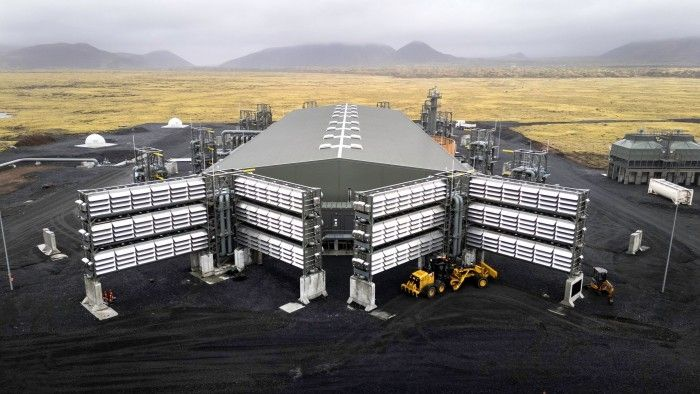
The Mammoth carbon removal plant in Iceland © John Moore/Getty Images
@collapse2050.bsky.social:
“Casting doubts” Well no shit! Doubts were cast years ago. Now is the “told you so” phase.
Direct carbon capture falters as developers’ costs fail to budge, Some experts say the technology is crucial for climate change goals but scaling up is proving hard by Rachel Millard in London and Kristina Shevory in Austin, Sep 27 2025, Financial Times
A top developer of technology to extract carbon dioxide from the air has signalled that its costs are falling much slower than anticipated, casting doubts on the nascent technique’s role in tackling climate change.
Direct air capture, which involves operating large fans to vacuum up carbon dioxide directly from the atmosphere, is seen by some technology companies and governments as crucial to meeting net zero targetsconning the concerned public into enabling more and more fossil fuel pollution, while making the public pay for it! Evil, like AI.
But Climeworks, owner of the world’s largest direct air capture station, said it was still far from meeting cost-cutting targets that it wanted to achieve two years ago, showing the challenge facing companies trying to scale up the process and make it less energy intensive.
In 2019, the Swiss start-up, which has raised more than $1bn from investors, predicted it would cut its capture costs from $600 per tonne to roughly $100 per tonne in “another four years”.
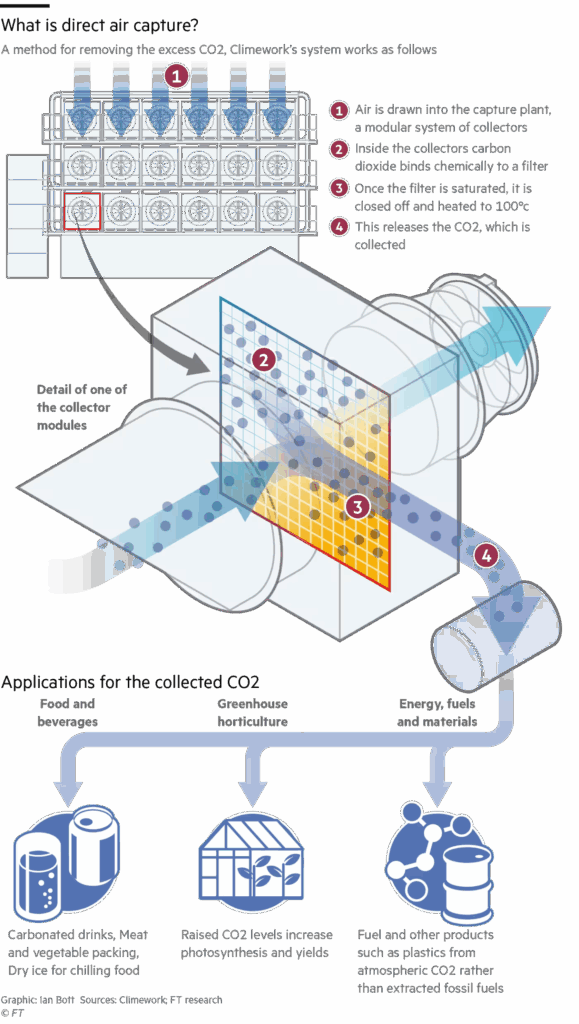
Information graphic showing how a carbon capture machine works
Now, it has a more modest expectation of $250-$350 per tonne by the end of the decade, and $100 per tonne by 2050, according to figures Climeworks shared with the Financial Times.
“Deep tech development is never linear, and our journey is no exception,” the company said, noting that it has produced “years of operational data, testing and iteration”.
Climeworks — which is cutting 100, or 20 per cent, of its staff — and its peers have been hit by rising costs while US President Donald Trump’s hostility to climate initiatives has put government funding at risk. The policy uncertainty has also raised questions about the viability of carbon offset markets crucial to funding and scaling up projects.
Analysis by Bloomberg NEF has shown that costs for the industry as a whole are even higher, with the average cost of capture currently $900 per tonne and likely to reach $487 per tonne at the end of the decade.
The International Energy Agency estimates that as much as 1.2bn tonnes of annual carbon dioxide extraction could be needed by 2050, compared with just about 100,000 tonnes of maximum output available today, which is split across 40 facilities worldwide.

Direct air capture is seen as complementary to conventional carbon capture and storage as it can extract existing carbon dioxide, rather than just at the point of emission. But it is pricier and requires more energyhow fucking stupid is that?. The techniques have also been criticised by some environmentalists for taking attention away from investing in reducing emissions.
“It’s all about getting the cost down to a level where it is competitive,” said Morten Halleraker, senior vice-president for new business and investments at Norway’s energy group Equinor, which is developing direct air carbon capture technology that it bought from Rolls-Royce.
Climeworks chief executive Christoph Gebald remains optimistic despite the industry’s challenges, which have also forced San Francisco-based DAC start-up Heirloom to cut jobs amid doubts about $1.8bn in funding from the US government.
Gebald expects improvements in material and processes to help Climeworks, which raised $162mn during its last fund raise in July, to eventually halve its energy use to 1.5 megawatt-hours.
Last year, the company opened Mammoth, the world’s largest direct air capture and storage plant, in Iceland. It has a capacity to extract 36,000 tonnes of carbon dioxide annually and has removed and stored 873 tonnes in its first 13 months of operation, amounting to net removals of 205 tonnes once lifecycle emissions are taken into account.
The plant is “doing exactly what it’s supposed to do . . . We are continuously driving tech innovation,” Gebald said, adding that it was natural for Climeworks to have some consolidation after “a phase of hyper growth”.
BloombergNEF data suggests that investment into the sector is not rising fast enough. It drew $1bn last year, down from $1.3bn in 2023. Investors poured in $11.2mn in the first quarter of 2025, from $52mn a year earlier.
“We need to allocate more capital to everything [in decarbonisation],” said Nick Stansbury, head of climate solutions at Legal & General Investment Management.No. Humans need to stop over populating and over polluting and consuming which requires no capital (which is why the rich polluting fuckers don’t like those simple free techniques). The only decarbonisation that works, is to stop producing and pumping pollution into the air.
Current costs are far higher than the cost of credits for polluters in markets where they are legally obliged to pay for their emissions. costs for polluters which which I bet traitors Danielle Smith, Doug Ford, Scott Moe, Dave Eby, Mark Carney et al will remove completely to make sure American rich can get richer while polluting more and more and wiping out more life on earth and destroying more and more drinking water via frac’ing and enhanced oil recovery using “captured” CO2 which is also frac’ingThey are also much higher than the tax credits from the US government.
Climeworks’ cost projections of capture also do not include storing the carbon undergroundwhich will not stay permanently put!~, meaning that its total carbon removal costs will be $400-$600 per tonne, rather than $250-$350, by the end of the decade, and $100-$250 by 2050.
To raise money, companies have turned to selling carbon credits to companies that voluntarily want to offset their carbon emissions.
But “direct air capture” credits tend to be more expensive than those based on avoiding or reducing emissions through reforestation and other measures.
“You have to have some credit sale agreement to make it work. Can you cover the cost is the question,” said Brendan Cooke, vice-president of North America carbon capture utilisation storage at Rystad Energy.Meaning, make the public pay for industry’s profit raping pollution. One of the most important factors politicians and carbon capture tech always ignore is that the fossil fuel industry is one of the most law violating, promise breaking, polluting, community harming, lying, greedy on earth. Fossil fuel polluters hate to clean up while or after their profit raping, and nearly always walk from clean up, dumping massive harms on living creatures, not just humans and all the costs to clean up, on the citizenry which cannot afford to feed their families or pay rent, never mind cover $hundreds of billions in clean up costs.
A big test of the technology’s prospects will come this year, when Occidental Petroleum, a $42bn oil and gas company, opens Stratos, a direct air capture facility in west Texas, which will only be the second in the US and overtake Mammoth as the world’s largest.
Asset manager BlackRock has pledged up to $550mn towards Stratos, which will be able to capture 500,000 tonnes of carbon dioxide annually, and is due to start operating this year. Texas is frac’d to hell, like Alberta is. The CO2 injected will not stay put, and besides, I highly doubt it will be injected for “storage.” I bet it’ll be injected as frac’ing, to recover more oil.
Abu Dhabi National Oil Company has agreed to provide up to $500mn for another Oxy venture.
“We believe carbon capture and DAC in particular will be instrumental in shaping the future energy landscape,”Yes, by stealing billions of dollars from investors and citizens, to enable polluting big oil, gas and coal companies to produce more and more pollution Vicki Hollub, Occidental Petroleum’s chief executive, said during a results conference call in August.
But some analysts warn the industry is a long way from cutting costs enough to enable it to grow at scale.
“$100 per tonne is still that magic number,” said Jeffery Jen, a senior analyst at Enverus, an energy data company. “DAC is a long way from that.”
Data visualisation by Janina Conboye. Illustration by Ian Bott
***
Amber Bracken/Bloomberg
Carbon capture startup moves project to Canada from U.S. by Michelle Ma And Robert Tuttle, Oct 2, 2025, Bloomberg in Pittsburgh Gazette
A carbon capture startup has moved its first commercial pilot project from the U.S. to Canada due to what it sees as more stable government incentives and support.
CarbonCapture Inc. subsidiary True North Carbon is constructing a direct air capture (DAC) system in Alberta, Canada, that it expects to go online by the end of October. The project will have the ability but like all the rest of the carbon capture scams, most likely will failto capture 2,000 tons of carbon dioxide per year at full capacity, making it the biggestcon job system of its kind operating in the country.
In Canada, tax incentives and billions of dollars in freebies while ordinary Canadian families struggle to pay rentand the look the other wayregulatory landscape will make it easier for the carbon capture and storage industry to scale, CarbonCapture Chief Executive Officer Adrian Corless said. The company originally planned to build the project in Arizona and had components for it ready in a factory in the state. But earlier this year, CarbonCapture decided to pivot, shipping all the equipment to a rural patch of farmland in Alberta in a matter of months, Mr. Corless said.Douche Fucker will be able to steal far more from stupid rural Albertans, led by Big Oil Dildo Queen Danielle Smith
Canada offers a 60% investment tax credit for DAC projects deployed in the country, with the Alberta government offering an additional 12% for projects based in the province. Those “significantly improve the economics” of projects, Mr. Corless said. The technology has struggled to gain traction due to high costs around the world.But welcomed in Quisling Carney Canada and Big Oil Polluted and Controlled Alberta.
The Canadian incentives are key to scaling CarbonCapture’s DAC technology, Mr. Corless said, which currently costs the company about $1,000 per ton to operate at the pilot level. So, too, is the infrastructure that can support the project.Paid for by our corrupt politicians stealing $billions from ordinary Canadians to give to companies knowingly destroying life on earth, and worse, putting lives (human and other) at serious risk of death or brain damage when the “infrastructure” fails, which in GreedVille Alberta, always happens sooner or later
The company relocated its 2,000-ton system to Innisfail, Alberta, just north of Calgary, the country’s oil and gas hub. Alberta is home to the world’s third-largest oil reserves and has hosted facilities thatfail to capture carbon from smokestacks and store it in underground saline aquifers for yearsbut which transfers billions of citizen dollars into pockets of the rich, and enables more oil and gas pollution. Carbon capture is always buffoonery, producing more pollution than it captures. It’s also host to a robust network of life threatening, most likely leakingCO2 pipelines and has plans to build more, Mr. Corless said.
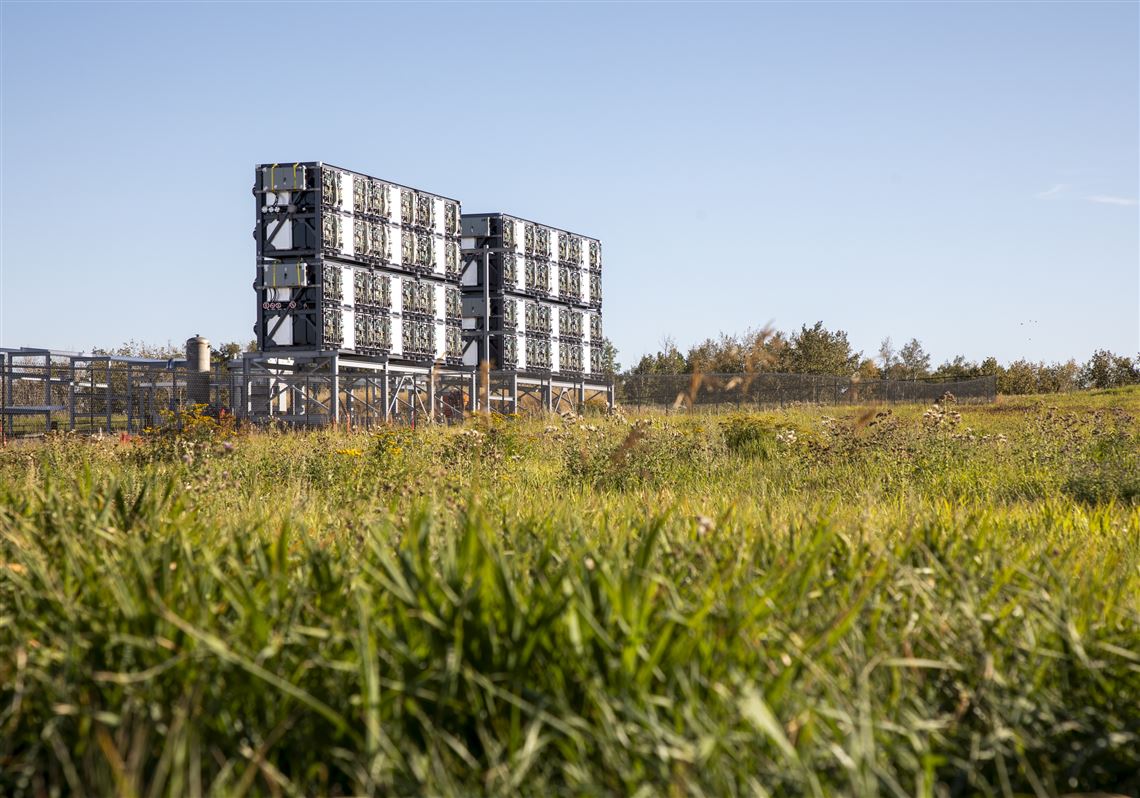
CarbonCapture has partnered with Canadian startup Deep Sky, which runs the facility where the system will be located. There, a three-story structure that resembles stacks of air conditioning units is being erected amid the green fields.

Large fanselectricty in Alberta mostly comes now from water destroying toxic frac’d unnatural gas, and is the most expensive in Canada. Who pays for this carbon scam’s electricty? Taxpayers? will suck air through specially engineered cartridges that absorb CO2 from the air and then carry the greenhouse gas via pipeline to a tank where it will eventually be trucked to another location and buried deep underground.Stupidest fucking CO2 “capture” plan yet, *and* it causes more pollution than it’s worth! Bonus, the “buried” Co2 will not stay buried.
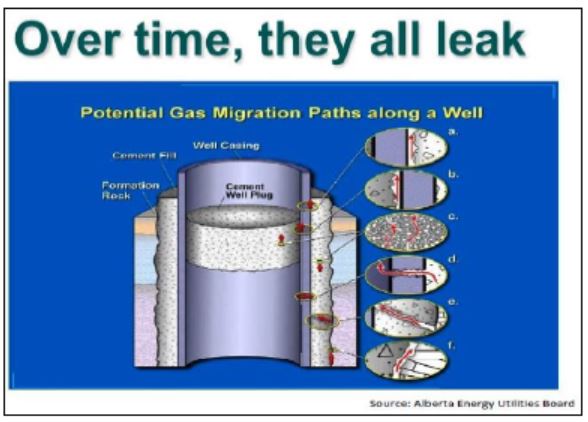
Deep Sky’s site is home to DAC systems from five other companies, with more planned. It and CarbonCapture will split the new system’s operational costs as well as carbon credit sales.Fucking scam artists
CarbonCapture had previously attempted to build a DAC facility in Wyoming, where it planned to capture 5 million tons of CO2 annually by 2030. But it abandoned those plans last year, citing a lack of available carbon-free energy and transmission constraints. It would have taken multiple years for the company to get power, whereas
Mr. Corless expects interconnection in Alberta to happen within “a matter of months, not years.”Nothing to be proud of. Alberta’s the stupidest province in Canada, and the most greedy, selfish, polluting, religious and corrupt, like Texas.
WinstonSmith1984:
….Direct Air Capture or DAC is another government fool’s errand. These systems require enormous amounts of energy to operate in order to pull a small amount of CO2 from the atmosphere, and you would need tens of thousands of them to make any measurable change in ground level atmospheric CO2 levels. And then what do you do with the CO2 that has been captured? You have to compress it and pump it into the ground (geological sequestration) to be stored into perpetuity (good luck getting a permit to do that on a large scaleMark Carney and Danielle Smith have proven themselves to be traitors, eagerly giving billions to and bending over for and lying about American companies with projects that industry, politicians and regulators know are intentional con jobs to steal $billions from taxpayers to give to the rich while enabling more pollution. All are disgusting con artists, Mark Carney the most evil fraud of them all. The compression and pumping steps require even more energy. It makes absolutely no sense. You would be 100% better off planting trees.
Let the Canadian taxpayers fund this boondoggle. Eh?
Slim Shady:
2,000 tons is what, five city buses worth? LOL
Refer also to:
2025: US taxpayers will pay billions in new fossil fuel subsidies thanks to the Big Beautiful Bill
It looks like Trump-copying Carney is planning to give $billions more to big polluters – most of them American companies – in Canada too.
… Carbon capture and storage is the process of capturing CO2 emissions and injecting them deep underground. The oil and gas industry has for decades injected CO2 underground to help recover difficult reserves that don’t respond well to traditional drilling methods. Environmentalists have long argued that the logic of replicating an oil and gas technique as a climate solution is seriously flawed — especially considering that a company could reap a climate tax credit from injecting CO2 that will then be used to create more fossil fuels.
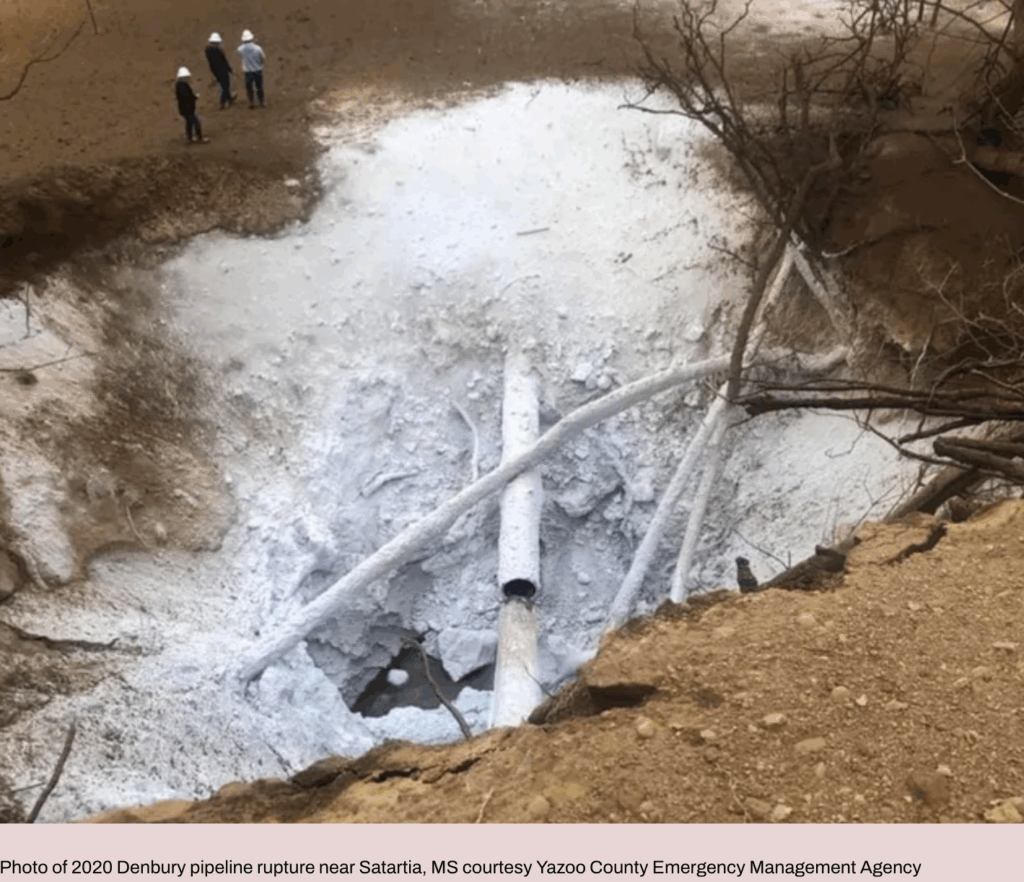
2012: CO2 in Stream, Dead Ducks Prompt Wyo. DEQ Citation against Anadarko
The leak happened in an area where CO2 is injected underground to help revive an old oil field and boost oil production. The Wyoming Department of Environmental Quality has ordered Anadarko Petroleum to identify and control the carbon dioxide leak into Castle Creek in central Wyoming. The Casper Star-Tribune reports…DEQ also is telling Anadarko to monitor the stream’s acidity until three consecutive tests show normal pH. A state violation notice says company officials identified a nearby carbon dioxide injection well as the possible source of the leaking gas. Anadarko spokesman Dennis Ellis says Anadarko hasn’t yet verified where the gas originated.