Thank you wise courageous people of New Brunswick, saying “No!” and still saying “No!” to frac’ing. Terrible betrayal by Premier Susan Holt; the only thing frac’ing brings politicians is greed & corruption! “How many kids need cancer for this industry to be worthwhile? Like, how much money offsets that? How many people getting asthma?”
People in the Sussex area had a chance to ask questions last night about the possibility of more shale gas development. (Nipun Tiwari/CBC)
Residents from Sussex, surrounding areas and some from farther away pressed New Brunswick government officials on the impacts of shale gas development during a public meeting Tuesday night as part of a provincial process to potentially lift its moratorium on fracking.
“How many kids need cancer for this industry to be worthwhile? Like, how much money offsets that? How many people getting asthma?” asked Beth McQuinn of nearby Penobsquis.
“How much damage do we have to do to our environment and to our wildlife just for some money for maybe 20 years? Because I understand we’re nearing the end of the lifespan of these [projects].”
The “community dialogue” event was an informal Q&A session, where residents could question public officials on potentially lifting the moratorium on shale gas development implemented in 2012.
Roughly 130 people crowded into the Sussex Lions Club community hall for the session.
Beth McQuinn attended from Penobsquis. She said she found responses to resident questions dismissive. (Megan Goddard/CBC)
The questions focused on environmental impacts and resulting impacts to human health.
“These are the questions we’re wrestling with as a review,” Jennifer Welles, a panel member representing the Department of Natural Resources, said to McQuinn.
“What benefits could come from this? Are they financial or otherwise? What impacts could be felt from this, whether it’s health, environment, community impacts, that sort of thing? And then that gets weighed. So no decisions have been made.”
The sessions panel was composed of, from left to right, Jennifer Welles, Katie Pettie, Dr. Yves Leger, Sara Morris Colter and Hemant Kumar. The panelists represented the provincial departments of Natural Resources, Environment, Health, Post-Secondary Education, Training and Labour, and the Regional Development Corporation. (Megan Goddard/CBC)
Welles said she couldn’t answer McQuinn’s questions but tried to offer assurance.
“This is a fact-finding expedition that we’re on for these five months, and we will be preparing recommendations for the government to take and then they can make the call,” Welles said.
The provincial government announced its intention to review lifting the moratorium in August. Tuesday’s event, along with a survey conducted by the province, is part of the review.
Oil and gas company Headwater Exploration extracts natural gas from 32 wells in the region.
Opponents, supporters at meeting
Attendees also included Natural Resources Minister John Herron, local government representatives of Sussex and Butternut Valley and provincial government staff.
Most of the 16 who stepped up to the mic to ask a question expressed criticism or skepticism. Some expressed concerns of tensions over the topic boiling over to involve clashes between protestors and law enforcement, as they did over a decade ago.
Two spoke in support of opening up the potential of shale gas development.
“With the global economical changes being forced on us by our southern neighbor, I support this,” said Bill Crow, who said he had previously worked in the industry. Traitor
“I feel safe in my community. I’m still alive and I’m still healthy. What am I missing here? Why can’t our children have jobs here? Why can’t our community prosper?”
WATCH | Provincial minister, staff pressed on impacts to environment, health and economic benefit:
Provincial officials questioned on risks, benefits of fracking at public meeting
3:24Residents in Sussex, surrounding communities and beyond faced New Brunswick government representatives in a public consultation session with questions on fracking. The session was a part of the government’s review of the province’s shale gas development moratorium.
Kattie Pettie, a panellist representing the provincial Environment Department, responded to Crow, saying exploring benefits and also new methods in the industry are part of the review. It’s impossible with new or old methods to make frac’ing safe; there are zero benefits and endless harms.
“We need to look at other jurisdictions and we are asking key questions of those other jurisdictions because we haven’t had a lot of activity here in recent years,” she said.
Speaking with reporters after the Q&A session, Pro frac traitor Crow said the criticisms from the audience, from his perspective, came from “fear” and “not knowing the facts” about what he considers to be a safe industry.
“This is not what I worked at. This is not where I had dirty boots from,” he said.
“We live with it. There’s been no alarms, no panics, no accidents.”Liar! Liar~! Pants on frac fire!
Bob Osborne asked if the province would commit to a referendum on the subject so New Brunswickers could have a say. (Megan Goddard/CBC)
Bob Osborne, coming from Cornhill, a rural community northeast of Sussex, said he protested against shale development over a decade ago before the moratorium. Osborne asked provincial officials if they would commit to holding a referendum.
“This is supposed to be a democracy rather than the government make a decision like this which impacts a tremendous number of people,” he said.
“Will you give us the vote to say yes or no?”
Herron referred to this as a “political” component to the issue.
“We will figure that out come January,” Herron said.
Paul Bedford, another traitor to families, community, health, well being and peacewho supports the industry, said he hopes New Brunswickers get a say as well.
“And that the individuals in New Brunswick are the ones that are reaping the benefit of the natural resources being produced here in our province,” he said.
Paul Bedford, a supporter of the industry, said he wants to see a way New Brunswickers can voice their opinions. (Megan Goddard/CBC)
Officials repeated multiple times that no decisions had been made. McQuinn, also speaking with media after the session, said she found responses to be dismissive.
“Really, they’re listening to the community. I get that,” she said.
“But they’ve got to take no for an answer. It’s very clear from the science that there’s health ramifications from this industry. There’s lots of information about the lack of true jobs, long-term jobs from it, the dangers to the environment, dangers to water and air in this province.”
Premier Susan Holt said the previous week that more meetings are planned after the province’s working groups have gathered more information.
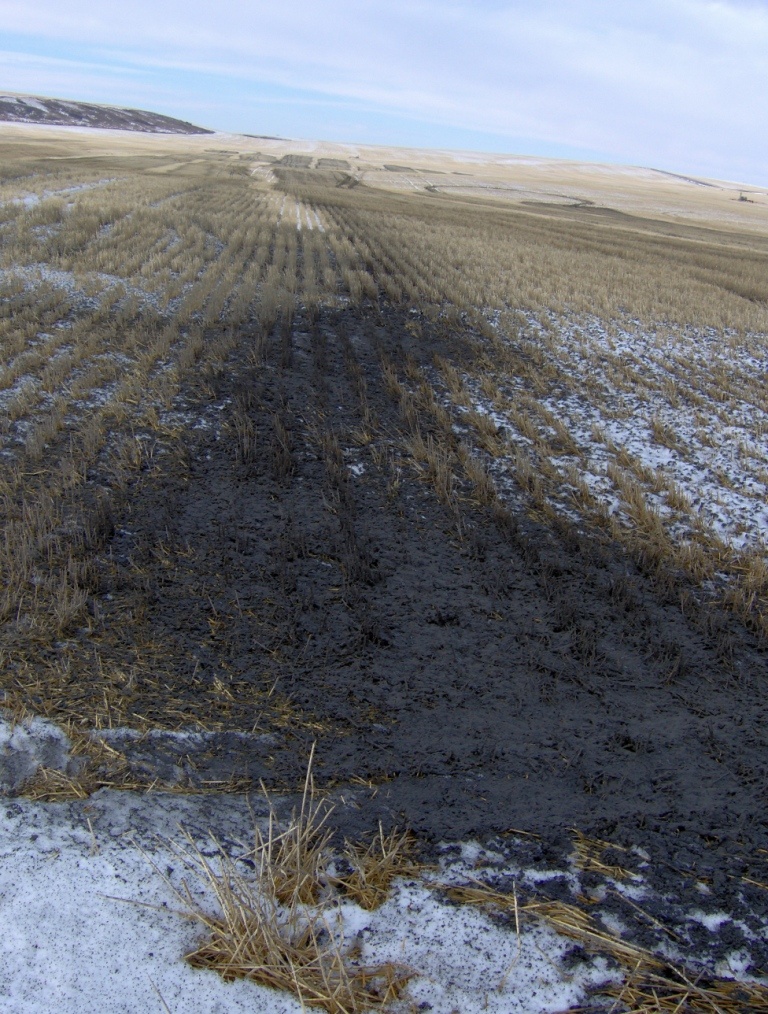
2012: Encana (now Ovintiv) dumping its waste on cropland at Rosebud Alberta under AER’s “World-Class” regulations (which the regulator refuses to enforce).
Encana/Ovintiv dumping waste heavy (illegally) at Rosebud; it reeked of hydrocarbons. From Page 7, A Landowner’s Guide to Drilling Waste Disposal from Oil and Gas Wells by industry’s self regulator: “In this method, drilling wastes are sprayed at very low application rates. … Wastes containing hydrocarbons are not allowed to be disposed of by this method.”


 Caveman