When the Playground Is Also an Oil Field
An SLP sees firsthand how oil and gas development in her Colorado community negatively affects clients, families, and health outcomes.
By Kate M. Christensen, July 16, 2026, ASHA Leader, American Speech-Language-Hearing Association

Since 2007 I’ve worked as an early intervention speech-language pathologist on the eastern edge of Boulder County, Colorado, a borderland where the high plains meet the foothills. Boulder, home to the University of Colorado’s main campus, is consistently ranked among the healthiest places to live in the U.S. and is known as a pristine training ground for professional athletes (see sources).
But things are different on the county’s eastern edge, where I cruise around with a car full of snacks and an insulated mug of coffee. The grasslands and subdivisions are prairie dog brown and surrounded by desert high plains, with snowcapped peaks in the distance. Prairie dog brown is also the color that camouflages the ubiquitous metal tanks in the middle of neighborhoods, near swing sets, in fields next to grazing cows, and in open spaces and alongside trails. I drove past them for years without actually seeing them.
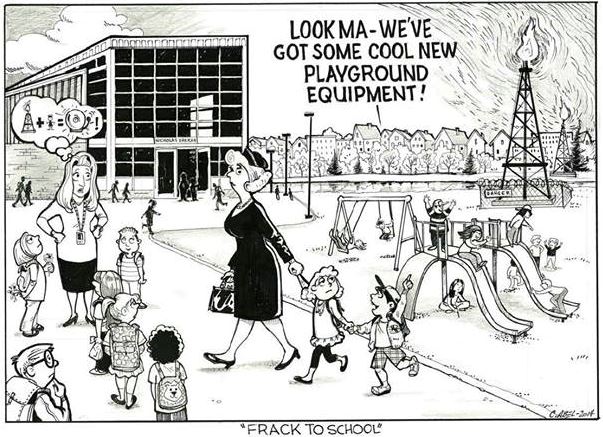
Then, in 2017, the land around my neighborhood and my children’s school was optioned for hydraulic fracturing (fracking) by Extraction Oil & Gas, Colorado’s third-largest oil and gas producer at the time. I didn’t know what that meant, but it sounded alarming. I’d heard about fracking in the oil fields in North Dakota. Some dads of children on my caseload travel up there on two- or three-week rotations to work. But it took an oil and gas company calling dibs on drilling near my family for me to realize I was also living and working on an oil field, as are my clients and their families.
Our oil field home is part of the Denver-Julesburg Basin, which covers about 20,000 square miles, extending into parts of Colorado, Wyoming, Nebraska, and Kansas. In Colorado, it stretches all along the Front Range, a corridor of the Rocky Mountains.
Real effects
After noticing the tanks in neighborhoods and the open spaces in between, I wanted to learn more about what this all meant. It turned out these vessels are storage tanks, separators, and combustors for active oil and gas sites, with concerning implications for nearby humans.
Research links proximity to fracking sites to an increased risk of preterm births, low birth weight, and certain types of leukemia (see sources). Contamination of drinking water, in particular, has been associated with shorter gestational periods and lower birth weights. Preterm delivery and low birth weight are associated with higher risk for developmental and communication delays. These children are more likely to be diagnosed with autism, cerebral palsy, and behavioral challenges, and to come to us for services (see sources).
Fracking also contributes to poor air quality. Along Colorado’s Front Range, we are in what the Environmental Protection Agency (EPA) calls an ozone nonattainment area, which means our air quality exceeds limits for one or more pollutants. Consequences include mandatory federal pollution reduction measures, such as carpooling and using electric lawnmowers, but the state doesn’t address pollution from oil and gas production.  of course not, all part of the polluters evil plan to blame ordinary families, kids, pets, single seniors for their profit-raping polluting practices.
Young children are more vulnerable to the health impacts of air pollution because their lungs are still developing, and they breathe more air per pound of body weight. We know that outdoor time is critical for many facets of development, from physical abilities to social interactions. I personally see how outdoor time benefits my young clients’ sensory regulation.
While Colorado lacks specific state regulations, most child care facilities pay attention to air quality. They limit children’s outside playtime during ozone alert days (we had 41 in 2024), which deprives children of outdoor benefits and can lead to increased tension and conflicts among them. And poor air quality isn’t just a Colorado problem: 109 million Americans were living in counties with dangerous air pollution levels in 2024, according to the EPA.
I didn’t learn about fracking-related health issues from literature in our field; I learned about them from environmental justice organizations fighting climate change. I also learned that these environmental risks aren’t just a concern in Colorado. More than a dozen states, including California, New Mexico, North Dakota, Ohio, Oklahoma, Pennsylvania, Texas, West Virginia, and Wyoming, and many Canadian provinces, are seeing significant amounts of oil and gas activity. Roughly 17.9 million Americans live within a mile of an active oil and gas site, likely more because that number is from 2017.
The pollution leaking off the fracking tanks is often invisible. It takes a special optical gas imaging (OGI) camera to actually see it. Several years ago, Colorado resident Andrew Klooster used an OGI camera to film a giant leak from a tank in the middle of a subdivision (see sources).
He told the Colorado Times Recorder, “It was a jarring sight to stumble upon because there are all these families at the playground and on the bike path. … But it looks benign. The site doesn’t smell unless you’re downwind or right next to it.” It isn’t just new drilling that causes problems in Colorado. Old legacy wells that surround some of our schools often leak more methane than new wells do (see sources).
Advocacy and action
It’s a tricky balance: knowing the risks but not wanting to scare people away. I have information about the health impacts resulting from fracking, but how much of that do I share with families?
Generally, unless families ask—which they usually don’t—I don’t bring up fracking. Part of early intervention is meeting families where they are, and fracking is highly politicized in Colorado and many other parts of the country. I work with children whose parents work in the oil and gas industry, and our shared goal is to help their child communicate successfully. Instead, I advocate to protect families from environmental harms by calling my local elected officials (see “ASHA Member Advocacy: Communicating With Your Legislators”), testifying at the Colorado State Capitol, and working on campaigns to get oil and gas companies to clean up toxins. But direct conversations with client families are few and far between.
Advocating against environmental harms is part of communication disorders prevention, and prevention is one of our primary professional responsibilities. But it isn’t in everyone’s comfort zone. Educating ourselves is a helpful first step.
Physicians for Social Responsibility offers a compendium of information about fracking-related health risks. And there are other things we can do: We can talk with families about how a high-quality air filter in their home can help protect their health. Or let them know how to make an inexpensive, effective DIY air filter using a furnace filter and box fan. Filters are excellent ideas for allergies, dust, dander, COVID and other viruses, bacteria, and for wildfire smoke, but not for most oil and gas pollutants unless they have carbon filters as well. Gases are not trapped by air filters, not even HEPA filters. Gases, if leaking into homes, schools, water wells, hospitals and other buildings, can be life threatening if they ignite and cause explosions. Much oilfield waste is radioactive, HEPA filters do not filter out radioactive materials either.
Taking these steps can help protect clients and family members of all ages, including (on the other end of the age spectrum) older adults with respiratory issues.
Ideally, we CSD professionals can collaborate with public health advocates, whether it’s to advance research or policy, and to learn how to effectively communicate about research indicating an association between environmental toxins and developmental disorders, including communication delays. Using ear protection can help prevent hearing loss and wearing sunscreen can help prevent skin cancer, but there’s no real way to erase the harm from the pollution of drilling.
We can, however, take action to reduce future harm. Air filters may help mitigate the effects indoors, but, ultimately, the most effective solution is action to plug old leaking wells and phase out future drilling. The health and well-being of our clients depend on our advocacy efforts.
Kate M. Christensen, MA, CCC-SLP, is an early intervention SLP with A&I Avenues (formerly Imagine!). email hidden; JavaScript is required
The views and opinions expressed in this article are those of the author and do not reflect any official positions of the American Speech-Language-Hearing Association.
Sources
Cairncross, Z. F., Couloigner, I., Ryan, M. C., McMorris, C., Muehlenbachs, L., Nikolaou, N., Wong, R. C., Hawkins, S. M., Bertazzon, S., Cabaj, J., & Metcalfe, A. (2022). Association between residential proximity to hydraulic fracturing sites and adverse birth outcomes. JAMA Pediatrics, 176(6), 585–592. https://doi.org/10.1001/jamapediatrics.2022.0306
Crump, C., Sundquist, J., & Sundquist, K. (2021). Preterm or early term birth and risk of autism. Pediatrics, 148(3), e2020032300. https://doi.org/10.1542/peds.2020-032300
Hill, E. L., & Ma, L. (2022). Drinking water, fracking, and infant health. Journal of Health Economics, 82, 102595. https://doi.org/10.1016/j.jhealeco.2022.102595
Ibrahim, H., Wilkins, A., Ali, S. A., Lisonkova, S., Chan, N. H., & Ting, J. Y. (2025). Narrative review of neurodevelopmental and psychiatric complications associated with prematurity. BMC Pediatrics, 25(1), 933. https://doi.org/10.1186/s12887-025-06306-z
Konkel L. (2017). In the neighborhood of 18 million: Estimating how many people live near oil and gas wells. Environmental Health Perspectives, 125(12), 124003. https://doi.org/10.1289/EHP2553
Pascual F. (2022). Fracking and childhood leukemia: New evidence supports greater residential setbacks. Environmental Health Perspectives, 130(9), 94002. https://doi.org/10.1289/EHP11982
Price, S. (2022). Thermal imagery exposes leaks at CO oil and gas sites, cracks in state pollution violation procedures. Colorado Times Recorder. https://coloradotimesrecorder.com/2022/03/thermal-imagery-exposes-leaks-oil-and-gas-cracks-in-pollution-procedures/44492/