Frackalachia: Frac’ers lied about economic promises; jobs and population were lost, not gained with families poisoned and drinking water contaminated; water permanently lost from the hydrogeological cycle; and pollution escalated, worsening the global warming crisis.
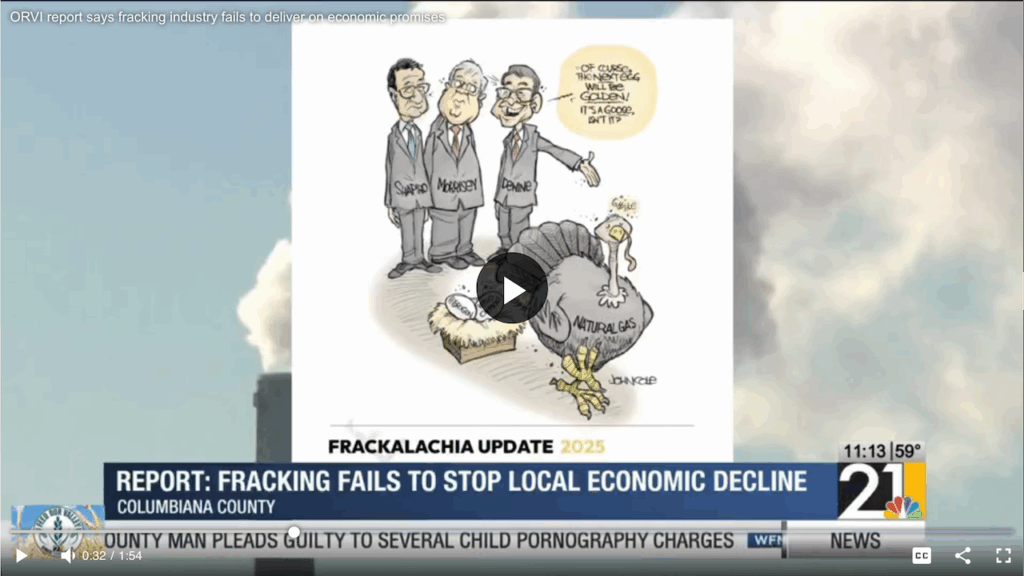
COLUMBIANA COUNTY, Ohio – When it comes to fracking, politicians often fight over what is best for the economy versus what is best for the environment. But according to one new report, the natural gas industry hasn’t delivered the economic benefits it’s promised to Appalachia.
“I’m from Wheeling, West Virginia,” said Sean O’Leary, senior researcher at the Ohio River Valley Institute. “I kept hearing these glowing reports about how the economy was expanding with the growth of the natural gas industry, but I could look around and I could see we were losing population, we were losing jobs.”
The ORVI, a think tank dedicated to “a more sustainable, equitable, democratic, and prosperous Appalachia,” released an updated “Frackalachia” report Thursday. Previous versions of the report came out in 2021 and 2023.
Their analysis focused on 30 counties in Ohio, Pennsylvania and West Virginia that are responsible for 95% of Appalachian gas production, including Columbiana County.
“Columbiana is, frankly, a poster child for the damage that’s being done,” O’Leary said.
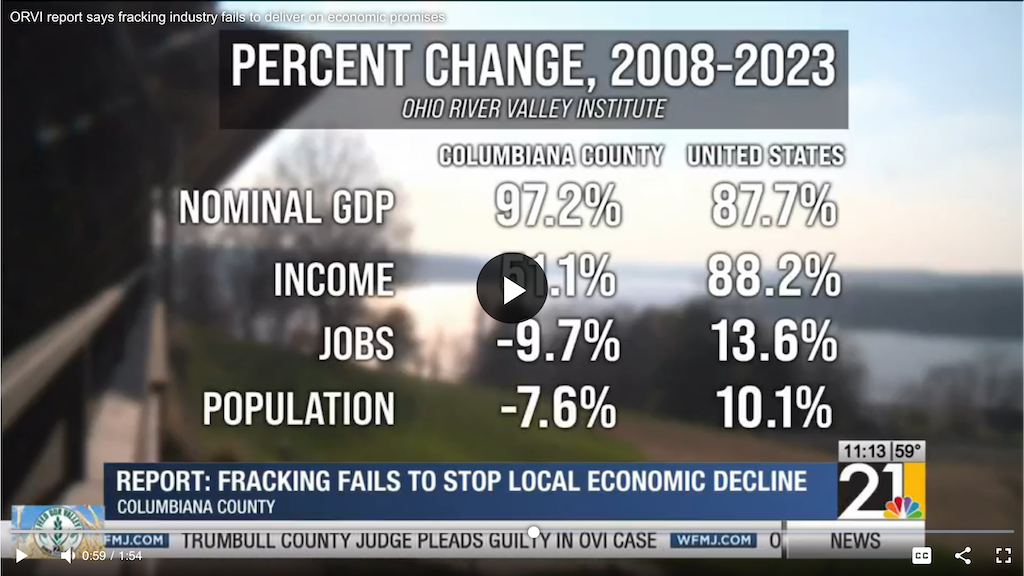
The report found Columbiana County outperformed the U.S. in Gross Domestic Product change from 2008-2023. Columbiana County’s GDP grew roughly 97%, while the U.S. GDP grew by about 88%.
But despite strong GDP growth, the county saw only about 60% of the income growth the nation saw — and while the U.S. overall gained both population and jobs, Columbiana County showed losses in both categories. This pattern continued with many counties in the study.
According to O’Leary, strong GDP appears in the data alongside weaker jobs and income data because the natural gas industry is capital-intensive, but not labor-intensive.
In other words, it requires a lot of money to develop, but due to improved technology and efficiency, they don’t require much labor. Therefore, while the revenue generated from those plants will manifest in a stronger GDP, not as much money is infused into the local economy through wages.
“Nearly all of that money is landing in the pockets of investors, and the corporate executives, and shareholders of the companies, and in their creditors and providers of professional services, virtually all of whom are somewhere else,” O’Leary said.
The ORVI isn’t trying to claim fracking has caused these trends, O’Leary clarified. But he said the numbers are proof the natural gas industry “is structurally incapable of generating growth in those measures of prosperity.”
“Any efforts that state or local governments make to try to encourage development of natural gas may or may not work in terms of the natural gas industry, but … they won’t make much of a difference with respect to local economic performance,” O’Leary said.
“That’s all pretty much wasted effort, and it’s diverting important public resources that we could otherwise use to invest in other industries and in other activities that would have far more promise economically,” he added.
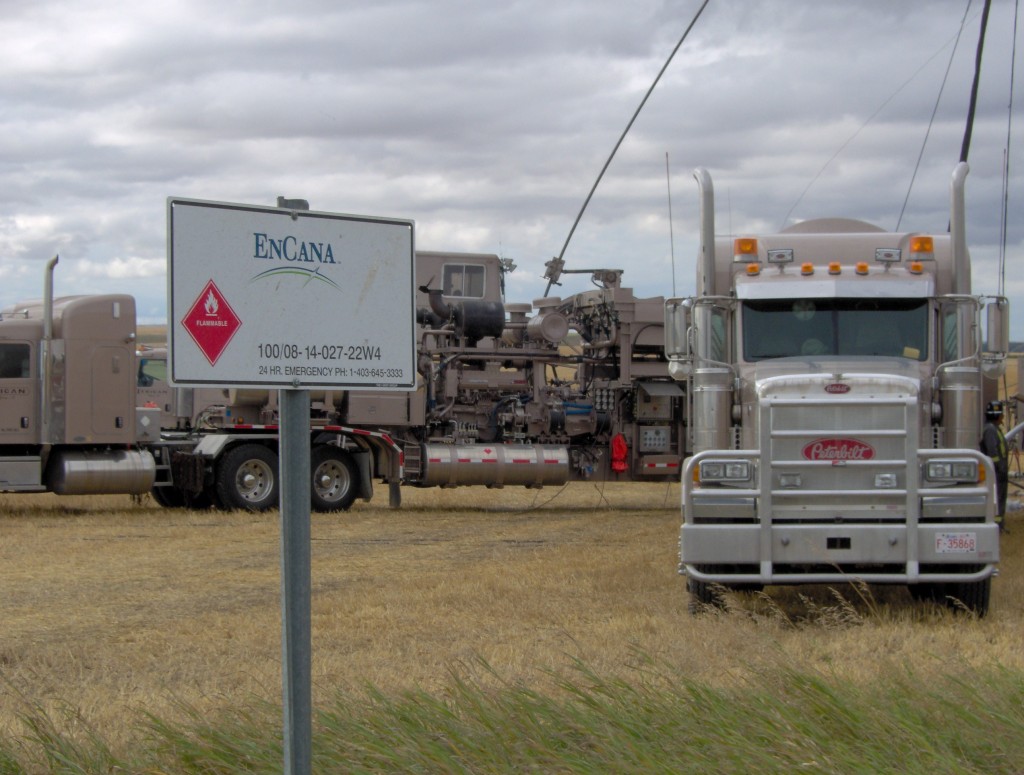
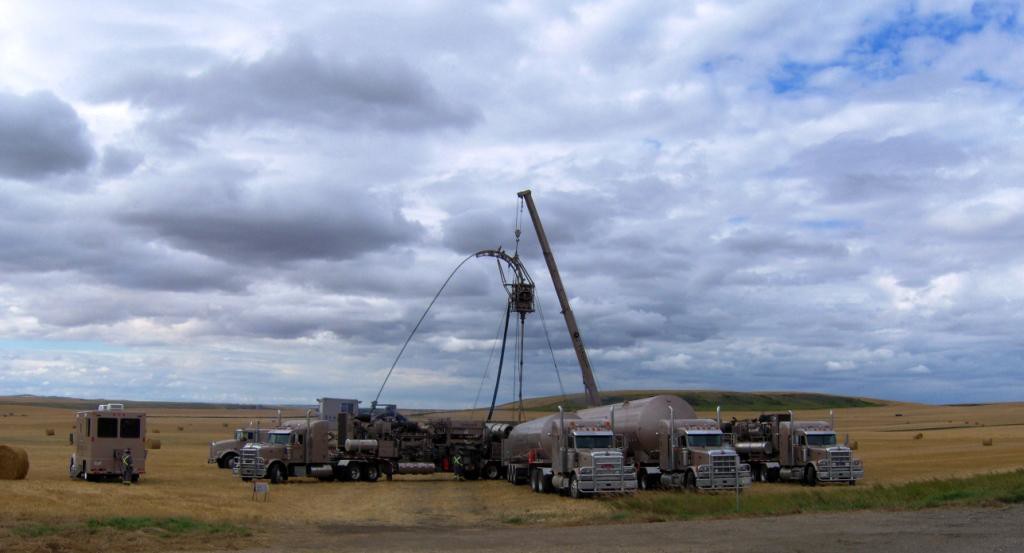
Trican frac’ing above the base of groundwater protection at Rosebud, about 800 metres from my home, after they had already illegally repeatedly frac’d and contaminated my community’s drinking water aquifers for their client Encana (now Ovintiv).
A proportion (25% to 100%) of the water used in hydraulic fracturing is not recovered, and consequently this water is lost permanently to re-use, which differs from some other water uses in which water can be recovered and processed for re-use.
This website stores cookies on your computer. These cookies are used to provide a more personalized experience and to track your whereabouts around our website in compliance with the European General Data Protection Regulation. If you decide to to opt-out of any future tracking, a cookie will be setup in your browser to remember this choice for one year.
 News clip at link