After years of opposition, Mexico’s president is reconsidering fracking, The government has tasked a group of scientists with assessing new technologies for “sustainable” oil and gas drilling—but many experts say it’s a fantasy by Humberto Basilio, June 11, 2026, Science
Mexico’s government has assembled a group of scientists to assess whether fracking could be revived in the country in a more sustainable form, despite previous promises from President Claudia Sheinbaum to prohibit the controversial method for extracting gas and oil. The U-turn, part of a strategy aimed at reducing Mexico’s dependence on hydrocarbon imports from the United States, has alarmed many Mexican scientists, who warn that allowing fracking would be harmful for the environment and human health.
“There is no such thing as sustainable fracking,” says geologist Luca Ferrari, who is part of the government’s 30-member evaluation committee. And even if there were, Ferrari says, Mexico lacks the fracking infrastructure needed to achieve its long-sought goal of energy sovereignty.
The government says it will make no decision until the committee has conducted an impartial and rigorous analysis. Sustainability must be demonstrated empirically and scientifically and “cannot be a marketing slogan,” says Mexico’s science secretary Rosaura Ruiz Gutiérrez. “The way we are doing this is the way it should be done.”
Fracking, or hydraulic fracturing, uses wells that are up to 5 kilometers deep and extend horizontally through rock layers that contain oil or gas.  Frac’ing is also done on extremely shallow vertical wells, including insanely repeatedly perforating, cementing and frac’ing directly into community drinking water aquifers as Encana/Ovintiv did in Rosebud Alberta, contaminating them, and then blamed the harmed residents for contaminating the drinking water supply, and that of their neighbours. There is nothing good about frac’ing. Nothing. Operators pump millions of liters of water mixed with sand and chemicals into the well at high pressure, cracking the rock
 and allowingforcing, often with great damage to formation and the surface, the fossil fuels to be brought to the surface. Many critics are concerned about the environmental impacts of fracking, such as leaks of methane into the atmosphere and high water usage. Some studies suggest and case histories prove methane and toxic drilling, frac’ing and servicing chemicals other materials from wells could docontaminate drinking water, although other industry controlled and corrupted research suggests this is not a major worry. The concerns have led to fracking being banned in several countries and in some U.S. states, including New York and Maryland.
Mexico opened its doors to fracking in the 1990s, eventually developing about 8000 extraction wells along the Gulf of Mexico and the northern border. A ban on fracking discussed by Sheinbaum’s predecessor, former left-wing President Andrés Manuel López Obrador, never materialized, although the number of new wells in the country declined. During Sheinbaum’s presidential campaign in 2023, she promised “not to allow the exploitation of hydrocarbons through fracking,” and many commentators expected her to prohibit fracking entirely after she was elected. On 15 April, however, she introduced a group of scientists, academics, and engineers tasked with making recommendations on how and where fracking could be revived.In my view, she’s been bought or coerced. Very disappointing and disgusting, but typical. It’s impossible to frac safely or responsibly or without contaminating the surface and drinking water, or permanently removing most of the water injected. Anyone who says it can be is a fucking liar.
The committee, selected to represent a diversity of academic backgrounds, political viewsthat contaminates the committee right there, and positions on fracking, is evaluating a range of cutting-edge technologies designed to reduce environmental impacts, Ruiz Gutiérrez says. These include fracturing systems that use less water by recycling it, or replace water entirely with liquefied petroleum gas or supercritical carbon dioxide. Other fracking approaches could disturb less land by allowing multiple wells to be drilled from a single site.All of these fucking “cutting-edge” frac cons have already been tried in Canada and elsewhere. None of them will reduce the endless harms caused by frac’ing, using liquefied petroleum gas has proven it comes with much worse harms, injuries and pollution than frac’ing with water. Some companies frac with fucking diesel and various secret hydrocarbon brews causing horrific contamination of the subsurface, drinking water aquifers and in some cases, also the surface. Encana frac’d Rosebud’s drinking water aquifers with nitrogen gas and their secret brew of chemicals. They still contaminated the entire community’s drinking water supply with methane, ethane, and toxic drilling, frac and cementing chemicals. CO2 can damage the brain and kill when it escapes pressure or leaks, which happens regularly, putting communities and all life in them at risk. No matter what is used to destroy the formations to force out reluctant methane and or oil, the subsurface remains destroyed, resulting in methane rising and leaking at the surface and contributing to climate chaos, via the well bores (whether on one pad or many) and elsewhere far from the well bore. Frac’ing isn’t even economical. It makes much better financial sense to produce non fossil fuel energies, notably solar and wind.
Scientists inside and outside the committee stress, however, that these technologies remain under scrutiny, and it is unclear how much they could reduce the industry’s overall environmental footprint. “Many are currently being used only in experimental studies rather than commercial operations,” says anthropologist Manuel Llano, who is a member of the Mexican Alliance Against Fracking and is not a member of the committee.
The regions most likely to be targeted by fracking also make low-impact drilling virtually impossible, Llano says. In central and southern Mexico, oil- and gas-rich formations are typically located very close to human settlements, putting people at risk of developing health issues related to air pollution from wells. In northern Mexico, wells would be somewhat farther from communities but the region has been experiencing a water crisis for years, leaving experts concerned that fracking could exacerbate water shortages.
Sheinbaum’s evaluation committee is scheduled to deliver its recommendations to the president this month, and she will make the final decision on whether fracking moves forward. Sheinbaum will only approve drilling if the committee indicates there would be no severe impacts on communities or the environment, Ruiz Gutiérrez says.The committee is politically contaminated. Besides, committees in many other areas have already concluded frac’ing is bad, no matter how when where or which companies do the damage with which techniques. It is impossible to frac without causing severe harm, the most serious, to drinking water, regardless of whether the frac’d water is recycled which companies refuse to do because it’s too expensive (Canada’s National Energy Board already concluded frac water is unsuitable for recycling for use in energy wells because it corrodes and or clogs them). Using radioactive frac waste water or drilling waste on agricultural lands is most unwise.
Even if Mexico does intensify fracking, it would likely fail to ease the country’s energy dependence on the U.S., Ferrari warns. About 60% of Mexico’s electricity generation depends on U.S. natural gas, in part because the country lacks the infrastructure needed to produce sufficient gas domestically. To build that infrastructure, the country would need support from U.S. companies. Amping up fracking represents “a contradiction,” Ferrari says. “It would only place us in a position of greater dependence.”FFS Go solar!
In addition, Mexico’s oil fields are already so depleted that fracking would yield hydrocarbons for only about 10 additional years at best, he adds. (Ruiz Gutiérrez says the country is moving toward greater use of solar, wind, and geothermal energy, but that will take timewhy waste time the with this politically contaminated committee thinking of ramping up toxic expensive stupid frac’ing?.)
Sheinbaum’s U-turn on fracking reflects an openness to cautiously considering new scientific developments, Ruiz Gutiérrez says. “Technology and science advance every day,”as do greed and stupidity she says, “at a pace where an opinion you held a few years ago may need to be revised.” But both Ferrari and Llano speculate that tensions with the U.S., along with pressure from the state oil company to exploit the country’s remaining oil reserves, have pushed Sheinbaum to reconsider a possibility she opposed throughout her career. “I think the president does not want fracking to return,” Llano says. “But reality goes beyond what she wants or doesn’t want.”
The Tiny Solar Panel That Could Change America By Robinson Meyer, June 14, 2026, NYT

Mr. Meyer is a contributing Opinion writer and the founding executive editor of Heatmap, a media company focused on climate change.
It’s not so easy to harvest the sunshine if you live in America. Homeowners can hire someone to install solar on their rooftops, but it can take many years for it to pay for itself. You might be able to buy a share in a nearby solar farm, but only if you’re lucky enough to live in a place where community solar is available. If you live in an apartment or condo, forget it — in many states, you have no options at all.USA, and Canada, sleazily serving polluters.
But that might be changing soon in more than half the country. A technology — known as plug-in, balcony or garden solar — is already enormously popular in Germany, in part because you can buy a kit for less than $600 at IKEA. It’s a small solar panel system, often producing up to 1,200 watts of electricity, or a little more than a refrigerator consumes, that you can affix to a wall, hang on a railing or prop up in a garden — and then plug directly into a wall socket. With the help of a small device called a micro inverter, it pumps electricity into your household circuits to offset your power demand.
At least 30 states have passed legislation to legalize these plug-in solar kits or are considering similar bills. The idea has wide appeal: Last year, Republican-led Utah became the first state in the country to allow plug-in solar sales.
Although these kits are modest in scale, they have the potential to change how Americans understand and consume energy. More states should get on board with them as part of a broader campaign to transform how our country harnesses renewable and zero-carbon power.
There are a few good reasons America should embrace balcony solar. For one, it will expand access to a clean power source that’s playing an increasingly important role in the global energy system. After a decade of staggering cost declines, solar has become a powerhouse: Last month, the United States — despite the Trump administration’s meddling with renewable energy projects — generated more electricity from solar than from coal power for the first time ever.
A balcony or backyard solar kit could also recruit a much larger group of people to cut their greenhouse gas pollution — in particular, renters. Climate advocates often coach homeowners to replace the big machines in their homes with cleaner alternatives: Buy a heat pump, not a furnace; an induction stove, not a gas range; an electric vehicle, not an internal-combustion car. But renters like me can rarely make permanent changes to the buildings where we live, and we may not own a car. In most cases, that’s fine, of course: Taking public transit, walking instead of driving and living in an apartment or condo gives us a low-carbon lifestyle, gratis. Balcony solar is a small way that apartment- and condo-dwelling Americans can take ownership of their energy choices and cut down their pollution on the margins.
At the same time, most Americans live in single-family homes, and one of the biggest reasons only about 9 percent of them have solar panels is the price tag. If the billions of tax dollars subsidizing the oil, gas and frac industries in USA and Canada (anywhere they operate) and the the hundreds of billions of dollars in clean-up the rich fuckers are walking from everywhere with “regulators” and politicians falling over themselves to help them walk, hanging the public with the toxic pollution and costs to clean up, I bet solar systems could be provided to every home owner, renter and small business – for free, and for 1/10th the cost of subsidizing the fucking fossil fuel polluters. The United States has eye-watering rooftop solar costs compared with those in the rest of the world. A standard 7-kilowatt rooftop solar system that costs $28,000 to install in the United States would cost only $4,000 in Australia or $10,000 in Germany, according to the research and advocacy group Permit Power. What experts call our “soft costs” — marketing and sales, as well as our mishmash of local permitting rules and practices — can add thousands of dollars to the cost of a project.
Many of the countries that have brought down the cost of rooftop solar to low levels rewrote local rules. Here in the United States, the truly transformative reforms for cutting rooftop solar costs would have to happen in the states. Going forward, balcony solar should be able to avoid some of rooftop solar’s creeping costs: It will be bought off-the-shelf like a consumer product, not sold by a team, like a swimming pool; it can be installed by just about anyone, with no special training; and it requires minimal approval.
There are still some technical questions to resolve about how balcony solar will work in the United States, in part because our electricity networks work differently than Europe’s. A plug-and-play balcony solar system has yet to be certified in the United States; testing began only recently. Utah’s law legalizing plug-in solar requires any system to be certified as safe by outside authorities; other states should follow its lead.
There is one concern I have about balcony solar, which is that users could exaggerate its contribution in the future. The little panels have a certain romance to them, suggesting we all might generate our own homespun electricity, the way our frontier forebears baked their own bread or sewed their own clothes. But they are too small to ever replace the power grid. On the year’s coldest mornings and hottest evenings, and on many more days besides, the vast and powerful electricity generation and distribution system will still be needed. And that is OK: We won’t be able to take on climate change, or achieve our greatest economic ambitions, until we work together to build a new power grid.
But if I can dream for a second, I hope balcony solar’s charisma and low cost help us imagine the energy-abundant future we are so close to achieving. Americans and our government have a tendency to treat the current energy system, and the current set of technologies that enliven it, as finished and fixed. In reality, they are always changing. The electricity system of the 2000s relied far more on coal than ours does now. We will not always pump a carcinogenic cocktail of fossil fuels into our vehicles just to run errands or go to work, just as we no longer illuminate our homes with kerosene.
Plug-in solar demonstrates one version of the coming changes: With its small size, it makes balcony and backyard power production possible. But it’s only one messenger of many from that new world. As batteries continue to develop, larger and larger amounts of energy will be stored at ever-smaller sizes and scales, and that will enable innovations and technologies we cannot yet imagine — technologies that will change our world as much as the sextant, the bicycle or the jet engine. Some new zero-carbon energy technologies are already at the cusp of widespread deployment or at least technological feasibility: enhanced geothermal, space-based solar, mined hydrogen, new forms of nuclear fission and even nuclear fusion.
Balcony solar will play one small role in that drama. It is cheap and modular and an affable addition to the energy system. And it may yet teach Americans the importance of adding new energy generation, recruiting ever more Americans to the head-spinning potential of the new technologies that stretches out before us — should we only wish to change.
Refer also to:
2025: Ojital Viejo, Mexico: They Came for the Oil. They Took and Contaminated Everything.
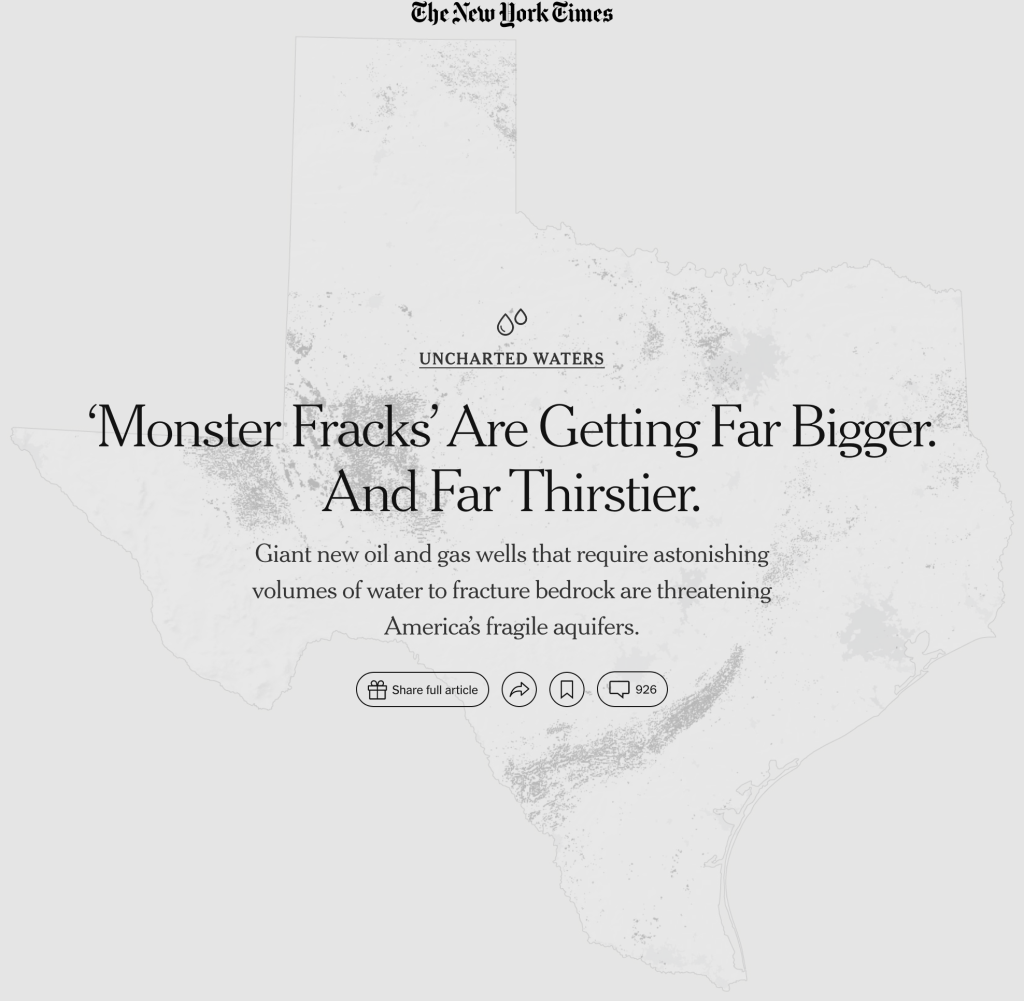
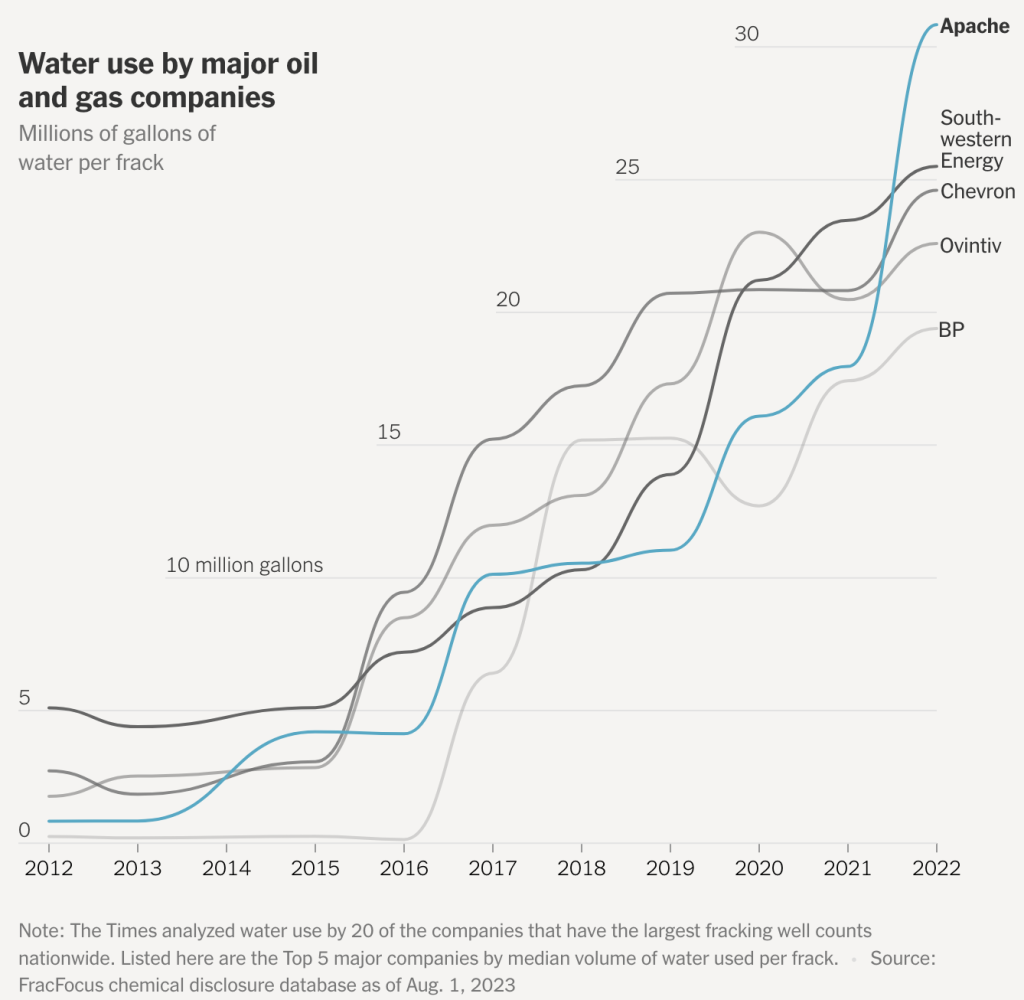
2023: Monster Fracs, getting bigger and thirstier, threatening America’s drinking water aquifers
2020: Harvard researchers suggest not living within 12 miles of frac’ing
A proportion (25% to 100%) of the water used in hydraulic fracturing is not recovered, and consequently this water is lost permanently to re-use, which differs from some other water uses in which water can be recovered and processed for re-use.
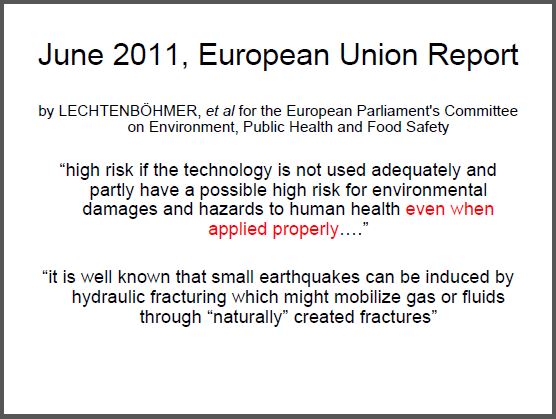
2011: European Union Report on Frac’ing:
“high risk if the technology is not used adequately and partly have a possible high risk for environmental damages and hazards to human health even when applied properly….”
2011:
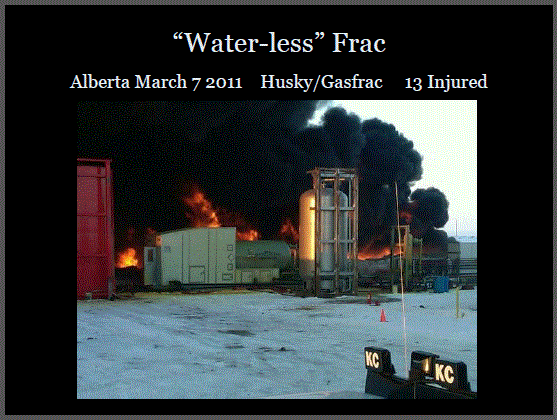
2011: Oil workers suffer burns in blast by Canada’s Occupational Health and Safety Magazine.
Three GASFRAC Energy Services Inc. employees were transported to an Alberta hospital with burn injuries following an explosion and fire on January 14 [2011]. At about 5:30 pm, the employees of the Calgary company were performing gas fracturing – a process that stimulates the production of oil and gas – on a wellsite near Edson, Alberta, when a fire broke out, says Barrie Harrison, a spokesperson for Alberta Employment and Immigration in Edmonton. The site is owned by prime contractor Husky Energy Inc. The propane leak was quickly contained, although the resulting fire damaged the back end of two fracturing pumpers, reports James Hill, chief financial officer of GASFRAC. Of the employees who suffered burn injuries, two were released from hospital and the third remained with second-degree burns to his hands, Hill notes. As a precautionary measure, “GASFRAC has suspended operations until the root cause of the leak has been identified and necessary corrective actions initiated,” notes a company statement. Harrison said following the incident that two orders had been issued: a stop-work order to Husky Energy for work at the site; and a stop-work order to GASFRAC for its gas fracturing equipment.
2011: Husky well fire injures several Alberta workers by Nathan Vander Klippe with files from Josh Wingrove, The Globe and Mail
About a dozen workers were injured after a “flash fire” burst out from an Alberta natural gas well owned by Husky Energy Inc. RCMP reported that 12 workers were hurt, with two evacuated to hospital by helicopter. Officials with Alberta Occupational Health and Safety said the number may be closer to eight, although investigators were to arrive on site Monday afternoon to determine exact specifics. No deaths have been reported, although three people were sent to an Edmonton burn unit. … Bob Curran, a spokesman with the Energy Resources Conservation Board, said the fire burst out as workers were setting up to begin the underground fraccing. Mr. Curran said the well was to be fractured using propane, a technique that has already injured three other workers this year. In January, Gasfrac Energy Services Inc. said a propane leak at one of its work sites created a “short fire.” The company suspended all operations for more than two weeks as it sought to figure out what went wrong.
2009: A Primer for Understanding Canadian Shale Gas – Energy Briefing Note
…
Flow-back water is infrequently reused in other fracs because of the potential for corrosion or scaling, where the dissolved salts may precipitate out of the water and clog parts of the well or the formation.
…
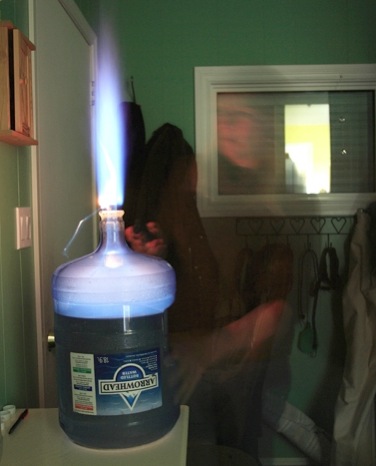
2006: My drinking water after Encana/Ovintiv illegally frac’d the aquifer – with regulator and gov’t blessings – that supplies my water well: