@oilfieldwitness.bsky.social:
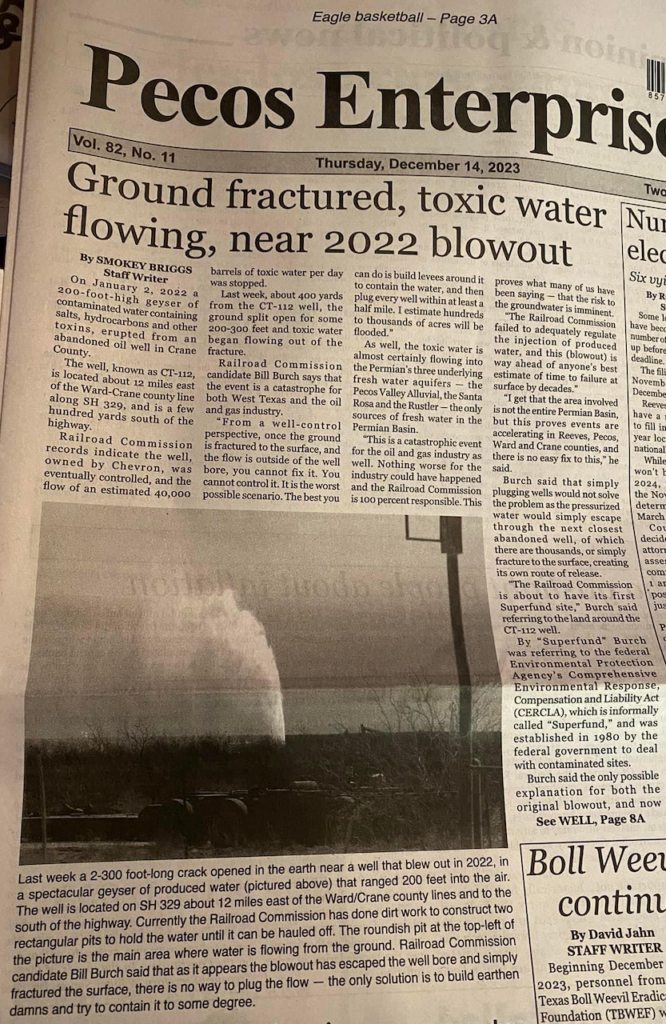
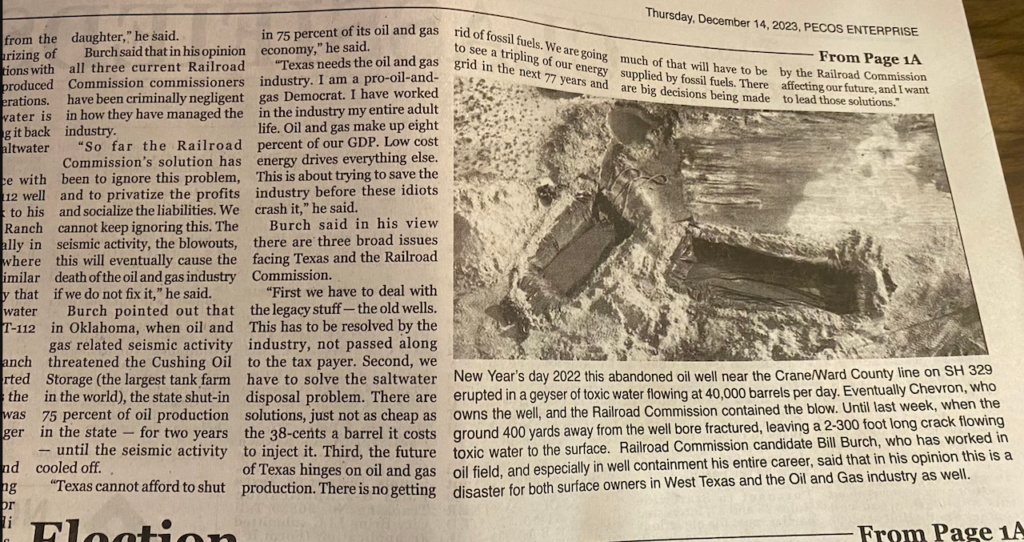
Some great reporting by Bloomberg on the oil wastewater situation in Texas. ….Hawk Dunlap really sums up the problem here:
“The pipe does not lie,” Dunlap said, gesturing to oil bubbling out of a well that was supposedly plugged decades ago. “The Earth is full.”
They are disposing of all of the toxic wastewater by injecting it underground. They were doing it deep but that caused earthquakes so they went shallow. And now its all blasting back to the surface and contaminating groundwater.
The have no solution for this problem.
 Excellent horrifying clip at the top of Bloomberg’s link (need not have subscription to see it):
Texas Oil Boom Spawns a Toxic Crisis of the Industry’s Own Making by Kevin Crowley, David Wethe and Dave Merrill, September 16, 2025, Bloomberg
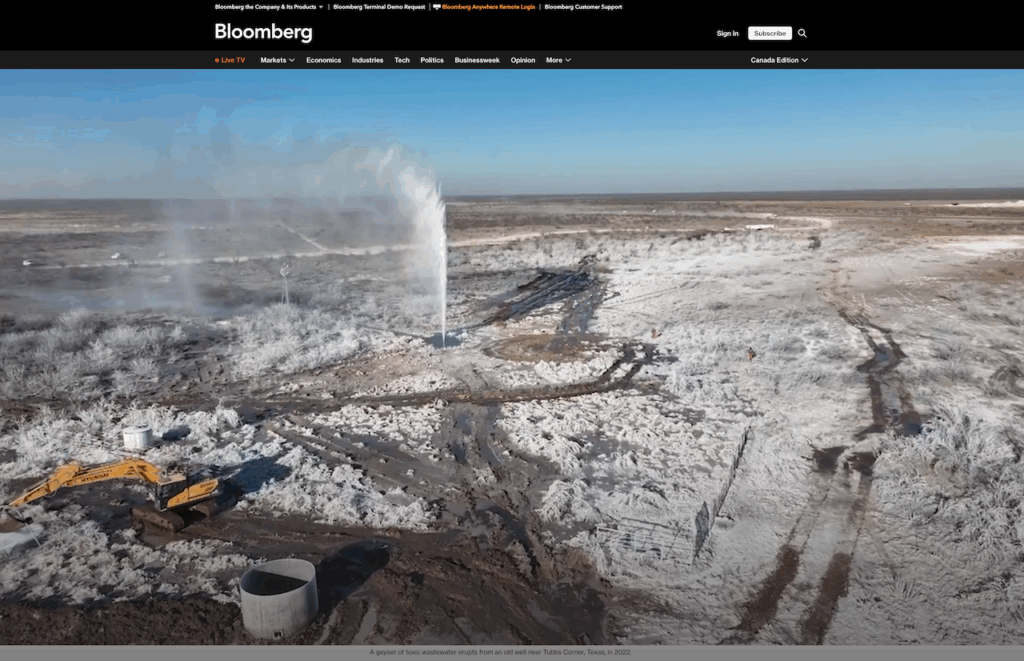
Screen grab from the Bloomberg clip
Hawk Dunlap fought fires and blowouts in oil fields around the world over a 30-year career, but nothing prepared him for what he found when he finally came home to Texas.
There, on the Permian Basin’s dusty expanse, Dunlap encountered towers of toxic wastewater that gushed more than 100 feet (30 meters) in the air, bursting through oil wells cemented shut decades ago. It was unlike anything he’d ever seen in Algeria, Uzbekistan or Iraq.
So was the resistance to his attempts to figure out the cause.
When Dunlap was asked by a rancher to investigate leaking wells owned by Chevron Corp., he expected state regulators to help. Instead the commission that oversees oil and gas operations in Texas directed the ranch’s concerns to its lawyers. Relations with Chevron deteriorated into an acrimonious lawsuit.
nd after the rancher captured drone footage of wastewater spewing high into the sky, the regulatory commission made the area a no-fly zone, citing safety concerns.

“They don’t want to know about it, and they don’t want anyone else to know about it,” he said on a sweltering afternoon in West Texas, pausing to spit chewing tobacco into an empty Topo Chico bottle. “But I don’t back up too easy.”
Three years after Dunlap began investigating, the wells are still leaking. The problem of too much wastewater is spreading across America’s biggest oil field, posing a pressing threat to a basin that has grown into a cornerstone of global markets and is critical to President Donald Trump’s push for energy dominance.
For each of the 6.4 million barrels of crude produced in the Permian every day, about three to five barrels of salt and chemical-laden wastewater flow back out and must be disposed of underground. By 2020, the volume had grown so large it was triggering earthquakes that were felt hundreds of miles away, prompting state regulators to tighten disposal limits.

Documents obtained by Bloomberg News through the Texas Public Information Act show that operators lobbied the state oil and gas regulator — the archaically named Railroad Commission of Texas — for a compromise: They would stop injecting into deep geologic zones near where the earthquakes were occurring if they could shift their wastewater to shallow ones instead.
But as the Railroad Commission, or RRC for short, was considering the idea in October 2023, some of its staff identified several environmental problems connected to shallow disposal, the documents show.
The practice was already causing “regional ground uplift” from bulging underground reservoirs filled to the brim and “break outs” of oilfield waste onto the surface, they said in an internal presentation.
They were the same type of leaks that shocked Dunlap.

Despite the evidence, the RRC granted a concession to the industry in January 2024, suspending injection into deep geologic zones near the Texas-New Mexico border while offering to “amend the permits for these wells for injection into shallow strata.”
The decision provided a crucial outlet for oilfield waste, helping crude production to keep growing.
Companies have now pumped so much wastewater underground that the Permian’s shallow reservoirs are filling up, exerting pressure on the thousands of oil wells drilled in the region over the past century, according to Heather DeShon, professor of geophysics at Southern Methodist University in Dallas. With each old well representing a potential pathway to the surface, ranchers are concerned that drinking water could be contaminated. Meanwhile, oil producers including ConocoPhillips have warned of their reserves being partially flooded out.
Read more: Texas Land Agency Warns Fracked Water Is Threat to Oil Fields
In a statement to Bloomberg News, the RRC said it has “successfully reduced” earthquake activity in the region. Allowing disposal wells to convert from deep to shallow “in no way compromised the RRC’s protective standards on injection pressure, volume or other technical requirements that would jeopardize environmental safety,” the commission said.RRC fuckers lie like Trump and AER/Encana/Ovintiv/Alberta gov’t.

In June, the RRC tightened limits for new shallow disposal wells as it recognized “the physical limitations of the disposal reservoirs” as well as risks to oil production and fresh water.
But as the industry and legislators now rush to find alternative disposal methods, which are likely to come at a much higher cost, the wastewater dilemma is raising questions about whether the RRC should have taken action sooner and whether it’s too close to the industry it regulates.


In spite of its name, the Railroad Commission of Texas has nothing to do with trains. Founded in 1891 to stop railroads from charging usurious rates, the agency shed its last ties to transportation in 2005 and now regulates almost every aspect of oil and gas in America’s top crude-producing state.
Many state regulators are appointed by the governor or legislature. The RRC, in contrast, is led by three commissioners elected by Texas voters to six-year, staggered terms.
The current commissioners, all of whom are Republicans, regularly praise the state’s oil and gas prowess and laud Trump’s policies favoring fossil fuels.
The RRC’s supportive regulatory approach helped usher in the shale revolution in the 2010s, an oil boom unlike anything the world had ever seen. As the industry perfected horizontal drilling and fracking — blasting water, sand and chemicals underground to break apart rock and allow oil to flow — the Permian turned the US into the world’s biggest oil producer.
Since the water is expensive to treat, the industry pumps nearly 16 million barrels a day back underground, according to industry consultant B3 Insight. Currently that’s almost as much as is used in Chicago, America’s third-largest city. But B3 Insight forecasts this figure to increase 39% by 2035If, and it’s a big fucking if, there is any life left on earth with the industry polluting as disgustingly as it does, enabled by corrupt shit-filled “regulators” and stupid buffoons like Adolf Orange and his Nazis as oil production grows and shifts to more water-intensive formations.
The RRC has long known that underground water disposal increased the risk of earthquakes. The practice was found to cause seismicity in North Texas around 2008 because the fluid put pressure on natural rock faults, leading them to slip. But the tremors in the early days of the Permian’s growth were small, and the RRC was content to take a “reactive not proactive” approach to seismic activity, according to one internal presentation.
The RRC adopted guidelines for permitting disposal wells in seismically active areas in 2019 but was forced to change tack on March 26, 2020, when a 4.9 magnitude earthquake struck near Mentone, Texas, in the heart of the Permian. It was the fifth-biggest in the state’s history and was felt 200 miles away in El Paso.
It didn’t take long to figure out the cause. RRC State Seismologist Aaron Velasco said in a November 2021 presentation that the wastewater injection was “up steeply” six to nine months prior to the tremor, and cited research from the University of Texas that said disposal was the “mostly likely” cause of the seismicity.
From 2021 to 2023, more than 200 earthquakes in the state registered 3.0 or above annually, ten times higher than in 2017, according to the TexNet Earthquake Catalog.

The RRC established so-called Seismic Response Areas, within which it could restrict water disposal. It also created “operator-led response plans” in which oil companies would share data and coordinate efforts to reduce earthquakes.
Crucially, it also allowed them to participate in the RRC’s rule-making process.Sounds mighty corrupt, like AER
The stakes were high: Any reduction in water disposal allowances could, in theory, force operators to cut oil production.
But the industry got some breathing room. Water disposal curtailments would be made “preferably voluntarily with broad industry cooperation,” RRC staffers wrote in a September 2021 presentation.

It would not be a “prescriptive, pre-determined suite of limitations or restrictions.”
Oil and gas lawyer Sarah Stogner was hunting feral hogs on a friend’s ranch in West Texas in mid-2021 when she spotted what looked like crude bubbling from a rusty pipe sticking out of the brush. Soon after, she found another leak. And then another.
Ashley Watt, who owns the 22,000-acre (8,903-hectare) Antina Ranch in Crane County, became alarmed and tested a water well that supplied her home. It was saltier than the ocean.
Stogner and Watt used county records to trace the leaks to Gulf Oil. A predecessor of Chevron, the company drilled for crude on the ranch in the 1950s. Decades after they had stopped producing, the wells appeared to be coming back to life.
Stogner, who was elected district attorney for an oil-rich area of West Texas late last year, dubbed them “zombie wells” and posted about them on social media. She reached out to Chevron and the RRC to clean them up and figure out the cause.
Unsatisfied by what they perceived as a lack of action to fix the problem, Watt and Stogner took their concerns to the RRC’s three elected commissioners at a public meeting in 2021.
“The well has been blowing out toxic radioactive brine directly into three separate freshwater aquifers,” she said at the meeting. “It appears the reservoirs under this ranch have been filled past the breaking point.”
It would prove to be a prescient analysis.

Commissioner Wayne Christian replied that his staff would be in touch, but both Stogner and Watt say the regulator still hasn’t fully addressed the problem. “They are openly hostile to us in favor of the oil and gas companies,” Watt said.
The RRC is fulfilling its “critical mission to protect the residents and environment of Texas,” it said in a statement.

The regulator has “performed inspections and investigated complaints” on Antina Ranch while its staff has continued to work with Watt and Chevron on clean-up efforts, it said.

Stogner and Watt turned to Dunlap as they prepared legal action. He formerly worked as a well control specialist at oilfield contractors including Boots & Coots, which helped extinguish the Kuwaiti oil blazes in the 1991 Gulf War and whose founders worked with legendary oil-well firefighter Paul “Red” Adair.
Dunlap performed pressure tests and checked the casing on more than 150 wells, he said. According to Dunlap, almost all of them have leaks caused by a build-up of underground fluid pressure around poorly plugged wells.
It all pointed to one culprit, Stogner thought: the vast volumes of wastewater being pumped underground by the Permian’s shale oil industry.
Watt sued Chevron in December 2022 for remediation and lost earning potential from not being able to use her land. In court documents, Chevron argues Dunlap’s analysis has no basis in fact. The case has dragged on for years due to arguments over how many wells are leaking and how they should be fixed.
Chevron has successfully re-plugged several wells on the ranch and is attempting to remediate others, the company said in a statement. “However, over the course of the case, Ms. Watt has opposed Chevron’s efforts, and Chevron has been forced to seek court intervention to proceed with its plugging operations,” the company said.Poor frac baby!

A Texas judge recently sided with Chevron in a dispute related to access to the property. Daniel Charest, Watt’s trial lawyer, says Chevron’s plugging methods have failed to address the underlying cause of the leaks. “We’ve kicked them off the property when they’ve cut corners, when they’ve not done the job correctly,” he said.
A trial is set for January 2026.
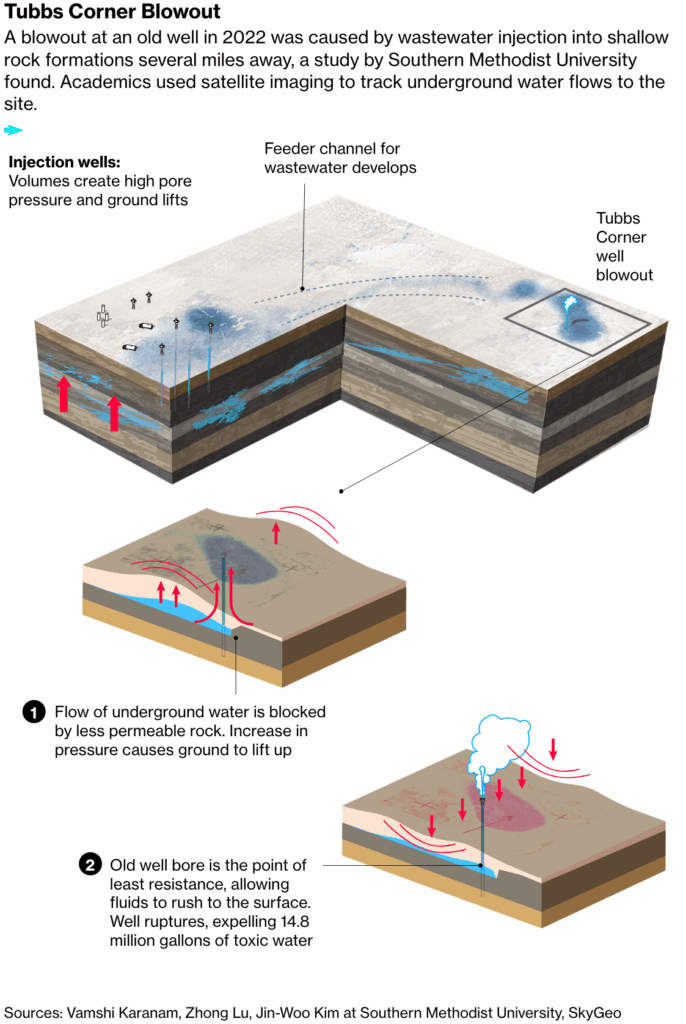
Back in the oil field, the leaks were getting worse. A few months after Stogner warned the RRC about rising underground pressure in 2021, an orphan well at a property neighboring Antina Ranch exploded, shooting saltwater and oil residue into the air for two weeks.
The geyser was so toxic it killed all the vegetation it touched. Using satellite imaging, researchers from Southern Methodist University later found that wastewater injection volumes several miles away “strongly” correlated with a 15.7-inch uplift in the ground near Tubbs Corner, Texas.
“Several more such blowouts are possible in the near future,” they said.
Meanwhile, earthquakes were also growing in intensity. As they reached record levels in 2022, the RRC realized its initial response was too weak.

“Recent events indicate that the original scope was likely not as aggressive as it should have been, or that it should be now and going forward,” Paul Dubois, the RRC’s assistant director for technical permitting, wrote in a letter to Chevron in November 2022.First thing all oil industry “regulators” need to do, is expunge the word “should” from any use, verbally and in writing!
 The text box contents didn’t copy; in the article, the box contains the highlighted text above in larger font, same with those below
The commission proposed wastewater curtailments in both deep and shallow areas in the Permian’s Delaware sub-basin near the Texas-New Mexico border.
Almost immediately, operators started to push back on the new rules.

They agreed to limit deep injection, but lobbied the RRC to allow more disposal in shallow areas.
After all, the Permian’s oil production was growing fast, and its wastewater had to go somewhere.

WaterBridge, a disposal specialist, Chevron and others argued in presentations to the operator-led response group that shallow disposal did not cause earthquakes.!!!! Dirty fucking liars!!!!! Representatives for WaterBridge declined to comment.

The companies’ presentations reviewed by Bloomberg focused narrowly on seismicity. They did not mention other risks related to shallow disposal, such as the blowouts Dunlap and Stogner were seeing in the field. Even so, the RRC agreed to consider “options for reducing restrictions on shallow injection” in July 2023, according to an internal presentation.
Soon after, RRC staff began warning of hazards related to shallow disposal in the Delaware sub-basin.
“Shallow disposal formations are pressure constrained,” they wrote in an internal presentation in September 2023. They also noted their “concern” for “containment” within shallow rock formations.
The findings supported what Stogner told the commission at the public meeting two years earlier.
An internal RRC presentation in October 2023 cited evidence of more hazards. It showed a map of a dozen leaking sites near the Texas border with New Mexico. “Break-outs reported by field operations could be linked to shallow disposal,” RRC staff wrote, referring to leaks.

The map showed ground surface deformation over five counties along the state line, with the ground lifting up in some parts and sinking down in others. The difference between the extremes on the map, sourced from the University of Texas, was 29 centimeters, or nearly a foot.
Ground uplift in the worst affected area, which contained five of the leaking sites, “is correlated with shallow disposal,” according to the presentation.

RRC staff also said they had received “complaints” from operators about “the seismic review of shallow applications when the seismicity is mostly linked to deep disposal.”
Less than three months later, the RRC wrote to companies including Chevron, Coterra Energy Inc. and BP Plc to suspend deep injection in the northern Delaware sub-basin. But the regulator offered “alternative relief to ease the transition away from deep disposal,” Ivan Salas, the commission’s injection-storage permits unit manager, said in the December 2023 letters.
An example of this relief included “easing permit limitations on shallow disposal.”
If deep disposal permits were suspended, companies could apply for them to be amended for shallow disposal instead, Salas said. “RRC staff will expedite review of these applications.”Of course they fucking will, regulators everywhere, always serving the insane destructive polluting frac’ers while enabling more and more harms to the harmed. Douche Fuckers Supreme.

Shallow disposal, and distributing water further afield through pipeline operators, was “the next best currently available alternative after we were compelled to stop deep disposal,” said Scott Neal, Chevron’s general manager for asset development for the Permian. BP said it signed a deal to move water away from the area earlier this year. Coterra declined to comment.
In a statement, the RRC denied that shallow disposal permit restrictions were ever eased and that it blocked some deep-to-shallow conversions when they did not meet technical standards. All permits go through a “rigorous review process,” it said.

Asked whether it considered banning all disposal given the environmental concerns, the RRC responded: “The suggestion, even as a hypothetical, to simply suspend all deep and shallow disposal in the highest-producing oil field in the nation is untenable at every level and would cripple US hydrocarbon production, impacting jobs and jeopardizing our national security and energy independence.”Narrow minded frac pimps, like Canadian energy regulators.
A month after Salas sent the letters, RRC staff met in Houston with the Texas Pipeline Association, an industry lobbying group, to give companies a detailed update on potential regulatory changes. In a presentation dated January 2024, Dubois, the assistant director for technical permitting, listed eight “hazards from increased reservoir pressure.”
They included “confinement failure,” “surface flows,” and “harm to underground sources of drinking water.”

Eventually, some 80% of water disposal in the earthquake-prone area near the Texas-New Mexico border shifted from deep to shallow disposal, according to an RRC letter to the US Environmental Protection Agency in August 2024.
But old wells continued to erupt around the Permian.
In October 2024, Dunlap went out to investigate a geyser that consisted of wastewater and the deadly gas hydrogen sulfide. It was shooting high in the air from an old well near Toyah in West Texas in a similar fashion to the one in Tubbs Corner two years prior. When no one showed up to deal with it, he pulled well records, traced ownership to Kinder Morgan Inc. and corresponded directly with the pipeline company. It took more than a week to shut down the well. Kinder Morgan declined to comment.Douche Fuckers! How many brains did they harm in those two weeks? How many wild beings did they kill?


Ultimately, in June of this year — roughly 18 months after authorizing the shift from deep to shallow — the RRC introduced new permit restrictions aimed at preventing well blowouts and surface leaks. The agency now requires operators in vulnerable areas to limit underground injection pressure and disposal volumes and increase space between wells.
The decision comes nearly four years after Stogner warned the commission about wastewater risks.
“They see me as attacking the industry,” she said. “But I wasn’t trying to attack the oil and gas industry. I was just trying to say, ‘This is reality, and we have to deal with reality.’”
Academics, companies and state officials acknowledge that wastewater practices need to change.Indeed! This is what needs to happen, globally:
Chevron, alongside other Permian operators, wants to recycle more wastewater for fracking, move disposal to less concentrated areas and invest in alternatives to disposal such as desalination and cleaning the water for use in irrigationNO! Companies will never clean their waste properly, this is angling towards dumping the waste directly into water bodies, and onto farmland, under the guise of saying they’ll treat it when they bloody well know they won’t – they are too cheap and dirty! Like the asshole tarsands companies demanding in Alberta to empty their massive toxic waste lakes directly into the Athabasca watershed, with a tiny tit of promised cleaning when we all know there will be none and cooling data-centers. Hello Radioactive AI!
“We’ve been in the Permian for 100 years, and we plan to be here for decades to come,” Chevron’s Neal said. “We understand the importance of environmental protection. We are going to part of the solution — we are going to be part of what comes next.”
Options for cleaning up water could be costly and take years to implement at scale. They’re also a long away from the reality in Crane County.
“The pipe does not lie,” Dunlap said, gesturing to oil bubbling out of a well that was supposedly plugged decades ago. “The Earth is full.”
With assistance from: Cedric Sam
Editors: Christine Buurma, Joe Ryan and Alex Newman
Photo editors and production: Marie Monteleone and Sophie Butcher
Toxic Shale Drilling Wastewater Threatens Top Oil Fields, Texas Agency Warns, A Texas agency overseeing 13 million acres of state land is warning that toxic waste fluid from shale drilling threatens to contaminate oil wells in North America’s most prolific crude basin by David Wethe and Kevin Crowley, Aug 11, 2025, Bloomberg in Financial Post Canada’s own American Repuglican controlled and owned propaganda outlet
A Texas agency overseeing 13 million acres of state land is warning that toxic waste fluid from shale drilling threatens to contaminate oil wells in North America’s most prolific crude basin.
The General Land Office of Texas, which was founded in 1836 and generates billions of dollars for public schools by leasing land to oil companies, said plans by Pilot Water Solutions LLC to add three wastewater disposal wells in the Permian Basin near New Mexico would damage its nearby oil reserves.
ConocoPhillips, one of the largest producers in the basin, is also arguing against the proposal. As of March of last year, the company says it only produced 37% of the oil it expected — while generating almost double the amount of water — in the area near Pilot’s proposed disposal wells.
The pushback from the General Land Office and ConocoPhillips underscores how the wastewater problem has reached a new level of urgency. As many as five barrels of water are produced for each barrel of Permian oil, creating a major disposal dilemma.
For years, environmentalists and ranchers sounded the alarm about earthquakes and geysers caused by pumping the fluid underground. But as Permian oil output hits fresh records, the situation has grown more acute.
“Disposal of waste should not be done in a manner or location that endangers oil and gas resources,” Dawn Buckingham, commissioner of the land office, wrote in a June 2 letter to the Texas oil regulator. She said the wastewater — possibly from outside of Texas — injected into Pilot’s wells “could have a detrimental impact on oil and gas revenue constitutionally dedicated to the schoolchildren of this state.”
ConocoPhillips is the biggest producer yet to raise concerns about wastewater, but it’s far from the first.
Coterra Energy Inc. warned investors last week not to expect any oil production this year from wells that were contaminated by wastewater leaks. Before that, closely held New Mexico producer Stateline Operating Co. filed suit against Devon Energy Corp. and Aris Water Solutions Inc., alleging that toxic water leaked from the companies’ disposal wells into its production zones and rendered its reserves worthless.
Operators “are now filing more protests than they were in the past,” said Derek Cook, a Midland, Texas-based attorney at DDC Law Pllc, who is not involved in the ConocoPhillips vs Pilot case.
“They can see the real risks and problems disposal can cause to their prime investment, which is the mineral estate,” Cook said.
For its part, ConocoPhillips says water from Pilot’s proposed wells “will render a substantial amount of otherwise recoverable oil and gas reserves to be permanently left in the ground,” according to a May filing with the Railroad Commission of Texas, which regulates the oil industry.
Closely held Pilot said in a rebuttal to ConocoPhillips that its application for new wells meets or exceeds all legal requirements. It added that “in light of regional pressure concerns,” the water handler’s application includes measures that are stricter than Railroad Commission rules for disposal wells.
ConocoPhillips’ argument is “riddled with hedging language demonstrating its own lack of confidence in its hypothesis,” Pilot said in a May filing.
The protest is still pending in the hearings division of the Railroad Commission, which recently warned that wastewater from fracking is causing a “widespread” increase in underground pressure that could harm oil reserves and freshwater resources. Representatives for ConocoPhillips, the Railroad Commission and the Texas General Land Office declined to comment.
Opposition to disposal wells has long been used by other water handlers as a way to gain leverage or slow down competitors, said Patrick Patton, vice president of product at B3 Insight, an industry water consultant. About five years ago, the Railroad Commission began to limit protests to only those directly impacted, he said.
One of those protests recently prompted Aris’ Solaris Water Midstream to scrap plans for a handful of water disposal wells in the central Permian Basin. The area — east of the zone that’s at the heart of the ConocoPhillips and General Land Office complaints — has so far seen less wastewater injection than other places, but has seen its effects in the form of surface leaks.
Contango Resources LLC, a subsidiary of Crescent Energy Co., had argued in a November filing that four of Solaris’ proposed disposal wells could leak dirty water into its production zone and “create mass degradation” of its oil and gas resources nearby.
But Solaris, whose parent company Aris recently agreed to be taken over by Western Midstream Partners LP for $1.5 billion, said last week that it won’t move forward with four wells. Solaris didn’t immediately respond to requests for comment, while a spokesperson for Crescent declined to comment.
As Permian wastewater problems proliferate, drillers are clamoring for information. After Coterra discussed the issue on its first-quarter earnings call in May, the company soon learned that it was not the only producer grappling with well contamination, Chief Executive Officer Tom Jorden said at a JPMorgan conference in New York in June.
“As soon as our call finished,” he said, “our phone rang with other operators having the same problem, wanting to talk about it.”
Refer also to: