@armineyalnizyan.bsky.social:
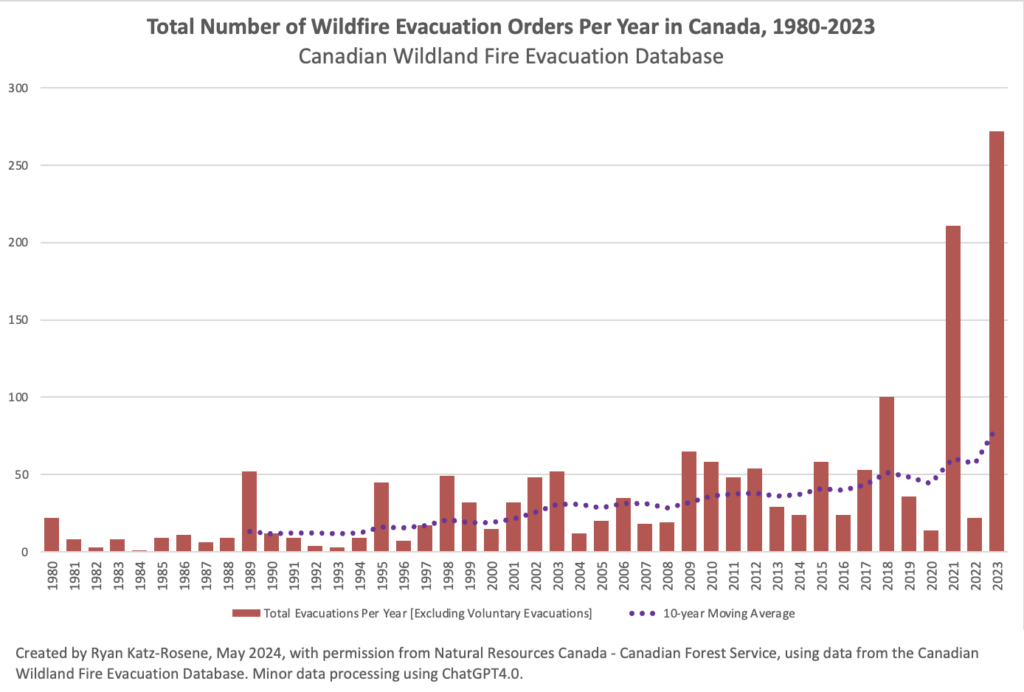
My god look at Canada
@ianhall.bsky.social:
A new study shows that extreme fire years in global forests are 88-152% more likely now than they were in pre-industrial times, driven by climate change.
…necessitating proactive measures to mitigate risks and adapt to extreme fire years.
@marvbeatty.bsky.social:
We go through so-called “bad fire seasons” almost every two years in B.C. now. If you’re here and need studies to help you understand that human-induced climate change is not only happening, but is a serious problem and is only getting worse … then you need to open your eyes.
@winderwinder.bsky.social:
Bye bye boreal
Climate change has increased the odds of extreme regional forest fire years globally
- John T. Abatzoglou,
- Crystal A. Kolden,
- Alison C. Cullen,
- Mojtaba Sadegh,
- Emily L. Williams,
- Marco Turco &
- Matthew W. Jones
July 10, 2025, Nature Communications volume 16, Article number: 6390 (2025)
Abstract
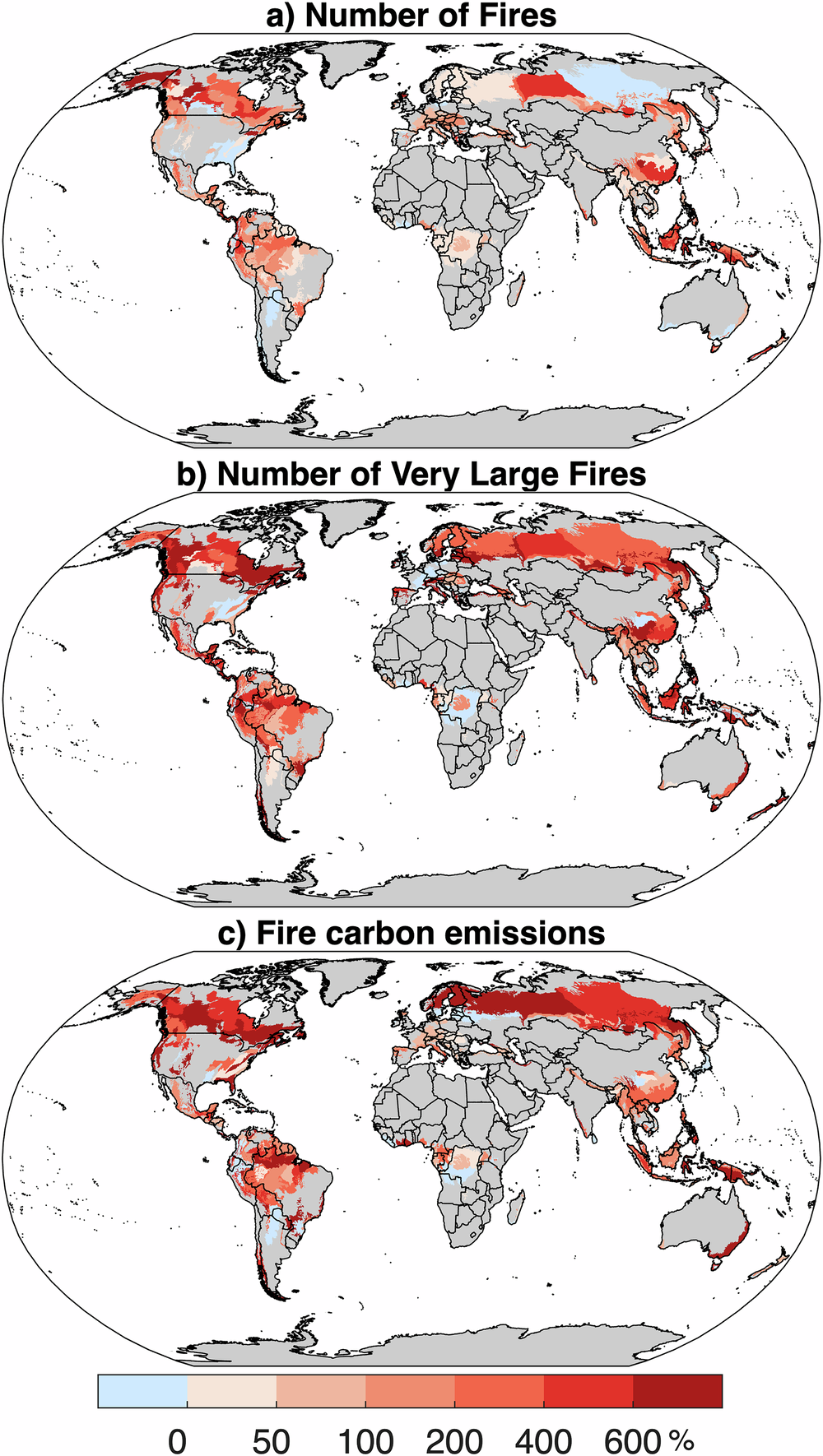
Regions across the globe have experienced devastating fire years in the past decade with far-reaching impacts. Here, we examine the role of antecedent and concurrent climate variability in enabling extreme regional fire years across global forests. These extreme years commonly coincided with extreme (1-in-15-year) fire weather indices (FWI) and featured a four and five-fold increase in the number of large fires and fire carbon emissions, respectively, compared with non-extreme years. Years with such extreme FWI metrics are 88-152% more likely across global forested lands under a contemporary (2011–2040) climate compared to a quasi-preindustrial (1851–1900) climate, with the most pronounced increased risk in temperate and Amazonian forests. Our results show that human-caused climate change is raising the odds of extreme climate-driven fire years across forested regions of the globe, necessitating proactive measures to mitigate risks and adapt to extreme fire years.
…
Fig. 3: Fire characteristics during extreme regional fire years.
…
Discussion
Prior research has shown strong intra-to-interannual climate-fire relationships at regional scales2,15,16 and the role of weather in driving extreme fire events30. This study adds to this body of work by demonstrating that extreme regional fire years across forested areas of the globe typically coincide with statistically rare fire weather conditions (e.g., chronically high FWI, days exceeding the 95th percentile FWI), quantified with a 1-in-15-year recurrence interval. While previous studies have alluded to such relationships on limited geographic scales in the modern and historical record4,38,39,40, our findings show these results to hold for most forested lands globally outside of regions dominated by deforestation and forest degradation. Similar to other climate extremes, the FWI extremes examined here are a product of multiple interacting drivers on the weather-climate continuum. These drivers include prolonged periods of simultaneous warmth and aridity41, accentuated by persistent meteorological patterns42, and capstone weather events at the apex of fuel drying, such as dry frontal passages, pyrocumulonimbus events, and downslope winds43.
Extreme regional fire years in temperate and boreal forests, which tended to occur in the latter portion of the record, often occurred in years with extreme FWI metrics. Extreme fire years in temperate forests of the Mediterranean Basin, Chile, the western US, and Australia have been additionally exacerbated by excess fuel abundance and fuel continuity stemming from fire suppression, abandonment of rural agriculture, forestry practices that favor high-density monocultures, and the introduction of flammable non-native species44—all of which favor fires that resist fire suppression coincident with extreme fire weather. Moreover, concurrent widespread fire weather extremes increase potential for favorable fire growth across broad regions that can feed back to limit the efficacy of fire suppression efforts17.
Conversely, we found a different response for regions that were dominated by forest degradation (Amazon, Southeast Asia) and widespread anthropogenic fire use, including prescribed burning (e.g., southeastern US). Extreme fire years in tropical biomes qualitatively occurred in places subject to deforestation–agricultural burning that coincided with moderate-to-severe drought conditions. The tendency for most of the most extreme fire years seen in tropical ecoregions in the first decade of the study period (Fig. 1b) may be a product of waning deforestation rates45. Conversely, 2024—which was outside of our study period—had the highest burned area on the MODIS record for parts of the Amazon, coinciding with extreme drought and record chronic FWI46. Notably, we show here that Amazon was one of the global hotspots of escalating odds of FWI extremes with continued climate change.
The lack of unifying relationships between extreme fire years in forested areas and antecedent moisture in the prior one to two years is consistent with these regions being primarily flammability-limited and less dependent on factors influencing antecedent vegetation productivity2,47. Longer-term drought was not as closely linked to extreme fire years as within fire season FWI metrics, similar to findings in the western US48. Likewise, our focus on surface fire weather metrics does not account for the potential for other atmospheric drivers, such as instability that contribute to plume-dominated fires or widespread lightning events in ignition-limited fire regimes49 facilitating extreme fire years. Lastly, while these results hold for forested ecoregions globally, there are distinctly different biophysical constraints in fuel-limited grassland and shrubland-dominated regions, suggesting that our findings between extreme FWI and extreme fire years are not transferable to non-forested landscapes.
We demonstrate that human-caused climate change has significantly increased the likelihood of extreme regional fire years in global forested areas. Prior work has shown that anthropogenic climate change has and is projected to increase fire weather for parts of the globe36,50,51, and a few studies have focused on changing probabilities of extreme fire years, albeit at limited geographical scales52. Here we find that the likelihood of 1-in-15-year FWI extremes—comparable to the magnitudes coincident with the most extreme regional fire years this century—are 88-152% greater across forested ecoregions under contemporary climate (2011–2040) than under a quasi preindustrial climate (1851–1900) with robust results across the climate models used herein. Our findings largely align with limited regional attribution studies in terms of the direction of change27,28,53, although they differ in magnitude due to varied choices of indicators, attribution approaches, spatial scales, models, and specific thresholds used (e.g., event-attribution studies often use thresholds based on events versus the generic thresholds used herein). Models with multiple ensemble members were used to aid in robustness. However, we are limited by only using output from nine climate models that had the necessary meteorological variables for calculating FWI and furthermore are unable to resolve finer-scale changes that might be pertinent to extreme fire weather or land-surface feedbacks, given the use of non-downscaled climate model output.
Our results are particularly important in the context of fire management—historically, response-driven fire management has focused on suppressing individual wildfires as they arise with the assumption that sufficient emergency response resources will be available to deal with both existing and new fires. Region-wide extreme fire years, however, have demonstrated the fallacy of this strategy, as suppression resources are overwhelmed by the high number of large wildfires burning simultaneously, and demand exceeds supply. While climate mitigation efforts to reduce greenhouse gas emissions remain crucial2,12, adaptation strategies will be vital in improving readiness and resilience in at-risk regions. These on-the-ground efforts take several forms: proactive fuel reduction at local scales to reduce fire intensity and weaken climate-fire sensitivity, fire prevention efforts to minimize human-caused ignitions, and adaptation measures to minimize direct and indirect impacts of fires on communities and ecosystems54. With increasingly extended fire seasons, resource limitations will necessitate a shift in fire management tactics to be less reactive and suppression-oriented and become more proactive in restoring beneficial fire and preparing landscapes and communities to withstand fire and mitigate disastrous outcomes.

Refer also to:
Canada: Total number wildfire evacuation orders annually (1980-2023)
New study says after wildfires we must clean our homes, contents, clothes and replace HEPA filters.
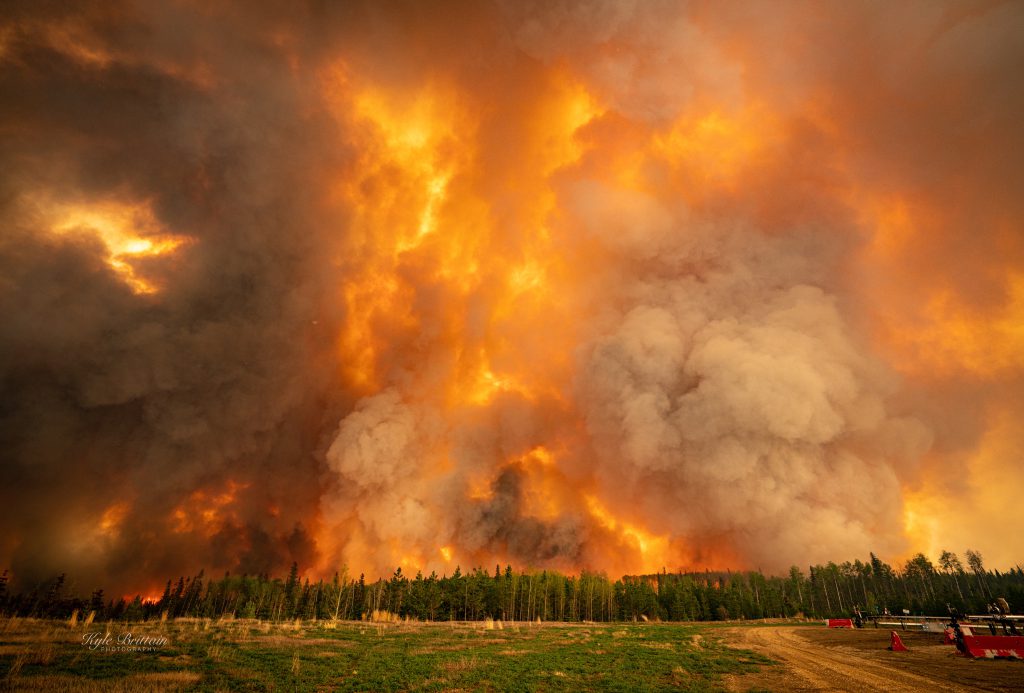
Photo by Kyle Brittain