
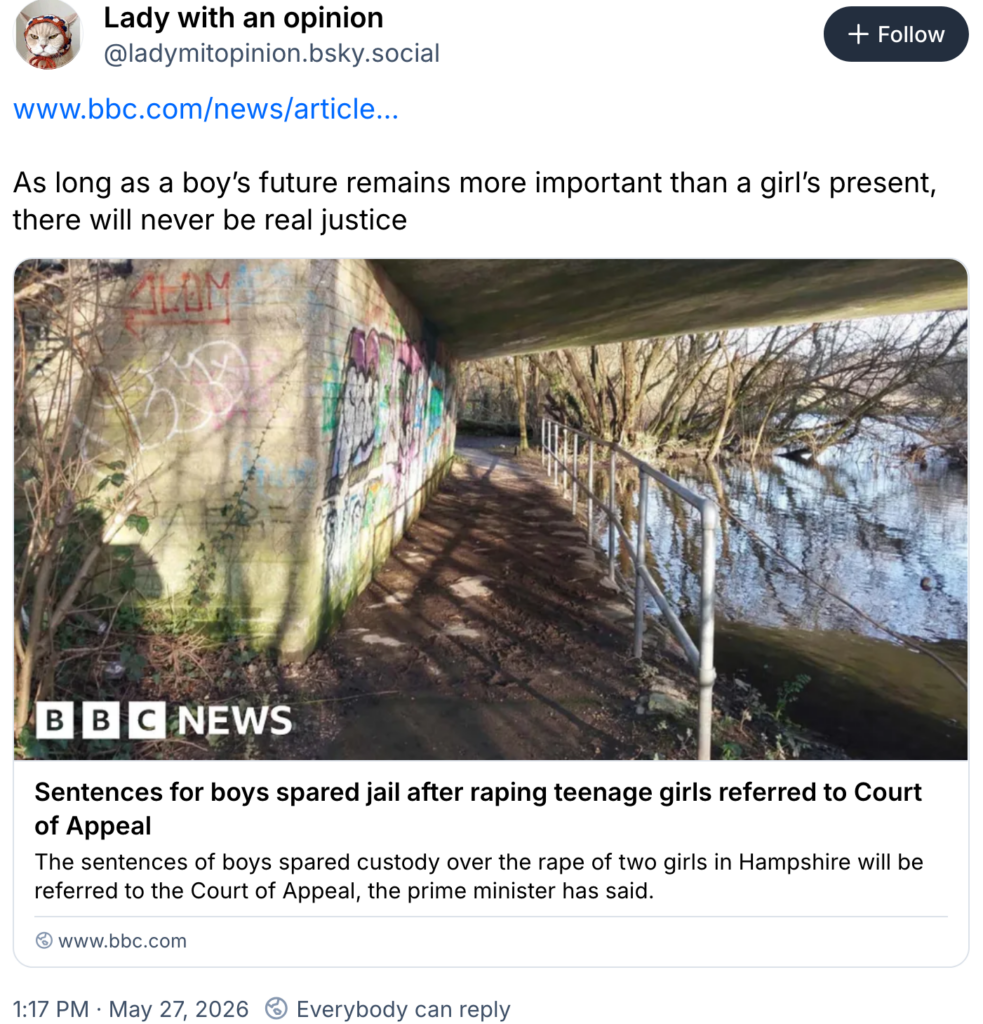
Teenage boys avoid jail after rape and sexual assault of girls in north-east England, Exclusive: Calls for urgent change after rehabilitation orders and ‘laughable’ £26 in court fees in three separate cases by Vikram Dodd, 29 May 2026, The Guardian
Three teenage boys convicted of the rape and serious sexual assault of girls as young as 14 were given rehabilitation orders and paid £26 in court fees, the Guardian has learned.
The three separate cases all took place over the past year in north-east England. They were tried under youth court rules that deal with suspects aged 17 or under and place a greater emphasis on rehabilitation than adult courts.
One victim, who was 15 when she was raped, said: “It feels like he just got away with it.” She said she was scared she would bump into her attacker, and that such sentences would give boys like him, who were a danger to women and girls, a sense of impunity.
One justice group said the fees of £26 were less than a parking fine. In one case, a boy avoided prison after he was found guilty of three attacks, including a rape.
There was public anger over a case in southern England last week in which three teenage boys were given youth rehabilitation orders after two were convicted of rape and one was convicted of involvement in the attacks. The victims were two girls aged 15 and 14, who were attacked in separate incidents in Fordingbridge, Hampshire.
Those sentences have been referred to the court of appeal by the attorney general, the government’s top law officer, for being unduly lenient. Keir Starmer described the case as “appalling”.
Youth courts are normally closed to the public. But specialist advisers to the young girls in the three newly revealed cases were so appalled by the sentences that they decided to expose the punishments being passed in youth courts for serious sexual offences.
In one case, a male aged 14 at the time of his offences was found guilty of raping a victim aged 16 or over in August 2023, as well as sexual assault by penetration in August 2023 and the sexual assault of a girl aged 15 in February 2023.
He was sentenced under youth court rules in a hearing at Teesside magistrates court on 4 December 2025 and given a youth rehabilitation order, and was placed on the sex offender register for 30 months.
In another case, a boy aged 15 was convicted of a serious sexual assault against a girl aged 14. He was found guilty of sexual assault by penetration in April 2024.
The boy was sentenced in July 2025 and placed on the sex offender register for 42 months, and given a youth rehabilitation order and a restraining order preventing him from approaching or contacting the victim.
In a third case, a 17-year-old male was sentenced in September 2025 after being convicted of the rape of a girl aged 15. He was given a youth rehabilitation order and was put on the sex offender register for 30 months. The convicted rapist turned 18 this month.
The sum of £26 is imposed as a surcharge on all youth defendants who receive a youth rehabilitation order, regardless of the offence committed and is used to fund victim services.
The victim in that case, now aged 16, told the Guardian her attacker should have been jailed. “I didn’t feel as though the punishment given was justice for me and what happened. He is still able to live his life normally and do what he wants,” she said. “This isn’t a deterrent for others. Boys think they can do what they want so they make bad choices and take bad actions.”
Explaining why she believed imprisonment was the right sentence, she said: “That way he would have time to reflect on what he did and it would mean this didn’t happen to anyone else because of him.”
She was 15 when attacked by the boy, whom she knew, and she said her rapist being freed by the court despite being convicted had added to her continuing trauma.
“I am worried about bumping into this person and I am worried for other people in case he does this again after no real consequence,” she said. “I don’t know where he is or what he is doing. I am constantly looking over my shoulder. I trust people less because of this.”
She added: “It would be good for the public to know the struggles with emotions this has caused and to understand the impacts on me as a young person.”
She said her attacker had made a choice to rape her and should be on the sex offender register for life, not 30 months.
These cases only came to light because official victim advocates from the Rape and Sexual Abuse Counselling Centre (RSACC) covering Darlington and County Durham, who attended court to support the victims, witnessed the sentences and were horrified.
They first raised concerns within the criminal justice system but said there had been little or no sign of action. They believe radical change is urgently needed.
Isabel Owens, the chief executive of RSACC, said: “It takes incredible bravery for a survivor of sexual violence to report what has happened to them. We are deeply concerned about the trend we are seeing towards more lenient consequences for young perpetrators’ actions and the impact this may have on behaviours and reporting rates in future.
“The survivors who have experienced these outcomes say they feel hopeless and worried for other young people who might fall victim to the crimes of individuals who are not being held meaningfully accountable. They are rightly questioning whether reporting to the police and enduring the process is worth it.”
Leonie Hodge, of Justice Is Now, which campaigns for survivors of sexual violence, said: “You would be charged more for a parking ticket than for rape. A £26 fee for rape is laughable and insulting to the public who put trust and faith and taxes into a system which is not protecting these girls. This is pure impunity for the attackers.
“Teenagers raping other teenagers should not become a socially accepted norm. We fear it is.”
Victims of sexual violence are granted lifelong anonymity by the law. Perpetrators convicted in youth courts also have anonymity, because of their young age.
The Ministry of Justice neither condemned nor justified the sentences, saying it did not comment on individual cases.
A spokesperson said: “Sentencing decisions are made by independent judges in line with sentencing guidelines. We are clear that punishments must fit the severity of the crime, and custody should always be considered for serious offences. This government is determined to do all we can to make sure victims have confidence they will get justice.”
Stephanie Roberts-Bibby, the chief executive of the Youth Justice Board, said: “It is also important that individual judges and frontline youth justice services are not unfairly critiqued for applying the legal framework and the evidence they are required to consider in such cases. Nevertheless, confidence in the justice system matters, particularly in cases involving violence against women and girls, and it is essential that public concern is not dismissed.
“The overwhelming majority of children do not commit offences of this seriousness. But where they do, the response must balance accountability, public protection, victim harm, deterrence and the long-term goal of preventing future violence.”
Sentences of boys spared custody over rape referred to Court of Appeal by Dominic Casciani and Ros Tappenden, May 27, 2026, BBC
The family of a teenage rape victim whose attackers were spared custody has told the BBC they hope “the correct outcome will prevail” when the case is referred to the Court of Appeal.
Two girls, then aged 15 and 14, were raped in separate incidents in Fordingbridge, Hampshire, in November 2024 and January 2025, by two 14-year-olds. Another boy, then 13, was also convicted for his involvement in the second attack.
The sentences of the boys will be referred to the Court of Appeal, the prime minister, Sir Keir Starmer, has said, after he described the case as distressing and said “there are questions about the sentence”.
The family of one of the victims told the BBC: “Our hope is that the initial sentence will be overturned and the correct punitive sentence handed out. We also hope that moving forward it serves as a message to judges, be sure the sentence fits the crime…. no excuses.”
The teenagers were given youth rehabilitation orders and walked out of court with 10 rape convictions between them.
Asked about the case during a visit to East Sussex on Monday, the prime minister said: “I think it’s a really distressing case. I think it’s distressing for everybody to see, to hear about.”
He praised the “courage” of the victims, but said he found the case “distressing as a politician” and “as a father”.
Following the announcement, the victim’s family said in a statement: “This is not just for our child, but for every other victim that has had to face such a heinous crime and our thoughts go out to them also at this time. Our message is not to let this deter other victims today or ever from coming forward.
“Hopefully, the correct outcome will prevail and this sends a message to any perpetrator. It’s not OK and due justice will be served.”
‘Immense bravery’
The attorney general, Lord Hermer, said: “There has understandably been a huge amount of public interest and concern at this horrific case.
“I directed my officials to work urgently to allow me to consider this decision swiftly, and to begin to bring closure to the victims and their families.
“It is clear to me from their powerful personal statements that these girls have displayed immense bravery in coming forward.
“There is an epidemic of violence against women and girls in this country, and this government will not hesitate in taking action to ensure all women and girls feel safe and have confidence in the justice system.” Pfffft, that’ll never happen until women and girl hating religions and judges and lawyers and politicians and media are no more. Humans jealously cling to misogyny and misogynistic religion, human extinction will happen before men give up their power and privilege.
Laura Kuenssberg spoke to one of the victims and her family
After the sentences were handed down, one of the victims told the BBC that the judge’s decision to spare the boys jail sentences had been like a “rock straight in my face”.Enablers of rape and protectors of rapists are often rapists too.
The girl, who spoke anonymously alongside her family, said the judge’s decision “almost made it seem as if what the boys did was not OK, but it was OK in the eyes of the law because they were still children”.
French rape survivor Gisèle Pelicot told the BBC she saluted the “strength and courage” of the girl for speaking out after the attack.
After headlining this year’s Hay Festival, an arts and literary festival in Wales, Pelicot told BBC Breakfast she was “deeply shocked that these individuals were in fact able to gain their freedom again when, in fact, the victims are suffering so hard they will never be able to heal”.
“I salute the strength and courage” of rape victim, says Gisèle Pelicot
The boys, who cannot be named because they are children, had denied the charges but were found guilty in March after a trial at Southampton Crown Court.
Explaining his sentencing decision on Thursday, Judge Nicholas Rowland said: “I should avoid criminalising these children unnecessarily and understand the effects of their behaviour and support their reintegration into society.”The last thing humanity needs is more rapists coddled by judges and “reintegrated” to rape again and again and again! Old enough to rape and film rape, old enough to go to prison.
The judge stressed the seriousness of the crimes and said the filming of the assaults made them even more serious.
He then emphasised their very young ages and said: “None of you need to go to prison today.”

Two of the boys’ mothers burst into tears as the sentence was read out.
‘Prolonged ordeals’
The first girl was 15 when she was raped three times in an underpass by the River Avon in Fordingbridge.
The girl was pressured into having sex while being filmed and feared she might be thrown into a river if she did not comply with their wishes, prosecutors added.
The second girl was 14 when she met the boys at Fordingbridge Recreation Ground and was raped repeatedly in a nearby field.
A defendant pushed her down and used a knife to cut her clothing before forcing himself on her.
The boys filmed the attacks on their phones and shared some of the footage online.

The footage showed the second victim lying motionless on the ground with “her face buried in her hands”, the prosecutor said.
The girls were “significantly outnumbered” and suffered prolonged ordeals, the court heard.
Judges never publicly comment on cases they oversee because to do so would potentially undermine the words they have used in court but they always have to show in court the reasons why they have sentenced a defendant the way they did.
Anyone can complain that a sentence is too short. That complaint goes to the attorney general – a cabinet minister and the government’s top legal adviser.
The attorney general asks top prosecutors to advise whether it is in line with expectations, taking into account the discretion that judges have, or completely at odds with what would have happened in comparable cases.
If the attorney general concludes the sentence was out of line, he will refer it to the Court of Appeal where three senior judges will look at what happened in a public hearing and rule on whether the sentence was right or unduly lenient.
Refer also to:
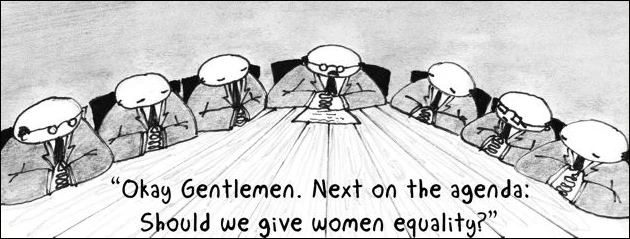
etc.etc.etc.
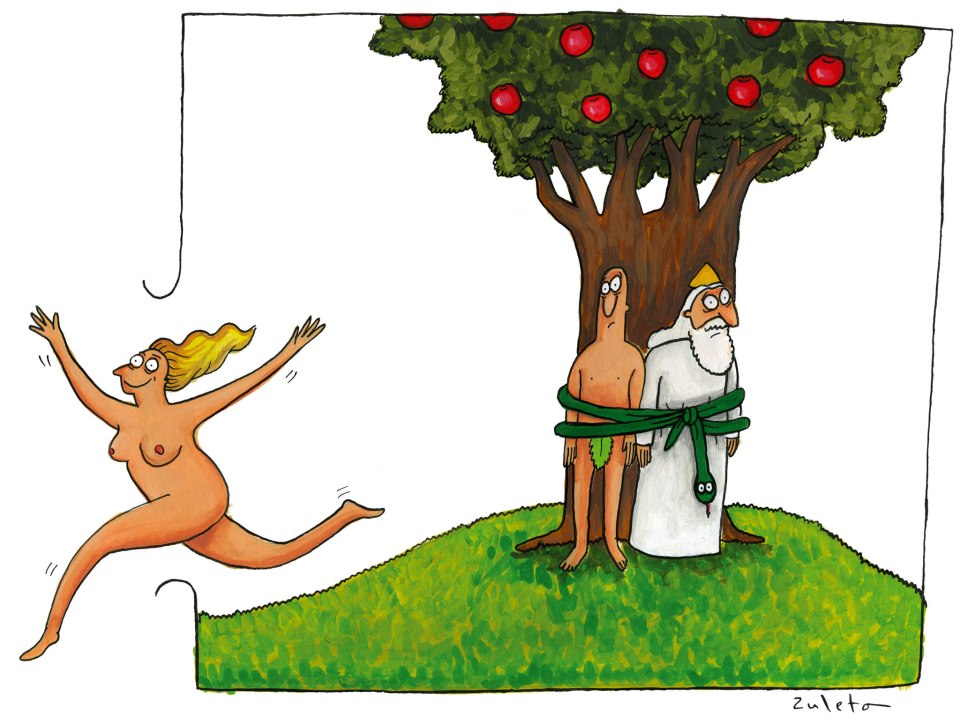
If only things had been written this way in the big book of fairy tales.