
2025 comments: Russell Brown stepping down still smells like secret frac sauce to me. I put this post and my comments together as the shit went down in 2023, but I was so deeply grossed out, and shaken by it all, I was not able to review and publish it until tonight.

Caveman Alberta went ape shit, of course. The many pro polluter, racist misogynist bigots there saw Brown as their special judge, their hero.
Since CJ Wagner’s secretive suspension of J Russell Brown for his “creepy” “hanky panky in Arizona became public (thanks to Law360) and the investigation by his self regulator, the Judicial Council, I’ve been disgusted. These Harper appointed jerk judges are supposed to uphold the rule of law. Pffft, what we mostly get are secrets and lies, lots and lots of lies.
This takes the self regulation of judge’s cake, CJ Wagner (also put on the supreme court by Harper) on J Russell Brown:
“I’d like to remind the pulbic, the allegations he was facing at the Judicial Council had nothing to do with his work as a judge.”
– Chief Justice Wagner, June 13, 2023
Excuse me!? How fucking condescending with slick word trickery. Sure, not directly. But, after learning about those allegations and how lamely Brown and his lawyers claimed no big deal and that nothing done by Brown was inappropriate, I’d never trust anything Brown said or ruled on in relation to sexual assault cases. He, like so many Harper judges, seems to be just another misogynist who thinks it’s OK to touch/pressure women inappropriately in public. I am so sick of it, and rude uber privileged, dirty old white men.
It’s a thousand times worse when such vile behaviour is by a person in a powerful position as a judge – never mind one from Canada’s supreme court, or any country’s.
Now, Brown cowardly stepping down, slamming the door shut on a public inquiry, hiding the details that Canadians need to see, I do not trust his past rulings, especially not his charter-damaging ruling in my case and the Jordan ruling.
This 1:14 Min clip below is an excellent relevant must listen:
Gemma Hartley:
Why does the church care more about homosexuality than pedophilia? Because it upsets the structure of power in a way that child abuse doesn’t.
***
2016:
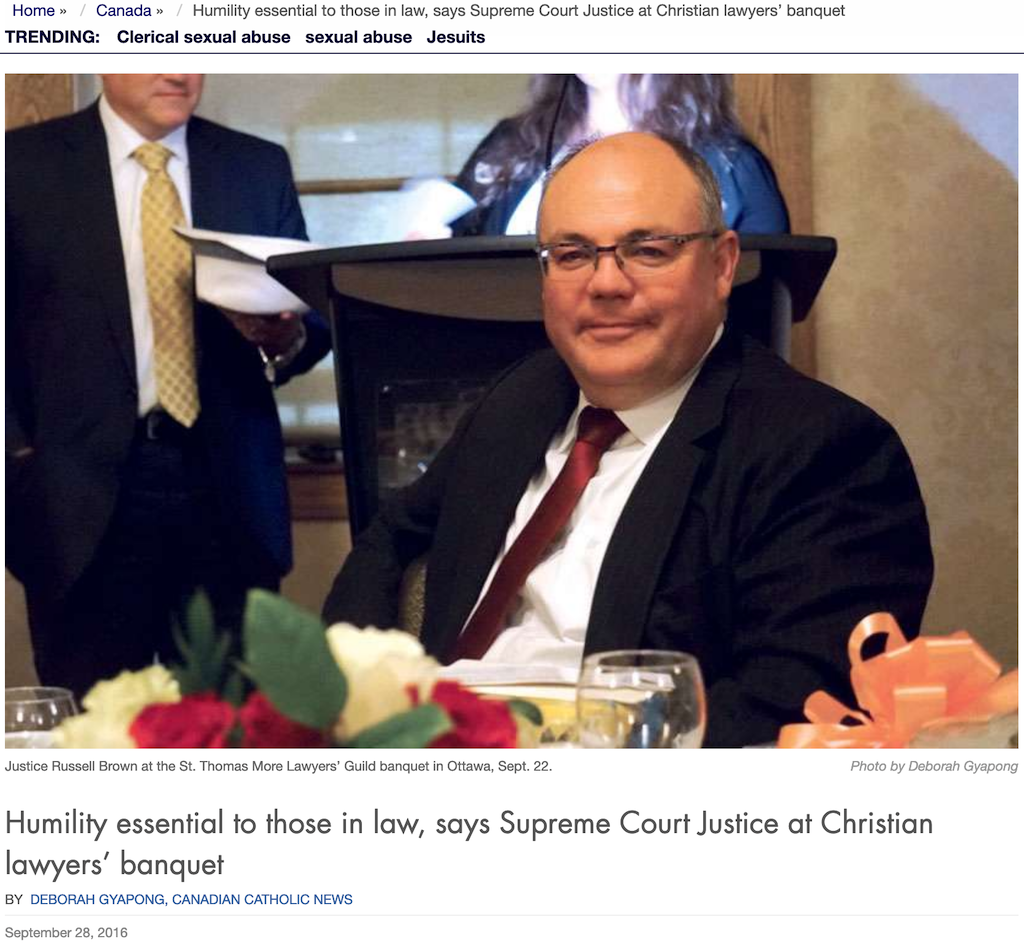
2023:

Snap from Frank Magazine
2025:
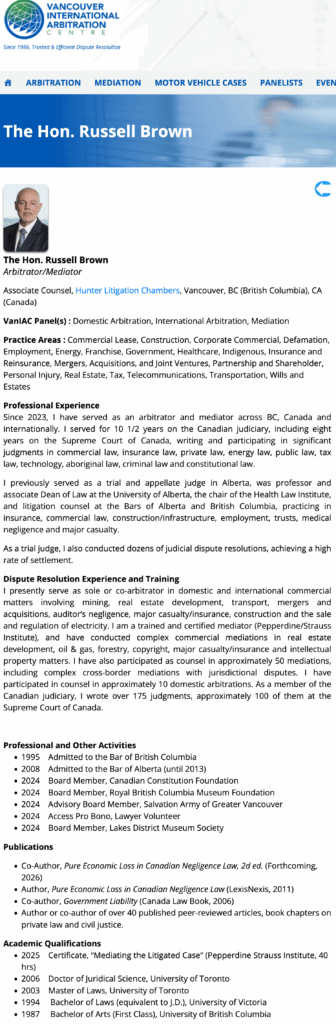
Snap from Vancouver International Arbitration Centre, Russell Brown Page, taken Aug 14, 2025
In my view, the Canadian Constitution Foundation is creepy as fuck, and same as Justice Centre for Constitutional Freedoms. PS I refuse to designate someone like Harper or Brown as “Honourable” when they’ve proven they are anything but.
Amir Attaran (@email hidden; JavaScript is required)@profamirattaran:
This is an agonizingly sad thing for a law professor to say, but:
As long as the Canadian Judicial Council covers-up its findings on Justice Brown, Canadians are right to distrust judges. Massive own goal.
The accusation against Brown is as serious as it gets: sexual harassment.
Yet publicly, there is ZERO evidence the CJC did anything about it. There’s allegedly a secret “report”—which may or may not actually exist—and then Brown suddenly resigned.
It’s a cover-up. Of course it is. That’s main job of the CJC (most complaints staff at the CJC sweep creeps quickly under the carpet, I bet without any judges even reading them. Seems only complaints that are covered in the media, and or with lots of citizen outrage, get “reviewed.” I was sure it was going to be a cover-up wrapped in secrets and impressive pretend regulation fluff to keep the public happy, long before J Brown quit – that’s what self regulators do best, whether of judges, lawyers or the oil and gas industry. And that’s why the status quo demands self regulation for those powerful players. It’s the best way to cover up their crimes and better yet, tax payers finance it and we even pay the legal fees of any judges that are investigated, sometimes to the tune of millions of dollars.
My fifth grade teacher said “Show your work”. Perhaps the slow learners of @CJC_CCM could take that in.
The question journalists should ask: Did the CJC lawfully “prohibit the publication” of its report on Brown for public interest reasons, or are they just unlawfully and arbitrarily hiding it? My money is on the latter.
Avnish Nanda@avnishnanda June 21, 2023:
This “insightful” piece takes complaint as well-founded for arguments sake, and says not a big deal, doesn’t impair Brown’s ability to perform functions, reputation of the court.
Complaint is he touched w/out consent, came on to mom + daughter at same time, fought daughter bf
I must live in an alternative reality than the law bros because that’s not a great thing for Canadian justices to do (imho). But, I recognize that the complaint is contests, which grounds the more persuasive arguments against all that went down.
Paul Griffins:
If the claims were true, I’d not want a “jerk” serving on the Supreme Court. Jerks behave like jerks when they are drunk.
Alexander deCerigo:
…it is about him and his conduct ..no liberal made him drink and grope
Theodore Charles:
I think the only one really at fault here is Justice Brown himself. He broke one of the cardinal rules of business travel; “Don’t get drunk in hotel bars!” That’s how you end up buying a timeshare, or getting robbed.
Regardless of what actually happened that fateful night, his voice has not been heard in the Court since February. It’s now almost July. The deliberations on critical things like Bill C-69 and C-92 are happening without him there. God knows how those will now turn out, Now with his resignation and the need to find a replacement, it’ll probably be another four or five months before the Court is back at full strength. Those could end up being the most expensive drinks ever.
Chris Fournier:
By all accounts Brown behaved like a buffoon while intoxicated in another country. Poor judgement and now we don’t want him as a judge. I’m okay with it.
An American woman gave a statement to police that Brown was aggressively handsie and trying to kiss her. He wasn’t her type.
That’s plenty of “account” for me.
Leave your pretty robe on the back of the door when you go.
Marcel Stanford:
Russell Brown failed Russell Brown.
Personal responsibility.

Snap from Frank Magazine
Image-conscious Supreme Court Chief Justice failed Russell Brown, The focus on appearances may threaten judicial independence by Leonid Sirota, June 21, 2023, Special to National Post
The Supreme Court’s Justice Russell Brown retired prematurely last week under lamentable circumstances. A complaint had been made about him following an altercation at an event he attended and he was no longer participating the Court’s work. The Canadian Judicial Council (CJC) was investigating and may, perhaps, eventually, have recommended his removal from office.
Justice Brown says that retiring and allowing a replacement to be appointed instead of leaving the Court short-handed for the duration of these proceedings was “for the common good.” This seems doubtful, not least because it is rather optimistic to expect the government to make an appointment quickly.
Be that as it may, we are left with many questions. What were the circumstances of that altercation? Was it Justice Brown’s choice to withdraw from the court’s work once he had been the subject of the complaint, or did the Chief Justice Richard Wagner order it? Why was the CJC’s inquiry taking so long?
These questions lead, naturally, to criticisms of both the Supreme Court’s and the CJC’s lack of transparency — and the CJC’s lack of urgency. Others have already made these criticisms, and there is no need to repeat them.
There is a further line of questioning and criticism that I have not seen addressed elsewhere, though. Why did the chief justice and the CJC react so forcefully to the complaint against Justice Brown? I suggest that this is because they misunderstand the principle of judicial independence.
If the media reports of its substance are accurate, what is alleged is no more than a trivial misdemeanour in a social setting. Perhaps Justice Brown had a bit much to drink; perhaps he was unpleasant; perhaps there was a minor scuffle. I hasten to add that Justice Brown denies all this. Like many others, I am skeptical that the allegations are true, though now there will not be any impartial adjudication of the claims.
But let us suppose, for the sake of argument, that the complaint is well-founded. What then? Would that mean that Justice Brown “has become … disabled from the due execution of the office of judge by reason of … having been guilty of misconduct” ― the standard, set out by the Judges Act, that would allow the CJC to recommend his removal?
There is no allegation of law-breaking; there is no contemptuous or otherwise inappropriate behaviour towards a litigant, lawyer or other person involved in a case. There is, at most, a one-off social misdemeanour. Can one no longer credibly serve as a judge if one has ― to put this colloquially ― been a bit of a jerk that one time after having had a drink too many?
It is tempting to say that a Supreme Court judge, like Caesar’s wife, must be above suspicion — even suspicion of behaviour that would call for no more than an apology from just about anyone else. But that would effectively give a veto on who can serve to the most suspicious among us. We live in suspicious times; people are prompt to interpret others’ words and actions uncharitably, and partisan polarization exacerbates these trends. In relation to the Supreme Court specifically, partisan polarization is made worse by commentators who insist on attaching simple ideological labels to complex jurisprudential disagreements.
In a perfect world, judges would behave irreproachably, always. In reality, a (necessarily limited) degree of forbearance is still in order. Why, then, did the chief justice and the CJC seemingly show none in the case of Justice Brown?
This is by no means the first case where the CJC has overreacted. Another recent instance was that of Justice Patrick Smith of Ontario’s Superior Court, who accepted to serve as an interim dean of Lakehead University’s law school in 2018. He did so at the university’s request, in light of his expertise in aboriginal law and ties to the local communities, to help address a crisis at the law school.
Responding to media reports of controversy ― not even a formal complaint ― the CJC launched an investigation into Justice Smith and concluded that he had behaved unethically, though not that he should be removed from office. Justice Smith challenged this finding before the Federal Court of Canada, which, in May 2020, reversed the CJC’s decision on several grounds.
It is difficult to avoid the impression that the CJC is far too sensitive to the image of the judiciary, and hence prone to overreact when that image might be called into question, however unreasonably. The chief justice, we know, is acutely image-conscious, and endeavours to make Supreme Court’s “work, activities and role in Canadian democracy known to a wider audience,” as he put in a speech at one of the court’s roadshow events in Quebec City. He may have been unduly preoccupied with these considerations in deciding how to address the complaint against Justice Brown.
Undue regard for the judiciary’s image risks coming at the expense of the independence of individual judges. The CJC or the chief justice might think that throwing a controversy-embroiled judge under the bus of hostile opinion will serve the greater good by preserving the institution’s public standing. But it will only encourage more complaints by people who are, or affect to be, too easily offended.
Ultimately, this will not save the judiciary’s public standing either: why should the public trust an institution to lawfully uphold the rights of unpopular members of society when it readily submits to passing controversy? The courts sometimes must place themselves on the wrong side of public opinion and media criticism. The courage to do so is a muscle that needs exercising, not saving.
In the last few days, a number of people ― including, interestingly, the chief justice himself ― have called for reforms to the CJC’s disciplinary process. But that might not be enough. It is worth at least considering replacing the CJC altogether with an institution that will be independent of both political pressure and of the judiciary’s institutional self-regard. New Zealand’s judicial conduct commissioner is one example.
Justice Brown’s retirement deprives the Supreme Court — and all Canadians — of the services of one of our most thoughtful judges, one who was willing to challenge received wisdom to keep the Court’s jurisprudence aligned with the law and the constitution. If this spurs reform (the necessity of which it so vividly illustrates), it could after all turn out to be for the common good in the long run. Otherwise, it will stand as an unmitigated tragedy.
National Post
Leonid Sirota studied law at McGill University in Montreal and New York University, and now teaches public law at the University of Reading in the United Kingdom.
Sean Fine@SeanFineGlobe June 19, 2023:
BROWN REPORT STILL SECRET.
David Sterns asks: “How can the public have confidence knowing that a report saying why the matter needed to be aired in public is itself kept secret?”
/via @globeandmail
CDNForumCivilJustice@CFCJ_FCJC June 19, 2023:
Legal observers say the Canadian Judicial Council is harming the public’s trust in judges the tiny trust that we had by its secrecy and should release its report ordering a public inquiry into the alleged conduct of Russell Brown, who has resigned from the Supreme Court of Canada….
Andrew Bell@AndrewBellBNN June 19, 2023:
There’s a school of thought that Brown is a real loss to the court …
Report is a matter of public interest & should be released
Judicial council pressed to release Russell Brown report that ordered inquiry into alleged harassment
BrindusaB@BrindusaB1 Jun1 19, 2023:
SCC
ExJudgeRussellBrown
Impenetrable secrecy
“Legal observers say the Canadian Judicial Council is harming the public’s trust in judges by its secrecy and should release its report ordering a public inquiry into the alleged conduct of Russell Brown”
Clement Parsons@parsons_clement June 19, 2023:
Release the report or refer it to the remaining SCC bench so they can rule on it, like they did in rejecting the appointment of Mr. Justice Marc Nadon.
Judicial council pressed to release Russell Brown report that ordered inquiry into alleged harassment by Sean Fine, June 19, 2023, The Globe and Mail (req’s subscription)
Legal observers say the Canadian Judicial Council is harming the public’s trust in judges by its secrecy and should release its report ordering a public inquiry into the alleged conduct of Russell Brown, who resigned last week from the Supreme Court of Canada.
Secrecy clouds a Supreme Court justice’s resignation. Transparency is the remedy by The Editorial Board, June 19, 2023, The Globe and Mail (req’s subscription)
***
Sean Fine@SeanFineGlobe June 14, 2023:
For anyone wondering who ordered #scc judge Russell Brown to face a public hearing — that is, the review panel that looked at the evidence and heard from both sides — they were, mostly, senior judges from across Canada. Here are their names . . .
Quebec Chief Justice Manon Savard (chair);
Associate CJ Shane Perlmutter, Manitoba Court of King’s Bench;
CJ Tracey DeWare, New Brunswick Court of King’s Bench;
Justice Grant Currie, Saskatchewan Court of King’s Bench;
Pierre Riopel, chair, U of Sudbury board of governors.
***
Amy Salyzyn@AmySalyzyn June 14, 2023:
I’m not aware of anything that would legally prohibit CJC from releasing any written reasons/findings from the Review Panel.
If there isn’t a legal prohibition, they should release as they did in the Spiro matter. If there is a legal prohibition, they should say what it is.
CJC is the self regulator of judges, made up of judges, mostly old white men (how many of them rapists?). Photo of the colonial status quo protecting klan at the time of the Russell Brown matter below:

Their job is to slam the door shut on most complaints, and sweep away and hide things Canadians need to know. I wouldn’t be surprised if Brown got a deal, big money and he and his lawyers get to publicly ramp up their proclamations of innocence in exchange for a protective priestly cover-up if he willingly “retired.”
Hushing up the fall of a Supreme Court judge by Campbell Clark, June 14, 2023, The Globe and Mail
Something has happened: A justice of the Supreme Court of Canada fell off the bench. Just what happened wasn’t revealed at first. It was then treated as confidential. And now that it’s over, it’s none of your business. We should have some concerns.
Justice Russell Brown resigned Monday when he was about to face a public hearing about allegations of improper behaviour while on a trip to Arizona in January.
And apparently, the case is closed. Now that Mr. Brown is no longer sitting as a judge, the whole business is over, Chief Justice Richard Wagner told reporters on Tuesday.
“The process is there and it’s finished because the judge resigned,” Chief Justice Wagner said. “So there’s no matter to deal with any more.”
When the Chief Justice tells you the issue is moot, it’s probably a solid legal perspective. But it’s not enough for the Canadian public.
This is the unsettling Canadian way of saying little about this unpleasantness and moving on quietly. But we’re talking about a justice of the highest court in the land being directed to a formal disciplinary process and, for the first time ever, quitting over a claim of misconduct.
Yet there’s been a lot of whispery hush-hush. Even though there are lingering questions.
For one thing, Mr. Brown’s lawyers indicated that he thought he’d eventually be cleared but balked at the onerous process launched by a complainant who had “weaponized” the disciplinary process. It’s hard to know if that’s just an excuse, but it’s still notable when a Supreme Court justice complains there’s no justice in the system.There isn’t! I know; I experienced it at the hands of Mr. Brown and other judges. Except for the rich, powerful and criminals, notably rapists (they have charter rights the supreme court reveres, the rest of us ordinary non criminal Canadians get rotten potatoes). The abuse I endured by our “justice” system took over a decade and half a million dollars to get nowhere but lied about by judges and our charter damaged by them (Harper hates the charter, 7/9 of the supreme judges that heard my appeal, including Brown, were appointed by Harper – how they treated me, and their rulings showed it). Brown is lucky! He got paid $38,000/month by us taxpayers during the investigation of his bad drunk behaviours and all his legal fees paid for by us too! I was paid nothing, for years and sacrificed my life-long savings trying to protect the public interets and seek justice for an oil and gas company’s self-regulator breaking the law trying to silence me for speaking out about that company also breaking the law, contaminating my community’s drinking water supply.
Perhaps that question really is unresolvable now that Mr. Brown won’t contest the complaint.
But the questions about transparency are worth revisiting.
The complaint against Mr. Brown stemmed from an altercation during a trip to Arizona for an award ceremony. After the event, Mr. Brown was invited to join a group at their table in the lounge of the resort, and later, one of them, an ex-Marine named Jon Crump, punched the judge. The two parties disagree on why.
Mr. Crump called the police and alleged that Mr. Brown was drunk and creepy and hitting on two women in the group, kissing one on the cheek and touching her in an unwanted but non-sexual way, and that he punched Mr. Brown when the judge tried to follow the women into their room. Mr. Brown, on the other hand, said a drunken Mr. Crump suddenly punched him, unprovoked.
But the Canadian public didn’t know about any of that for five weeks after the complaint was filed and Mr. Brown took a leave from the Supreme Court.Took a leave, or was put on leave by CJ Wanger?
In fact, the public didn’t know that Justice Brown was on a leave at all. Amazingly, a Supreme Court justice was disappeared without a word. The complaint was received Jan. 29, Justice Brown went on leave Feb. 1, and the Canadian Judicial Council revealed it to the public on March. 7. A Supreme Court justice was sidelined but it was all hush-hush.
That’s some creepy Canadian confidentiality.
Canadian self-regulators of petroleum companies, lawyers and judges love their secrets (and lies)! As do oil and gas and frac companies and rich rapists like Donald Trump. It’s disgusting and grossly unjust but it’s how the world’s largely religion driven rape and pillage patriarchy rolls.
Last week, the judicial council was preparing to announce that a review panel had determined that the complaint against Mr. Brown should go to a public hearing.
Presumably that panel, which includes four judges and a layperson,See above list of names by Sean Finehad their reasons. Was it the type or severity of the allegations that made the panel find a full-bore complaint process was necessary? Were there facts we didn’t know, or new evidence coming to light?
We’ll never know now. Those questions were all wrapped up when Mr. Brown resigned. The panel’s review decision will not be made public. Transparency is moot.“He quit, it’s over” is not a real reason. It’s rude deflective condescending crap from CJ Wagner. Canadians deserve much better. We pay his way, and that of the other judges. They are our servants, not the other way around.
Chief Justice Wagner told reporters he shared those concerns about transparency. He said that when he received the complaint against Mr. Brown, the rules provided that the judicial council, rather than the chief justice, would decide when to reveal the complaint to the public – so he couldn’t disclose it. He said he suggested the judicial council’s disciplinary bodies review their policies.
Of course, the whole affair is embarrassing for the Supreme Court. “It’s unfortunate,” Chief Justice Wagner said. He added the fact that there are ethical standards for judges should reassure Canadians.Pffffft! Roaring laughter
But this episode was not reassuring. A judicial ethics case affecting the highest court was treated like a matter that could be settled by private litigants behind closed doors.Excellent summary of Brown’s creepy altercation, the CJC’s creepy secretive process and CJ Wagner’s creepy secretive condescension (I bet he read the report). I am unable to decide which is most creepy.
Thinking Ahead:
Another corrupt appointee inflicted on us by Stephen Harper. You have to love the effect that Alberta has on our moral landscape.
Autistic Endeavours:
Well done Campbell – many good points.
What really stands out (to me) is the uniqueness of the tone which is reminiscent of what used to be the highest standard journalism; today this is labelled an opinion piece.
The facts are presented and issues raised on topic that easily lends itself to agendas, grandstanding, politics and virtue signalling; think of the Ghomeshi / Mesley circuses where everyone got to pick a tribe and defend vigorously.
This is more a presentation of facts, very little indignity, and sends you off to make up your own mind (albeit with a few opinions).
Bob in London:
I don’t believe they had to be more transparent after he resigned. The bigger question though is … how does a person who can get himself into this kind of trouble … get a seat on the Supreme Court?
frankiehornhill66:
Thanks to his relationship with alcohol, he’s had to quit two years short of qualifying for a full pension and lost out on 18 more years of prestigious employment. I wonder if he’s learned anything?Sadly, drunks rarely learn anything until they’ve lost everything that matters to them and admit they have a problem, and seek help. Alcoholism is a terrible disease that is challenging to escape and heal from and which has destroyed many families and lives.
app_75351748:
He was a fascist behaving as fascists do. Hopefully he will be replaced by a jurist that follows the law not his scary personal philosophy.
Vliegender Hollander:
What else is new? Us, common folk, have known for a long time that the law is there to protect the wealthy. We can’t afford it!
Ancient One 72:
The question here is whether or not something is being covered up. As far as I can tell, no charges are forthcoming in Arizona.
On the face of it, absent a trial in Arizona, it appears that justice Brown was indeed guilty of conduct unbecoming of a supreme court judge. …
Johnny Canuck62:
Campbell Clark you are bang on. None of this inspires confidence in our Supreme Court. Surely the allegations here require an airing of the matter, in the interest of preserving respect for this public institution. Justice Brown’s excuses for ducking this hearing have no air of reality.
Going_Forward:
The public has a right to know why this debacle chewed up and wasted so much time, energy and taxpayers money while disrupting the justice system for half a year. Was this episode handled correctly or not? Does the investigative review system need to be overhauled or not?
***
Amy Salyzyn@AmySalyzyn June 12, 2023:
The CJC has announced that Justice Brown has resigned and that “as such, proceedings before the Council that involve Justice Brown have come to an end.”
Presuming this means that any CJC findings to date will not be public, there would seem to be some important lingering questions relating to transparency and which implicate public confidence in the judiciary.
@SeanFineGlobe reports the background:
“on Thursday, moments before the council was to announce it would be holding a public hearing into the allegations, Justice Brown asked for the weekend to consider his options.”
Does this mean the 5 member Review Panel has findings/reasons about why “the matter might be serious enough to warrant the removal of the judge” that were shared w/Brown but won’t be released to public? I don’t know if this is the case but we are left w/these sorts of questions..
Amy Salyzyn@AmySalyzyn June 13, 2023:
Perhaps worth emphasizing: Fine reports “Last Thursday, the Canadian Judicial Council was set to announce it would be holding a public hearing into the allegations, but delayed releasing its decision to give Justice Brown time to consider his options”
This presumably means, per CJC bylaws, that the five person CJC Review Panel made a determination that “the matter might be serious enough to warrant the removal of the judge” such that it was appropriate to escalate to a public hearing.
At this point, we don’t actually know what information/evidence the Review Panel considered & the reasons why they apparently made this determination. More transparency is warranted. Are there written reasons? What do they say?
There is also a question whether it is appropriately transparent for the public to learn that CJC had decided to hold a public hearing from the media & not from the CJC itself. (This assumes the reporting is accurate; I note it was reported yesterday & hasn’t been corrected)
Section 2(7) of CJC Bylaws: “The Judicial Conduct Review Panel must prepare written reasons and a statement of issues to be considered by the Inquiry Committee.” https://cjc-ccm.ca/sites/default/files/documents/2019/CJC-CCM-Bylaws-Reglement-2015.pdf Was this stage reached? If so, will these reasons be made public?Of course not! The purpose of self regulation is to protect bad behaviour by lawyers and judges, and oil, gas and frac companies!
Simon Wallace@SimonWallace June 13, 2023:
Yes. I’ve written to them to ask for the reasons but not heard back yet.
Angela Chaisson@angelawya:
!!!!!
Ari Goldkind@AriGoldkind:
The man LITERALLY in charge of due process in Canada resigns because he doesn’t want to face, wait for it, due process.
It’s telling, isn’t it, about so many things in our “system”, that, until it happens to you, you can’t appreciate how flawed it is
Drew Yewchuk@DrewYewchuk June 13, 2023:
Justice Brown’s sudden departure from the Supreme Court is likely to precipitate a big fight over the independence and political nature of the Supreme Court. The problem has been growing for a while.
Canada’s system for appointing Supreme Court justices is ad hoc. Nothing in the system offers meaningful protection from with the ideological and partisan court the U.S. has, and the same right wing political movement that did it in the U.S. has already established branches all over Canadian media and law schools – I have been watching it happen since I started law school.I’ve been watching it happen and grow too, notably during Steve Harper’s horrifying rule and the way his judges lied about me in their rulings, to denigrate me and my case. Just ugly extreme right wing, anti-freedom for the rest of us, hate-filled trash. It has been done almost out in the open, because it is not illegal:
Show Not Tell: Why I Am Declining to Participate in a Runnymede Society Debate by law prof Joshua Sealy-Harrington
… The Society’s public track record suggests that it aspires to perform as Canada’s Federalist Society—indeed, their own “Law & Freedom” conference keynote speaker said as much, describing Runnymede as the Federalist Society’s “intellectual equivalent” (at 49:28). But its organizers hold firm—at least publicly—that the Runnymede Society is “entirely non-partisan.”
Let’s put this claim to rest: the Runnymede Society has an obvious ideological bent. This is apparent both from (1) its self-description and (2) its activities. And I suspect it would be apparent from (3) its funders, as well. …
…
With respect to its self-description, the Runnymede Society’s stated goal is “shift[ing] the legal culture in Canada towards liberty”. Likewise, its architects oppose the “living tree” approach to interpreting the Canadian constitution. These are ideological positions, whether or not the Society names them as such.
But let’s go further. The Runnymede Society bills itself as an organization devoted to “exploring the ideas and ideals of constitutionalism, liberty and the rule of law.” These are code words, a form of neutrality theatre staged with rhetorical props:
- by “constitutionalism”, they mean advancing originalist interpretations of the constitution (see here, here, here, and here);
- by “liberty”, they mean privileging certain liberties over equality (e.g., freedom of religion over gay rights or freedom of speech over trans rights) and privileging formal equality over substantive equality; and
- by the “rule of law”, they mean prioritizing colonial legal systems over pre-existing Indigenous legal systems—which, as John Borrows notes (at 581-584), is antithetical to the rule of law.
These deployments of “constitutionalism”, “liberty”, and the “rule of law” are ideologically loaded. The Runnymede Society is—viewed globally and critically—an organization that favours conservative (or, if you prefer, “small-l liberal”) legal methodologies and principles.
…
Third, consider the discussion itself. Just three and a half minutes into this hour and fifteen minute long “debate”, Pardy pivots into what this event is really about—not the substance of existing protections for transgender people under human rights law, but the merit of transgender people having human rights protections at all. What “heterodox” insights did this “debate” feature? [Content Warning: transphobia]:
- comparing transgender people to two-year-old “egocentric” infants (at 23:08);
claiming that transgender identity is “a game people are playing at that moment” (at 29:00);
- describing the philosophy underlying transgender identity as “pathological” (at 29:40);
- characterizing providing transgender people with human rights as “dangerous” (at 31:15) and inevitably leading to “carnage” (at 38:00);
- dehumanizing nonbinary people by referring to them as “it” (at 36:00);
- calling Bill C-16 “a vicious, ill-written, pathological piece of legislation” (at 40:30) and a “tyrant [that] makes people into its slave” (at 47:42);
- saying that “human civilization progresses and maintains itself when we respect people who’ve earned respect” (at 46:06), implying that transgender people do not deserve respect, at least concerning their pronouns; and
- arguing that transgender people who want validation of their gender identity are demanding that other people act as a “mirror for [their] narcissism” (at 1:06:25).
This is not just ideology—it is bigotry. And as Pardy notes at 1:47, “this is exactly the kind of thing that Runnymede was conceived for.” In response to calls for greater transparency, Mancini wrote that the Runnymede Society holds events and “should be judge as an org based on their quality.” Well, this is an event that the Runnymede Society held. And I judge it—and the Society—accordingly.
… With respect to its funding, Mancini is unwilling to disclose who financially backs the group because, in his view, that “sets a bad precedent.” Indeed, he considers such calls for transparency analogous to attacks by oil companies on environmental groups—a questionable comparison, as Nanda observes. (Comparing the power of some of the world’s largest private corporations to a few individual twitter accounts is a stretch, to say the least.) Supporters of the Runnymede Society, like Leonid Sirota, claim that funding is irrelevant to the “ideas” it advances. This is transparently false, as anyone familiar with climate denial and the Koch brothers understands. Money is power. And a lack of candour about funding conceals motivation.
For example, if Sirota’s report on the alleged unconstitutionality of anti-vaping legislation was specifically funded by the Vaping Industry Trade Association—which actively lobbies against such regulations—it is relevant context to the political aims of the Canadian Constitution Foundation, which both published the Report and founded the Runnymede Society. Of course, the quality of his legal analysis can be questioned on its own terms. But the genesis of research—like the genesis of the debate underlying this post—is relevant. It speaks to the power underlying the gloss of “debate and free discussion” which is specifically designed to conceal that power.
It is disingenuous to claim that an organization is “expressly apolitical” based on its promotion of ‘discussing ideas’ and ‘asking questions’. What ideas? Which questions? Despite Mancini’s support for “unbridled free speech” in law schools (at 9:32), if a student proposed a panel on the merits of slavery, one would hope that the Runnymede Society would not hold it (not due to a fear of “ideas and intellectualism”, but an exercise of judgment). Yet it does agree to host panels debating the merits of basic human rights for transgender people. And it wants to host a debate where one side seemingly takes the position that learning about the law’s role in upholding racism is a distraction law students should do without. These are choices. And those choices reflect the organization’s ideology and priorities, whether or not the Society sees it that way.
To be clear, I take no issue with a conservative legal organization holding political preferences; but I do mind it hiding them. And to the extent that my participation in this debate assists that concealment—to the extent it distracts from these plain facts—I would rather not take part.
If the Society is really open to comprehensive critique, then its financial supporters should be disclosed. And if the Society really wants to debate whether critical race theory has any place in law schools, it can do so without me.
… How can you understand the law without understanding its relationship with power? How can you frame a legal argument effectively without being mindful of the politics that inevitably influence the judicial exercise? (This is the case not only for concepts like “reasonableness”, “best interests”, and “proportionality”, but also for the broadly phrased constitutional values that the Runnymede Society itself is interested in.) How can you critique the law without considering its material effects? ...
The Runnymede Society is named after the meadow in which King John signed the Magna Carta—an act which is itself emblematic of the law’s inextricable relationship to contests for power. Its co-founder’s view that dissecting this relationship is a distraction from a proper legal education is a profound irony given his organization’s namesake.
... My final reason for declining the debate is dignity. Critical race theory is a foundational intellectual tradition in my doctoral research. Also, I am a Black man. I’m not going to debate whether race is relevant to a comprehensive or ethical legal education in a country with a long past, and present, of racism—it clearly is. The law is a primary instrument through which Canadian racism has been—and continues to be—reified. Lawyers’ competence and ethics demand reckoning with this fact, not ignoring it.
… In other words, our disagreement is not simply political, but also legal. Law performs politics. And Honickman’s desire to exclude politics from law school is itself a political position masked in a façade of neutrality.
Returning to Patricia Williams’ timeless insight: “much of what is spoken in so-called objective, unmediated voices is in fact mired in hidden subjectivities and unexamined claims” (The Alchemy of Race and Rights, supra at 11). These words perfectly capture the Runnymede Society’s operation—a veneer of objectivity, which, when more closely examined, reveals latent political commitments.
…
Lisa Di Valentino September 3rd, 2020 at 5:13 pm
Thank you for this post Joshua. And thank you for standing up to these bad-faith offers of “debate”, which are in reality a offers for you to waste your time talking about things to people who have really no interest in learning about them.
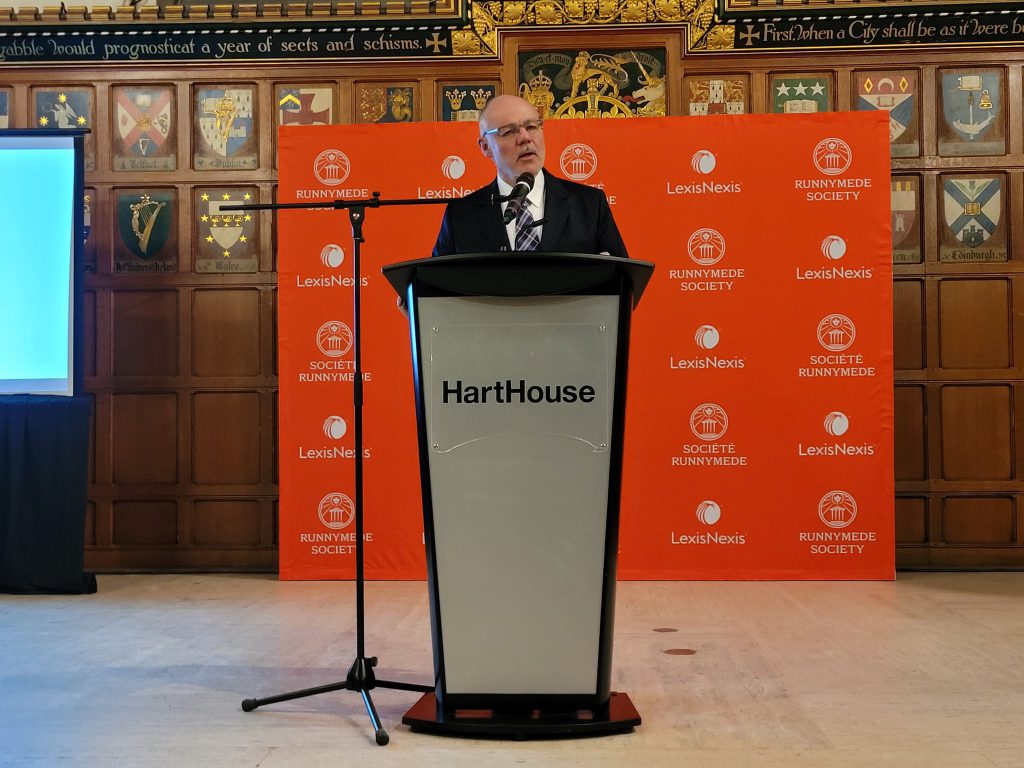
In Jan 2023, just days before his drunken creepy seemingly misogynistic conduct in Arizona, and while still on Canada’s supreme court, J Russell Brown gave the keynote speech at ultra creepy Runnymede’s annual conference.
Canadians looking at the U.S. Supreme Court and thinking “Can’t happen here” have their heads in the sand. The arms race to stock a partisan and ideological supreme court has begun, it’s starting to get more visible, and I don’t see anything that will stop it.
Things are gonna get worse before they get even worse.Yes, especially because our police and RCMP are carefully selective in protecting rapists, racists, misogynistic hate mongers, as long as they are white and extreme right wing, while punishing, abusing, and trying to intimidate those not afraid to speak up for the marginalized, and for the public interest/common good. I’ve also been watching with horror, how many lawyers are promoting disinformation, outright lies, hatred, and protecting/enabling racism, misogyny, bigotry, etc. (think the violent “bullets for Trudeau” Fucker Truckers). We are in for a nasty future, notably with human greed, over population and pollution induced climate change harms biting us in the ass, more viciously every year.
Canadian Legal Takes@LegalTakes to @DrewYewchuk:
Probably true. But let us not forget that the fault for it lies with the SCC itself. It didn’t have to appoint itself as the 9 most impactful politicians in the land. They chose to take on that role instead of their actual job and it has consequences.I see too many Canadian judges operating as political armpits for their masters that appointed them. I don’t buy it when lawyers squeal loudly that our judges haven’t been politicized.
Joshua Sealy-Harrington@JoshuaSealy June 15, 2023;
There’s a capacious middle-ground between the extremes of:
“all Canadian judges fit neatly into ‘right’ or ‘left’”
and
“the Canadian judiciary is apolitical”.
How about: “fairly reliable patterns emerge when you review how some judges analyze certain issues.”
Charles Smith@ProfSmithSask:
As he tried to scale back women’s rights and environmental protection I don’t really see this as a crisis.
No transparency, no Justice.
Cecil Nagy@CecilNagy:
This is the Long Game that CPC & right of center provincial parties are playing, appoint incompetent social conservatives to the bench, when a majority of incompetents are on the bench pass anti Human rights legislation. (see USA & GOP)
Avnish Nanda@avnishnanda June 15, 2023 referring to Globe article below:
I don’t agree with this — Justice Brown came to the law from a particular perspective, for sure, but I don’t it can be characterized left/right, liberal/conservative. There are many things he advocated for that I supported, other things I vehemently opposed (approach to s. 15)
I also found the critique on Charter values to be quite glib, superficial. But, he appreciated many of his other Charter decisions, including Ernst, which was in dissent, he ruled against the Alberta govtYa, but, the dissent’s ruling still shat on the charter.
Jennifer Koshan@JenniferKoshan June 14, 2023:
Anyone else laugh-crying at the suggestion that “biased left-wingers” have ever dominated the Supreme Court of Canada? Or maybe just crying?
MeToo Barbie, MD@ana_safavi:
Seriously. When’s the last time they rendered a leftist or progressive decision??
Fauza Mohamed@FauzaMohamed:
I can’t believe this is a headline in a major Canadian newspapers. It reads like a Trump slogan.
Justice Russell Brown’s departure leaves conservative vacuum on Supreme Court of Canada by Sean Fine, June 14. 2023, The Globe and Mail
Justice Russell Brown of Alberta was the most powerful conservative voice on the Supreme Court of Canada and, to some, the strongest such judge in 40 years or more.
Now he has resigned rather than face a public hearing into an allegation that he harassed two women at an Arizona hotel in January.
Courts, unlike legislatures, do not have an official opposition. But the 57-year-old Justice Brown was the outspoken leader of the Supreme Court’s unofficial opposition, repeatedly challenging a liberal view of rights and the role of the court’s judges that has prevailed for decades.
Often in dissenting opinions – but occasionally winning big – Justice Brown attempted to push the court to the right on everything from women’s equality to international human rights, from climate change to gay rights and from property rights to voting rights.
Justice Brown was “an indispensable reality check” on a liberal court, says Queen’s University law professor Bruce Pardy.
“As the Supreme Court has become ever more progressive and collectivist, Justice Brown has been a beacon of judicial restraint and clear thinking,” said Prof. Pardy, the executive director of Rights Probe, a conservative think tank. (Prof. Pardy was a campaign co-chair for lawyers who ran for board positions at the Law Society of Ontario this spring, using the slogan “Stop woke.”)
Conservative legal observers such as academic Leonid Sirota say most Canadian judges come from the same “ideological monoculture,” interpreting the Charter of Rights and Freedoms to fit their own rights-expanding biases. Hence, Justice Brown had been a source of delight on the right. As recently as May 31, an outspoken judge on a lower court celebrated Justice Brown’s effect on the Supreme Court’s view of Charter rights.
“Gone is inspiration from some vague feel, spirit or vibe, things that are in the eye of the beholder,” Justice David Stratas of the Federal Court of Appeal wrote, attributing the change on the top court to two rulings co-authored by Justice Brown. (Justice Stratas made the comment in a judgment rejecting court-ordered repatriation of Canadians in Syrian prison camps.)
Russell Brown’s exit from Supreme Court points to need for better process, Chief Justice says
While liberal observers saw Justice Brown differently – as a judge bent on discarding or overcoming precedents perceived as left-wing – both groups agreed on the power of his voice.
“He is a bold and confident thinker unafraid of challenging legal orthodoxy,” said Bruce Ryder, a professor at York University’s Osgoode Hall Law School, who tended not to see eye to eye with Justice Brown.
The court’s liberal orthodoxy was strong when Conservative prime minister Stephen Harper appointed Justice Brown, the son of a hardware store owner from the remote northern community of Burns Lake, B.C., in 2015.
The Supreme Court had just been through a remarkable period of unanimity: 9-0 on the right to medical assistance in dying; 9-0 on striking down prostitution laws; and 9-0 on stopping the Harper government from shutting down a health clinic where people could inject illegal drugs in front of nurses.
A former professional rugby player, Justice Brown travelled the world on $7 a day when he was young and, like a real-life Zelig, popped up in Poland during the heady days of the Solidarity movement and at Tiananmen Square during the historic student protests. He had a nose for where the action was.
His convictions were well-known by the time Mr. Harper first appointed him, to a lower court. As a law professor at the University of Alberta, he published a provocative, caustic and often funny blog, taking on everyone from Justin Trudeau to then-Supreme Court Chief Justice Beverley McLachlin.
In his eight years on the Supreme Court, Justice Brown continued to blast away at entire areas of the court’s case law – for instance, at “substantive equality,” which he called “an open‑ended and undisciplined rhetorical device” used by judges to conceal “their own policy preferences.” (The court has defined the term since 1989 to mean laws must not simply treat people the same; their effect on disadvantaged groups must be considered.)
Not since Ronald Martland (1958-1982) has the Supreme Court had such a strong conservative voice, legal historian Jim Phillips, who teaches law at the University of Toronto, says.
What is a conservative judge in the Canadian context? Too often an old white male sexist bigot, racist and misogynistic, who enablers rapists, law-violating corporations (re GDP), and abusers of women, notably Indigenous.
Prof. Phillips says conservative tends to mean one of two things: “conservative in approach to precedent, very respectful of it, unwilling to innovate, and conservative in the sense of right-wing. They quite often go together, but not always.”
He saw Justice Brown as more of a conservative activist, pushing against a perceived liberal tide on Canada’s top court, than a conservative respectful of precedent and the plain meaning of the Constitution and legislation.
Consider one of Justice Brown’s signal victories, a 5-4 majority ruling in Annapolis Group Inc. v Halifax Regional Municipality, co-written last year with Justice Suzanne Côté.
Halifax had barred development of certain privately owned lands, and the owner sued, saying the restrictions were a “de facto expropriation” or a “taking” – essentially, government theft of private property. Before he became a judge, Justice Brown wrote voluminously on the topic, calling the Supreme Court’s pro-government precedents in this area of law “incoherent.”
“The bizarre thing,” Prof. Phillips said of Justice Brown and Justice Côté, “is that they say consistently, ‘We’re not changing the law’ – but they are. They’re trying to pretend they’re not activists, but they are.”
Still, Justice Brown took a very different approach in Frank v Canada, in 2019, on voting rights.
The case was about whether the federal government could bar Canadian citizens from voting in elections if they had been out of the country for more than five years. A 5-2 majority said it could not.
Justice Brown said the decision was Parliament’s to make, not the court’s. Co-writing again with Justice Côté, he cited the approach of Oxford law professor Richard Ekins, who heads a British group that argues activist judges threaten democracy.
The Ekins philosophy “is an argument against having judicial review,” said David Dyzenhaus, a professor of law and philosophy, also at the University of Toronto. Justice Brown’s co-written dissent in Frank “is the first sign of senior judges in Canada expressing support in a judgment for a deeply illiberal position, at odds with the Charter.”
But Prof. Dyzenhaus sees that as an outlier among Justice Brown’s judgments.
Justice Brown himself, in his blog, described the tensions in his outlook as a conservative libertarian, saying that when the two forces conflict, the libertarian usually prevails.
His writing style is a combination of deep intellect and brute force.
Consider Fraser v Canada, a women’s equality case from 2020. He and co-author Justice Malcolm Rowe called the majority ruling by Justice Rosalie Abella “corrosive of the rule of law” and “truly arbitrary.” The RCMP had allowed officers to work part-time, which helped young mothers. But it didn’t allow them to earn pension credits as part-timers. A 6-3 majority found that to be discriminatory.
Similarly, dissenting in the greenhouse gas reference case in 2021, Justice Brown criticized the majority’s “abandonment of any meaningful constraint” on federal power. The question in the case was whether the federal government had the authority to impose a carbon tax on the provinces. A 6-3 majority found it did.
If Justice Brown stood outside the court’s consensus on equality and the environment, he also challenged the prevailing views when gay rights clashed with religious freedom in Law Society of B.C. v Trinity Western University, in 2018.
In that case, a proposed Christian law school would have required students to abstain from sex outside of heterosexual marriage. Two law societies said they would reject the graduates. The court ruled 7-2 that the law societies were within their rights to have done so. Justice Brown, once again co-writing with Justice Côté, accused the law societies of a profound interference with a religious body’s moral commitments in a private space.
“He has a spine,” Old white male legal bigot racist misogynistProf. Pardy said.
Justice Brown could usually count on Justice Rowe and Justice Côté. Prof. Ryder called their coalition BROC, because they would go for broke and expressed the view that the court’s jurisprudence is broken.
But on key interpretive questions – the kind that could shape rulings for many years – Justice Brown proved critical to a rightward swing on the court.
In Toronto Council v Ontario, in 2021, he and Chief Justice Richard Wagner wrote for a 5-4 majority that “unwritten constitutional principles” such as democracy cannot be used to strike down laws. This was one of the two cases that, in Justice Stratas’ view, returned rigour to the court’s Charter analysis. (The result in this case was that Ontario’s changes to Toronto ward boundaries shortly before a municipal election were deemed lawful.)
“He thinks, not unreasonably, that in a democracy citizens ought to be able to govern themselves through their parliamentary representatives, and he is resistant to what he sees as too-easy, paternalistic, second-guessing of those decisions by judges,” former University of Victoria law dean Jeremy Webber said.
It is on criminal law where Justice Brown most surprised court watchers – including in a pronouncedly liberal ruling on policing and race. That came in R v Le, in 2019, in which police entered a private backyard in Toronto where several racialized youth were chatting. Eventually, one of the youths ran and dropped a bag with a gun. Justice Brown, co-writing with Justice Sheilah Martin for a 3-2 majority, threw out the conviction for illegal gun possession, saying a racialized person in Tom Le’s shoes would have felt detained, and the detention was illegal and arbitrary.
In R v J.J., dissenting yet again, Justice Brown described a federal law that gives sexual-assault complainants new privacy protections as a “formula for wrongful convictions.” Brown again, working to protect rapists putting victims in increased harms way knowing full well rape victims are at the disadvantage, before, during and after rape? Scheesch I am so sick of sexist old white man assholes in positions of power enabling the bad guys. I am glad he’s too cowardly to stand up to a legal process with him the centre of it, although I believe the public is owed all the information his lawyers say he has, and what the CJC has. Shows me his true shit nature. A 6-3 majority upheld its constitutionality last year.
***
Nickel Energy & Environment Dude@LyleTrytten:
He’s still a lawyer, right? Law society misconduct review?I think he must reapply to the self regulator of lawyers, the law society (privileged mostly white boys’ club) to get his law licence back, which I expect they’ll issue without a fuss or questions. They licence known convicted pedophiles and gave disgraced misogynist (yes, another one) Steve Harper judge (yes another one) Robin Camp his licence to practice law after he was investigated by the CJC and “urged” to “retire” re his shaming a rape victim in court
635Bur@635bur:
Resign and avoid all consequences for your behaviourYa, I was really looking forward to what was going to be exposed in the inquiry. So pathetic, that bad judges walk or are urged to walk rather than face the music for their inappropriate actions. I feel ripped off, yet again, by the supreme court of canada and it’s self regulating judicial council. They least they need to do, is make their file on the matter public and Brown’s lawyers need to step up to the evidence plate and make all of their “evidence” public, pronto.
***
finally@fing_hell June 12, 2023 responding to above statements:
He was told it wasn’t going to be dismissed.
If they drop the review, that’ll be proof.
Pffft. Nope, I don’t buy the statement by either Brown or his legal team (which Canadians are forced to pay for, fully, throughout the Judicial Council’s investigation. I have documented evidence in the supreme court’s ruling in Ernst vs AER, that supreme court judges intentionally publish lies in rulings (by J Rosalie Abella) and not only intentionally publish those lies, include them in the court’s summary of the ruling while not including the calling out of the lie by other judges; and lawyers lie, often (my ex lawyers Cory Wanless and Murray Klippenstein in their rule violating quitting email to me), in court, in writing, in official court briefs (Glenn Solomon saying I was a terrorist – without any evidende – thus had no charter rights for AER to respect) and even in sworn Affidavits filed in court (Murray Klippenstein). The judicial-legal industry lies too often to trust any party in it. Even our current CJ Richard Wagner lied to law students at Harvard.
If the above in the statements by Brown and his lawyers were true, I expect the Judicial Council would have concluded their investigation, and cleared Brown. They didn’t and they have had months to. Reportedly, Brown was also drunk. Why no admission of that in his statement? Are Brown’s lawyers posting the “evidence” on their website? Will the supreme court of Canada or the Judicial Council?
Where do we get to see this evidence for our selves? We paid for this creepy judge and now his lawyers.
And Brown quitting/giving up because it’s taking so long? Pffffft! Hogwash! It’s only been four months! He was on the supreme court when it made me wait a year and a day, to release it’s lying, charter damaging ruling in Ernst vs AER on an extremely simple matter of law that the judges could have released from the bench on the day of the hearing.
In my expensive more than decade-wasting experience trying to access Canada’s inaccessible justice system, it’s easy for judges, yes, even supreme court judges, and lawyers, to pull shit out of their flaming asses, and claim it as fact. None of them are trustworthy. Once a liar, always a liar.
Is the above why @glen_mcgregor was let go June 14, 2023? He dug into the Russell Brown creepy mess and the vile Fucker Truckers fabulously, persistently and deeply. Thank you Mr. McGregor, for your exemplary service.
Amir Attaran (@email hidden; JavaScript is required)@profamirattaran June 14, 2023:
I’m calling out the disgraceful lawyers at @StockwoodsLLP who wrote that complainants “weaponized Canada’s judicial discipline process” against Justice Brown.
Weaponized? Recycling that Donald Trump excuse—for a weapons-master like an SCC judge no less!—is shameful advocacy.
Brian Gover and Alexandra Heine should retract and apologize for this Trumpian nonsense at once. I bet they got paid huge money to write precisely that rage-farming garbage on the Canadian taxpayers’ dime. They won’t retract, and they won’t apologize.
It’s beneath the dignity of the profession. https://stockwoods.ca/wp-content/upl
Roddy@RodKahx June 12, 2023:
Waiting for folks to tell us all that Justice Russell Brown was a pillar of integrity as a civil servant.
Brown and his lawyers did it themselves, in typical legal-judicial arrogance and disdain expecting us to believe them. Fuck that.
Frank Magazine@frankmagonline June 12, 2023:
All Thumbs Review: Brown Out!
https://frankmag.ca/2023/06/all-thumbs-review-brown-out
‘cdnpoly #briangreenspan #russellbrown
Amir Attaran (@email hidden; JavaScript is required)@profamirattaran June 14, 2023:
Russell Brown quitting the Court is good for everyone but him. He had an opportunity to present evidence that those accusing him of sexual harassment lied. By demurring, and refusing to go under oath himself, many (including me) will think he did it.
Amir Attaran (@email hidden; JavaScript is required)@profamirattaran June 13, 2023:
The appearance that the Supreme Court, Russell Brown, and the CJC secretly agreed to a stitch-up the day before the Chief Justice’s annual press conference is overwhelming. And with no pesky public hearing, Canadians will never know.
Amir Attaran (@email hidden; JavaScript is required)@profamirattaran June 12, 2023:
Brown’s legal team is behaving disgracefully here. If a client wants evidence made public, counsel should present it in a hearing, rather than idly opinionating.Or, at the very least, link to their evidence in their statement or Brown’s. That they didn’t shows me their words are empty. Major loss of respect for @stockwoodsllp today.
Supreme Court chief justice slams Liberal government over slow judicial appointments process, Justice Richard Wagner said he’s concerned about lack of transparency in Russell Brown misconduct case by John Paul Tasker, June 13, 2023, CBC News
The chief justice of the Supreme Court of Canada said Tuesday the federal Liberal government’s sluggish judicial appointment process is allowing some alleged criminals to walk away because there aren’t enough justices to hear cases in a timely manner.Pfffft! Pot kettle? CJ Wagner was on the court when it pissed on our charter, and let AER, one of the nastiest criminals in Canada walk, even with my “valid” charter claim (in writing) against them. And he recently lied to law students at Harvard. I have no trust in what CJ Wagner says, he’s a judicial hypocrite, just another snotty privileged old white guy.
Speaking to reporters at an end-of-session press conference, Chief Justice Richard Wagner said he wrote a letter to Prime Minister Justin Trudeau earlier this year to press him to speed up the appointment process.
Wagner said he wanted to “alert him to the serious consequences of this lack of appointments.”
He said the prime minister phoned him back for a short conversation but, so far, he hasn’t seen much progress.
Wagner also was asked about Russell Brown, the former Supreme Court justice who resigned Monday after the Canadian Judicial Council launched an investigation into a drunken brawl at an Arizona resort earlier this year.
‘It has major effects’: Chief justice discusses judicial vacancies
Duration 5:01 Chief Justice Richard Wagner talks about a lack of funding from provincial governments and a shortage of personnel. ‘If the [federal] government would at least appoint judges where there [are] vacant positions,” says Wagner, “that would help. That would be a big, very good remedy, at least on the short term.’
Because Brown retired early, the CJC dropped its probe into the matter, which included allegations of unwanted touching and harassment.
Wagner — who chairs the CJC but is not responsible for adjudicating judicial misconduct cases — said he understands the frustration over the fact that the CJC’s conclusions will never be released publicly.So why isn’t CJ Wagner demanding an end to lawyers and judges self regulating themselves in Canada? That’s a place to start to clean up dirty legal-judicial characters, and begin the much needed work to start serving all Canadians a “justice” system instead of just serving the status quo, the rich, rapists, polluters, and criminals
“I share the concerns of the public for transparency,” Wagner said, adding that he asked the CJC that CJ Wagner is the head of. Ya, right, as if he’s believable. Not.to review its “opaque” approach to judicial misconduct with an eye to allowing more openness.
Reporters asked about a lack of closure, since the public will never really know what transpired on that January night in Scottsdale.
“There is closure.BULLSHIT! There’s only closure for Brown and his family, the secretive self regulating judicial council, and other judges. Not for ordinary Canadians that paid his legal fees and paid his wages and expenses He resigned,” he said. “That is the end of the process.”Yes, all those dirty judicial secrets, nicely hidden under creepy dirty carpets, like all those rapes, shuffled pedophile priests and NDAs hidden in deep vaults of the Vatican
WATCH: Chief justice says he takes ‘pride’ in judicial review process Of course he enables the dirty secretive process. He’s head of it!
Chief Justice Richard Wagner says Canadians are ‘lucky…to haveBig Secretive Self Regulator of Judges Judicial Council some institutions to cover up take care of those complaints.’ He was being asked by reporters about the case of Russell Brown, who announced Monday he was stepping down from the Supreme Court of Canada, ending a Canadian Judicial Council investigation of a misconduct claim against him.
On the judicial appointments issue, Wagner said he’s hoping Trudeau and Justice Minister David Lametti, who appoints judges, will push through well-qualified appointments to bring an end to months-long vacancies.
He said there’s an “alarming” shortage of federally appointed judges and current vacancy rates — 10 to 15 per cent in some jurisdictions — make for an untenable situation.
The federal government appoints judges to the federal courts, the superior courts of the provinces and territories and the Supreme Court of Canada.
Wagner said the Montreal district of the Superior Court of Quebec, one of the busiest in the country, has been without a chief justice for 16 months.
“There are candidates in every province. There’s no reason why those cannot be filled,” Wagner said. “This could be resolved easily. So now we wait and we’ll see.”
The shortage means judges have to make difficult decisions about which criminal matters to hear first — allowing some accused criminals to walk away because their cases have been awaiting trial for too long.Ya, ya ya, but, but, but, such judicial hooey. Russell Brown and then CJ Beverley McLachlin wrote that fucking Jordan Ruling, and other judges on the supreme court enabled it, knowing full well it lets criminals walk, I believe to protect rapists especially and keep them free to keep raping (because the Patriarchy demands it, payback, for being appointed top judges). Beverley McLachlin seemed extremely protective of rapists and even publicly nastily opposed victims of rape speaking out, trying to seek justice. If Brown and McLachlin were humane judges, they would have excluded all rape and sexual assault from their hideous Jordan Ruling
“In some provinces, judges are called to make decisions on which case will proceed. In criminal cases they say, ‘This one should proceed before the other one,'” Wagner said.
“We should not ask judges to make those decisions. I think we have to correct the system.”I think we must stop letting judges regulate themselves via the cover-upper of dirt by judges’ judicial council
- Chief justice warns Trudeau that judicial vacancies are putting criminal trials at risk
- Child porn charges stayed against N.S. man because of judge shortage
- ‘Daily miracles’ keeping justice system going, Quebec chief justice warns
The Supreme Court of Canada’s 2016 R. v. Jordan decision dictated that trials should finish either 18 or 30 months after a person is charged, depending on the type of trial.
The court ruled that unreasonable delays must lead to proceedings being “stayed” — which effectively means a trial does not go forward.
That landmark decision has had a series of knock-on effects. Hundreds of criminal cases have been thrown out, leaving victims and their families without a sense of justice.“Sense?” WTF? The supreme court judges, including R Brown, knew damned well what they were doing when they created that escape hatch for rapists and other criminals
But Wagner, who was on the top court when the Jordan decision was handed down, said the court-imposed deadlines aren’t to blame for ongoing frustration with trial timelines.He’s a liar, and head of his self regulator. Of course he’ll blame everything but his part in it.
It’s the lack of judges and the fact that provincial governments are giving their justice systems adequate funding, he said.
The federal government appoints and pays the judges of superior courts, but provinces and territories actually administer them.
“A society like ours, governed by the rule of law with a strong democracy and Charter of Rights, Triple WTF!!! CJ Wagner was on the court when it intentionally damaged our charter in their ruling in Ernst vs AER should be able to make sure criminal trials come to trial with a reasonable delay,” Wagner said, adding it’s not appropriate for victims and witnesses to wait seven or eight years for a trial.Oh what a fart. That’s nothing. Had I not had lawyers that betrayed me and the public interest, and quit, violating the rules of their self-regulated industry, I would have had to wait likely 20-25 years for a civil trial, with most of the delays caused intentionally by judges to punish me for daring to try to hold a polluter and its enablers to account. As it was, I waited and waited and waited, for over 12 years, going nowhere but having judges slam their privileged doors in my face and burning through half a million dollars in the rude and abusive process. And, I broke no law!
Asked by reporters when he’d start to fill some of the dozens of vacant positions, Lametti said, “We’re working on that. We are working on that diligently and we’ll continue to fill those.”
When asked about cases being thrown out due to delays, Lametti said he’s “always concerned” about that.I fully blame the supreme court judges, including R Brown and B McLachlin, for that.
“We work diligently. I would point out that the vast, vast majority of criminal cases are actually done by provincial courts across Canada,” he said.
Lametti said the process to pick Brown’s replacement for the top court will be like those for the Liberal government’s past appointments.
For Trudeau’s last five Supreme Court picks, an independent advisory board was struck to identify suitable candidates and provide non-binding recommendations to the prime minister.
Trudeau’s picks then filled out a questionnaire, which was released publicly, and MPs and senators were given a chance to question them before a parliamentary committee.
In keeping with convention, it’s likely there will be another westerner appointed to fill the spot left by the B.C.-born Brown, who served on the Court of Queen’s Bench and Court of Appeal of Alberta (appointed to both those courts by Harper also) before former prime minister Stephen Harper tapped him for Canada’s final court of appeal.Harper plunks Brown on the court in Alberta in the first place, quickly rushed him up, all the way to the top when Harper realized Canadians hated him and were going to punt him out on his vile law-violating hideous ass in the 2015 election.
Supreme Court Chief Justice calls for changes to ‘obscure’ disciplinary process for judges, ‘It costs millions of dollars right now … And for me, it was scandalous. It had to be changed,’ Wagner said by Christopher Nardi, Jun 13, 2023, National Post
OTTAWA — Canada’s top judge called on Parliament to adopt reforms to the disciplinary process for judges that he says is opaque, too long, too costly and undermines the public’s trust amid the resignation of Supreme Court Justice Russell Brown.
Chief Justice Richard Wagner was speaking during his annual press conference Tuesday morning, less than 24 hours after his Supreme Court colleague surprisingly resigned from the bench.
Brown said Monday afternoon he was leaving the top court because of the “strain” and the length of an investigation into his alleged involvement in an altercation in an Arizona hotel this year. He had been on leave since Feb. 1.
In a statement, Brown took a swipe at the lengthy delays of the investigative and hearing process of the Canadian Judicial Council, saying that despite being certain he would be exonerated, the file would likely extend into next year.That’s nothing compared to the decade I had to endure going nowhere because of bullshit by Canadian judges stringing me, the public interest and my case, along far too long at each judicial step. And Brown knows it. Four months to decide to hold a public inquiry is dandelion fluff in the wind.
Wagner said a reform of the judicial disciplinary regime via Bill C-9 was tabled in 2021 but is currently sitting at a standstill in Parliament. He called on Parliament to move the bill quickly to make major changes to the existing regime that costs millions of dollars to handle a single complaint.Make the judges that do the dirty pay their own legal fees, that’d save Canadians heaps of money and quickly speed up the process by judges instantly cleaning up their bad conduct, and might even make them stop lying
“I was happy to see that government has decided to legislate on that issue, to be more transparent, less costly. It costs millions of dollars right now, according to the same process, which has not been amended yet. And for me, it was scandalous. It had to be changed,” Wagner said.
He said C-9 has “been kicking around Parliament” for quite a few years and that “has to stop.”
“This legislation has to be adopted. And I think that it would be in the best interest of the public, best interest of the of the judiciary, and in the best interest of transparency,” he said.
Wagner also reiterated his longstanding complaint about the lack of appointment of judges to courts across the country, noting that there are currently around 80 vacancies. The federal government is responsible for naming judges to dozens of courts and tribunals, including the federal court and provincial superior courts.
“These empty positions have a significant impact on the administration of justice, the function of our courts, and access to justice for the public. They exacerbate an already alarming situation in some courts. That are facing a critical lack of human and financial resources,” Wagner said.
S Autumn:
What a shame it wasn’t Wagner himself who resigned.
He is but one of the Supreme Court Justices who’s conduct has been rather questionable; in fact it is looking like Russel Brown may have been the only un-compromised justice left in our high court.
There has been a very troubling shift in Canadian courts. A shift that is seeing presiding justices/judges align with politicians, and political mandates over the actual the law.
It is that kind of questionable judicial conduct that is eroding public trust in once respected institutions.
Jennifer Koshan@JenniferKoshan July 13, 2023:
Wagner CJ taking Qs from media. First question is how closing of Justice Brown’s case after his resignation meets the judiciary’s goals around transparency. Response: this is a CJC matter and Q should be addressed to them, but CJ agrees process should be more transparent.
… Q about whether CJC’s report should be made public even though Brown J has resigned and file has been closed. Not really answered, and next journalist is pressing the same Q. Response: process is finished because the judge resigned. This is closure.
Amy Salyzyn@AmySalyzyn June 13, 2023:
Also maybe worth noting that if there are written reasons, it would seem that Wagner CJ would have been given a copy per CJC Bylaw? Section 2(7) states: ” The Council’s Executive Director must send a copy of the Judicial Conduct Review Panel’s decision, reasons and…
Neil B@DouglasNBailey1 June 13, 2023:
I’m certain that was part of the agreement when he “resigned”. I can see a discussion along the lines of, “if you go away, so does the report” having happened
***
Emmett Macfarlane @EmmMacfarlane:
Also, wow, he should really talk to whoever chairs the CJC about this!
Oh.
… The process is established in the CJC bylaws. It is, on its face, rather elaborate, with too many stages. He could easily spearhead reforms.
worse, the supreme court gave itself the ability to keep some secrets forever – maybe to hide why they grossly and nastily dragged out their process and ruling release in Ernst vs AER, and why they intentionally published lies in that ruling denigrating me – an ordinary frac-harmed Canadain scientist, and damaged our charter with that ruling.
***
Georgie the Porgy@GeorgiethePorgy June 13, 2023:
Fuck Russell Brown, another privileged bald White man who thought the rules don’t apply to him.
Now PMJT can appoint another minority woman Justice who will be a Trudeau Ideologue. Need to make the SCC a Trudeau-Safe Bastion. #cdnpoli
***
Susan Ruyselaar@susanr1212 June 13, 2023:
Morning Update: Justice Russell Brown resigns, avoids public inquiry
Cassandra@Issisaaneq June 13, 2023:
Supreme Court Justice Russell Brown retires early, ending probe into alleged drunk and obnoxious behaviour
Running scared of charges and shame, Brown walks away from the bench.
What a vile man.And, he’s back in a position of legal power
The Globe and Mail@globeandmail June 13, 2023:
Morning Update: Justice Russell Brown resigns, avoids public inquiry
Gina InTheBurg @GinaInTheBurg june 13, 2023:
Canadian Supreme Court Justice Russell Brown announced Monday he’s stepping down effective immediately after probe begun re claim of his misconduct in an alleged alcohol-fuelled incident in Arizona. There will be no public report on the matter.
Canadian Supreme Court justice steps down amid probe into misconduct claim by Chloe Kim, June 13, 2023: BC News
A Canadian Supreme Court justice facing a judicial conduct review has stepped down from his post, the Canadian Justice Council said.
Justice Russel Brown allegedly had a drunken altercation at an Arizona resort, which involved harassment of a female guest in January.
Mr Brown, who has denied the allegations, has been on leave since February.
The retirement ends the CJC’s probe into his alleged misconduct.
There are differing accounts of the incident, which took place while Mr Brown, 57, was staying at the luxury Omni Scottsdale Resort & Spa at Montelucia, attending a gala celebrating a former colleague.
In a police report filed in January, a US Marine Corps veteran claimed Mr Brown touched a female guest without consent and that he later punched Mr Brown “a few times” during an argument.
Jonathan Crump, a 31-year-old mortgage adviser and US army veteran, told The Vancouver Sun that the judge was harassing his female friend after they met Mr Brown in the resort bar late on 28 January.
He said he was irritated by what he claimed was the judge’s boastful behaviour and that the judge later followed the group back to their room.
Following the publication of that story, Mr Brown released a statement, saying that “in light of the false statements in the media by Mr Jonathan Crump, I am compelled to respond”.
He confirmed parts of Mr Crump’s account, saying he joined the group at the table but “did not speak or otherwise engage with him”.
The CJC announced in March that it was reviewing a complaint into the alleged conduct of Justice Brown.
On Monday, the CJC in its statement said since Mr Brown was no longer a judge the Council’s jurisdiction over the complaint against him had ended.
“As such, proceedings before the Council that involve Justice Brown have come to an end,” it said.
Contacted by BBC News on Monday, Mr Brown’s lawyer, Brian Gover, shared a statement from the judge saying the allegations were “false” and he had “hoped this issue would be dispensed quickly and would not significantly impact the Court’s business” but that has not been the case.
Since being on leave for four months, the court has had to “hear and decide important appeals without the benefit of a full panel”.
“While my counsel and I are confident that the complaint would have ultimately been dismissed, the continuing delay is in nobody’s interests – the Court’s, the public’s, my family’s or my own,” said the statement from Mr Brown.
His lawyers, Brian Gover and Alexandra Heine, said he would have been “vindicated” at the council’s conclusion.
“It is extremely disappointing that, for the first time in the CJC’s history, the complainant’s unchallenged accusations were released to the public,” they wrote.Secrets are a lawyer’s and judge’s and their self regulators’ best friend.
This is the first time a Canadian justice has stepped down over misconduct claims.
The council was going to hold a public hearing into the allegations last week, but Mr Brown asked to delay it to weigh his options.
The council could have decided to dismiss the judge if it decided the judge had lost the confidence of Canadians.
It has recommend five federal judges for dismissal in the past.
The shocking resignation of Russell Brown by Emmett Macfarlane, Jun 13, 2023, Declarations of Invalidity
Late yesterday Supreme Court justice Russell Brown announced his resignation from the Court, putting an end to an ongoing Canadian Judicial Council investigation into a complaint about Brown’s alleged behaviour at a bar in an Arizona resort in late January. Brown has been on leave from the Court since February.
In statements by Brown (pdf) and his legal team (pdf), Brown continues to maintain that the allegations against him were false, and that the legal team was confident the CJC process would end with him exonerated. However, Brown indicates that the lengthy process was unfair to his family and to the Court, and so his resignation serves “the common good” by moving us all past this.
A number of implications flow from this whole affair. One is that – typical in all facets of Canadian governance – we have a fundamental lack of transparency surrounding what the CJC was prepared to do. Media reports indicate there was about to be an announcement about public hearings and the implication is this prompted Brown’s decision. Professor Amy Salyzyn questions whether the Judicial Conduct Review Panel had prepared written reasons and a statement of issues to be considered by the Inquiry Committee, as required by the CJC bylaws, and whether these reasons would be released.
It appears as though we won’t, in fact, hear anymore from the CJC on this. Brown is no longer a judge, and the CJC suggested in its statement that this puts an end to its jurisdiction over the matter.
Canadians should find this rote secrecy unacceptable. A respected Supreme Court judge has resigned, maybe for the reasons stated, or maybe because there was something the CJC knew that we don’t. The Court has been without its full complement for months, and has already issued or heard several important decisions without the benefit of a full bench. The CJC may have been being exceptionally rigorous and careful on this matter, but it has also been interminably slow. From what we know, there are but a handful of witnesses, a police report, and some video. This was hardly the public inquiry into the Emergencies Act invocation, and yet the CJC seems to have plodded slowly in its multi-stage process – and at the end of the day, Canadians will get no illumination on an incident that topples a top court judge?How much money were tax payers forced to fork over to pay for Brown’s lawyers? He causes his demise but we pay his legal fees? I was harmed by frac’ing, had no control over the laws Encana, AER and the Alberta gov’t violated or the fraud they engaged in, yet I had to pay my own legal fees, and worse, endure much longer delays for nothing by courts in Alberta and year delay by the supreme court with Brown on it! I think it’s sweet justice, Brown freaked out about suffering the stress and hell of waiting for four months. No way, would he and his privileged male ass have had the stamina to endure the repeat rude stressful delays I was forced to endure by lying Canadian judges and lawyers.
What are the implications for the Court? First, they lose a strong and distinctive voice. Brown was a zealous advocate for legal rights. Here, his legal consistency defied an obvious conservative ideological bent: in the name of the rights of criminal defendants he was both in the majority (which included some of the Court’s progressive wing) in R v Jordan on unreasonable trial delay, but has also opposed laws expanding the rape shield in the interests of fair trial rights. From a constitutional perspective, Brown was a key voice on a Court divided over its general approach to interpretation, favouring one more rooted in the constitutional text than the more liberal or broader structural interpretation. His joint majority reasons with the Chief Justice in City of Toronto v Ontario was a fundamental antidote to an expansive vision of ‘unwritten principles’ as free-floating legal tools for courts to effectively rewrite the constitution.Why leave out that Brown was on the court when it used my case (Ernst vs AER) to damage our Charter? I think that ruling shows Harper’s judicial purpose with appointing Brown – to work at destroying the charter that Harper and many other old white Albertans hate so deeply and to protect rapists.
Second, there is the threat that this incident will spark renewed partisanship over Supreme Court appointments in Canada. We already have deeply misguided op-eds about that evil Trudeau guy getting to further stack the Court with activist liberals (never mind that the specific examples of activism thrown at readers at the top of that piece occurred under a Court dominated by Harper appointees). We desperately need to avoid the Americanization of the appointments process: one polarized by ideological and partisan affiliation.
My claim here isn’t that politics doesn’t affect the Court or appointments to it. Rather, that Justin Trudeau’s appointments have been every bit as reasonable as Stephen Harper’s. Putting aside the Marc Nadon imbruglio, Harper’s appointments were fundamentally reasonable. Yes, politics comes into play: he avoided appointing outwardly progressive justices like Rosalie Abella. But there were hardly any rabid Antonin Scalia-like judges roaming those halls after eight Harper appointments either. Similarly, while Trudeau has – overall – appointed judges with a more progressive attitude, he also appointed Malcolm Rowe, who is a solid member of the small conservative bloc on the Court (with Brown leaving, it’s down to Rowe and Côté). And another recent appointment, Mahmud Jamal, seems like a perfectly moderate voice thus far.
We must remember that Trudeau also brought in a new appointments process that mitigates the Prime Minister’s ability to ‘stack the court’ – the independent No such thing when it comes to appointments in Canada, notably in the legal-judicial industry advisory committee [full disclosure: I was one of the people the PMO consulted on this when it was first designing it] recommends a set of names to the PM, a list from which the PM makes the final appointment. This should but it does not for me. I see the crap that claims “independence” all the time. When there’s a dirty politician in power, anything is possible, anywhere increase our confidence that the process cannot be overtly tainted by partisanship – however, that depends on the Conservative opposition from remaining minimally responsible and principled over the next few days, weeks, and months. We’ll see.
Eric Vallillee@EricMVallillee JUne 13, 2023:
Is it just me, or is the Supreme Court becoming spicier under the current Chief Justice?
Chief Justice Richard Wagner said he’s concerned about lack of transparency in Russell Brown misconduct case, “slams” Liberals for not appointing judges fast enoughTit for Tat Buddy CJ. I slam you CJ Richard Wagner for your part in the supreme court’s cruel and stress-loaded, prohibitively expensive process for my hearing, Ernst vs AER, and the court’s dreadful dragging out for a year, their ruling in my case on merely a preliminary matter. There was no reason for that, other than to punish me. Just prior to the court finally releasing it’s ruling, I had detailed carefully on my website Lawsuit Page, all the other cases heard after mine, that the court released their rulings on long before mine. So fucking obvious their cruel bias against me (never mind then intentionally publishing Abella’s lies, to denigrate me). CJ Wagner, Brown, and the other judges on the supreme court, and CJ Wittmann and the other judges on Alberta courts owe me many apologies, publicly but they are not man enough to deliver.
Jonathan Rose@JonathanRose Replying to @EmmMacfarlane:
Thanks for the deep dive in your substack and agree re: lack of transparency. Noteworthy is that for other professions (e.g., teachers in Ont.) resigning does not stop the disciplinary clock as acts were still alleged to have been committed while a member of the profession.
Emmett Macfarlane @EmmMacfarlane June 13, 2023:
lol, I respect a couple of people on this list but maaan does The Hub sure not follow the ‘viewpoint diversity’ it preaches…
Chris Horkins @chorkins JUne 13, 2023:
The only one of these that didn’t read like hagiography was @Honickman
and @gerardjkennedy. Kudos to them for actually highlighting Brown J’s decisions that mattered instead of holding up the dissent in TWU as if it isn’t already seen as horribly backwards.
Margot Young@MargotYoung3 June 13, 2023:
Here’s a “treasure” from this collection: “The most serious allegations against him—that he engaged in unwanted sexual advances…, if true, would hardly warrant removal from the bench.” Really?In my view of Harper’s judicial appointments, this ugly misogynistic rape-enabling attitude is why he put Brown on the bench, and up and up, same as for disgraced stepped down “knees together” ex judge Robin Camp. And, to destroy our Charter, and protect the law -violating polluting oil patch and its self regulator, the charter-violating AER.
‘A terrible precedent’: The Hub reacts after Supreme Court Justice Russell Brown steps down, ‘It constitutes an honourable act by an honourable man in a dishonourable process’ by various arrogant sexual assault condoning idiotic misogynists at The Hub, June 13, 2023
Russell Brown announced on Monday that he would step down as a justice of the Supreme Court of Canada. The decision comes after the Canadian Judicial Council began probing a claim of misconduct against Brown related to an incident in the United States and for which the former justice has denied any wrongdoing.
Here at The Hub, we’ve assembled a handful of the country’s top legal minds for their instant reactions to Brown’s decision to step down and to explain what it means for law in Canada.
An indictment of the disciplinary process for Canadian judges
By Yuan Yi Zhu, an assistant professor of international relations and international law at Leiden University
Justice Russell Brown’s resignation from the Supreme Court of Canada is a blow to the quality of Canadian jurisprudence, which has for too long laboured under the baleful McLachlinism of the majority in the Supreme Court. But it is also an indictment of the disciplinary process for Canadian judges, which has long been unfit for purpose.
From Chief Justice Wagner’s decision to place Brown on an immediate leave of absence without official explanation on the basis of a flimsy complaint filed by a man who had assaulted his colleague, to the Canadian Judicial Council’s unbearably sluggish preliminary investigation which took the better part of half a year, to the numerous leaks from well-informed insiders to favoured journalists, the whole process has been designed to be as exhausting and wounding to Justice Brown as possible.
There can be no better illustration of what American law professor Malcolm Feeley described as “the process is the punishment.” Even if Justice Brown had been fully exonerated at the end of the open-ended process, his reputation would still have suffered, not to mention the fact that he would have been barred from exercising his chosen profession for the duration of the investigation, which could have run into years. Little wonder that he chose to resign, in the process forfeiting substantial pension rights and the opportunity for vindication, to put it all behind him.
Some readers may remember the case of Justice Lori Douglas, who was also dragged through the mud by the CJC’s open-ended investigative process without end in sight. Her main crime in the eyes of the CJC was that she had been the victim of revenge porn. After five years, Douglas resigned—humiliated and exhausted by the ordeal.
At the time, the CJC justified its vendetta on the grounds that the presence of the pictures on the internet was “inherently contrary to the image and concept of integrity of the judiciary,” thus undermining public confidence in the justice system. But what really undermines public confidence in the justice system is the sorry sight of a disciplinary process in which judges cannot even do justice to their own colleagues.
Brown’s departure leaves a yawning intellectual hole on the Court
By Howard Anglin, contributing writer at The Hub and doctoral student at Oxford University
When Russell Brown joined the Supreme Court of Canada in 2015 from the Alberta Court of Appeal, it was a place of comfortable conformity. While the apex courts in other countries regularly divide in sharp contests over the foundational questions of adjudication—What are the sources and limits of judicial legitimacy in a democracy? How do we apply generally-stated rights to specific situations?—ours had become known for an unusual degree of incurious unanimity. This is usually, and I think not unfairly, attributed to the influence of Beverley McLachlin, who as Chief Justice enforced benignant mediocrity with a firm hand.
Enter Justice Brown, a distinguished law professor with a decidedly Western view of Central Canadian establishment pieties and unafraid to question the Court’s stale dogmas. Even more surprisingly, he did so with a verve rarely seen in a judicial culture that discourages rhetorical flourish almost as much as it distrusts intellectual vigour. In dissents in cases such as References re Greenhouse Gas Pollution Pricing Act (defending the principle of federalism) and Trinity Western University v. Law Society of Upper Canada (defending religious freedom), he deftly punctured majority decisions that read Laurentian fashion into the constitutional text. And in Frank v. Canada (a non-resident voting case) he authored perhaps the most intellectually interesting opinion in recent Supreme Court history, challenging the very way the Court conceives of rights and their limits.
But I don’t want to give the impression that his legacy lies only in his dissents. As a persuasive writer and genial colleague, Brown was as adept at bringing along his colleagues in a majority opinion as he was dissecting them from the minority. His departure leaves a yawning intellectual hole on the Court. The Supreme Court today is a more jurisprudentially diverse body than it was eight years ago when he joined it, but it is always a threat to resume its old ways of lazy collegiality. If it does, at least future justices and scholars will have Brown’s trove of fine writing and clear thinking to challenge, inspire, and shake them out of that all-too-Canadian tendency to complacency.
His track record on the Supreme Court is extraordinary
By Joanna Baron, contributing writer at The Hub and executive director of the Canadian Constitution Foundation
Canada’s loss of Russell Brown following the announcement of his early retirement is monumental.
In writing this I have the mournful sense of writing a too-early judicial eulogy. Justice Brown was a judge of extraordinary rigour and clarity, who consistently hewed to the demands of the rule of law, namely clarity, consistency, and congruence.
His legacy includes his dissent in 2020’s Nevsun, a case where a majority of the Supreme Court decided, rather oddly, that a hotly contested norm of customary international law could be binding on Canadian courts. As Brown revealed, the whole point of customary law is that a practice has become so universal that its adoption as law is natural, and here the proposed legal claim—direct corporate liability for human rights violations—was novel and itself the case’s central controversy.
Brown also offered a strong and lucid defence of the constitutional division of powers in 2021’s Greenhouse Gas Pollution Pricing Act. He was skeptical of the move by the majority to accept that Parliament could wade into provincial jurisdiction to legislate reduction of carbon emissions under the “national concern” doctrine, noting that such a move would permanently vest exclusive jurisdiction in Parliament over any matter said to be of the vaguely defined “national concern.”
And in 2022’s Annapolis v. Halifax, a case where the City of Halifax promoted the use of a piece of privately owned land as a city park without offering compensation to the land’s owner, Brown authored an important precedent for protecting property rights in Canada (which are not guaranteed by the Charter). He traced back the protection of property rights to the common law on “takings.” The Court cited cases from the 1800s for this proposition, but the same principle of natural justice—that if the government confiscates your property you are entitled to compensation for it—likely is much older. And the decision in Annapolis importantly emphasized that such ancient common law rights continue in force, even if they are not part of the far younger Charter.
His track record in just under eight years on the SCC is extraordinary. It’s sad to consider the counter-history of what his judicial career might’ve been otherwise.
Canada needs more Russell Browns
By Sean Speer, The Hub’s editor-at-large
Conservatives often despair about their influence over policy and politics in Canada. But their lack of influence can be overstated. At various points in my own lifetime, conservative ideas about free markets and limited government have been on the ascendancy. In recent years, there’s been promising signs in some provinces of conservative education and health-care reforms. And we’ve even seen in recent days budding signs of conservative pushback against the excesses of identity politics and so-called “wokeism.”
The one area though where conservative despair has been justified is the judiciary. The “living tree” view of the Constitution has been the dominant (even the sole) judicial philosophy at law schools and on the bench for more than a generation. This of course has been at a time when the Charter has made the judiciary a critical locus of policymaking and political decisions. It’s notable for instance that many of the biggest political developments in the past forty years or so have come from left-wing judicial decisions including, most recently, the creation of a previously-rejected right to physician-assisted death.
Yet this despair about the progressive monopoly over the judiciary has been replaced in recent years with hopefulness about a new generation of law students and scholars who’ve begun in earnest to build an intellectual ecosystem that’s rigorous, substantive, and ultimately capable of challenging the prevailing legal monoculture.
Mr. Russell Brown was an important part of these developments. After being appointed to the Supreme Court by Prime Minister Harper in 2015, he became something of an intellectual beachhead for this burgeoning movement. He seemed to self-consciously understand this role.
His judicial dissents, including in high-profile cases like References re Greenhouse Gas Pollution Pricing Act and Trinity Western University v. Law Society of Upper Canada, gave this emerging cohort of conservative legal thinkers and practitioners a credible and different way to think about individual rights, the division of powers, and the role of the court. They represented an alternative future in which the court was far more circumscribed about reading its political preferences into the constitution.
His departure from the bench, therefore, represents a regrettable blow to these efforts. That future now feels farther away especially since he’ll predictably be replaced by another “living tree” exponent.
It’s important however, particularly for the young people involved in the legal movement that Brown came to personify, that it must ultimately be bigger than one person. While his resignation creates a significant void, it cannot bring an end to these efforts. Quite the contrary. It reinforces the need for more Russell Browns.
An honourable act by an honourable man in a dishonourable process
By Geoffrey Sigalet, the director of the UBC Centre for Constitutional Law and Legal Studies
Justice Russell Brown’s retirement constitutes an honourable act by an honourable man in a dishonourable process. The grounds for the Canadian Judicial Council’s investigation of Justice Brown are based on the words of a drunk ex-marine who told the policeman interviewing him “Shut up man, just shut your mouth.” Many of the ex-marine’s allegations were disproven by video and his companions’ social media posts. The most serious allegations against him—that he engaged in unwanted sexual advances—were made in the context of serious credibility issues and, if true, may not warrant removal from the bench. Making sexual advances toward strangers in a bar is allowed so long as basic boundaries are observed.
From what we know, Justice Wagner claimed to have “put [Justice Brown] on leave.” It is difficult to understand how Chief Justice Wagner could claim the power to put a puisne judge on involuntary leave. There is no authority for this under the Judges Act (which only contemplates voluntary leave for six months without cabinet approval). There is no precedent for a leave of this nature; though chief justices have authority to decline to assign judges credibly accused of potentially removable conduct to new cases, they are still allowed to complete their reserves and work with their colleagues in such a situation. Justice Brown was denied this. This essentially meant that Chief Justice Wagner removed a judge from our highest Court, which sets a terrible precedent for how to handle future complaints and threatens judicial independence.
As a result, Canada has lost the voice of one of its finest jurists on the Supreme Court. At a time of strong Western alienation, Alberta and Western Canada have lost their only true representative on the Court. Justice Brown was the only member of our highest Court to be born and raised for most of his childhood West of Ontario. (Justice Sheilah Martin deserves respect but she was born and raised in Montreal and her views on federalism and constitutional interpretation are in line with the centralizing “living tree” consensus.) The West has lost its most ardent champion for constitutional federalism, and that should not escape the attention of Premiers Eby, Smith, Moe, and Stefanson as the Liberal government begins to search for a new candidate to fill Brown’s Western seat on the Court.
The closing of the judicial mind
By Kerry Sun, a research associate at the Centre for Constitutional Law and Legal Studies, University of British Columbia Okanagan
The untimely retirement of Justice Brown from the Supreme Court of Canada marks a major loss for the juristic integrity and intellectual coherence of Canadian law. In an institution often characterised by right-thinking and straining for preferred results over right reason, his jurisprudence swam against the tide. He provided a cogent and reasoned, if inconvenient, voice against the imperious propensities of the Court and its own ideological blind spots—perhaps singularly exemplified by his dissent (with Justice Côté) in the Trinity Western University case, where he appealed against the majority’s “pernicious”, “far-reaching”, and “intolerant” judgment that effectively excluded a religious community from public life.
In both public and private law, Justice Brown’s reasons modeled fidelity to legal principle and coherence over “policy-based” decision-making, a domain he rightly viewed as falling beyond the proper limits of judicial power. Indeed, some of his most notable contributions were in dissent, such as critiquing the Supreme Court’s tendency to conceal its moral presuppositions within the technical-sounding device of “proportionality analysis” (R. v. K.R.J.); refuting the assumption, shared by many judicial supremacists, that Parliament is incapable of reasoning about rights and acting for the common good (Frank v. Canada); and unravelling Court’s assertion that Canadian federalism permits “minimum national standards” to be foisted upon the provincial governments (Reference re GGPPA). Equally, however, this fidelity to principle and legal learning informed his private law judgments, where he placed constraints on the role of “policy considerations” in tort law (Livent and Maple Leaf) and, among other things, defended the distinctiveness and integrity of the common and civil law traditions against a homogenising, reductive school of thought (Callow v. Zollinger).
Justice Brown’s jurisprudence took the law seriously, as animated by an internal logic and “legal language”—and not merely an instrument of judicial policy or preferred dogmas. It is why legal conservatives rightly regard Justice Brown as an intellectual leader, and why his premature departure is a true intellectual loss. His contributions should remind us that judicial activism is not a static question of whether the courts are frustrating the will of Parliament, but how judicial decisions are justified and whether they adhere to essential principle and the reason of the law.
For the inquisitive law student, therefore, Justice Brown’s legal corpus will repay careful study. For the Supreme Court of Canada, one may fear, his departure is a harbinger of the closing of the judicial mind.
Brown’s departure is a significant blow
By Stéphane Sérafin, an assistant professor at University of Ottawa
Justice Brown was the Supreme Court’s only true common lawyer and one of the few judges that would consistently give voice to the best aspects of our inherited tradition.
His departure puts an end to any serious challenge to the new role that the Court fashioned for itself in the post-Charter era, as a forum of “policy” akin to a legislature instead of one dedicated to adjudicating disputes and developing legal doctrine.
The implications are profound. In high-profile cases, Justice Brown has frequently served as the decisive vote and authored reasons that strive to provide a coherent and rational account of foundational principles. He has done the same in many less-noticed contract, tort and property law cases as well.
From Charter rights to the separation of powers to tort, contract law and property law, his departure is a significant blow for those of us who care about the proper role of the judiciary.
A singular voice in Canadian law
By Asher Honickman, the president of Advocates for the Rule of Law, and Gerard Kennedy, the executive director of ARL
We are saddened to learn of the retirement of Justice Russell Brown from the Supreme Court of Canada. Over the past 8 years, he has been a singular voice seeking to bring doctrinal coherence, fidelity to precedent, and legal predictability to vastly different areas of Canadian law. All the while, he has taken the lead in unearthing and expounding a Canadian doctrine of the separation of powers. These commitments will live on in his majority, dissenting, and concurring decisions such as Quebec (Attorney General) v 9147-0732 Québec inc; Toronto (City) v Ontario (Attorney General); Atlantic Lottery Corp v Babstock; Uber Technologies Inc v Heller; and Wilson v AECL, which doubtless influenced the majority decision of which he was part in Canada (Minister of Citizenship and Immigration) v Vavilov.
Justice Brown’s departure robs this country of one of the greatest judicial minds and legal writers to have presided over the Court in recent decades. We urgently recommend that the Prime Minister appoint a successor from Western Canada who exhibits a similar legal brilliance and commitment to foundational principles.
We understand what a difficult decision this must have been for Justice Brown and wish him success in all of his future endeavours.
Bus Gays@BusGays June 13, 2023:
Eat my fuckin ass, the guy resigned to avoid a hearing
Brianna-nana@Marmee33 June 13, 2023:
… But this is not a good article to share. In the end, it insinuates that women are nothing but play things for men at a bar, and they should be able to do anything to us and remain in powerful positions because they used to be respected.
Ubaka Ogbogu@UbakaOgbogu June 13, 2023:
“Ousting”?
… A certain segment of the legal academy consisting mainly of overwrought males are having quite an emotional experience over this. JFC.
Okay, I read further and this is a gobsmacking statement. JFC.
“Making sexual advances toward strangers in a bar is allowed so long as basic boundaries are observed.”
I am stunned. I don’t even know where to begin with this one.
First, this is not what was alleged. Second, the downplaying of this angle in all of the “quick takes” is quite frankly the worst of the legal profession on display. Truly appalling.Ya, no kidding. And horrid law violating politicians like Harper and his misogynistic Klan appointed the worst of the worst to the bench. Myself, I am hugely relieved Russell Brown removed himself, whether of his own cowardice and guilt, or under pressure by his family, the SCC and CJC. I feared the CJC would do everything possible to keep him on the bench, to keep him serving Harper and the GOP, damaging further our Charter to serve the mega raping oil, gas and frac polluters in Alberta, and the many propagandizing con Klan orgs, as on prime display above via The Hub and financing and rage farming/aiding the Fucker Truckers and their cruel ilk, and rapists.
The profession needs a reckoning with bro culture that informs all of these odious takes. It really does.
Also, what the fuck is a “basic boundary” when it comes to making unwanted sexual advances in a bar. What the actual fuck?
… This is enraging.
… The calamity here is that we don’t have an official investigation into what happened anymore. That is serious for a variety of reasons I won’t get into.
I think the R Brown mess and how the SCC, CJC, Brown himself and his lawyers got him out of it, is the perfect portrait of how “the law” and its legal and judicial players work to protect and enable men that assault women, and sweep their sordid doings under the carpet. Was there a settlement and gag too? It’s all putrid and vulgar.
***
JteaM@JohnMat75918205 June 12, 2023:
… Justice delayed is justice denied – now justice is out!Was it ever in?
Aurelia Cotta@AureliaCotta June 12, 2023:
Good, I keep remembering those women in Arizona and the audio recording when they reported to police. Press focused on the guy, but set him aside.
The women #RussellBrown harassed were clearly scared, worried, and felt threatened. They were credible, sober and clear. #cdnpoli
J.D.M. Stewart@jdmstewart1 N June 12, 2023:
Prime Minister Justin Trudeau will have appointed 6 of 9 justices when Russell Brown is replaced. Stephen Harper appointed 8 during his tenure.7/9 of the supreme court judges that heard my appeal were Harper appointees. Because of how political our top court is, I knew I had lost my case on election night in May 2011 when Canadians voted Harper a majority (along with illegal election actions by Harper’s Klan, notably Pierre Poilievre) before my first court hearing in 2012. I do not think the global Patriarchy or colonial rapists (including the catholic church) will allow a majority female supreme court of Canada. Heavens to Betsy! Rapists and polluting corporations destroying earth’s livability might be held to account!
Black Class Action@BlackClassActn June 12, 2023:
With the resignation of Russell Brown from the Supreme Court of Canada @SCC_eng, we call on the Prime Minister @JustinTrudeau to recommend a Black judge to address the lack of Black representation on the bench. Our judiciary must be representative of our communities. The replacement judge will have to be from Alberta, severely limiting a fair representative pick
David Zelcer @davidzelcer June 12, 2023:
So Russell Brown lied about what happened in his original statement? Shock
Keirsten @CdnNovid June 12, 2023:
Hmm. A CSCJ appointed by Harper.
AQC@wmsqc June 12, 2023:
My guess is there is lots more to the story than J.Brown wanted to be made public
Quite the fall from grace
Christian Balagus@CBalagus June 12, 2023:
Must’a been more serious than initially reported.
Russell Brown@RussHBrown June 12, 2023 Replying to @bruce_arthur:
This guy, ruining the name Russell Brown for the rest of usToo funny!
Lorrie Goldstein@sunlorrie June 12, 2023:
Whoa. Suggesting the allegations may be true:
Russell Brown steps down from Supreme Court after probe launched into misconduct claim: Brown’s departure halts Canadian Judicial Council’s investigation of his conduct
Emmett Macfarlane @EmmMacfarlane June 12, 2023:
Hol-eeee shit.
Brown’s retirement from the SCC puts an end to the CJC’s investigation. I suspect in some people’s minds his decision to retire rather than endure the Review Panel investigation will be seen as validating the complaint against him. But in truth we’ll never know.
The reporting on this saga, as with any allegations of this type, wasn’t very illuminating. The initial round of stories made it seem like almost nothing. Later reports contained more troubling details. Which, I guess, is why the CJC probe had advanced to the next level.
To my knowledge, this is the first time an SCC judge has ever retired under such circumstances (while under investigation by the CJC). Certainly in my lifetime.
Jason Markusoff@markusoff June 12, 20323:
Alberta SCC Justice Russell Brown has given up his red robe, as he faced a disciplinary hearing into one weird night at an Arizona hotel.
From the Dept of Things That Matter Far Less in Canada:
Russ Brown was the final SCC appointee by Harper. His replacement will allow Trudeau to appoint his 6th justice to the 9-person court.
KJ@stuckncalgary June 12, 2023:
I didn’t even know this doofus was from Alberta. It all makes sense though.Yes, too much so. But, Brown was originally from BC, he taught at U of A, wrote for Alberta’s dubious, seemingly anti rule of law, and only rights for them, Justice Centre for Constitutional Freedoms, and was quickly appointed and promoted through Alberta courts by Harper, who then also quickly put him on the supreme court. I believe the appointment was to work at destroying our Charter, which Harper hates, and which Brown started with the supreme court’s charter-damaging ruling in my case there, Ernst vs AER.
Daniel,Monsieur Lafleur to u Baron of Cadillac@lafleurmtl June 12, 2023:
Canadian Supreme Court Justice Russell Brown got into a drunken brawl in Arizona a while ago
He resigned today
No treason, no bribery alleged
Martha Cody@marcody8 June 12, 2023:
Well SOMETHING happened in Arizona. With “creepy old man” Russell Brown. I want to know the truth of it.Me too, but we never will. I expect keeping it covered-up is why Brown stepped down.
NNorma.@NNorma192 June 12, 2023:
SCJustice Russell Brown has resigned & retired. Case is closed! What is open for discussion & debate is Justice Russel Brown was appointed by Con.Harper in 2015 under a cloud of controversy! What say you ConvoyConPeePeePoilevre?
Rob Currie@RobCurrieMusic;
Well holy smoke.
Christopher Nardi (unpaid blue checkmark)@ChrisGNardi:
Holy shit: Russell Brown has resigned from the Supreme Court as he’s being investigated for the drunken altercation incident in Arizona. He is 57 years old, meaning he still had almost 20 years left to sit if he wanted to.
Richard P Church (Twatter captured account) @RichardPChurch June 12, 2023:
True. Chief Justice Richard Wagner has been caught up three scandals that we know of. And then there’s hands on Justice Russell Brown. And also former Justice Beverley McLachlin, who outsourced her talents to China.
The Breakdown@TheBreakdownAB June 12, 2023:
“Russell Brown has resigned from the Supreme Court of Canada rather than face a public inquiry into allegations he harassed women at an Arizona hotel, the first time a justice on Canada’s highest court has quit amid questions of misconduct.”
And he was the UCP’s great hope…
Peter Llewellyn@CHHSenior:
Justice Russell Brown retires early, ending probe into alleged drunk and obnoxious behaviour https://thestar.com/politics/federal/2023/06/12/justice-russell-brown-retires-early-ending-probe-into-alleged-drunk-and-obnoxious-behaviour.html via @torontostar
Emily@YYZemily June 12,2023:
Russell Brown announced today he’s stepping down as a justice of the Supreme Court of Canada effective immediately — steps down amid months of alleged scandal.
Rod Woolridge@RodWoolridge June 12, 2023:
Supreme Court Justice Russell Brown retires, ending judicial review
Whistleblower@Whistle49097396 June 12, 2023:
Shocker corruption in our judicial system.
CBC: Russell Brown steps down from Supreme Court after probe launched into misconduct claim.
Swan@SweetLadySwan Replying to @PierrePoilievre June 12,2023:
Even though Harper appointed disgraced judge steps down, I bet he could school you on the law & constitution. Call him!
RussellBrown Hitting on & touching women, described as a creep.
Not surprised, many Cons are creeps.I remain horrified how many Alberta conservative men sexually assaulted me. Their misogyny and arrogant vulgarity is boundless and sits paid by us in the Legislature and on Alberta courts.
Avnish Nanda@avnishnanda June 12, 2023:
This is a big deal. Unprecedented. Major ramifications. Huge story
I wonder if Justice Brown’s next position is @UAlbertaLaw — imagine without clarity to what transpired, it may be difficult for him to return to teachingbut not to a lucrative job for liberterian Danielle Smith, helping her destroy Canada’s unity and our charter to please Herr Harper and Trump, and take away Albertans’ CPP to give it to bankrupting polluting frac’ers like Kenney did with Teachers’ Pension; or working secretly for Steve Harper at the IDU; or for an oil and gas company; or back to writing qwackerly law for Justice Centre [Con] Freedoms
Dennis Buchanan@LawyerBuchanan June 12, 2023:
Just had the same conversation here – another lawyer asked if I thought he’d go back to UofA, and my reaction was that the specifics of the cloud over his head (acknowledging that he denies those particulars) might make that controversial.
Van Isle Anodizing Inc.@vanisleano:
See SCOTUS this is how you save faith & hide from disgrace in the highest court! Supreme Court Justice Russell Brown resigns in Ottawa
G.T. Lem @gtlem:
Supreme Court Justice Russell Brown who RESIGNED due to alleged harassment
Was appointed by STEPHEN HARPER
Justice Brown was one of the most Conservative Judges on the Supreme Court
Good riddance – the less the Supreme Court is Conservative the better
Look @ USA Supreme Court
EZØR @XEZZ0NT0:
What a Story:
“Supreme Court Justice Russell Brown Retires early, ending Probe into Alleged Drunk and Obnoxious Behaviour” – Toronto Star
@RGBAtlantica@RGBAtlantica:
Harper appointed Supreme Court Judge Resigns
After Drunken Altercation in Arizona Spa….
Eric Vallillee@EricMVallillee:
Wow. Supreme Court Justice Russell Brown resigns 18 years early over that alleged altercation in Arizona. Unprecedented in Canada.
Justice Brown was instrumental in the Jordan decision and was well-known for dissenting in TWU.
About five years ago a BC university that forces students to sign a contract that promising not to have sex outside of straight Christian marriage lost its appeal against the BC Law Society’s refusal to allow them to open an accredited law school. It was a 7-2 decision and Justice Brown was one of the two dissents. Very high profile at the time.He’s always given me the creeps
Angie Rivers Waterloo Regional Police Officer@shesrideordie:
Trinity Western University? Looking at their site, student policies are crazy there.
6 Min worth watching: U of Alberta’s Malcolm Lavoie: “… this sort of dribble of information that came out was not ideal …” Secrets are a court’s and the status quo’s best friend!
NotStewieNotStewie:
“He’s a well respected member of the court”
“He stepped down to avoid public inquiries”
Very odd to say those things about the same man not 10nseconds apart from each other
MolteninkMoltenink:
Funny how a guy who wrote a dissention about preventing character assasination in a courtroom “retires” to escape an investigation of his character
Cody T.Cody T.:
A lot of people in power want to avoid public inquiries these days after they get caught.
ConreeseConreese:
He only quit cause he got caught wheres the integrity in that?
SpongbobzSpongbobz:
They stop investigating if you resign, shouldn’t it continue regardless.Of course it should. Quitting is cowardly escape and prevents us, the public, from finding out what happened. Secrets are a judge’s and our judicial industry’s best friend – judicial secrets keep the status quo marching on, raping the public interest, us, our kids, other species, and earth’s livability.
ldssggrdssgdsldssggrdssgds:
Hes a coward. Good riddance.
smashypeoplesmashypeople:
… Justice Brown leaving the Supreme Court helps retain the integrity of the court. In no way does it indicate integrity from Justice Brown.
tremble:
Fair, but that doesn’t erase the fact that given this information, we now know that it is entirely “possible” that Supreme Court justices, already vetted in the system, can avoid public accountability/responsibility by simply stepping down. Shouldn’t we at all be concerned that the “system” failed in a way here? Should we not address any systemic issues so that it doesn’t continue to happen? That, to me, would restore confidence – not someone voluntarily deciding upon themselves to step down.
Joshua Graham:
He should be forced to testify
Vociferon – Herald of the Winter Mists:
So he’s admitting guilt. Good to know.
Liza:
The first order of business is to get these justices into some new outfits. Second, investigate this guy, based on the allegations.Roaring laughter! Too funny! In my view, the ridiculous outfits are to intimidate ordinary citizens needing and trying to get access to justice, citizens the judges usually slam the door closed on, excluding us peons from their privileged rape club – even though we pay their expensive way.
J.:
Yea… right…. strong and respectected member of the court… until he wasn’t…
His stepping down says it all… he didn’t want to embarass himself or the court… any more than he already has….
Ray H:
Based on many of his opinions written as a SCJ, I think we’re well rid of him.
And, you’d think a lawyer of all people would defend themselves to the hilt if they were innocent.
Ed Schram:
Why step down if your innocent
Ray H:
It makes him look guilty …
Vociferon – Herald of the Winter Mists:
Why should the investigation stop?The powerful do not want Canadians to know what really happened. I expect there’s much more to the sordid story than drunken hanky panky and if it had come out publicly, might call some rulings into question, notably the Jordan Ruling. Status quo doesn’t dare risk Canadians believing our courts serve justice or that there is one rule of law for us all.
Pj K:
Sounds like he should return to private practice and make better choices of his tipple.
Sharon Zehr@sharon_zehr:
Evaded responsibility via retirement? How many public servants across Canada have done that? …
Mr. Surveillance @surveilz Replying to … @SCC_eng and @MinJusticeEn:
TRANSLATION: Before what was to become an inevitable damning conclusion to our investigation, Canadian Supreme Court Justice Russell Brown has decided to retire.
Kristopher Kinsinger@kkinsinger:
I am incredibly sad to learn that Justice Russell Brown has resigned. During his tenure, he arguably became the SCC’s leading judicial mind. Beyond this, he was and is an incredibly gracious man, and I will always be thankful for the time he made for both me and @RunnymedeSoc.This tweet sums up for me, why Brown was inappropriate as judge on the supreme court, and most likely why Steve Harper put him on it. More in another post, perhaps. Runnymede Society is one super creepy organization, like America’s Federalist Society. In my view, its bad bad bad for the majority of citizens and mostly about brain washing lawyers to serve religious evil over rule of law.
Stuart Hargreaves@hargreaves_s·2m:
“Russell Brown has resigned from the Supreme Court of Canada, choosing to step down rather than face a public hearing over allegations he harassed women in an Arizona hotel. It is the first time a justice on the SCC has quit over a misconduct claim.” https://www.theglobeandmail.com/canada/article-justice-russell-brown-resignation-supreme-court/
Canada: top judge investigated over alleged drunken fight steps down, Supreme court justice Russell Brown says allegations of misconduct are false but investigation has placed strain on family by Reuters in Ottawa, 12 Jun 2023, The Globe and Mail
A Canadian supreme court judge under investigation for his alleged involvement in a drunken fight has resigned, marking the first time a member of the top court has resigned amid questions of misconduct.
Russell Brown, appointed to the nine-judge court in August 2015, had stepped aside in February after reports emerged of a confrontation with a US marine veteran in an Arizona resort in late January.
The veteran told reporters that Brown had been drunk and made women at the resort feel uncomfortable. Brown denied this, saying the veteran was intoxicated and had punched him several times in the face without warning.
Brown said the investigation, which showed no sign of ending, had imposed a significant strain on his family and was hampering the court.He might have thought of that before imbibing in public, in a fancy resort, after already imbibing at an award ceremony earlier. Brown was the judge in public, he had all the power to protect his reputation, the court’s, his peers and his industry’s.

“Because the allegations made against me are false, I had hoped the issue would be dispensed with quickly … sadly, that has not been the case,” he said in a statement on Monday.
Supreme court chief justice Richard Wagner thanked Brown for his service. The Canadian Judicial Council, an independent body investigating the allegations, said Brown’s resignation meant its investigation was over.
Brown was appointed by Conservative former prime minister Stephen Harper. In a statement, Wagner invited current Liberal prime minister Justin Trudeau “to exercise promptly the necessary care and consideration in appointing a new justice.”
Politics Briefing: Russell Brown resigns from Supreme Court of Canada, halting harassment inquiry by Ian Bailey, June 12, 2023, The Globe and Mail
Justice Russell Brown retires early, ending probe into alleged drunk and obnoxious behaviour, Brown’s sudden retirement was announced by The Canadian Judicial Council, which was investigating a complaint filed by an American man by Tonda MacCharles, June 12, 2023, Toronto Star
OTTAWA—Justice Russell Brown, 57, has retired early from Canada’s top court, effectively ending a disciplinary probe into a public complaint about allegedly drunk and obnoxious behaviour at an Arizona resort hotel.
The Canadian Judicial Council, which was investigating the complaint by an American man, announced Brown’s sudden retirement before the Supreme Court of Canada or the prime minister or the federal justice minister.
Brown’s decision to retire after just eight years on the high court means the judicial council’s investigation, which could have led to a public trial and potentially a vote in Parliament on his fate, immediately halts that probe.
Brown held one of two Western seats at the country’s top court, and his departure opens up a vacancy that will provide Prime Minister Justin Trudeau an opportunity to name his fifth judge to the Supreme Court.
In a written release, the judicial council — which is headed by Richard Wagner as the chief justice of Canada and chief justice of the Supreme Court of Canada — said Monday Brown’s decision to retire is “effective immediately.”
In a statement shortly afterward, Wagner first appeared to defend the court’s integrity, and ability to sit short-handed, saying, “The Supreme Court of Canada will continue to serve Canadians in rendering independent and impartial decisions on questions of importance to the public.”
Wagner had put Brown on paid leave as of Feb. 1 after Jonathan Crump of Philadelphia filed his complaint Jan 29.
He noted the court has heard appeals with five or seven judges since then, a practice that avoids ties. There are nine judges on the top court.
“On behalf of the Supreme Court of Canada, I would like to acknowledge Justice Brown’s contribution over the last eight years and wish Justice Brown all the best in his future endeavours,” said Wagner.
The judicial council’s investigation, announced in March, stemmed from events following a banquet dinner in tribute to Canadian jurist Louise Arbour on Jan. 28, at which Brown delivered a speech. Crump alleged Brown harassed a group of people. The complaint was referred to a full judicial panel of inquiry, following an initial review, at the end of March.
Crump’s allegations were first publicly reported by the Vancouver Sun. Phoenix police were also probing the incident. Crump alleged Brown was at the resort’s bar when Crump and his friends arrived at about 11 p.m. after a baby shower. The Sun reported Crump said he briefly left the table, and his friends who remained invited the Canadian judge to join them. Crump alleged that when he returned, Brown was boasting of his importance, read from his speech earlier in the evening and followed them back to their room. That’s when Crump claimed he confronted Brown, told him he was drunk and “creeping out” the group, according to the Sun. He claimed Brown shoved him first, prompting Crump to punch Brown in the face twice, knocking him to the ground.
Brown, in a rare public statement issued by his lawyer in March, contended he was falsely accused and that it was he who was attacked “without warning or provocation” and punched in the head by the Philadelphia man who filed a complaint to the Canadian Judicial Council. Brown said Crump was trying to shift blame by portraying the judge as the instigator.
Peter:
Guy obviously has an ego that’s bigger than his thought capacity. Good that he is gone
Lawrence:
He will score a good $200 K in Pension Cash Annually then go back to “Work” as a Lawyer for some Big Shot Law Firm and get at least another $300 K and likely more … If that had been you in that situation you would have been busted and in serious trouble but different standards for different people and he doesn’t have to answer for it just walk away and get richer…
Ian:
Sounds like he was going to be further embarrassed by the inquiry so he cut losses, took his pension and left…
Anthony:
At that level, they don’t fire someone. They politely (or otherwise) suggest it may be wise to “resign” or “retire”, the implication being that if he/she doesn’t, then it’s likely he/she will be fired. Or as they say in the rarified air of the judiciary’s upper echelons, “removed”. So for that to happen, there must have been some fire under the smoke.
Arthur:
… I think the Inquiry should continue to its conclusion despite Brown’s resignation.Me too.
Margaret:
Just checked the story in the National Post . The comments there are asserting that this is a Liberal plot “cancel culture” targeting Justice Brown. Interesting take on judicial prudence!
Of course they claim that he will be replaced by a POC (probably a woman). Sounds like a good idea, if she doesn’t hang out in bars and assault people.
Wayne:
The disgraced former judge thought otherwise…I wonder why? There must have been video evidence.
Pat 1:
It is so wrong that as a justice at any level you can retire and all investigations disappear. Talk about “being above the law”!!
Massive hypocrisy!
Not the first time this has happened recently showing there are two sets of laws in this country.
This escape clause needs to be stopped.
… He has resigned. Guess why? Guess what he avoids?
Robert:
Brown was nominated by Harper, so it will be interesting to see how Poilievre And Albertans, and Danielle Smith, and Steve Harper and and and will manage to make this Trudeau’s fault.
Jeri:
Clearly the Judicial Council Investigation was not going to be helpful to his case.
Christopher:
I guess it shows that in Canada, “shame” is still a thing, at least in some circles.
Justice Russell Brown retires from Supreme Court, Justice Brown was facing a judicial review by The Canadian Press, Jun 12, 2023, Vancouver Sun
Justice Russell Brown is retiring from the Supreme Court of Canada effective immediately, ending a probe into alleged misconduct.
The Canadian Judicial Council, the body tasked with disciplining judges, says it no longer has jurisdiction to continue investigating allegations of misconduct stemming from an event at an Arizona hotel in January.
Brown has vigorously denied accusations that he was intoxicated and harassed a group of friends at an event in Scottsdale, Arizona, honouring another judge, allegations first revealed by The Vancouver Sun.
The justice, who was appointed to the Supreme Court in 2015 by then-prime minister Stephen Harper, had been on leave from the court since Feb. 1 pending the outcome of the council’s review.
Supreme Court Chief Justice Richard Wagner acknowledged Brown’s contribution over the last eight years in a statement, and wished him all the best in his future endeavours. He is calling on Prime Minister Justin Trudeau to promptly appoint a new justice to replace Brown.
Emmett Macfarlane @EmmMacfarlane:
I mean, you’re complaining in your lede about the SCC bringing in MAID and knocking down mandatory minimum sentences like bowling pins?
When the Court started doing those things, it was with a majority of Harper appointees!
I too will miss Brown’s judgments. I agreed with his judgments over those of the ‘liberal’ side of the Court often enough, though hardly all the time. But let’s not let the conservative commentariat Americanize the appointments process with partisan drivel.
Flip Flip@Iamfourboats:
What do you think of Brown’s justification for retirement?
“I would be fully vindicated, but I’d rather retire at age 57 than prove my innocence” seems… I dunno, wrong?
Like, is the public interest actually best served by sweeping it all under the rug? I’m skeptical.
Press Release by the Supreme Court of Canada June 12, 2023
OTTAWA, June 12, 2023 – Today, the Right Honourable Richard Wagner, P.C., Chief Justice of Canada, was informed that Justice Russell Brown has decided to retire as a judge of the Supreme Court of Canada, effective immediately.
Justice Brown was appointed to the Court on August 31, 2015. He has been absent from the Court since February 1, 2023, while the Canadian Judicial Council reviewed a complaint against him. The Council announced today that the matter has been closed, given the resignation of Justice Brown. Although Chief Justice Wagner serves as Chair of the Council, he did not participate in the review process, in accordance with the Judges Act and the relevant procedures.
Chief Justice Wagner said, “The Supreme Court of Canada will continue to serve Canadians in rendering independent and impartial Bullshit. The court is as politically dependent on and biased towards its rich raping colonial masters and our politicians and self regulating “regulators” are decisions on questions of importance to the public.” Since February 1, the Court has sat with five or seven judges, as provided for under the Supreme Court Act. Sitting nine, seven or five judges has been a long-standing practice. The Court also continues to decide applications for leave to appeal.
“On behalf of the Supreme Court of Canada, I would like to acknowledge Justice Brown’s contribution over the last eight years and wish Justice Brown all the best in his future endeavours”, said Chief Justice Wagner.
With Justice Brown’s departure, Chief Justice Wagner invites the Prime Minister to exercise promptly the necessary care and consideration in appointing a new justice of the Supreme Court of Canada.
Stéphanie Bachand
Executive Legal Officer and Chief of Staff, Supreme Court of Canada
613-996-9296
Stéemail hidden; JavaScript is required
OTTAWA, le 12 juin 2023 – Le juge en chef du Canada, le très honorable Richard Wagner, C.P., a pris acte aujourd’hui de la décision du juge Russell Brown de prendre sa retraite à titre de juge de la Cour suprême du Canada, avec effet immédiat.
Le juge Brown a été nommé à la Cour le 31 août 2015. Il en était absent depuis le 1er février 2023, alors que le Conseil canadien de la magistrature examinait une plainte à son égard. Le Conseil a annoncé aujourd’hui que l’examen de cette affaire était maintenant clos, compte tenu de la démission du juge Brown. Le juge en chef Wagner, bien que président du Conseil, n’a pas participé à l’examen de la plainte, conformément à la Loi sur les juges et aux procédures applicables.
Le juge en chef Wagner a indiqué que « la Cour suprême du Canada continuera de servir les Canadiens et les Canadiennes en rendant des décisions indépendantes et impartiales sur des questions d’importance pour le public ». Depuis le 1er février, la Cour siège à cinq ou sept juges, comme le prévoit la Loi sur la Cour suprême. La Cour a d’ailleurs couramment siégé à neuf, sept ou cinq juges depuis de nombreuses années. La Cour continue également de décider des demandes d’autorisation d’appel.
« Au nom de la Cour, j’aimerais reconnaître la contribution du juge Brown au cours des huit dernières années, et je lui souhaite le meilleur dans ses projets futurs », a souligné le juge en chef Wagner.
Avec le départ du juge Brown de la Cour, le juge en chef Wagner invite le Premier ministre à déployer tout le soin et la diligence nécessaires pour nommer un nouveau ou une nouvelle juge de la Cour suprême du Canada dans les meilleurs délais.
Stéphanie Bachand
Conseillère juridique principale et chef de cabinet, Cour suprême du Canada
613-996-9296
Stéemail hidden; JavaScript is required
Press Releases
Ottawa, June 12 2023
Canadian Judicial Council provides an update in the matter involving Justice Russell Brown Press Release June 12, 2023, Canadian Judicial Council
The Canadian Judicial Council was informed today of Justice Russell Brown’s decision to retire as a judge of the Supreme Court of Canada, effective immediately.
The Council announced on March 7, 2023, that it was reviewing a complaint into the alleged conduct of Justice Brown, stemming from events which took place while he attended a banquet in Arizona on January 28, 2023. That complaint was referred to the Chairperson of the Council’s Judicial Conduct Committee, and on March 30, the Council announced that the matter had been referred to a Judicial Conduct Review Panel, in accordance with the Council’s By-laws.
As per the Judges Act, the Canadian Judicial Council has the duty to investigate complaints made against federally appointed judges. Since Justice Brown is now no longer a judge, the Council’s jurisdiction over the complaint against him has ended under the Act. As such, proceedings before the Council that involve Justice Brown have come to an end.
Contact:
Johanna Laporte
Director of Communications
Email: email hidden; JavaScript is required
Refer also to:
Is this perhaps because Supreme Court of Canada wants Ernst and others concerned about the court’s charter-damaging and lying ruling in Ernst vs AER to be long dead before Justice Abella’s drafts and deliberations of her ruling, and where she got her fabricated facts from (AER’s outside counsel Glenn Solomon perhaps?) are “accessible” to the public?