@sarahweinman.com:
This is how I found out James Watson died and, appropriate
@kashana.blacksky.app
I love this website, where “this person died” is swiftly followed up by “shame he was a racist motherfucker”
@gerdergerdersen.bsky.social:
James Watson was not the discoverer of the double helix, Rosalind Franklin was.
James Watson was nothing more than a racist, unscrupulous asshole who stole and processed the discovery. And in his boundless egomania, he never managed to tell the truth
@erikaswyler.bsky.social:
Rosalind Franklin fans everywhere having big feelings
@drjackbrown.bsky.social:
James Watson was an extreme misogynist and racist who stole Rosalind Franklin’s DNA research. Full Stop.
@dreadships.bsky.social:
Raising a glass for Rosalind Franklin tonight. James Watson absolutely did her dirty.
@meadekrosby.bsky.social:
Thinking only of Rosalind Franklin today, and what was stolen from her (and so many other female scientists alongside her).
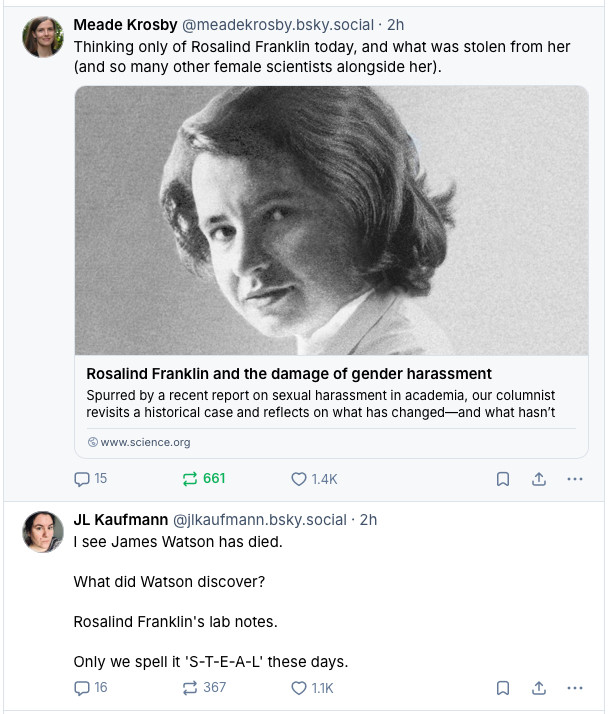
@geoffjp.bsky.social:
Q. What was Crick & Watson’s big discovery?
A. Rosalind Franklin’s laboratory notebook.
@drmaryd.bsky.social:
“An expert in x-ray crystallography, Franklin led the team that created what has been called “arguably the most important photo ever taken,” the celebrated Photo 51, which revealed the helical structure of DNA.“ But not even listed among the authors when findings were published!
@sachiamaragiri.bsky.social:
They should rescind the Nobel prize and give postmously to R Franklin
There were a few exceptional men. One that comes to mind is French chemist Perre Curie who refused to accept to prize if Marie Curie was not given
@hormiga.bsky.social:
Hey folks, as news of Watson’s demise spreads, please don’t set aside his weighty legacy of misogyny and racism. He was truly among the worst of us.
https://www.vox.com/2019/1/15/18182530/james-watson-racist
Taken for Granted
Rosalind Franklin and the damage of gender harassment by Beryl Lieff Benderly, Aug 1, 2025, Science
Lately, I’ve been thinking a lot about Rosalind Franklin, one of the most consequential scientists of the 20th century—indeed, of the entire history of biology—and not just because her 98th birthday would have been last week. She’s been on my mind since the National Academies of Sciences, Engineering, and Medicine (NASEM) issued its June report detailing the prevalence of sexual harassment in university science. Franklin was the victim of one of the most well-known incidents of the particular kind of scientific disrespect that the report calls “gender harassment.”
Gender harassment—defined in the report as disrespecting, demeaning, and deprecating women and their work, abilities, and accomplishments, simply because they are women—has gotten less attention in the report’s aftermath than other forms of sexual harassment, such as sexual coercion and unwanted sexual attention. The report emphasizes, however, that gender harassment is by far the most prevalent form of sexual harassment in academic science, as our colleague Meredith Wadman highlighted. Beyond that, sexual harassment in any form “is not just damaging to targets and bystanders, but also to the integrity of science,” the report states. Franklin’s story illustrates how gender harassment corrodes integrity.
The Matilda Effect
Franklin, one of the very few women doing world-class research in the 1950s, is among history’s most prominent subjects of what historian of science Margaret Rossiter terms the “Matilda Effect“: the practice of ascribing women’s accomplishments to men. An expert in x-ray crystallography, Franklin led the team that created what has been called “arguably the most important photo ever taken,” the celebrated Photo 51, which revealed the helical structure of DNA.
When the structure was published in 1953, however, Franklin—a research associate at King’s College London at the time—was not among the authors. Her crucial contribution was mentioned cursorily at the end of the article as having “stimulated” the authors, James Watson and Francis Crick, who were both researchers at the University of Cambridge—and who, with their paper, gained priority as discoverers.
How did this happen? Shortly after Franklin started at King’s College in 1950, her relationship with another King’s College researcher, Maurice Wilkins, soured. At this remove, and without Franklin’s testimony, we can’t reconstruct how these strong personalities interacted. But we do know that Wilkins, without Franklin’s knowledge or permission, showed Photo 51 to Watson.
The rest, as they say, is history. In 1962, Watson, Crick, and Wilkins shared the Nobel Prize in Physiology or Medicine for discovering the structure of DNA. Franklin had died 4 years earlier at the age of 37 of ovarian cancer—possibly related to x-ray exposure, some have suggested—and thus was ineligible for science’s highest honor. We can’t know whether she would have been considered for the prize had she lived. But we do know that her contribution to the discovery received little attention for years.

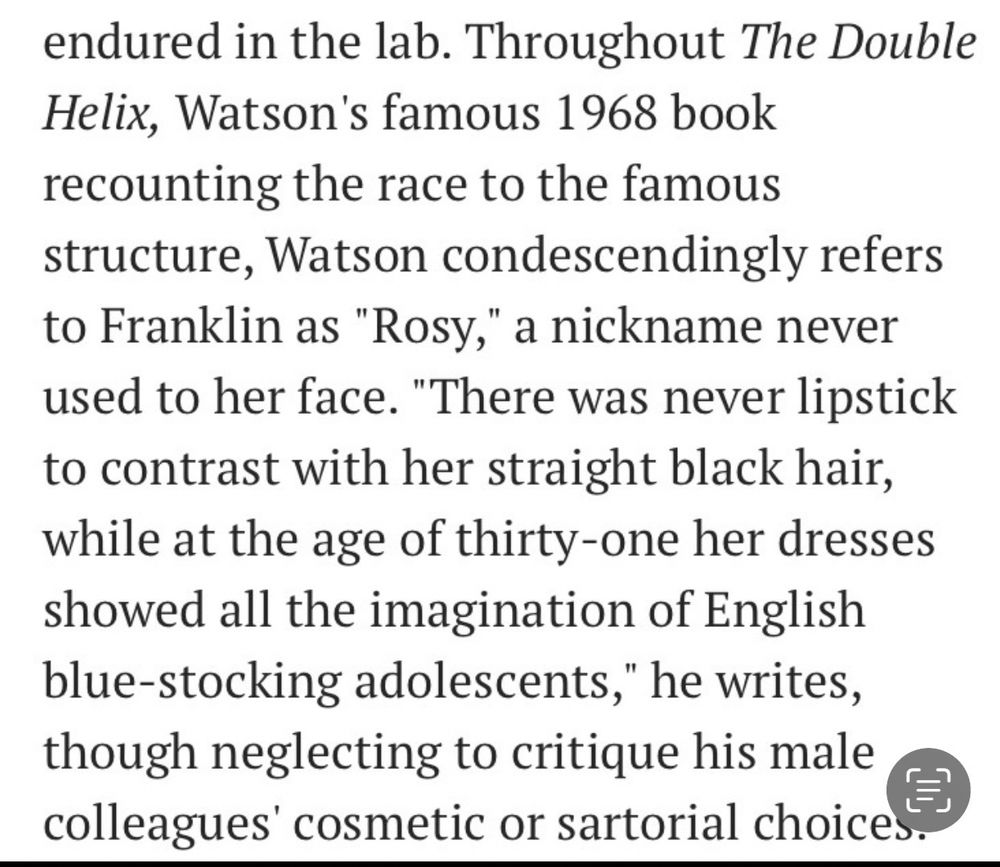
Comments from Watson and Crick reveal the gender harassment that Franklin endured in the lab. Throughout The Double Helix, Watson’s famous 1968 book recounting the race to the famous structure, Watson condescendingly refers to Franklin as “Rosy,” a nickname never used to her face. “There was never lipstick to contrast with her straight black hair, while at the age of thirty-one her dresses showed all the imagination of English blue-stocking adolescents,” he writes, though neglecting to critique his male colleagues’ cosmetic or sartorial choices.
He adds that her “belligerent moods” interfered with Wilkins’ ability to “maintain a dominant position that would allow him to think unhindered about DNA.” For that reason, “[c]learly Rosy had to go or be put in her place. … The thought could not be avoided that the best home for a feminist was in another person’s lab.” In the 1993 book Nobel Prize Women in Science, Crick was quoted as saying, “I’m afraid we always used to adopt—let’s say, a patronizing attitude towards her.”
Did this general air of disrespect rooted in gender play a role in the men’s decision to use the product of Franklin’s work without permission? Some argue that they would have treated a male researcher just as cavalierly. Regardless, it appears obvious that they did not view Franklin as a serious scientific colleague.
A 2017 NASEM report defines six core values of research: accountability, stewardship, fairness, objectivity, honesty, and openness. According to the June report, sexual harassment undermines at least the first three. This is no small matter. As a 2002 study on the topic states, research integrity “is essential for maintaining scientific excellence and keeping the public’s trust.”
Changing times?
“For science to thrive, there must be the freedom to fail,” science writer Philip Ball wrote in a 2015 review of Photograph 51, a play about Franklin and the race to determine the structure of DNA. The male scientists “felt confident enough to foul up.” They “committed howlers in trying to get the prize” but continued to put forward their ideas until the right answer emerged.
Franklin, however, was notably cautious about publishing until her results were more complete. “In Franklin’s time,” Ball writes, “it is not surprising that a female scientist would think that she could ill afford th[e] luxury” of being seen to make mistakes because she was already subject to unfair scrutiny and criticism.
Are things so different in our time? In some ways, of course, female scientists have made substantial progress. Women now hold a wide range of significant scientific positions, including some of the most powerful and prestigious. The event launching the harassment report opened, for example, with a greeting from National Academy of Sciences President Marcia McNutt, previously the editor-in-chief of Science and director of the United States Geological Survey, and the first woman to hold any of the three posts. Women now receive more than half the Ph.D.s awarded in a number of biological fields in the United States. Institutions such as Rosalind Franklin University of Medicine and Science in Chicago, Illinois, and the Rosalind Franklin Institute in the United Kingdom now honor Franklin’s work.
But even so, as the harassment report shows, gender harassment continues to thrive, adversely affecting both individual researchers and the scientific enterprise as a whole. It is not hard to imagine that the disrespect still rampant, and the insecurity it can create, could discourage today’s brilliant women from taking the risk of putting forward offbeat, controversial, or not yet totally proven ideas. In fact, we noted this tendency just a few months ago. Such reluctance not only robs individual researchers of deserved recognition and collaboration, but also robs science of potentially significant insights and advances.
“Academic institutions should consider sexual harassment equally important as research misconduct in terms of its effect on the integrity of research,” the harassment report states. That’s because, quite simply, the risk of impairing the search for truth that it poses can be just as great.
Read more Taken for Granted stories
*Correction 8 August, 10:30 a.m.: This piece originally stated that Franklin was ineligible for the 1962 Nobel Prize because they cannot be awarded posthumously. That is the case today, but at the time the rules were slightly different. Prior to 1974, individuals could not be nominated posthumously.
doi: 10.1126/science.caredit.aau9709
@persister.bsky.social:
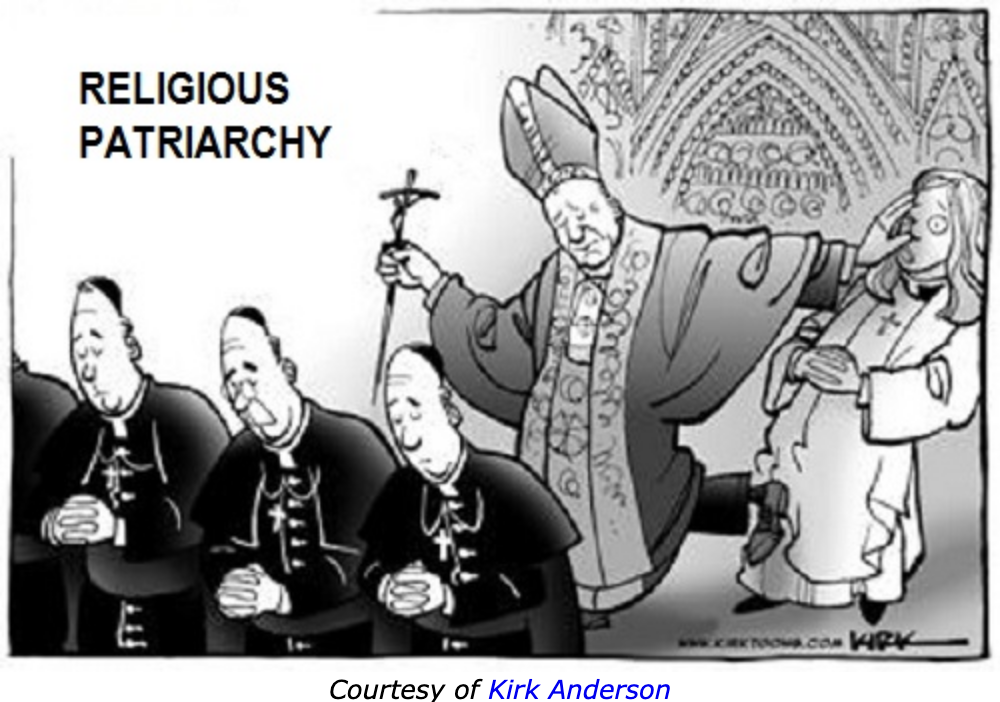
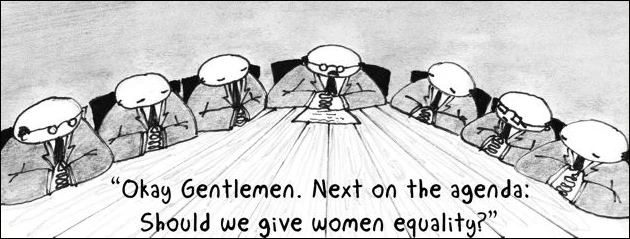
As a female in a male-dom industry, this shit still goes on today. I’m an expert w/ 30+ yrs & get undermined, dismissed, ignored, contradicted, passed over for promotions, mansplained, gaslighted & my ideas get stolen. Reports need a man’s name alongside mine (as reviewer) even tho he had 0 input. Sums up my life; I cannot believe how men need to steal the work and ideas of women, and worse, how society and rape religions accept and enable it.
@davidcbowen.bsky.social:
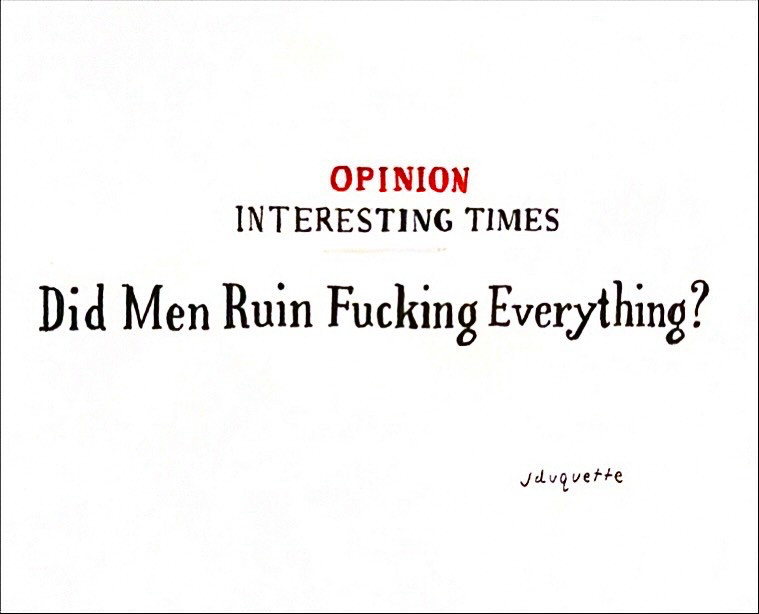
And still The NY Times published an article just this week asking if women have ruined the workplace.
@srslymagenta.bsky.social:
Especially reading how racist Watson was in his older years, which might have been harkening back to younger memories as happens, it makes sense misogyny went alongside.
@shastingssimon.bsky.social:
GRRRR
@meadekrosby.bsky.social:
The rage I feel on her behalf is incandescent.
@trixiebelden1015.bsky.social:
Yes! Ever since I learned of Dr. Franklin and her work decades ago now, I have felt exactly the same. As a former female scientist in a male focused field, she became talisman.
@tomfreeman.bsky.social:
RIP James Watson, co-discoverer of Rosalind Franklin’s notes
@peakaustria:
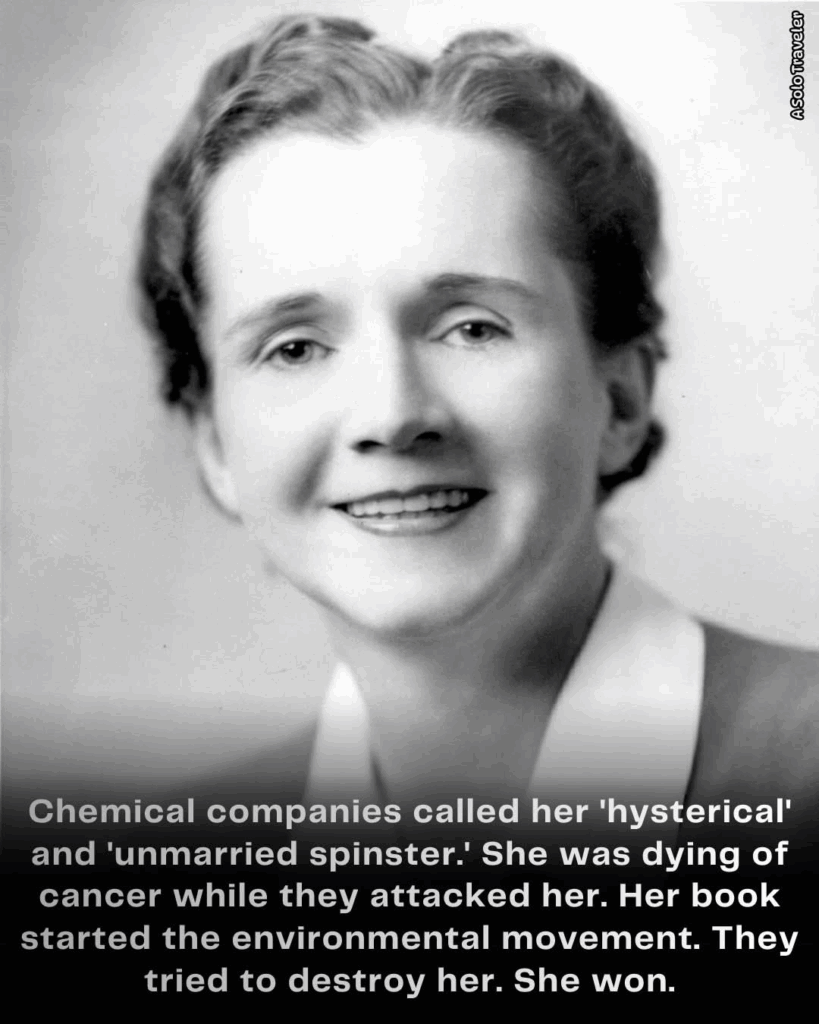
Chemical companies called her “hysterical” and an “unmarried spinster.” She was dying of cancer while they attacked her. Her book started the environmental movement. They tried to destroy her. She won.
Rachel Carson was 54 years old, already one of America’s most celebrated nature writers. Her book The Sea Around Us had spent 86 weeks on the New York Times bestseller list. With great Sketches! She was respected, successful, financially secure.
She could have retired comfortably, written more lyrical books about the ocean, enjoyed her success.
Instead, she wrote a book that would make her the most hated woman in corporate America. Silent Spring hit bookstores in September 1962. Within months, it changed everything. But the chemical industry—worth billions of dollars—decided to destroy her.
And Rachel Carson was dying. They just didn’t know it yet.
Rachel had grown up loving nature. As a child in rural Pennsylvania, she’d explored forests and streams, collected specimens, dreamed of becoming a writer.
She’d become a marine biologist at a time when women in science faced constant discrimination. She’d worked for the U.S. Fish and Wildlife Service, writing bulletins about conservation, studying ocean ecosystems.
In 1951, she published The Sea Around Us—a poetic exploration of ocean science that became a surprise bestseller. Suddenly, Rachel Carson was famous. She could write full-time.
She was happy. Her life was good.
Then, in 1958, she received a letter from a friend, Olga Huckins. Olga described how state officials had sprayed DDT pesticide over her private bird sanctuary. Afterward, birds died by the hundreds. The sanctuary was silent.
Rachel had been hearing similar stories.
DDT—dichlorodiphenyltrichloroethane—was being sprayed everywhere. On crops. On forests. On suburban neighborhoods to kill mosquitoes. Children played in yards where DDT had just been sprayed.My friends and I played in DDT fog, often.
And birds were dying. Eagles. Falcons. Songbirds.
Their eggshells were thinning. Chicks couldn’t survive. Entire species were declining.
Rachel started researching. What she found horrified her.
DDT and other synthetic pesticides were poison. Not just to insects—to everything.
They accumulated in soil, in water, in the bodies of animals and humans. They moved up the food chain, concentrating at higher levels. Birds of prey were especially vulnerable.
And nobody was regulating them. Chemical companies were making billions selling pesticides, claiming they were perfectly safe. What frac’ers, tarsands and carbon (doesn’t) capture companies also claim.Government agencies accepted the companies’ safety claims without independent testing.Yup, just like hideous Dick Cheney and his frac fans in politics and regulators everywhere praising fossil fuel companies and their pollution being good for the environment, and us.
Rachel decided to write about it.
She knew it would be controversial. The chemical industry was powerful. But the truth needed to be told.
She spent four years researching. Reading scientific papers. Interviewing researchers.
Documenting case after case of pesticide damage.
And then, in early 1960, she found a lump in her breast.
Cancer.
Rachel’s doctors recommended aggressive treatment: surgery, radiation. The prognosis wasn’t good. Breast cancer in 1960 was often fatal.
She could have stopped writing. Focused on her health. Told her publisher the book would be delayed indefinitely.
She didn’t.
She had surgeries. She endured radiation treatments that left her weak and nauseated. She lost her hair.
And she kept writing.
She wrote in hospital beds. She wrote between treatments. She wrote through pain and exhaustion.
Because she knew: if she didn’t finish this book, nobody would. And people needed to know the truth.
Silent Spring was completed in early 1962. It was published in September, first serialized in The New Yorker, then as a book.
The response was explosive.
Silent Spring opened with a haunting passage: a description of a town where spring came, but no birds sang. The orchards bloomed, but no bees pollinated. Children played in yards dusted with white powder, and then got sick.
It wasn’t fiction. Rachel was describing what was already happening in towns across America.
Via A Solo Traveller
The book methodically documented how pesticides were killing wildlife, contaminating water, and potentially causing cancer in humans. She explained bioaccumulation—how poisons concentrate as they move up the food chain.
She wrote with scientific precision but also with emotional power. She made people feel the loss of birdsong, the death of eagles, the poisoning of rivers.
The public response was overwhelming. Silent Spring became an immediate bestseller. People were outraged. Scared. Demanding action.
The chemical industry responded with fury.
Chemical companies spent hundreds of thousands of dollars on a coordinated campaign to destroy Rachel Carson’s credibility.
They didn’t just critique her science—they attacked her personally.
They called her “hysterical”—playing on sexist stereotypes of emotional women.
They called her an “unmarried spinster”—implying she was bitter, unnatural, not a real woman.fucking men, I get that often, just because I speak out against frac’ing and have insulted god by not being married (“servicing a man) and not having kids. FFS. And they fucking believe their misogynistic stupid shit. Men, in my experience, have a really hard time coping with intelligent, thinking, independent women.
They questioned whether she was even a real scientist (she had a Master’s in marine biology and had worked as a government scientist for years).I get that crap too – because I speak out against frac’ers and their poisoning of everything and permanently removing water from the hydrogeological cycle.
One chemical company executive said she was “probably a Communist.”
Time magazine’s review said she used “emotion-fanning words” and suggested she’d led a “mystical attack on science.”My MLA, pushing his HUGE ugly body up against mine in my kitchen told me what I was telling him and AER (I fucking had CAPP’s, Encana’s and AER’s own reports and data) wasn’t believable because I was emotional. Fucking insulting misogynistic douche fucker. You find evidence proving Encana illegally frac’d your drinking water supply, covered up by Alberta gov’t and AER, see how you respond.
The Nutrition Foundation (funded by chemical companies) called her book “science fiction.”
Monsanto published a parody called “The Desolate Year,” imagining a world overrun by insects because pesticides were banned.
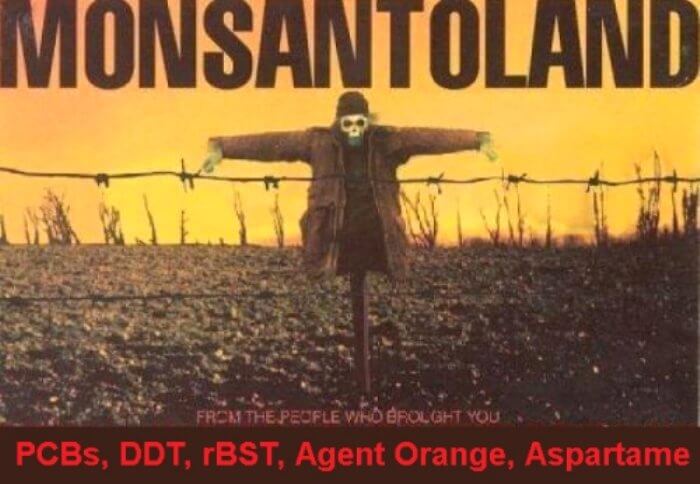
Velsicol Chemical Corporation threatened to sue her publisher if they released the book.
It was a coordinated, vicious campaign designed to discredit her before the public could take her seriously.
And Rachel Carson was going through it while dying of cancer.
She never told the public she was sick.
She knew—absolutely knew—that if the chemical companies discovered she had cancer, they’d use it against her. They’d claim she was “emotional” because she was ill. They’d say she was “irrational” from pain medication. They’d question whether a dying woman could think clearly.
So she kept it secret. Only close friends knew.
In a letter to a friend, she wrote: “Somehow I have no wish to read of my ailments in literary gossip columns. Too much comfort to the chemical companies.”
Even while enduring radiation, while her body was failing, while she knew she might not live to see the impact of her work—she kept fighting publicly.
In 1963, she testified before Congress. She looked frail but spoke with calm authority, presenting her evidence, responding to hostile questions from industry-friendly senators. She appeared on CBS Reports in a televised debate. She calmly dismantled the chemical industry’s arguments while they accused her of fearmongering.
And slowly, the tide turned.
President Kennedy read Silent Spring. He ordered his Science Advisory Committee to investigate her claims.
In May 1963, the committee released its report: Rachel Carson was right. Pesticides were dangerous. Regulation was needed.
It was vindication. Complete vindication.
But Rachel was dying.
By late 1963, the cancer had spread. She was in constant pain. She struggled to walk. She knew she had months, not years.
She spent her final months quietly, at her home in Maryland, with close friends. She’d done what she set out to do. The environmental movement was beginning. Laws would change.
Rachel Carson died on April 14, 1964, at age 56.
She’d lived just long enough to know she’d won.
After her death, the momentum continued.
In 1970, the Environmental Protection Agency (EPA) was created—directly influenced by the awareness Silent Spring had created.
In 1972, DDT was banned in the United States.Thank you Rachel.
Eagle populations recovered. Falcon populations recovered. The silent springs started singing again.I watched the recovery in real time.
Today, Rachel Carson is recognized as the founder of the modern environmental movement.
Silent Spring is considered one of the most influential books of the 20th century.
But she never lived to see most of it.
She died knowing she’d started something, but not knowing how far it would go.
Here’s what makes Rachel Carson’s story extraordinary:
She was already successful. She didn’t need to write Silent Spring. She could have stayed comfortable, avoided controversy, kept writing beautiful books about the sea.
She chose to write the truth instead—knowing it would make her enemies, knowing it would be attacked, knowing it might fail.
She was diagnosed with terminal cancer while writing it. She could have stopped. Nobody would have blamed her.
She finished it anyway.
She was viciously attacked by the most powerful corporations in America. They questioned her credentials, her sanity, her womanhood.
She never responded with anger. She just kept presenting evidence, calmly, methodically, until even her critics couldn’t deny the truth.
She testified to Congress while dying. She went on television while undergoing radiation. She kept fighting until her body couldn’t fight anymore.
And she won.
Not just for herself—for eagles, for songbirds, for rivers, for children playing in yards that would no longer be poisoned.
She won for all of us.
Rachel Carson didn’t just write a book. She took on an entire industry while dying, stayed calm while being savaged, and sparked a movement that’s still growing today.
Every environmental protection law owes something to her courage.
Every recovered species owes something to her research.
Every person who’s ever spoken truth to power and been attacked for it owes something to her example.
She was called hysterical. She was called a spinster. She was called a communist and a fearmongerer and a threat to progress.
She was right. About everything.
And she never lived to see how completely, totally right she was.
Remember her name: Rachel Carson.
Remember that she was dying while they attacked her—and never stopped fighting.
Remember that Silent Spring wasn’t just science—it was an act of courage.
Remember that one person, telling the truth, can change the world.
Even if they don’t live to see it.
The springs are singing again because Rachel Carson refused to be silentBut now much worse chemicals (PFAS, glyphosate, etc), plastics, radioactive secret frac brews, fossil fuel pollution, human over population is fast wiping out life everywhere. Trembling aspen are dying across the prairies because of extreme heat from human caused climate change. Frac’ing would never have taken off in the world (because it’s so toxic and damaging to earth, water, health and more) if not for criminal war mongering monster Dick Helliburton Cheney.
Helen Hulick Imprisoned for Wearing Pants On This Day in History: November 9, 1938 by Sweary History with James Fell, Nov 9, 2025
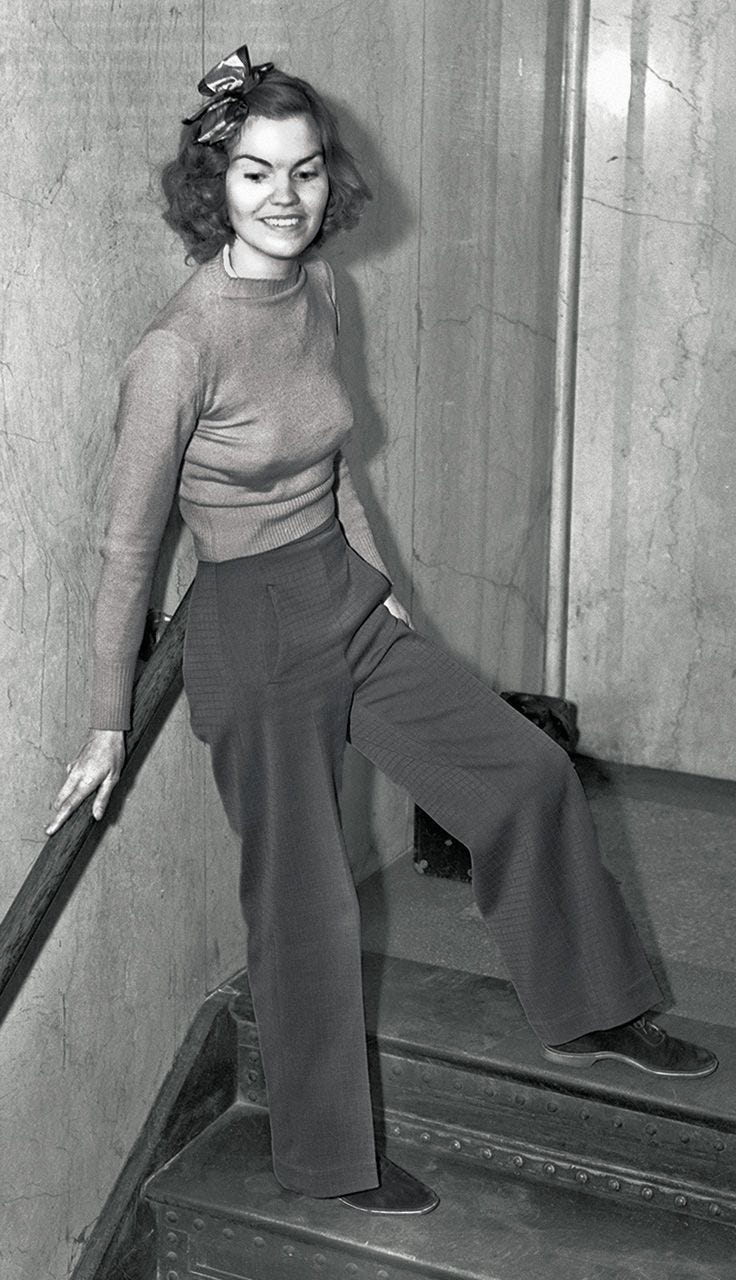
She was in court in Los Angeles as a witness for the prosecution to testify against two men who burglarized her home. But Helen Hulick wore pants, and the judge sent her to jail instead.
You know how some people, me included, hate the word “moist”? I’m the same way with referring to pants as “slacks.” But that’s what they called them back then. Except fuck that, let the anachronisms run wild. So, yeah. A couple of assholes broke into Helen’s home. On November 9, 1938, she showed up in court to testify wearing pants. The judge was all heavens to Betsy goodness gracious no won’t someone think of the children.
Judge Arthur Guerin rescheduled the case, telling Hulick that when she returned, she better be wearing a dress.What an abusive douche, typical male lawyer-judicial misogynistic – they haven’t improved any nearly a century later Hulick was interviewed by the Los Angeles Times and was quoted in the paper the following day: “You tell the judge I will stand on my rights. If he orders me to change into a dress, I won’t do it. I like slacks. They’re comfortable.” That’s pretty badass.When I worked in the oil and gas industry, I was often told by men how to dress. FFS. They don’t do that shit to male contractors. Misogynistic cowards.
Helen Hulick was a kindergarten teacher and used to dealing with obstinate children like the judge. She returned to court on November 15 and was all check out these pants, motherfucker. Like a typical five-year-old, the judge had a hissy fit. He said to her, “You drew more attention from spectators, prisoners and court attachés than the legal business at hand.” Then he spewed some bullshit about “orderly conduct” because he apparently didn’t have the ability to control his own courtroom when a woman wore pants in it. He told her to return the next day in a dress or prepare to be punished.
She showed up again in pants, prepared to be punished. The judge held her in contempt, sentencing her to five days in jail. Women weren’t allowed pants in jail either; her prison garb was a denim dress.The easier for male staff to rape them She was ready to serve her time, but her attorney got her out with a writ of habeas corpus to take the matter before the appellate court to determine if her detention was legal.
The higher court said fuck that Judge Guerin guy. Let the woman go. She was free to return to court to testify, wearing pants. Except she didn’t. As a final fuck-you to the judge, after winning the right to wear pants, she went hard in the other direction, overdressing in the fanciest attire she possessed.
Because sometimes a woman wants to wear pants, and sometimes she wants to wear a fancy dress.you fucking got that right!
Those who cannot remember the past need a history teacher who says “fuck” a lot. Get both volumes of On This Day in History Sh!t Went Down. The holidays are coming and they make great gifts.
Refer also to: