

I believe human patriarchy and misogyny created god, religion and religious texts to propagandize and control the masses (and earth) for profit-raping by the rich and powerful. And to farm hate and rage against women and girls and give men ownership of them to legally abuse them, sex trade them, use for free labour, and to rape, burn and murder as men pleased.
I’ve watched religions, religious politicians (fake – e.g. Trump, and real), the rich and the Patriarchy abuse girls and women all my life. They now freak out and rage at DEI (even racist misogynist Mark Carney is secretly attacking it) and are furious women and girls have a few rights, including – heaven forbid – the right to say NO to sex/rape/marriage/kids/abuse/murder, etc.
The War on Women by inhumane “religious” men taking our rights away to our own bodies is religious, hate-based and vicious. We grossly greedy humans have likely already crossed the point of no return to destroying earth’s livability with our over raped, over populated, religion and GDP driven world.
I believe the current douche fuckery going down in our Nazi genocidal raping polluted insanity is the Patriarchy, religions, and hateful (usually religious and often kid-raping) misogynists wanting total control back over women and girls. If life on earth is to continue, the Patriarchy; propaganda and lies by religions, the rich, the rapist-protecting legal-judicial industry, and politicians; frac’ing; and AI must be criminalized.
Imagine if the religious fairy tale had been written this way:
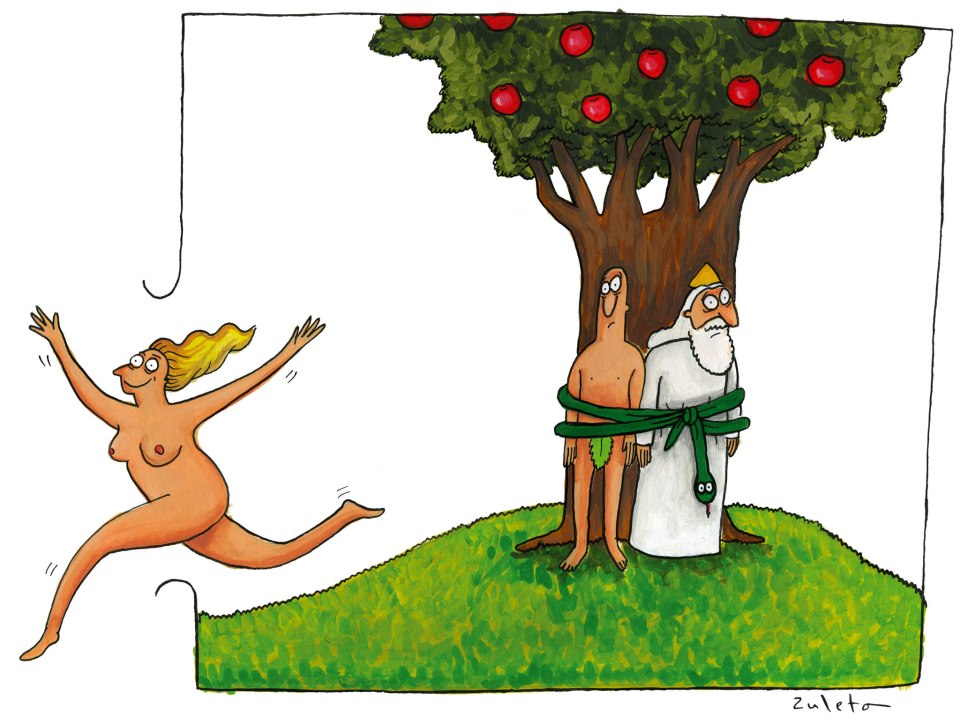
2013 Cartoon by Raul Fernando Zulea
@race2extinct.bsky.social:
The things humanity clings to — corporations, money, nations, religions — are not anchors. They’re myths. And when the storm comes, they will turn to dust and blow away.
What Stephen Hawking said about God and what happens after we die by TOI Science Desk / TIMESOFINDIA.COM, Nov 07, 2025
Stephen Hawking, one of the greatest minds of our time, often faced big questions about God and what happens after we die. His replies were calm but striking, he didn’t believe in heaven or an afterlife, seeing life as a precious moment shaped by science. Yet his curiosity showed a deep awe for the universe.
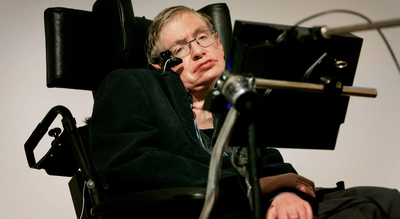
Stephen Hawking, who lived with ALS for decades, believed the brain is a computer and rejected heaven or an afterlife/ file
Few figures have reshaped our understanding of the universe as profoundly as Stephen Hawking. Known for his groundbreaking work on black holes and the origins of the cosmos, Hawking was not only a scientist but a symbol of resilience, a man who defied a devastating diagnosis to become one of the most influential thinkers of the modern age. Yet when it came to questions that reach beyond the limits of science, God, heaven, and life after death, his answers were as unflinching as his intellect.
A life defined by defiance and discovery
Born in 1942, Stephen Hawking’s life was transformed at just 21 when doctors diagnosed him with Amyotrophic Lateral Sclerosis (ALS), a form of motor neurone disease. He was told he had only two years to live. Instead, he went on to survive for more than half a century, passing away in 2018 at the age of 76, making him the longest-living motor neurone disease survivor on record. Over those decades, Hawking’s physical abilities deteriorated steadily, yet his mind remained as sharp as ever. He continued to work, teach, and write, communicating through a computerised speech system attached to his wheelchair. The system, powered by his wheelchair batteries, used cheek movements to control an on-screen keyboard, a painstaking process that allowed him to write books, deliver lectures, and share ideas with the world.
“There is no heaven or afterlife for broken down computers”
Hawking’s views on death were as direct as his scientific reasoning. Asked in 2011 what he thought happened after we die, he told The Guardian: “I have lived with the prospect of an early death for the last 49 years. I’m not afraid of death, but I’m in no hurry to die. I have so much I want to do first. I regard the brain as a computer which will stop working when its components fail. There is no heaven or afterlife for broken down computers; that is a fairy story for people afraid of the dark.” It was a stark, unsentimental view, one that echoed his lifelong commitment to scientific evidence and rational thought. To Hawking, death was not something to fear, but a reminder of the finite nature of our existence. He believed that meaning could be found not in promises of eternity, but in the pursuit of understanding and in making the most of the time we have. Even as he dismissed the notion of life beyond death, he urged people to live purposefully, saying we should “seek the greatest value of our action.” For Hawking, science itself was a form of beauty, “beautiful when it makes simple explanations of phenomena or connections between different observations. Examples include the double helix in biology and the fundamental equations of physics.”
His simple answer on God
When asked about the existence of God, Hawking offered a response that was as calm as it was final. In his later years, he elaborated on this question in his final book, Brief Answers to the Big Questions.“For centuries, it was believed that disabled people like me were living under a curse that was inflicted by God. Well, I suppose it’s possible that I’ve upset someone up there, but I prefer to think that everything can be explained another way, by the laws of nature. If you believe in science, like I do, you believe that there are certain laws that are always obeyed. If you like, you can say the laws are the work of God, but that is more a definition of God than a proof of his existence.” He went further still, writing: “We are each free to believe what we want and it’s my view that the simplest explanation is there is no God. No one created the universe and no one directs our fate. This leads me to a profound realization, there’s probably no Heaven and no afterlife, either. We have this one life to appreciate the grand design of the universe and for that I am extremely grateful.”In the same book, he described belief in an afterlife as “just wishful thinking”, adding: “There is no reliable evidence for it, and it flies in the face of everything we know in science.” These reflections didn’t come from cynicism but from his deep trust in the laws of physics, the same laws that, in his eyes, governed everything from galaxies to human life itself.
Seeing the future through science
Even near the end of his life, Hawking’s attention remained firmly on humanity’s future. In Brief Answers to the Big Questions, published posthumously in 2018, he warned of the dangers and promises of artificial intelligence (AI).“We may face an intelligence explosion that ultimately results in machines whose intelligence exceeds ours by more than ours exceeds that of snails,” he wrote. He cautioned that dismissing the power of AI would be a grave mistake: “It’s tempting to dismiss the notion of highly intelligent machines as mere science fiction, but this would be a mistake — and potentially our worst mistake ever.” Hawking had already raised the alarm in a 2014 BBC interview, saying: “The development of full artificial intelligence could spell the end of the human race. It would take off on its own, and re-design itself at an ever-increasing rate. Humans, who are limited by slow biological evolution, couldn’t compete, and would be superseded.”
A legacy rooted in reason, and a universe of questions
Stephen Hawking’s outlook stood in clear contrast to others who grappled with similar questions from different vantage points. Antony Flew, once the world’s most prominent atheist philosopher, eventually changed his mind, affirming belief in a Creator after reflecting on the complexity of DNA and the origins of life, a journey he detailed in his book There Is a God. Similarly, Francis Collins, the geneticist who led the Human Genome Project, moved from atheism to Christianity, describing his conversion in The Language of God and crediting both science and personal experience for reshaping his beliefs.
Albert Einstein, on the other hand, rejected the notion of a personal God who intervenes in human affairs, saying he believed in “Spinoza’s God,” one revealed through the harmony of nature and the laws of physics. He called himself a “religious nonbeliever,” acknowledging not a deity of scripture, but a deep, almost spiritual admiration for the order of the universe. Hawking’s views diverged sharply from Flew’s faith and Collins’s reconciliation of science and belief, yet shared something of Einstein’s cosmic awe, a deep respect for the elegance and inevitability of natural law. In the end, his insistence on reason over revelation was not a denial of mystery but a profound recognition of its true scale. Perhaps it takes a true man of science, one unafraid to question the sacred and confront the unknown, to bring humanity closer to understanding the vast universe, and in doing so, closer to whatever we may call God.
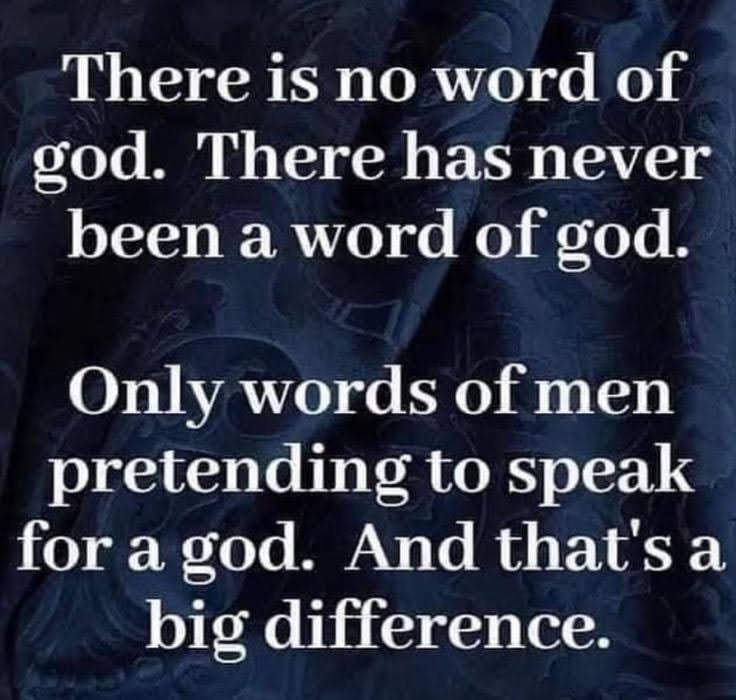
“There is no word of god. There has never been a word of god. Only words of men pretending to speak for a god. And that’s a big [raping] difference.”
The Eucharist Becomes Official, On This Day in History: November 11, 1215 by James Fell, Nov 11, 2025, Swear History with James Fell
How many times do you have to take communion before you’ve consumed an entire Jesus? How many Jesuses have been consumed since people started the practice? I’m sure some math whiz could figure it out, but we need to begin at the beginning.
Christianity is weird. It has zombies and embraces the symbol of its savior’s torture. And the dude who speared Jesus to death? They made him a saint. Like, the fuck? Imagine explaining that shit to Jesus. Pope: “Hey, JC. Remember the soldier who coup-de-grâced your ass? We thought that was awesome so we gave him the highest honor we could.”
JC: “The fuck is wrong with you?”
Anyway, right after Jesus got sent off to meet his dad/himself people didn’t automatically go “Hey let’s start pretending to eat the guy.” At least, not officially. That didn’t happen until November 11, 1215, at the Fourth Council of the Lateran in Rome. See, rape religions make shit up to serve their business needs and rape desires
Prior to that, it all started at the Last Supper with Christ telling his pals this bread is me this wine is me so down the hatch with that shit, and apparently they didn’t think that was weird. I expect they were all mindlessly drunkIt’s called the Eucharist and it caught on as a ritual among Christians so that a dozen centuries later the Church figured they should formalize some rules around it, affirming it as official dogma.
The Eucharist was cemented under Pope Innocent-Raped how many kids?-III, and if I know anything about popes, I doubt he or any of the others who took that name were all that innocent. Anyway, it was a big ecumenical council with a ton of patriarchs and bishops and abbots and shit. The council decided a lot of stuff, including stamping out heresy, calling for yet another crusade against those infidels in the Middle East, plus a bunch of other housekeeping bullshit. But a big one was about transubstantiation—that’s where it became official Church doctrine to accept that some wafer and cheap wine are for-real transformed into the body and blood of Christ by a priest during the Mass, so be a good Christian and go cannibal on the Lord.
How does it work? The answer is simple, and one often used among various religions to explain myriad phenomena: God did it; “the bread being changed (transubstantiation) by divine power into the body, and the wine into the blood,” they said.
A few hundred years later Martin Luther was all “Are you fucking kidding me?” about the Eucharist, and Protestants created their own version that was more a “memorial,” going through the motions with no magical transformations into flesh and blood. Alas, the ensuing disagreements between Protestants and Catholics over the right way to pray to Jesus would lead to centuries of rending and spilling of literal flesh and blood.
PancakeSushi:
I’m sorry, that first line, about how many times you have to take take Communion before you consume an entire Christ? Burst out into laughter. And I think somewhere George Carlin is rolling over in his grave, wishing he’d have thought of that one
lynn z:
And once he is served to you, you may NOT chew him or touch him with your hands, even if he gets stuck to the roof of your mouth and you start gagging a little bit. Christ is only to be dissolved, not masticated or touched by non-priestly, mere mortal fingers.
Dale Rowett AR OK VA PA NY:
The more you know … and the more you think about it … the more you realize that the whole religion thing … the deities, the sacred texts, the rules and regs, the sacraments, the whole nine yards is just bullshit made up by a bunch of old illiterate misogynisticmen sitting around their fires at the beginning of timelusting to rape 5 and 6 year olds and how to make it acceptable
Some kid walked up to the Old Farts Circle and asked, “How come birds can fly and I can’t?”
And the old farts were off and running with nonsense about how the world got made and who’s good and who’s bad, blah, blah, blah.
Lance Trottier:
Awesome writing from a reformed Catholic [meaning that, though I was brung up (I wasn’t raised up… that was Jesus) in strict Catholic household by a Sargeant of the Korean war and my Mum who was quite literally a nun who left the nunnery to marry my Sargeant… I mean my Dad… and take care of him and his five brats (me being the youngest)… YEPpers, you guessed it… a real walkin’, talkin’ Julie Andrews in the Sound of Music… even sang her songs to us as rugrats…]…
Where was I?
Oh, yeah! I was ‘splainin’ being a reformed Catholic…
Though I was an Altar Boy, a Lector and all, I stopped all that shit and haven’t looked back… that was many decades ago…
Yeah, eat that and drink that? Made no sense to me even as a kid.
He became a Zombie? That didn’t compute, either…
He and his Dad and that other even more Invisible Dude in the Sky, the holy Spirit… now, they were once in the same? Jesus Christ, Awmighty… Make that make sense!
And, that “Immaculate Conception” crap… Seriously??? Mary was messin’ around on Joey, and she got knocked up… and Ol’ Joey, he was either ignorant to the whole damned enchilada or he simply didn’t question it and did the honourable thing… “Oh, you mean you screwed around on me? Jesus Christ, Woman! But, I see… It was God, so I’m cool with it. Let’s get married.”
Jim Slaughter:
There is a lot of hocus-pocus in religion. It rivals witchcraft sometimes.