
Guess where masses of hydraulic fracturing takes place? Yup, Colorado. It’s been known for years by authorities and frac’rs that much water foolishly injected underground via frac’ing is lost to reuse by humans forever.
A proportion (25% to 100%) of the water used in hydraulic fracturing is not recovered, and consequently this water is lost permanently to re-use, which differs from some other water uses in which water can be recovered and processed for re-use.

How can England possibly be running out of water? by Helena Horton Environment reporter, Aug 17, 2025, The Guardian
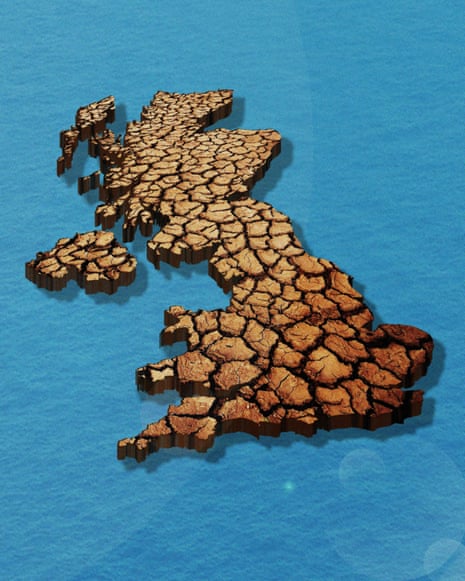
While famously rainswept, climate crisis, population growth and profligacy mean the once unthinkable could be possible
During the drought of 2022, London came perilously close to running out of water. Water companies and the government prayed desperately for rain as reservoirs ran low and the groundwater was slowly drained off.
Contingency plans were drafted to ban businesses from using water; hotel swimming pools would have been drained, ponds allowed to dry up, offices to go uncleaned. If the lack of rainfall had continued for another year, it was possible that taps could have run dry.
That, however, was just a taster of what could come down the line. On Tuesday, the government announced a “nationally significant” water shortage in England, which means the whole country is at risk of running out if the dry weather continues. People across England are already banned from using hosepipes, with more restrictions probable over coming months. The UK Centre for Ecology and Hydrology (UKCEH), an independent research institute, has warned of exceptionally low river flows. Reservoirs are also at extremely low levels and groundwater is dwindling.
Droughts are generally two-year events.  There is nothing “general” about anything under the extremes of global warming and human over-population and our grossly excessive greed and water wasting and contaminatingA year of dry weather means water supplies are running out – that is what is happening now. Things really come to a head if the following year does not bring above average rainfall. That is when the shortages start to bite, with farmers unable to irrigate and households and businesses hit with sweeping restrictions. With reservoirs at record lows and stream flows exceptionally low, England is desperate for rain.
Forecasts indicate that by 2055 England’s public water supply could be short by 5bn litres a day without urgent action to future-proof resources, the equivalent to more than a third of the supplies available today. The effect on the economy will be profoundly negative. The thinktank Public First has estimated that the economic cost of water scarcity could be £8.5bn over this parliament.
So how on earth did famously rainswept England, notorious the world over for being green and wet with our national symbol pretty much a furled umbrella, come to this?
Britain’s geology and climate means there should be plenty of water. Underground in the south of England the rock is made of chalk, which is very soft and porous. These layers of rock filter rainwater into some of the cleanest water in the world, collecting in huge aquifers that have been tapped by local residents for centuries. Water companies now use those aquifers to provide the majority of the drinking water in some parts of the south.
Further north, the rock underfoot is harder; sandstone and limestone, so lacking the benefits of the chalk aquifer. But it tends to receive more rainfall than the south, so there has generally been plentiful water from the skies to fill the reservoirs on which the northern water companies rely. There are also the rivers that crisscross the country, which (when clean) include gin-clear chalk streams buzzing with mayflies and thronging with salmon and other fish.
The UK is one of the rainier places in Europe. Some areas are wetter than others. In England, the Lake District generally receives an average of 2,000mm of rainfall a year, while in parts of the south-east it is as low as 700mm.
Perhaps it is because the country has always had such rich resources, that they have been taken for granted. Running out of water has never really been in question. But with population growth and climate breakdown, this is starting to look like folly.
It was in the 17th century that the New River Company began piping water into London’s homes from the springs in nearby Hertfordshire for the very rich. Slowly the technology began to spread and grow in popularity. Over the next decades, England’s population would rise dramatically and the water systems of its rapidly growing cities would come under increasing stress.
When the Great Stink hit London in 1858 during a heatwave, the civil engineer Joseph Bazalgette had already been commissioned to draw up plans to urgently update the city’s sewage system. Known for his tirelessness, Bazalgette checked every connection himself, making thousands upon thousands of notes, and saved many lives as the system diverted sewage away from the city and into the Thames estuary. Later, treatment centres were added to purify the water.we are a disgusting vulgar water disrespecting, water raping species. All my life, I’ve been horrified how humans waste and destroy water, and stupidly take it for granted.
Today, consumers are used to having water coming out of a tap and they want to use a lot of it. Future generations, who will be dealing with long, dry summers, would probably be shocked at the profligate way clean tap water was used to flush toilets, water gardens and run washing machines. UK households use more water, mostly on showering and bathing, than other comparable European countries, at about 150 litres a day per capita. For France the average is 128, Germany 122 and Spain 120 (although in Italy its 243 litres a day).
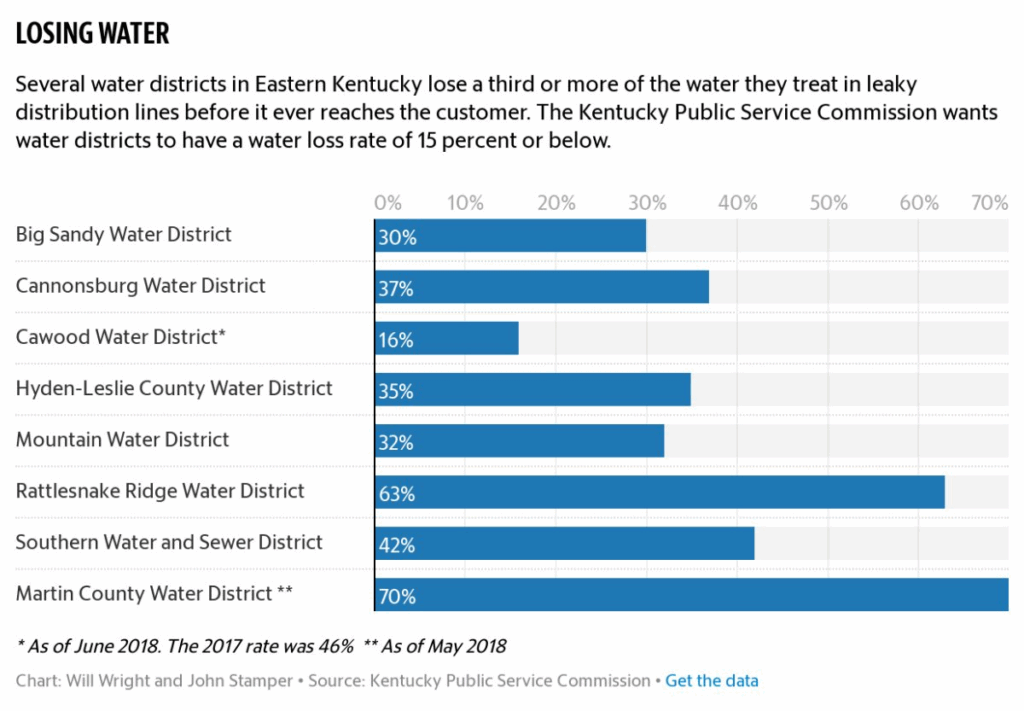
And the waste starts long before it gets to people’s taps. Water companies in England and Wales lose about 1tn litres of water through leaky pipes each year. The industry has said that about 20% of all treated water is lost to leaks. The water firms have pledged to halve leakages by 2050.Too late!
Meanwhile, the annual pipe replacement rate is 0.05% a year across all water companies: much of the sewage system in London, for example, has not been significantly updated since Bazalgette and his colleagues installed it in the 19th century.
No new reservoir has been built in 30 years despite significant population growth and climate breakdown meaning longer, drier summers during which the country desperately needs to store water. The reservoirs England does have are at their lowest levels in at least a decade, just 67.7% full on average. According to Dr Wilson Chan, a hydroclimatologist at UKCEH, “above average rainfall over several months is needed to ease pressures on water resources”.
Was it the privatisation of the water and sewerage industry in 1989 that has led to this situation? England’s water system has been widely criticised, and privatisation has been blamed for a lack of investment in infrastructure. Some say this is owing to the water companies paying out dividends rather than using the money raised by customer bills solely for investment in infrastructure; others blame a privatised regulated monopoly system that has prioritised low customer bills over investment.
Experts have also pointed to the regulatory system. Water company drought plans compel firms to follow a series of steps before they can increase abstraction, taking more water from reservoirs, rivers and the ground to supply customers, beginning with reducing consumption (a hosepipe ban).
“Water companies must now take action to follow their drought plans – I will hold them to account if they delay,” says the water minister, Emma Hardy. “We face a growing water shortage in the next decade.”
But water companies believe that people hate being told to reduce their water consumption, so avoid hosepipe bans as much as possible. It does not help that bans may also lead to customers giving low satisfaction marks for their company, which are then taken into account by the regulator.
The end result of these incentives; unsustainably high levels of abstraction from the natural environment, most of which will not be replaced by rain on the same timescale. Stores of water such as fossil aquifers and chalk streams recharge over centuries. The Environment Agency (EA) assess that 15% of surface water bodies and 27% of groundwater bodies in England have unsustainable levels of abstraction.
“We are calling on everyone to play their part and help reduce the pressure on our water environment,” says Helen Wakeham, the EA’s director of water and chair of the National Drought Group.“Water companies must continue to quickly fix leaks and lead the way in saving water.”
This is not just a management problem. As climate breakdown accelerates, rainfall patterns are changing fast, and water will increasingly become less available at certain times of year. As Sir David King, a former UK chief scientific adviser who chairs the Climate Crisis Advisory Group, says: “Drought in England is no longer a warning. It is a clear signal that climate collapse is unravelling our water, food and natural systems right now.
“This crisis demands a fundamental shift that places real value on our planet and environment, invests in nature, restores water cycles and transforms how we use every drop. If we rise to this moment we can turn crisis into opportunity, delivering economic resilience, ecological renewal and climate leadership.”
The UK is not the only country that is already struggling to deal with changing weather patterns. Almost half of Europe is in drought, with wildfires tearing across the continent and farmers struggling to grow crops.
Many of the economies of Southern Europe are dependent on sunny weather that has historically made the region the perfect place to grow vegetables for export. Scientists are concerned that farming in certain southern European countries will become less and less viable. More than 90 million people in eastern and southern Africa are facing extreme hunger after record-breaking drought across many areas has led to widespread crop failures and the death of livestock.
As the impacts of the climate crisis unfurl around the world, is the UK government awake to the scale of the problem? Nine new reservoirs are in the pipeline to be built before 2050, while there are consultations on reducing demand for water. But this may be too little, too late; many housing developments are on pause because of water scarcity.
The first new reservoir planned for Abingdon in Oxfordshire is sited in the same place as the government’s new datacentre zone, leading to fears the water will be used to cool servers rather than serve customers in one of the most water-stressed areas of the UK.
Green homes experts have said government building codes for new housing should include rainwater harvesting for internal use such as in lavatories and washing machines.And when global heating makes it stop raining? People with gardens could use a water butt in summer, so that clean tap water is not being pumped through a hose into garden plants.
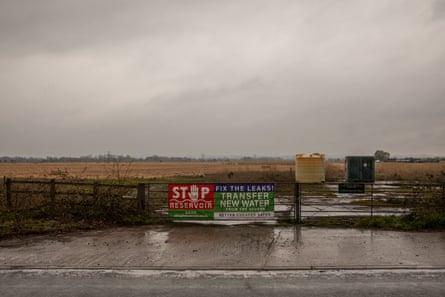
Not all those living near the proposed Abingdon reservoir are keen on the plan. Photograph: Antonio Olmos/The Observer
Reducing time in the shower by a minute can save water, says Waterwise, while green building groups recommend the use of water-saving shower heads. A recent government commissioned report recommends smart water meters are installed nationally, so households who use sprinklers and fill swimming pools are charged more than those who are more frugal with their use.
More broadly, farmers could build reservoirs on their land to reduce the need for irrigation. Nature-based solutions could be used too, such as releasing beavers that create dams and hold water in the system, or restoring wetlands.
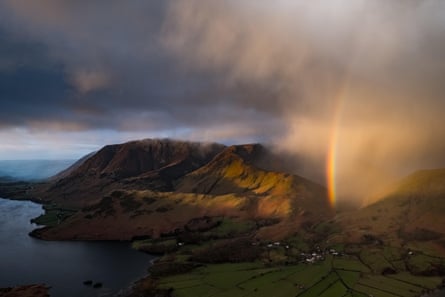
A shower passing over the Lake District. ‘We need to use rainwater where we can, such as car washing, gardening, washing pets, filling paddling pools, and flushing the loo.’ Photograph: Nigel Wilkins/Alamy
“We need to build more resilience into our rivers and their catchment areas with nature-based solutions at scale, such as healthy soils that allow water to filter into the ground and not rush off taking the soil with it; riverside tree planting to provide shade and further slow the flow of water; wetlands to store and slowly release water, and rewiggling streams to raise the water table and purify pollutants,” says Mark Lloyd, the chief executive of the Rivers Trust.
“We also need to finally implement the use of rainwater rather than drinking water where we can, such as car washing, gardening, washing pets, filling paddling pools and flushing the loo. Other water-stressed countries have used this approach for decades and we need to join that party.”
***
USA
@KenBerenger Aug 26, 2025:
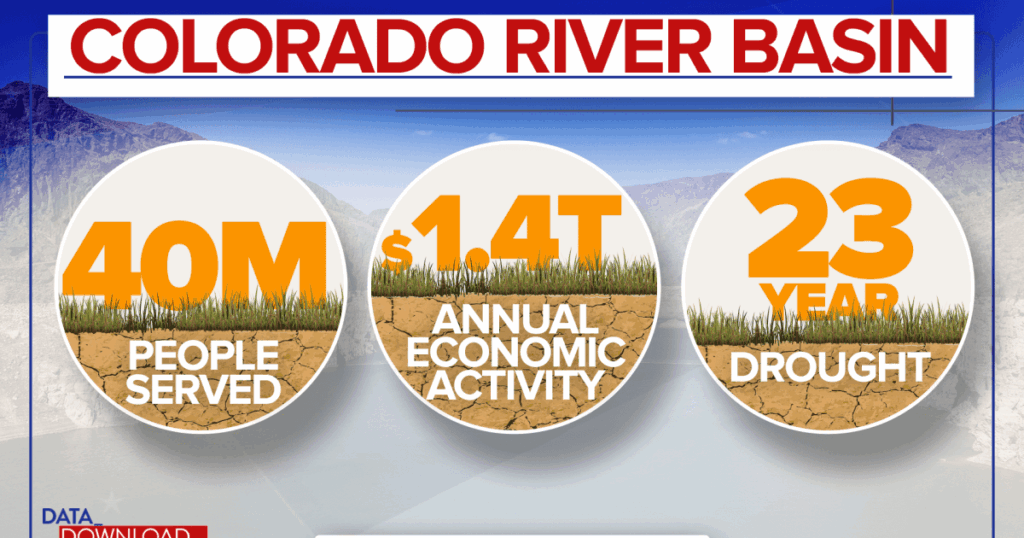
The Colorado River powers over 16 million families, 5 million acres of farmland, and $1.4T in economic activity. In 2025, it’s collapsing at an ALARMING rate. Since the government and media won’t show you.
Here’s the story of America’s deadliest ticking time bomb…

Stretching 1,450 miles, the Colorado powers the Southwest.
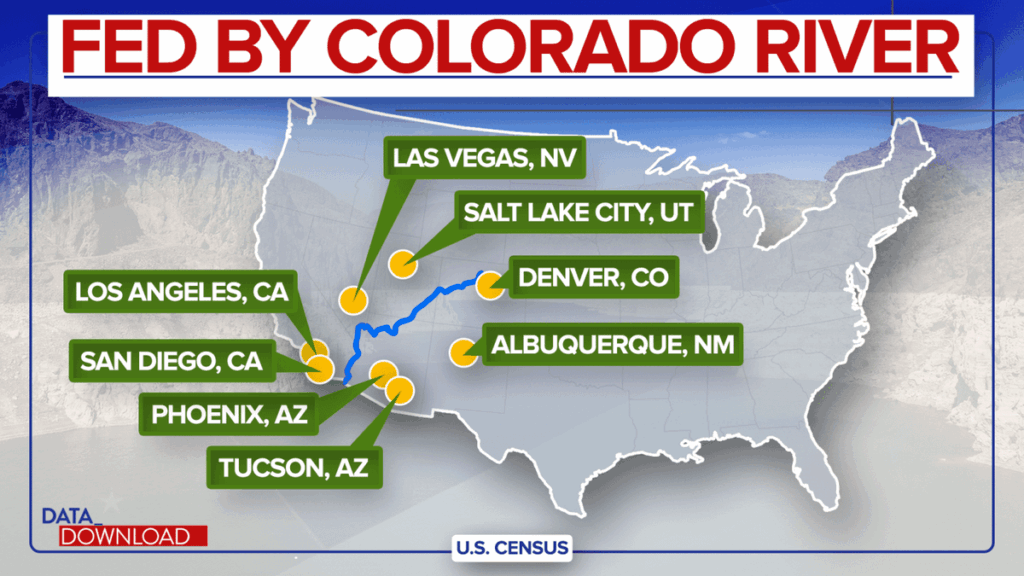
• It supplies Phoenix, LA, San Diego & Denver.
• It irrigates 90% of America’s winter vegetables.
• It lights up Las Vegas through the Hoover Dam.
Lose it, and the American West shuts down.
The stakes are massive. Colorado supports 16 million jobs in farming, real estate, energy, and tourism. If Hoover Dam fails, it won’t just be crops at risk. It’s homes, businesses, and entire economies. This is bigger than any oil shock in history.
1/ The river is drying up. Since 2000, it’s lost at least 20% of its flow. Lake Mead and Lake Powell, its two giant reservoirs, are at historic lows. If they drop much further, the Hoover Dam stops producing power. The lights go out in Vegas, Phoenix, LA.

2/ This isn’t just climate. The problem is baked in. In 1922, the Colorado River Compact promised more water to 7 states than the river ever produced.
For 100 years, demand has been greater than supply. Now the math is catching up.
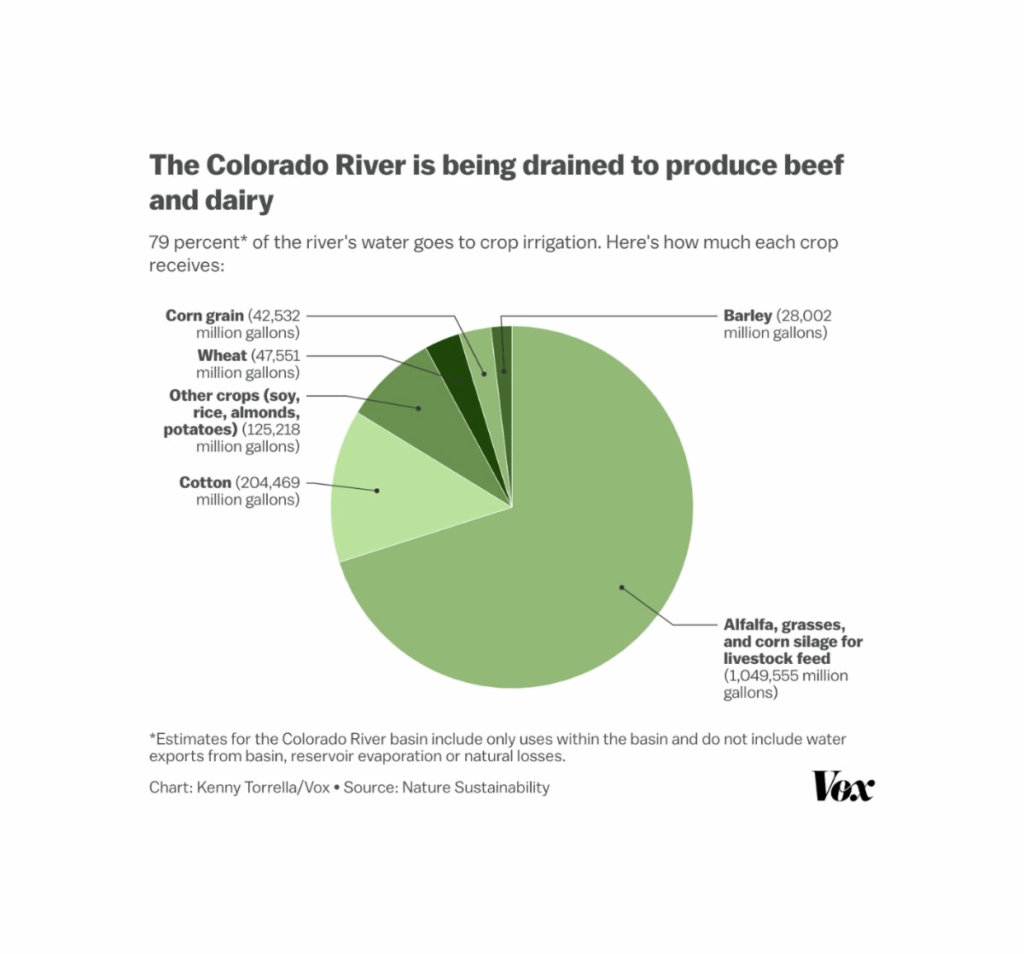
3/ Farmers take the lion’s share.
- 80% of the river goes to agriculture, alfalfa, almonds, lettuce, and beef.
- Cut farmers, and America’s food supply collapses.
- Cut cities, and growth stops.
Every choice is catastrophic.
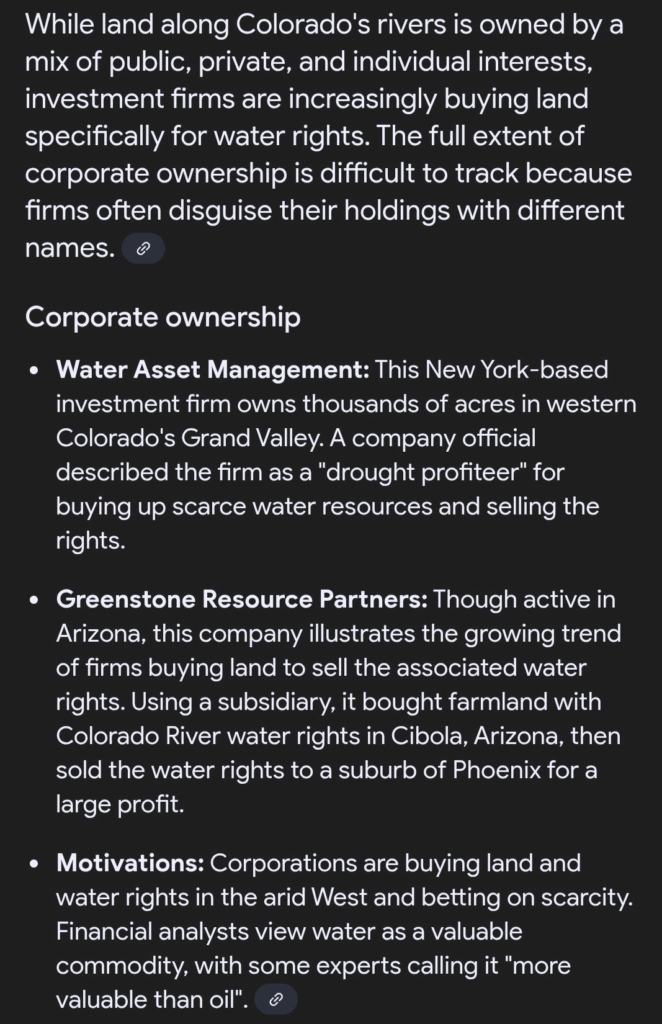
4/ Meanwhile, private firms are circling. They’re quietly buying water rights betting on shortages. When supply collapses, whoever controls the taps controls the future. This is how water becomes oil 2.0.
5/ Colorado is just the beginning.
From Michigan to Mississippi, America’s water systems are collapsing under drought, overuse, and privatization.
The West is simply the first domino to fall.
6/ The U.S. government is scrambling for a solution.
In 2023, states agreed to cut 3 million acre-feet of use. But scientists warn the river may lose another 30% by 2050.
The cuts are a band-aid on a severed artery.
7/ 40 states face freshwater shortages within a decade.
Every year, the U.S. loses 6 billion gallons of clean water from 250,000 pipe breaks.
Today, water monopolies are using the same playbook, quietly turning collapse into dynasties.
If America’s water collapse feels inevitable, it’s because we’re trying to fix a 21st-century crisis with a 20th-century model. The solution isn’t bigger government pipes. It’s building DECENTRALIZED systems that treat water where it’s needed—fast, secure, local.
Our model at @waterondemand is tackling this. – Investors fund the equipment – We build decentralized water systems – 20.3% projected annual returns with debt leverage & 100% bonus depreciation Secured. Inflation-protected. Real. Like oil wells, but with water.
Every $100000 invested can restore 1.4 million gallons of water EVERY YEAR.
With projected IRR’s better than oil and gas, real estate and solar.
The future runs on water!
I’ve secured early access, before institutional capital floods in.
The first $20M of accredited investors also receive founder’s shares in Water On Demand Inc.
This is infrastructure for the people. DM me “WATER” to learn more about working with us.
@DragonTrader_x:
All that water supporting 2 desert cities that shouldn’t exist (vegas & phoenix) thats the problem.Yup, evil old human greed and stupidity, dreadful combo. Then, add in misogyny and rape religion demanding more and more and more babies on a finite planet with limited fresh water, food, and shelft, we get the madness of today which will quickly lead to the USA Nazis invading Canada, and taking our water, and all other natural resources, and likely rape most Canadian kids while they’re robbing and abusing us to death.
@ChiefNiftyswell:
This isn’t some new thing. There was a projection study conducted 40 yrs ago that stated exactly this would occur.
Government simply doesn’t care.because the evil fucks in USA fed and state gov’ts know they are the bigger bully on the continent, and can easily invade Canada and take whatever they want.