@resistandfight.bsky.social:
Seriously. Now the regime is going after the NAS over climate change research. God damn, I hate his fucking guts.
@feraljoe.bsky.social:
I hope people are archiving everything the can so we can restore what is being censored.
Trump Attacks Nation’s Top Scientific Body Over Climate Chapter in Manual, The president joined Republican officials who slammed the National Academies of Sciences for a chapter about climate science in an educational guide for judges by Karen Zraick, July 20, 2026, NYT
President Trump has jumped into the fray over a hotly contested chapter on climate science in a reference manual for judges.
Hours after attending the World Cup final on Sunday, the president took to Truth Social to attack the National Academies of Sciences, Engineering and Medicine over the manual, which was released last year and has drawn criticism from Republican officials.
The chapter in question provides an overview of climate science, including how carbon dioxide and other gases trap heat in the atmosphere, and how human activity has disturbed that natural cycle. The authors noted that science is always evolving but characterized the United Nations’s scientific body, which has said the burning of fossil fuels is driving climate change, as an authoritative source.
The reference manual was partly funded by a grant from the National Science Foundation to the National Academies of Sciences, and the president wrote in his post that he was ordering officials to scrutinize the funding. “Our Taxpayers should not be funding Climate Fraud, and Judges should never have relied upon it,” Mr. Trump wrote.

The White House did not immediately respond to a request for comment or clarification.
The 1,700-page manual covers many different topics and was designed to provide mini-tutorials to federal judges about scientific issues that might come up in cases over which they preside. It was jointly published by the Federal Judicial Center, a government agency, and the National Academies of Sciences, the nation’s top scientific advisory body, which operates as a private organization.
Molly Galvin, a spokeswoman for the National Academies, said it remained committed to its mission to provide independent and objective scientific advice. “Our activities are conducted to ensure scientific rigor, transparency, and independence,” she said.
The Federal Judicial Center withdrew the chapter in February, after a firestorm led by Republican attorneys general. But the National Academies stood by the chapter, and it remains available on its website.
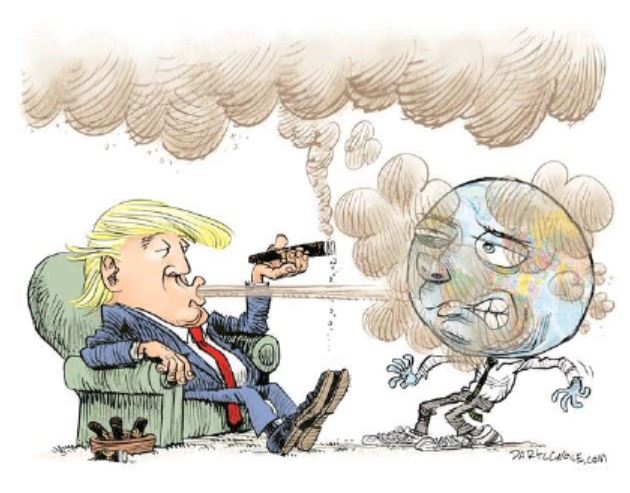
The president, who has dismissed global warming as a hoax, wrote in his post that the Academies was run by “Radical Left Dumocrats who, it turns out, published fraudulent, biased, and misleading Manuals on Climate Change.” He claimed that the manuals “were used by Judges to decide massive ‘Climate Change’ Cases, and have created huge losses across our Country.”
While there are a growing number of cases that involve climate change in the courts, there “has not been a single court decision anywhere in the world that imposes financial liability on any country or company because of its greenhouse gas emissions,” Michael Gerrard, director of the Sabin Center for Climate Change Law at Columbia University, wrote in a recent blog post.
Dozens of American state and local governments, mostly in Democratic-led municipalities, have sued oil companies over their role in climate change, but those cases all remain in preliminary stages. None have gotten close to trial yet.
The  grossly corrupt Pedophile Trump worshipping Supreme Court is scheduled to hear arguments over a legal question in one of the cases, brought by the city and county of Boulder, Colo., in its next term. The issue is whether federal law blocks the case from proceeding, and the decision could have major ramifications for the entire batch of litigation.
Conservative groups have argued that Justice Elena Kagan should recuse herself from the Boulder case because she wrote the foreword to the judges’ manual. She addressed the controversy during an appearance before Congress last week, in which she and Justice Amy Coney Barrett sought funding for security for judges amid escalating threats.
“The entire purpose of this book, really, is not to take positions on contested and contestable matters. It’s to help judges, assist judges with respect to scientific issues, but not with any kind of slant either way. And because so many people did think that that chapter was slanted in a particular direction, Judge Rosenberg decided to take it out of the book,” Justice Kagan said, referring to the director of the Federal Judicial Center, Judge Robin L. Rosenberg.Ya, slanted towards truth and facts. Heaven forbid the truth about climate change ever enters and American courtroom! God would explode!
Clara Altman, the deputy director of the Federal Judicial Center, said on Monday that the center never distributed hard copies of the manual containing the climate science chapter.
Groups on the left have called for Justice Samuel A. Alito Jr. to recuse himself from the Boulder case, pointing to his past stock holdings in energy companies.And what about Amy Cony-Barrett because of her oil patch dad?
The president’s post came days after the National Academies released a report on attribution science for extreme weather and climate events, which has also come under attack by oil-industry pollutersallies. That emerging science focuses on quantifying the effect of climate change on storms, wildfires and other disasters.
The House Committee on Science, Space and Technology has been investigating the National Academies over its “administration of federally supported activities, including its stewardship of taxpayer resources, scientific advisory processes, and compliance with applicable federal requirements,” according to a letter the committee sent to the organization last week.
Refer also to:
2018: Lawsuits vs. big oil lead to court lessons on climate change
SAN FRANCISCO — A federal judge presiding over lawsuits that accuse big oil companies of lying about global warming to protect their profits turned his courtroom into a classroom Wednesday in what could be the first hearing to study the science of climate change.
U.S. District Judge William Alsup asked lawyers for two California cities and five of the world’s largest oil and gas companies to present “the best science now available on global warming.” He said at the start of the hearing that he wanted to “stick to the science”and avoid politics.
“This is a serious proposition to try to educate the judge,” Alsup said.
Myles Allen, a professor at the University of Oxford who studies human influences on climate, discussed the history of climate change research and explained how carbon dioxide concentrations affect global temperatures.
Alsup next heard about sea level rise from Gary Griggs, an earth sciences professor at the University of California, Santa Cruz, who studies coastal hazards.
Legal observers say they have never heard of a court holding a tutorial on climate change, and they are eager to see how the oil companies explain global warming.
Alsup may want to get the companies’ views in the court record, said Michael Wara, a lawyer at Stanford University’s Woods Institute for the Environment who studies climate and energy policy.
“That could speak to the lawsuits’ claims that these companies were not forthcoming about their internal thinking about climate change,” Wara said.
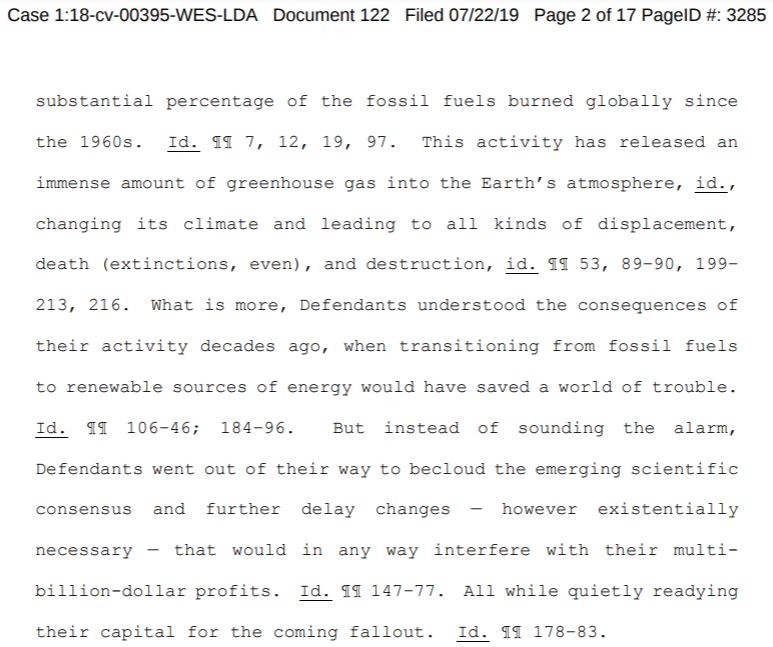
Alsup is considering two lawsuits, one by San Francisco and the other by neighbouring Oakland, that accuse Chevron, Exxon Mobil, ConocoPhillips, BP and Royal Dutch Shell of long knowing that fossil fuels posed serious risks to the climate, but still promoting them as environmentally responsible. They also allege the companies mounted campaigns to downplay the risks of global warming and discredit research that human activity was to blame.
The companies have asked the judge to dismiss the lawsuits. Federal law controls fossil fuel production, and Congress has encouraged oil and gas development, they said in court documents. They say the harm the cities claim is “speculative” and part of a complex chain of events that includes billions of oil and gas users and “environmental phenomena occurring worldwide over many decades.”
“The relief that plaintiffs seek would require a single judge sitting in San Francisco to unilaterally change the nation’s energy and environmental policies,” Joshua Lipshutz, an attorney for Chevron, told reporters.
The lawsuits say the companies have created a public nuisance and should pay for sea walls and other infrastructure to protect against the effects of climate change — construction that could cost billions of dollars.
New York City, several California counties and another California city have filed similar suits.
San Francisco City Attorney Dennis Herrera said the city looks forward to providing the “objective history of climate change science.”
“We’ll see whether big oil acknowledges the scientific consensus and its role in causing climate change or doubles down, once again, on deception,” he said in a statement.
Chevron will not engage in a debate about climate change but instead present the conclusion of an international panel of scientists that said it is extremely likely people are the dominant cause of observed warming since the mid-1900s, said Avi Garbow, another attorney for Chevron.
Alsup said in a court filing about Wednesday’s tutorial that he wants to know whether the collective heat from burning fossil fuels contributes to warming, and if so, how. He also wants to know the main sources of carbon dioxide that account for the buildup of the gas in the atmosphere.
Deciding the lawsuits in favour of Oakland and San Francisco would be “revolutionary” and open the door to similar lawsuits, so Alsup may want to establish a strong base of scientific knowledge on climate change, said David Takacs, a professor at the University of California, Hastings College of the Law, who studies climate change.
“He has to dot his i’s and cross his t’s,” he said. “It has to be a long public display that, ‘The science is making me rule on behalf of the plaintiffs.”’