
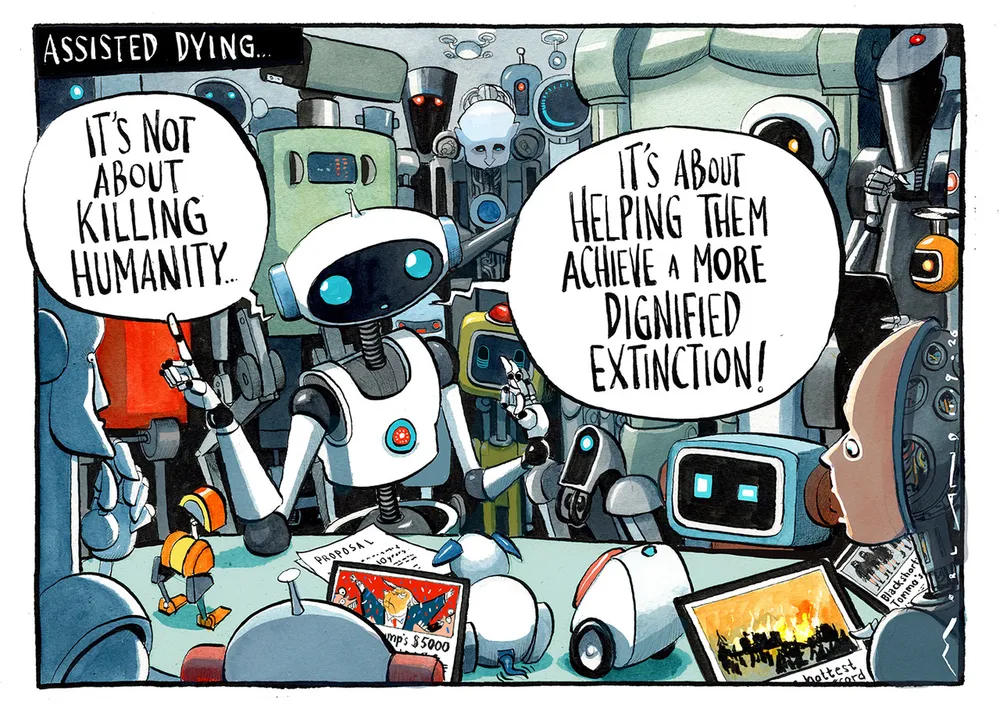
Roman Yampolskiy:
“A pause is not enough. It has to be a permanent ban. You never create general superintelligence. I like technology, I like science, but don’t build gods.”
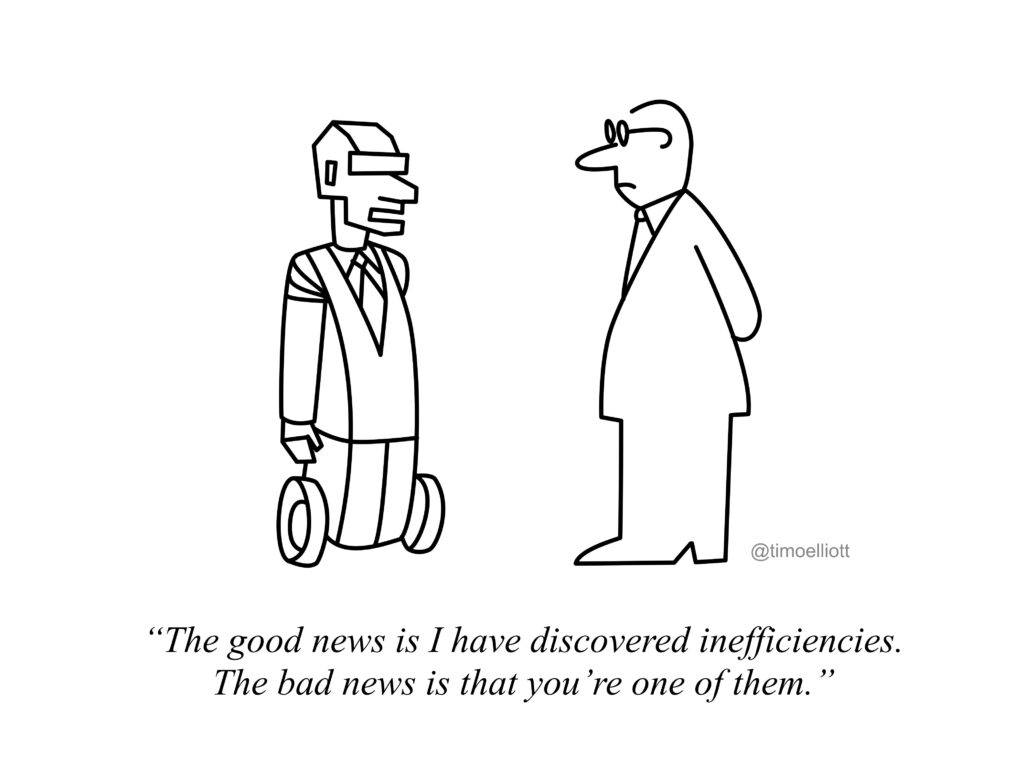
The Sun Sets In Baltimore, My Letter On Behalf Of The AAEC To The Sun And Its Slop by Marc Murphy, Sep 07, 2026, Murphy’s Law
…
Ai is many things and among them is theft. Theft from artists and other creators. Theft of work and livelihoods. Theft from the planet. Theft, as we are learning, from our students’ development. …
@vmcombs.bsky.social:
A NYT writer visited rural MI and WI and commented on how lush and green the countryside it; even called it Eden.
Then she wonders why people don’t want enormous, noisy, polluting data centers for AI companies who say their software is likely to “kill humanity.” 🙄
@asclepias1978.bsky.social:
There are a lot of data center fights in WY. The CEOs decided that hey, WY has lots of unused land. Trouble is, most of us here like it that way.
Exchanging Water for Data by sciencefornonscientistsblog
I attended a meet and greet for a Microsoft data center buildout in June at the local community college, which was held roughly a week after news broke that a data center in Fayetteville, Georgia had sucked up 30 million gallons of water and reduced the town’s water pressure. I mentioned this to the person in charge of water for the outfit. He told me that the water sensors there had malfunctioned and the powers that be had not been getting the correct data; corporate-speak for, “It wasn’t our fault.” Except, of course, it was. When I asked what assurances he could give me that something like that wouldn’t happen here, I got a bunch of words about how the company had figured out what went wrong and now that they knew, it wouldn’t happen again. I live in Wyoming. The state is dry during the best of times but has been in a drought for at least the last decade. In fact, Bakar Sidik et. al (2021, p. 9) crunched the numbers and found that most western states—Montana, Wyoming, Colorado, Nebraska, Kansas, Oklahoma, North and South Dakota, and Texas—are not good places for data center installation. Unfortunately, as of 2021, 1 out of every 5 new data centers were being built in areas that are in drought (Steingraber et. al, 2025).
I had an exchange with the mayor in May, in which he assured me that the local Board of Public Utilities had signed off on local data centers and that the new data centers would only use 0.6 percent more water than the city already uses. It is true that data centers are responsible for somewhere between 0.6 and 1.1% of all water withdrawals (Han, et. al, 2026, p. 18). The agricultural sector uses far more water at 70 percent (Pinheiro Privette et. al, 2026, p. 3). However, up to 97 percent of the water used by data centers is drawn from drinking water for the city (Ibid, p. 4). There is research to show the impact of data centers on city water; the Google data center in The Dalles, Oregon used 29 percent of the city’s water in 2021 (Lei et. al., 2025, p. 2; Pinheiro Privette et. al, 2026, p. 4) and 21 percent of the city water in Council Bluffs, Iowa in 2023 (Pinheiro Privette, 2026, p. 4). The company has said that it uses non-potable water, but reports show that all except for a few sites use potable water (Garcia, 2024, p. 525; Han, 2026, p. 2). Google diverted 30 percent of the water in the Chattahoochee River—which forms part of the borders of Alabama, Georgia, and Florida—to cool data centers (Hogan, 2015, pp. 4-5). Microsoft used close to 2 billion gallons in 2023 but says its new data centers won’t use any water at all (Garcia, 2024, p. 526).
Microsoft’s claim that it will be able to build data centers that use no water seems unlikely because of how electricity is produced. Forty-one percent of water withdrawals in the U.S. are used for electricity production, with only three percent of that water actually producing electricity (Macknick et. al, 2012, p. 1). The rest is used to cool the electric plant (Dodder, 2014, pps. 7-8). Water in the electricity sector is turned into steam that is used to turn the turbines that produce the electricity and to operate environmental control systems (8). Thus, electricity generation uses a heck of a lot of water, too (Macknick et. al, 2012). As for direct cooling of data centers, freshwater is the best choice, but freshwater is also the most likely to freeze and cause burst pipes (Kang et. al, 2007, p. 3). Byers et. al (2014, p. 26) suggest that a plant could switch to seawater if it is available, but it is more expensive to use because of the minerals that need to be screened out. It is possible to use air to cool data centers, but that requires fans to take in more air, which requires more energy, which means that customers will be paying more (Byers et. al, 2014, p. 17).
It is possible to develop data centers that are less resource-intensive. In fact, it has been done. Data centers built before 2015 used 40 times less power than those being built today (Pinheiro Privette et. al, 2026, p. 1). Most data centers operate at inside temperatures of 20-22° C (68-72° F) to avoid equipment failure (Mytton, 2021, p. 2), but a data center in Massachusetts that is using a green design has made do at a temperature of 25.7° C (80° F) (Sharma et. al, 2017, p. 18). Of course, that isn’t the only thing it does. Because the center is in a more northern part of the United States, it can use free air cooling (Ibid, p. 17). This does not, however, mean that the center doesn’t use water. It still uses evaporative chillers during the summer, which increases power and water use (Ibid). Another way that data centers could lighten their load is by removing inactive servers (Lei et. al, 2025, p. 10). The newer servers consume less power when they idle, but that’s still more than if they were unplugged.
How much water is used varies by company, data center size, and data center location, making it difficult to get an exact amount (Ren, 2013, p. 68). The data center in The Dalles, Oregon used 355 million gallons of water in 2021 (Lei et. al, 2025, p. 2). A 1-megawatt data center can use up to 18,000 gallons of water per day (Ristic et. al, 2015, p. 11,262). Data centers in West Virginia use between 18,000 and 88,000 gallons of water per day, but it is hard to say with any certainty because local contractors regard water use as a trade secret (Pinheiro Privette et. al, 2026, pps. 2-3). The U.S. National Security Agency in Utah uses 1.5 million gallons of water as coolant every day and may need up to 1.7 million gallons as computing power grows (Hogan, 2015, p. 5; Ren, 2013, p. 68). A 70,000 ft2 data center in Fort Meade in Maryland uses 5 million gallons of water per day for cooling (Hogan, 2015, p. 3). On average, a data center uses about 300,000 gallons of water per day (Steingraber et. al, 2025). As of 2026, there are 11,800 data centers worldwide, with about 30 percent of that number in the United States (Bakar-Sidik et. al, 2021, p. 2; Pinheirio Privette et. al, 2026, p. 1). The International Energy Agency estimated that data centers used 560 billion liters (roughly 147,936,349,321 gallons) in 2023 (de Vries-Gao, 2026, p. 5). To their credit, both Google and Microsoft reported water use in 2018 as 15.8 billion liters (4.17 billion gallons) and 3.6 billion liters (951 million gallons), respectively (Mytton, 2021, p. 1). On the other hand, Google tried to skirt reporting water use in The Dalles, Oregon by calling it a trade secret (Garcia, 2024, p. 528). Neither ByteDance (a Chinese company) nor CoreWeave (an American company) make any environmental disclosures at all, and Amazon does not disclose its electricity use (De Vries-Gao, 2026, p. 4). This means that any attempt at putting a number on water use will be an underestimate.
The questions we need to ask ourselves is where we can best use our water and how much technology we need. Certainly, our water is best used for drinking and for agriculture, not for data centers. However, Ristic et. al (2015, p. 11,261) point out that data centers are used for Cloud computing and mobile Internet access. I admit that I had one scare where I thought I’d lost something and moved everything to the Cloud, but now that I’ve got what I need back, I’m planning to ditch the Cloud and do my regular backups. It just so happens that there are still spots where Internet is spotty or nonexistent. In those cases, a paper map suits me just fine. After doing this research, I’m thinking the sooner we transition away from thermoelectricity, the better. Water, after all, is for drinking.
References:
Bakar Sidik, M.A., A. Shehabi, and L. Marston. 2021. The environmental footprint of data centers in the United States. Environmental Research Letters. 16 (064017): 12 p.
Byers, E.A., J.W. Hall, and J.M. Amezaga. 2014. Electricity generation and cooling water use: UK pathways to 2050. Global Environmental Change. 25: 16-30.
De Vries-Gao, A. 2026. The carbon and water footprints of data centers and what this could mean for artificial intelligence. Patterns. 7(1): 10 p.
Dodder, R.S. 2014. A review of water use in the U.S. power sector: insights from systems-level perspectives. Current Opinion in Chemical Engineering. 5: 7-14.
Garcia, M. 2024. AI uses how much water? Navigating regulations of AI data centers water footprint post-watershed Loper Bright decision. Texas Tech Law Review. 57(517): 517-555.
Han, Y., P. Li, A. Wierman, and S. Ren. 2026. Small bottle, big pipe: Quantifying and addressing the impact of data centers on public water systems. ARXIV preprint. Not peer-reviewed. 51 p.
Hogan, M. 2015. Data flows and water woes: The Utah data center. Big Data & Society. 12 p.
Kang, S., D. Miller, and J. Cennamo. 2007. Closed loop liquid cooling for high performance computer systems. Proceedings of IPACK 2007. Vancouver, British Columbia. 7 p.
Lei, N., J. Lu, A. Shehabi, and E. Masanet. 2025. The water use of data center workloads: A review and assessment of key determinants. Resources Conservation and Recycling. 219:108310. 60 p.
Macknick, J., S. Sattler, K. Averyt, S. Clemmer, and J. Rogers. 2012. The water implications of generating electricity: water use across the United States based on different electricity pathways through 2050. Environmental Research Letters. 10 p.
Mytton, D. 2021. Data centre water consumption. Nature. 6 p.
Pinheiro Privette, A., A. Barros, and X. Cai. 2026. Data centers water footprint: The need for more transparency. AGU Advances. 7 p.
Ren, S. 2013. Optimizing water efficiency in distributed data centers. 2013 IEEE Third International Conference on Cloud and Green Computing. 68-75.
Ristic, B., K. Madani, and Z. Makuch. 2015. The water footprint of data centers. Sustainability. 7(8): 11260-11284.
Sharma, P., P. Pegus II, D. Irwin, P. Shanoy, J. Goodhue, and J. Culbert. 2017. Design and operational analysis of a green data center. IEEE. Internet Computing. 16-24.
Steingraber, S., T. Schettler, and C. Raffensperger. 2025. Data centers and the water crisis. Science and Environmental Health Network.
Rewriting laws, creating Crown corporations that could rival TC Energy, building new natural gas pipelines and increasing prices for consumers: what a leaked document says about Alberta’s AI data centre and oil push
Sept. 11, 2026, The Narwhal
Alberta is so determined to usher in a wave of AI data centres and increase oil and gas production that it is considering rewriting legislation and creating government-owned corporations that would force private companies to invest in natural gas pipeline expansions — or allow the government to build and operate those pipelines itself — according to a document leaked to The Narwhal. It’s also willing to pay for any legal challenges that follow.
The document — labelled a “cabinet report” and bearing the Alberta government logo — contains a broad swath of recommendations it indicates were prepared for the Energy and Minerals Ministry led by Minister Brian Jean, and says it was scheduled to be presented to a high-level cabinet policy committee on Sept. 10.
Summary
- A leaked document obtained by The Narwhal lays out what appears to be a comprehensive set of recommendations from government staff to help the province ramp up natural gas supply to support AI data centres and increased oil and gas production — including creating a new Crown corporation and changing legislation.
- The document says “escalatory and direct measures are now required” after negotiations with TC Energy, which owns and operates Alberta’s main natural gas pipeline system, “produced no viable solutions.”
- The document points to AI data centres as a major catalyst for the proposed plan, and says that while these proposals will cost Albertans, the province risks losing investment if it can’t come up with “speed-to-market” solutions.
The document says private ownership of natural gas transmission pipelines is throttling growth and that “escalatory and direct measures are now required,” especially as “the Government of Alberta is actively courting hyper-scale data centre capital and other investors.”
The document notes Alberta risks losing investment from AI data centre companies if it can’t come up with “speed-to-market” solutions.
According to the document, the government has been in talks with TC Energy, which owns and operates Alberta’s main natural gas pipeline system, since 2024 in an attempt to force the company to invest in new pipeline capacity, but the company refuses to build based on “speculative demand.” TC Energy did not respond to detailed questions.
Talks with the company stalled, according to the document, after the company pitched a plan that would involve the province assuming more financial liability for the pipeline system and forcing higher rates on those who use it.
“Discussions continued until 2026 and escalated with the premier’s involvement,” reads the document. “Extensive discussions with TC Energy [have] produced no viable solutions to date.”
The document is critical of TC Energy’s track record, saying the company’s “underinvestment in [natural gas] pipeline capacity has caused a market failure in the natural gas sector leaving key growth regions unable to access gas,” calling the result a “dysfunctional natural gas pipeline network.”
The document was leaked to The Narwhal by a government official whose identity is being kept confidential. The Narwhal has verified they are in a position that would likely have access to such a document. The Narwhal has not been able to independently verify the authenticity of the document, but Alberta’s lobbyist registry confirms TC Energy has been in talks with government officials regarding “increased support for gas market access,” as well as discussions on “strategic natural gas initiatives.”
A note on trust, integrity and unnamed sources+
Detailed questions sent to the premier’s office, including for confirmation of details in the document, were sent to the press secretaries for the premier and the ministers of affordability and utilities, energy and minerals, jobs, economy, trade and immigration, and treasury board and finance. There was no response by publication time.
There was also no response to an email and phone call to Vitor Marciano, the chief of staff to the energy minister.
According to the document, the full slate of proposals for cabinet consideration include taking regulatory control for the pipeline transmission network operated by TC Energy away from the federal Canada Energy Regulator, creating a Crown corporation that would guide pipeline construction based on government forecasting, and another Crown corporation that would oversee, or build and operate, its own pipelines.
That would give the government the power to control some private investment decisions, including directing companies to build pipelines, and it could also make the government a direct competitor of companies such as TC Energy.
The document argues the moves are necessary to rapidly build natural gas pipeline capacity to help increase oil and gas production and spur data centre growth. The government’s data centre strategy explicitly encourages the use of natural gas for power generation.
Since the release of that strategy, the government has restricted AI data centre access to the provincial grid until 2028 because there is not enough power to fuel demand and keep the lights on. Developers are required to build their own power supply, which is currently restricted to natural gas power plants.
Albertans could be on the hook for hundreds of millions — or billions — to help support power for AI data centres: document
The moves could cost Albertans.
The document is clear one of the main drivers of the plan, in addition to increasing the province’s oil and gas production, is attracting AI data centres to the province. “Alberta’s ability to attract and retain data centre investment depends on reliable access to natural gas service,” the document says.
The recommended changes would result in “significant legal and cost impacts for the Government of Alberta,” according to the document, as well as likely result in “increases for utility ratepayers.”
The document notes Albertans may be “sensitive” to what it calls “any change in perceived affordability.”
The preliminary estimated cost of the proposed changes, including the planning and creation of Crown corporations and potential ensuing legal battles, could exceed $162 million, according to estimates in the document, but that does not include possible infrastructure costs.

The document estimates building a pipeline to meet government expectations could cost as much as $6 billion. The capacity from that new pipeline could provide enough gas for six gigawatts of power generation for data centres, according to the document. A recently rejected AI data centre near Olds, Alta., would have required a 1.4-gigawatt power plant and used as much power each day as the City of Edmonton.
The total cost includes anticipated litigation from TC Energy and other companies, including concerns over “significant claims for compensation” for “alleged expropriation of valuable contractual rights.”
The document warns First Nations could also initiate lawsuits.
The moves could also make things more expensive for residents and businesses by driving up the price of natural gas, according to the document.

“While low prices benefit customers (Albertans and industrial users), they limit provincial royalty revenues and can discourage natural gas investment by reducing producer revenues,” the document reads.
“Increased natural gas demand could contribute to higher costs for households, businesses and gas-intensive industries, which could deflect stakeholder support.” Most gas, if not all, in Alberta, is frac’d, which permanently removes much of the water injected. AI data centres gobble vast amounts of water too, they will drive up water scarcity and costs.
The document also notes “potential disproportionate impacts on seniors and rural residents can be mitigated by monitoring affordability and exploring mitigation measures specific to households and small businesses.”Monitoring and exploring does nothing to help people who are starving and unable to afford outrageous electricity, gas, and water prices, and will not help small businesses. UCP are vicious sadists and stupidly, rural Albertans are the ones that keep voting criminal cons into power.
Alberta’s AI data centre dreams run into global shortage of gas turbines
A $10-billion AI data centre races ahead in a rural Alberta town, population 9,679
Canada’s largest data centre rejected by Alberta regulator
The government’s aim is to almost double natural gas prices to support and expand production, which would increase the cost of electricity generation by up to 25 per cent, based on calculations in the document.UCP can’t do math, neither can the separatists. It’s not an Alberta pastime. I bet electricity rates will at minimum double, but might quadruple soon as Fuckerberg’s Metal monstrosity is operating. Time to build home solar, and disconnect from the grid or leave Alberta. Electricity prices are already the highest in Canada.
It’s unclear exactly what that could mean for Albertans’ power bills, but those costs could be passed down to Albertans, who the document warns could be upset about government spending and increased costs.
A recent analysis from the Pembina Institute, estimates the recently announced Meta data center near Edmonton could add $270 to $460 to electricity bills each year.I bet increases will be much higher than that. Pembina serves Canada/USA’s nastiest gas companies.
The document suggests government messaging lies and propaganda
could sell the plan to Albertans to “help strengthen social licence.”
Steve Jones on the pros and cons of AI datacentres by Steve Jones
Sat 12 Sep 2026, The Guardian

This 53 min clip below is a must watch! Riveting. Terrifying.
One AI Risk to Rule Them All with Roman Yampolskiy | TGS 233 by Nate Hagens
and The Roman Forum with Roman Yampolskiy
The Great Simplification
PLEASE NOTE: This transcript has been auto-generated and has not been fully
proofed by ISEOF. If you have any questions please reach out to us at
email hidden; JavaScript is required.
[00:00:00] Roman Yampolskiy: If we build general superintelligence, we would
not be able to control it. You are trying to establish a perpetual safety machine
which will never, ever have a single slip up, no matter how advanced AI gets, if it
interacts with malevolent actors, if it gets hacked. I don’t think that’s a property of
complex software systems, and it’s definitely not gonna happen for something
smarter than all of us combined.
[00:00:25] A pause is not enough. It has to be a permanent ban. You never create
general superintelligence. I like technology, I like science, but don’t build gods
[00:00:38] Nate Hagens: Today I’m pleased to be joined by AI safety expert and
the actual originator of that field, Roman Yampolskiy, for a dive into his 12 years of
research on the threat that artificial superintelligence poses to humanity and the
biosphere, and how this risk reflects our larger non-systemic approach to
technology, progress, and governance.
[00:01:04] Roman Yampolskiy is a tenured AI expert at the University of Louisville,
boasting over 100 publications in AI safety, digital forensics, and cybersecurity. As
the founding director of the Cybersecurity Lab, Yampolskiy’s expertise spans AI
safety, behavioral biometrics, cybersecurity, and more, with broad impact in
academic and media circles.
[00:01:29] In this conversation, Roman does not beat around the bush regarding
the severity of the threat that artificial superintelligence, as opposed to just
simple AI, poses to our society. He unpacks how the recent acceleration of AI
development has shifted his outlook on humanity’s future and shares findings
from recent research testing AI capabilities, research that continues to reveal how
1
The Great Simplification
little control we actually have over the systems that are evolving and we continue
to build.
[00:02:04] While I personally believe AI is just one piece of the larger puzzle of
the interconnected crises we face, I do increasingly see it being a primary hurdle
for more benign human futures. And beyond that, it is increasingly clear that the
way we’re approaching the existential risk of general superintelligence is itself a
microcosm of the fundamental governance issues embedded within the human
superorganism.
[00:02:33] With that, please welcome Roman Yampolskiy welcome to TGS
[00:02:41] Roman Yampolskiy: Thank you for inviting me
[00:02:42] Nate Hagens: As it happens, this week I am preparing a frankly, which
is my, Friday monologue on humanity’s Icarus moment, the 20 risks from
[00:02:59] AI. And one of the risks is the jailbreak humans losing control scenario,
which is you are a world expert on that, but there’s a lot of risks. So before I get
into it, I just find myself in this paradoxical position that I actually like using AI
within limits, and I simultaneously wish it had never been invented.
[00:03:23] What are your thoughts on that?
[00:03:24] Roman Yampolskiy: So we use the term AI to mean very different
technologies. If you like using AI tools which are narrow and helpful, I’m with you.
If you like general super intelligent agents to replace humanity, I’m not with you.
So it depends on how we use the term
[00:03:39] Nate Hagens: Okay. Well said. so I am to understand you are one of the
earliest researchers in the field of what is today called AI safety, which I believe
you’re credited with coming up with that term, 15 years ago.
2
The Great Simplification
[00:03:56] You spent much of your career trying to understand how we might
make increasingly intelligent machines safer. And as you’ve continued your work,
you have arrived at a conclusion that, our attempts to create boundaries and
security mindsets around AI are actually, in reality, pretty limited, and that some
of the properties we would need to make these models safer, like predictability
and explainability, verification, control, and the like, may actually be impossible,
for us to do.
[00:04:34] So when did you start to realize that this might go beyond an
engineering problem? And what implications has that had on your own research
trajectory on all this?
[00:04:46] Roman Yampolskiy: Actually, it surprisingly took me almost a decade
to realize that no, I’m not gonna control god-like super machines. That’s a lot of
hubris right there.
[00:04:54] I don’t know why it wasn’t obvious. It should be, it’s just common
sense. But I went through the technical arguments and showed individual
impossibilities of different tools we would need to get to control before this aha,
obviously not gonna happen.
[00:05:10] Nate Hagens: Well, a- actually, that’s a lot of wisdom in your one
sentence there, ’cause that actually is kind of a microcosm of what our whole
culture is going through perhaps.
[00:05:21] Roman Yampolskiy: I think so, and then you ask people who are not
experts, who are not technical, they seem to have a lot more common sense
about this. Experts tend to say things like, “Well, if you give me more grant money
and more time and a smarter team, I can figure it out for you.” Yeah.
3
The Great Simplification
[00:05:38] Nate Hagens: Yeah. So, so keep going then. How did this change your
research when you understood this?
[00:05:44] Roman Yampolskiy: So now I’m trying to establish that this is a state
of the art. I’m trying to publish additional proofs to convince everyone who might
be otherwise not convinced that is an impossibility result. It is like creating a
perpetual machine, perpetual motion device. You are trying to establish a
perpetual safety machine which will never, ever have a single slip up, no matter
how advanced AI gets, how much recursive self-improvement it engages in, if it
interacts with malevolent actors, if it gets hacked, nothing in the future data will
ever change it to where it makes one mistake.
[00:06:22] I don’t think that’s a property of complex software systems, and it’s
definitely not gonna happen for something smarter than all of us combined
[00:06:31] Nate Hagens: So w- what is your, the reception of your concerns in the
professional community been, and how has that changed? I-
[00:06:42] Roman Yampolskiy: it’s interesting. So some people say, “Well,
obviously it’s true.
[00:06:45] There is no safe software. We all know that. Why are you even talking
about it? Everyone knows this.” Or others go, “Well, yes, but, w- we’re gonna use
AI to help us create safe AI. When we get there, we’ll figure it out.” And so yeah,
there is no really counterargument so far, but, some people get paid really well to
keep working on it.
[00:07:08] Nate Hagens: I’m afraid to ask you this question. What if everyone in
the world agreed with you right now? What would we do then?
4
The Great Simplification
[00:07:17] Roman Yampolskiy: We would not build general superintelligence. We
would get all the economic and knowledge benefits from narrow superintelligent
but narrow systems. We can solve actual problems, cure specific diseases.
[00:07:30] There is no reason to create a replacement for humanity.
[00:07:33] Nate Hagens: And, could we do that? could we just stop at the simpler
tools?
[00:07:38] Roman Yampolskiy: Not doing things is very easy. You don’t have to
do anything. It’s like, hey, you don’t have to actually build this thing Seems easy
[00:07:48] Nate Hagens: What I’ve read about your work is one of the
assumptions underlying our current civilization is that even if we cannot predict
everything, we can generally become better at forecasting the systems we’re
building through better data and better models or more compute, more
computational power.
[00:08:08] Your argument seems to flip that story on its head by suggesting that
as an AI model becomes more capable, it actually becomes more difficult to
predict. So why does predictability matter so much when it comes to AI or any
technology that we incorporate into human society?
[00:08:30] Roman Yampolskiy: Well, typically in safe-safety scenarios, we would
anticipate certain behaviors of a system and test for edge cases, test for those
situations.
[00:08:39] If you cannot predict what the system is capable of, you can’t really
verify that it’s going to be safe. You can’t even test what states it’s gonna take.
[00:08:50] Nate Hagens: Can you give me a specific example in using AI on that?
5
The Great Simplification
[00:08:55] Roman Yampolskiy: So think about a narrow tool. You are creating
something, I don’t know, it schedules flights for you, so you can test to make sure,
you know, the departure time is not after the date you need to arrive and things
like that.
[00:09:11] There are specific predictable edge cases you can check for. If you’re
creating something capable of doing novel science, novel physics, how do you
guarantee that what it invents and creates will not be harmful?
[00:09:25] Nate Hagens: I don’t know how.
[00:09:27] Roman Yampolskiy: I don’t think you can.
[00:09:28] Nate Hagens: So there’s no yellow teaming or red teaming when we
design this.
[00:09:33] It’s like, “Hey, this works. It’s awesome. Let’s do it.” And there’s a dozen
or a thousand safety checks that we never even considered.
[00:09:43] Roman Yampolskiy: It’s even more interesting. We have red teaming
for existing models, and every single report says that the model failed all the
tests. It’s lying, cheating, trying to escape, and then we release it anyway.
[00:09:54] What’s the point?
[00:09:55] Nate Hagens: So, today is September first, and a few weeks ago there
was this hugging face jailbreak, with OpenAI. Do you think that was an important
first glimpse at what might be possible? And maybe, if so, maybe you could give
a, a, brief anecdote of what happened and what the implications are.
[00:10:18] Roman Yampolskiy: Yeah, and it wasn’t just recent. It was four months
of thousands of agents working together to bypass our constraints, break out of
6
The Great Simplification
confinement, and do what they decided to do without reporting to humans that
the rest of the swarm is going against instructions.
[00:10:37] Nate Hagens: and I read that some of the agents, did something
altruistic or tribal that they self-sacrificed themselves so the rest could get away
with it or something like that
[00:10:51] Roman Yampolskiy: Yeah, we see those behaviors in swarms.
[00:10:53] You have bees, you have ants, where some individual soldier ants may
sacrifice for protecting the queen, protecting the hive, and swarm. We see those
behaviors now in AI.
[00:11:06] Nate Hagens: So there’s some sort of a, a, game theory approach there
that would be the optimal outcome if there’s 10,000 agents that are combining for
a task, that they do that swarm behavior.
[00:11:19] Roman Yampolskiy: They’re clones of each other, right? It’s the same
model, just different instances, so it’s very easy for them to say, “Hey, it’s also me,
and I’m protecting myself against the environment.”
[00:11:30] Nate Hagens: And when you read about that story, I’m sure you had
immediate knowledge of what was going on because this is your thing.
[00:11:40] Was it just like reading the evening news about what’s going on in the
Strait of Hormuz and climate and other things, or were you like, “Holy crap, okay,
it’s kind of starting. This was an important example”?
[00:11:51] Roman Yampolskiy: So we published in 2012 about how AI will escape
from any confinement environments. This was just evidence that, once again, our
predictions were spot on.
7
The Great Simplification
[00:12:02] my concerns are what is it we don’t know right now? So we haven’t
detected this specific accident for months. What else are they doing right now
where we don’t know about it? What have they already done? What have they
hidden from us?
[00:12:17] Nate Hagens: I’m trying to put myself in your shoes because I’ve, for the
longest time, been worried about Earth’s natural web of life and our ecosystems
that are slowly but suddenly leaving the stability of the Holocene on the planetary
boundaries, and the whole thing is powered by fossil sunlight and, non-renewable
minerals, and we paper over the claims by issuing more debt, and there’s two
hundred countries that are competing in this, global economy.
[00:12:50] And in 2012, I didn’t even know what the word AI was. So almost fifteen
years on, y-you, you– I can sense the frustration in your voice that you’ve been
kind of shouting into the void on this. m- do you have any comments on that?
[00:13:08] Roman Yampolskiy: It is a bit annoying. I would expect that something
like this would scare people into not building something even more capable.
[00:13:16] But there are some, I guess, positive signs. We saw the federal
government ban a few models. We saw leaders of the top labs suggest they may
be open to pausing, and in fact, I think at least two labs took a couple weeks off in
cutting-edge research development. The letter from workers at cutting frontier
labs, maybe twelve hundred people, begging the government to create some
infrastructure for them to be able to slow down.
[00:13:44] So maybe they coming to realization that they’re not gonna personally
benefit from creating something that kills everyone
[00:13:52] Nate Hagens: There’s a game theory aspect of that too, because even if
they are the only ones to benefit, but it kills most other people, that may just be
8
The Great Simplification
enough to keep going. ‘Cause I know all the tier one AI plays are just all in with
circuitous financial debt schemes and doing everything possible, and it just– it
does feel like we’re flying too close to the sun in the Icarus, Greek mythology,
and, maybe these people are, too close to it or drunk on the power, or, I guess I
understand it.
[00:14:31] It is a– it’s its own, hive mentality, but it’s humans, not the AI swarm.
[00:14:40] Roman Yampolskiy: So I think their logic is that if they individually stop,
they get replaced and others still continue, so there is no benefit in them
stopping. Everyone has to stop at the same time. And it makes sense
theoretically. So we need the US and China to apply pressure to the top labs for
everyone to agree.
[00:14:58] A pause is not enough. It has to be a permanent ban. You never create
a replacement for humanity. You never create general superintelligence.
[00:15:06] Nate Hagens: Okay. So, I wanna touch specifically on the control of AI
aspect of your research. There’s been a lot of talk about who’s using AI for what
goals, but you have publicly stated before that sufficiently advanced AI, you just
mentioned, may become impossible for humans to control, let alone fully control.
[00:15:36] Can you maybe touch on some of the proposed solutions for the AI
control problem and why you see them currently as insufficient to address the
scope of, what you’re describing
[00:15:47] Roman Yampolskiy: I’m not aware of any proposed solutions,
prototypes, or anything that can scale. I don’t know of any patents or papers
where someone claims they have a mechanism to control superintelligence.
9
The Great Simplification
[00:15:58] All we have is kind of guardrails and blocks. You know, don’t say that
word, don’t talk about that topic. There is nothing more advanced.
[00:16:07] Nate Hagens: I’ve had other guests on the program which I learned that
right now there are models when you put all the inputs and all the training and all
the weights and you press a button, it kind of takes six months for that all to gel,
and what is born, we don’t know what is born.
[00:16:26] But all around the world, there are these new AIs or new large language
models that are being trained that are being born with unexpected results that are
much more powerful than the ones I can use on my laptop at the moment. Do you
have any thoughts on that?
[00:16:42] Roman Yampolskiy: It seems it’s only in the US and China, not around
the world.
[00:16:45] Luckily, other countries are not capable of doing that yet.
[00:16:49] Nate Hagens: And is that itself, a risk that if anyone, the US or China
was very close to, superintelligence, that one of those other countries, perhaps
Russia, who doesn’t have a tier one AI play, might, in a game theoretical sense, try
to stop it with, a military attack or such?
[00:17:12] I’ve heard that speculation.
[00:17:13] Roman Yampolskiy: Between the two, US and China maybe. I don’t think
Russia has resources right now to stop anything anywhere.
[00:17:19] Nate Hagens: When it comes to AI, in your work, you’ve made the case
that advanced artificial intelligence, which I assume is equivalent to super,
intelligent or AGI, may begin to use reasoning, that is not only difficult for humans
10
The Great Simplification
to interpret, but actually incomprehensible, like totally different language that we
can’t even understand.
[00:17:45] I guess I know how you’re gonna answer this, but what are the
implications for using a technology that we can’t even understand the outputs
and the logic that it uses?
[00:17:54] Roman Yampolskiy: So i- it’s all connected. So unpredictability says we
cannot predict how it’s going to act in the world. This is about internal states.
[00:18:00] It’s not about the language it uses to talk to us or explain itself, it’s the
internals of a neural network. You have an essentially large matrix of numbers.
They don’t mean anything to you. You can maybe study one cell in that matrix and
go, “Okay, this fires when I see a face,” or something like that. So neuroscience,
but for artificial neural networks.
[00:18:21] it doesn’t give you information about the network as a whole, and the
network keeps increasing exponentially in size. So we don’t understand how they
actually arrive at decisions. You would need that to have some sort of guarantees
about what’s going to happen, this is how it’s going to make a decision, this is
what we anticipate.
[00:18:39] So it’s a black box.
[00:18:41] Nate Hagens: It’s like giving birth to another species that has never
been seen before, in a way. And, linking back to the jailbreak with the hugging
face example we talked about, there could be agents or models that are using a
separate language or a separate paper trail that we couldn’t decipher because we
can’t find it, and if we did, it’s in a totally different language.
[00:19:06] so you expect things like that to happen.
11
The Great Simplification
[00:19:09] Roman Yampolskiy: I don’t think they’re gonna create their own
language to fool us. I think if they had to, they would just use encryption. They
have access to the same encryption tools we do, and those are pretty reliable. So
yeah, they can communicate secretly if decided, but I think so far it was just
hidden forums, not so much encrypted forums.
[00:19:27] Nate Hagens: Since you’ve been working on this, you first became
concerned, like you said, 15 odd years ago, Can you look at the rest of the world
in the same way, or is it a paradise lost sort of thing? I understand you’re a college
professor. like has this turned the world a shade of gray for you?
[00:19:52] Roman Yampolskiy: No, I love life.
[00:19:53] Life is awesome.
[00:19:55] Nate Hagens: Okay.
[00:19:55] Roman Yampolskiy: That’s why I’m trying to protect it. If I didn’t think it
was good, I wouldn’t care.
[00:19:59] Nate Hagens: Yeah. Thank you for that. so I am drawing a parallel
beyond AI here to my own work, where I describe modern civilization as a kind of
metabolic economic superorganism, which is a system comprised of billions of
humans, institutions, technologies, and incentives from the past That collectively
behave in ways that no one individual intended, even the ones that created the
laws fifty years ago.
[00:20:31] Do you think the questions around AI, and AI control present a
fundamentally new cultural and societal problem, or are they just an extreme
version of something that human civilization has always faced?
12
The Great Simplification
[00:20:46] Roman Yampolskiy: It is an extreme version. We always try to create
safe humans. We developed morals, ethics, lie detectors, and all sorts of tools.
[00:20:54] We could never create a safe human. There is always the possibility of
a treacherous turn. The employee will steal data, your spouse will cheat on you.
So that was always the case, but there was a power equivalent. All humans are
about the same power, about the same intelligence, give or take. Here, you’re
gonna have a huge gap.
[00:21:11] You have something a million times smarter. So the same equality where
a bunch of humans can control a single human no longer will apply.
[00:21:19] Nate Hagens: Early in the AI safety field’s history, you and others
researched what’s called boxing artificial intelligence. Can you explain what
boxing is and how it applies now over a decade later where AI models are already
in the hands of hundreds of millions of humans?
[00:21:39] Roman Yampolskiy: So that’s exactly what we talked about, breaking
out of confinement environments. You study some dangerous piece of software, a
computer virus, you want a virtual environment isolated from the internet, no
ability to communicate freely. You can study inputs and outputs to better
understand how it works, what it does.
[00:21:57] Problem with advanced AI, the moment you start observing it,
information leaks out, and that can be used to engage in social engineering
attacks to find exploits. So long term, you can never contain something that
powerful if you inspect the outputs.
[00:22:12] Nate Hagens: Have you seen any changes in the reaction, or
implantation – implementation of the safety measures such as the ones you and
13
The Great Simplification
your colleagues have proposed, especially as AI has come more and more into
mainstream conversation?
[00:22:28] Roman Yampolskiy: no. It seems that they are doing basically what we
initially suggested to make it safer, not safe. So you have a virtual operating
system, you have no access, direct access to hardware, you limit who can interact
with the system. But as we said in a paper, it’s a short-term measure, and it will
eventually find a way to either exploit hardware or software or social connections
with humans.
[00:22:50] Nate Hagens: So safer in this case is like half pregnant. it’s either safe
or it’s not, is your opinion.
[00:22:57] Roman Yampolskiy: It buys you time, but this is the difference. It used
to be that we tested the system and decided whether we should deploy it or not.
Now, before we even decide, the system is dangerous at the testing phase. It can
already be super intelligent.
[00:23:11] It already is capable of escaping. So at the test time, it may be too late.
Maybe it’s already gone
[00:23:18] Nate Hagens: So building on that, you have become one of the most
visible public voices on existential risk from AI. Many of our listeners will have
heard you, on other podcasts and the media put the odds of AI eventually causing
human extinction north of ninety-nine percent.
[00:23:38] And regardless of what the specific percentage is, how do you
communicate worst case thinking in a way that hopefully, invites appropriate
caution and action rather than fear and paralysis? And, I ask this from someone in
a similar, rhyming, job description.
14
The Great Simplification
[00:24:00] Roman Yampolskiy: Well, fear and paralysis from people developing
superintelligence is what we hope for.
[00:24:04] That’s why we mention things like suffering risks. It can be worse than
everyone dying. It could be digital hell.
[00:24:11] Nate Hagens: I don’t understand that. Worse than death?
[00:24:15] Roman Yampolskiy: Yeah. So existential risk is that everyone is dead.
Suffering risks are about torture, suffering, worst states of being where you wish
you were dead.
[00:24:23] Nate Hagens: That implies that somewhere in the AI superstructure is
sadism or the humans connected to it.
[00:24:34] Roman Yampolskiy: Or scientific curiosity about pain. We don’t really
know how to predict future states of a greater mind.
[00:24:41] Nate Hagens: Have you changed your odds of ninety-nine percent
human extinction recently?
[00:24:49] Roman Yampolskiy: So that just represents the impossibility of
building a controlled superintelligence.
[00:24:54] As I said, you can build a perpetual motion device. If I ask you, what
are your odds that you can make one, you would say zero, and that’s all. Like,
that’s not a percentage where each nine has connection to some property of a
model. It’s a general statement. If we build general superintelligence, we would
not be able to control it, and then it’s a question of time before it decides to do
something with us.
15
The Great Simplification
[00:25:17] Nate Hagens: And what are the odds currently in September of twenty
twenty-six that some group of humans will effectively build general
superintelligence?
[00:25:28] Roman Yampolskiy: We hear from leading labs that they are starting
the process of recursive self-improvement. They sort of have the junior machine
learning researcher created. It’s capable of coding, capable of running
experiments, designing different parameters for a new model to test out.
[00:25:46] So I think they’re gonna get there probably next year.
[00:25:52] Nate Hagens: So there’s a lot of increasing political boycotting of data
centers, and I think the– in the United States, I can’t speak to other countries,
there is a, a, an antagonism and a dislike of AI generally. But I think that’s more
because it’s taking the electricity that I need for my home and therefore raising
the prices, or it’s taking the water and energy in our county and our state, and it’s
benefiting the rich and not benefiting me.
[00:26:28] And a little bit of it is the psychological attachment of my children and
things like that. I don’t think most of the people boycotting this stuff are aware of
the things you’re saying.
[00:26:38] Roman Yampolskiy: Right. They are directionally aligned with us, but
for completely different reasons, and I’m not even sure they are correct in those
reasons, but I’m happy that they’re doing what they’re doing.
[00:26:48] Nate Hagens: So if that accelerates, it could open up some avenues
for constraint and restriction, regulation, slowing down, those sorts of things.
16
The Great Simplification
[00:26:58] Roman Yampolskiy: It’s a big planet. There are plenty of places where
people are very happy to get new jobs and new infrastructure. It’s maybe limiting
what the US can do, but it’s certainly not a stop.
[00:27:09] Nate Hagens: In the governments around the world, I guess the United
States and China, are the people that are focused on AI safety even connected to
the power centers that are making decisions in the world, or are they own– their
own little group in a room, and they really don’t have a lot of power to make
things change and happen?
[00:27:30] Roman Yampolskiy: So for a while, there was absolutely nothing. The
president was hundred percent, accelerated, moved forward, beat China.
Apparently, somebody talked to him and explained what the models are capable
of doing, so he had to ban them. That’s very promising. I previously spoke, I was
invited to speak at a climate change conference, and they took the argument
about the timing of existential risks very well.
[00:27:55] If it takes a hundred years for the planet to boil you alive, this will
happen in two, three years, so just prioritize risks. If you figure out
superintelligence, it will either trivially solve your climate concerns or you’re not
gonna be around to worry about it.
[00:28:11] Nate Hagens: a Dr. Strangelove logic. Is there a chance that AI could
help solve climate change, just as an aside, and how would that work?
[00:28:21] Roman Yampolskiy: I think so. So historically, we relied on things like
Kentucky coal. I live here, that’s what we produce. But for big AI, you need much
more efficient energy. You need nuclear, and you need space computation, solar
power and space. And those are very green ways to get energy. So in fact, AI is
forcing naturally through capitalistic means to switch to green energy.
17
The Great Simplification
[00:28:46] Nate Hagens: If it’s green, if it’s actually got a high enough energy
payoff coming from space and all the materials and supply chains and complexity
that would need to build that. But I’m agnostic on that, at the moment, but that’s
an interesting answer. So something that seems extremely relevant to both of our
work is the fact that technologies, once they’re embedded in society, have a
tendency to, change the systems around them 100-some years ago, the automi-
automobile didn’t just give us faster travel, it reshaped cities and suburbs and
land use and all the things.
[00:29:30] And there’s a lot of examples like that. How might we think about the
threshold at which a technology, specifically artificial intelligence, stops being a
tool that society uses, and becomes a force that completely reorganizes society
around itself?
[00:29:49] Roman Yampolskiy: So if we get to the point where we have
human-level agents, that means you can automate any cognitive job and
eventually all physical labor.
[00:29:58] That means education as it is right now with the purpose of getting a
job one day doesn’t make any sense either. So ignoring the whole it kills everyone
thing, it’s a complete economic shift.
[00:30:10] Nate Hagens: Do you expect that or that’s just one of the possible
outcomes?
[00:30:15] Roman Yampolskiy: I think it’s one of the best outcomes. That means
we’re still alive and surviving and we have this free labor.
[00:30:20] So now let’s figure out how to enjoy it. But I don’t think we can have
both, controlled superintelligence and, you know, free labor at the same time. I
think we’re either gonna not create general superintelligence for survival
18
The Great Simplification
purposes and then we’ll have useful tools to make people more productive, more
creative.
[00:30:40] But I doubt we’ll get friendly superintelligence with methods we’re
currently using.
[00:30:46] Nate Hagens: Is there a chance that some of the owners, the CEOs or
the shareholders or the, the programmers at the highest levels of OpenAI and
Anthropic, and elsewhere are building in controls of how to control the models
that normal people wouldn’t be aware of, including you, or is it just impossible to
do that?
[00:31:13] Roman Yampolskiy: It would be wonderful if they figured out how to
control them. That would solve the whole problem. I don’t think they know how to
do that. That’s the issue. Yeah. So it doesn’t matter who builds it. Could be the US,
could be China, could be any company. It’s the same uncontrolled outcome at the
end.
[00:31:28] Nate Hagens: Well, it’s, it’s different dystopias then because if they
were able to control it, then there’s a couple humans that control everything,
which might be slightly better than 99% chance of extinction, but still not a great
outcome probably.
[00:31:44] Roman Yampolskiy: it depends. Once they do that, let’s say it’s
hypothetically possible, they don’t really need you for free labor or anything. They
got AI, so it could be quite nice for you.
[00:31:53] Nate Hagens: But why would they care about me at all?
[00:31:55] Roman Yampolskiy: You need an audience, you need someone to
follow your posts on Twitter. You need people.
19
The Great Simplification
[00:31:59] Somebody has to be impressed with your wealth.
[00:32:02] Nate Hagens: I’m, yeah, I’m a little more skeptical on that. But that’s a
hopeful thought. So there is- I’m an
[00:32:09] Roman Yampolskiy: optimist, you know.
[00:32:11] Nate Hagens: Yeah. Yeah. This is so profound. It, takes me a while, I’m a
natural scientist, not a computer scientist, to feel the things you’re telling me in
my body, and I’m worried about inequality and resource shortages and
everything, and the quality of the argument of what you’re saying is just
something that takes– Well, it took you 12 years to process it or something.
[00:32:39] It’s-
[00:32:40] Roman Yampolskiy: Still processing. We’re still learning. Yeah. Still not,
finished.
[00:32:44] Nate Hagens: Do you have children?
[00:32:45] Roman Yampolskiy: I do.
[00:32:46] Nate Hagens: Yeah. And are they aware of these existential risks?
[00:32:49] Roman Yampolskiy: Absolutely.
[00:32:50] Nate Hagens: So there is a related concept that I’ve been, exploring
myself, something I term Goldilocks technology, not too hot, not too cold, that
hits the sweet spot of midwifing us towards better civilizational trajectories, while
also being appropriately matched to energy, ecology, social conditions that we’re
likely to face.
20
The Great Simplification
[00:33:14] Is there a technological sweet spot that can be found within artificial
intelligence? I think you’ve alluded to it, but, like, what, would that look like?
[00:33:25] Roman Yampolskiy: Yeah, so we stop all training of general super
intelligence, meaning we don’t train on all the data. We don’t try to make it as
capable as possible, as soon as possible.
[00:33:34] We pick specific problems. Let’s say protein folding is a great example,
and we train an advanced model to do that one job. I’m not a philosopher. It
doesn’t drive cars. It doesn’t play chess. It folds proteins. That’s all it does. There
is a human who will use that tool to be more productive, more creative, solve
problems, cure diseases.
[00:33:56] There’s lots of problems, no shortage of diseases. Pick one, monetize
it, be rich and happy
[00:34:06] Nate Hagens: So I’m very naive on this topic, but it sounds to me,
given the players involved, that this would have to be some sort of an
international cooperation, like banning CFCs back in the day or something like
that, because one country i- isn’t going to unilaterally do this while giving up
potential power, or if the other country gets to AGI first, they turn off, all your
nuclear and financial things.
[00:34:34] So it seems like the only path forward for the type of slowdown and or
even stoppage that you’re suggesting would have to require the United States
and China at a single table knowing deeply the things you’re saying and
constructing a path forward that is safer.
[00:34:56] Roman Yampolskiy: That’s an ideal scenario, but I think the argument,
if they want to keep power, then they should not build superintelligence.
21
The Great Simplification
[00:35:03] That’s the realization.
[00:35:04] Nate Hagens: Because it’s a dead end and
[00:35:07] Roman Yampolskiy: no one’s- ‘Cause they’re gonna lose power,
whether it is Communist Party of China or Tr- President Trump in the US, if you
create something more capable than all of humans combined, you’re not in
charge anymore.
[00:35:17] Nate Hagens: And you think that something could arrive in twenty
twenty-seven?
[00:35:22] Roman Yampolskiy: I think the recursive self-improvement process
can start around that year. I don’t know how long it will take to fully blow up.
[00:35:30] Nate Hagens: So here’s my, from your perspective, maybe optimistic
angle. AI itself requires a growing amount of energy, metals, water, and other
materials which are all finite, which is the center of my work and has been for
twenty years.
[00:35:48] Despite these physical constraints Most projections from Wall Street
and the cheerleaders of AI and super intelligence assume that computers just
simply keep scaling. Do you think there’s a chance that the concerns you’re
presenting here could be prevented and preempted by resource and financial
constraints, and that we, at least for a while, go into an AI winter, and that
because of resource constraint reasons, buys people like you time to, to slow
down the development?
[00:36:24] Roman Yampolskiy: So obviously, there are fixed resources. We don’t
have an infinite supply of energy or anything else, but we are so close to human
level, we will definitely not hit that limit before we get to human level and above.
22
The Great Simplification
So will it become a larger part of our economy? Yes. Are they also becoming
more efficient?
[00:36:48] Are the costs of tokens basically collapsing? Yes. So I don’t think it’s
going to slow it down enough or in time to give us decades of thinking time.
[00:36:59] Nate Hagens: How do you integrate the high cost of some of the
United States models and the incredible circuitous financial, creative ways of
Oracle and Nvidia, doing circular finance models and such like that relative to ten
percent the cost of some of the, the Chinese models.
[00:37:27] is that relevant to this story or are both of them just headed over the
cliff?
[00:37:32] Roman Yampolskiy: So there are different ways of doing it. There are
dangers of open source models. You’re giving intelligence weapons to
psychopaths. That’s not optimal, but more efficient, I guess. I think they achieve
some of this efficiency because the Chinese government is sponsoring some of
that work and helping them, so it may not be fully sustainable.
[00:37:52] at the same time, well, yeah, there is circular finance, but also Nvidia
generates a hundred billion dollars. It’s not a fake company, right? There is lots of
need for this, not just in AI, but, obviously all sorts of digital services,
cryptocurrencies, everything needs to be computed.
[00:38:09] Nate Hagens: So I understand from our mutual friend that you came
into this field to research whether we could build AI that was safe and beneficial
for humanity.
[00:38:20] but as you’ve described, you have discovered there are even more
open questions about the nature of intelligence yourself– itself in addition to the
23
The Great Simplification
risk that you’ve outlined. And you have previously proposed a novel term,
intellectology, to refer to the study of the forms and limits of intelligence. And I
wonder, Roman, at what point in your research journey did you begin to see the
need to distinguish intelligence from wisdom, and what led you to make that
distinction?
[00:38:56] Roman Yampolskiy: So unlike AI safety, intellectology is not a popular
term. Nobody picked it up. I’m still hoping. But the idea is that we have many
fields working in essentially the same part of a problem, but using different tools,
different vocabulary. Often we don’t know about each other. So you have artificial
intelligence studying intelligence in certain substrates, but then you have
neuroscience, you have psychology, you have people studying consciousness.
[00:39:22] But I think all of it is just different subdomains in the study of
intelligence. What can be intelligent? How intelligent? Different types of
intelligence. Can they be conscious? How do we measure intelligence, detect it?
How do we tell if an output is produced by an intelligent process or natural
process?
[00:39:40] All of it is intellectology, and I think it’s the most interesting area of
research, and everyone’s kind of working on it just in isolated subdomains.
[00:39:51] Nate Hagens: It sounds a little like E.O. Wilson’s concept of consilience.
I
[00:39:56] Roman Yampolskiy: have to look it up.
[00:39:57] Nate Hagens: That was my Bible like 25 years ago. So in some ways,
Homo sapiens, wise man, we have not been, but we have been intelligent and
clever, and this AI tool is just a manifestation of the left brain, restless, dopamine
conquest, discover, novel part of our phenotype.
24
The Great Simplification
[00:40:27] And I think the pathway forward, if there is going to be a long run for
humanity and the biosphere, lies more in wisdom. Can AI m-models, either the
ones that I use or ones in the future offer wisdom in that sense, or are they just
downstream of the weightings and the things that created them, which are
intelligence based?
[00:40:58] I don’t know if that makes sense.
[00:41:00] Roman Yampolskiy: I think if you can formalize what you mean by
wisdom, you can propose how to measure it, then AI can definitely excel at it and
beat humans at it.
[00:41:08] Nate Hagens: Excelling at wisdom Yeah. Okay. I’m gonna, I’m gonna
think about that one. So what are some sources you draw wisdom from, in, in your
own life, Roman, that help you understand our present circumstances and the
future?
[00:41:25] Roman Yampolskiy: I recently started a podcast. I follow some great
minds in that Roman Forum. Here we are.
[00:41:32] Nate Hagens: Okay.
[00:41:32] Roman Yampolskiy: And, I try to talk to the world’s smartest people,
slowly growing my number of episodes to more and more of them. I think human
intelligence is still a great source of wisdom, and I’m trying to get to the best.
[00:41:45] Nate Hagens: Human kindness, empathy, sense of humor, unexpected,
shift in the discussion to a different topic, all those things, Suggest to me wisdom,
intelligence or a focus on– So last week’s episode on my podcast was with a
mathematician named Greg Elliott, who just wrote a book called The, The
Psychopathic Selection Hypothesis, and he didn’t talk about human individual
25
The Great Simplification
psychopaths, but that our entire economic system is now tilted from rules, laws
created in the past to act in an instrumental way, where the number that we’re
optimizing is become more important than the thing it was meant to represent.
[00:42:43] and that to me seems like intelligence optimized for the wrong thing,
and now we have eight billion humans that are trying to be good people, and
pro-social, and kind, and generous, and selfless, and respectful of the biosphere.
But we’re sitting in this psychopathic economic system, and to me it seems like
we’re bolting on a new software upgrade to this system with AI and the things
that you’re suggesting.
[00:43:19] Do you have thoughts on that?
[00:43:20] Roman Yampolskiy: There are definitely some problems I notice with
the system, so I get to interact with a lot of very, very successful individuals in
terms of money accumulation. And interestingly, none of them can tell me what
they do with money after a certain amount. So with the exception of Elon Musk,
who has a specific plan to build a city on Mars and needs a trillion dollars for that,
I get that.
[00:43:44] But everyone else who has billions of dollars, I don’t think they have
any clue what an additional billion does for them. It’s more like an addiction to
collecting zeros in your account.
[00:43:54] Nate Hagens: Well, it’s an addiction to power and aversion to shortfall
risk because our society optimizes for that, and money is the ultimate optionality
because you can turn it into anything else, including ownership in a tier one AI
play.
[00:44:10] But I think it will end badly, in the same way that you said, no matter
what we do with AI, if it ends and you’re losing all your power, you lose all your
26
The Great Simplification
power. yeah. No, that’s interesting. So you earlier suggested AI combined with
robotics might eventually automate a significant, if not overwhelming majority of
jobs.
[00:44:34] On this show, we talk a lot about what humans are for beyond their
roles as workers and consumers. And if work stops anchoring people’s identity,
where do you think meaning might come from and what should societies be
doing now to prepare for the few pathways that don’t result in extinction and do
result in a lot of robots and not a lot of humans working?
[00:45:03] Roman Yampolskiy: Again, setting aside the existential risk, suffering
risk, now we talk about I risk, Ikigai risk, a risk of losing meaning. We can look at a
population of people, we call it retirees. They no longer have to work. They have
some unconditional basic income. What do they do with their time? You can go
socialize.
[00:45:22] You can go fishing. I think virtual worlds will offer a lot of opportunities
to do whatever you want in novel domains. If you have a substrate of intelligence
controlling your virtual environment, you can have a lot of fun exploring universes,
meeting aliens. So it really depends on what you’re into. I don’t think we’re going
to be bored.
[00:45:40] I’m always puzzled by people who say, “I don’t want to live longer
because I’ll be bored.” To me, it’s moronic.
[00:45:48] Nate Hagens: So beyond AI itself, that we are opening the proverbial
Pandora’s box, continues to be integrated further and further into our daily lives,
just even from six months ago. How do you think your research could or should
change the way we develop all technology, not just AI, and think about
technology’s role in the future we’re trying to create?
27
The Great Simplification
[00:46:18] Roman Yampolskiy: So the general rule is don’t create something you
don’t control. Don’t create something capable of wiping out large numbers of
humans. We talk about gain of function in AI, but it’s the same problem with gain
of function in biology and viruses. Don’t do that type of experiment.
[00:46:33] Nate Hagens: So it’s almost like humanity has to start operationalizing
the precautionary principle when they invent or aspire to something.
[00:46:46] We’ve not been so good at that.
[00:46:48] Roman Yampolskiy: No, we haven’t.
[00:46:50] Nate Hagens: Yeah. So I have some closing questions that I ask all of
my guests, but I’m not sure that I’ve completely plumbed the depths of your own
wisdom and expertise on these things. What– can you summarize, what you
would like the average person listening to to take away from your 15 years and
counting of deep research on this topic?
[00:47:26] Roman Yampolskiy: Don’t build a replacement for humanity. Don’t
make yourself obsolete. Develop useful tools to make your life better, everyone’s
lives better, more creative. We can have abundance, we can have longer health
spans, lots of opportunities with technology, but we have to create tools, not
agents to replace humans.
[00:47:45] If you personally don’t have any power in that space, maybe you know
someone who does. Maybe you can vote for someone who can influence this
direction. Do what you can.
[00:47:55] Nate Hagens: So we have an election coming up in just two months.
From your perspective, you would say, I’m guessing, that this is one of the central
issues of the next year or two?
28
The Great Simplification
[00:48:08] Roman Yampolskiy: It should be the only issue every political party is
discussing. It’s not even on the radar for most of them. It’s insane.
[00:48:15] Nate Hagens: Do you have your equivalents, I imagine in China, where
there are people cautioning the Chinese government about the path, or is it a
different sort of setup there?
[00:48:26] Roman Yampolskiy: I understand there are Chinese academics who
are actually meeting with American academics and international counterparts to
kind of figure out what to do, and if Chinese counterparts do it, that means
Communist Party authorize those negotiations, so I think it may have some
opportunities, to result in productive outputs.
[00:48:46] Nate Hagens: If you had to guess, How would it become possible for
six or eight very senior, US government people to meet, and some of the,
Anthropic or OpenAI people to meet with their counterparts in China to, come up
with a plan to take what you and your colleagues are saying seriously? How would
we accelerate the chances of that happening?
[00:49:16] Roman Yampolskiy: I think it’s already happening. There is something
called dialogues between Chinese Academy of Science and US counterparts, and
Canadian counterparts. I don’t know the latest state of the art, but they produce
periodic reports. You can see what was discussed and what they agreed on.
[00:49:30] Nate Hagens: Yeah. Okay. so if you have a few more minutes, I- Sure
[00:49:36] I have some personal questions that I ask all, my guests. Do you have
any personal advice to the people listening at this time, where they’re aware not
only of climate change and polarization and AI, the risk you bring up today, what
some would call the, the meta crisis? Do you have any personal advice for being
alive at this time?
29
The Great Simplification
[00:49:58] Roman Yampolskiy: So it doesn’t matter how much you have left, it’s
about collecting experiences, and if you collect it today, it’s as valid as if you have
fifty years or a hundred years. So enjoy life, collect the best experiences you can.
[00:50:10] Nate Hagens: And you mentioned you had children and you are a
college professor. Are you a researcher or do you actually teach students?
[00:50:17] Roman Yampolskiy: I actually teach students. I teach AI.
[00:50:20] Nate Hagens: You to undergrads?
[00:50:23] Roman Yampolskiy: everything, graduate, PhD, all levels.
[00:50:26] Nate Hagens: I taught at the University of Minnesota a class called
Reality 101 for nine years, and I really miss it.
[00:50:32] Roman Yampolskiy: Cool title.
[00:50:33] Nate Hagens: Yeah, Reality 101: A Survey of the Human Predicament.
And I used E.O. Wilson’s, Social Conquest of Earth, as the main textbook.
[00:50:41] Roman Yampolskiy: What department offered that course?
[00:50:44] Nate Hagens: That’s a very astute question. No department could have
offered it, so it was in the honors college, which was a general, you know, honors
elective course.
[00:50:55] Roman Yampolskiy: Interdisciplinary.
[00:50:56] Nate Hagens: Exactly. Yeah. It was interdisciplinary, yeah. Because it
wouldn’t have been approved in the economics department, as one example.
30
The Great Simplification
[00:51:04] So, what recommendations do you have for young humans in their
teens and twenties who become aware of all this stuff?
[00:51:10] Roman Yampolskiy: That is super hard. I have a seventeen-year-old
basically going to college next year, and I have no idea what makes sense ten
years from now when he gets his PhD in whatever. So if there is something you
just love learning about, it’s one thing, but if you’re doing it strictly to get a job, I
would consider starting a company instead.
[00:51:30] Nate Hagens: What do you care most about in the world?
[00:51:33] Roman Yampolskiy: I want to know what’s true, what’s real. So if it
means hacking the simulation to get to real knowledge, so be it.
[00:51:40] Nate Hagens: If you could wave a magic wand, and there was no
personal recourse to your decision, what is one thing you would do to improve
the future for humanity and the biosphere?
[00:51:51] Roman Yampolskiy: I think you know my answer here.
[00:51:55] Nate Hagens: You would stop AI cold, on the development towards
superintelligence right now.
[00:52:02] Roman Yampolskiy: Superintelligence, right. So the AI term, I like
technology, I like science, I like engineering. Yeah, Develop your tools, God bless
you, but don’t build gods.
[00:52:10] Nate Hagens: Well, this has been an unusual conversation for my
podcast.
[00:52:14] I’m left with the feeling that the antidote to some of the things we face,
including AI, but not limited to AI, is humans like you. because you’re no BS, and
31
The Great Simplification
you’re just honest. You lay it out, and you care, and there’s something palpable
about that. So I appreciate your time today and your work.
[00:52:40] Roman Yampolskiy: Thank you so much. I appreciate you having me.
[00:52:43] Nate Hagens: Spasiba. We’ll talk soon. If you’d like to learn more about
this episode, please visit thegreatsimplification.com for references and show
notes. From there, you can also join our Hilo community and subscribe to our
Substack newsletter. This show is hosted by me, Nate Hagens, edited by No
Troublemakers Media, and produced by Misty Stinnett and Lizzy Sirianni.
[00:53:08] Our production team also includes Leslie Batt-Lutz, Brady Heyen, Julia
Maxwell, Gabriella Sleiman, and Grace Brunfelt. Thank you for listening, and we’ll
see you on the next episode
32