Ottawa authorizes destruction of 37 Quebec waterways to store mining waste internet translation of article by Alexander Shields, July 10, 2024, Le Devoir
The Trudeau government has just approved the destruction of 37 waterways, including lakes, to allow the company Orerai de fer Québec to dump hundreds of millions of tonnes of mining waste there over the next few years, Le Devoir has noted . Environmental groups are denouncing this decision, which was made to allow the expansion of production at the Bloom Lake iron ore mine, located near Fermont.
Strongly criticized by the Bureau d’audiences publiques sur l’environnement, but approved by the Legault government in 2022, the watercourse destruction project also had to obtain the green light from Ottawa, which had the power to refuse the filling of these natural environments.
The federal government, however, chose to approve it , “on the recommendation of the Minister of the Environment,” Steven Guilbeault. In an email in response to questions from Le Devoir , the latter’s office defended Ottawa’s decision, while repeating from the outset that “it is important to protect our ecosystems.”
Under this approval, the federal government agreed to redefine the watercourses, which are currently habitats for various fish species, to designate them as “tailings disposal areas for the Bloom Lake Mine Expansion Project,” says Environment and Climate Change Canada (ECCC). They are mainly lakes and wetlands.
Details of the decision, which has been awaited for more than two years, were published in the Canada Gazette on July 3. It states that the Fisheries Act prohibits such habitat destruction operations unless Ottawa approves them under the Metal and Diamond Mining Effluent Regulations. The purpose of these regulations is to “protect the water quality of natural water bodies.”
“Compensations”
However, to exploit its deposit until 2040 at a rate of 15 million tonnes per year, which amounts to doubling production, Quebec Iron Ore estimates its “storage needs” for tailings and waste rock at 1.3 billion tonnes. Of this number, 872 million tonnes will have to be stored in new sites located near the mining pit.
The company, however, believes that “the available land space” is insufficient, according to what could be read in the mining company’s impact study. This subsidiary of the Australian mining company Champion Iron therefore rejected the idea of storing the tailings in the pit so as not to “jeopardize the exploitation of a resource that could potentially be exploited in the future.”
It is in this context that the mining company has been seeking authorization since 2020 to backfill various watercourses in the area in order to store tailings and waste rock. ECCC and Fisheries and Oceans Canada (DFO) therefore carried out “consultations” based on a plan of “compensation measures” proposed by Minerai de fer Québec, in order to compensate for the destruction of the watercourses.
According to what ECCC specified in an email, “the compensation plan presents seven projects spread over nine sites scattered in several locations across Quebec,” which should be completed by 2035. It includes projects on salmon rivers on the Côte-Nord. According to the federal government, these projects “will support the conservation and protection of fish and their habitat.” Minister Guilbeault’s office essentially states the same thing in its email to Le Devoir .
DFO “also expects that these projects will provide ecological benefits commensurate with the adverse effects resulting from the loss of fish habitat caused by the use of water bodies for the disposal of mine tailings.” The total cost of the offset projects is estimated at $16 million.
Several environmental groups have criticized the project to destroy waterways to meet the needs of the mining industry. The Coalition Québec meilleure mine, Eau Secours, the Fondation Rivières and MiningWatch Canada had also asked the federal government to close the door on the use of bodies of water for the storage of mining waste.
“This is a dangerous precedent,” said André Bélanger, CEO of the Fondation Rivières, in an interview. According to him, this approval of the destruction of waterways by a mining company risks encouraging other companies to propose the same type of project in Quebec in the years to come.
The same story comes from the co-spokesperson for the Coalition Québec meilleure mine Rodrigue Turgeon. “The signal we are sending with such a decision is that we can boast about the purity of our lakes, but we are ready to sacrifice them for the mining industry. It is an aberrant decision.”
The Quebec government does not prohibit the destruction of lakes, waterways and wetlands for the storage of mining waste. In 2018, it authorized the ArcelorMittal mining company to increase the surface area of its mine tailings park , also located in the Fermont region. The project will result in the destruction of 11 lakes, 15 ponds and 25 streams. The mining company has therefore planned a “restoration” program to compensate for the loss of natural environments.
Caribou in the region
The woodland caribou is also likely to frequent the area where the Bloom Lake iron ore mine is located. But the mining company believes that its project “will not have a significant effect” on the caribou habitat, since “the current rate of disturbance of the woodland caribou habitat linked to anthropogenic sources is very high and the latter already avoids the project area.” And even after possible restoration of the site, “this area will probably not offer the biophysical characteristics to meet the habitat needs of the woodland caribou, and this, for several decades.”
Jean-Marie Francoeur:
To vomit
It is incredible the nonchalance with which the federal government indulges in helping to increase the profits of a foreign company at the expense of Quebec’s ecology. Revolting.
Louise Morand:
An alternative to destruction
It seems that the desire to destroy is stronger than reason! The mining company can fill in the pit it has just dug, but the company’s leaders do not seem capable of being satisfied with a reasonable solution. The thirst for profit, even imaginary, is stronger than the thirst for life. And what about governments!
Stephen Harper Allowing More Toxic Waste to Poison Our Water by Emily Dee, Sept 11, 2010, pushedleft.com
I had posted before on Stephen Harper using a loophole to allow mining companies to dump their toxic waste into our lakes and rivers.

Well apparently, the water was still too clean for his liking, so he has given the Brazilian company, Vale, the right to spew more junk into the beautiful waters around Newfoundland.
A coalition of environmental groups is fighting to set a national precedent by stopping Brazilian mining giant Vale from dumping 400,000 tonnes a year of toxic tailings into a Newfoundland lake known for its prize-winning trout.
“Sandy Pond is a wonderful, beautiful lake and all aquatic life is going to be annihilated,” said Meera Karunananthan, national water campaigner for the Council of Canadians and a member of the newly-created Sandy Pond Alliance. “The authorities are allowing the company to use our pristine water as one big garbage dump.”
Vale plans to use the lake for waste from a nickel processing plant, set to open in 2013. It’s located near Long Harbour on the Avalon Peninsula in southeastern Newfoundland, about an hour’s drive from St. John’s. The environmental alliance recently filed a legal challenge in federal court to what they see as a loophole in the Fisheries Act. It allows Canadian lakes to be reclassified as “tailings impoundment areas.” Once a body of water is reclassified, a company can’t be sued for dumping.
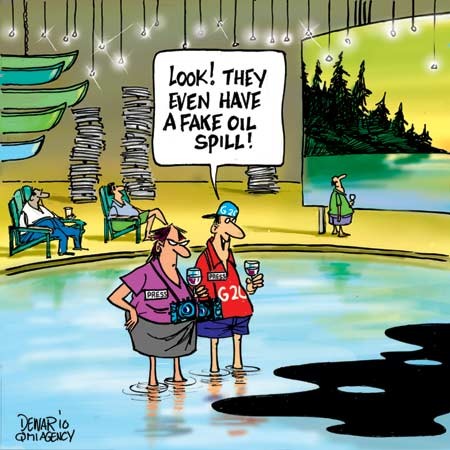
Look on the bright side. I guess we can always build more “fake lakes”.
Refer also to: