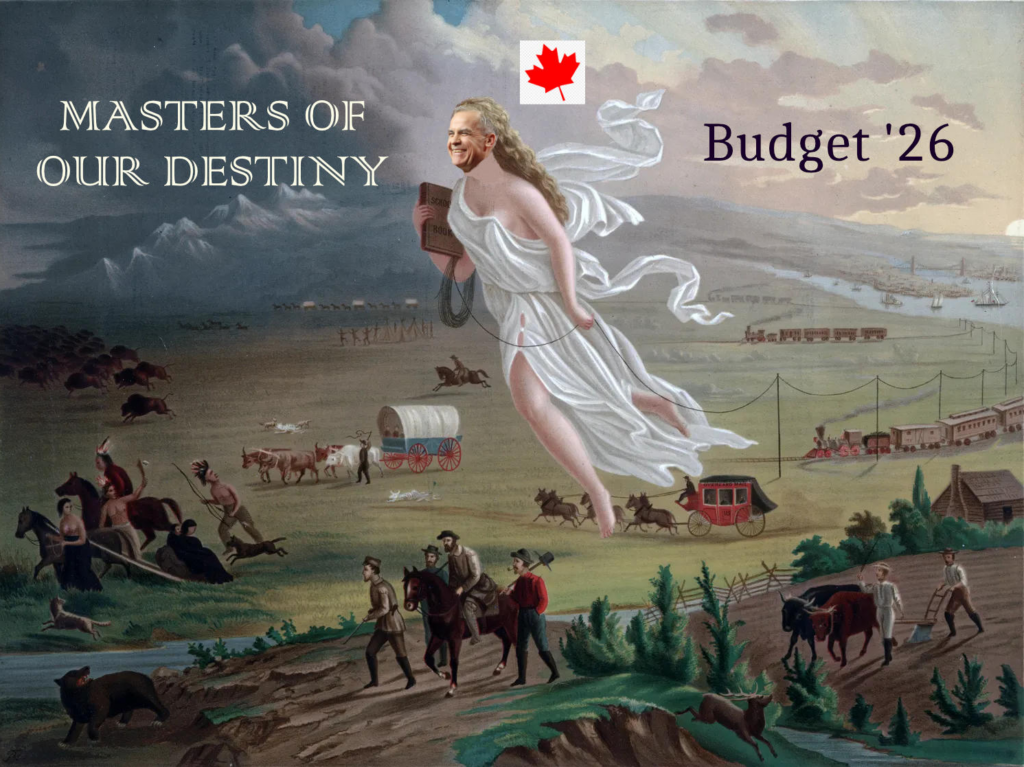
John Gast’s painting “American Progress” altered by Will Koop in honour of Mark Carney’s 2026 budget betraying Canadians by again serving mostly rich American white male Nazis
@204queenb0574.bsky.social:
We’ll need one of these when Carney’s done. But he’ll be gone and have his suitcases full of cash. Prick. just like Herrs Mulroney and Harper, blowing our money on themselves and their rich American pals


@ourcommondefense.bsky.social:
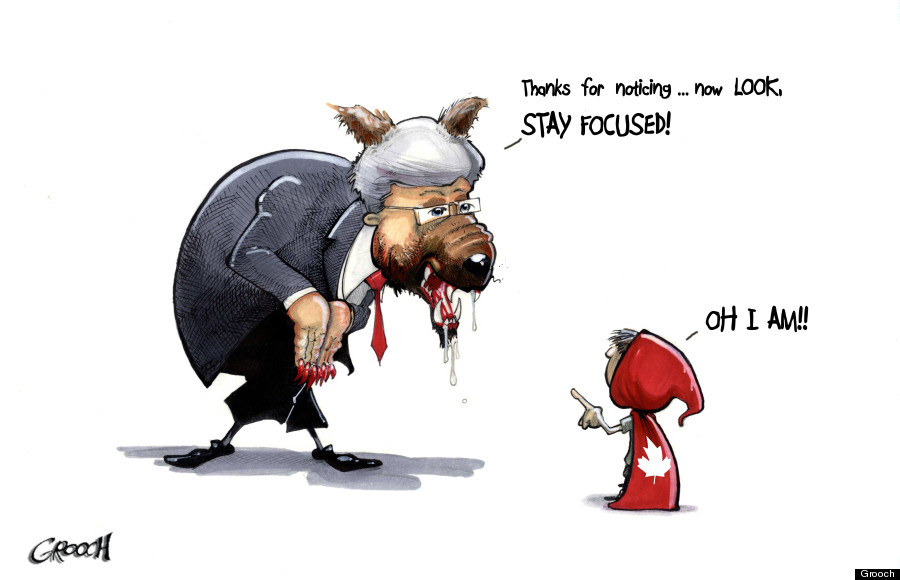
After Orban’s landslide defeat the ‘National Asset Recovery and Asset Protection Office’ was created by Hungary’s parliament to recover public assets stolen during the Orban era
@consbegone.bsky.social:
And Carney uses our taxes to promote climate-destroying big oil and gas, AI data centres, and mines. All while gutting environmental protections and the public service and failing to support public healthcare. He’s an arrogant, gaslighting dinosaur
@westernwriter.bsky.social:
The new Liberal budget only confirms that Carney’s book “Values” was just smoke to get him elected. The cynicism it took to write it then torch it through legislation is Tony Blair standard of dark arts politics.
He’s a shrewd political creature, but he underestimates Canadian values.
@oliver48.bsky.social:
“This year may be seen as a turning point in the climate crisis. The U.N. has accepted that global warming is going to exceed 1.5°C, while climate scientists have concluded that the rate of warming has [effectively doubled] over the past decade”
A recent doubling of global warming rate signals a 1.5 °C breach by 2028 by Qinjian Jin & Bing Pu, Oct 8, 2026, npj Climate and Atmospheric Science (2026)
We’re sharing this article early to provide faster access to peer-reviewed, accepted research. It is citable and carries a permanent DOI. This version is subject to further edits and will be replaced automatically by the final Version of Record. All legal disclaimers apply.
Abstract
Timely and accurate projections of when global warming will exceed the Paris Agreement’s 1.5 °C threshold are essential for effective climate policy. Existing estimates place this exceedance in the early 2030 s but carry substantial uncertainty. Here we analyze the latest observational temperature records through 2025 and identify a statistically significant doubling of the global warming rate during 2011–2025 (0.40 °C per decade) compared to 1971–2025 (0.20 °C per decade). Extrapolating this accelerated rate projects a crossing of the 1.5 °C threshold by 2028, nearly a decade earlier than previous estimates. Regional analyses attribute this acceleration primarily to intensified warming over East Asia–the North Pacific, mid-latitude Eurasia, and the South Atlantic–Antarctic regions. The ensemble mean of 26 climate models fails to capture the observed doubling of the warming rate, simulating a rate of only 0.29 °C per decade. These findings suggest a narrower window remains to limit warming to 1.5 °C, underscoring the urgency for rapid and substantial reductions in greenhouse gas emissions.