She Thought Her Daughter Was Faking Sick. Then She Found Out Her Elementary School Was Built on a Drilling Waste Site. Homeowners are livid they weren’t told what their properties were built on. The developers claim it’s all perfectly safe. They just can’t show you the proof by Saul Elbein May 5, 2026, The Barbed Wire
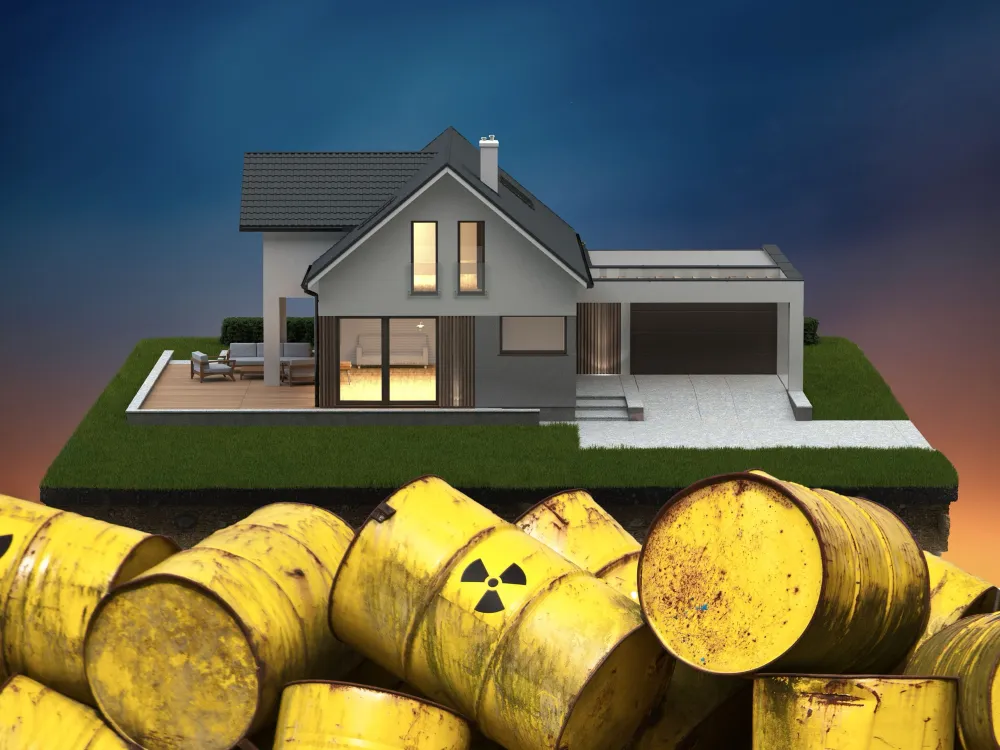
Credit: Photo illustration by The Barbed Wire / Photos Getty
EXCLUSIVE
If anyone had told Joey Giminiani what was under his house, he never would’ve bought it.
On April 23, Giminiani took off work at the electric utility and joined a Zoom meeting from the home he had sunk his life savings into. He watched as the residential developers on the call insisted on two things.
First, that no matter what anyone said, the site was safe. And second, that no one ever had any reason to tell him what lay beneath it.
Giminiani had been bracing for these test results for weeks. If they came back inconclusive, he told me last month, there would be an uproar. If they came back contaminated, it would force the state to test every lot in the development.
Instead, he tuned in that Thursday, along with 25 other homeowners from the hundreds in the neighborhood, to hear the developer arguing there had never been a problem — or as he put it, trying to “sweep things under the rug.” Bret Pedigo, a partner at Terra Manna Homes, opened by telling residents that Silo Mills in Johnson County was “a place to call home, to raise your families,” that it was perfectly safe — and that it was being “attacked or terrorized by irresponsible media stories.”
Reader, he was talking about us.
In February, The Barbed Wire and the Texas Observer published investigations that found Silo Mills had been built on a former landfarm — a site where solid, often toxic waste from oil and gas drilling had been spread on the land and left to break down. A whistleblower who had worked the site, Lee Oldham, told us he had personally helped bury radioactive drilling waste there.
We also reported that Silo Mills was one piece of a much larger problem: an estimated 20 to 60 million tons of drilling waste from the fracking boom that had been buried, plowed under, or dumped in municipal landfills around Dallas-Fort Worth, a region now in the middle of rapid suburbanization.
Silo Mills was exceptional, however, in a couple of ways. First, that a whistleblower with knowledge of the site had come forward to tell the public of what he had done there. Second, there were the kids: As part of the deal to develop the property, Terra Manna donated land to the local school district, which built Pleasant View Elementary on the same ground. So our story caused an uproar. In the weeks that followed our investigation, the Texas Attorney General’s Office began looking into the development. The Texas Railroad Commission visited the site. And Pleasant View parents, some of whose children had health concerns they attributed to the waste buried under 500 elementary school students, pressed Pleasant View administrators for answers.
Meanwhile, the superintendent, hoping to reassure parents, released the environmental records the district had relied on when the school was built. Which only made things worse: Parents reading the records realized they showed a walkabout-and-paperwork inspection — not soil or chemical testing of the site itself. (As we’ll get to, the developers would later argue the site had been tested back when it operated as a waste disposal site, but their records, they claim, have been lost.)
The developers were rattled by our reporting too. “When the first article came out, it certainly caused a lot of stress and concern here,” Jeffrey Harper, an attorney representing Terra Manna and Prophet Equity, told me. “Did we misunderstand here? Why are people making these claims? Who the heck is Lee Oldham?”
Late last month, the Silo Mills developers came before the residents who had bought the houses they built to argue that all of the concerns had been overblown — a product of bad-faith journalism. The testing the developers cited to make this case was substantial. According to Harper and a recording of the Zoom meeting I later reviewed, UES Professional Solutions — the firm hired to do the testing — had audited the original mud-farm records in Austin, cross-referencing them against the property to confirm the historical permitting and test data checked out and didn’t have gaps.
The developers say this 2010s-era testing of the active oil and gas waste disposal site was exhaustive, though they have not released hard copies of either the testing or the methods they used. They told residents, and us, that last month’s testing involved drilling more than 60 holes around the school and community buildings. These boreholes went down 15 feet, and then every foot of every hole was sampled for a variety of common oilfield contaminants — radiation, toxic oil-cousins like benzene and toluene, and heavy metals like arsenic.
The result: 137 core samples and roughly 1,996 individual data points. Company representatives said that results for every contaminant they looked at came back below regulatory limits for the primary human-health exposure pathways — skin contact, ingestion, and inhalation.
UES is a reputable company, and Eurofins — which tested the samples — is a reputable lab.  Yes, but, experts in sampling know well how to sample to avoid getting results showing contamination, and what to avoid sampling for. Alberta Environment and Encana/Ovintiv did that kind of sampling to claim the many contaminated Rosebud water wells were not contaminated, and if they were, nature was to blame.
But the methodology that the company shared with us revealed significant holes. For one, there is a long list of cancer-causing compounds common in oilfield waste that the developers didn’t test for: polycyclic aromatic hydrocarbons like benzopyrene, which can cause skin cancer; the metal nickel, which can cause breathing problems and lung cancer; and PFAS, the “forever chemicals” that wreck the endocrine system. These chemicals stick around in soil, don’t break down well in landfarms, and have led to major lawsuits.
Perhaps most importantly, per Pedigo’s statements on the Zoom call, UES had sampled the school grounds, the common areas, and around the amenity center — but not the soil under or directly around the houses where families actually lived.
Despite these holes, Terra Manna and its financier, Prophet Equity, told The Barbed Wire they had spent more than $1 million on follow-up testing — and insisted no more was needed. Harper said UES had expressed “100 percent certainty” that the site was clean of radiation.Fucking wow, the gall of them. “A granite countertop has more radiation than this land,” I’ve heard that deflection over 100 times now by various oil patch polluters he said of Silo Mills. The testers, he added, had “reiterated everything that we knew and thought, which was that there is no way any radioactive materials ever made it to this farm.” Harper said UES had also told the company there was “no point doing any further testing out there.”
Such absolute language is unusual in environmental science, where empirical findings tend to come with caveats.
Johnson County Detective Dana Ames, who led the county’s investigation into PFAS dumping that had killed 80-plus cattle on nearby farmland, said she would be testing the Silo Mills site herself, including for PFAS. Ames told The Barbed Wire she could not comment on the developer’s results because the company had not given her their data or methodology. The county’s investigation, she said, was ongoing.
‘She’s a Completely Different Kid’
Many residents weren’t convinced by the developers’ assurances that all was well. In the weeks after our story ran, a half-dozen parents responded to a survey I posted online with health concerns about themselves and their children — symptoms they said appeared during the school year and cleared up during breaks. We followed up with these parents to get more information about their stories and to verify their identities; The Barbed Wire granted them anonymity because of concerns about backlash in a community that has polarized around the issue.
One mother told us she had long ago begun making her kids shower off after coming home from school and that she felt sick when at events on the premises. Another said her daughter’s constant dizziness and bad headaches after school had led her to suspect the girl was making things up — until she read our reporting.
Still another described how, in the months before our story came out, her family had tried detoxes, parasite cleanses, and mold remediation to address their continual symptoms.
“I’m so tired of having to keep my kids at home because they don’t feel well, and then getting in trouble with the school because of absences,” she said. Two families told us that the symptoms disappeared during holiday breaks. “Over summer,” one mother wrote, “she’s a completely different kid than the school year.”
One mother who lived next to Silo Mills reported in a Facebook post that when the wind blew south, a foul “rotten” odor filled her house.
What caused the symptoms and smells hasn’t been established. But the pattern the families describe appears consistent with something tied to the school property and Silo Mills at large, considering that symptoms showed up during the academic year and cleared up during breaks, when children weren’t on the premises. (Pleasant View takes children from surrounding communities, not just Silo Mills.)
The complaints echoed older ones about the site, dating back to 2018 — before the development existed. That year, neighbor Sue Beaton told Texas state environmental regulators — in records reviewed by The Barbed Wire — that fumes from the mud farm, by then decommissioned, had stripped the paint from her house and her car, left a foul odor in her pool, and that dying animals, which she assumed came from the site, kept ending up on her property.
‘You Didn’t Do the Proper Testing’
The developers said they had always known the site underneath Silo Mills was safe. They used to own it. Why would anybody dispute that they knew what was buried there?
Before it financed the construction of Silo Mills, Prophet Equity owned a controlling share in a gas drilling company and in a drilling fluids company. That drilling company sent its waste to Joshua Land Farm LLC — a company owned, per state records, by Prophet Equity founder and managing partner Ross Gatlin, who scowled, camera-on, through the Zoom town hall last month.
In other words, the companies generating the waste, receiving it, and building homes on top of it were all controlled by or partnered with the same private-equity firm.
The site had been farmland before it was a land farm. After the DFW-area oil and gas boom largely ended and the landfarm was decommissioned, Prophet had tried to convert the property into a wastewater treatment plant; when that effort fell through, the company turned to housing.

Lee Oldham was the source whose testimony first revealed what was under Silo Mills — both in our previous story and to Dana Ames, the Johnson County detective. Oldham, 52, was a former landfarm worker who had spread and buried drilling waste at what locals called the Joshua Mud Farm during the Barnett Shale fracking boom of the early 2010s. He believes he was poisoned by radiation there — something the company now argues its post-publication tests have proven impossible. When Pleasant View Elementary opened on the site, he came forward with claims that the dust he inhaled during his time at the landfarm had severely degraded the bones in his jaw and neck, a known side effect of radium exposure.
Harper disputed parts of Oldham’s timeline. “I’m confident that we have multiple people in charge of the property, and confident he was not working on our land at that time,” he told me. The company, Harper said, had been in contact with former landfarm employees who could dispute Oldham’s account, though he did not provide their names.
But the developers did not consult with Oldham when they did their testing, and none of these employees have brought their concerns about him to law enforcement. Ames told me she would welcome the chance to interview anyone who had worked the site, but that the developer had not provided that information to her and none of those alleged witnesses had come forward. (A Facebook post from one man claiming to be an employee said the truckloads were radioactive; another former worker wrote on Oldham’s page after our story published that her colleagues at the landfarm had experienced “odd cancers & birth defects passing to the younger generations.”)
Swipes at the whistleblower aside, Harper’s main point was this: Exhaustive testing before construction of the new development on a former waste site had been unnecessary because Joshua Land Farm LLC had run such a rigorous intake operation. The dump site was fenced, monitored by cameras, and patrolled by security personnel. At the gate, every incoming truck was inspected. The staff, Harper said, had been trained to assess the loads by smell — “it doesn’t take a genius,” he said he’d been told, to tell the difference between water- and oil-based drilling muds. Trucks that smelled wrong were turned around. The rest were sent on to a testing pad, where a technician ran samples against chemical strips.
But what, exactly, that technician had been testing for, Harper could not say. The one substance she could swear she had checked for, he said, was petroleum — the company’s main concern was making sure no one was sneaking in oil-based drilling mud, which is regulated more stringently. Beyond that: “The short answer is, she just wasn’t [sure],” Harper said.
The records of what had been tested at the landfarm were also gone. “I can’t give you the documentation for what we did back then, because we don’t have it,” Harper said. “When the company closed down, that was put in storage for, I think, seven years, and we looked for it to see if we still had it. And we just don’t.”
And as with the UES testing, there was one category of pollutant the company had never tested for at all: radioactive heavy metals, which Harper said the site wasn’t licensed to receive. PFAS — forever chemicals — also went unchecked.
“Other than avoiding oil, I don’t think that they were making any particular test,” Harper said. The company had since done its own radiation testing, post-publication, and concluded nothing was there — proof, they argue, that their controls when it was a landfarm had worked. But during its operating years, was there ever actual testing for radiation in the trucks dumping at the landfarm? Harper was unequivocal: “There was not.”
The testing the company did perform before construction — the results the Godley Independent School District superintendent released, to widespread frustration — was what’s called a Phase I environmental assessment, which isn’t really testing at all. Instead, an assessor walks the property, reviews the available records, and writes a report. The hands-on work — drilling cores, sampling soil, testing groundwater — is a separate process. At Silo Mills no one broke ground to test the former landfarm between the time it was closed and the time the homes were built, or before Pleasant View Elementary opened on the same ground.
The Phase I report TBK Environmental had written for the site flagged this issue directly: The lack of surface-level toxic waste, the inspectors wrote, did not prove that nothing was there. The only way to know for sure, they wrote, was through “soil and groundwater testing and/or excavation.”
The company, Harper told me, didn’t feel the need to do soil testing before Silo Mills was built because of the stringent testing the Railroad Commission had required to run the site and to decommission it. But that decommissioning testing, like last month’s UES work, had the same blind spots — which included no testing for PFAS.
Of these, PFAS are a particular concern, both due to their carcinogenic and estrogen-disrupting impacts and presence in oilfield waste. A 2021 report by Physicians for Social Responsibility found that PFAS — the same forever chemicals Detective Ames was now testing for — had been used in hydraulic fracturing in more than 1,200 oil and gas wells since 2012.
The figure is almost certainly an undercount, since testing for the chemicals is expensive and access to wells is hard to come by. The developer’s testing at Silo Mills had not covered them.
For Giminiani, the lack of proactive soil testing on a known oilfield waste disposal site was the thing that didn’t add up. “It’s incredible,” he told me. “You’re gonna invest millions and millions of dollars into a property and then not go the full route?”
Another homeowner, Clayton Boley, had pulled the Phase I report and read it himself. The records were “pretty spotty,” he told The Barbed Wire.
“You didn’t do the proper testing,” Boley said, of Prophet Equity and Terra Manna. “You just rolled the dice.”
“They’ve only ever answered the questions they’ve been asked,” he added.
Blake Scott of Waste Analytics, an industry veteran who runs the site Wellfacts to help homeowners untangle whether their property hosts old oil-and-gas infrastructure, said that even if the developers could ultimately prove a site like Silo Mills was safe, they had already taken from homeowners something critical: the right to choose whether to buy a property built on oilfield waste.I would never knowingly live on oilfield waste – it’s toxic, whether it smells or not
“Just because they decided it was okay, and the state decided these were the standards to close the facility — well, I get to make my own choice for my family over whether I think that’s okay.”
Someone buying a used car, he added, “gets a Carfax report. But you don’t tell me about this being spread on the site of a home I’m gonna live in?”
For their part, the developers have held the line on the argument that no one ever needed to disclose any of this to residents in the first place — though Harper was at pains to argue that it was the real estate agents, not his clients, whose responsibility it would have been, had it been anyone’s.Same pass the puck blame game in Alberta’s oil patch, where homes were built on known oil/gas wells.
At the online town hall on April 23, a homeowner who was listing her property asked Pedigo — the partner at Terra Manna Homes who gave the presentation — whether she had to disclose the site’s waste history to a future buyer. Pedigo’s answer:
“This is a very subjective matter and each homeowner can decide what they want to do with this information — whether you want to disclose it or not.”
But, he said, “it’s kind of like if you didn’t have a hole in your roof, you wouldn’t go around saying you don’t have a hole in your roof. There’s nothing to disclose.”Fucker!
Giminiani called the answer “a non-answer” — “mob boss advice.” He added, “But of course he isn’t going to say that dumping anything from the oilfield onto the ground isn’t a good idea.”
Harper, the attorney, made a different case: If you start disclosing a site’s history, where does it all end? He argued, effectively, that all development in rural Texas carried with it a long history and a buried risk of toxins. Regardless, no one ought be conned into living on toxic waste with their kids
Before it was a landfarm, he explained, a property like Silo Mills “has been ranchland, and before that it was being used to grow wheat, and before that it was being used as a landfarm. The question is how far you choose to go back.” Each of those uses came, like a landfarm, with its own potential residue of poisonous petrochemicals — fertilizers, pesticides, herbicides for the ranch and the wheat, drilling waste for the landfarm. It was, Harper contended, “difficult to know what to disclose.” Fucking bullshit. The oil, gas and frac industry are, for the most part, much more toxic than farming or ranching
The developers, Harper argued, had revealed “what they felt was relevant based on all the information at their disposal.”
The legal picture, however, is more contested than Pedigo’s “nothing to disclose” suggests.
Texas Real Estate Commission disclosure forms list specific fields for hazardous waste and former landfill sites. Real estate attorneys familiar with the area told The Barbed Wire they would advise their clients to disclose, even where the law’s requirements are unsettled. Texas law also requires sellers to disclose deaths caused by a defect in a property — and Boley, one of the homeowners, argues the same principle applies to a home knowingly built on oilfield waste, however benign it may prove to be.
If he ever sells his house, Boley said, “Morally and ethically I still have to disclose. There are still people that don’t trust those reports and don’t want anything to do with those places.”
Asked about the residents’ frustration, Harper noted that the builder, not the firms he represents, was the entity in direct contact with buyers — while acknowledging that the underlying decision about what to disclose had been his clients’.
“If there is a thought by somebody that they would have liked to have known more,” Harper said, “I’m sorry that they feel that way.” He added: “I’m not disputing that somebody out there says, ‘Gee, I wish I’d known.’”What a douche
The question of what needs to be told to potential buyers is not academic, nor is it simply an exercise in where the fault lies. Silo Mills — and some of its residents — still have homes to sell.
In a complaint to the Texas Attorney General, Giminiani warned what could come as a result of Terra Manna and Prophet Equity’s failures to properly test the site before building there: If “prospective buyers become fearful that the site is contaminated,” the development “could stall or be abandoned altogether,” leaving current homeowners “unable to sell or refinance” and bearing “the financial burden of a partially completed or stigmatized development.”
Meanwhile, construction at Silo Mills has not stopped.
The builder is advertising the final lots in Phase 1 and pre-selling Phase 2 — which is being built, Oldham said, on the precise part of the property where he once helped bury the highest concentration of toxic drilling waste.
Homes are available, if you’re in the market, for $339,990 to $584,990 apiece.
Whistleblower Says Radioactive Fracking Waste Site Melted His Jaw. Now There’s an Elementary School There. by Saul Elbein February 11, 2026, The Barbed Wire

Between 20 million and 60 million tons of hazardous waste have been dumped in and around Dallas-Fort Worth.
EXCLUSIVE
Sure, Lee Oldham told me, he had spread radioactive fracking waste on Texas farmland. But in his defense, he never in a million years thought anyone would put a school there.
We were standing in the frigid wind on a field in Johnson County. It was January, and 52-year-old Oldham wore a heavy flannel sweatshirt pulled tight over his belly.
In the early 2010s, when the region was ground zero for the biggest fossil fuel production boom in human history, Oldham worked in waste disposal for a company that helped get rid of the millions of pounds of solid waste that came out of tens of thousands of natural gas wells about two miles underground.
That work, Oldham believes, exposed him to a witches’ brew of chemicals that, even now, likely lurked inside the fabric of his cells. His doctors have diagnosed him with injuries consistent with radiation exposure. Though he has no definitive proof of the cause, he believes the dust he inhaled during his time in the land farm melted the bones in his jaw and neck.
He also believes it made him an accessory to what he now views as an enormous crime — albeit one that was technically legal. thanks to corrupt politicos, easily bought and controlled like Alberta’s Danielle Smith and Canada’s Mark Carney, the oil and gas industry engages in endless crimes, technically legal, and even when not legal, regulators and courts usually protect the polluters and further harm the poisoned.
According to the nonprofit FracTracker — which shares maps, data, and analysis on the oil and gas industry — there were at least 21,000 oil and gas wells in the Dallas–Fort Worth area. Most of them sit in and around residential neighborhoods.
Each one of those underground wells produced between 1,000 and 2,000 tons of solid waste — sometimes as much as 3,000 or 4,000 tons as the decade wore on — laden with PFAS (per- and polyfluoroalkyl substances, also known as “forever chemicals”), radiation, and other toxic contaminants.
In total, somewhere between 20 million and 60 million tons of hazardous waste were dumped in and around Dallas-Fort Worth — in the very hinterlands the city is now expanding into.
But the public has little idea where any of it went.
It could be in your mother’s backyard, or, in the case of this story, under the playground at your child’s school.
Near a square of concrete in the midst of the field in Johnson County, where waste trucks used to drop off, Oldham held a small black box at ground level to track the radioactive particles pinging through the topsoil: a telltale sign of the presence of fracking waste, which is commonly disposed of by being spread on soil.
A hundred yards away stood a low-slung building with a roof like a ski ramp: Pleasant View Elementary School. The school, which serves nearly 500 students from Pre-Kindergarten to 5th grade, is part of Silo Mills, a 2,500-home “fresh, new residential community” that opened in 2023, offering residents an affordable slice of country living, just half an hour from downtown Fort Worth. About two-thirds of students at Pleasant View are considered economically disadvantaged.
Again, the waste — drilling mud and bits of subterranean rock pulled up by drilling rigs in a part of the quest for oil — tends to be toxic: radioactive and impregnated with cancer-causing chemicals, in particular high levels of PFAS, a massive family of hormone-disrupting, never-dissolving “forever chemicals” that are essential for fracking.
At ground level, Oldham’s detector began to beep faster: a sign of something that those residents hadn’t been informed of. Those beeps showed something below the surface was emitting higher than normal levels of radioactive particles. While the levels weren’t dangerous — at least, not in that spot, on the other side of the topsoil — they were a small piece of evidence in favor of his story that developers had built a whole community on a toxic waste site he’d helped cover up.
His claims are now being probed by Detective Dana Ames, an investigator with Johnson County. She’s a rare rural Texas law enforcement officer with experience handling complex environmental crime cases, and she’s trying to determine whether they have a public health crisis on their hands.
The next step will be to drill into the topsoil to take soil samples, looking for traces of dangerously radioactive materials, as well as PFAS. Over the coming weeks, that soil will be tested by labs specializing in environmental contamination — yielding evidence that could be used in lawsuits or, ultimately, criminal charges.
For now, however, the constable’s first priority is to see if the hundreds of people living in the development are in any danger. If the levels come back normal, then residents can breathe a sigh of relief. If, the sampling was done appropriately to find contaminants expected to be there. There are endless ways to take samples to avoid finding life threatening contaminants.
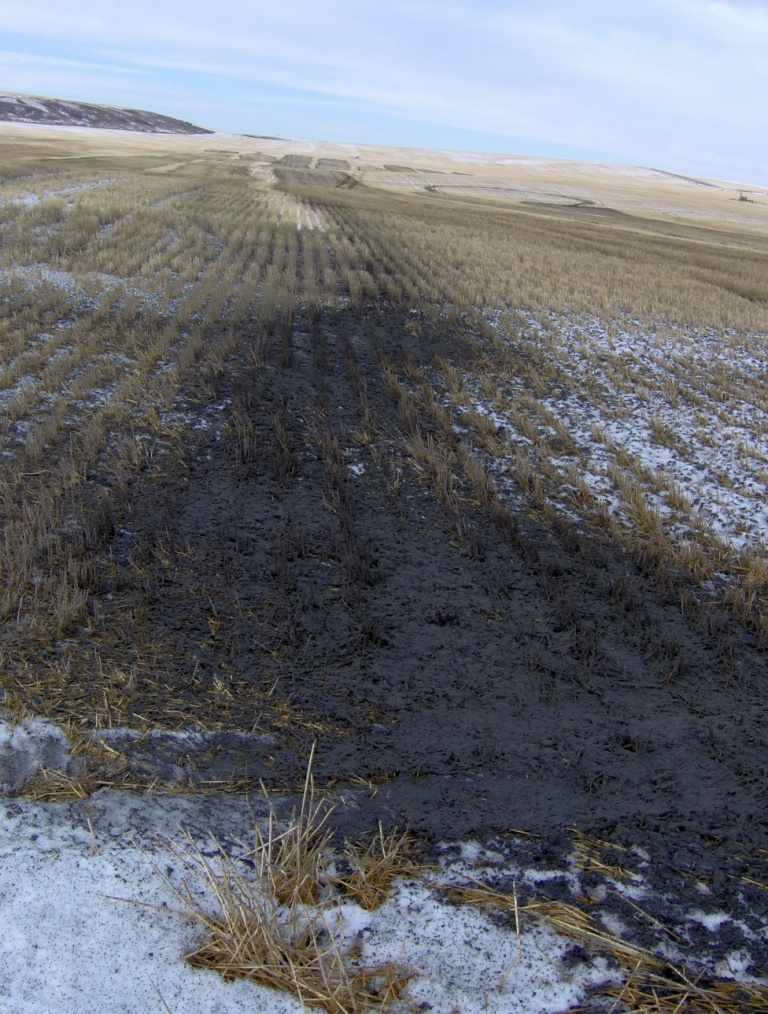
But they can also consider themselves to have dodged a bullet. Because the most troubling part of Oldham’s story are the parts that are legal and well-understood: For decades, Texas let drillers spread staggering amounts of radioactive and PFAS-ridden waste on the fringes of the nation’s fourth largest metro area — while making it virtually impossible for the public to know where.This happened and continues happening in Canada too. Encana/Ovintiv dumps its toxic shit on crop and pasture land, and roads, and on the muskeg in the north, with blessings from regulators and politicos. There are “regulations” which companies ignore, and regulators let them. The photos below were taken just west of where I live at Rosebud.
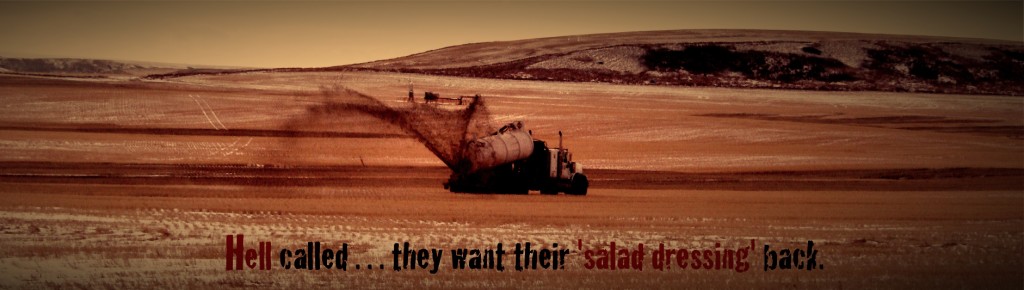
Meaning that, as America’s fourth-largest metro area expands — the region has added more than a million people since 2015 — an unknown number of people are now living and playing, in blissful ignorance, on top of what may be toxic waste.
“The whole thing operated on the honor system,” Oldham said.
“And the only honor you can bank on in the oil and gas industry is there ain’t nothing honorable being done.”
‘Are You Guys Nuts?’
At the dawn of the 21st Century, oil and gas drillers faced terminal declines in fossil fuel production — a fact that caused leading newspapers “to panic about a world running out of oil” and Texas Republicans like George W. Bush and Rick Perry to throw their influence behind the solar and wind industries.
This awful fate was avoided thanks to a cocktail of technologies that became known by the not-very-flattering shorthand of fracking, which reached its first flowering in the outskirts of Dallas-Fort Worth.
Faced with depleted reservoirs, the early frackers like George Mitchell looked even deeper to the layers of “source rock” that the oil and gas that America burned in the 20th Century had come from.
By figuring out how to blast open these layers of carbon-rich black shale, the frackers threw the peak oil saga into reverse, paving the way for the flood of cheap gas that powered cloud computing, fueling a new age of the American energy empire, and funding the rise of the modern hard-line right.
This came with significant risks. Scientists and oilmen have known for decades that the source rock is radioactive.
Three hundred million years before my site visit with Oldham, the land that would one day host the Dallas Fort-Worth metro area lay at the bottom of a warm, shallow sea.
Year by year, huge blooms of plankton and algae died and sank into the deep silt at the bottom of the sea. Over millions of years, they were pressed by their own weight and baked by the slow cooker of the earth into a flat, stony cake of oily shale.
As the seas rose and disappeared, radioactive uranium and thorium from the ground also settled by the ton down in the muck of the shallow sea.
It was undisturbed until the past 20 years, when a two mile-long drill bit cut them from the surface and dragged them back into the light — the first of many waste products on the path to natural gas.
The waste that comes out of the wells are full of toxins.
There’s the organic trash — naturally-occurring chemicals like benzene, which blasts apart the body’s ability to make blood. Forever chemicals like PFOS and PFOA lubricate drill bits cutting through oily rock — but also disrupt our hormone systems — the chemical language that all living things use for their cells and organs to talk to each other — as well as the immune defenses, energy processing, and DNA-formation essential to all complex life on Earth.
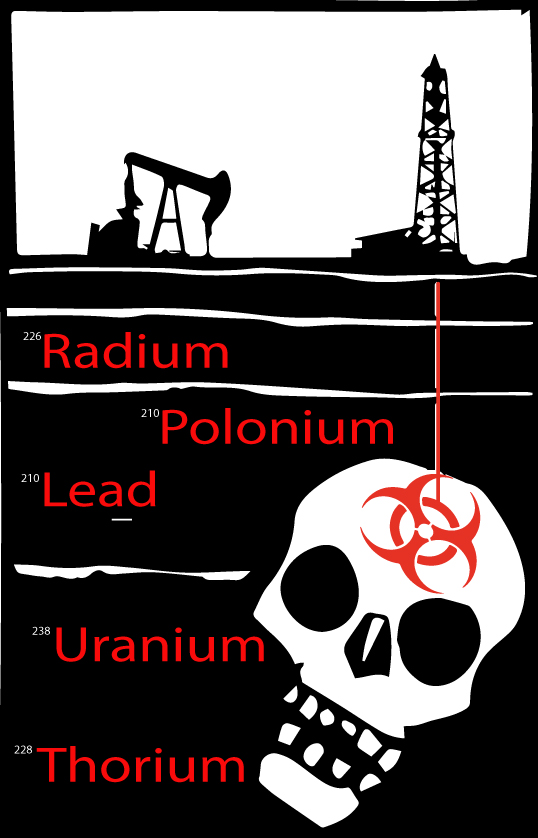
And then there are the radioactive elements like radium, which under the circumstances of oil and gas extraction can reach levels hundreds or thousands of times more concentrated — and dangerous — than the normal, low levels of radiation that form a background hum to life on Earth.
Even when those levels are low, “we don’t know what happens when we lay it out in a horizontal landscape, as water moves it, and air moves it,” said Justin Nobel, an investigative journalist who has been published in Rolling Stone and specializes in the toxins that come out of oilfields. He is also the author of “Petroleum-238,” a defining book on radiation and fracking waste.
Scientists have long warned this is dangerous. When John Stolz, a Duquesne University microbiologist who studies fracking waste in Pennsylvania’s Ohio Valley region region, first heard about Texas companies doing landfarming— the technical name for spreading solid drilling waste on farmland —around the Barnett Shale, his first reaction was, “Are you guys nuts?”
The Barnett Shale was the oil rich geologic layer below North Texas that served as ground zero for the state’s fracking boom.
Radium, he told me, is sticky — lay it out in a field or put it in a waste pit, and water will tend to wash out soil and salts, leaving an ever-more-concentrated product behind: something like a natural reactor, releasing a radioactive plume for thousands of years.
But for regulators, fracking waste is, by definition, safe. Since the 1980s, the Environmental Protection Agency has treated oil and gas waste as “non-hazardous” by definition, allowing it to be spread on farmland without treatment. Yes, ordered so by the polluters, to be able to get rid of their mountains of toxic waste as cheaply as possible, who or what gets sick or dies, the oil rich and their politicians, don’t care.
And the Texas Railroad Commission — the state’s confoundingly-named and notoriously underfunded oil and gas regulator — left operators to, as Oldham said, “self-police.” They didn’t require oil and gas operators to test their waste for radiation or PFAS or require them to line waste pits with plastic to keep contaminants from seeping into the water supply.
They also didn’t offer public maps — or in most cases, even keep track themselves — of where the waste was going.
And while the agency forbade polluting Texas’ land and waters, their slapdash record keeping and weak penalties offered “little deterrent effect” to bad industry actors, according to a blistering 2016 audit by the Texas legislature’s Sunset Advisory Committee.
That meant drillers with radioactive waste — and drill cuttings are radioactive by definition — could either take extra time, paperwork and expense to do things the right way and send it out to a designated hazardous waste landfill, despite the fact that those loads had almost no chance of encountering a state agent with a Geiger counter.
Or, he said, “You could just let it slide, and go out there and dump it on the ground.”
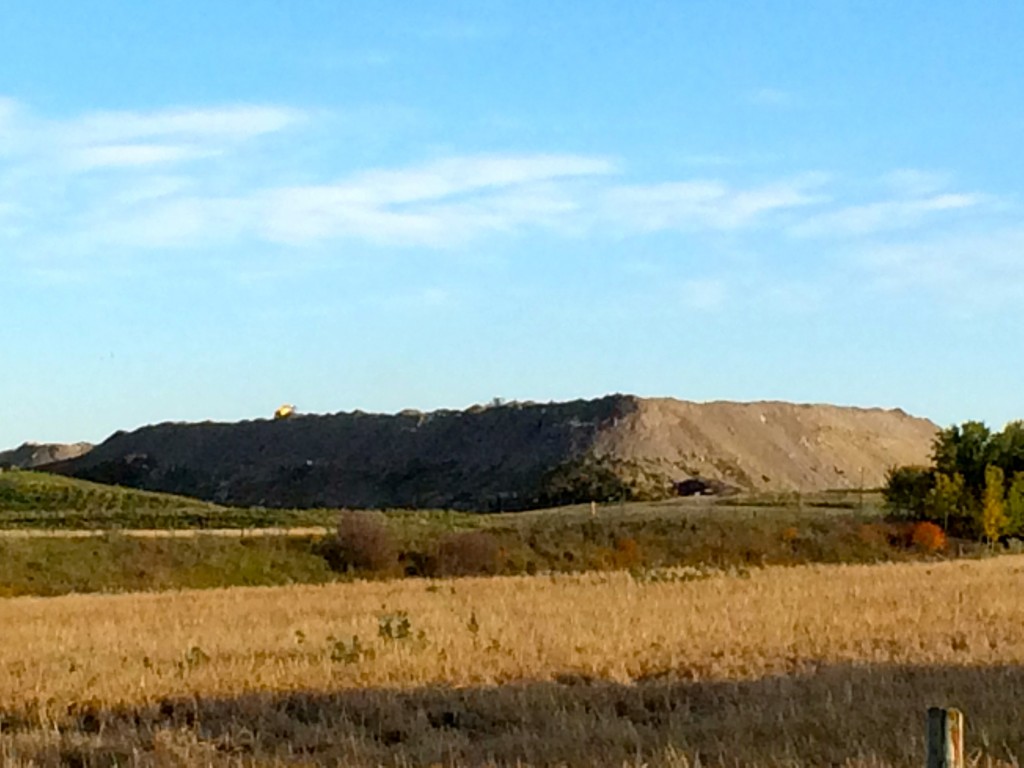
Drilling waste piled high for permanent “disposal” near Didsbury, Alberta
‘This Stuff Is Radioactive’
Back in the days of the Barnett Shale gas boom — the first frenzied phase of Texas fracking between 2002 and 2009 — Oldham worked in waste disposal at a Johnson County landfarm: effectivelya spread‑out dump where drilling muds and contaminated soils were plowed into open fields and left for microbes, air, and sunlight to slowly break down the pollution.
In practice, that meant Oldham — like other workers at sites across North Texas — was spreading thousands of truckloads of drilling waste on farmland. Vacuum trucks would discharge their loads of drill cuttings and lubricating mud, and Oldham and his crew would spread the trash across the field to dry out, then plow it under: dump, dry, repeat.
In 2012, Oldham made an unpleasant discovery. After the worn-out steel tracks for his skid-steer had been sent to a scrap yard, he overheard two other workers saying that the yard had rejected them because they were radioactive.
“Those tracks were put on new,” Oldham said. “They’d only ever touched the drilling mud.”
That’s when he started to put other things together: That the scrap yards in the Barnett Shale region all had Geiger counters. That a supervisor yelled at a young roughneck who was spread-eagled on a pipe to get his ass up if he ever wanted to have kids.
All those metal objects, Oldham realized, had a common denominator — they had been touching the drilling mud and Barnett Shale cuttings.
“I’m sitting going, ‘This stuff is radioactive, and we’re blowing it out on the ground,” he added.
In 2012, he asked his boss if it would be possible to get personal protective equipment and radiation tests for the crew. After that, he told The Barbed Wire, everything changed. His boss told him he was “too smart for my own good” and put him on what he called “a punishment job” at an isolated ranch. Then men in a pickup ran his car into a boulder on his way home from the job, he said.
He left Johnson County, he said, in fear for his life.
Three years later, in 2015, he mended fences with his bosses and came back to help with the Railroad Commission-overseen project to clean up and shut down the mudfarm.
Once while on that job, in the July heat, the air filters on his bulldozer filled with the dust rising off the dried-out drilling mud. Cleaning them out, he got a faceful of dust, he told The Barbed Wire, and he was laid out for days with agonizing pain in his throat.
In the coming years, his teeth began getting loose in his jaw, and in 2023, the dentist found that his jaw bone had become seriously degraded. An orthopedic surgeon told him that — at 51 years old — his vertebrae looked like that of a 70-year-old woman with osteoporosis. (The Barbed Wire reviewed medical records that corroborated Oldham’s account.)
While Nobel, the oil and gas journalist, said establishing direct causal connection to these health scares lies at the frontiers of science, these are characteristic impacts of radiation poisoning. Radium — which is in the same periodic table column as calcium — is what’s known as a bone-seeking carcinogen, which means the body inadvertently binds it right into bone, where it begins to kill the cells that form and repair bone.
There is suggestive evidence that Barnett wells are a source of persistent radiation pollution into surrounding communities: In 2020, a study in the scientific journal Nature found that Fort Worth-area communities downwind of fracked wells had airborne radiation up to 40% above average. Fort Worth, which has more than a million people living in the danger zone of fracking sites, also had the highest number of upwind oil and gas sites of any city in the country.
And a 2023 study found that in the early years of the fracking boom, Tarrant County — the home of Fort Worth — had 60% more children born with serious birth defects than would have been expected for its population. Hauntingly, this data only went till 2014, though the county remains a hotbed of new drilling, and there has been no comprehensive attempt to clean up waste.
Soon after Oldham received his diagnosis, Pleasant View Elementary, the school built on the mud farm Oldham said he had helped bury, opened its doors. Oldham decided he could no longer keep quiet. He began posting on Facebook, which brought him to the attention of Detective Ames.
He was lucky. Almost uniquely among oil and gas whistleblowers, Oldham had made his claims in a county where officials, all staunch Republicans, were willing to dig.
Watching Their Animals Die
Ames saw Oldham’s posts in the midst of an entirely separate environmental crisis.
In 2023, Johnson County made headlines around the world comparing the situation to Chernobyl when a plume of PFAS, or “forever chemicals,” began killing fish and cattle on two farms outside the town of Grandview.
As county officials would discover, the poison had originated in sewage from the Fort Worth water treatment system that the farmer’s neighbors had spread on their fields as fertilizer.
This practice was, like spreading fracking waste on farmland, entirely legal even though the sewage was dangerously high in PFAS. PFAS are ubiquitous in fracking fluid. While no source for the PFAS in the solids has been proven, it’s a fact that it came from a water treatment plant in an area of Tarrant County that’s being actively and extensively fracked.
We know this because Johnson County did its own investigation — outlined in a civil complaint — in the face of indifference, and even opposition, by state regulators and industry lobbyists in Austin. Through that process, Johnson County’s Detective Ames learned more than she ever cared to about PFAS, a vast family of artificial oil-like substances treated with fluorine to give them exceptional stability — the reason that the Teflon on a nonstick pan doesn’t burn off like cooking oil. They stick tightly and irreparably to fat molecules like a drop of cooked oil dissolving on the surface of a greasy burger.
Tens of thousands of varieties of PFAS can hitch a ride into virtually any system in the body, causing insidious and prolonged effects. One 2025 study in Nature found that PFAS altered the sperm of male mice, making them less likely to be able to conceive a viable embryo, and raising the risk that embryo would have birth defects.
One such defect: the inability to have healthy children themselves. Those PFAS-induced changes in sperm can also impact the fertility of the next generation of males — and the next, and so on — said Dana Sheinhaus, a doctoral student at the University of Texas at Austin whose research specializes in PFAS and male fertility.
In her lab, she said, “we are looking at the children and the grandchildren [of affected individuals], and we are seeing changes in those fertility genes.”
Male fertility, she noted, is falling relentlessly year by year — an accelerating drop some researchers have linked to fossil fuels and chemicals made from them, like PFAS.
These studies raise the possibility that men, and particularly oil workers, exposed to today’s contaminants — or, say, boys playing in the dirt of Pleasant View Elementary — may leave their children or grandchildren unable to have healthy kids of their own.
It can also cause more immediate problems for this generation.
For the Colemans, one of the families whose farms had been contaminated, it meant two agonizing years of watching their animals die one by one as their bodies and nervous systems failed — their cattle beginning to drool; their careful gait turning sickening and scissor-like; their eyes failing. Once gentle cattle began to attack them.
“I had a yearling come straight for me with all her might trying to take me out,” TonyColeman told The Barbed Wire.
The liver of one stillborn calf showed levels of one PFAS-family chemical at more than 100,000 times the level the Environmental Protection Agency considers safe.
The story broke amid a national wave of mass litigation around PFAS, and in its wake New York banned the practice of spreading biosolids on farmland, and Minnesota required them to be tested for PFAS.
That was the kind of change Johnson County officials — naively, two officials told me they now believe — expected in Texas. Ames turned her results over to Texas environmental regulators, and Johnson County officials asked Gov. Greg Abbott for a disaster declaration that would allow the farmers, like the Coleman family, financial support to leave their ruined farm. But Abbott never signed it.
To the consternation of both the Coleman family and county officials, Texas state officials have refused to act. In the 2025 legislative session, a slate of bipartisan bills aimed at requiring PFAS testing of biosolids all failed — some, as The Texas Tribune reported, under direct opposition from the oil and gas industry, which relies on both PFAS and land application as part of its business model.
So when Ames saw people on Facebook beginning to panic over Oldham’s allegations, she reached out and visited the site with him. She told me she could not speak specifically about Oldham’s allegations, considering the pending investigation, beyond saying that the county was involved in site testing of its own.
And her time in environmental enforcement, from cleaning up illegally dumped construction waste and mattresses from county roadways to the Coleman’s case, had taught her two iron laws of industry.
First, that Texas state regulators have refused to force polluting industries to clean up their mess. Second, that no one industry cleans up its mess unless it is forced to.
Ames is waiting on preliminary results of her testing, which will take weeks; more comprehensive ones will take longer, assuming the county can come up with the money to pay to conduct them. If the 2,500 homes sold at Silo Mills turn out to have been built — without the knowledge of their buyers — on tainted land, a wave of litigation looms; for now, she is trying to determine if they have a public health crisis on their hands.
There’s a still-more-troubling connection between Oldham’s allegations and the PFAS case. County Commissioner Larry Wooley said that county officials only knew about the PFAS because the Coleman family, staunch Christians, had come forward rather than quietly selling off their tainted cattle and their contaminated land — despite having no legal obligation to do so.
“Everybody knows that Tony’s not selling those cattle, and he’s taking a huge financial hit because of that, because of his morals, that he doesn’t want to introduce that stuff into the food chain,” Wooley said. “But a lot of people weren’t concerned about that.”
Wooley has become something of a Texas leader in the fight against PFAS contamination, and said that to this day — thanks to the expense, opposition from biosolid-using farmers, and the lack of interest from state leaders — only Johnson and Ellis County have done any testing at all.JFC! What the hell are humans eating, thanks to the majority of our species having no morals?
One unsettling conclusion he drew from this experience was that his county wasn’t unique in having a serious contamination problem. It was unique in investigating it. The county where I live enabled Encana’s crimes. No authority or regulator investigated the company’s waste dumping on foodlands, legal or illegal.
Texas legislators did consider some reform — requiring drillers to notify landowners when waste pits are dug or requiring pits to be universally lined. But as the Texas Tribune reported, the oil and gas industry called the measures “too stringent,” and they failed.Encana didn’t line their toxic waste pits at Rosebud either. Just dump mix cover ‘n shut up, and if one is lucky, a warning sign.
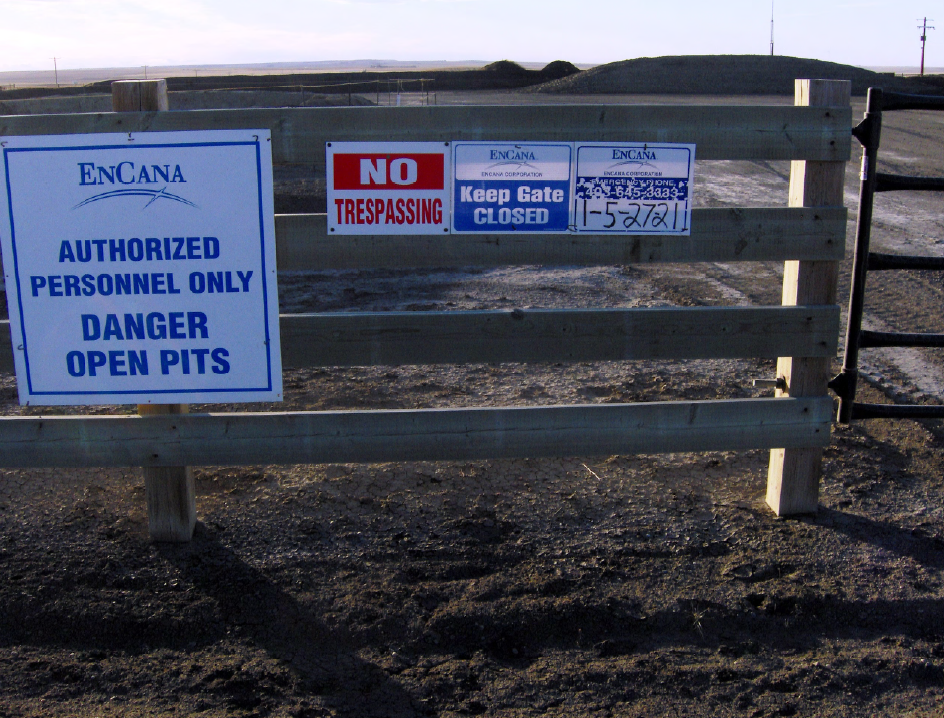
Two reforms the legislature did pass point to a wider problem. One reform, which safety advocates say was needed, will for the first time in state history require oil and gas companies to register the location of their waste pits. But that rule only takes effect going forward: underscoring the extent to which Texans simply do not, and perhaps cannot, know where the staggering amount of waste created in the fracking boom is buried.
The other measure was less welcome: a bipartisan push to allow oil and gas companies to dispose of treated fracking fluid in Texas rivers and on Texas farmland. It also protects any company or landowners who sells, treats or applies this water — which has been proposed as irrigation for crops — from litigation in most cases.
And though fracking fluid is ridden with PFAS, the law does not require it to be tested for PFAS.

That’s caused a rift among Johnson County Republicans. “If I’m elected, we need to get that bill thrown out,” said Mary Louise Wells, a Johnson County child safety advocate running to replace state Rep. Helen Kerwin. While Kerwin herself was the only statehouse Republican to vote against the fracking waste disposal bill, recent campaign finance filings show that she received more than $55,000 in cash — and $26,500 in push polling support — from Texans for Lawsuit Reform (TLR), a principal group advocating for it.
Those donations represented around 60% of Kerwin’s total fundraising that period.
For Oldham, the prospect of liquid fracking waste — even if treated — spread on Texas crops contributed to his sense of mission.
He had returned, he said, to make what he had done right. He had grown up in Cleburne, he told me, and he knew the men who had done this. “If they could walk around knowing what they did to me — well, they have to look at me. And know I’m looking right back at them.”
Refer also to:
2026: The Trillion-Gallon Time Bomb: Inside the Oil Industry’s Wastewater Crisis
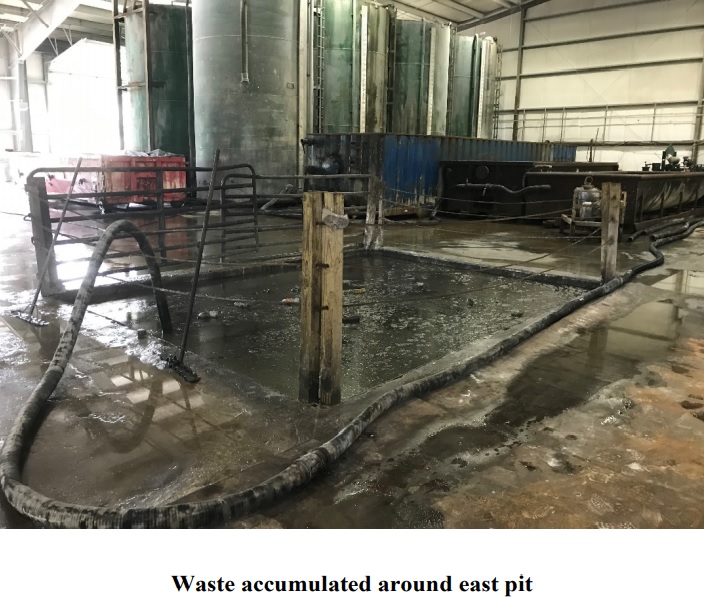

2021: Presentation by Justin Nobel on frac waste and its “terrifying levels of radioactivity”