@amirattaran.bsky.social:
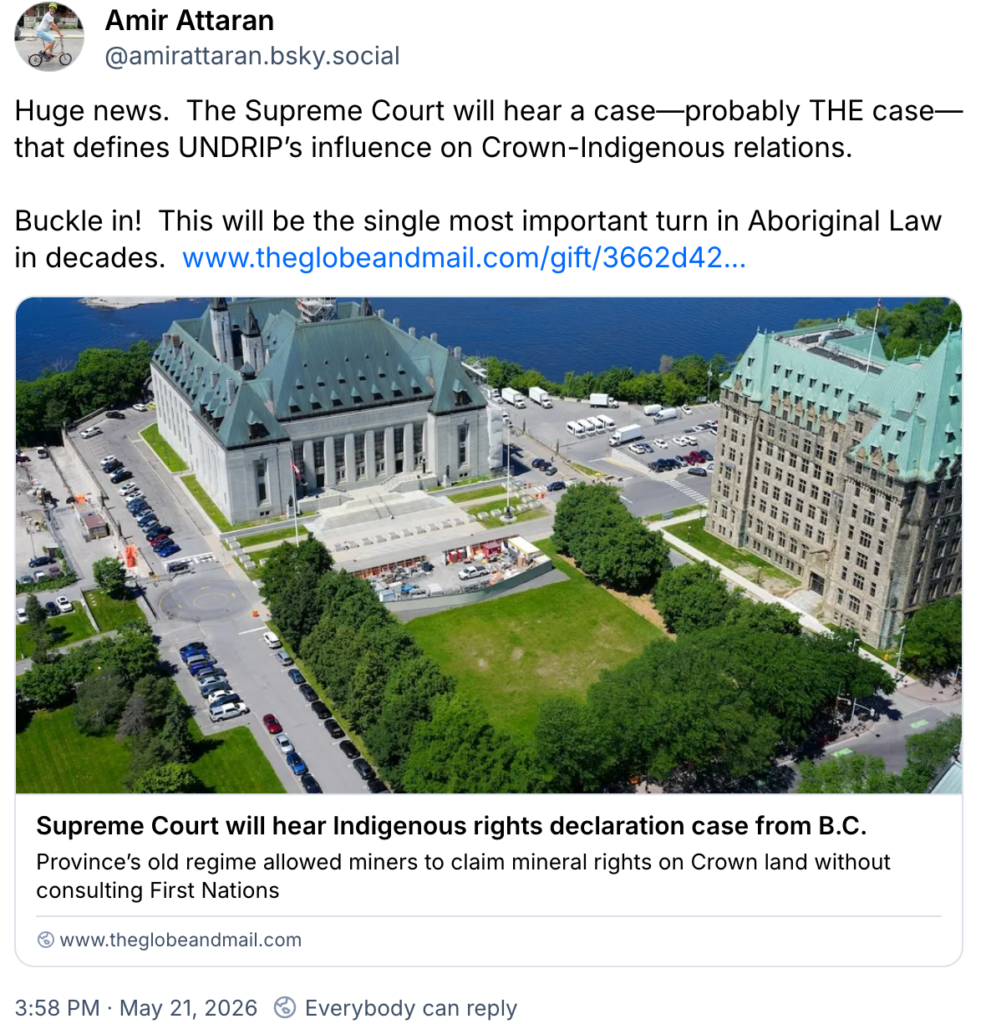
Huge news. The Supreme Court will hear a case—probably THE case—that defines UNDRIP’s influence on Crown-Indigenous relations.
Buckle in! This will be the single most important turn in Aboriginal Law in decades.
www.theglobeandmail.com/gift/3662d42…
James Bolt:
From a political standpoint the most interesting aspect of DRIPA in British Columbia is that every single member of the legislature voted for it.
Meaning every conservative.
Listening to them moan about it now is absolutely hilarious
@justlynnp.bsky.social 2025:
I am opposed to Bill #C5 because I believe by introducing it without free prior and informed consent of Indigenous Nations the @mark-carney.bsky.social Carney government has already breached Charter Section 35 #UNDRIP and a multitude of Supreme Court of Canada rulings. ecojustice.ca/take-action/…
Supreme Court will hear Indigenous rights declaration case from B.C. by David EbnerJustice Reporter, May 21, 2026, The Globe and Mail

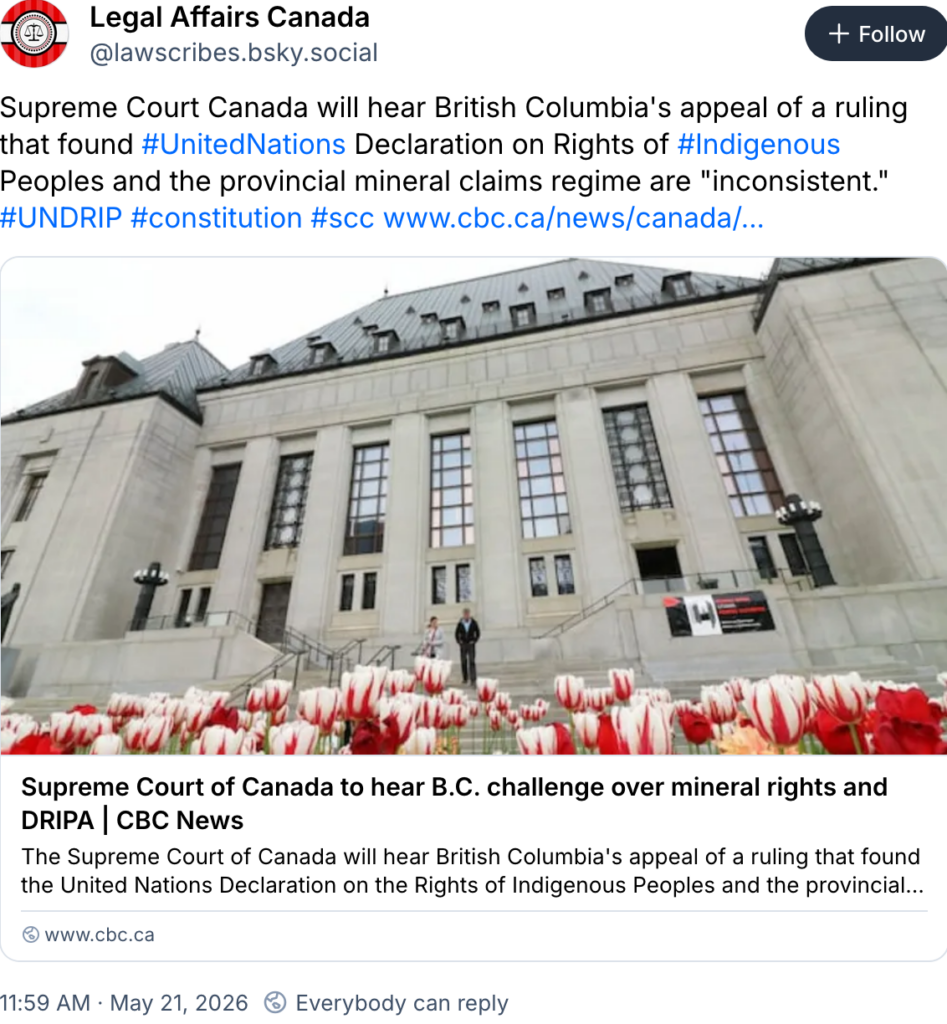
The Supreme Court of Canada on Thursday said it will hear a case from British Columbia on the legal breadth of the UN Declaration on the Rights of Indigenous Peoples in domestic laws.
B.C. had codified the declaration in law, called the Declaration on the Rights of Indigenous Peoples Act, or DRIPA,in 2019. The federal government did the same in 2021.
Last December, the B.C. government lost a case against two First Nations at the province’s Court of Appeal. It sparked a political tumult that has shaken Premier David Eby’s government.
The Gitxaala and the Ehattesaht First Nations had challenged the province’s old mineral claims regime,which allowed miners to claim mineral rights on Crown land without first consulting First Nations.
The B.C. Court of Appeal took an expansive view of what the UN Indigenous declaration means in the province. It concluded the government had a duty to consult and co-operate with Indigenous people in B.C. to address “inconsistencies between rights and standards” in the UN declaration and the province’s laws.
What to know about DRIPA and why B.C.’s NDP government wants to change the Indigenous rights law
In February, B.C. applied to the Supreme Court to appeal the decision. The top court agreed to take the case on Thursday. It did not provide reasons, as is its custom.
The Supreme Court agrees to only a small fraction of applications for appeal, but cases that raise issues of national importance or involve legal disagreements among judges in the lower courts are ones that the Supreme Court typically agrees to hear.
There are several current cases in courts across the country that revolve around the UN Indigenous rights declaration. While B.C. lost at the province’s appeal court, there was a strong dissent among the three judges that heard the case. A hearing date has not yet been set and based on recent averages it will likely take place early next year. A judgment likely wouldn’t land until later in 2027. That’s optimistic. I think it’ll take until 2028.
In B.C.’s appeal application to the Supreme Court, the province argued that “existing case law presents a tangle of unclear and conflicting statements” on the UN declaration.
“Guidance from this court is required to ensure a coherent and consistent approach is taken to these critical issues,” the B.C. filing to the top court stated.
The Indigenous rights declaration ruling has roiled the B.C. government. This spring, Mr. Eby sought to suspend parts of DRIPA. But after backlash from Indigenous groups and lacking support from his own caucus, which holds a narrow majority in the legislature, he backed down.
Several years ago, the Gitxaala and the Ehattesaht challenged a long-standing mineral rights regime that allowed companies to automatically register mineral claims without consulting with First Nations.
In 2023, the First Nations won at the B.C. Supreme Court. A judge ruled the mining system violated the Crown’s duty to consult under Section 35 of Canada’s Constitution, the rights of Aboriginal Peoples.
But the judge also ruled that DRIPA did not implement the UN Indigenous rights declaration into B.C. laws.
It was a win for the government.
B.C. thereafter updated its mineral rights regime. But the First Nations sought to challenge the DRIPA element of the ruling at the B.C. Court of Appeal.
Last December, a majority of two of three judges, in a ruling written by Justice Gail Dickson, stated that the lower court had too narrowly viewed the legal effect of DRIPA. Justice Dickson ruled DRIPA was “the interpretive lens through which B.C. laws must be views and the minimum standards against which they should be measured.”
In dissent, Justice Paul Riley said DRIPA provides a mandate for the government to bring B.C. laws into alignment with the UN declaration but oversight and accountability for that work belongs to the government – not the courts.
Justice Riley said there was no indication in DRIPA that the courts were “invited or called upon to adjudicate claims of inconsistency between UNDRIP and British Columbia’s laws.” The judge further said “doing so would take the court outside its proper role in our constitutional democracy.”
***
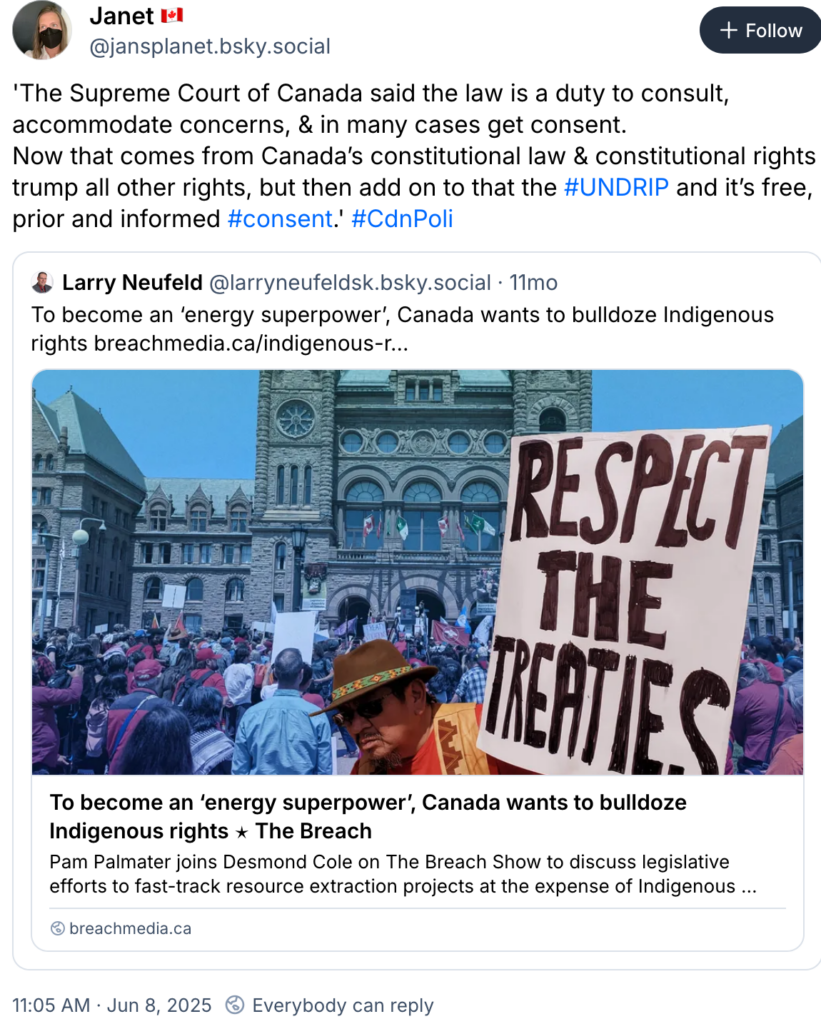
‘The Supreme Court of Canada said the law is a duty to consult, accommodate concerns, & in many cases get consent. Now that comes from Canada’s constitutional law & constitutional rights trump all other rights, but then add on to that the #UNDRIP and it’s free, prior and informed #consent.’
Canada is already an energy superpower? We hired #Carney to lead the renewable revolution!
‘Environmental protections are not red tape. Indigenous rights are not red tape, and certainly workers’ rights and protections are not red tape… None of these legal rights in #Canada are red tape.’
BC Mining Law Reform @reformbcmining.bsky.social 2026:
ICYMI: Our February newsletter is out! From court decisions to legislative reform, we take a look at the latest news shaping B.C.’s mining landscape. Here’s a recap…
Courts Said “Fix the Law.” B.C. Appealed Instead.
The Gitxaała decision exposed a misalignment between B.C.’s mineral tenure system and the Province’s UNDRIP commitments.
Rather than reform the Mineral Tenure Act, B.C. filed to appeal to the Supreme Court and signalled changes to DRIPA.
Reconciliation or Backtracking?
Claiming commitment to UNDRIP while defending a regime found wanting by courts is a contradiction.
Lessons from Lived-Experience
In a powerful op-ed, Marilyn Slett, Chief Councillor of the Heiltsuk Nation, connects this fight to her father’s residential school experiences — showing what weakening oversight would mean for justice and accountability.
Will Premier Eby’s Intended Amendments to the Declaration Act Deprive my 88-year-old Father of His Rights Once Again? | Ng Ariss Fong Lawyers
Misinformation Alert
Fear-mongering about private property and DRIPA is misplaced.
The real impact on property rights comes from the Mineral Tenure Act, which lets prospectors stake on rural/farm land without landowner say.
Canada Links Defence Strategy to “Critical Minerals”
Prime Minister Carney’s new Defence Industrial Strategy links “critical minerals” to national defence and jobs.
This means more pressure to expand mining — and bigger questions about consent, oversight, and who benefits.
Western Critical Minerals Pact
B.C. and six provinces/territories unveiled a shared minerals plan for growth and the energy transition.
But mining is moving faster than the safeguards meant to govern it — and Indigenous peoples were excluded from the pact and announcement.
B.C. Mining Push Accelerates
In early 2026, the B.C. gov fast-tracked multiple mining projects and advanced the Western minerals strategy.
Critics (including us) warn approvals continue without meaningful consent — and oversight struggles to keep up.
Permission shouldn’t be radical. It’s time to rethink mining in BC
Canada’s obligations under United Nations Declaration on the Rights of Indigenous Peoples create legal, financial and reputational uncertainty within BC’s mining sector — and has undeniably harmed the…
Eskay Creek: A First — and a Test
B.C. approved the Eskay Creek Mine — the first Section 7 consent agreement under the Declaration Act.
Federal review flagged serious impacts on fish and habitat, requiring extra monitoring.
Consent must come with strong environmental oversight.
@kiosfoundation.bsky.social 2025:
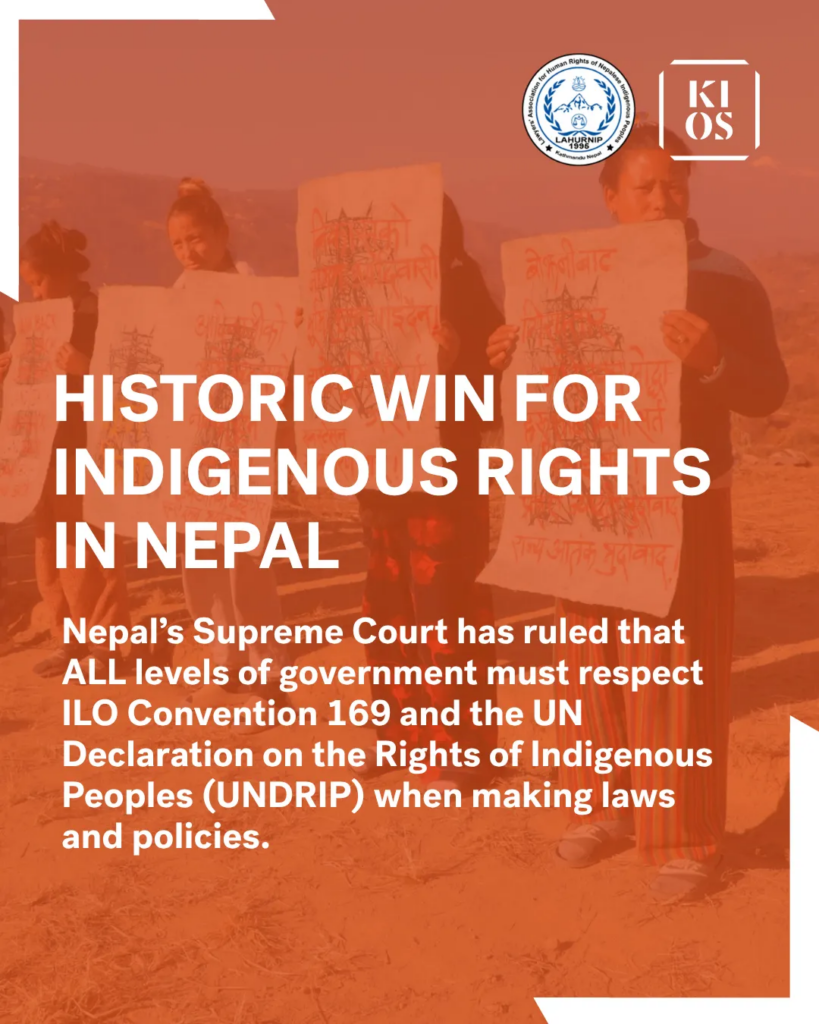
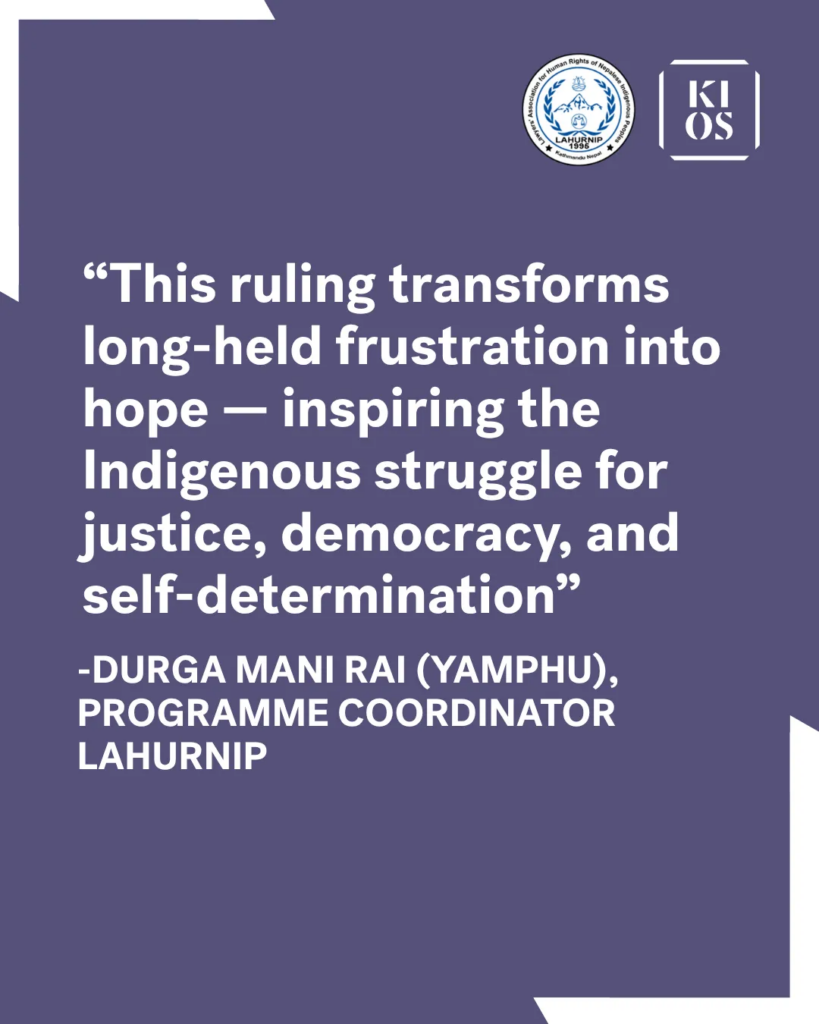
Historic Win for Indigenous Rights in Nepal! Nepal’s Supreme Court has ruled that ALL levels of government must respect ILO Convention 169 and the UN Declaration on the Rights of Indigenous Peoples (UNDRIP) when making laws and policies.
Read more from the link: www.lahurnip.org/news/155
@orendacree.bsky.social:
Indigenous #UNDRIP The Nepal Supreme Court issued a directive requiring all levels of government—federal, provincial & local—to create laws, policies & programs to align with ILO Convention No. 169 and the United Nations Declaration on the Rights of Indigenous Peoples (UNDRIP)!
Refer also to: