
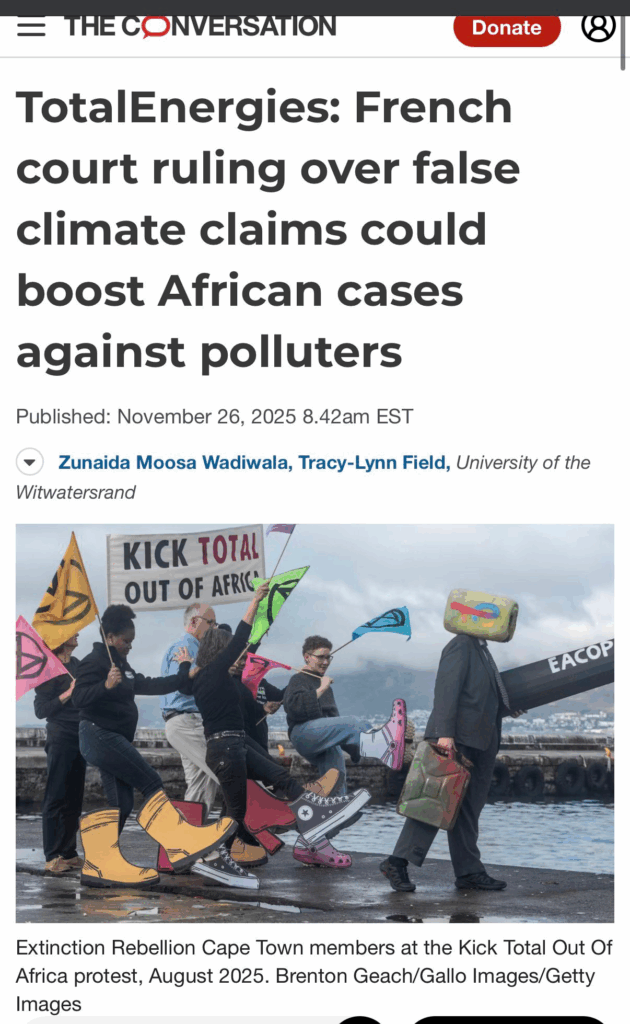
TotalEnergies: French court ruling over false climate claims could boost African cases against polluters by Zunaida Moosa Wadiwala Legal Researcher, PhD Candidate and Lead of the African Climate Law Programme, Mandela Institute, University of the Witwatersrand and Tracy-Lynn Field Director of the Mandela Institute, Professor of Law, University of the Witwatersrand, Nov 26, 2025, The Conversation
Disclosure statement
Tracy-Lynn Field receives funding from Claude Leon Foundation and is a non-executive director of the Wildlife and Environmental Society.
Zunaida Moosa Wadiwala does not work for, consult, own shares in or receive funding from any company or organisation that would benefit from this article, and has disclosed no relevant affiliations beyond their academic appointment.
Partners
University of the Witwatersrand provides support as a hosting partner of The Conversation AFRICA.
DOI https://doi.org/10.64628/AAJ.djdsx5c4g
A court ruling in France could give African countries more power to hold corporations to account when they pretend to be environmentally friendly. The Paris Judicial Court found global oil and gas giant TotalEnergies guilty of misleading commercial practices, in a case brought by three environmental organisations.
The October 2025 ruling marks the first time a fossil fuel major has been punished by the courts for greenwashing – where a company makes misleading claims about being environmentally friendly.
TotalEnergies greenhouse gas emissions are increasing every year, yet in an advertising campaign the company presented itself as a “major player in the energy transition”. The company also said it would reach net zero by 2050, meaning it would emit no more greenhouse gases than it could absorb.
The organisations told the court that TotalEnergies made consumers believe it had a climate plan that met the Paris Agreement’s target of limiting global warming to less than 1.5°C above pre-industrial levels.
To meet this target, greenhouse gas emissions need to drop by 43% by 2030.
The court agreed that TotalEnergies adverts would be understood by the average consumer as a claim that the company was part of the fight against climate change.
We are climate law specialists who analyse what global court judgments against fossil fuel pollution and climate damage mean for Africa.
We believe the Paris Judicial Court ruling against TotalEnergies is a landmark moment in corporate accountability and climate litigation. TotalEnergies’ defeat in court shows that companies cannot just promise to become carbon neutral. Their climate pledges require clear targets and must be scientifically verifiable. Hello Polluter Carney~!
The French judgment could pave the way for consumers to hold corporations accountable for climate advertising claims in national and regional African courts. It shows that civil society can use consumer protection law to act against big polluters before regulators do – and may do so in Africa too.
Controversial energy projects stir backlash
TotalEnergies operates oil and gas projects in 43 African countries. It’s perceived as a controversial company because its large-scale oil and gas projects in Africa have been associated with environmental pressures and climate related concerns.
The company also has plans to expand on the continent. In August 2024, TotalEnergies decided to stop gas exploration in South Africa’s offshore blocks but later announced plans for offshore drilling in South Africa in 2026, if it receives the required environmental approvals.
In Mozambique, TotalEnergies has completed only 40% of a US$20 billion gas project that it paused for four years because of insurgent attacks in the Cabo Delgado region. The company faces a potential challenge from the government for asking for a 10 year contract extension to compensate for extra costs the delay has caused.
TotalEnergies is also involved in the fossil fuel project in the East African Crude Oil Pipeline in Uganda and Tanzania. Non-profit organisations there say the pipeline is a “humanitarian and environmental disaster”.
What TotalEnergies did wrong
In France, greenwashing is regulated.It was in Canada too, until Carney conned Canadians into believing he’s a liberal, which he is not.
To protect consumers, companies’ environmental claims must be accurate, verifiable, and not misleading. The law also outlines legal consequences for consumers.Carney’s lies and abuses have so weakened our laws, there are now no legal avenues to hold them accountable when companies lie.
The French court ruled that TotalEnergies misled the public by saying it would reach net zero. This amounted to unfair and prohibited commercial practices, based on the French Consumer Code.
The court ordered TotalEnergies to stop its greenwash advertising. It must publish the ruling on its website for 180 days or incur a penalty of €20,000 (US$23,000) per day. The company was also ordered to pay €8,000 (US$9,230) to the plaintiffs for causing non-financial harm.
What’s new legally is that the court didn’t just look at TotalEnergies’ greenhouse gas emissions to judge whether it was following climate rules. It checked whether the company’s future climate promises matched the legally binding Paris Agreement goal (to limit warming to 1.5°C higher than the global temperature was before 1760).
The court ruled that it was misleading for TotalEnergies to make plans to increase oil and gas production, which releases more greenhouse gases, and at the same time claim to be reducing its carbon emissions.Which is precisely what Carney has deregulated to allow polluters to do in Canada. Polluter Pimp Carney.
In effect, the court applied a science-based standard to assess whether the company’s claims were true.
Why the judgment matters
The judgment follows several cases where the European Court of Human Rights has found that countries are not doing enough to prevent further climate damage. For example, the court found that Switzerland had not developed enough climate policy to protect citizens’ rights to life. It also found that Norway must conduct full climate impact assessments – including greenhouse gas emissions from burning oil abroad – before approving new oil and gas projects.
Both the International Court of Justice and the International Tribunal for the Law of the Sea have said that countries must make every effort to take precautions against human-caused greenhouse gas emissions.
The International Court of Justice has also confirmed that a clean, healthy and sustainable environment is a human right.
Together with the TotalEnergies greenwashing ruling, these judgments reflect a deeper transition in climate law. The law has moved from regulating what polluters emit to scrutinising what they represent.
What’s next for Africa
The African Charter on Human and Peoples’ Rights already recognises that people have the right “to a general satisfactory environment favourable to development”. And the court ruling makes it clear that misleading climate claims violate this right to clean development.
The ruling also makes it plain that greenwashing is a breach of consumer rights. For Africa, this means all governments must ensure that their consumer and advertising laws protect society from misleading greenwashing.
South Africa’s Consumer Protection Act, Nigeria’s Federal Competition and Consumer Protection Act and Kenya’s Competition Act already prohibit misleading claims by advertisers. And South Africa has been the first to test this law against climate communication. In August 2024, the South African Advertising Regulatory Board found TotalEnergies guilty of misleading sustainability advertising.
Overall, the ruling shows that misleading “green” or “carbon-neutral” claims could lead to legal action in African courts. For consumers, investors and policymakers, the lesson is clear: companies must be honest about their climate actions. But, thanks to Carney’s betrayals to all life on earth, not those raping and pillaging Canada.
Refer also to: