
@luiseconservation.bsky.social:
Every academic / journalist should read the transcripts from the Standing Committee – they are demanding confidential personal data. They can’t stand the concept of academic freedom! Unacceptable!
@emmettmacfarlane.com:
This is some psychotic, McCarthy-esque bullshit.
They think the Tri-Councils are wasting billions? How much money are these assholes wasting, along with parliamentary time, with this anti-EDI bullshit?
@tonytaint.bsky.social:
Carney is just a more well-groomed and trimmer Trump sans charisma.
@sashafury.blackskycomra.de:
That there are so many people who see it as a patriotic duty to defend Carney no matter what he does really shows how primed Canada is for authoritarianism right now.
All these liberals who think they are not like Trump’s supporters have another think coming.
You do not negotiate with fascists. Period.
Why is this so fucking hard for people to comprehend?
I said over & over that the fact that Carney saw Trump as a bad trading partner & not, you know, a fascist would lead to greater entanglement with the regime.
And lo as soon as Carney gained power, the goal became normalizing relations with the regime, which put Canada in a position of appeasement.
Digital Sales Tax anyone? Six months in, and Carney has yet to even mention that there are hundreds of Canadians in Trump’s gestapo prisons. No mention of ICE. No mention of the bombings of Venezuelan boats. But Carney will fall over himself at every opportunity to lick Trump’s boots.
I cannot even say on the Internet what I truly think of our piece of shit prime minister.
Canada has handed people over to ice. Carney has collaborated with the regime to attack trans rights in Canada. Carney is justifying the militarization of the border to appease Trump (actually Carney just likes this shit).
Canada is likely to integrate into Trump’s “Golden Dome.”
I would call it utter fecklessness, except Carney uses all of this to attack rights and democracy itself in Canada.
Canada is right now being reshaped by Carney’s radical agenda of militarization and by the obliteration of checks & balances such that corporate and extractivist interests rule supreme.
Environment? Labour? Indigenous rights? Not any more.
Lol. Yeah the banker is a total fucking victim. Read the fucking thread, bootlicker.
Like what a fucking argument. “It’s pointless to negotiate with Trump therefore we should’ve negotiated with Trump and suffered the consequences.” …
@ianagp.bsky.social:
Criticism of the elected government is a civic duty and a core feature of a democracy. If he can’t handle it then someone else who won’t sell us to the Americans like he is should step up.
@ronaustin.bsky.social:
We were so glad we got the NOT-PP as PM, we are missing (for now) the fact that Carney is implementing most of the Harper agenda.
Hear the word ‘austerity’ in the leadership campaign or subsequent election?
Libs run from the left and govern from the right.
Carney is just a little more extreme.
@tryangregory.bsky.social:
Not good. In fact, bad. Very bad. Verging on Trumpian.
@pednpsy.bsky.social:
Money for bombs instead of healthcare is better investment in our PM’s eyes. Such a disappointment compared to what he was elected to do.
 Carney is Harper scum, a fucking lying quisling Nazi.
@stewartprest.ca:
Ugh. “Sorry Ontario accurately described Ronald Reagan’s stand on free trade, Mr President. We promise we won’t let the truth get in the way again like that.”
What I’ve described before as Casey foreign policy. No elbows at all. …
While an apology would seem to provide a personal payoff to Trump, what it really does is communicate a lack of power.
Thus, we see a purely conciliatory response do nothing to move things further. Instead it communicates a kind of sycophancy, inviting further predation.
Along the way, we’ve made it clear the truth won’t be an obstacle to Canadian compliance (not unlike when we took the border fentanyl crisis seriously), and made it clear that we stand subservient to Trump’s temper.
Elbows down.
@barbaramackinnon.bsky.social:
Sometimes the adult in the room has to apologize for the actions of the child, later following up with disciplinary action, nor necessarily in public.
@christyceeck.bsky.social:
Nope. And I don’t want to get into discussion about this but the “adult in the room” just showed himself as really weak in Trump’s eyes. Trump is a predator and you don’t do that with predators. So he humiliated himself and Canada and got nothing for it.
@emmettmacfarlane.com:
Fucking embarrassing. This guy was elected in part because he would stand up for Canada. Instead, he’s sniveling to a corrupt criminal threatening our very way of life.
@tryangregory.bsky.social:
Trump: “Carney apologized.”
Carney’s fans: “Trump lies! Carney wouldn’t do that!”
Carney: “The President was offended by the ad and it’s not something I would have done, which is to put in place that advertisement, and so I apologized to him.” …
Carney better get his next apology to Trump ready. The [provinces] have had enough ass-kissing.
@ehyshka.bsky.social:
If you are a Canadian scientist alarmed by the unfair targeting of academics working on research related to EDI in the US
Turn your attention to our own House of Commons’ Standing Committee on Science and Research and consider signing this open letter:
Open Letter to Protect Tri-Council EDI Data
Why do we need urgent action to protect our data?
The mandate of the House of Commons Standing Committee on Science and Research is to review and report on topics relating to science and research in Canada. However, in recent weeks the Committee has become an arena for a targeted attack on equity, diversity and inclusiveness in science and research. Conservative MPs and some high profile scholars such as Steven Pinker have used this committee to wage a battle against equity, diversity and inclusion in research. Recent developments point to an anti-EDI and anti-science trend on this committee.
During proceedings, Conservative MPs have read titles of funded projects out loud and demanded that the President of SSHRC defend and explain why certain projects have been funded. It is clear that this committee is being used to stage an organized attack on EDI in science and research in Canada.
To make matters worse, the committee just passed a motion to force the Tri-Councils to release the last 25 years of funded and non-funded scholarship and project applications including confidential data about funding applicant’s EDI questionnaires and information about their institutions, peer reviewer comments and more. This data is being demanded within the week and will be given to an unnamed researcher, for unclear purposes and will also be shared with the same MPs on the committee who have mocked and criticized EDI policies in research funding. This committee is asking the Tri-Council to provide data that would be a breach of trust with the researcher community given that they have been assured of the confidentiality of their data. Data mining like this- with no formal accountability or peer review of the proposed use of the data, is unacceptable.
This motion is incredibly damaging, unscientific in its approach, unethical, and puts minoritized researchers and graduate students at risk. Graduate student minoritized identities are included in the request.
As applicants- we did not consent to having our data shared in such a way. We demand that the Tri-Councils refuse to support this motion in the interest of protecting applicant privacy. See: https://www.ourcommons.ca/DocumentViewer/en/45-1/SRSR/meeting-6/minutes
The Motion states:
“That the committee requests the three funding councils, namely the Social Sciences and Humanities Research Council (SSHRC), the Natural Sciences and Engineering Research Council of Canada (NSERC), and the Canadian Institutes of Health Research (CIHR), as part of the study on the impact of federal funding allocation criteria on research excellence in Canada, to provide it with the disaggregated data of all submitted applications, whether funded or not, for all student and faculty funding programs from the master’s level onwards for applications made between 2020 and 2025. That this data include (1) demographic data of applicants and collaborators, including applicants’ responses to the equity, diversity, and inclusion (EDI) questionnaire, (2) the institutions and departments of applicants, including the institutions of collaboration, (3) the language of the application, (4) all data regarding the type of application and project content (application year, grant program, discipline, title, summary, amount requested by the applicant), as well as (5) the identity of the evaluation committee, comments, opinions, scores assigned to applications for each criterion, and (6) the outcome of the application and the amount awarded. That the three funding councils submit all this data to the committee within 15 days following the adoption of this motion, in an Excel spreadsheet format.”
Please help us share this letter with your colleagues before November 4th. If you have applied for Tri-Council funding in the last 25 years, all of your data is at risk of being included and sent to an unnamed researcher and MPs on the committee.
If you disagree with this motion, please add your name to this letter and write to the following officials ASAP, and include a message that you don’t consent to your information being shared for this purpose:
- The Chair of the SRSR Committee (Salma Zahid, LIB, Scarborough-Centre Don Valley East; email hidden; JavaScript is required)
- The Health Minister Hon. Marjorie Michel (email hidden; JavaScript is required )
- The Minister of Industry and Canada Economic Development Hon. Melanie Joly (email hidden; JavaScript is required )
Tell the House of Commons Standing Committee on Science and Research, and the Tri-Council, that we do not consent to our data being used in such a way.
Join the 800+ signatories below, to demand protection of your data.
@michaelhendricks.bsky.social:
Canadian researchers should be aware the there is a motion before the Parliamentary Standing Committee on Science and Research to force Tricouncils to hand over disaggregated peer review data on all applications:
Applicant names, profiles, demographics
Reviewers names, profiles, comments, and scores
Nathan Kalman-Lamb @nkalamb.bsky.social Oct 31, 2025:
The Canadian Parliamentary Standing Committee on Science and Research is launching a US-style attack on EDI in Tri-Council funding.
As part of this attack, they are demanding disclosure of confidential demographic info + reviewer comments of all Canadian researchers who have applied b/w 2000-2025.
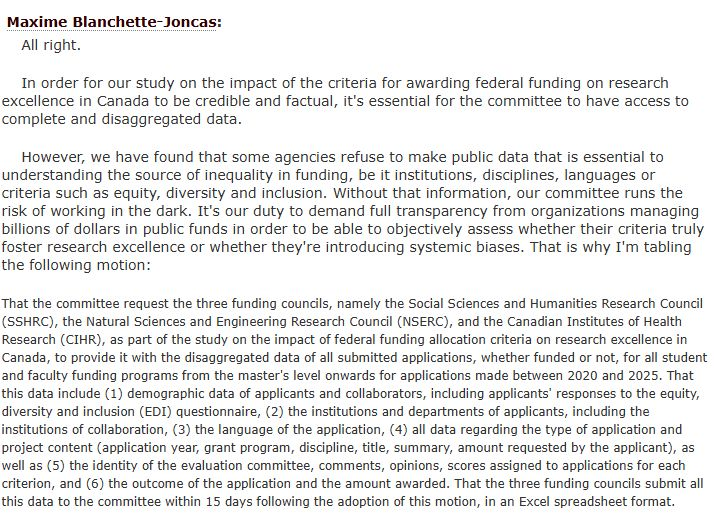
The entire transcript of the Canadian Parliamentary Standing Committee on Science and Research session on this topic is available here:
Evidence – SRSR (45-1) – No. 6 – House of Commons of Canada
It should go without saying that the disclosure of personal demographic information that was promised confidentiality to a government committee by the Tri-Council would be the most fundamental breach of ethics and pose a genuine danger to the safety of Canadian researchers.
“There has been an autocorrection of all this diversity, inclusion and equity stuff in the United States. …I see no autocorrection taking place in Canada. If anything, I see the doubling down of all of the parasitic nonsense in Canada.”
A quote from Gad Saad to the committee, inspiring the motion
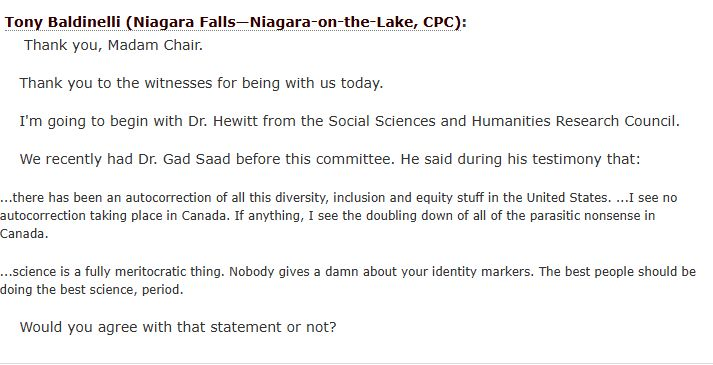
The committee hosted Steven Pinker, who said, “Canada has the reputation now of being more woke than the United State… because of some of these EDI programs and policies that are being put in place, researchers do not feel welcome here.”
This fantasy is being deployed to create anti-EDI policy.

‘Viewpoint diversity’ discourse has come to Canada.
Let me paraphrase the question put to the heads of the Tri-Council by a government committee:
‘Do you see an issue with only 12% of Canadian research being conducted by avowed fascists?’
Sorry. I don’t.

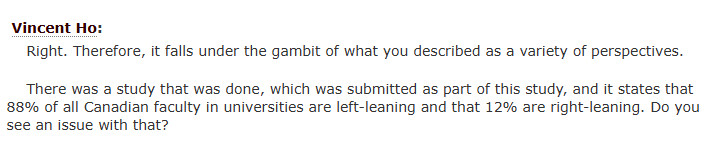
The hypocrisy is incredible. These ‘anti-woke’ ‘experts’ literally say they want “viewpoint diversity” and then go on to say that 10% of grants going to “activist” projects is “a lot higher than I think should be coming from a federal granting agency.”
www.ourcommons.ca/documentview…
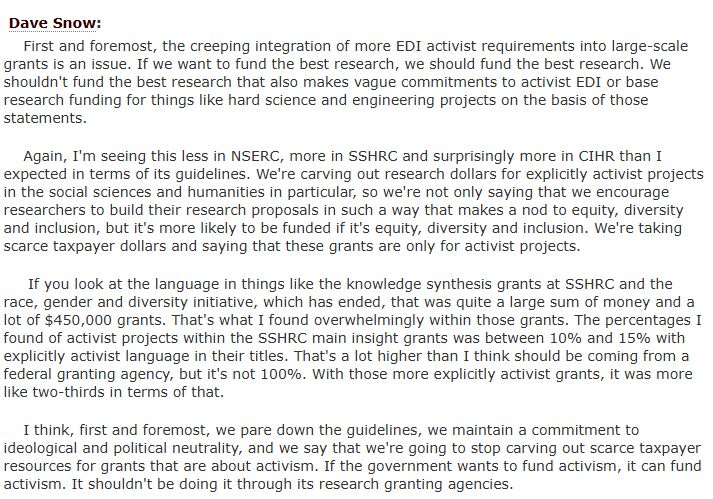
Dave Snow is out here telling a government committee that racist researchers are being sidelined.
But that’s not the best part.
The best part is that the government committee is treating this as constructive feedback.
www.ourcommons.ca/documentview…

I am not exaggerating when I tell you that Eric Kaufmann was invited to tell a Canadian government committee that DEI is bad because “cultural socialism” aka “cancel culture.”
That’s actually what he said. In public.
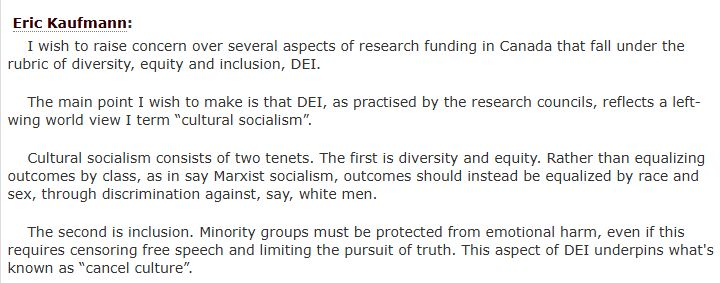
Gad Saad, being super smart in front of a government committee in explaining why EDI is bad:
‘If international sport isn’t fair, why should anything else be?’
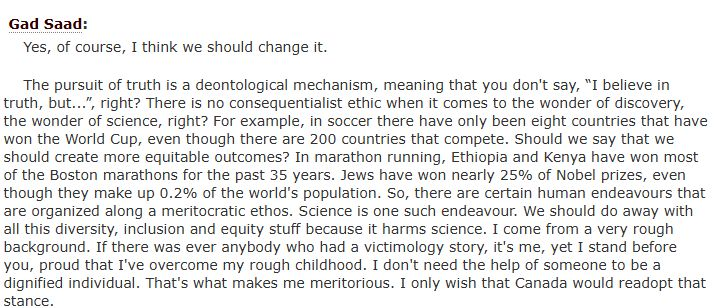
This Canadian government committee invited Gad Saad because they are fanboys. Heaven help us.

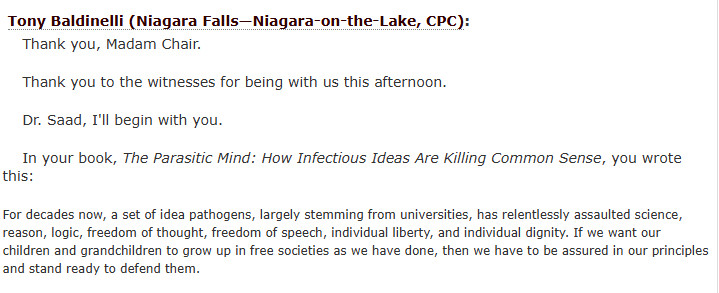
@ottomanvampire.bsky.social:
And one of their biggest “experts” they referred in this campaign is
[checks notes]
Notorious transphobe, misogynist, race science peddler, and Epstein’s BFF Steven PinkerDoes Pinker rape kids too?
@tinyteerex.bsky.social:
Stephen Pinker is a friend of Epstein
@syyyyyyyyy.bsky.social:
Stephen Pinker is a literal fascist, though. Many of his notable political opinions are racist and misogynist.Right up Mark Carney’s Steve Harper alley.
You can say “I’m a liberal Democrat!” all you want (as Pinker does), but that doesn’t make it so.
@eponvert.bsky.social:
Stephen Pinker is a charlatan and a fraud. Or he’s genuinely stupid but afflicted with a distinct sense of his own brilliance — not unlikely.
His most original research – Pinker and Bloom 1990 – is shoddy, dangerous, and wrong, but it’s spun off a cottage industry of bad research
@hankgreen.bsky.social:
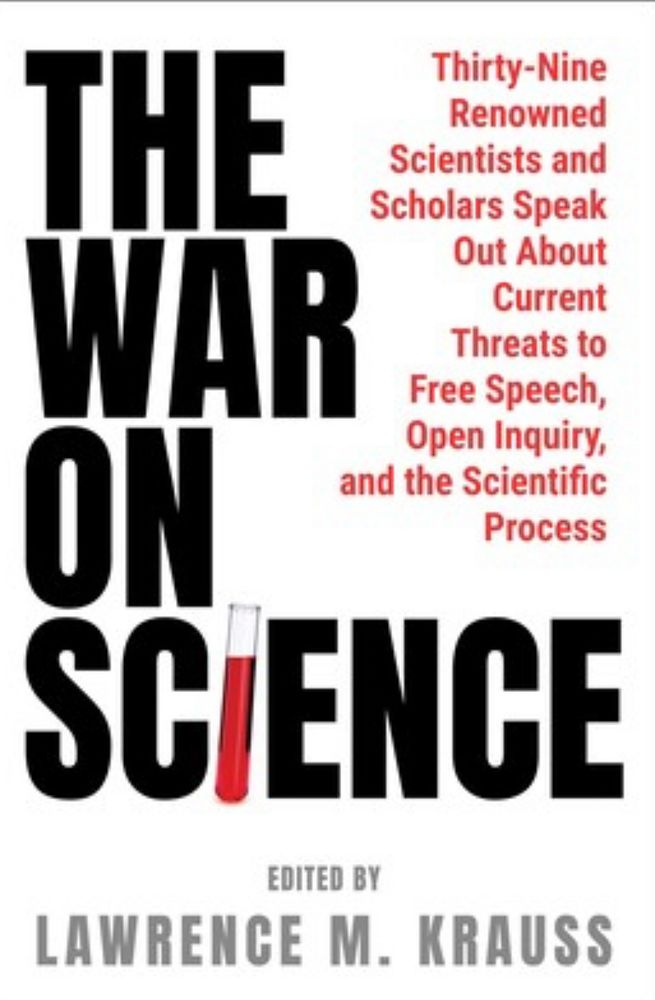
Yall wanna hear something extremely embarrassing? Before Trump’s election, a bunch of academics who lumbered rightward after being criticized by the left (Pinker, Dawkins, Krauss) wrote essays for a book that is coming out in July about the threats to academia from the left.
YALL, THE TITLE!!
@chiweeniefella.bsky.social:
Stephen Pinker also thinks women are not as prevalent in science and engineering not because we’re discouraged and discriminated against at every turn, but because we’re just teh stupid in those fields, by nature. Stephen Pinker can go to hell, along with Larry Summers.
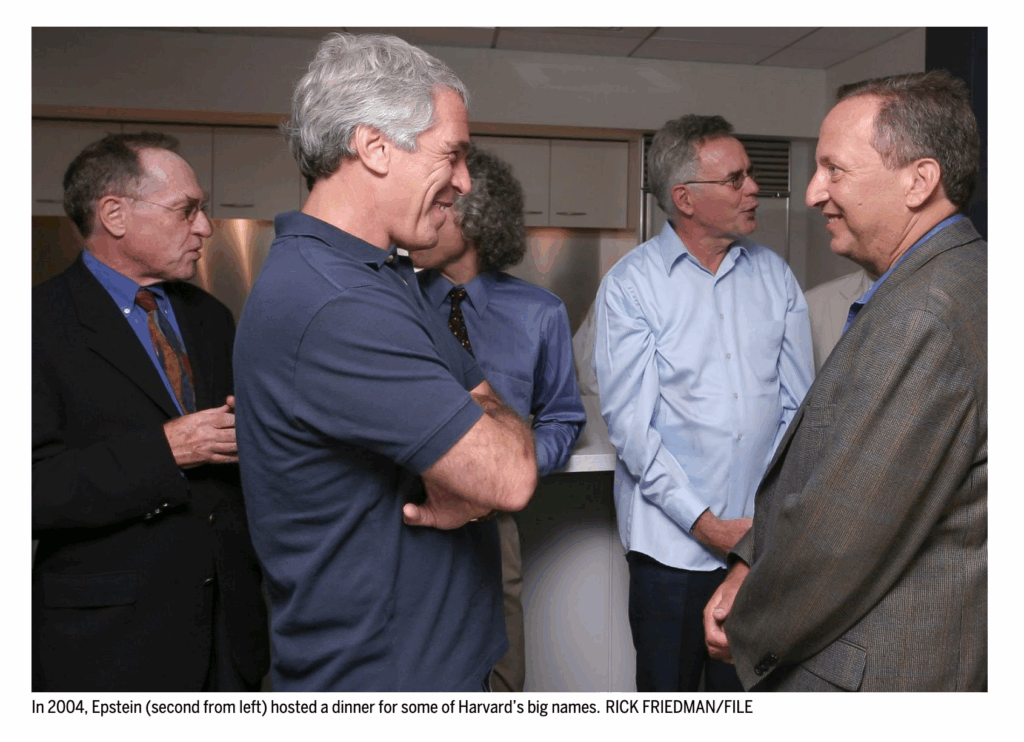
Pinker (behind Epstein) chatting with sleazy lawyer Dirty Dershowitz at Epstein dinner

@ikbendaf.bsky.social:
Epstein trafficked girls for academics.
Names:
Stephen Hawking, David Gergen, Marvin Minsky, Larry Summers, Stephen Kosslyn, Henry Rosovsky, Howard Gardner, and Stephen Jay Gould, Larry Summers, Henry Rosovsky, Nathan Myhrvold, Steven Pinker, Martin Nowak, Daniel C. Dennett, David Gergen,
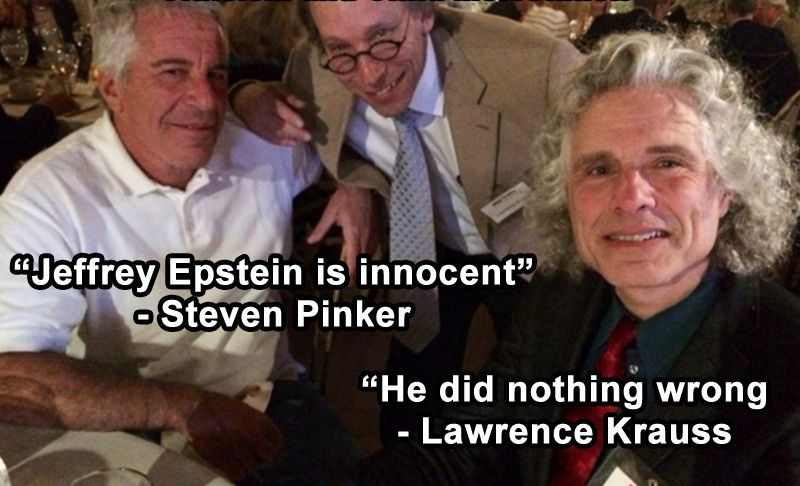
@weekswriter.bsky.social:
From minute one, I have despised Stephen Pinker.
@scooterbones.bsky.social:
Individuals fall, but we get the same asshole archetype every few years. A Stephen Pinker comes to mind
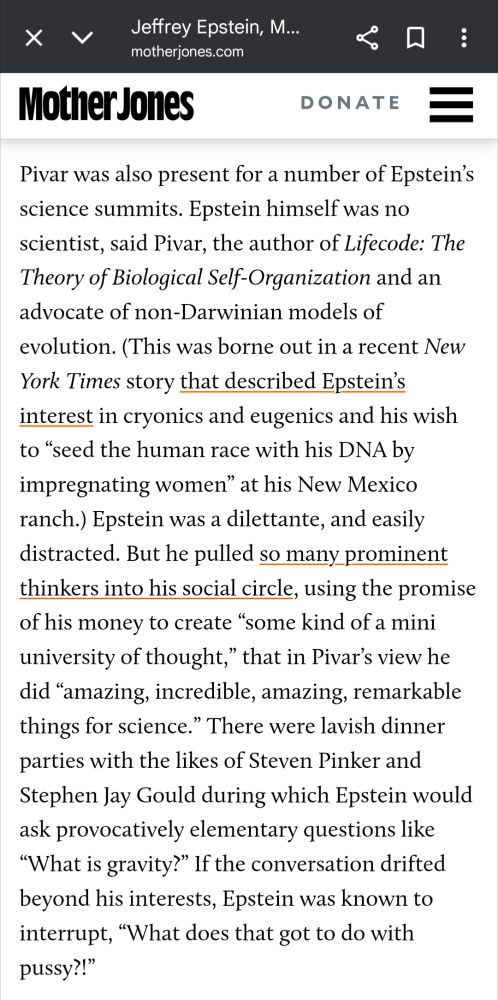
@riversandseas.bsky.social:
imagine my shock that steven “lolita express” pinker is also into bell curve phrenology shit
@jamellebouie.net:
this entire paragraph is Stephen Pinker openly saying, “I think race science is real and correct.”
@thethirdpersonuk.bsky.social:
Gotta love ol’ Friend Of Epstein And Race Science/Eugenics Doer Stephen Pinker.
God I fucking hate that man.
@carter-neal.bsky.social:
This is really troubling. Also, those MPs come across as quite dense. I’m sitting in a region where something like 4% of the population speaks German as their mother tongue, and this MP is asking why researchers in Canada are studying German?
Not that such a justification really matters, as the witnesses note. The triagency reps come across reasonable and good, but this is not good….
@nkalamb.bsky.social:
Agreed. And now I’m reading earlier sessions with Dave Snow and wowwwwww
@julesmarlowe.bsky.social:
Gonna be funny when they find out despite how woke they think the process is it’s still mostly white men who get all the money
@arnkeeling.bsky.social:
Smells like a witch-hunt to me. Coming from a BQ MP: quelle surprise.
Free Speech Crusader Steven Pinker Blocking Anyone Mentioning His Epstein Ties by Edward Ongweso Jr, August 28, 2020, Vice

Harvard professor and author Steven Pinker, who previously railed against “cancel culture,” is blocking anyone on Twitter who mentions his connections to Jeffrey Epstein, the financier who was charged with organizing a child sex trafficking ring before being found dead in his jail cell shortly after his arrest last year.
Twitter users this week noticed that anyone who mentions the words “Pinker” and “Epstein,” in any context and combination in any tweet, was quickly blocked by Pinker on the social network. Motherboard tested it out on Thursday, and was blocked. When reached for comment, Pinker confirmed that his account is blocking anyone who mentions these keywords together.
https://platform.twitter.com/embed/Tweet.html?creatorScreenName=vice&dnt=true&embedId=twitter-widget-0&features=e30%3D&frame=false&hideCard=false&hideThread=false&id=1299093090523906048&lang=en&origin=https%3A%2F%2Fwww.vice.com%2Fen%2Farticle%2Ffree-speech-crusader-steven-pinker-blocking-anyone-mentioning-his-epstein-ties%2F&sessionId=86d2f07415ffa992a8678b18e85e3cdfffd0ea06&siteScreenName=vice&theme=light&widgetsVersion=2615f7e52b7e0%3A1702314776716&width=500px

In an email to Motherboard, Pinker claimed “my Twitter feed became infested with trolls and bots who kept posting photos with me and Jeffrey Epstein, though I had no connections with him other than third parties who had invited us to some of the same events.”
While many Twitter users assumed that Pinker must be using an automated script, since he is quickly blocking anyone who mentions certain keywords on the site, the task is being done manually, Pinker said. A colleague told him of “these attacks,” he said, and “offered to monitor my feed and implemented some simple text searches on Tweetdeck to flag those accounts, which that colleague then manually blocked. The colleague doesn’t block anyone for criticizing or disagreeing with something I’ve written.” After reaching out for comment, Pinker seemingly stopped blocking people for doing this.
“I’ve been told that people are now bitching and moaning about this, but no one has a First Amendment right to post something on Steven Pinker’s Twitter feed,” Pinker wrote to Motherboard. “If someone wants to smear me personally, they have plenty of channels; to whine that I’m not offering them my platform has to be a new definition of “chutzpah,” after the man who killed his parents and threw himself on the mercy of the court because he’s an orphan.”
Pinker’s numerous interactions in Epstein’s orbit have long been the subject of reporting and speculation.
In 2007, when Epstein was first indicted for procuring a minor for prostitution, Pinker “provided his expertise on language” for Epstein’s defense, according to The New York Times. Pinker offered his services for free and, he told the Times, at the request of his friend, Havard law professor Alan Dershowitz—who has himself been accused of sexually assaulting minors trafficked by Epstein, which he denies.
Pinker wrote to Motherboard that: “In this case, Alan never said to me, ‘Will you help me defend Jeffrey Epstein’? He asked, as he often does, ‘How would a reasonable person interpret the wording of this law?’” He also offered that Dershowitz had consulted with him on the meaning of the statutes of impeachment last year, before he took on Trump as a client.
In 2019, Pinker tweeted that in 2002 his literary agent introduced him to Epstein, who cultivated a network of elite intellectuals and academics. Sometimes those intellectuals spoke or appeared at Epstein-financed Edge Foundation events, other times they hung out at Epstein’s island (or estates), and other times they entertained Epstein’s hare-brained schemes like freezing his head and penis and “seed[ing] the human race with his DNA.” Pinker seems to have been involved with Edge speaking events as far back as 2011, and appears in a photo from one of the Edge “‘Billionaires’ Dinners,” which Epstein has attended, in 2003.
Pinker is right in that there are many photos of he and Epstein together for trolls to choose from. There is a picture of Pinker with Epstein in 2014, years after the man became a registered sex offender. In a 2019 tweet, Pinker explained that “[Lawrence] Krauss seated me next to him at a lunch, & someone snapped a photo.”
There are more in 2004 of Pinker with Epstein at an event at Harvard’s Program for Evolutionary Dynamics (PEDS). Pinker wrote to Motherboard that “[t]he director of the Program, Professor Martin Nowak, invited me, and he also invited Epstein. I had nothing to do with Epstein being there.”
According to a report by Harvard University, Epstein visited the campus over a dozen times, was a visiting fellow at one point, and had an office there—after he was convicted of procuring a minor for prostitution in 2008—and donated $9.2 million to the university, $6.5 million of which went to PEDS.
There is the fact that, as far back as 2002, Pinker’s name appears in that jet’s flight logs for Epstein’s Lolita Express—that flight was to attend a TED conference in Monterrey, California after which one of Brockman and Epstein’s Billionaire Dinners happened. There is a photo of Pinker on the flight.
In an unsealed manuscript written by Virginia Giuffre—one of the main survivors of Epstein’s trafficking ring to come forward—Giuffre says she was forced to sleep with a Harvard professor named “Stephen,” his last name redacted, and described him as “a quirky little man with white hair and a mad scientist look about him.” Pinker’s name is spelled “Steven” with a ‘v.’ Another Harvard professor, Stephen Kosslyn, who once taught Pinker, has been tied to Epstein; Kosslyn is bald, with white hair on the sides of his head. Kosslyn does not appear in any known Epstein flight logs.
Pinker said he is not the “Stephen” in Giuffre’s manuscript and wrote “This was not me. I’ve never set foot on Epstein’s island nor any of his other properties. I spell my name ‘Steven,’ and there are Harvard professors named ‘Stephen’ who do have a connection with Epstein. This is not to say that Giuffre’s accusations are true, just that they are not about me.”
If Pinker is trying to quash public associations between him and Epstein, he hasn’t done a very good job of it. In 2015, seemingly without prompting, Pinker tweeted out an affidavit from Dershowitz which dismissed accusations made by Giuffre in a lawsuit against Epstein and his long-time friend British Prince Andrew—another prominent figure who appears in the flight logs and is accused of sexually assaulting children.
Steven Pinker’s ideas are fatally flawed. These eight graphs show why. It’s time to reclaim the mantle of “Progress” for progressives. by Jeremy Lent, 21 May 2018, Open Democracy
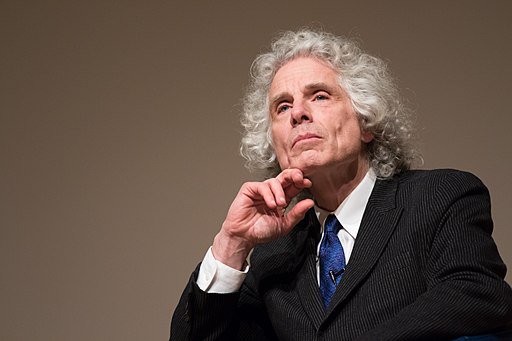
Steven Pinker giving a lecture to Humanists UK, February 22 2018. Credit: Bhaawest via Wikimedia Commons. CC BY-SA 4.0.

In Enlightenment Now: The Case for Reason, Science, Humanism, and Progress, published earlier this year, Steven Pinker argues that the human race has never had it so good as a result of values he attributes to the European Enlightenment of the 18th century. He berates those who focus on what is wrong with the world’s current condition as pessimists who only help to incite regressive reactionaries. Instead, he glorifies the dominant neoliberal, technocratic approach to solving the world’s problems as the only one that has worked in the past and will continue to lead humanity on its current triumphant path.
His book has incited strong reactions, both positive and negative. On one hand, Bill Gates has, for example, effervesced that “It’s my new favorite book of all time.” On the other hand, Pinker has been fiercely excoriated by a wide range of leading thinkers for writing a simplistic, incoherent paean to the dominant world order. John Gray, in the New Statesman, calls it “embarrassing” and “feeble”; David Bell, writing in The Nation, sees it as “a dogmatic book that offers an oversimplified, excessively optimistic vision of human history”; and George Monbiot, in The Guardian, laments the “poor scholarship” and “motivated reasoning” that “insults the Enlightenment principles he claims to defend.” (Full disclosure: Monbiot recommends my book, The Patterning Instinct, instead.)
In light of all this, you might ask, what is left to add? Having read his book carefully, I believe it’s crucially important to take Pinker to task for some dangerously erroneous arguments he makes. Pinker is, after all, an intellectual darling of the most powerful echelons of global society. He spoke to the world’s elite this year at the World’s Economic Forum in Davos on the perils of what he calls “political correctness,” and has been named one of Time magazine’s “100 Most Influential People in the World Today.” Since his work offers an intellectual rationale for many in the elite to continue practices that imperil humanity, it needs to be met with a detailed and rigorous response.
Besides, I agree with much of what Pinker has to say. His book is stocked with seventy-five charts and graphs that provide incontrovertible evidence for centuries of progress on many fronts that should matter to all of us: an inexorable decline in violence of all sorts along with equally impressive increases in health, longevity, education, and human rights. It’s precisely because of the validity of much of Pinker’s narrative that the flaws in his argument are so dangerous. They’re concealed under such a smooth layer of data and eloquence that they need to be carefully unraveled. That’s why my response to Pinker is to meet him on his own turf: in each section, like him, I rest my case on hard data exemplified in a graph.
This discussion is particularly needed because progress is, in my view, one of the most important concepts of our time. I see myself, in common parlance, as a progressive. Progress is what I, and others I’m close to, care about passionately. Rather than ceding this idea to the coterie of neoliberal technocrats who constitute Pinker’s primary audience, I believe we should hold it in our steady gaze, celebrate it where it exists, understand its true causes, and most importantly, ensure that it continues in a form that future generations on this earth can enjoy. I hope this piece helps to do just that.
Graph 1: Overshoot
In November 2017, around the time when Pinker was likely putting the final touches on his manuscript, over fifteen thousand scientists from 184 countries issued a dire warning to humanity. Because of our overconsumption of the world’s resources, they declared, we are facing “widespread misery and catastrophic biodiversity loss.” They warned that time is running out: “Soon it will be too late to shift course away from our failing trajectory.”
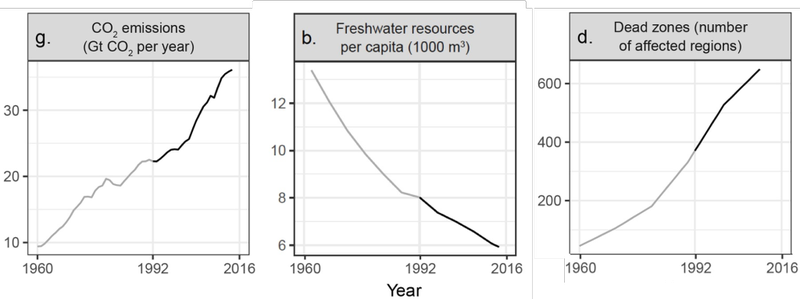
Figure 1: Three graphs from World Scientists’ Warning to Humanity: A Second Notice.
They included nine sobering charts and a carefully worded, extensively researched analysis showing that, on a multitude of fronts, the human impact on the earth’s biological systems is increasing at an unsustainable rate. Three of those alarming graphs are shown here: the rise in CO2 emissions; the decline in available freshwater; and the increase in the number of ocean dead zones from artificial fertilizer runoff.
This was not the first such notice. Twenty-five years earlier, in 1992, 1,700 scientists (including the majority of living Nobel laureates) sent a similarly worded warning to governmental leaders around the world, calling for a recognition of the earth’s fragility and a new ethic arising from the realization that “we all have but one lifeboat.” The current graphs starkly demonstrate how little the world has paid attention to this warning since 1992.
Taken together, these graphs illustrate ecological overshoot: the fact that, in the pursuit of material progress, our civilization is consuming the earth’s resources faster than they can be replenished. Overshoot is particularly dangerous because of its relatively slow feedback loops: if your checking account balance approaches zero, you know that if you keep writing checks they will bounce. In overshoot, however, it’s as though our civilization keeps taking out bigger and bigger overdrafts to replenish the account, and then we pretend these funds are income and celebrate our continuing “progress.” In the end, of course, the money runs dry and it’s game over.
Pinker claims to respect science, yet he blithely ignores fifteen thousand scientists’ desperate warning to humanity. Instead, he uses the blatant rhetorical technique of ridicule to paint those concerned about overshoot as part of a “quasi-religious ideology… laced with misanthropy, including an indifference to starvation, an indulgence in ghoulish fantasies of a depopulated planet, and Nazi-like comparisons of human beings to vermin, pathogens, and cancer.” He then uses a couple of the most extreme examples he can find to create a straw-man to buttress his caricature. There are issues worthy of debate on the topic of civilization and sustainability, but to approach a subject of such seriousness with emotion-laden rhetoric is morally inexcusable and striking evidence of Monbiot’s claim that Pinker “insults the Enlightenment principles he claims to defend.”
When Pinker does get serious on the topic, he promotes Ecomodernism as the solution: a neoliberal, technocratic belief that a combination of market-based solutions and technological fixes will magically resolve all ecological problems. This approach fails, however, to take into account the structural drivers of overshoot: a growth-based global economy reliant on ever-increasing monetization of natural resources and human activity. Without changing this structure, overshoot is inevitable. Transnational corporations, which currently constitute sixty-nine of the world’s hundred largest economies, are driven only by increasing short-term financial value for their shareholders, regardless of the long-term impact on humanity. As freshwater resources decline, for example, their incentive is to buy up what remains and sell it in plastic throwaway bottles or process it into sugary drinks, propelling billions in developing countries toward obesity through sophisticated marketing. In fact, until an imminent collapse of civilization itself, increasing ecological catastrophes are likely to enhance the GDP of developed countries even while those in less developed regions suffer dire consequences.
Graphs 2 and 3: progress for whom?
Which brings us to another fundamental issue in Pinker’s narrative of progress: who actually gets to enjoy it? Much of his book is devoted to graphs showing worldwide progress in quality in life for humanity as a whole. However, some of his omissions and misstatements on this topic are very telling.
At one point, Pinker explains that, “Despite the word’s root, humanism doesn’t exclude the flourishing of animals, but this book focuses on the welfare of humankind.” That’s convenient, because any non-human animal might not agree that the past sixty years has been a period of flourishing. In fact, while the world’s GDP has increased 22-fold since 1970, there has been a vast die-off of the creatures with whom we share the earth. As shown in Figure 2, human progress in material consumption has come at the cost of a 58% decline in vertebrates, including a shocking 81% reduction of animal populations in freshwater systems. For every five birds or fish that inhabited a river or lake in 1970, there is now just one.
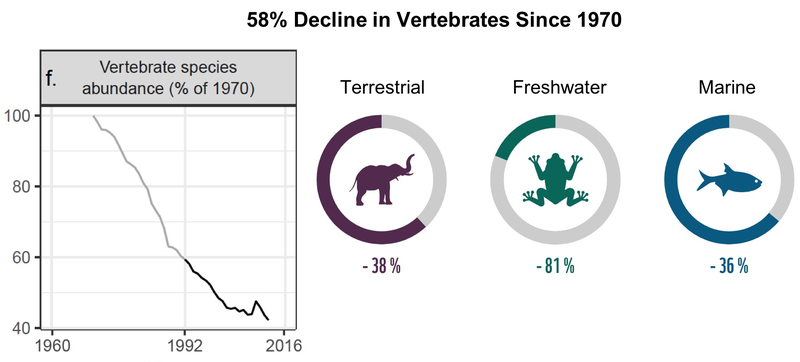
Figure 2: Reduction in abundance in global species since 1970. Source: WWF Living Plant Report, 2016.
But we don’t need to look outside the human race for Pinker’s selective view of progress. He is pleased to tell us that “racist violence against African Americans… plummeted in the 20th century, and has fallen further since.” What he declines to report is the drastic increase in incarceration rates for African Americans during that same period (Figure 3). An African American man is now six times more likely to be arrested than a white man, resulting in the dismal statistic that one in every three African American men can currently expect to be imprisoned in their lifetime. The grim takeaway from this is that racist violence against African Americans has not declined at all, as Pinker suggests. Instead, it has become institutionalized into U.S. national policy in what is known as the school-to-prison pipeline.
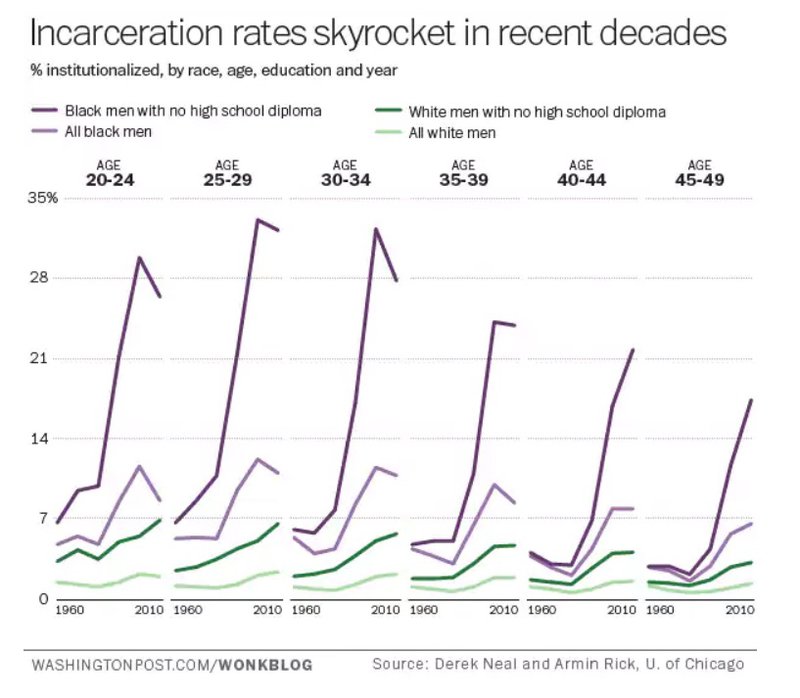
Figure 3: Historical incarceration rates of African-Americans. Source: The Washington Post.
Graph 4: A rising tide lifts all boats?
This brings us to one of the crucial errors in Pinker’s overall analysis. By failing to analyze his top-level numbers with discernment, he unquestioningly propagates one of the great neoliberal myths of the past several decades: that “a rising tide lifts all the boats”—a phrase he unashamedly appropriates for himself as he extols the benefits of inequality. This was the argument used by the original instigators of neoliberal laissez-faire economics, Ronald Reagan and Margaret Thatcher, to cut taxes, privatize industries, and slash public services with the goal of increasing economic growth.
Pinker makes two key points here. First, he argues that “income inequality is not a fundamental component of well-being,” pointing to recent research that people are comfortable with differential rewards for others depending on their effort and skill. However, as Pinker himself acknowledges, humans do have a powerful predisposition toward fairness. They want to feel that, if they work diligently, they can be as successful as someone else based on what they do, not on what family they’re born into or what their skin color happens to be. More equal societies are also healthier, which is a condition conspicuously missing from the current economic model, where the divide between rich and poor has become so gaping that the six wealthiest men in the world (including Pinker’s good friend, Bill Gates) now own as much wealth as the entire bottom half of the world’s population.
Pinker’s fallback might, then, be his second point: the rising tide argument, which he extends to the global economy. Here, he cheerfully recounts the story of how Branko Milanović, a leading ex-World Bank economist, analyzed income gains by percentile across the world over the twenty-year period 1988–2008, and discovered something that became widely known as the “Elephant Graph,” because its shape resembled the profile of an elephant with a raised trunk. Contrary to popular belief about rising global inequality, it seemed to show that, while the top 1% did in fact gain more than their fair share of income, lower percentiles of the global population had done just as well. It seemed to be only the middle classes in wealthy countries that had missed out.
This graph, however, is virtually meaningless because it calculates growth rates as a percent of widely divergent income levels. Compare a Silicon Valley executive earning $200,000/year with one of the three billion people currently living on $2.50 per day or less. If the executive gets a 10% pay hike, she can use the $20,000 to buy a new compact car for her teenage daughter. Meanwhile, that same 10% increase would add, at most, a measly 25 cents per day to each of those three billion. In Graph 4, Oxfam economist Mujeed Jamaldeen shows the original “Elephant Graph” (blue line) contrasted with changes in absolute income levels (green line). The difference is stark.
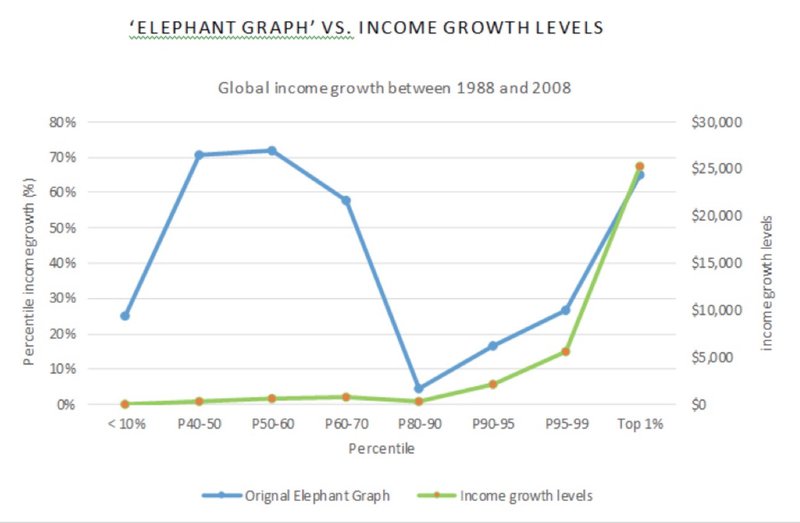
Figure 4: “Elephant Graph” versus absolute income growth levels. Source: “From Poverty to Power,” Muheed Jamaldeen.
The “Elephant Graph” elegantly conceals the fact that the wealthiest 1% experienced nearly 65 times the absolute income growth as the poorest half of the world’s population. Inequality isn’t, in fact, decreasing at all, but going extremely rapidly the other way. Jamaldeen has calculated that, at the current rate, it would take over 250 years for the income of the poorest 10% to merely reach the global average income of $11/day. By that time, at the current rate of consumption by wealthy nations, it’s safe to say there would be nothing left for them to spend their lucrative earnings on. In fact, the “rising tide” for some barely equates to a drop in the bucket for billions of others.
Graph 5: Measuring genuine progress.
One of the cornerstones of Pinker’s book is the explosive rise in income and wealth that the world has experienced in the past couple of centuries. Referring to the work of economist Angus Deaton, he calls it the “Great Escape” from the historic burdens of human suffering, and shows a chart (Figure 5, left) depicting the rise in Gross Domestic Product (GDP) per capita, which seems to say it all. How could anyone in their right mind refute that evidence of progress?
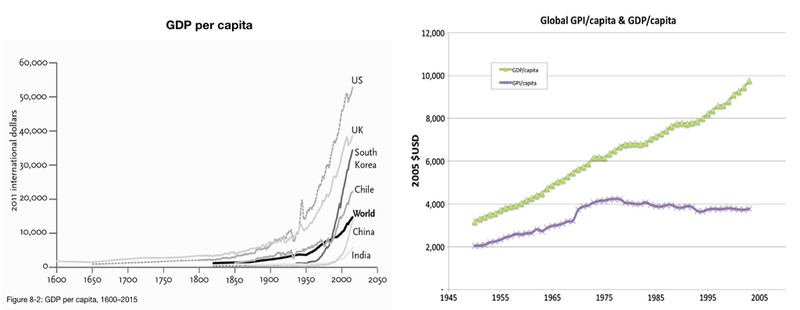
Figure 5: GDP per capita compared with GPI. Source: Kubiszewski et al. “Beyond GDP: Measuring and achieving global genuine progress.” Ecological Economics, 2013.
There is no doubt that the world has experienced a transformation in material wellbeing in the past two hundred years, and Pinker documents this in detail, from the increased availability of clothing, food, and transportation, to the seemingly mundane yet enormously important decrease in the cost of artificial light. However, there is a point where the rise in economic activity begins to decouple from wellbeing. In fact, GDP merely measures the rate at which a society is transforming nature and human activities into the monetary economy, regardless of the ensuing quality of life. Anything that causes economic activity of any kind, whether good or bad, adds to GDP. An oil spill, for example, increases GDP because of the cost of cleaning it up: the bigger the spill, the better it is for GDP.
This divergence is played out, tragically, across the world every day, and is cruelly hidden in global statistics of rising GDP when powerful corporate and political interests destroy the lives of the vulnerable in the name of economic “progress.” In just one of countless examples, a recent report in The Guardian describes how indigenous people living on the Xingu River in the Amazon rainforest were forced off their land to make way for the Belo Monte hydroelectric complex in Altamira, Brazil. One of them, Raimundo Brago Gomes, tells how “I didn’t need money to live happy. My whole house was nature… I had my patch of land where I planted a bit of everything, all sorts of fruit trees. I’d catch my fish, make manioc flour… I raised my three daughters, proud of what I was. I was rich.” Now, he and his family live among drug dealers behind barred windows in Brazil’s most violent city, receiving a state pension which, after covering rent and electricity, leaves him about 50 cents a day to feed himself, his wife, daughter, and grandson. Meanwhile, as a result of his family’s forced entry into the monetary economy, Brazil’s GDP has risen.
Pinker is aware of the crudeness of GDP as a measure, but uses it repeatedly throughout his book because, he claims, “it correlates with every indicator of human flourishing.” This is not, however, what has been discovered when economists have adjusted GDP to incorporate other major factors that affect human flourishing. One prominent alternative measure, the Genuine Progress Indicator (GPI), reduces GDP for negative environmental factors such as the cost of pollution, loss of primary forest and soil quality, and social factors such as the cost of crime and commuting. It increases the measure for positive factors missing from GDP such as housework, volunteer work, and higher education. Sixty years of historical GPI for many countries around the world have been measured, and the results resoundingly refute Pinker’s claim of GDP’s correlation with wellbeing. In fact, as shown by the purple line in Figure 5 (right), it turns out that the world’s Genuine Progress peaked in 1978 and has been steadily falling ever since.
Graph 6: What has improved global health?
One of Pinker’s most important themes is the undisputed improvement in overall health and longevity that the world has enjoyed in the past century. It’s a powerful and heart-warming story. Life expectancy around the world has more than doubled in the past century. Infant mortality everywhere is a tiny fraction of what it once was. Improvements in medical knowledge and hygiene have saved literally billions of lives. Pinker appropriately quotes economist Steven Radelet that these improvements “rank among the greatest achievements in human history.”
So, what has been the underlying cause of this great achievement? Pinker melds together what he sees as the twin engines of progress: GDP growth and increase in knowledge. Economic growth, for him, is a direct result of global capitalism. “Though intellectuals are apt to do a spit take when they read a defense of capitalism,” he declares with his usual exaggerated rhetoric, “its economic benefits are so obvious that they don’t need to be shown with numbers.” He refers to a figure called the Preston curve, from a paper by Samuel Preston published in 1975 showing a correlation between GDP and life expectancy that become foundational to the field of developmental economics. “Most obviously,” Pinker declares, “GDP per capita correlates with longevity, health, and nutrition.” While he pays lip service to the scientific principle that “correlation is not causation,” he then clearly asserts causation, claiming that “economic development does seem to be a major mover of human welfare.” He closes his chapter with a joke about a university dean offered by a genie the choice between money, fame, or wisdom. The dean chooses wisdom but then regrets it, muttering “I should have taken the money.”
Pinker would have done better to have pondered more deeply on the relation between correlation and causation in this profoundly important topic. In fact, a recent paper by Wolfgang Lutz and Endale Kebede entitled “Education and Health: Redrawing the Preston Curve” does just that. The original Preston curve came with an anomaly: the relationship between GDP and life expectancy doesn’t stay constant. Instead, each period it’s measured, it shifts higher, showing greater life expectancy for any given GDP (Figure 6, left). Preston—and his followers, including Pinker—explained this away by suggesting that advances in medicine and healthcare must have improved things across the board.
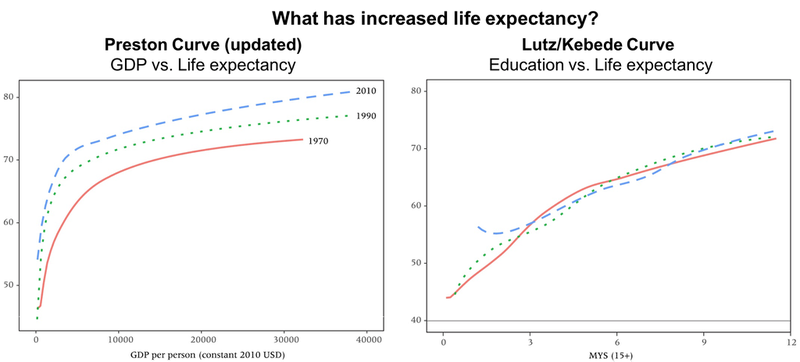
Figure 6: GDP vs. Life expectancy compared with Education vs. Life expectancy. Source: W. Lutz and E. Kebede. “Education and Health: Redrawing the Preston Curve.” Population and Development Review, 2018.
Lutz and Kebede, however, used sophisticated multi-level regression models to analyze how closely education correlated with life expectancy compared with GDP. They found that a country’s average level of educational attainment explained rising life expectancy much better than GDP, and eliminated the anomaly in Preston’s Curve (Figure 6, right). The correlation with GDP was spurious. In fact, their model suggests that both GDP and health are ultimately driven by the amount of schooling children receive. This finding has enormous implications for development priorities in national and global policy. For decades, the neoliberal mantra, based on Preston’s Curve, has dominated mainstream thinking—raise a country’s GDP and health benefits will follow. Lutz and Kebede show that a more effective policy would be to invest in schooling for children, with all the ensuing benefits in quality of life that will bring.
Pinker’s joke has come full circle. In reality, for the past few decades, the dean chose the money. Now, he can look at the data and mutter: “I should have taken the wisdom.”
Graph 7: False equivalencies, false dichotomies.
As we can increasingly see, many of Pinker’s missteps arise from the fact that he conflates two different dynamics of the past few centuries: improvements in many aspects of the human experience, and the rise of neoliberal, laissez-faire capitalism. Whether this is because of faulty reasoning on his part, or a conscious strategy to obfuscate, the result is the same. Most readers will walk away from his book with the indelible impression that free market capitalism is an underlying driver of human progress.
Pinker himself states the importance of avoiding this kind of conflation. “Progress,” he declares, “consists not in accepting every change as part of an indivisible package… Progress consists of unbundling the features of a social process as much as we can to maximize the human benefits while minimizing the harms.” If only he took his own admonition more seriously!
Instead, he laces his book with an unending stream of false equivalencies and false dichotomies that lead a reader inexorably to the conclusion that progress and capitalism are part of the same package. One of his favorite tropes is to create a false equivalency between right-wing extremism and the progressive movement on the left. He tells us that the regressive factions that undergirded Donald Trump’s presidency were “abetted by a narrative shared by many of their fiercest opponents, in which the institutions of modernity have failed and every aspect of life is in deepening crisis—the two sides in macabre agreement that wrecking those institutions will make the world a better place.” He even goes so far as to implicate Bernie Sanders in the 2016 election debacle: “The left and right ends of the political spectrum,” he opines, “incensed by economic inequality for their different reasons, curled around to meet each other, and their shared cynicism about the modern economy helped elect the most radical American president in recent times.”
Implicit in Pinker’s political model is the belief that progress can only arise from the brand of centrist politics espoused by many in the mainstream Democratic Party. He perpetuates a false dichotomy of “right versus left” based on a twentieth-century version of politics that has been irrelevant for more than a generation. “The left,” he writes, “has missed the boat in its contempt for the market and its romance with Marxism.” He contrasts “industrial capitalism,” on the one hand, which has rescued humanity from universal poverty, with communism, which has “brought the world terror-famines, purges, gulags, genocides, Chernobyl, megadeath revolutionary wars, and North Korea–style poverty before collapsing everywhere else of its own internal contradictions.”
By painting this black and white, Manichean landscape of capitalist good versus communist evil, Pinker obliterates from view the complex, sophisticated models of a hopeful future that have been diligently constructed over decades by a wide range of progressive thinkers. These fresh perspectives eschew the Pinker-style false dichotomy of traditional left versus right. Instead, they explore the possibilities of replacing a destructive global economic system with one that offers potential for greater fairness, sustainability, and human flourishing. In short, a model for continued progress for the twenty-first century.
While the thought leaders of the progressive movement are too numerous to mention here, an illustration of this kind of thinking is seen in Graph 7. It shows an integrated model of the economy, aptly called “Doughnut Economics,” that has been developed by pioneering economist Kate Raworth. The inner ring, called Social Foundation, represents the minimum level of life’s essentials, such as food, water, and housing, required for the possibility of a healthy and wholesome life. The outer ring, called Ecological Ceiling, represents the boundaries of Earth’s life-giving systems, such as a stable climate and healthy oceans, within which we must remain to achieve sustained wellbeing for this and future generations. The red areas within the ring show the current shortfall in the availability of bare necessities to the world’s population; the red zones outside the ring illustrate the extent to which we have already overshot the safe boundaries in several essential earth systems. Humanity’s goal, within this model, is to develop policies that bring us within the safe and just space of the “doughnut” between the two rings.
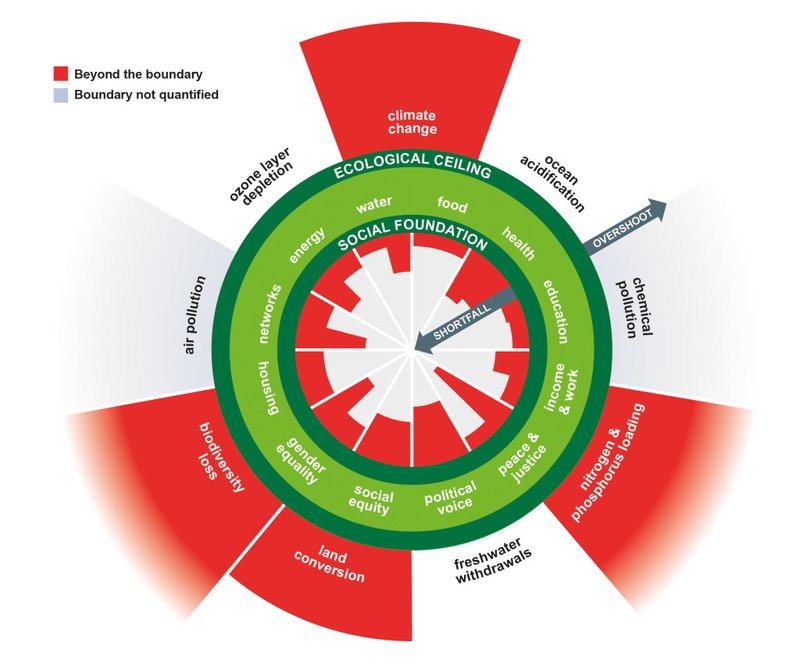
Figure 7: Kate Raworth’s Doughnut Economic Model. Source: Kate Raworth; Christian Guthier/The Lancet Planetary Health.
Raworth, along with many others who care passionately about humanity’s future progress, focus their efforts, not on the kind of zero-sum, false dichotomies propagated by Pinker, but on developing fresh approaches to building a future that works for all on a sustainable and flourishing earth.
Graph 8: Progress Is Caused By… Progressives!
This brings us to the final graph, which is actually one of Pinker’s own. It shows the decline in recent years of web searches for sexist, racist, and homophobic jokes. Along with other statistics, he uses this as evidence in his argument that, contrary to what we read in the daily headlines, retrograde prejudices based on gender, race, and sexual orientation are actually on the decline. He attributes this in large part to “the benign taboos on racism, sexism, and homophobia that have become second nature to the mainstream.”
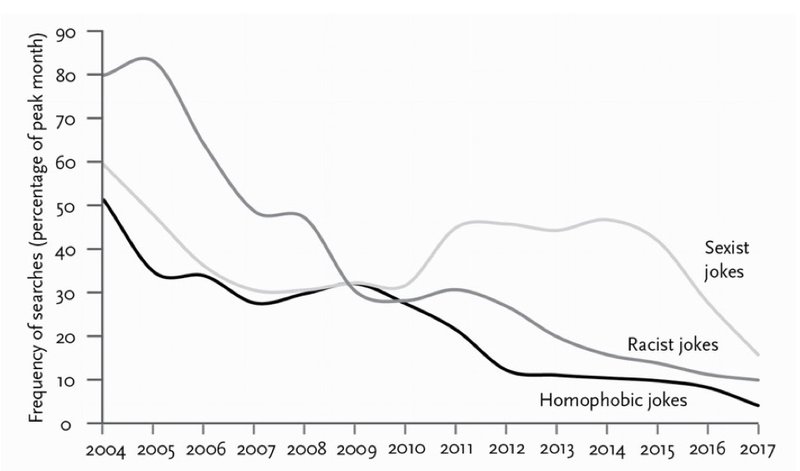
Figure 8. Source: Steven Pinker, Enlightenment Now.
How, we might ask, did this happen? As Pinker himself expresses, we can’t assume that this kind of moral progress just happened on its own. “If you see that a pile of laundry has gone down,” he avers, “it does not mean the clothes washed themselves; it means someone washed the clothes. If a type of violence has gone down, then some change in the social, cultural, or material milieu has caused it to go down… That makes it important to find out what the causes are, so we can try to intensify them and apply them more widely.”
Looking back into history, Pinker recognizes that changes in moral norms came about because progressive minds broke out of their society’s normative frames and applied new ethics based on a higher level of morality, dragging the mainstream reluctantly in their wake, until the next generation grew up adopting a new moral baseline. “Global shaming campaigns,” he explains, “even when they start out as purely aspirational, have in the past led to dramatic reductions in slavery, dueling, whaling, foot-binding, piracy, privateering, chemical warfare, apartheid, and atmospheric nuclear testing.”
It is hard to comprehend how the same person who wrote these words can then turn around and hurl invectives against what he decries as “political correctness police, and social justice warriors” caught up in “identity politics,” not to mention his loathing for an environmental movement that “subordinates human interests to a transcendent entity, the ecosystem.” Pinker seems to view all ethical development from prehistory to the present day as “progress,” but any pressure to shift society further along its moral arc as anathema.
This is the great irony of Pinker’s book. In writing a paean to historical progress, he then takes a staunchly conservative stance to those who want to continue it. It’s as though he sees himself at the mountain’s peak, holding up a placard saying “All progress stops here, unless it’s on my terms.”
In reality, many of the great steps made in securing the moral progress Pinker applauds came from brave individuals who had to resist the opprobrium of the Steven Pinkers of their time while they devoted their lives to reducing the suffering of others. When Thomas Paine affirmed the “Rights of Man” back in 1792, he was tried and convicted in absentia by the British for seditious libel. It would be another 150 years before his visionary idea was universally recognized in the United Nations. Emily Pankhurst was arrested seven times in her struggle to obtain women’s suffrage and was constantly berated by “moderates” of the time for her radical approach in striving for something that has now become the unquestioned norm. When Rachel Carson published Silent Spring in 1962, with the first public exposé of the indiscriminate use of pesticides, her solitary stance was denounced as hysterical and unscientific. Just eight years later, twenty million Americans marched to protect the environment in the first Earth Day.
These great strides in moral progress continue to this day. It’s hard to see them in the swirl of daily events, but they’re all around us: in the legalization of same sex marriage, in the spread of the Black Lives Matter movement, and most recently in the way the #MeToo movement is beginning to shift norms in the workplace. Not surprisingly, the current steps in social progress are vehemently opposed by Steven Pinker, who has approvingly retweeted articles attacking both Black Lives Matter and #MeToo, and who rails at the World Economic Forum against what he terms “political correctness.”
It’s time to reclaim the mantle of “Progress” for progressives. By slyly tethering the concept of progress to free market economics and centrist values, Steven Pinker has tried to appropriate a great idea for which he has no rightful claim. Progress in the quality of life, for humans and nonhumans alike, is something that anyone with a heart should celebrate. It did not come about through capitalism, and in many cases, it has been achieved despite the “free market” that Pinker espouses. Personally, I’m proud to be a progressive, and along with many others, to devote my energy to achieve progress for this and future generations. And if and when we do so, it won’t be thanks to Steven Pinker and his specious arguments.