 A preview of what’s ahead for Nova Scotia (and the rest of Canada under Herr Hideous Carney, master fraudster and con man (he’s not a liberal, he’s a Harper con):
@ssteingraber1.bsky.social:
This is a story about the climate crisis and how data centers make it worse.
New essay from me about a Chinese-owned data center in rural central Oklahoma (El Reno, pop. 16K) that was operating illegally and drained the municipal water supply during the teeth of an extreme drought, closing public schools. …
@peggyfrompa.bsky.social:
Horrific & despicable!
Repercussion Section: The Chinese Data Center at the Crossroads of Route 66 and the Chisholm Trail by Sandra Steingraber, senior scientist and writer in residence, Oct 21, 2026, Science & Environmental Health Network
The city of El Reno, Oklahoma (population 16,996), sits in the center of Canadian County in the center of the state but is otherwise divided by a lot of things. These include water rights, a tangled web of Chinese companies, and an illegal crypto mining operation.
But let’s start with geography.
El Reno, Oklahoma, is split by the 98th Meridian, which means that its eastern half once occupied what was formerly called the Unassigned Lands, and its western half was situated on Cheyenne and Arapaho lands. So, the city was founded at two different times.
In case your U.S. history class skipped this chapter, here’s a review:
The Creek and Seminole Indian tribes once lived in Georgia and Alabama. They fled to Florida to escape white settlement but then, as part of the Indian Removal Act of 1830, were forcibly and shamefully displaced west of the Mississippi River to live in Indian Territory in what is now Oklahoma.
After the Civil War, the federal government punished these two tribes for supporting the Confederacy by taking away their communally held lands, which then became federal property. These two million unplowed acres were called the Unassigned Lands.
At the blast of a gunshot at high noon on April 22, 1889—and this should sound familiar—the Unassigned Lands were opened to homesteaders as part of the 1889 Land Run. The ones who waited for the starting pistol were called Boomers, and the cheaters who snuck across early were famously named Sooners. All told, more than 50,000 settlers rushed in and, within 24 hours, had claimed plots for themselves. Thus, El Reno (the eastern half) began as a tent city on the western border of the Unassigned Land on the evening of that very same day.
Setting up a post office was the first order of business.
The western half of El Reno originated some years later with a subsequent land run and the settler occupation of the Cheyenne and Arapaho lands.
“It’s good to be here” is the city’s motto.
El Reno is also divided by the Chisholm Trail, which ran directly through the city from its origin in southern Texas to the stockyards and railyards in Kansas. An estimated six million cattle were driven along this route until fences, farms, quarantines, and a cattle industry-destroying blizzard ended the trail-drive era—and spawned cowboy nostalgia that persists to this day. The Chisholm Trail within the city of El Reno was itself bisected in 1926 by U.S. Route 66, one of the nation’s first continuously paved highways that stretched from Chicago to Los Angeles.
More dislocations followed. In the 1930s, Route 66 became a major migratory pathway for many of the descendants of the original white settlers, the Boomers and Sooners, who, having plowed up the prairie for row crops between 1901 and 1930, were caught in the crosshairs of both the economic crisis of the Great Depression and the ecological crisis of the Dust Bowl.
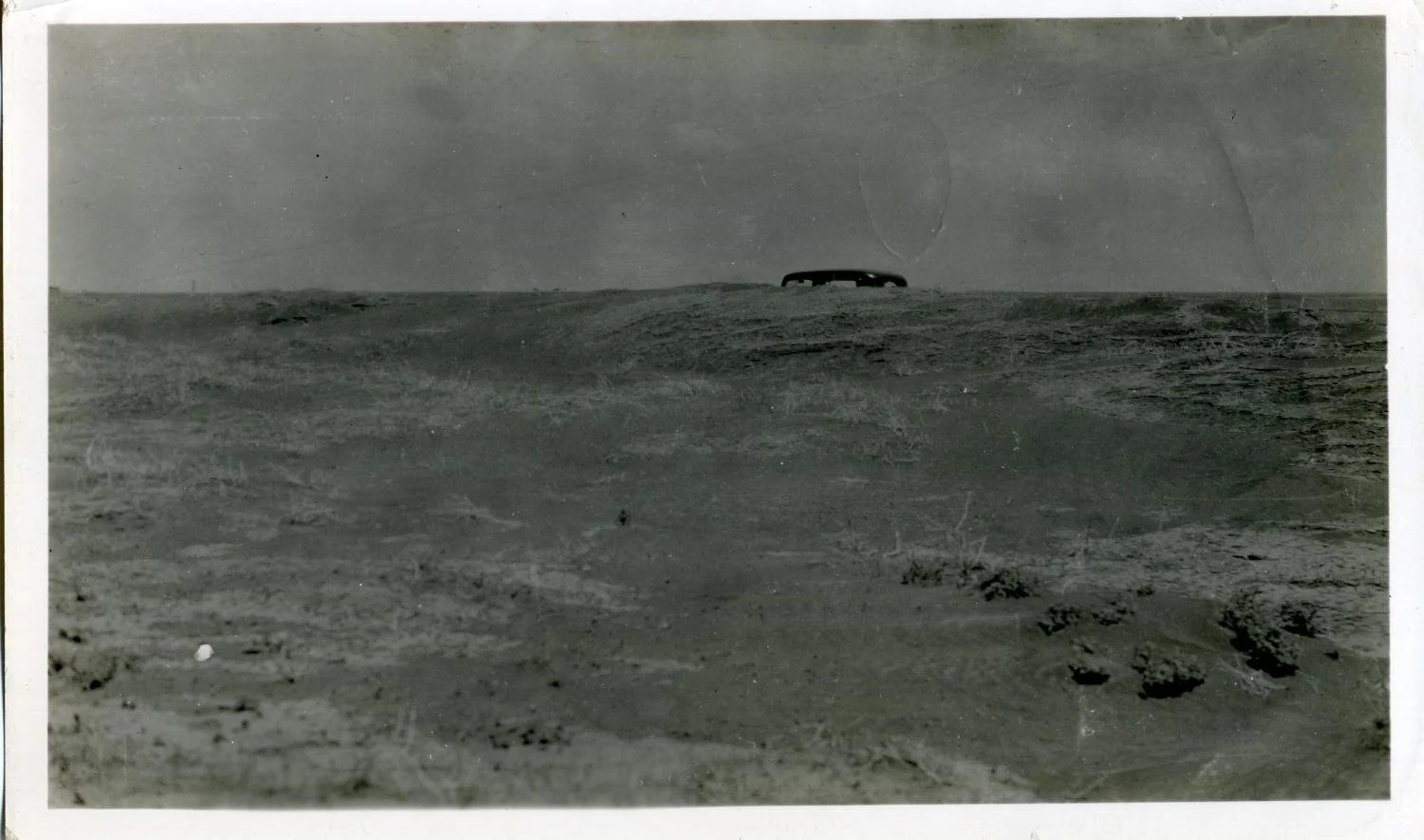
Throughout the 1930s, a prolonged drought plus high winds sent black blizzards of topsoil across the Great Plains, blinding and suffocating cattle, destroying crops, and killing children via “dust pneumonia.” One third of Oklahoma’s population fled, many heading to California’s Central Valley to work as farmhands—as memorialized in John Steinbeck’s 1939 novel, Grapes of Wrath—where their name changed to Okies.
The stories of the ones who stayed are told in Timothy Egan’s 2006 historical account, The Worst Hard Time. The farmers and ranchers who hunkered down and held out in central Oklahoma have no special moniker, but Egan quotes the child survivors in their old age saying things like this: “God didn’t create this land around here to be plowed up. He created it for Indians and buffalo. Folks raped this land. Raped it bad.”
***
Between 2020 and 2026, prolonged drought, once again, sank its teeth into Canadian County, Oklahoma.
Throughout the southern Great Plains, rainfall petered out and cattle herds thinned. Yields of cotton, wheat, and sorghum fell. So did the depth of drinking water reservoirs. The words “flash drought” showed up on community Facebook pages.
By October 2024, the drought in central Oklahoma was so bad that Oklahoma City exercised its right to divert water from a lake in the northwest part of the state into the reservoir that serves as a primary drinking water source for Oklahoma City whose levels had fallen by more than seven feet. Water from the lake would otherwise flow into the northern branch of the Canadian River, which flows through El Reno. But El Reno also buys some of its drinking water from Oklahoma City, so….
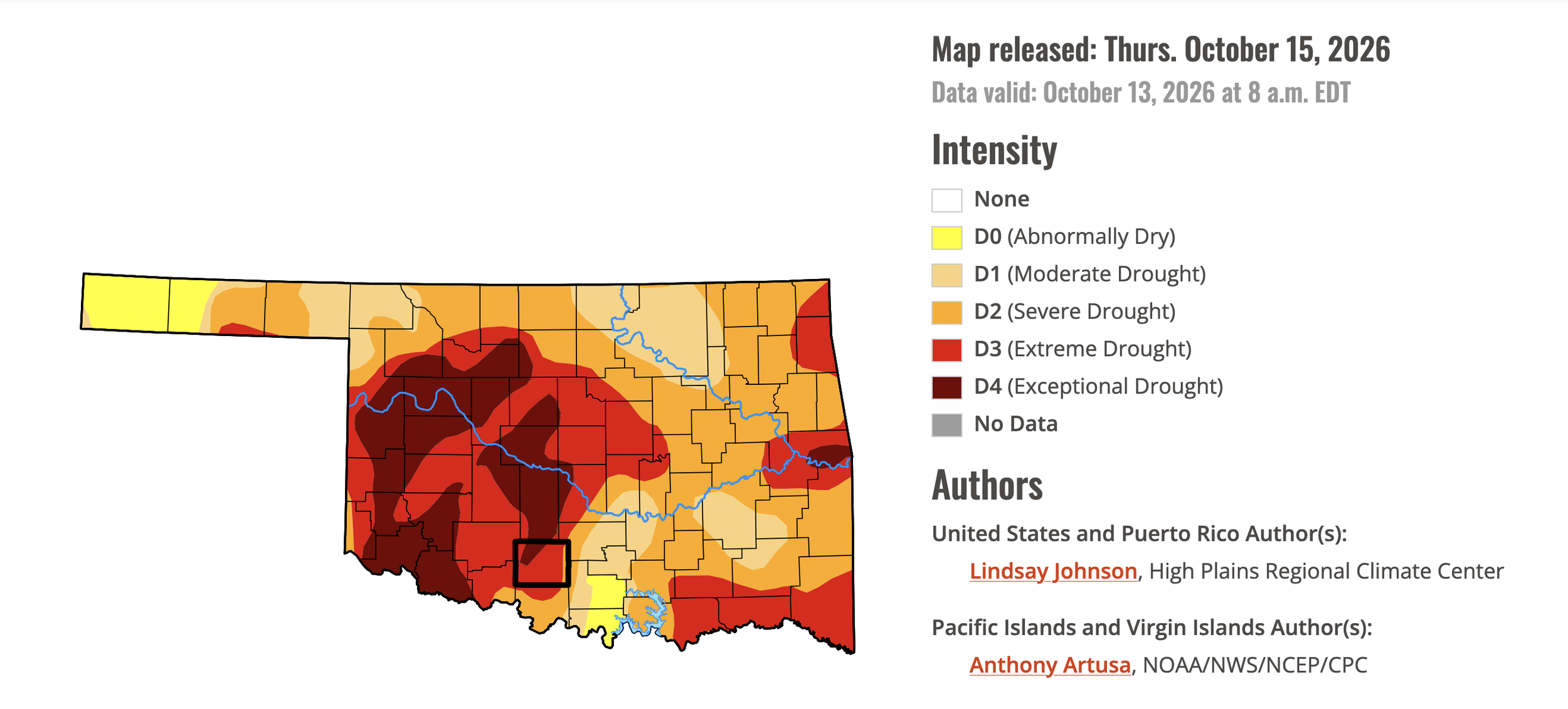
By 2026, maps released by the U.S. Drought Monitor colored Canadian County entirely in red and maroon, indicating areas of extreme (D3) drought and exceptional (D4) drought. The map key explained that maroon signifies existential calamity, namely, “fire season is long; rural fire departments are running out of finances; ground is cracking; farmers are bailing failed crops; pastures are bare; land is abandoned; ranchers and farmers are desperate and experiencing huge economic loss.”
And then to make matters way worse, on August 26, 2026, the drinking water suddenly disappeared in El Reno. Which is to say that municipal water pressure plunged, becoming insufficient for fire suppression and other basic needs.
Offices and public schools closed immediately, including in the nearby town of Union City that gets its drinking water from El Reno. Emergencies were declared. Bottled water was distributed to residents.
The cause was a mystery, but the presumption was that there must be a massive water leak in the municipal water system somewhere. Drones and helicopters were dispatched, and the high school football team was enlisted to join public officials in an emergency search for its location.
Indeed, there was a leak. A private water line hooked up to unauthorized fire hydrant on the property of a nearby data center linked to bitcoin mining—and maybe AI?—had breached, drained 3.8 million gallons from the public water tower, and swamped a large area. This discovery came as a surprise to everyone, including local elected officials who had granted Athlon Blockchain Technology LLC a building permit in 2021 but, two years later, after multiple fire and safety violation and permit issues, had issued a stop-work order.
And apparently failed to enforce it. So much for the Code of Ordinances.
On August 31, the interim city manager, in a published letter in the local newspaper assured the citizens of El Reno that the citizens of El Reno that none of the costs related to the data center’s water leak would be passed along to taxpayers. “The City’s legal team stands ready and is preparing to take the necessary legal actions to recoup all costs and expenses related to the water leak from the property owner, including city resources expended in locating and addressing the leak.”
The data center was described on Athlon’s website (ironically now offline) as being fully equipped with “hydro-cooling technology.” The facility was swiftly condemned.
But data centers are not traditional workplaces inhabited by shifts of workers who can be queried about operations. Finding the property owner proved elusive. In a media interview, El Reno’s mayor, Steven Jensen, said that the property’s chain-link fence made it difficult to discern what exactly went on inside. “It’s hard to tell—where they were in operation, where they working, was anything going on?”
At a hearing on September 14, attorneys for Athlon sat down with El Reno city legal staff to make a plan for correcting the various violations. The meeting ended with a decision to meet in another 30 days to “check in.” Out in the parking lot, Athlon’s attorneys refused to answer questions from television reporters as to why they had ignored the work-stop order three years ago and what specific construction and operating activities went on out there.
***
Who exactly owns Athlon Blockchain Technology? Here’s where the story gets confusing and required a two-part investigation by a team of journalists with (NBC affiliate) News 4 in Oklahoma City to partially untangle it.
Their findings: City records, including emails between El Reno officials and Athlon, names Tony Shi as the property owner and CEO of Athlon.
But a former unlicensed employee interviewed by News 4 had never heard of the name Athlon or Tony Shi. He said that he had been hired—for a job that included monitoring water tanks—by representatives of WuWa Technology LLC.
Records filed with the state show that Shi, who lives in Palo Alto, California and has registered seven other companies, is indeed also Wuwa’s president but only associates publicly with Athlon, which is also registered in Singapore. Further, Wuwa operates another crypto mining operation next to an electrical substation in Oklahoma City together with second company that is tied to Chinese entities with further ties to companies with a presence in in Houston and Nevada. The state legislator who represents that district said that he had no idea and was unable to answer questions about potential national security risks.
In the words of the investigative team:
…the El Reno Bitcoin mine behind a massive water leak is tied to a second, bigger mine in Oklahoma City—and both mines connect to a tangled web of companies reaching China, displaying a pattern one expert says she’s seen in other Bitcoin operations whose owners were ultimately tied to the Chinese government. The same man founded both the company that owns the El Reno mine and the company whose employees work at both sites. A second company operating mines at the Oklahoma City site also stems from a trail of other shell companies registered in foreign countries…That leaves unanswered where the tangled web really leads, and the essential question of who is benefiting from this, and why.
In the words of an El Reno resident:
We have children….Our schools paid the price. You know, they missed class days and then also the community buildings…not to mention what it’s going to do to the animals that are, you know, like our, water, our wildlife, our land.

***
Post script: On October 14-15, 2026, ten inches of rain fell within 48 hours in El Reno, Oklahoma and the North Canadian River flooded, overturning a trash truck on Route 66 and prompting the emergency water rescue of its driver along with four other individuals trapped in another vehicle.
Sandra thanks Oklahoma resident Jessica Hyatt for her research assistance.
***
@sashafury.myatproto.social:
Easily the most corrupt Canadian government in my life.
Blatantly and belligerently corrupt.
***
‘A terrifying project,’ but there will be no environmental assessment for EverWind’s hyperscale data centre by Joan Baxter October 22, 2026, Halifax Examiner

The massive $8 billion data centre complex EverWind is proposing to build in Point Tupper, and lease to the controversial U.S. AI colossus Anthropic for 20 years to power its AI model Claude, will not require an environmental assessment approval from Nova Scotia Environment and Climate Change (NSECC).
In a statement to the Halifax Examiner, NSECC spokesperson Philip Croucher said EverWind will require only an industrial approval “for the diesel generating station they want to build to help power” the proposed data centre.
“Nova Scotia Environment and Climate Change will work closely with EverWind to ensure rules under the Environment Act are met and followed,” Croucher wrote.
“In terms of water required for its operations, EverWind will be working with Landrie Lake Water Utility for its required water using current allotments,” he said.
Croucher added that NSECC’s Large Industrial File Team (LIFT), a “dedicated team for large and complex industrial projects, will provide coordinated oversight to ensure environmental requirements are met and the project moves through the regulatory process responsibly.”
When NSECC announced the creation of LIFT in June 2025, it described it as a team that would “manage all mining applications to ensure timely, consistent decisions.”
There was no mention of data centres.
Premier Houston’s flip-flop on data centres
In June 2026, Premier Tim Houston said even a discussion about data centres was “far in the future,” and not something that would be entertained unless there was enough energy on the grid so Nova Scotians would not be put at risk.
Three months later, Houston abruptly changed his tune, and said he was open to discussions about data centres. The same day, EverWind Fuels communications director Claire Parsons told CBC the company was “exploring opportunities to host a data centre at our existing industrial site at Point Tupper.”

EverWind Fuels first appeared in Nova Scotia in 2022 when it bought the Nustar fossil fuel terminal and storage facility in Point Tupper for $60 million. Australian native and New York-based Trent Vichie, who made his fortune in private equity, is founder and CEO of EverWind.
EverWind’s plans were to build a green hydrogen and ammonia plant on the property, power it with wind projects it would develop across the province, and export the ammonia to two German utilities with which it signed memoranda of understanding in 2022.
Related: EverWind Fuels CEO Trent Vichie is a devoted supporter of Donald Trump
Related: Premier Tim Houston’s expense claims leave questions about his March 2024 New York trip unanswered
From hydrogen to hyperscale data centre
As we reported earlier this week, it is now “more than three years since EverWind told the Examiner it would be exporting 200,000 tonnes of green ammonia a year to Europe by 2025, and that would be 800,000 tonnes in its second phase starting in 2026.
To date, not a single wind turbine has been erected, no hydrogen or ammonia plant has been started in Point Tupper, and no announcement has been made about financing that would allow for a final investment decision so the project could proceed.”
In the meantime, EverWind Fuels continues its business of shipping and storing fossil fuels at its Point Tupper facility.

In September, we reported that EverWind had lost E.ON, one of its German buyers for any ammonia it might one day produce, making it more difficult to find investors to finance the project.
So far, EverWind Fuels has received $22.5 million from Transport Canada for three new tugboats, and US$125 million from Export Development Canada.
In March 2026, global asset manager Nuveen announced $240 million financing for EverWind’s wind projects, still far less than it needed.
EverWind also owes the government of Newfoundland and Labrador millions of dollars after that province revoked the company’s land holdings for its apparently stalled hydrogen and ammonia project on the Burin Peninsula. EverWind had not paid mandatory fees of 3.5% of the land’s market value per quarter.
Related: EverWind green hydrogen projects in Atlantic Canada hit headwinds
The eventful announcement
With all these setbacks, perhaps it’s no surprise EverWind has now turned to data centres for its Point Tupper property, although the company maintains it will continue to pursue its plans for hydrogen and ammonia production.
Hence the big announcement of the $8 billion data centre on Oct. 16 in Point Tupper, from which two Examiner reporters — Jennifer Henderson and myself — were unceremoniously expelled.Fucking hell.

Slimy little evil fucker.
In attendance were Premier Tim Houston, EverWind CEO Trent Vichie, Membertou Chief Terrance Paul, Kings-Hants MP Kody Blois who is also parliamentary secretary to Prime Minister Mark Carney, and Sydney-Glace Bay MP Mike Kelloway. The event was MC’ed by Richmond County deputy warden Amanda Mombourquette, who is also vying for the leadership of the provincial Liberal Party.
Houston, Vichie, and Blois all emphasized that the $10 billion investment for the data centre and four wind projects would be “private” money. However, no specific investors were named.I bet you they’re lying, and will use public money, with $billions of our tax dollars tossed in by our Nazi in Chief, Herr Carney.
It wasn’t until late that afternoon that it was reported that Anthropic would lease the proposed data centre for 20 years.The fucking AI Nazis are losing billions hand over fist, I betchya, they will not pay their rent, just like American douche fucking oil and gas companies in Alberta don’t
In a statement on Oct. 21, Membertou First Nation Chief Paul clarified that while Membertou is the “majority owner of proposed on-land wind farms to
produce clean wind power at four sites in the province, Bear Lake, Kmtnuk, Upper Afton and Windy Ridge,” it is “not partnered on the data center project.”
“We’re currently assessing and learning about the project in deeper detail and haven’t invested at this time,” wrote Chief Paul.
Related: EverWind announces $10 billion AI megaproject in Nova Scotia but many questions remain
Related: Halifax Examiner reporters thrown out of EverWind data centre announcement in Point Tupper
‘Approvals’ do not include an environmental one
On a new EverWind website devoted to the data centre “campus,” the company says phase one of the project will be a data centre that will draw 95 megawatts (MW) from the grid, which should be “online in late 2027.”Steal your power and water, our public money, just to spy on us all. Fucking Nazi invasion alright.
The website says the planned 325 MW expansion for phase two would come “online in 2028,” and be powered by the Bear Lake, Kmtnuk, Windy Ridge, and Upper Afton wind projects. All four were planned for the hydrogen project. The idea was to feed the 768 megawatts into the grid, and withdraw an equivalent amount of electricity from the grid to power its hydrogen production in Point Tupper.I bet there will not an ounce of wind from these sleazy rotten fuckers
Phase one is subject to “core System Impact Study and Facilities Study work” that “has been completed.”
“Remaining work includes implementation of the identified protection, control and communications requirements with NSPI [Nova Scotia Power Inc.] and the IESO [Independent Energy System Operator], final customer-service arrangements, commissioning and any applicable project permits or approvals,” according to the website.
Nevertheless, as confirmed by NSECC to the Examiner, there will be no environmental assessment approval for the mega-project.Of course not, if there was, there would be no project approval or, far too many expensive mandatory conditions. NS, you must vote asshat traitor Houston out.
The National Observer reports that in Alberta, the Sturgeon Lake Cree Nation is suing the provincial government of Danielle Smith for allowing Kevin O’Leary’s “gargantuan Wonder Valley data centre” to proceed without an environmental assessment.
‘Flawed process’
Why the massive data centre project in Nova Scotia will not have to undergo an environmental assessment is beyond belief, according to Chris Benjamin, associate director of energy programs at the Ecology Action Centre.
“We should have seen a proper environmental assessment,” Benjamin said in an interview. “Our environmental assessment process is fundamentally flawed. We just see stuff get greenlit by the province so quickly.”
Benjamin referred to the example of the two peaker methane gas plants planned for Salt Springs and Marshdale, in environmentally sensitive areas near salmon rivers in Pictou County. He noted that many people and groups submitted valuable comments to NSECC about the projects, but these were not made public on the NSECC environmental assessment page until after the plants had already been approved.
“It’s a very flawed process,” he said. “And then on top of that, you see projects approved that then get altered, without any public involvement.”
A data centre is not a hydrogen facility
Benjamin pointed out that EverWind had to undergo an environmental assessment for its proposed hydrogen and ammonia plants in Point Tupper, and Environment and Climate Change Minister Timothy Halman approved that project in Feb. 2023.
However, the approval was for a hydrogen and ammonia production facility, not for a massive data centre that would draw 95 MW from the provincial grid and half a million litres of water a day from the Landrie Lake Water Utility, in addition to the 9.5 million litres permitted for the proposed hydrogen and ammonia facility.
Nova Scotia’s Environment Act dates back to 1994-95, with the most recent amendments made in 2022. Its regulations on what kinds of projects require a shorter Class I environmental assessment or a more thorough Class II assessment do not even mention data centres, for the simple reason that giant AI data centres didn’t exist when the regulations were written.
However, the regulations do stipulate that energy generation projects “(like wind, hydrogen and natural gas)” and industrial facilities “(like those that manage certain wastes)” require a Class I environmental assessment.
Even the project to put in a pumphouse to “enhance” water yield in the Landrie Lake reservoir, from which EverWind has permission to draw 10 million litres of water a day, is undergoing a Class I environmental assessment.
So why does the data centre get a free pass?‘Cause they owners and your Premier are Nazis and love Trump.

‘A terrifying project’
Benjamin worries it’s a sign of the times, now that Nova Scotia has signed a “one project, one review” agreement with Ottawa, and there is pressure from Houston’s government on the Impact Assessment Agency of Canada to leave all the impact assessments up to the province, and basically to butt out of the process.
EverWind’s data centre seems to be a case of one project, no review.
“It’s obviously being ramrodded right through,” Benjamin said. “It should have a full environmental assessment that will look not just at the immediate physical impacts of building the thing, but also operational impacts on water, on emissions — which will be huge — and on the energy system.”
“It’s a terrifying project,” Benjamin said.And, the AI bubble is coming and will be violent. The AI Nazis do not know how to manage money or their stupid businesses and abusive products
“It was just sprung on us with three government levels of approvals, and no one seemed to stop and think, ‘Why do we need this thing? And why are we working with these billionaire mystery men? And who is it serving?’” he said.
“It makes no sense,” Benjamin told the Examiner. “It’s $10 billion for 215 jobs. That’s $46.5 million per job. That’s insane! Give me $46.5 million and I will employ a lot more than one person with that.”

‘World class?’
NSECC Minister Halman describes Nova Scotia’s environmental protections as “stringent environmental guardrails.”
Premier Houston goes even further, boasting on Facebook that the province has “world-class environmental safeguards.”Ya, sure, keep on lying Fuck Face! AER in Alberta has the best “world-class” safeguards and system in the world – for American polluters and illegal aquifer frac’ers, and nothing for people and communities harmed, or land air and water and other species.
Asked for his reaction to those claims, Benjamin responded:
It’s inaccurate. First of all, there are federal rules that govern every province and territory, and those were gutted under [Prime Minister Stephen] Harper and never really fully bounced back. So you can’t call it “world class.”
It’s a joke to say we have world class [environmental safeguards]. I mean, by what standards are we comparing ourselves to here?
On top of that, there is the provincial jurisdiction, and we do not have strong environmental protections. There’s no way. We have a long history in this province of these pie-in-the-sky type of projects.
“Once these corporations get their permits, no one seems willing or able to stop them.”

Noise levels?
Several people have expressed concern to the Examiner that without an environmental assessment, there will be no way of knowing how much noise pollution the proposed data centre will cause.And, best, no “world-class” limits on the pollution, none whatsoever
Catherine Fergusson knows a thing or two about Nova Scotia’s environmental regulations and their enforcement when it comes to noise pollution.
Fergusson lives seven kilometres from the Kameron Coal’s Donkin mine in Cape Breton, and is a member of the Cow Bay Environmental Coalition, a non-partisan community group that has been working for the past seven years to address the adverse health effects the industrial noise from the mine is having on residents living around Morien Bay and surrounding area.
In an email, Fergusson wrote that environmental assessments are critical, but they also “need to be more than just a paper pushing exercise.”
“For example, the Industrial Approval for the Donkin Mine was renewed, with the government knowing full well that the pure tone noise from the mine was harming the health of local residents,” Fergusson said, adding:
The provincial noise guidelines do not protect Nova Scotians from the pure-tone industrial noise caused by the blade-pass frequency of ventilation fans. As is the case with the Donkin mine. In addition, the coal company oversees the noise-testing process, and when testing does take place, the noise is mysteriously absent.
“The regulatory process does not protect us — it is failing us,” said Fergusson.
StellaC says:
October 22, 2026 at 9:15 am
Thank you for covering this issue in depth. Would the NS Govt. do business with a local company who made promises it did not keep; was being sured by another Atlantic province for failure to live up to its agreement? Somehow when an American company shows up with the right buzz words, we shower money on them. It is difficult not to see this ending in our tears.