
@ecowarriorss.bsky.social:
Google is evil
Wolves Descend on Finnish Villages After Google Hacked Down 1,300 Acres of Habitat to Make Room for AI Data Centers
They have nowhere else to go after Google destroyed their forest home
Authorities will now probably shoot the wolves
@unraveledlissa.bsky.social:
I find this so depressing that I have no words. I weep for all this loss. It turns my stomach.
Wolves Descend on Finnish Villages After Google Hacked Down 1,300 Acres of Habitat to Make Room for AI Data Centers, “We had wolves coming into the village because all the wild animals moved out of the forest.” by Joe Wilkins, Oct 23, 2026, Futurism

Earlier in October, Finnish authorities ordered Google’s affiliate data center developer Tuike Finland Oy to immediately suspend the illegal cutting of some 1,300 acres of forest. The tech giant was given a week to draft a report explaining its actions, which soon became a flashpoint for Europe’s growing outrage over the data center boom.
As the anger grew, reporters descended on the scene — and what they found is a clear-cut example of the AI revolution’s impact on the environment.
New reporting by the Guardian shed fresh light on the impacts of Google’s deforestation. After the 1,300 acres of pristine boreal forests were reduced to tracts of mud and stumps, fauna which once called the woods home has been forced to vacate.
In the felling-site near the Finnish village of Otanmäki, the ensuing loss of prey has forced packs of wolves to search for food elsewhere: nearby villages.
“We had wolves coming into the village because all the wild animals moved out of the forest,” 53-year-old Otanmäki resident Anni Ranta told the Guardian. “They fled.”
Though Ranta’s family has called the area home for generations, the tumult has her considering whether to move out of Otanmäki for good.
“I don’t want them here,” she continued, speaking of Google’s data centers. “I don’t want them in Finland at all. I don’t like the whole idea of AI and the world changing and the way it’s changing. It’s going too fast, too soon.”
Antti Jakonen, a resident of Muhos, put it in even starker terms. “It has been done in the wrong way. American style. No sense. No sense at all,” he told the Guardian.
Sure enough, back in Google’s home country, data center developers are increasingly duking it out with the natural world — and winning handily.
In West Virginia, a grove of critically endangered Chestnut trees is under threat of being bulldozed to make way for a new Anthropic hyperscale facility. Outside of Fort Wayne, a chunk of Indiana’s once-bountiful wetlands is being tilled to fit a new Google data center. In Southern New Jersey, a data center operator was recently slapped with a $1 million fine after inspectors uncovered 62 illegal gas generators belching exhaust into the surrounding environment.
Wherever in the world data centers go up, it seems the destruction of natural resources is inevitable — and increasingly difficult for humanity to ignore.
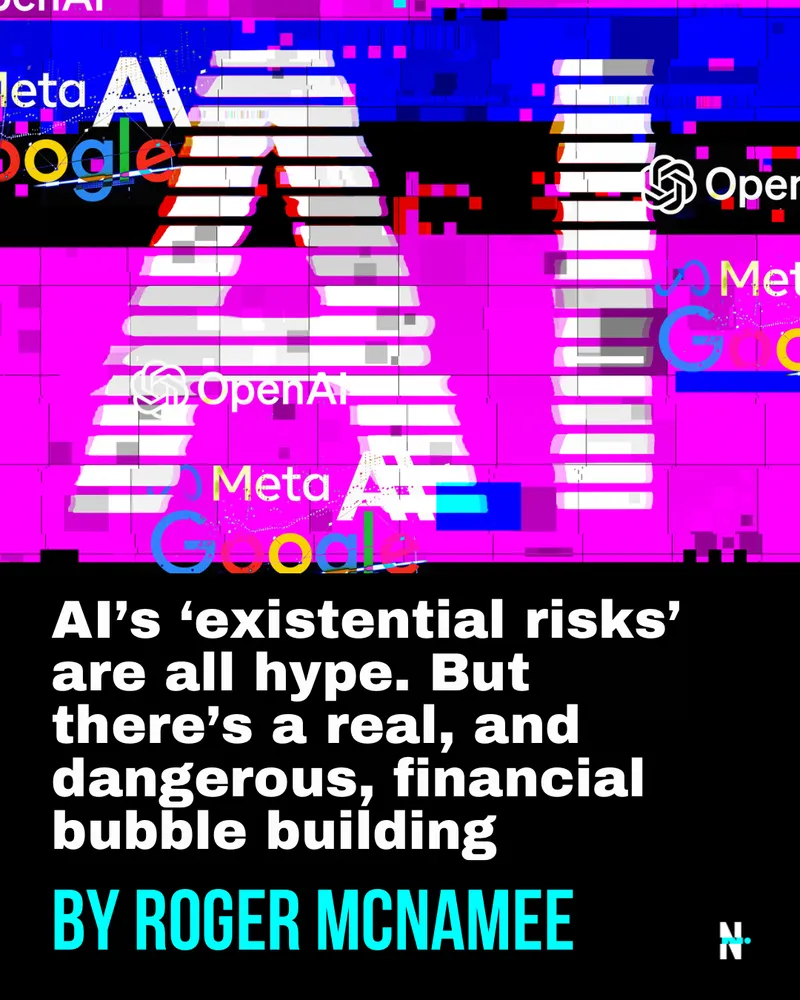
Rogue technology is not going to kill us. But it generates errors, deskills young people and, above all, threatens global financial stability, writes the former Google and Facebook investor
Oct 23, 2026
The enthusiasm for artificial intelligence among investors, CEOs and journalists has been at a fever pitch since the release of ChatGPT four years ago. Elected officials, executives, investors and journalists were quick to hail it as the fourth industrial revolution, despite statements from OpenAI and Anthropic that their products would lead to massive layoffs and possibly the extermination of humanity. Four years after the launch of ChatGPT, it is time to acknowledge that the reality of AI has fallen so far short of the promise that we should cut our losses and do what we can to protect ourselves.
Few doubt the enormous potential of AI to transform our economy and society, but it now appears likely that the transformation will be for the worse. We can see now that the industry talked about existential risk in order to create the impression that AI was inevitable and that the people who created it should not be held accountable for the negative consequences, of which there are many.
The recent hacks of Hugging Face, agencies of the government of Australia, and many other organisations are violations of anti-hacking laws, which could be a felony. At a minimum, the AI companies have been negligent, and it is possible they are also incompetent. The role of ChatGPT in an elementary school shooting in British Columbia and of several chatbots in assisting suicides suggests that the current products also do not meet consumer safety standards. There are studies that say the use of chatbots leads to cognitive impairment, something that is particularly threatening in the young. And, finally, the entire AI project has depended on the theft of copyrighted materials and private data. The latter is particularly troubling in the context of national security, where government data and secrets can become training data.
Anthropic’s IPO is an opportunity for existing investors to cash out, rather than for new investors to get rich
The people who argue that AI is transforming the world for the better should be forced to explain the apparent absence of enterprise customers who pay more for AI services than it costs the vendor to provide them. The promised benefits of scaling training sets and data centres have yet to materialise. Worse yet, surveys of enterprises indicate that the productivity gains promised from AI have been slow to materialise. How is it that the industry continues to attract unprecedented levels of investment for a technology whose harms are evident, but whose benefits are difficult to measure?
Into this frenzy, Anthropic has filed paperwork for an initial public offering (IPO). The desired valuation could exceed $2 trillion. No matter the price, we should recognise that the IPO is an opportunity for existing investors to cash out, rather than for new investors to get rich.
…
Young people have already concluded that AI is a mistake. Now it is time for the rest of us to see the truth
The most important thing each of us can do today is to understand what is really going on in AI. When OpenAI and Anthropic use anthropomorphic language, saying that their products go “rogue”, that their agents “collaborate,” and that they “scheme” to avoid detection, we need to recognise that they are trying to evade accountability. The truth is that AI is software and software does exactly what its programming dictates. The AIs that hacked Hugging Face and other enterprises were programmed to hack and to lie about it.
Hacking is a felony, which suggests that the executives who are responsible may face the risk of imprisonment.
Young people have already concluded that AI is a mistake. Now it is time for the rest of us to see the truth about this industry. Be sceptical about everything you hear from AI companies. Existential risk is not real. Today’s AIs fail at interacting with the real world, so they are not going to kill us. However, there is a high probability that AIs will make our lives miserable.
The real threats from AI products today include cybersecurity, fraud and reduced productivity. For reasons that defy explanation, the AI industry prioritised hacking and fraud in their product designs, which is why you see so many stories about that. In addition, the firehose of AI slop is ruining the internet. AI is deskilling students and workers. AIs continue to give bad advice, especially as relates to health and wellness, finance, and the law. They increase social isolation. When used in warfare, AIs contribute to terrible mistakes that kill people or potentially start wars. Perhaps worst of all, the widespread deployment of AI will concentrate power in the hands of a very small number of people whose authoritarian tendencies are well known.
The AI industry may have great promise for the future, but according to the International Monetary Fund, its flaws are threatening the global economy. The markets are increasingly focused on default risk on AI debt. Banks are working overtime to repackage the risky debt so that it can be sold off to pension plans and insurance companies, which ensures that the harm from a financial crisis would be absorbed by the entire population instead of by the people who created the problem. The scale of current harms are increasingly out of proportion to the future opportunities.
None of these risk factors and issues contradicts the notion that AI can be valuable to people or important to the economy. They speak to the risk to investors, customers, and society as a whole from an industry whose business model does not appear to be viable. The question is whether past choices made by the people running the industry limit the opportunity for economic and investment returns over the next few years. I believe they do.
IMF Warns That AI Bubble Could Take Down the Entire World Economy, Prepare for the gravy train to go off the rails. by Frank Landymore, Oct 19, 2026, Futurism
Fears of an AI bubble have been growing for years. And now the International Monetary Fund is the latest to sound the alarm.
In its Global Financial Stability Report published last week, the global financial institution warned that markets everywhere are increasingly at the mercy of precarious AI investments. With Mark Carney bowing to Trump’s order for mass AI everywhere, unregulated and unhindered, and arrogantly and stupidly financing fucking American Nazi mass surveillance AI data centres here with our pension (including CPP) funds even though he knows they are not profitable enterprises and only lose billions of dollars
The untold billions poured into AI has driven economic growth, the IMF says, but the boom could quickly invert if profits, which so far have largely proven elusive, never come to fruition — or at least not proportionately with the epic investment levels. AI stocks would tank, and the resulting market correction would send powerful shocks across the global economy.
“Growing leverage could be a catalyst for such a correction,” the IMF warned in a blog post about its findings. “Hyperscalers, as the largest data center operators are known, are borrowing more and more, while investors have been leveraging to invest in AI stocks.”
The report also casts a wary eye to the circular nature of AI financing, in which the biggest benefactors and beneficiaries of AI companies are other AI companies. Nvidia, for example, agreed to invest $30 billion in OpenAI and provide another $105 billion towards an OpenAI data center; OpenAI is one of Nvidia’s biggest customers, relying on its chips to power and train its AI models, so a lot of those billions will go straight back to Nvidia when its buys more chips. Besides creating a mirage of robustness, it also means that their financial health is inextricably tangled with each other.
“Stress at key companies receiving investment could lower revenue forecasts and investment valuations, which in turn would weaken the value of the accumulated debt in those deals,” the IMF wrote. “Our review of 14 such transactions since 2023 found about $300 billion in equity investments and $650 billion in debt, in exchange for $1.4 trillion in future revenue commitments.”
A disastrous AI-driven market correction isn’t the only economic catastrophe potentially looming. The IMF is also worried about an increase in government bond yields, or interest rates, or a potential major cyberattack targeting critical government and financial institutions — a strike that could feasibly be assisted by powerful AI models.
The IMF is far from the only one to caution about an AI bubble, but as the stewards of the global economy, theirs is one of the weightiest warnings yet. Fears were freshly stoked again earlier this month when it was reported that OpenAI’s annualized revenue was $20 billion lower than anticipated, dampening hopes that it would soon be on the road to profitability. Everyone knows not to put all your eggs in one basket, but who can stop the runaway freight train of the global economy?