
Fig. 1: Thermal tolerance and acclimatization potential across the insect tree of life.
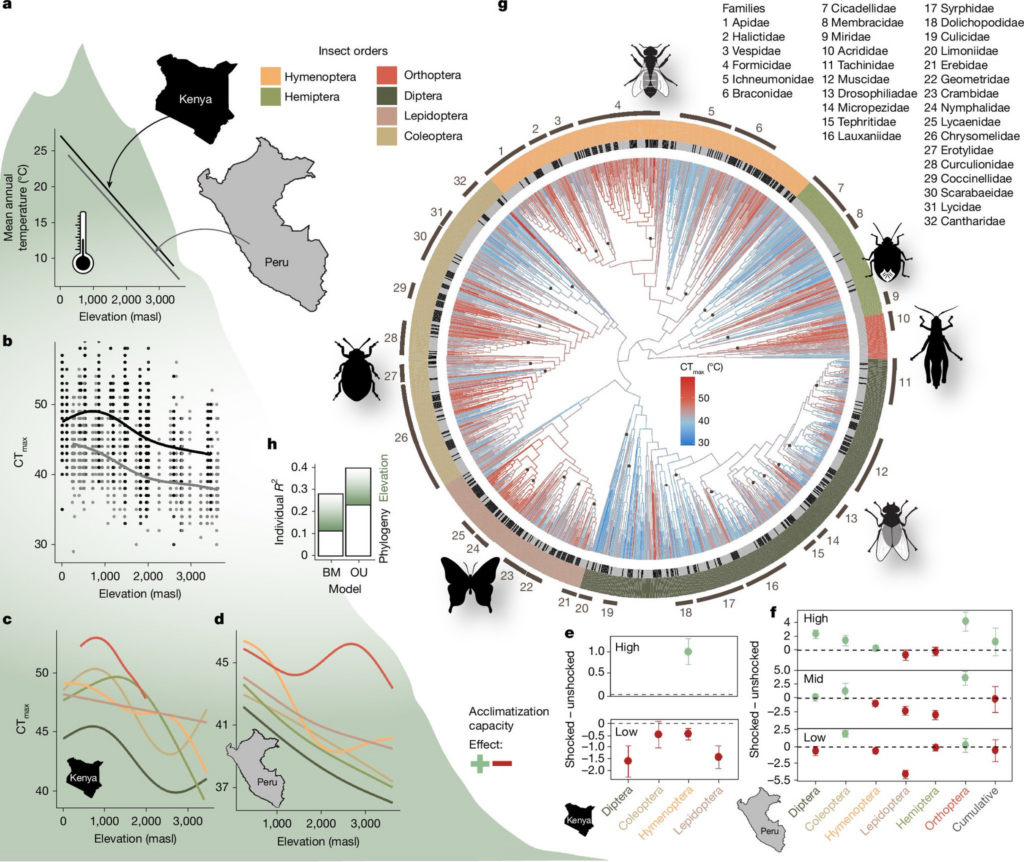
a, Mean annual temperature decreased linearly and was slightly lower at the Neotropical (Peru) gradient compared with the Afrotropical gradient (Kenya). b, Field-measured critical thermal maxima (CTmax) of insects (n = 3,229) decreased along both gradients. c,d, This pattern was also visible along the Afrotropical gradient (c) and the Neotropical gradient (d) for each major insect order. Trend lines were calculated with generalized additive models with the smooth term parameter set to k = 5. e,f, For both the Afrotropical gradient (e) and the Neotropical gradient (f), a potential to tolerate higher temperatures after a heat shock treatment was evident at high elevations (high, >1,200 masl) but the effect decreased with elevation (mid, 600–1,200 masl) and became negative in lowland habitats (low, <600 masl) in most insect orders (n = 777 insects). Data are mean ± s.e.m. g, Phylogenetic supertree constructed by adding trees constructed from DNA sequences (from all sampled insects from which sequences could be derived) onto a family-level backbone tree with ancestral trait value reconstruction of CTmax. h, The variation in CTmax was more strongly constrained by phylogeny than by effects of local temperature conditions (elevation), as indicated by variance partitioning. The Ornstein–Uhlenbeck (OU) model had better support than the Brownian motion (BM) model.
Limited thermal tolerance in tropical insects and its genomic signature by Kim L. Holzmann, Thomas Schmitzer, Antonia Abels, Marko Corkalo, Oliver Mitesser, Mareike Kortmann, Pedro Alonso-Alonso, Yenny Correa-Carmona, Andrea Pinos, Felipe Yon, Mabel Alvarado, Adrian Forsyth, Alejandro Lopera-Toro, Gunnar Brehm, Alexander Keller, Mark Otieno, Ingolf Steffan-Dewenter & Marcell K. Peters, March 4, 2026, Nature (2026)
Abstract
Insects make up the majority of all animal species, with 70% occurring in the tropics1, yet the impacts of warming on tropical insects remain highly uncertain2. This stems from sparse, taxonomically biased data on thermal tolerance of tropical insects and an incomplete understanding of the underlying physiological mechanisms3. Here we compared environmental temperatures with field-measured upper and lower thermal tolerance limits of around 2,300 insect species along Afrotropical and Neotropical elevational gradients and identified genomic signatures of thermal tolerance across the insect tree of life. We show that thermal tolerances do not proportionally track environmental temperatures but approach an asymptote in tropical lowlands. Insects at high elevations utilize plasticity to cope with rising temperatures, whereas lowland species have limited plastic abilities. Heat tolerance showed strong differences among insect orders and families, reflected in the thermal stability of proteins, suggesting that variation in thermal tolerance is founded in the fundamental protein architecture.
Up to 52% of future surface temperatures and 38% of air temperatures in the Amazonian lowlands can cause heat mortality in half of the studied community. Our data suggest a limited capacity of insects in the Earth’s most biodiverse regions to buffer future warming.
Refer also to: