
Alberta has been under extreme heat and drought for years, still frac’ing continues, and Tech Billionaires and their stolen stupid AI come to steal the last dregs of water, take electricity and gas to drive up costs of living for ordinary citizens, all to make billionaires richer.
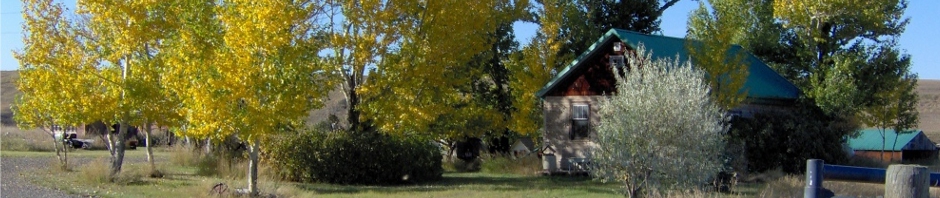
Three years ago, I decided to stop mowing the lawn. Extreme heat and drought was killing grasses where I mowed, helping invasive weeds take over. I do not irrigate (too dangerous with heavily methane and ethane contaminated frac’d water). I had read that longer grasses keep soils and their inhabitants cooler. There was nothing to lose by stopping mowing. Wheatland County council keeps making Rosebud uglier and uglier, wiping out my decades hard work healing, reseeding, cleaning up and restoring the beauty of the raped farm I (stupidly) bought. I say stupidly, because it’s stupid to buy land in rape and pillaged, oil gas and frac industry controlled Alberta.
I love the look of the long uneven grasses, and the many beautiful surprising wild flowers appearing among them. By the second year of no mowing, I started noticing many more insects and swallows flying over the grasses, especially damsel flies, dragon flies, lady bird beetles and wild bees and bumble bees. I’ll never mow again.
I never rake leaves (other than to sometimes pile for jumping in with kids and or dogs). Fall leaves provide vital habitat for many species. I’ll never understand humanity’s insane need to manicure yards and parks, killing everything living there in the process.
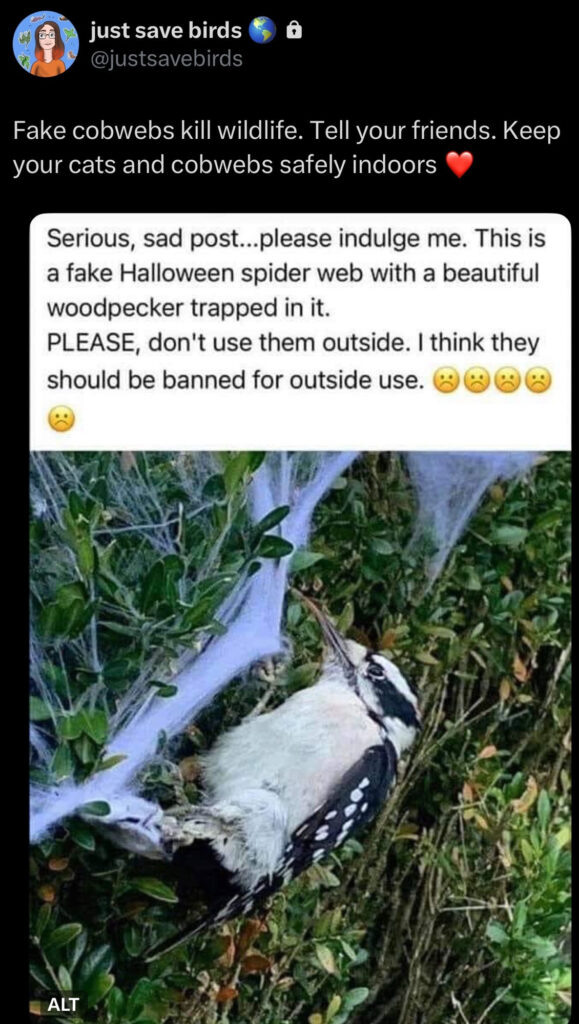
@robin-hood.bsky.social:
People are stupid. and many (stupid and intelligent) humans are cruel and callously don’t give a shit about other species or earth.
@lightsoutforbirds.bsky.social:
“persecution of porcupines took place in the last century when they were clubbed to death, poisoned & trapped. Basically, it was a war on porcupines, because of this reputation they have as tree damagers..not popular with the timber industry, orchardists, or dog owners”

I love porcupines and skunks, especially their happy chatter. I trained my dogs to avoid them, and fence my trees to protect them from porcupines, deer, rabbits, beaver and my neighbour’s livestock. I don’t allow hunters on my land, which has resulted in some humans viciously attacking me, for daring to say no to their invasive activities on my land.
Republicans try to weaken 50-year-old law protecting whales, seals and polar bears
One of the U.S.’s longest standing pieces of environmental legislation, credited with helping save rare whales from extinction, is the subject of an effort for cutbacks from Republican lawmakers who now feel they have the political will to do so by Patrick Whittle, Associated Press, October 11, 2025, ABC News
Republican lawmakers are targeting one of the U.S.’s longest standing pieces of environmental legislation, credited with helping save rare whales from extinction.
Conservative leaders feel they now have the political will to remove key pieces of the Marine Mammal Protection Act, enacted in 1972 to protect whales, seals, polar bears and other sea animals. The law also places restrictions on commercial fishermen, shippers and other marine industries.
A GOP-led bill in the works has support from fishermen in Maine who say the law makes lobster fishing more difficult, lobbyists for big-money species such as tuna in Hawaii and crab in Alaska, and marine manufacturers who see the law as antiquated.
Conservation groups adamantly oppose the changes and say weakening the law will erase years of hard-won gains for jeopardized species such as the vanishing North Atlantic right whale, of which there are less than 400, and is vulnerable to entanglement in fishing gear.
Here’s what to know about the protection act and the proposed changes.
“The Marine Mammal Protection Act is important because it’s one of our bedrock laws that help us to base conservation measures on the best available science,” said Kathleen Collins, senior marine campaign manager with International Fund for Animal Welfare. “Species on the brink of extinction have been brought back.”
It was enacted the year before the Endangered Species Act, at a time when the movement to save whales from extinction was growing. Scientist Roger Payne had discovered that whales could sing in the late 1960s, and their voices soon appeared on record albums and throughout popular culture.
The law protects all marine mammals, and prohibits capturing or killing them in U.S. waters or by U.S. citizens on the high seas. It allowed for preventative measures to stop commercial fishing ships and other businesses from accidentally harming animals such as whales and seals. The animals can be harmed by entanglement in fishing gear, collisions with ships and other hazards at sea.
The law also prevents the hunting of marine mammals, including polar bears, with exceptions for Indigenous groups. Some of those animals can be legally hunted in other countries.
Republican Rep. Nick Begich of Alaska, a state with a large fishing industry, submitted a bill draft this summer that would roll back aspects of the law. The bill says the act has “unduly and unnecessarily constrained government, tribes and the regulated community” since its inception.
The proposal states that it would make changes such as lowering population goals for marine mammals from “maximum productivity” to the level needed to “support continued survival.” It would also ease rules on what constitutes harm to marine mammals.
For example, the law currently prevents harassment of sea mammals such as whales, and defines harassment as activities that have “the potential to injure a marine mammal.” The proposed changes would limit the definition to only activities that actually injure the animals. That change could have major implications for industries such as oil and gas exploration where rare whales live.
That poses an existential threat to the Rice’s whale, which numbers only in the dozens and lives in the Gulf of Mexico, conservationists said. And the proposal takes specific aim at the North Atlantic right whale protections with a clause that would delay rules designed to protect that declining whale population until 2035.
Begich and his staff did not return calls for comment on the bill, and his staff declined to provide an update about where it stands in Congress. Begich has said he wants “a bill that protects marine mammals and also works for the people who live and work alongside them, especially in Alaska.”
A coalition of fishing groups from both coasts has come out in support of the proposed changes. Some of the same groups lauded a previous effort by the Trump administration to reduce regulatory burdens on commercial fishing.Humans are hideous; not too many years of life left in the oceans thanks to our viciousness. The Nazi Trump regime will speed up the murderous horrors.
The groups said in a July letter to House members that they feel Begich’s changes reflect “a positive and necessary step” for American fisheries’ success.
Restrictions imposed on lobster fishermen of Maine are designed to protect the right whale, but they often provide little protection for the animals while limiting one of America’s signature fisheries, Virginia Olsen, political director of the Maine Lobstering Union, said. The restrictions stipulate where lobstermen can fish and what kinds of gear they can use. The whales are vulnerable to lethal entanglement in heavy fishing rope.
Gathering more accurate data about right whales while revising the original law would help protect the animals, Olsen said.
“We do not want to see marine mammals harmed; we need a healthy, vibrant ocean and a plentiful marine habitat to continue Maine’s heritage fishery,” Olsen said.
Some members of other maritime industries have also called on Congress to update the law. The National Marine Manufacturers Association said in a statement that the rules have not kept pace with advancements in the marine industry, making innovation in the business difficult.
Numerous environmental groups have vowed to fight to save the protection act. They characterized the proposed changes as part of the Trump administration’s assault on environmental protections.
The act was instrumental in protecting the humpback whale, one of the species most beloved by whale watchers, said Gib Brogan, senior campaign director with Oceana. Along with other sea mammals, humpbacks would be in jeopardy without it, he said.
“The Marine Mammal Protection Act is flexible. It works. It’s effective. We don’t need to overhaul this law at this point,” Brogan said.
The original law makes it illegal to import marine mammal products without a permit, and allows the U.S. to impose import prohibitions on seafood products from foreign fisheries that don’t meet U.S. standards.
The import embargoes are a major sticking point because they punish American businesses, said Gavin Gibbons, chief strategy officer of the National Fisheries Institute, a Virginia-based seafood industry trade group. It’s critical to source seafood globally to be able to meet American demand for seafood, he said.
The National Fisheries Institute and a coalition of industry groups sued the federal government Thursday over what they described as unlawful implementation of the protection act. Gibbons said the groups don’t oppose the act, but want to see it responsibly implemented.
“Our fisheries are well regulated and appropriately fished to their maximum sustainable yield,” Gibbons said. “The men and women who work our waters are iconic and responsible. They can’t be expected to just fish more here to make up a deficit while jeopardizing the sustainability they’ve worked so hard to maintain.”
Some environmental groups said the Republican lawmakers’ proposed changes could weaken American seafood competitiveness by allowing imports from poorly regulated foreign fisheries.
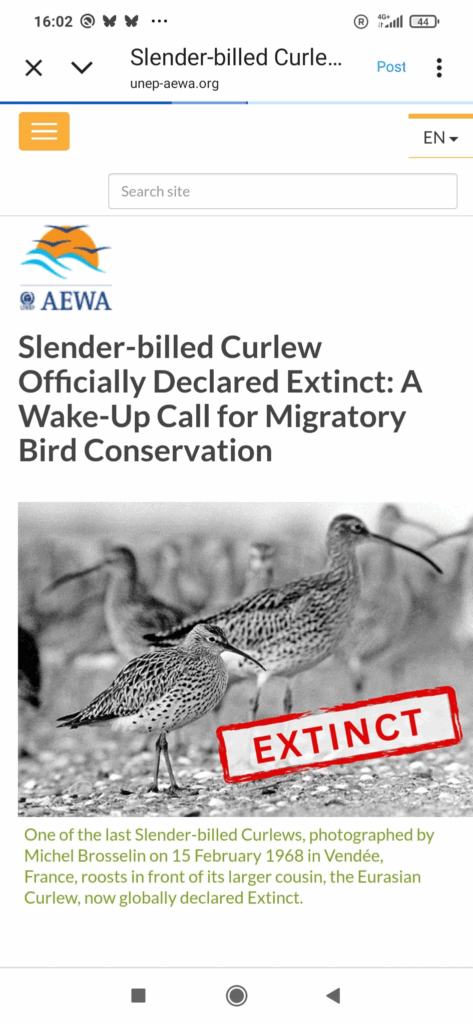
@curlewcalls:
Tragic. Preventable. Final.
The Slender-billed Curlew is officially extinct, declared today by the IUCN. On our watch.
We are technically brilliant and carelessly blind.
Sit with the silence. Then fight for what remains. #Extinction #BiodiversityCrisis #Curlews
@DavidGray
@DrTOMontgomery:
Extinction
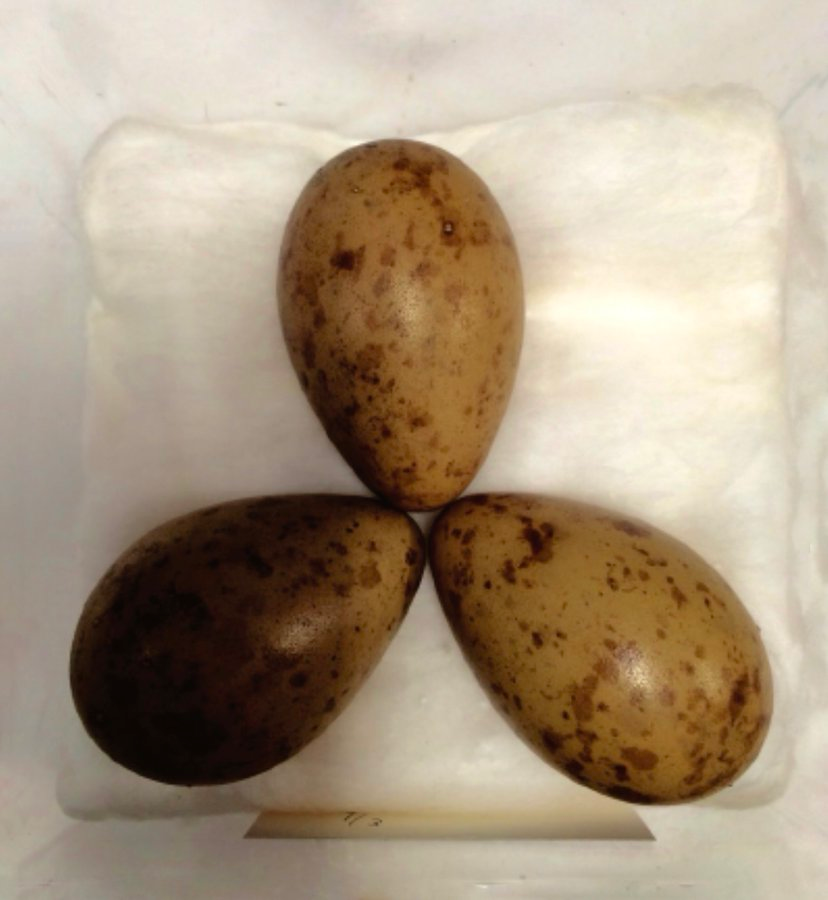
Three eggs laid by one of the last slender-billed curlews.
Officially confirmed extinct by IUCN October 10, 2025.
She invested in the future of her species; we invest in wiping them out.
@ECOWARRIORSS:
Humans fast creating a world where birds will be gone forever
More than 6 in 10 bird species around the world are in decline as agriculture and logging threaten their homes, 61% of bird species worldwide declining populations, an increase from 44% in 2016
@chistery1.bsky.social:
In many cases, you can just drive around your own community to see even tiny patches are always being devoured.I observe the vile devouring by humans daily, sometimes 5-6 times daily. It has horrified me all my life, still horrifies me. Most humans I talk to about it, don’t give a fuck, they’re more interested in their next holidays, next vehicle (and trying to make me buy a new one, which I absolutely do not need), more sex, more money, more freebies from gov’t, more church (why? to appear saintly while wiping out other life on earth?), etc. Protecting vital natural resources and habitats essential for other species to thrive? Nope. Certainly these don’t compare to “wild strongholds” but imagine the additive effect of squeezing in yet more development.
@race2extinct.bsky.social:
Everywhere. The growth mindset is overwhelming the planet……and people are oblivious.
@peterhagedoorn.bsky.social:
Too bad when mankind destroys wild strongholds as Okavango and Amazon. Seems nothing is holy for greediness of mankind.
@race2extinct.bsky.social:
The only thing that is holy is the dollar.And mankind’s war on women and girls forcing sex and forced birthing on them even when they insist no, and greedily making too many babies, not giving a damn that every new human baby born demands more natural resources and more water destroying frac’ing, and destruction of habitats other species need to survive to squeeze in that new greedy devouring human monster, and heaps more waste-filled plastic lined diapers overflowing landfills globally.
Number of wild bee species at risk of extinction in Europe doubles in 10 years, Number of endangered butterfly species also surging amid habitat destruction and global heating, finds study by Patrick Barkham, 11 Oct 2025, The Guardian
The number of wild bee species in Europe at risk of extinction has more than doubled over the past decade, while the number of endangered butterfly species has almost doubled.
The jeopardy facing crucial pollinators was revealed by scientific studies for the International Union for Conservation of Nature (IUCN) red list of threatened species, which found that at least 172 bee species out of 1,928 were at risk of extinction in Europe.
The number of butterflies threatened with extinction in Europe has increased from 37 to 65 since the last study, conducted 14 years ago. One species, the Madeiran large white (Pieris wollastoni) has now been declared extinct.
“Beyond their beauty and cultural significance, pollinators like bees and butterflies are lifelines for our health, our food systems and our economies – sustaining the fruits, vegetables and seeds that nourish us,” said Grethel Aguilar, the IUCN director general. “The latest European red list assessments reveal serious challenges, with threats mounting for butterflies and crucial wild bee species.”
The causes of the rapid recent declines are the continuing destruction or damage of habitats caused by agricultural intensification and land abandonment, draining wetlands, overgrazing by livestock, and the use of fertilisers and pesticides including neonicotinoids. The fragmentation of pollinator-friendly habitat greatly increases the risk of local extinctions.
Global heating is also revealed to be a major threat: 52% of all endangered butterflies in Europe are imperilled by the climate crisis – approximately twice as many as a decade ago.
Up to 90% of flowering plants in Europe depend on animal pollination, according to Dr Denis Michez, lead coordinator of the wild bee assessment. “Sadly, wild bee populations are in drastic decline and cannot be easily replaced by managed colonies,” he said. “If wild bees disappear, many wild plants might be at risk too – of which flower-rich meadows and beautiful orchid species are just a few examples.”
Fifteen species of bumblebee, which play a crucial role in pollinating peas, beans, peanuts and clover, and 14 species of cellophane bee, known for pollinating trees such as willows and red maples, are now classified as threatened. Simpanurgus phyllopodus, a mining bee unique to the continent and the only species of this genus in Europe, is now assessed as critically endangered – the scientific category closest to extinction in the wild.
Butterflies that are only found on mountain tops are particularly vulnerable to global heating as they need to move uphill as their habitats become warmer but eventually run out of space. In southern Spain, the Nevada grayling and the Andalusian anomalous blue are among more than 40% of European endemics (only found in Europe) threatened with extinction.
In the Mediterranean, species such as the critically endangered Karpathos grayling are imperilled by extreme drought and wildfires.
Meanwhile, in the Arctic Circle, global heating is causing the tree line to move north by tens of metres each year, with scrub encroaching on bog and tundra. Warmer conditions also mean reindeer can no longer cross the ice to graze Arctic grasslands and keep them open. Eight butterfly species are threatened with extinction in this region, including Freyja’s fritillary and the Arctic ringlet.
“The biggest habitat for all these pollinators is flower-rich grassland and that is disappearing very fast across Europe because of all these factors,” said Martin Warren, one of the lead coordinators of the butterflies assessment. “The positive thing is that so many people care now and there’s a lot more awareness. Under the EU nature restoration legislation, all member states have to reverse the decline in pollinators by 2030, and they are going to have to start doing something. There are landowners who are interested. Let’s hope they can get the incentives that will help them on their way.”
According to Warren, there is “low-hanging fruit” in terms of action for pollinators which won’t reduce food production – and may enhance it – such as farmers creating flower-rich margins around their fields.
Jessika Roswall, EU commissioner for environment, water resilience and a competitive circular economy, described the conservation status of wild bees, butterflies and other pollinators as “dire”.
“Urgent and collective action is needed to tackle this threat. Together with member states, the European Commission has put in place an EU-wide monitoring system for pollinators based on the EU nature restoration regulation, which will help to track our progress. Now, we need to focus on implementation and cooperation with member states to protect our pollinators,” she said.
The publication of the bee and butterfly assessments comes after the first Europe-wide assessment of hoverflies, another crucial pollinator group. Published in 2022, it revealed that 37% of all hoverfly species in Europe were threatened with extinction.
@race2extinct.bsky.social:
Since the Endangered Species Act became law, ~1.36 million species have gone extinct.
It’s funny how easily we speak of humanity’s “salvation” while driving every other form of life off the planet.
***
High-resolution ‘fingerprint’ images reveal a weakening Atlantic Ocean circulation (AMOC) by Prof. Stefan Rahmstorf, 12 Oct 2025
The #AMOC is the reason for Europe’s mild climate. Evidence that it is slowing has been piling up over the years – it now is likely at its weakest in at least a millennium, and it may even be approaching a tipping point. Here I will show you the latest high-resolution images – and also discuss whether there is serious evidence speaking against an ongoing AMOC weakening.
Our regular readers are well aware of the Atlantic Meridional Overturning Circulation, or AMOC in short, a large-scale overturning motion of water along the whole Atlantic which transports a quadrillion Watts (that is 1015 W) of heat to the northern Atlantic, partly via the Gulf Stream. (If you are new to the topic, check out this article.)
Instabilities of the AMOC have produced some of the most dramatic climate changes in recent Earth history, well-known to paleo-climatologists (see e.g. my by now ancient review in Nature 2002), and concerns that we are destabilizing it by causing global warming has been rising sharply in expert circles in recent years (see last year’s open letter by 44 experts).
One reason is what we are observing in the northern Atlantic. And another reason is the latest model simulations by the Dutch research group in Utrecht. A recent paper by van Westen et al. (2025) has shown that the much-feared tipping point where the AMOC breaks down (first demonstrated in a simple box model in 1961) is also found in a high-resolution (eddy resolving) ocean model – destroying any hope that it might be an artifact of too coarse and simple models. This tipping point has been consistently demonstrated across the entire model spectrum by now, and the cause is well-understood (a destabilizing salt transport feedback).
Also, that model simulation and paper provide us with the AMOC ‘fingerprint’ in sea surface temperature (SST) in unprecedented detail. So let’s have a look (Fig. 1)!
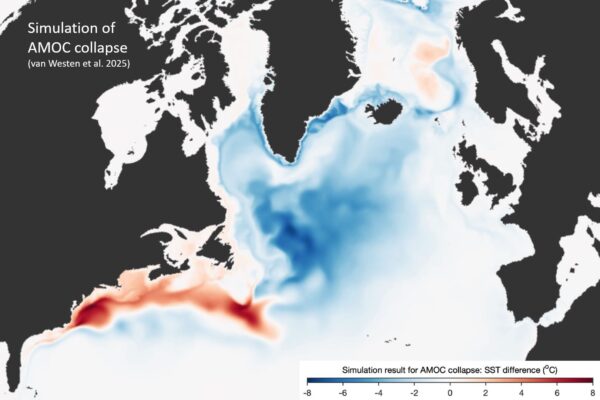
Figure 1. Sea surface temperature change pattern caused by the AMOC shutting down in a high-resolution ocean model. This is a pure AMOC effect without any greenhouse-gas climate change. We see the famous blue ‘cold blob’ due to less heat being brought to the northern Atlantic, and also in red the northward Gulf Stream shift, an ocean dynamics effect of weakening AMOC (Zhang 2008). Source: van Westen et al. 2025., mapped by Ruijian Gou.
And now compare that fingerprint pattern to the trend in satellite sea surface temperature measurements (Fig. 2). What do you see?
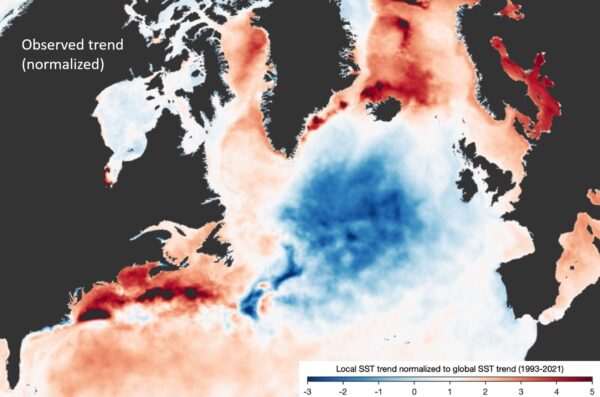
Figure 2. Normalised trend in satellite-derived sea surface temperature 1993-2021 (linear trend over that period). Normalised means it is divided by the global mean sea surface temperature trend in order to take out the global warming signal. So blue regions (values less than 1) have warmed less than the global mean or cooled, red have warmed more than average. Source: Copernicus satellite data, mapped by Ruijian Gou.
The cold blob and the Gulf Stream shift signal are both clearly seen in the satellite trend. Note we are only comparing the pattern, not its amplitude, and the colors correspond to different units: In the observational data we are talking about a moderate AMOC change, in the model a near-complete shutdown. That explains also the differences: in the satellite map the Labrador Sea hasn’t cooled, presumably as deep convection there still continues. And the Nordic Seas have warmed – we have a paper in preparation which shows this is due to increased flow of warm water toward the Nordic Seas and likely a result of AMOC weakening; these two overturning motions are dynamically anticorrelated, but only temporarily so until Nordic Sea convection shuts down.
Taken together, these two images provide once again clear evidence that an AMOC weakening is underway – as was first argued fifteen years ago by Dima and Lohmann (2010). The same fingerprint is also found in a coupled climate model simulation for CO2 doubling by the Geophysical Fluid Dynamics Lab in Princeton, as shown in Fig. 1 in this blog post from 2018. And the fingerprint pattern of cold blob and Gulf Stream shift can also be seen for a different time interval in the following global image of sea surface temperature change (Fig. 3).
This weakening is of particular concern because the AMOC has a tipping point, and our recent study has shown that in many of the standard future global warming simulations performed for the current IPCC report the AMOC passes that tipping point and shuts down in the following decades. The Guardian rightly titled that this danger “is no longer low-likelihood”, as we had discussed it for decades.
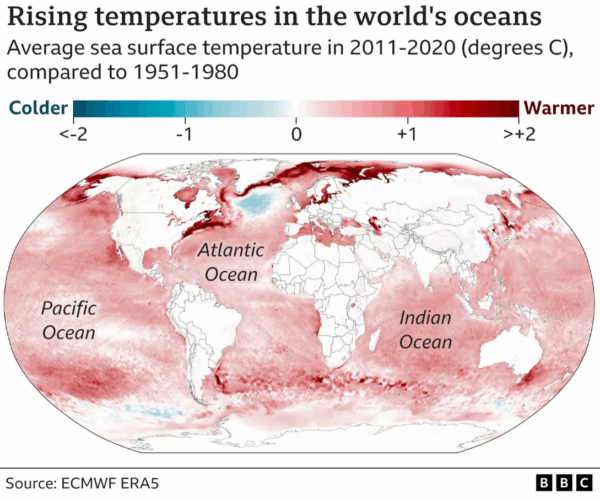
Figure 3. Global map of changes of sea surface temperature. Source: ERA5/BBC
What about counter-arguments?
I sometimes read counter-arguments against an ongoing AMOC slowing, but many just don’t hold water. Let’s have a look at some of them.
For example, the increase in Nordic Sea exchange is sometimes taken as contradicting an AMOC weakening – but that is a non-sequitur as there is no reason why these two circulations should be in sync, but good physical reasons and empirical evidence suggest that in fact they anti-correlate.
Not seldom different time periods are mixed up – for example when the Worthington et al 2021 reconstruction is quoted as questioning an AMOC weakening. Let’s compare that to the reconstruction by Caesar et al. 2018 where we estimated a 15 % weakening since the late 19th Century (Fig. 4) – I would say these two reconstructions strongly agree during the time interval 1981–2016 covered by Worthington.
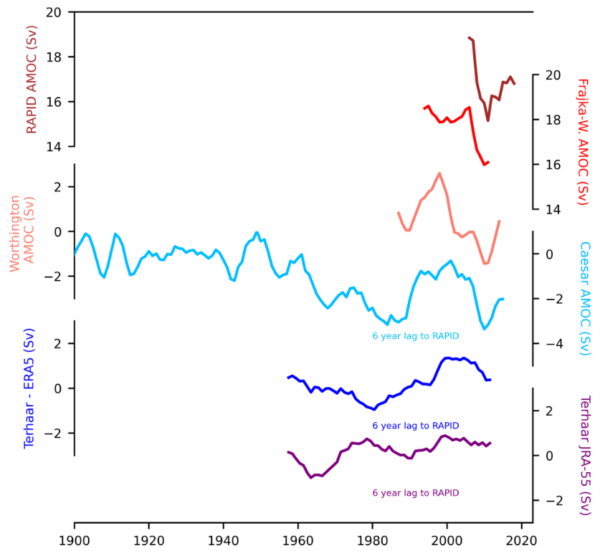
Figure 4 Several AMOC reconstructions, with the RAPID measurements on top. The reconstruction by Frajka-Williams et al. 2015 used surface height data from satellite, and the Worthington et al 2021 reconstruction uses a water mass regression based on RAPID data. Graph: Levke Caesar.
One recent prominent paper by Terhaar et al. (2025) that has questioned AMOC weakening covers a longer interval (1958 to 2022). But for the period since 1958 Caesar et al. 2018 also did not find a statistically significant AMOC weakening – so strictly no contradiction there – and what’s more, the calculated input data used (surface heat fluxes) are far more uncertain than the directly measured sea surface temperatures, as we can see in the large differences between their two reconstructions (dark blue and purple) using two different surface flux data sets. And they both disagree with the likely more reliable reconstruction method by Worthington. (More on the Terhaar study here.)
Then there is Latif et al. 2022. They don’t claim to contradict the Caesar reconstruction, they explicitly write they don’t. What they argue is that natural variability is larger than an anthropogenic effect. That is not the same as saying there is no AMOC slowing. In the Caesar reconstruction multidecadal variability is also larger than the slowing trend. I always show Latif et al 2022 in my talks in support of the observed SST fingerprint pattern indicating an AMOC slowing, since their paper shows a clear correlation of the SST fingerprint with the AMOC (as shown in Fig. 2 here in this post).
Sometimes also a paper by Rossby et al. 2022 is cited as questioning an AMOC slowdown. Let’s just quote their abstract: “There is evidence for a 2.0 Sv Gulf Stream slow-down between 1930 and 2020. Whether and to what extent this reflects a slowdown of the AMOC or wind-driven circulation cannot be established with certainty. Our estimate of a 0.4 Sv AMOC decrease is reported with low confidence.” They thus report a slowdown, just with low confidence.
There is also a reconstruction since 1900 by Fraser and Cunningham 2021. They write that “from the 1930s onwards we see qualitative agreement with Caesar et al. (2018), with mostly a high AMOC until the 1950s, followed by a weakening throughout the 1960s and then a lesser peak around 2000”. There is disagreement between 1900 and 1930, where however their method is very uncertain, so they conclude that although their “results do not resolve AMOC weakening over the last century, they should not be interpreted as evidence to the contrary.” Which some people do nevertheless.
As another example, a paper by He et al. 2022 argues based on a model simulation that the SST fingerprint pattern could also be caused by surface fluxes rather than an AMOC weakening. However, the observed fluxes suggest the opposite. And their model simulation starts in 1920 with a prescribed constant ocean heat transport that doesn’t match the initial state of the atmosphere – a model setup which invariably leads to an initial adjustment process of the model (in other words, climate drift) which will likely look like the ocean heat transport fingerprint, as I discuss in this talk.
And finally there was a paper which many media reported as showing a much more resilient AMOC even though it just redefined the word AMOC collapse, and the Volkov study about a stable Florida Current which climate skeptics confused with the AMOC (see postscript here).
So while there is quite a number of studies with different methods using temperature or salinity data or paleoclimate proxy data from ocean sediments that support a weakening AMOC since the 19th Century (as I have previously discussed e.g. here, here and here), I do not really see a credible counter-argument. If you know one that I have missed, please let me know in the comments!
And as a final reminder: if there is a risk that the AMOC is weakening and heading towards a tipping point, we need to act on that (just like with other major risks). This is not an issue where we can afford to wait until we are certain, or pretend it’s just an academic discussion without major consequences.
If you want more information on this…
My overview article in Oceanography Magazine (open access, many pictures)
My Alfred Wegener Medal lecture at the European Geosciences Union meeting 2024
@jrockstrom:
If the likelihood of a catastrophic event is > 10% then the Risks are unacceptable high. This is the point we have reached on scientific evidence for AMOC shutdown. This is the “Don’t look up moment” for risks of liveability on Earth
@WeatherProf:
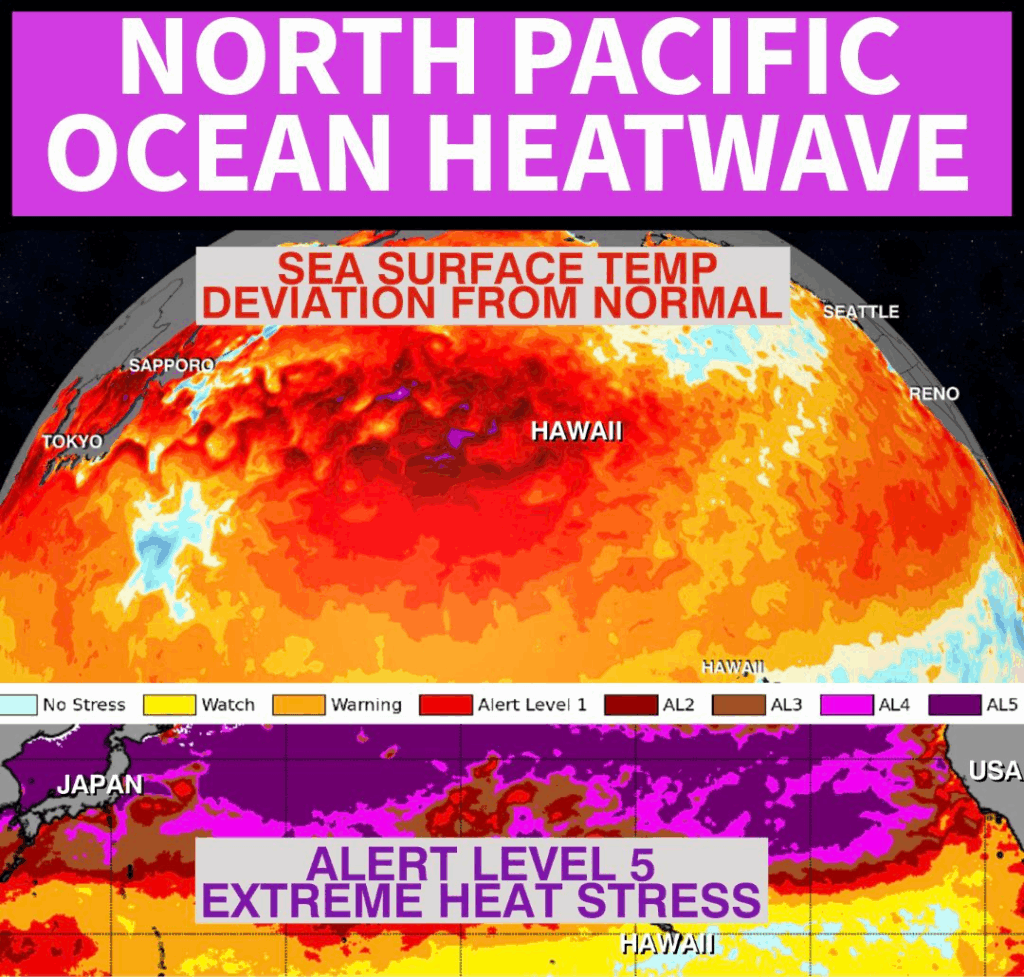
The North Pacific heatwave these past few months has been astonishing. Take a look at the bottom of this image. It’s “accumulated heat stress” from NOAA’s Coral Reef Watch program. Basically the whole north basin registers Alert Level 5, dark purple. The dark purple also happens to correspond with areas that have been 5-8C (9 to 14 F) above normal at some point in the past few months.
(Luckily there is little coral impacted as this alert level
5 is for surface water north of the coral zone. I’m no biologist but I imagine it has a big impact on ocean life)
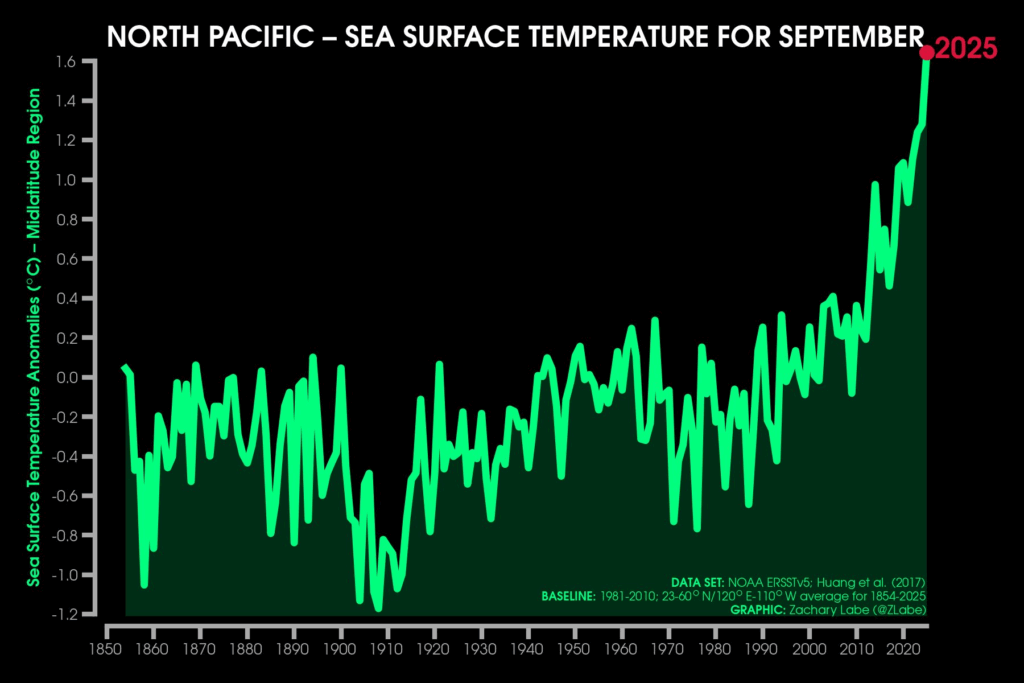
Now – I hope you are sitting – because take a look at this next graphic for September from @ZLabe
Top right is how far “off the charts” September 2025 sea surface temps are in this area of the North Pacific. >1.6C or ~3F above normal on average over this huge area.
I’d say even more alarming than the actual anomaly is the trend since 2010. In 15 years the anomaly jumped more than 2F!
Much of this is likely due to the unmasking of global warming from the decrease in aerosol pollution. This allows for more ocean heating from more direct sun getting through and reduction in clouds due to feedbacks. 2/ …
***
Top 40 Impacts of Climate Change by Eliot Jacobson, Ph.Dm, Oct 16, 2021
In this post, I list 78 current and future impacts of climate change, along with references for some of the more unexpected items. That list was compiled scouring the web along with suggestions and comments to a Twitter post I made. In retrospect, many of these items are redundant or speculative. And so, I refined that list down to 40 distinct and near certain short-term consequences, which is what I present here.
Most of these consequences are already happening to some degree. Many of these are harbingers of the collapse of modern industrial civilization. Some of these are foretelling of the sixth great extinction. All of them are extraordinarily sad.
As I write this, politicians all over the world continue to side with the fossil fuel industry. Greenhouse gasses, including CO2 and methane, continue to spike. The weather just gets more deadly and more chaotic. It’s hard to believe we have until 2050 (net-zero) or even 2030 to get on track. Truth: we don’t.
I am not suggesting that this is a list of problems that will be “solved” by addressing climate change. It’s too late for that. The events in this list will happen with ever increasing severity the deeper we get into the climate crisis.
There is so much suffering ahead. Be kind, be generous, be of service.
Top 40 Impacts of Climate Change
1. Acid rain
2. Algae blooms
3. Ash & smoke
4. Bees dying & pollination loss
5. Climate refugees & migration
6. Coral bleaching
7. Crop failures
8. Deforestation
9. Desertification
10. Disease, pandemics (plants & animals)
11. Droughts
12. Drying up of lakes, rivers, wells, springs
13. Earth axis shift
14. Earthquakes, Tsunamis, Volcanoes
15. Extreme cold
16. Financial/bank/stock collapse
17. Fires
18. Floods
19. Food & water riots
20. Hazardous, smoke-filled & polluted air
21. Heat waves: frequency, power, duration
22. Hunger, famine & starvation
23. Infrastructure collapse
24. Melting Antarctic & Greenland land ice
25. Melting Arctic & Antarctic sea ice / Blue Ocean Event
26. Melting glaciers (drinking water crisis)
27. Methane bomb (Siberian permafrost methane & Clathrates from ESAS)
28. Nuclear plant meltdown
29. Ocean acidification & deoxygenation
30. Ozone layer depletion
31. Permafrost thaw
32. Price instability & inflation
33. Reanimated bacteria/viruses
34. Sea level rise (e.g. Thwaites glacier)
35. Shutdown of AMOC, SMOC
36. Species extinction (100+/day)
37. Storms — more frequent, power, duration
38. Supply chain & transportation collapse
39. Unemployment & poverty
40. War, extremism, fascism & terrorism
References
Algae Blooms
- Is Humanity Doomed? Science Says We Are In The Middle Of A ‘Mass Extinction Event’, India Times, September 26, 2021
- Mass Extinction Events Can Turn Freshwater Into Toxic Soup, And It’s Already Happening, Science Alert, September 19, 2021
Bees & Pollination Loss
- Bumblebees are going extinct in a time of climate chaos, National Geographic, February 7, 2020
- Climate change reduces the abundance and diversity of wild bees, study finds, PENN State News, September 5, 2021
Earth Axis Shift
- Climate change has shifted the Earth’s axis, new study suggests, USA Today, April 26, 2021
Earthquakes, Tsunamis, Volcanoes
- How climate change triggers earthquakes, tsunamis and volcanoes, The Guardian, October 16, 2016
- Get Ready for More Volcanic Eruptions as the Planet Warms, Scientific American, December 21, 2017
- Five ways climate change increases the threat of tsunamis, Phys.Org, January 22, 2022
Extreme Cold
- A Full List of All The Record Cold Texas Temperatures , Spectrum News 1, February 17, 2021
- Antarctica’s last 6 months were the coldest on record, CNN, October 9, 2021
Nuclear Plant Meltdown
- Climate Change Could Cause Fukushima-Style Meltdowns in the US, The_Byte, April 19, 2019
- 2030 Doomsday Scenario: The Great Nuclear Collapse, Collapse2050.com, April 20, 2025
Ozone Layer Depletion
- The ozone hole over the South Pole is now bigger than Antarctica, CNN, September 16, 2021
Price Instability and Inflation
- The Great Inflation of the 2020’s, Eudaimonia, October 19, 2021
Reanimated bacteria/viruses
- Deep Frozen Arctic Microbes Are Waking Up, Scientific American, November 20, 2020
- Permafrost thaw could release bacteria and viruses, The European Space Agency, October 22, 2021
Supply Chain Collapse
- The workers who keep global supply chains moving are warning of a ‘system collapse’, CNN, September 29, 2021
Thwaites Glacier
- ‘The Fuse Has Been Blown,’ and the Doomsday Glacier Is Coming for Us All, Rolling Stone, December 29, 2021
Refer also to: