@race2extinct.bsky.social:
This headline would have been accurate at almost any point in the last few centuries.
Bird decline didn’t begin with modern monitoring. It began with habitat destruction and commercial exploitation.
What’s new isn’t the loss.
It’s that we can finally measure it.
@lyragrafenstahl.bsky.social:
Brids (aaside of the Usual suspects) returning to cities was probably the most notable side effect of the COVD lockdowns. Less traffic and thus less noise really did something. Not just for the Birds though. I loved the lockdowns, the quiet and yes, the birds. The world was still, the sky clear, and it was blissfully quiet. I couldn’t get enough of it.
@BroncoBilly360:
Audubon Society: Cats are wiping out America’sand Canada’s and the world’s bird population.
Cats Pose an Even Bigger Threat to Birds than Previously Thought
… A new study estimates that domestic cats, considered a global invasive species, kill 1.4 to 3.7 billion birds in the lower 48 states each year. “Our findings suggest that free-ranging cats cause substantially greater wildlife mortality than previously thought and are likely the single greatest source of anthropogenic mortality for US birds and mammals,” write the authors of the study, published in Nature Communications. …
Cats also kill 6.9–20.7 billion mammals each year
LycanFerret:
Ban all pesticides and herbicides, turn off nighttime lights in cities and on streets.And, in rural areas and towns, on farms and rural acreages, and on highways, compressor stations (frac’ing invades with horrific light pollution, among other harms, including chemical) and other industrial facilities, etc. The new hideous incredibly abusive stupid LED explosion – putting insanely massive industrial LED lights and too many of them on highways, streetlights, buildings closed for the night, and on homes, seed plants, and farms, is human ego, cruelty and a deadly waste of energy. I used to love walking at night, but now I hate it because more and more massive harmful LEDs are being installed everywhere, blinding and infuriating me. The harm to birds and insects, notably pollinators,is worse. It could be mitigated by turning the fucking lights off or putting timers or sensors on them. But, every time I ask for mitigation, more LEDs appear.
@VeronicaTellsIt:
I’ve noticed this personally in own lifetime. As a child in the 60s my suburban backyard was full of birds all day long. Now my backyard is silent.
@VWolfhound74839:
Cats are the leading human-related cause of bird mortality in North America, killing an estimated 1.3 to 4 billion birds annually in the U.S. and 60–350 million in Canada.
@delysscious7:
Can you imagine one day Playing the sound of birds singing on your phone cause you don’t get to hear it anymore. I’m gonna throw up
@AlabamaBags:
Look at the decline of grassland habitat over the past 30 years, particularly in the Southeastern US. Bring back the grasslands, savannas, and woodlands of the SE and birds will recover
Acceleration hotspots of North American birds’ decline are associated with agriculture by François Leroy, Marta A. Jarzyna, and Petr Keil, Feb 26, 2026, Science Vol 391, Issue 6788 pp. 917-921
Editor’s summary
Human activities, including dramatic changes to land cover and land use, are known to negatively influence populations of many species. As human populations and technologies have expanded, so has the rate of our influence on ecosystems. Leroy et al. investigated whether this “Great Acceleration” has led to increasing abundance changes in birds, one of the most highly studied taxonomic groups. Using data from the North American Breeding Bird Survey, the authors found that about half of the 261 species analyzed showed significant declines from 1987 to 2021, and a quarter showed accelerating declines. Hotspots of accelerating abundance decline were located in regions with high-intensity agriculture (high cropland area, fertilizer use, or pesticide use). —Bianca Lopez
Abstract
Human activities might have accelerated declines of population abundance, but this acceleration remains underexplored. Using 1033 North American Breeding Bird Survey routes, we analyze abundance change and its acceleration for 261 bird species, 54 avian families, and 10 habitats from 1987 to 2021. We show an average continent-wide decline of abundance of all birds per local route, with hotspots of decline in southern and warm parts of North America and hotspots of accelerating decline in the Mid-Atlantic, Midwest, and California, matching patterns of agricultural intensity. Overall, 122 species (47%) exhibit significant declines, of which 63 also show acceleration of this decline, and 67 show declining per-capita growth rate, raising concerns for a large part of North American bird populations. These findings suggest that bird abundance decline is mostly accelerating, with spatial patterns of this acceleration indicating that agricultural intensity may be a driver of this trend.
@Washingtonpost:
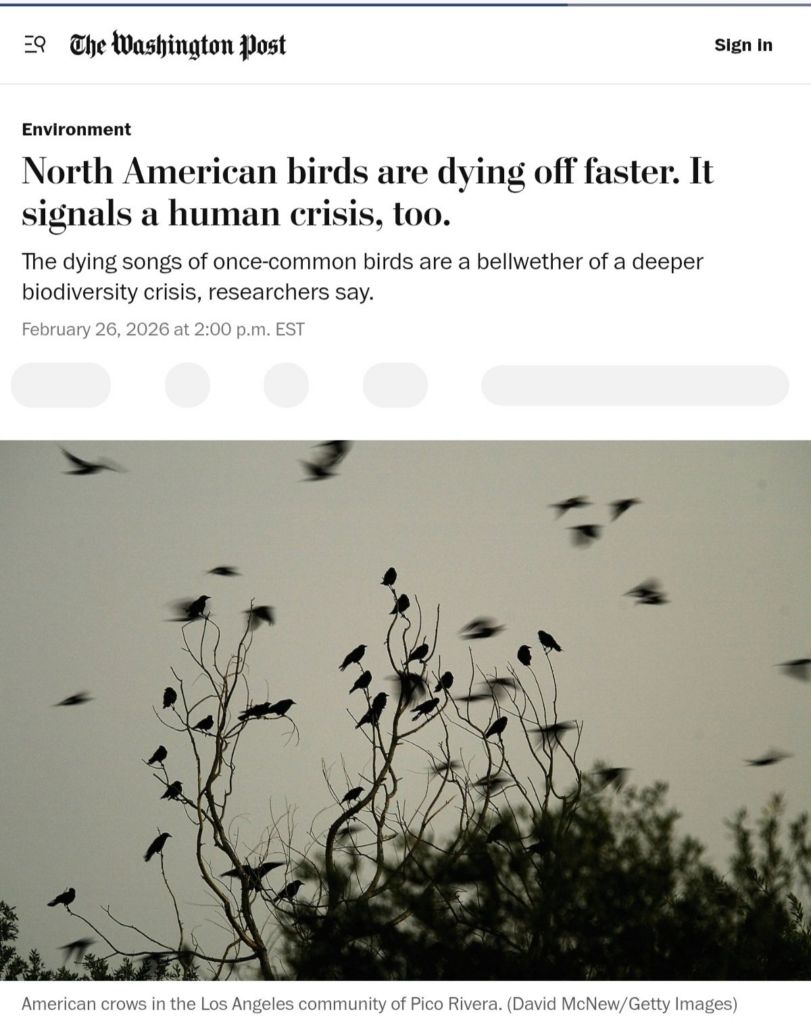
Many of North America’s birds are in a state of accelerating decline, with over half of 122 species dying out faster, according to a new study. Their vanishing songs are a bellwether of a far deeper biodiversity crisis, researchers say.
IGiveAHop;
“A staggering loss that suggests the very fabric of North America’s ecosystem is unraveling.”
Way too many species are dying off due to warming, pesticides, fertilizer.
Climate
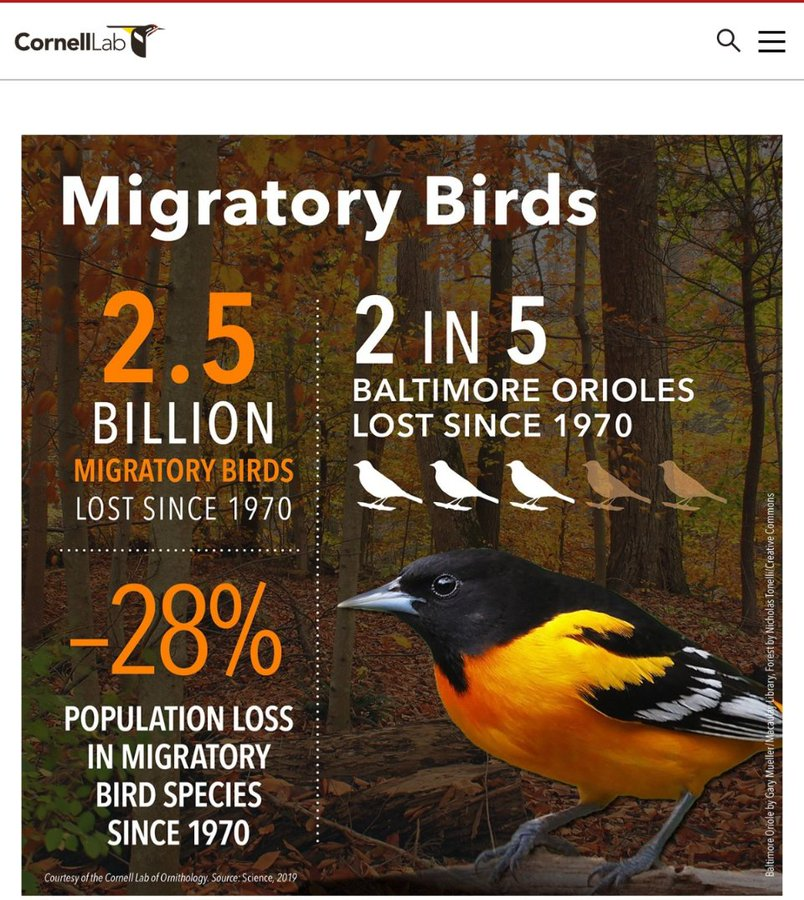
I love birds and their song, especially brown thrasher, catbird, red polls, goldfinch, pine grosbeaks, warblers, juncos and Baltimore orioles. Many birds live and nest on my land. Families of orioles return to my land at Rosebud in spring, nest and spend spring and summer there. They are beautiful singers, and often sing together with brown thrashers making music better than any human. To my amazement, one male oriole flies along with me when I walk out back on my land (pileated woodpeckers do too!). Other orioles pass through late in fall, even with snow on the ground, and rest awhile at my place. I love owls too, and love to listen to them at night teach their young to hunt, but some summers recently, there were no lessons heard because the owls had no young for lack of food.
Birds and their song were astoundingly plentiful at Rosebud when I moved there nearly 30 years ago. I’ve observed dramatic decline in all bird species, every year. As well as dramatic decline in insects, although I’ve noticed their numbers increase a bit since I quit mowing the lawn (the extreme multi-year drought and the idiots frac’ing us to hell, has it far too dry for mowing).
I go to sleep in dread and wake in dread because of the hideousness of our species.
North American birds are dying off faster. It signals a human crisis, too. The dying songs of once-common birds are a bellwether of a deeper biodiversity crisis, researchers say by Sarah Kaplan, February 26, 2026, The Washington Post
With every passing year, the springtime chorus grows quieter. There are fewer song sparrows cheeping amid the shrubs and grasses. The high-pitched trill of the indigo bunting is muted. Even the raucous calls of American crows are fewer and further between.
Decades of observations collected from all corners of the continent show that many of North America’s birds are in a state of accelerating decline, according to a new study in the journal Science.
Their vanishing songs are a bellwether of a far deeper biodiversity crisis, researchers say — one that threatens not only beloved species but also the humans who live alongside them.
“It’s bad enough if you’re seeing population sizes decreasing,” said co-author Marta Jarzyna, an ecologist at Ohio State University.
“But it’s even worse when that loss is stronger with each year, because eventually you will get to the point of no population left.”
The new analysis builds on years of data showing that birds are becoming less abundant, and provides the first-ever evidence that losses are accelerating, according to Jarzyna. Of 122 species with declining populations, her team found that more than half were dying out at an ever-faster rate.
The study also offers vital clues about the forces behind this trend. Populations living in warmer climates and regions of intense agricultural production saw the largest, most precipitous declines — suggesting that climate change may be compounding the negative effects of farming practices, Jarzyna said.

Since the 1962 publication of Rachel Carson’s “Silent Spring,” the loss of birds has often served as a leading indicator of broader environmental harms, said Amanda Rodewald, director of the Center for Avian Population Studies at the Cornell Lab of Ornithology. The decline of bald eagles brought attention to the dangers of the pesticide DDT, which was later found to also disrupt human hormones. The deaths of American crows in the late 1990s served as a warning sign of imminent West Nile virus outbreaks among people.
The fact that bird population losses are now accelerating should be “a wake-up call” about the entangled perils of climate change and pollution, said Rodewald, who was not involved in the Science study.
“We live in the same environments as birds,” she said. “And if they’re not healthy for them, they’re unlikely to be healthy for us.”
The findings published this week draw from the North American Breeding Bird Survey — a long-term monitoring program that study author François Leroy called “one of the best macroecological datasets in the world.”
Each June, scientists and amateur ornithologists wake before sunrise and set out along some 4,100 survey routes spread across the continent. At designated points, they spend three minutes looking and listening for as many birds as they can find. Once each sighting is catalogued, the surveyors move half a mile along their route and begin to count again.
The length and consistency of the dataset makes it ideal for identifying long-term trends, Leroy said. He and Jarzyna focused their analysis on 261 species recorded along the best-monitored survey routes since 1987.
On average, they found, surveyors are spotting 304 fewer birds per route than they did in the late 1980s — a roughly 15 percent drop in abundance. Just under half of the species studied were experiencing “significant” population loss, especially those that tend to live in grasslands, marshes, towns and open woodlands.
When researchers analyzed how much those losses changed from year-to-year, they found worrying evidence of larger and larger declines. The hardest-hit species weren’t the rarest or most endangered but everyday animals such as blackbirds and robins — an accelerating silencing of the familiar backyard chorus.
To determine the cause of this increase, Leroy and Jarzyna performed a statistical analysis that tested the relative importance of 20 environmental factors, ranging from temperature change to the amount of tree cover.
Areas where bird populations were falling faster coincided perfectly with areas where there was a lot of cropland and heavy use of pesticides and fertilizer.
“The stronger the agricultural intensity, the stronger the acceleration of the decline,” Leroy said.
This correlation doesn’t illuminate precisely why birds in agricultural areas have been hit so hard, he cautioned. It might be because they have lost habitat, or because pesticide use has depleted the insects they eat, or because fertilizer runoff has polluted their water sources. It will take lab experiments and on-the-ground research to determine the ultimate cause.
But the implications of these losses will be felt far beyond flocks and nests, Jarzyna said. Birds play a wide range of critical roles in their habitats: Hummingbirds pollinate flowers. Blue jays cache and disperse seeds. Swallows and nighthawks consume mosquitoes, aphids and other pesky bugs.
“We will probably see cascading consequences for ecosystem functioning,” she said. “If there’s one rule in ecology, it’s that everything is connected.”
Refer also to:
2025: Superb video and artwork on Clark’s Nutcracker and white bark pines: The Bird and the Tree.
@Race2Extinct:
Clark’s nutcracker plants thousands of whitebark pines in a season. No human project can match that.
Lose the bird, lose the tree.
Lose the tree, lose the bird.
Ecosystems are relationships, not machines.And the inhumane billionaire tech bros’ stupid AI and polluting, water guzzling, noisy data centres will drastically escalate humans destroying ecosystems and life on earth – including us, Homo stupidio
The Bird and The Tree 21:16 Min. by Cornell Lab of Ornithology, Aug 14, 2025
2023: Magnificent Documentary: Living in the Time of Dying, meeting the truth of the climate crisis
2021: New study: Songbirds’ reproductive success reduced by natural gas compressor noise.
2018: Fracking tied to reduced songbird nesting success
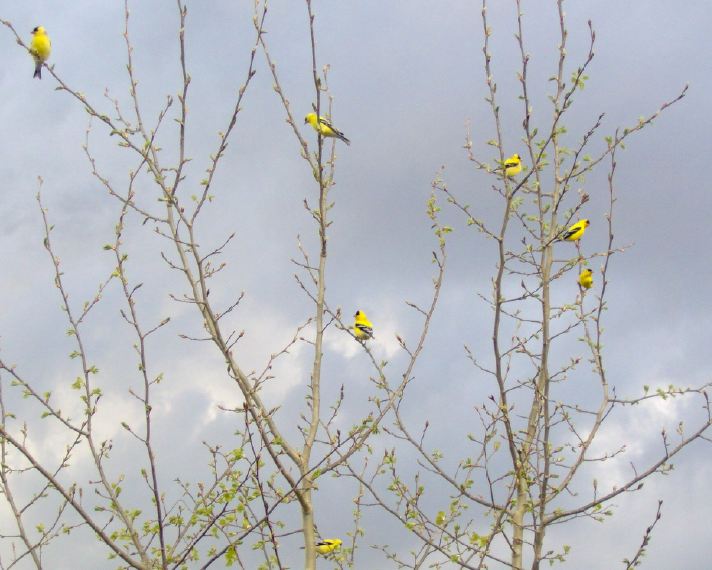
Gold finches in my kitchen window view pre frac’ing. There were 50 – 60 pair nesting on my land. After Encana’s noisy polluting frac invasion, I rarely see or hear them any more.