How Covid Quietly Rewires the Brain, Researchers keep discovering more about the long-term neurological effects of SARS-CoV-2. by Jason Gale, February 25, 2026, Bloomberg
Doctors call it Ondine’s curse—a catastrophic failure of the brain stem in which breathing no longer happens automatically, especially during sleep. It’s extremely rare, typically seen only in infants with genetic mutations or adults after severe trauma, and for a long time it wasn’t something doctors associated with viral infections.
But in the spring of 2020, Avindra Nath, clinical director of the National Institute of Neurological Disorders and Stroke, one of the National Institutes of Health, was helping investigate a handful of unexplained deaths in New York City. The victims had stopped breathing and died suddenly at home, with no lung or heart damage that might have suggested the underlying cause. The remains were sent for further examination to Maryland, where SARS-CoV-2, the coronavirus that causes Covid-19, was discovered in lung tissue. But that didn’t explain why the victims had stopped breathing. With no abnormalities evident in each victim’s brain, Nath was asked to take a closer look.
After his team examined the brains using high-resolution magnetic resonance imaging and microscopes, the problem came into focus:
Tissue in regions of the brain stem that control breathing had lost neurons. The finding unsettled Nath enough that he began warning colleagues Covid might not only be damaging the lungs—it might be disrupting the brain’s control of breathing.
Months later, patients who were recovering from Covid began contacting Nath describing Ondine-like symptoms. They recalled episodes in which breathing no longer felt automatic—going long stretches without inhaling unless they willed themselves to do so. In some cases the patients had been unable to sleep for days.
The breathing failures might have been dismissed as freak complications of an unfamiliar pathogen. Early in the pandemic, SARS-CoV-2 was being regarded primarily as a respiratory virus. Many patients were dying of pneumonia, and most medical attention was focused on symptoms that required ventilators and intensive-care beds.
But to Nath, who’d spent decades studying the ways in which viruses damage the nervous system long after acute infection, the sudden loss of smell, the headaches, the delirium and the strokes that many patients were experiencing, and those early findings in the victims from New York, pointed to something broader. Covid was indeed behaving like a virus capable of reaching the brain. He’d seen the pattern before, with HIV, Ebola and SARS-CoV-1—infections that first appeared to target one organ system before revealing quieter, more lasting damage in the brain and elsewhere.
“We thought for a long time that once you have it and you’re done with it, that’ll be it,” Nath told me over Zoom in June 2020, as ambulance sirens periodically cut through the call. “But it turns out that that’s not the case. Thousands of patients now are complaining of the fact that they have persistent symptoms.”
Disease Demographics
Percentage of US adults who say they’ve experienced long Covid
| National estimate | 18% | |
|---|---|---|
| Age | 18 to 29 | 18% |
| 30 to 39 | 19% | |
| 40 to 49 | 22% | |
| 50 to 59 | 21% | |
| 60 to 69 | 15% | |
| 70 to 79 | 11% | |
| 80 and above | 14% | |
| Sex | Male | 14% |
| Female | 22% | |
| Gender identity | Cisgender male | 14% |
| Cisgender female | 22% | |
| Transgender | 28% | |
| Sexual orientation | Gay or lesbian | 22% |
| Straight | 17% | |
| Bisexual | 23% | |
| Race or ethnicity | Hispanic or Latino | 20% |
| White | 18% | |
| Black | 15% | |
| Asian | 13% | |
| Other and multiple race | 23% | |
| Education | Less than a high school diploma | 22% |
| High school diploma or GED | 16% | |
| Some college/associate’s degree | 21% | |
| Bachelor’s degree or higher | 16% | |
| Disability status | With disability | 26% |
| Without disability | 17% |
Source: US Census Bureau Household Pulse Survey data collected from Aug. 20 through Sept. 16, 2024, and compiled by the US Centers for Disease Control and Prevention’s National Center for Health Statistics
Note: White, Black, Asian and Other categories exclude respondents who identify as Hispanic or Latino.
Before long, clinics were filling with patients who said their fevers and coughs had resolved but they were now experiencing crushing fatigue, cognitive slowing, malaise and swollen lymph nodes. This cluster of symptoms overlapped with myalgic encephalomyelitis, or chronic fatigue syndrome, a poorly understood illness that has long followed viral infections in some patients. Often referred to as ME/CFS, it can be a lifelong, debilitating condition that leaves sufferers unable to work or even to manage basic daily activities. Because ME/CFS itself has long been contested and underdiagnosed, the resemblance also meant many of the recovering Covid patients struggled to be taken seriously or to find effective treatment.
The overlap in symptoms, Nath says, is “not all that surprising because a lot of viral infections have been associated with this syndrome.” Indeed, some later studies of what came to be known as long Covid showed that a substantial share of patients met the diagnostic criteria for ME/CFS.
The implications went far beyond breathing. Damage to the small blood vessels and support systems in the brain stem, along with lingering irritation in the surrounding tissue, can interfere with thinking, mood and the body’s ability to regulate heart rate, digestion and blood pressure. Nath says the location of this damage, near the brain’s main lines of communication with the body, could help explain why the symptoms some Covid patients experienced didn’t simply resolve.
By the fall of 2020, he was increasingly focused on the prolonged neurological aftermath of acute Covid infection—in other words, long Covid. “It’s a drain on society at every single level,” he told me the following April. “It affects people in their 40s, the most productive years of your life. The economic toll, the psychological toll—every aspect of society it’s going to touch.”
Almost five years later, long Covid has had one of the fastest rises in diagnoses and become one of the most economically disruptive chronic conditions in modern medicine. A study published in December estimated that as many as 400 million people worldwide are living with long-term consequences of a SARS-CoV-2 infection. Another analysis, released in November, put the annual economic toll of long Covid at $1 trillion, close to 1% of global gross domestic product.
That scale in turn raises a troubling question: whether Covid is not only leaving millions chronically unwell but also accelerating the slow neurological processes that end in dementia—a pattern that has long been observed after some viral infections.
Some of the earliest signals came from the UK Biobank, where researchers compared people’s brain scans before and after Covid. Even among people with mild infections, the scans showed subtle loss in regions involved in planning and memory. In large community studies, UK researchers also began to see a small but measurable downward shift in cognitive scores.
Much of the clearest evidence of neurological damage emerged during this period, in the pandemic’s early waves, before vaccines were widely available and before most people had any immunity to the virus. one does not get immunity to SARSCov2, we get it again and again and again, with it disrupting our body, notably weakening our immune system Timothy Henrich, an infectious-diseases physician at the University of California at San Francisco who studies long Covid, says the risk of lasting brain effects appears to have fallen as vaccination rates rose and infections became milder overall. But the danger hasn’t vanished, particularly for people infected early on or for those who were reinfected and later developed persistent neurological symptoms. (Researchers are still debating whether those symptoms reflect cumulative damage or lingering effects from earlier infections.)
Covid wasn’t simply causing short-term confusion, but also leaving structural and biochemical footprints in patients’ brains
Nath says the brain can absorb a surprising amount of injury without obvious symptoms. It compensates; it reroutes; it recruits backup circuits. The trouble comes later, when its reserves are depleted. What looks sudden, he says, is usually anything but.
Henrich approaches the question from a different angle. Based on his research, he suspects that in at least some people, acute Covid involves the brain even when neurological symptoms aren’t obvious. That possibility, he argues, helps explain why symptoms don’t always line up neatly with biology—and why neurological effects may be missed or become apparent only over time.
Read more: What Covid in Pregnancy May Mean for a Generation of Children
To study possible hidden effects without some of the uncertainty that comes with real-world data, researchers in the UK took a rare step: In a closely monitored human challenge study approved by national ethics bodies, they deliberately infected healthy young adults who had no prior immunity with the original strain of the coronavirus. Most developed only mild illness, and none reported lasting problems, but after a year they performed slightly worse, on average, on memory and decision-making tests they’d taken before being infected. The difference was roughly comparable to six IQ points. Although that experiment followed participants for only 12 months, longer-term population studies suggest that cognitive symptoms are among the slowest to resolve after Covid, with full recovery proving elusive for a significant minority even years after infection.
Analyses drawing on pooled observational research and large population datasets were pointing in the same direction by the third year of the pandemic. People who’d contracted Covid faced a statistically higher risk of cognitive impairment—and, in older age groups, dementia-level decline—compared with those in matched control groups, even months or years after infection. The evidence was indirect, drawn from cognitive testing, health records and symptom surveys.
But the pattern was consistent: The brain didn’t always bounce back.
The long-term effects were most pronounced in older adults and people who’d been seriously ill. After Covid, many faced new memory problems and a loss of independence, particularly those who were in nursing homes. Blood tests in older patients also began turning up proteins linked to Alzheimer’s disease, raising fears that Covid could speed up neurological conditions the health-care system is already struggling to manage.

In a study published this January, researchers followed essential workers who’d donated blood samples both before and after Covid. Those who developed persistent neurological symptoms showed a clear rise in phosphorylated tau, a protein commonly used as an early warning sign of brain degeneration, especially when symptoms have lasted more than a year. The authors were careful not to claim that Covid causes Alzheimer’s. But they warned that the biological pattern was concerning and could point to higher long-term neurological risk in some patients. A separate study published in January by researchers at NYU Langone Health found that, in patients with neurological long-Covid symptoms, a structure that helps regulate immune activity and clear waste from the brain was enlarged and showed signs of impaired blood flow—changes that tracked with blood markers linked to Alzheimer’s.
Whether those kinds of changes in the brain translate into dementia or accelerated cognitive aging isn’t something researchers can say yet, according to Henrich. Detecting a signal in biomarkers or tissue doesn’t mean the clinical consequences are inevitable—and understanding what, if anything, it leads to may take years of follow-up.
Nath is less cautious. Drawing on patterns he’s seen across autopsies, imaging studies and long-term clinical assessments, as well as population data showing elevated dementia risk after Covid, he’s convinced the virus can accelerate neurodegenerative processes that are already underway in an aging population. “The incidence and prevalence of Alzheimer’s is going to just escalate,” he says.
“It’s a huge public-health problem.”
For a long time, studies hadn’t suggested what might be driving the changes inside the brain of some who’ve had Covid. That gap began to close last November, when a team of Korean researchers published a study in Nature Communications that went beyond the UK Biobank’s before-and-after scans, to probe structural and biochemical changes inside the brain. Scanning hundreds of people about a year after mostly mild Covid infections, the Korean scientists compared those with lingering cognitive problems to those with different long-Covid symptoms and to people who appeared to have recovered fully.
The differences were concentrated in the people with cognitive impairment. For them, brain regions involved in attention, emotion and memory were slightly thinner. Parts of the brain showed unusual iron buildup—a change often linked to aging and neurodegenerative disease. A structure involved in immune regulation and waste clearance in the brain was also enlarged, and blood tests pointed to ongoing stress and injury in brain cells. When the researchers repeated the analysis in a separate group of patients, the same abnormalities appeared again.
That kind of replication carried weight. It appeared to confirm that Covid wasn’t simply causing short-term confusion or “brain fog,” but also leaving structural and biochemical footprints in the brains of people who’d never been hospitalized. Something was still smoldering long after the acute phase of the infection had passed.
The picture that emerged was of a slow shift playing out beneath the surface of entire populations: a rise in cognitive problems, subtle declines in functional capacity, and lost independence. And although the medical implications are troubling enough, the economic ones are beginning to register too. If Covid is quietly accelerating cognitive aging or impairing decision-making in working-age adults, the consequences will ripple through workplaces and health systems for years.
For Nath the question now is whether any of that damage can be interrupted or even reversed. At the NIH he’s leading a clinical trial that treats long Covid as an immune-driven neurological condition, testing whether immunomodulating therapies aimed at damping down immune activity can quiet lingering inflammation and restore function months or years after the acute illness—to see whether calming the system can help the brain recover. The study is slated to conclude later this year.
“There’s something really biologically wrong,” Nath told me early in the pandemic, as patients with lingering symptoms began arriving in his clinic. “They need to seek help. And if their physicians cannot figure it out, they need to find researchers who are looking into these things.”
Adapted from After Covid: The Health Impacts That Will Last Generations, published by Johns Hopkins University Press. Copyright © 2026 by Jason Gale.
***
@amirattaran.bsky.social:
The low IQ COVIDiots have another hero.
Never mind that a dozen or so earlier Charter cases failed and that there is no Charter right to run a business.
They’ll try again bravely!
Toronto restaurant owner Adam Skelly in court for Charter challenge over defying COVID-19 rules, Adam Skelly, owner of Adamson Barbecue, calls filing the case “a reckoning with the unchecked exercise of state power.” by Ben Spurr, Feb. 25, 2026, Toronto Star
The Toronto restaurant owner whose defiance of indoor dining restrictions became a flashpoint in the debate over COVID-19 regulations will have his day in court on Wednesday, where a judge is set to hear arguments in his constitutional challenge against pandemic public health measures.
In an application that names the government of Ontario, the city of Toronto, and former Toronto medical officer of health Eileen de Villa as respondents, Adam Skelly, erstwhile owner of Adamson Barbecue, is asking the Superior Court of Justice to declare that restrictions imposed on him and his business five years ago infringed on his Charter rights and were unconstitutional.
While the three-day hearing is expected to be closely watched by Skelly supporters who view it as a chance to strike a legal blow against what they see as pandemic government overreach — he’s received more than $300,000 in donations for legal bills — one constitutional expert says his application is based on flawed arguments and is unlikely to succeed.
Skelly, for his part, is looking forward to going to court “after a very long and trying road to get here,” his lawyer, Ian Perry, said in a statement. He said his client “remains confident that justice will prevail.”
Etobicoke barbecue eatery a flashpoint
On Nov. 23, 2020 Skelly, whose legal name is William Adamson Skelly, announced on social media he planned to open the Etobicoke location of his barbecue spot for indoor dining, in contradiction of a provincial declaration earlier that day that limited restaurants to takeout or delivery service.
In a high-profile showdown that played out over three days as crowds of Skelly’s backers watched, de Villa ordered the restaurant closed, and when Skelly reopened it, directed the police and other officials to shutter it. In an ensuing confrontation Skelly was charged with mischief and obstructing a police officer, and the city later sued him for $187,000 for policing costs. His business has gone bankrupt.
In his application, Skelly argues that opening his restaurant was an act of civil disobedience, and the response from officials — which he says involved more than 200 police officers — was a disproportionate, “multi-level assault” that lacked “any proven health justification.” He’s asking the court to declare the city and province violated his Charter rights to freedom of expression, peaceful assembly and equality, among others.
His filing calls the case “a reckoning with the unchecked exercise of state power that devastated small business owners, silenced peaceful dissent, and trampled core constitutional protections.”
City rejects rights argument
In its response, Toronto rejects the idea Skelly’s Charter rights were violated. It argues the measures it took didn’t prevent him from protesting government regulations he disagreed with, for instance, and that protections on freedom of expression don’t give citizens a right to disobey laws they oppose.
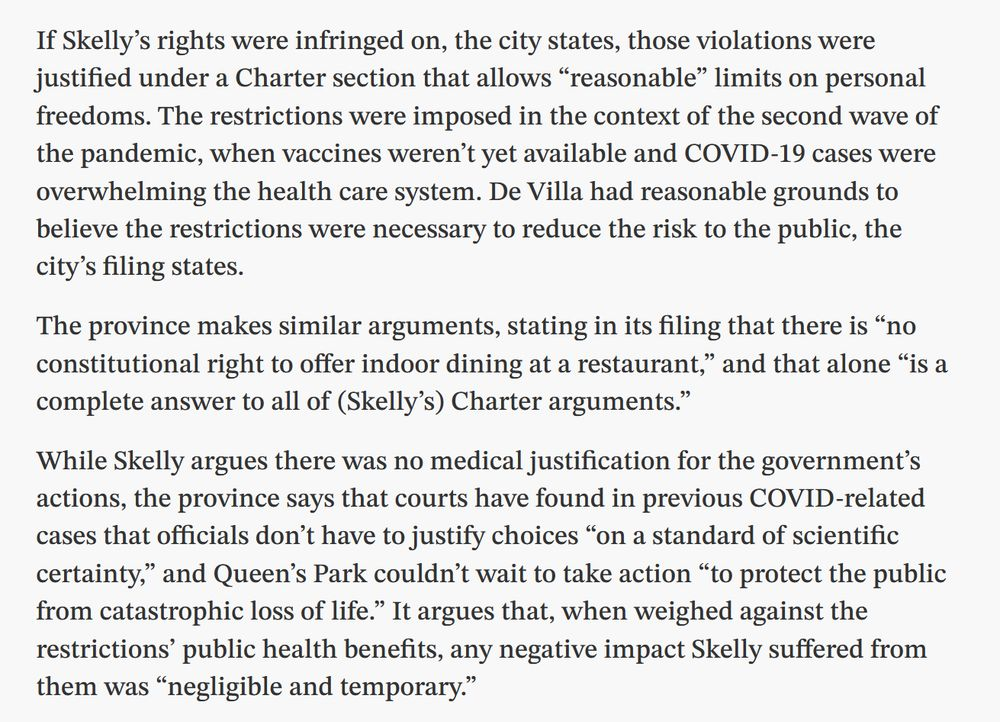
If Skelly’s rights were infringed on, the city states, those violations were justified under a Charter section that allows “reasonable” limits on personal freedoms. The restrictions were imposed in the context of the second wave of the pandemic, when vaccines weren’t yet available and COVID-19 cases were overwhelming the health care system. De Villa had reasonable grounds to believe the restrictions were necessary to reduce the risk to the public, the city’s filing states.
The province makes similar arguments, stating in its filing that there is “no constitutional right to offer indoor dining at a restaurant,” and that alone “is a complete answer to all of (Skelly’s) Charter arguments.”
While Skelly argues there was no medical justification for the government’s actions, the province says that courts have found in previous COVID-related cases that officials don’t have to justify choices “on a standard of scientific certainty,” and Queen’s Park couldn’t wait to take action “to protect the public from catastrophic loss of life.” It argues that, when weighed against the restrictions’ public health benefits, any negative impact Skelly suffered from them was “negligible and temporary.”
A long road to court
Skelly’s challenge has taken years to get to court. A judge dismissed an earlier attempt on procedural grounds, and Skelly, who previously told the Star he moved to Alberta after his business closed, has been tied up in other legal proceedings.
The civil case brought by the city and his sentencing on the criminal charges are on hold pending the outcome of the Charter application.
But in the years since the Adamson Barbecue controversy, according to Bruce Ryder, a constitutional law expert at Osgoode Hall Law School, courts have repeatedly ruled that pandemic restrictions were justified as long as they were based on a reasonable reading of health risks, and were flexible enough to allow some exercise of Charter rights. Ryder said that appears to be the case in this instance.
He said arguments in Skelly’s case are “flawed and lack nuance,” particularly his assertion that Charter protections against discrimination apply to him as a small-business owner who was allegedly targeted because he questioned the official COVID narrative. That section of the Charter only applies to specific categories such as race, religion, or sex, Ryder pointed out.
“I think it’s fair to say that Mr. Skelly’s chances of success are very small,” Ryder said.
@badbusinessbureau.bsky.social:
OMG, why would his lawyer even take on this case unless he too is incompetant.
Toronto restaurant owner Adam Skelly in court for Charter challenge over defying COVID-19 rules, Adam Skelly, owner of Adamson Barbecue, calls filing the case “a reckoning with the unchecked exercise of state power.”
www.thestar.com
@lincolnmjay:
Remember Adam Skelly from Adamson Barbecue?
In 2020, he defied COVID lockdowns and opened his Toronto restaurant, facing serious consequences. More than five years later, he’s still fighting it in court.
This is a chilling reminder of how dark the COVID era truly was.
@Arturmaks:
No. It’s an indication how Adam Skelly ignored public health warnings. I don’t know about you, but I would not go to a restaurant that doesn’t follow public health.
@songsung.bsky.social:
Toronto restaurant owner Adam Skelly in court for Charter challenge over defying COVID-19 rules – Toronto Star
Seriously what an asshole he broke the law!
@fatraccoon.bsky.social:
I hope this is the last we hear of Adam Skelly. Defying pandemic restrictions because you don’t like them is no excuse for putting people in harm’s way.
@illegitprez.bsky.social:
he looks like he’d defy covid rules. i wouldn’t eat there.
@mattpark10.bsky.social:
Oh, that fool! funny how forgettable he is until seeing this.
@danofavonlea1990.bsky.social:
He’s a complete nut job, all his Instagram is full of convoy BS…I didn’t even know who he was until this popped up but as someone who has worked in the culinary industry I hope he gets his just desserts!
@mattpark10.bsky.social:
Yup. He loved the attention however which I think was his primary goal.
@danofavonlea1990.bsky.social:
It usually is with people like that. It’s a shame how divisive the pandemic made society…I’m all for hearing views on issues and having thoughtful productive discussions but the nonsense it brought out was just terrible. At the end of the day, the winners of this will be his lawyers.
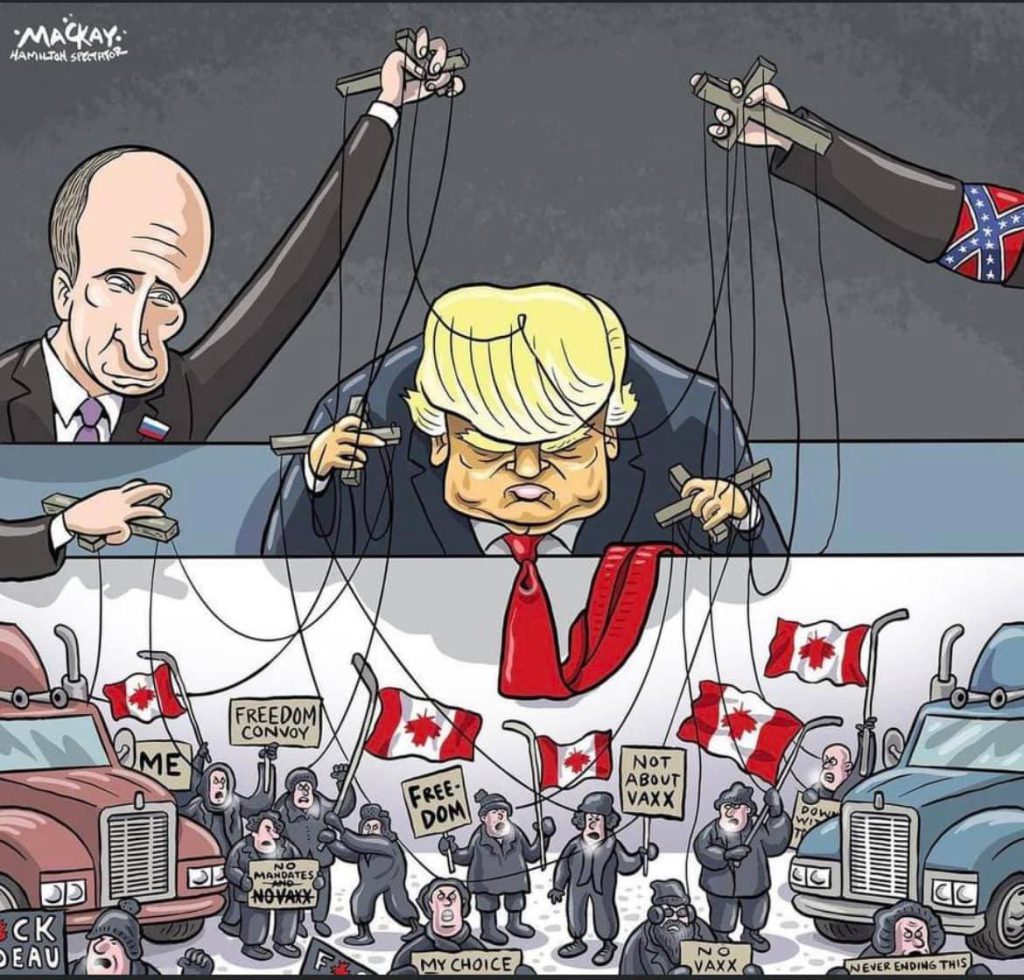
@celestialtalk.bsky.social:
Throw the book at him
Refer also to: