We don’t have a right to ask whether we’re going to succeed or not. The only question we have a right to ask is what’s the right thing to do? – Wendell Berry
I could die in peace, I think, if the world was beautiful. To know it’s being ruined is hard. – Wendell Berry
A Meeting
by Wendell Berry
In a Dream I meet
my dead friend. He has,
I know, gone long and far,
and yet he is the same
for the dead are changeless.
They grow no older.
It is I who have changed,
grown strange to what I was.
Yet I, the changed one,
ask: “How you been?”
He grins and looks at me.
“I been eating peaches
off some mighty fine trees.”
@blogoftheirown.bsky.social:
Rest in peaches, Wendell Berry.
And because I am not as well adjusted as he: God dammit, cosmos, take the destroyers and leave us the artists.
@noethematt.bsky.social:
STOP TAKING THE GOOD APPALACHIANS GODDAMNIT
@alissawilkinson.bsky.social:
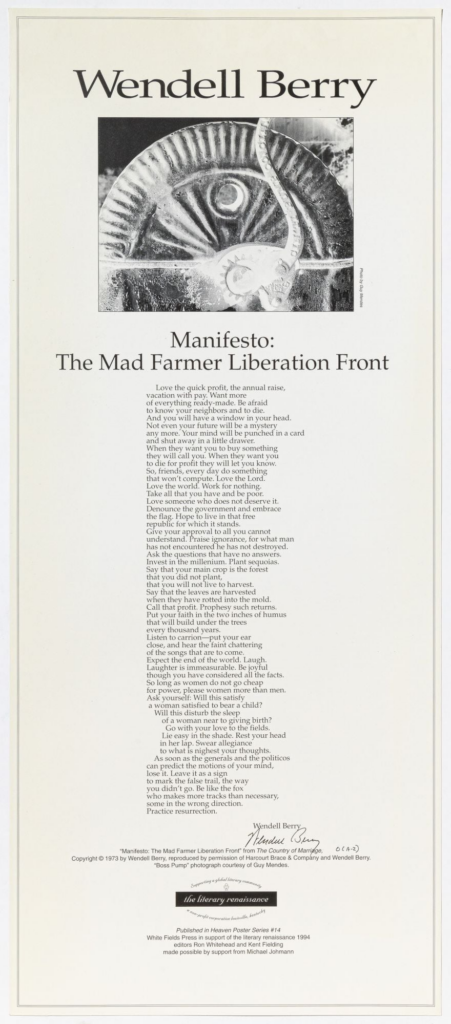
Love the quick profit, the annual raise,
vacation with pay. Want more
of everything ready-made. Be afraid
to know your neighbors and to die.
And you will have a window in your head.
Not even your future will be a mystery
any more. Your mind will be punched in a card
and shut away in a little drawer.
When they want you to buy something
they will call you. When they want you
to die for profit they will let you know.
So, friends, every day do something
that won’t compute. Love the Lord.
Love the world. Work for nothing.
Take all that you have and be poor.
Love someone who does not deserve it.
Denounce the government and embrace
the flag. Hope to live in that free
republic for which it stands.
Give your approval to all you cannot
understand. Praise ignorance, for what man
has not encountered he has not destroyed.
Ask the questions that have no answers.
Invest in the millennium. Plant sequoias.
Say that your main crop is the forest
that you did not plant,
that you will not live to harvest.
Say that the leaves are harvested
when they have rotted into the mold.
Call that profit. Prophesy such returns.
Put your faith in the two inches of humus
that will build under the trees
every thousand years.
Listen to carrion – put your ear
close, and hear the faint chattering
of the songs that are to come.
Expect the end of the world. Laugh.
Laughter is immeasurable. Be joyful
though you have considered all the facts.
So long as women do not go cheap
for power, please women more than men.
Ask yourself: Will this satisfy
a woman satisfied to bear a child?
Will this disturb the sleep
of a woman near to giving birth?
Go with your love to the fields.
Lie down in the shade. Rest your head
in her lap. Swear allegiance
to what is nighest your thoughts.
As soon as the generals and the politicos
can predict the motions of your mind,
lose it. Leave it as a sign
to mark the false trail, the way
you didn’t go. Be like the fox
who makes more tracks than necessary,
some in the wrong direction.
Practice resurrection.
(me now:) That last one is probably the most important thing I ever read in my life and I think about it every day.
Wendell Berry was, quite genuinely, an anomaly: an environmental activist who was arrested and booked for protesting a nuclear power plant in 1979. In 2011 — at the age of around 77 — he participated in a sit-in at KY governor (Steve) Beshear’s office to protest mountaintop removal.
Sometimes he sounded like a real conservative but conservatives could never get too comfy with him because he also sounded like a real lefty. I have been writing about him for 15 years and have never wrapped my head around him completely. Plus, those novels.
We don’t get a lot of prophets anymore, but he was one.
I disagreed with him all the time and agreed with him more often, and literally today I was writing a chapter about him and paused at listing his age and found myself thinking he would live forever.
@noethematt.bsky.social:
I return to Berry’s essays and poems constantly
For solace
For peace
For imagining
His words helped me a lot in the pandemic
His disdain for consumptive technology is what we needed
92 is an amazing run… but he kind of seemed like he’d keep going forever, y’know
May he find rest now
@alexsteffen.bsky.social:
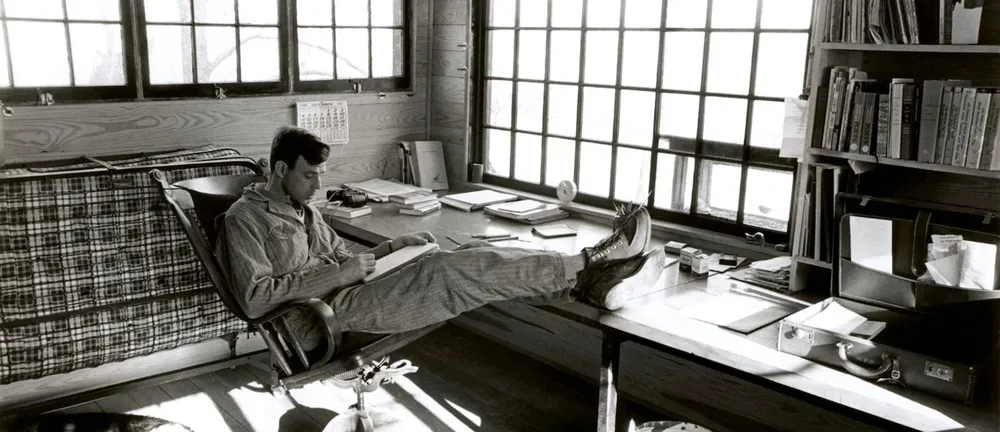
We have lost one of the 20th century’s most important voices for ecological sanity.
Wendell Berry, RIP.
@alonsonichols.bsky.social:
What is it with 2026? Taking all the wrong ones!
@brianpjcronin.bsky.social:
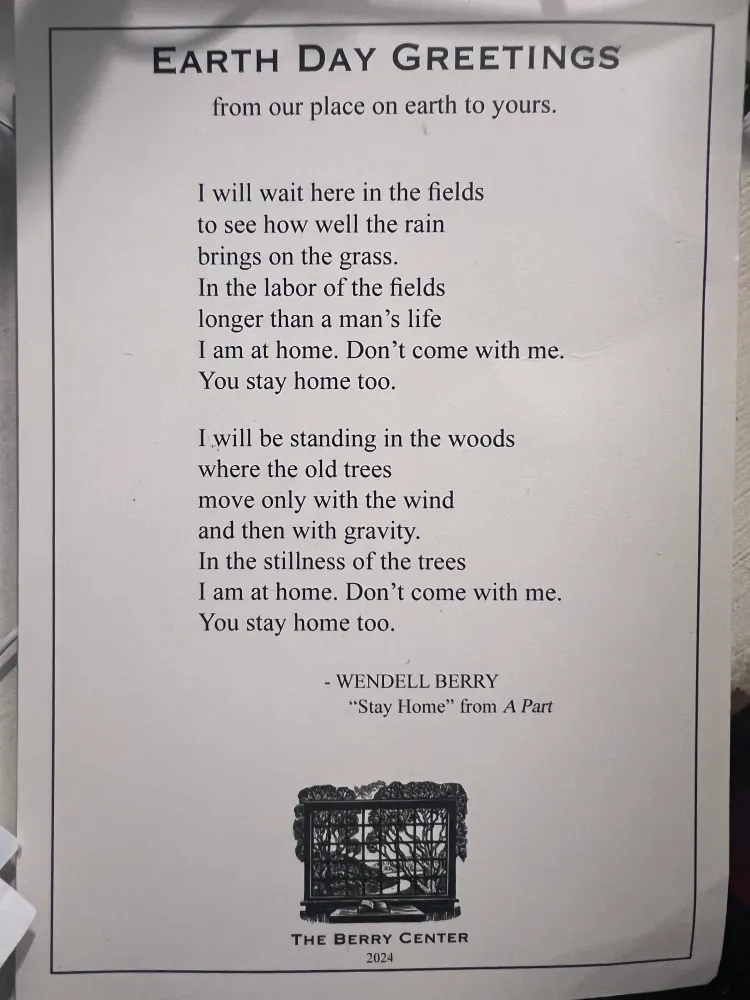
“In the labor of the fields longer than a man’s life
I am at home.
Don’t come with me.
You stay home too.”
@kleinman.bsky.social:
He’ll probably be remembered most on Bluesky for his nonfiction work (most of which does not stand the test of time) but you should read Jayber Crow, just a deeply moving novel about midcentury rural America.
Kentucky writer, farmer and advocate Wendell Berry dies at 92 by Sarah Ladd – August 31, 2026

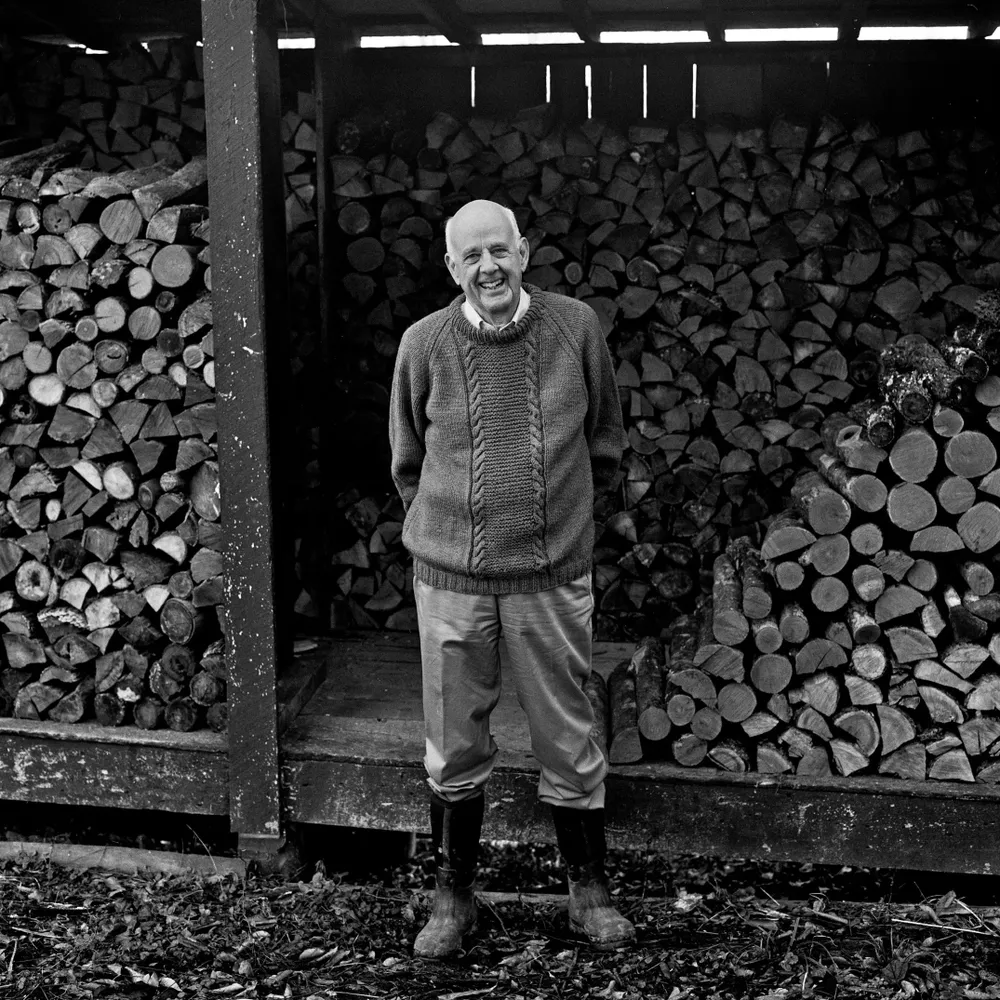
Wendell Berry with Nip and Jed, Lane’s Landing Farm, Henry County, KY 2012. (Photo by Guy Mendes)
Kentucky writer and conservationist Wendell Berry once wrote: “Beware the machinery of longevity. When a man’s life is over the decent thing is for him to die. The forest does not withhold itself from death.”
A lover of forests, the farmer, author and former English professor died on Monday at his home in Port Royal, according to the New York Times and other media reports. He was 92.
Born in 1934 to Virginia Erdman and attorney John Marshall Berry, Wendell Berry was a prolific writer of nonfiction, poetry and fiction from Henry County, Kentucky.
In dozens of books he wrote of the need to protect — and ethically use — land, of God as a part of nature and of modernity as a force to be rebelled against.
Berry was a member of a group of Kentucky writers called the “Fab Five,” which included Bobbie Ann Mason and the late Gurney Norman, James Baker Hall and Ed McClanahan.
He leaves behind a sprawling legacy of advocacy, conservationism, literary pursuit and protest that inspired people from the hills of Kentucky to Hollywood and beyond.
His death leaves a vacancy of voice that was not always without controversy throughout his life but was decisive and steady throughout a long career.
Tobacco and love of land
Berry came from a long line of tobacco producers. John M. Berry, Wendell Berry’s father, co-founded the Burley Tobacco Growers Co-Op in the 1920s, which stabilized the price of tobacco and helped farmers who’d been subject to the pricing impulses of the monopoly American Tobacco Company, according to a Bitter Southerner article.
“The brilliance of the program was that it successfully matched supply and demand, preventing farmers from falling victim to overproduction,” the Bitter Southerner article says. “Within this equilibrium, farmers in the co-op were guaranteed parity prices, which meant a price that compensated them for all of their inputs.”
That article also quoted Mary Berry, daughter of Wendell Berry, as saying the co-op “was the only farm program that I know of that served the people it was supposed to serve, and that was small farmers. It was never a subsidy, it was a price support. It cost the government nothing.”
His family farmed in Henry County for generations. In a 1987 interview with the Kentucky Historical Society, Berry’s father said his great-grandfather bought 500 acres of land in the county after serving in the Army in the War of 1812.
When Berry left New York City and returned home to Kentucky for good in the 1960s, he did so with “some fear and trembling, but also a sense of doing the right thing,” he told The New Yorker in 2019.
When he started the trek home, with all his belongings in a Volkswagen Beetle, he told the New Yorker: “I felt a great, deep relief — as if I was following, at last, my true path.”
‘Cheerful in dissent.’
Berry was a man of many lanes.
He protested the Vietnam War, saying in 1968 that “peace is more important than victory,” according to a Messenger Inquirer article from Feb. 11 of that year.
Berry was arrested in 1979 for trespassing as he protested the Marble Hill Nuclear Power Plant in Madison, Indiana. In a 2010 CounterPunch conversation, he said of that day: “People asked if I wanted to be arrested and I said, ‘Hell No’ but I was willing to be.”
In 2009, Berry joined thousands of people who marched in protest of the Capitol Power Plant in Washington, D.C., Inside Climate News reported at the time, in an effort to fight for cleaner emissions.
He echoed the same trepidation and resolve about the prospect of arrest: “Somebody asked me if I wanted to get arrested. The answer is very brief: No. But I’m willing to get arrested. Nothing else is working.”
The farmer fought to preserve a controversial piece of University of Kentucky art condemned as racist for many years and pushed back against mountaintop removal by joining a sit-in at former Gov. Steve Beshear’s office in 2011.
The National Endowment for the Humanities described him in 2012 as “cheerful in dissent” and a person who “writes to document and defend what is being lost to the forces of modernization, and to explain how he lives and what he thinks.”
The Berry Center was established in 2011 to put “Wendell Berry’s writings to work by advocating for farmers, land-conserving communities and healthy regional economies.”
The nonprofit works to bring “focus, knowledge and cohesion to the work of changing our ruinous industrial agricultural system into a system and culture that uses nature as the standard, accepts no permanent damage to the ecosphere, and takes into consideration human health in local communities.”

The center educates farmers “in agrarian thought and practice,” runs a bookstore, has a cooperative to help farmers sell to markets and more.
The work is in line with Berry’s legacy of advocacy for land preservation and agrarian life.
Berry and the University of Kentucky
Berry had a complicated relationship with his alma mater, the University of Kentucky.
He earned his bachelor and master’s degrees in English from UK, according to the Kentucky Historical Society. He then taught at the University of Kentucky from 1964-1977 and again from 1987-1993. (His teaching roster also includes Stanford University, Georgetown College, New York University, the University of Cincinnati and Bucknell University).
In late 2009, Berry withdrew papers he’d loaned UK, a quiet protest against the university’s acceptance of $7 million from coal producer and philanthropist Joe Craft to rename a residence hall the “Wildcat Coal Lodge.”
The Kentucky Kernel, the independent student newspaper at UK, reported that Berry could not abide what he considered an indignity as an advocate for the land and water polluted by mining.
“I was taught that taking care of land was one of the primary human responsibilities,” the Kernel quoted Berry as saying. “In the long run, the top soil, the forests and the woodland of this state will be more valuable than the coal deposits.”
Berry felt the university’s move was a split from his values and those held by other farmers.
“When the university accepted the gift from (the) coal industry in return for naming the basketball dormitory ‘Wildcat Coal Lodge,’ the university had sold an advertisement,” Berry said, according to the Kernel.
That wasn’t the only time Berry and UK clashed.
In July 2020, Berry joined a lawsuit against the University of Kentucky seeking to preserve a controversial 1934 fresco mural many criticised for its depictions of slavery in America and of Indigenous people.
Ann Rice O’Hanlon painted the fresco as part of the Public Works of Art Project and President Franklin D. Roosevelt’s New Deal.
It was a site for protests on campus and requests to have it removed for years. According to court documents, complaints began in the 1970s.
University of Kentucky President Eli Capilouto agreed to cover the mural in 2019 following a sit-in protest on campus that included the Black Student Advisory Council and others. In June 2020, seemingly moved by the racial justice movement sweeping through the country, he announced the university would remove it.
The next month, Berry stepped in and asked a court to halt the removal. In court documents from the time, Berry argued the art needed to be conserved because of its historical significance, difficulty to create and rarity, being one of around 42 frescos from the time.
“The O’Hanlon Mural is a figurative representation of the history of Lexington and Central Kentucky,” Berry’s petition read.
He wrote of her “artistic choices that abstract the essential truths of the art as opposed to mere representation,” which he said “is part of what makes the O’Hanlon Mural unique and a valuable piece of the cultural assets of Kentucky held in trust by the University.”
The Lexington Herald-Leader reported in January 2026 that the mural remains in its place on campus.
‘Radical and eclectic’
The late bell hooks, a renowned Kentucky author known for her many writings on feminist theory, racism and love, among other topics, wrote fondly of Berry in “belonging: a culture of place,” one of some 40 books she published throughout her career.
She praised him for the “wide range of issues in his essays that were fundamentally radical and eclectic.” She taught at Berea College from his book about race, “The Hidden Wound.”
Berry also inspired actor and writer Nick Offerman of Parks and Recreation fame. Offerman, himself an outdoorsman, has narrated several of Berry’s books for audiobook format, including his magnum opus, “The Unsettling of America.”
In a 2020 interview with Literary Hub, Offerman said in Berry he “unexpectedly found a chronicler of the nobility found in good, honest work, and thrift, and affection for one’s family and neighbors and animals and the land that supports and nourishes all of the above.”
“I have often asserted that if my job were simply to broadcast the works of Wendell Berry to the world, I’d die a happy man,” Offerman said in that interview.
Honors
Former President Barack Obama awarded Berry with the 2010 National Humanities Medal for his work as a poet, novelist, farmer and conservationist.
He also earned other notable honors, including the T.S. Eliot Prize, the Aiken Taylor Award for poetry, the John Hay Award of the Orion Society and the Richard C. Holbrooke Distinguished Achievement Award of the Dayton Literary Peace Prize, according to the Poetry Foundation.
In 1961, he traveled in France and Italy as part of a Guggenheim Fellowship, a prestigious honor for “exceptional individuals in pursuit of scholarship in any field of knowledge and creation in any art form under the freest possible conditions.” The Fellowship has gone to other notable writers including Ada Limón, Roxane Gay, Carmen Maria Machado and Sigrid Nunez.
His slew of other honors include the Kentucky Libraries Award’ for Intellectual Excellence, the Thomas Merton Award, The Cleanth Brooks Medal for Lifetime Achievement from the Fellowship of Southern Writers, the Martin E. Marty Award for the Public Understanding of Religion from The American Academy of Religion, the Poets’ Prize and others.
For a list of Berry’s books, visit this site.
Funeral arrangements are incomplete at this time.
***
@dianabutlerbass.bsky.social:
Rest in the peace of wild things, Wendell. Thank you, thank you, thank you for everything, every word.
@sjjphd.bsky.social:
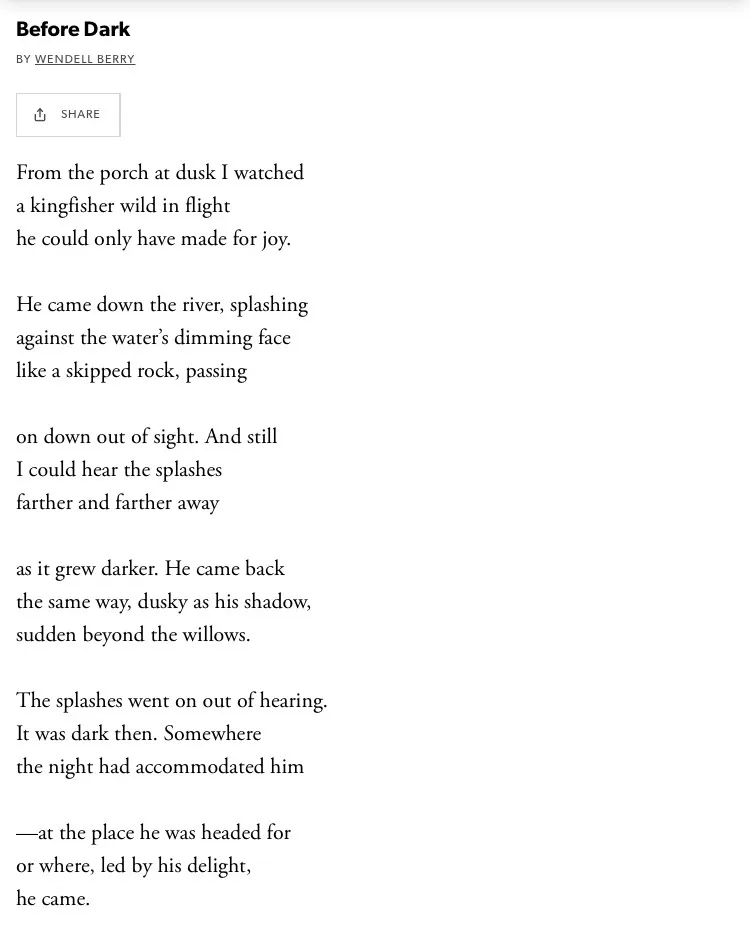
Wendell Berry is gone after a long life. I dare you to read or listen to this and not be overwhelmed by something
@scottedelman.bsky.social:
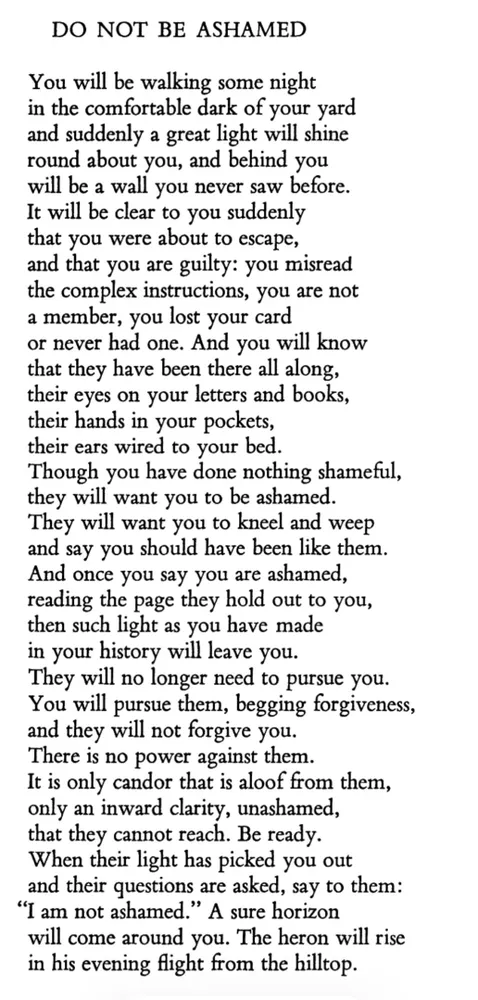
Farewell to the great Wendell Berry.
Remember — though you have done nothing shameful, they will want you to be ashamed.
@ecologicalev.bsky.social:
Rest easy to the great Wendell Berry. He challenged us to think differently about living a fast, technologically complex life.
He probably wouldn’t have loved me posting this on social media. Time for me to touch grass.
@dpowelloct.bsky.social:
He was a giant.
@ridderman.bsky.social:
I recently dug into his writings via the audiobook for The World Ending Fire, narrated by Nick Offerman. It was so good and so approachable. So sad that he’s no longer with us.
@maureenlangloss.bsky.social:
My entire feed is Wendell Berry poems, and I think this is what social media was always meant to be.
@taraeanderson.bsky.social:
Oh man. “Be joyful though you have considered all the facts” is a guiding aspiration for me.