
@atranscendedman.bsky.social:
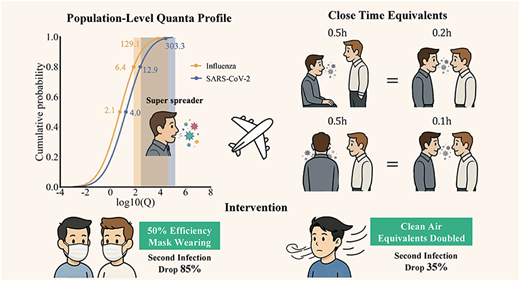
University of Hong Kong researchers analyzed 40 airplane outbreaks of COVID-19 and flu.
Infection risk was highest near infected passengers.
Models found N95 masks nearly eliminated transmission, while doubling ventilation alone was insufficient.
@jennifervestal.bsky.social:
I will never ever fly without an N-95.
COVID aside, we now know how to spend thousands on a vacation and not end up sick in a hotel room for all of it!
@rossqsmith.bsky.social:
This should be obvious to anyone with even a partially working prefrontal cortex… but I was on a packed flight yesterday… and only 3 of us wearing masks.

Influenza A (H1N1) and SARS-CoV-2 Transmission in Airplanes: Quanta Profiles and Infection Control by Ao Li; Hui-Ling Yen; Nancy H. L. Leung; Julian W. Tang; and Yuguo Li, Oct 27, 2026, Volume 60, Issue 42 Environ. Sci. Technol. (2026) 60 (42): 29955–29965.
https://doi.org/10.1021/acs.est.6c09696
Abstract
Airborne transmission of influenza A(H1N1)pdm09 and SARS-CoV-2 (ancestral strain) poses critical challenges in confined high-occupancy spaces, including aircraft, public transit, and institutional settings. Population-level quanta generation rate profiles, quantifying infectious particle emissions, are vital for assessing airborne infection risk but are poorly characterized. Short-range transmission complicates risk assessment due to variable close-contact scenarios. We estimated these profiles from 40 airplane outbreaks (14 influenza A(H1N1)pdm09, 26 SARS-CoV-2) using a novel heterogeneity matching method and an integrated Wells–Riley model combining short- and long-range transmission, calibrated via Monte Carlo simulations. Results reveal super-emitter-driven variability. A new metric, close time equivalents for standardizing close-contact exposure, was calculated for 23 outbreaks (6 influenza A(H1N1)pdm09, 17 SARS-CoV-2). Outbreak-derived quanta rates align with viral-load-based estimates, though the latter show greater variability. The population-level ventilation distribution compiled from commercial Boeing and Airbus cabin studies supports the robustness of the estimates. Impractical clean air equivalents for mitigating super-emitter transmission necessitate mask-wearing, effectively reducing close-contact and long-range transmission. These findings inform public health strategies for confined spaces and emerging variants.
Visual Abstract
***
