
@ssteingraber1.bsky.social:
Important new paper on so-called blue hydrogen, of intense interest to those of us who study methane.
Here’s quick, plain-English explainer thread for all the non-chemists out there who care about climate and feel suspicious of magic bullet solutions marketed by the oil and gas industry…
Starting in the middle of the story: hydrogen is definitely a clean- burning fuel. When you combine it with oxygen—which is what burning is—you get heat energy and water vapor. No greenhouse gas emissions to crash the climate system.
Also, hydrogen is the most abundant element on the planet! 2/11
And also, hydrogen fuel, by weight, contains three times as much energy as gasoline!
BUT…
…hydrogen doesn’t pal around alone or easily pair up with itself. So if you want to burn hydrogen as a fuel, you first have to make it.
You can’t just dig it out of the ground, à la coal, oil, or gas, and throw it in an oven or pump it into your car from the atmosphere.
The traditional way to make hydrogen molecules (H2) is to rip them from molecules of natural gas, aka methane (CH4), which has four of them.
This process is called steam methane reforming, and it requires tremendous amount of heat and pressure and energy.
Also natural gas is a fossil fuel.
In other words, hydrogen fuel means a lot of heat-trapping carbon dioxide (CO2) is released during manufacturing process even though not from the tailpipe or in your furnace when it’s burned
…somebody came up with the idea to capture and bury the CO2 from the steam methane reforming. Which is to say, combine hydrogen manufacturing with carbon capture and storage technology.
And they called it…Blue Hydrogen and claimed it was a climate solution.
Now comes this new study (from Bob Howarth at Cornell and Mark Jacobson at Stanford) which is the first to calculate the lifecycle greenhouse gas footprint of Blue Hydrogen.
And it’s terrible.
First of all, Blue Hydrogen requires even more methane than regular old hydrogen manufacturing bc methane is used to power the carbon capture machinery.
CO2 emissions are somewhat lower for the blue stuff, but its methane leaks are higher, and methane is a more powerful greenhouse gas.
So, in the end, after all the numbers are crunched, it turns out that “the greenhouse gas footprint of blue hydrogen is > 20% greater than burning natural gas or coal for heat and some 60% greater than burning diesel oil for heat.”
And that assumes that all of the captured CO2 stays captured 4EVR
…which we know it doesn’t.
Anyway, you were right to feel suspicious. The chemistry and the math show that hydrogen is still stupid even if you capture its CO2 emissions.
@ithacagreg.bsky.social:
Right up there with burning massive amounts of  frac’dnatural gas to condense it to liquid natural gas (And then shipping it on tankers).
Prof. Bob Howarth @profbobhowarth.bsky.social:
New paper shows high GHG footprint for H2 made from methane pyrolysis pubs.rsc.org/ee/article/d…
& I (2021) also found high footprint for “blue” H2 made by classic SMR technology & CO2 capture onlinelibrary.wiley.com/doi/full/10….
H2 from methane is simply a bad idea.
16 October 2026 Newly published
Limited potential of methane pyrolysis for energy production to reduce greenhouse gas emissions Open Access by Indranil Dutta, Rajesh Kumar Parsapur, Hongxing Song, Kuo-Wei Huang Corresponding Author, Oct 16, 2026, Energy Environ. Sci. (2026)
https://doi.org/10.1039/d6ee04160d
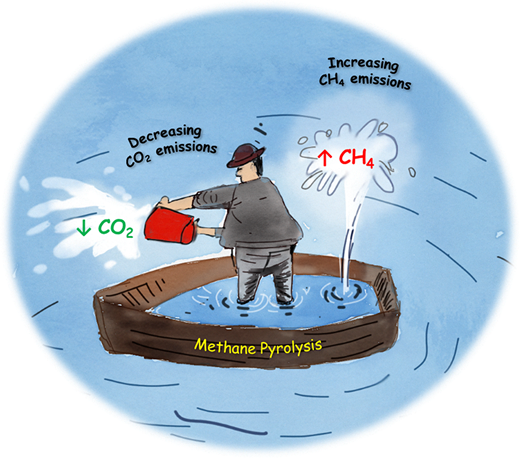
Because of the global energy transition towards low-carbon and renewable energy, it is imperative to address the escalating concerns of the energy and climate crisis. Before the large-scale deployment of renewable energy is achieved, methane (CH4) pyrolysis, a method that breaks down CH4 into hydrogen and solid carbon, has been proposed as a bridging technology with minimal CO2 emissions. However, because the energy stored in the carbon cannot be utilized, the rate of CH4 consumption and the corresponding fugitive CH4 emissions will double to meet the same energy demand. Based on an average rate of CH4 emissions of 2.5%, CH4 pyrolysis will have a limited impact on reducing greenhouse gas emissions, while increasing the dependence of the energy sector on natural gas resources.
Visual Abstract
…