@cingraham.bsky.social:
One of the most highly cited academic articles on the safety of glyphosate has been retracted, eight years after court documents revealed it was ghostwritten by Monsanto
For what its worth my docs at the Mayo clinic questioned me extensively about past glyphosate exposure when I was being treated for non-Hodgkin lymphoma. Environmental causes of cancer are notoriously hard to pin down, but that one’s real enough that docs will ask about it in a clinical setting.
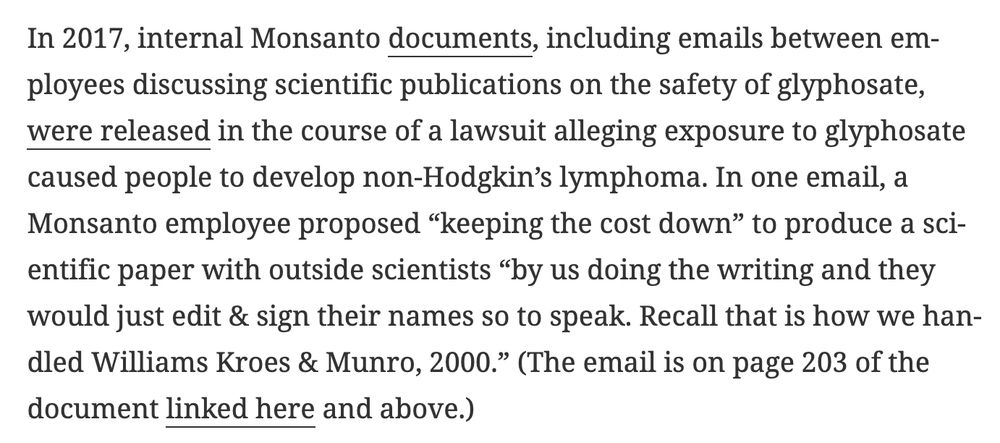
Emails show Monsanto employees casually discussing producing favorable research by “by us doing the writing and editing and [outside scientists] would just edit & sign their names so to speak. Recall that is how we handled [the now-retracted paper].”
retractionwatch.com/2025/12/04/g…
@lzfowler.bsky.social:
Monsanto is such a evil corporation. The depths of their depravity has no bounds. they step over the dead to cash the checks they make from selling poision that’s killing us all.
Lyle Lewis @race2extinct.bsky.social:
A major study claiming Roundup was safe has been retracted 25 years late after discovering corporations wrote the science and regulators accepted it. The public becomes the lab rat.
Killing people is a moneymaker.
Studies showed that Agent Orange could only affect plants as it worked specifically on a plant pathway that animals didn’t have. For years, veterans were accused of scamming the system.
Roundup is no different.
Roundup affects bacteria that have the same metabolic pathways as plants, including our symbiotic gut. Roundup doesn’t directly kill insects. It kills them indirectly over longer time periods by destroying symbiotic bacterial relationships, compromising their immunity.
Surfactants are added to Roundup to facilitate penetration into the plant. The surfactants used are often more toxic than the herbicide itself.
UV light is the primary factor that breaks down Roundup making it less toxic. The half life of Roundup is relatively long—several days to several months. The broken down components have a different chemical structure and so it is no longer “Roundup.”
“Our chemical is no longer causing any problem because, well…..it’s no longer our chemical.” However, sometimes the broken down component can be more toxic than the base chemical……and no one studies these.
Manufacturers can technically and successfully deny direct effects of herbicides. They don’t need to argue against indirect effects because they are impossible to prove.
@nonviolence.bsky.social:
The WHO considered glyphosate (Roundup) as carcinogenic in 2015. The EU hence wanted to ban it in 2023. But, due to pressure from Bayer aka Germany, it got delayed by 10 more years. We ignore most science today when it comes to food. Inbreeding & needless toxins©️ are the Greenwashing Revolution.
Ghostwriters, polo shirts, and the fall of a landmark pesticide study by Manon JACOB, Dec 6, 2025, phys.org
Editors’ notes In 2015, the World Health Organization’s International Agency for Research on Cancer classified glyphosate as “probably carcinogenic to humans”
A flagship study that declared the weedkiller Roundup posed no serious health risks has been retracted with little fanfare, ending a 25-year saga that exposed how corporate interests can distort scientific research and influence government decision-making.
Published in Regulatory Toxicology and Pharmacology in 2000, the paper ranks in the top 0.1% of citations among studies on glyphosate—the key ingredient in Roundup, owned by agri-giant Monsanto and at the center of cancer lawsuits worth billions of dollars.
In his retraction note last week, the journal’s editor-in-chief, Martin van den Berg, cited a litany of serious flaws from failing to include carcinogenicity studies available at the time to undisclosed contributions by Monsanto employees and even questions around financial compensation.
Elsevier, the journal’s Dutch publisher, told AFP in a statement that it upholds the “highest standards of rigor and ethics” and that “as soon as the current editor became aware of concerns regarding this paper a matter of months ago, due process began.”
But it did not address the fact that concerns date back to 2002, when critics wrote to Elsevier about “conflicts of interest, lack of transparency, and the absence of editorial independence” at the journal, including specific worries about Monsanto.
The matter exploded into public view in 2017, when internal corporate documents released during litigation showed one of Monsanto’s own scientists admitting to “ghostwriting.”
Harvard University science historian Naomi Oreskes, who co-authored a paper this September detailing the extent of the “fraud” in the 2000 study, told AFP that while she was “very gratified” at the “long overdue” action, but warned that “the scientific community needs better mechanisms to identify and retract fraudulent papers.”
“This is completely in alignment with what we were calling them out for at the time,” Lynn Goldman, a pediatrician and epidemiologist at GWU who co-signed the 2002 letter, added to AFP.
Polo shirts
Two of the paper’s three original authors have since died, while first author Gary Williams, a professor at New York Medical College, did not respond to AFP’s request for comment.
Monsanto maintains it acted appropriately, and that its product is safe. “Monsanto’s involvement with the Williams et al paper did not rise to the level of authorship and was appropriately disclosed in the acknowledgments.”
The company declined to comment on internal emails that suggested otherwise, including one in which a Monsanto scientist asked a colleague whether “the team of people” who worked on the Williams paper and another study “could receive Roundup polo shirts as a token of appreciation for a job well done.”
Glyphosate was brought to market as a herbicide in the 1970s and initially welcomed as less toxic than DDT.
But its soaring use—especially after Monsanto introduced glyphosate-tolerant seeds that allowed it to be sprayed widely over crops—drew increasing scrutiny in the 1990s, making the 2000 paper hugely influential.
According to Oreskes’s research, it was cited as supporting evidence for glyphosate’s safety by groups ranging from the Canadian Forest Service to the International Court of Justice, the US Congress and the European Parliamentary Research Service.
Legal interest
In 2015, the World Health Organization’s International Agency for Research on Cancer classified glyphosate as “probably carcinogenic to humans.”
Several countries have since moved to restrict or ban its use, including France, which has prohibited household applications. Bayer, which acquired Monsanto, said it would phase out Roundup for US residential use in 2023 in response to growing lawsuits.
Nathan Donley, a scientist with the Center for Biological Diversity, told AFP he does not expect the retraction to sway the US Environmental Protection Agency, now under the pro-agricultural-industry Donald Trump administration, which has thrown its weight behind Bayer in an ongoing Supreme Court case.
But “it could play a role in litigation that is moving forward in the US against the EPA’s proposed decision to renew glyphosate,” Donley told AFP, adding that European regulators might also take note.
For Donley and others, the deeper concern is that the case may be far from unique.
“I am sure there (are a) lot (of) such ghost-written and undeclared conflict papers in the literature, but they are very difficult to unearth unless one goes really deep in litigation cases,” John Ioannidis, a Stanford University professor who founded the field of meta-research told AFP.
France recalls Canadian lentils as Carney weakens pesticide rules by Marc Fawcett-Atkinson, December 5th 2025, National Observer
Canadian lentils are exposing simmering tensions between Carney’s European trade ambitions and his government’s proposal to eliminate a key part of Canada’s pesticide risk assessment, observers say.
The frustrations arose after an investigation last month by France 5 network journalist Hugo Clément found some of the Canadian lentils sold in major grocery stores were contaminated with glyphosate and diquat pesticide residues. The amount of glyphosate residue found in the samples was below the EU’s safety threshold — which was increased in 2012 under pressure from Canada during free trade negotiations.
The EU banned diquat in 2019 and heavily restricts glyphosate use because of health concerns.
Canada allows the use of both and lets farmers spray their fields with the chemicals right before harvest to kill and dry out the plants — a practice the EU prohibits because it leaves too much pesticide residue on crops.
Clément’s findings hit a nerve, with the journalist’s Instagram teaser racking up hundreds of thousands of views on top of the network viewership. The French food safety agency even recalled two brands of Canadian lentils, citing pesticide risks.
Across the Atlantic, Quebec outlets from La Presse to Radio-Canada ran headlines about the findings, which have mostly gone unnoticed in English-language media despite the legumes’ importance to farmers across the Prairies.
A spokesperson for Agriculture and Agri-food Canada (AAFC) told Canada’s National Observer that Canadian crops, including pulses, “consistently test well below EU MRLs (and those of other importing countries). The lentils tested within the documentary were shown to be within EU limits.”
Pulse Canada, the industry’s lobby group, told Canada’s National Observer the show “confirms that Canadian lentils continue to meet the EU’s rigorous safety standards.”
“If Europeans believe that they are at risk from consuming produce imported from Canada, that does not bode well for this government’s ambitions to expand new trade partners,” said Sean O’Shea, trade expert with Ecojustice.
Referred to by Retraction notice to“Safety evaluation and risk assessment of the herbicide roundup and its active ingredient, glyphosate, for humans” [Regul. Toxicol. Pharm. 31 (2000) 117–165] by Gary M. Williams, Robert Kroes, Ian C. Munro, Regulatory Toxicology and Pharmacology, Available online 5 December 2025, Pages 106006
RETRACTED: Safety Evaluation and Risk Assessment of the Herbicide Roundup and Its Active Ingredient, Glyphosate, for Humans by Gary M. Williams, Robert Kroes, Ian C. Munro, April 2000, Regulatory Toxicology and Pharmacology Volume 31, Issue 2, Pages 117-165
https://doi.org/10.1006/rtph.1999.1371
This article has been retracted: please see Elsevier Policy on Article Withdrawal (https://www.elsevier.com/locate/withdrawalpolicy)
This article has been retracted at the request of handling (co)Editor-in-Chief, Prof. Martin van den Berg, Ph.D.
Concerns were raised regarding the authorship of this paper, validity of the research findings in the context of misrepresentation of the contributions by the authors and the study sponsor and potential conflicts of interest of the authors. I, the handling (co)Editor-in-Chief of Regulatory Toxicology and Pharmacology, reached out to the sole surviving author Gary M. Williams and sought explanation for the various concerns which have been listed in detail below. We did not receive any response from Prof. Williams.
Hence, this article is formally retracted from the journal. This decision has been made after careful consideration of the COPE guidelines and thorough investigation into the circumstances surrounding the authorship and content of this article and in light of no response having been provided to address the findings.
The retraction is based on several critical issues that are considered to undermine the academic integrity of this article and its conclusions:
- 1.Carcinogenicity and Genotoxicity Assessments The article’s conclusions regarding the carcinogenicity of glyphosate are solely based on unpublished studies from Monsanto, which have failed to demonstrate tumorigenic potential. The handling (co) Editor-in-Chief also became aware that by the time of writing of this article in the journal, the authors did not include multiple other long-term chronic toxicity and carcinogenicity studies, that were already done at the time of writing their review in 1999. In their article the authors state that they are aware of other studies, that were unpublished and not available. However, the authors do not specify to what extent they tried to incorporate the findings of these (unpublished) studies. The reasons for this remain undisclosed but bring into question the broader objectivity of the conclusions presented. The handling (co)Editor-in-Chief identified the following additional publications:Atkinson C, Martin T, Hudson P, Robb D. Glyphosate: 104 week dietary carcinogenicity study in mice. In: Inveresk Research International. Tranent: IRIProject No. 438618; 1993.Sugimoto K. 18-Month Oral Oncogenicity Study in Mice, Vol. 1 and 2. Kodaira-shi: The Institute of Environmental Toxicology; 1997. Study No.:IET 94-0151.Takahashi M. Oral feeding carcinogenicity study in mice with AK-01. Agatsuma: Nippon Experimental Medical Research Institute Co. Ltd.; 1999.Enemoto K. 24-Month Oral Chronic Toxicity and Oncogenicity Study in Rats, Vol. 1. Kodaira-shi: The Institute of Environmental Toxicology; 1997.Suresh TP. Combined chronic toxicity and carcinogenicity study with glyphosate technical in Wistar rats. Syngenta: Toxicology Department Rallis Research Centre, Rallis India Limited; 1996. While it is recognized that these publications were not featured in peer-reviewed journals, the review by Williams, Kroes, and Munro did extensively utilize unpublished studies, which did not seem to impede its publication. Therefore, the conclusions about the non-carcinogenicity of glyphosate or Roundup in this article are limited to the Monsanto studies alone and hamper a general conclusion as suggested by the authors.
- 2.Lack of Authorial Independence Litigation in the United States revealed correspondence from Monsanto suggesting that the authors of the article were not solely responsible for writing its content. It appears from that correspondence that employees of Monsanto may have contributed to the writing of the article without proper acknowledgment as co-authors. This lack of transparency raises serious ethical concerns regarding the independence and accountability of the authors of this article and the academic integrity of the carcinogenicity studies presented.
- 3.Misrepresentation of Contributions The apparent contributions of Monsanto employees as co-writers to this article were not explicitly mentioned as such in the acknowledgments section. This omission suggests that the authors may have misrepresented their unique roles and the collaborative nature of the work presented. The failure to disclose the involvement of Monsanto personnel in the writing process compromises the academic independence of the presented findings and conclusions drawn in the article regarding carcinogenicity.
- 4.Questions of Financial Compensation Further correspondence with Monsanto disclosed during litigation indicates that the authors may have received financial compensation from Monsanto for their work on this article, which was not disclosed as such in this publication. The potential financial compensation raises significant ethical concerns and calls into question the apparent academic objectivity of the authors in this publication, which concerns and questions have not been answered.
- 5.Ambiguity in Research Findings This article has been widely regarded as a hallmark paper in the discourse surrounding the carcinogenicity of glyphosate and Roundup. However, the lack of clarity regarding which parts of the article were authored by Monsanto employees creates uncertainty about the integrity of the conclusions drawn. Specifically, the article asserts the absence of carcinogenicity associated with glyphosate or its technical formulation, Roundup. It is unclear how much of the conclusions of the authors were influenced by external contributions of Monsanto without proper acknowledgments.
- 6.Weight-of-Evidence Approach The authors employed a weight-of-evidence approach in their assessment of glyphosate’s carcinogenicity and genotoxicity. While this methodology is sound in principle, the potential biases introduced by undisclosed contributions from Monsanto employees and the exclusion of other existing long-term carcinogenicity studies may have skewed the interpretation of the data. The authors’ critical analysis of both unpublished and published studies must therefore be viewed with caution.
- 7.Historical Context and Influence The paper had a significant impact on regulatory decision-making regarding glyphosate and Roundup for decades. Given its status as a cornerstone in the assessment of glyphosate’s safety, it is imperative that the integrity of this review article and its conclusions are not compromised. The concerns specified here necessitate this retraction to preserve the scientific integrity of the journal.
- 8.Conclusion In light of the aforementioned issues, the handling (co) Editor-in-Chief lost confidence in the results and conclusions of this article, and believes that the retraction of this article is necessary to maintain the integrity of the journal. The scientific concerns regarding the lack of carcinogenicity only derived from Monsanto studies, concerns regarding (ghost-) authorship(s) and potential conflicts of interest, none of which have been responded to, are sufficient to warrant this action. We appreciate the understanding of the scientific community regarding this matter and remain committed to upholding the highest standards of integrity in published research in Regulatory Toxicology and Pharmacology.
Disclaimer: As handling (co)Editor-in-Chief, I emphasize that this retraction does not imply a stance on the ongoing debate regarding the carcinogenicity of glyphosate or Roundup, but originates from directly following the COPE guidelines.
Decades-old study on common weed killer retracted after journal editor says Monsanto may have helped write it, Glyphosate use is increasing with roughly 50 million kilograms of the chemical sold in Canada each year by Sarah Ritchie, The Canadian Press, Dec 05, 2025, CBC
Health Canada says its decision to approve a popular weed killer won’t be affected by the retraction of a key research paper.
 Of course not. Health Canada is really Poison Canada. If Health Canada cared about public health, it would release it’s 2012 study into frac’ing’s risks and harms to air and water and would ban frac’ing in Canada
The 25-year-old study said the main ingredient in Roundup — the herbicide glyphosate — is safe for humans.
The journal Regulatory Toxicology and Pharmacology retracted the paper last week, citing documents made public through litigation in the U.S.
“It was like a bomb dropped,” said Beatrice Olivastri, CEO of Friends of the Earth Canada.
“It’s really a foundational paper against which a lot of regulatory agencies made decisions about whether or not glyphosate was safe.”
The retraction notice cited documents made public through litigation in the U.S. that suggest employees of Monsanto, which makes Roundup, may have helped write the article without proper acknowledgment — a practice known as ghostwriting.
The documents also suggest Monsanto may have paid the study’s authors.
The retraction notice said the conclusions on whether glyphosate causes cancer were “solely based on unpublished studies from Monsanto.”Fucking typical of our corrupt species.
The journal’s editor wrote it is “unclear how much of the conclusions of the authors were influenced by external contributions of Monsanto without proper acknowledgments.”
Health Canada cites broader review
The study has been cited more than 700 times in scientific publications — including Health Canada’s 2017 re-evaluation of glyphosate use, which concluded that the chemical was “unlikely to pose a human cancer risk.”
That review approved the use of glyphosate-based herbicides until 2032.
WATCH | Calls to restrict herbicide:

Action lagging on glyphosate recommendations, MLAs sayJune 11|
Duration 2:45
More than three years after a legislative committee recommended tighter restrictions on the use of the herbicide glyphosate, some lawmakers say the pace of action hasn’t been fast enough.
Olivastri is calling on Health Canada to impose a moratorium on glyphosate sales while the health minister orders an expedited special review of the pesticide.It needs to be banned permanently, just like frac’ing also, and our lawyer self regulators granting licence to practice law to known convicted pedohiles. But, the right thing never gets done in Caveman Canada, if some rich fucker wants to make money off enabling harm to Canadians and our lands, waters, air, food, homes, etc.
Health Canada said in a written statement that “the retraction of this review does not affect our previous review conclusions” because the department also independently evaluated the primary data sources used in the 2000 review paper.
“Health Canada’s re-evaluation of glyphosate included more than 1,300 studies. This included studies from published scientific literature — including many studies on carcinogenicity and human epidemiology studies — industry-supplied studies, and information from other regulatory authorities,” the statement said.
Herbicide applied to canola and wheat
The department added it monitors glyphosate levels in humans and has found they are “more than 1,000 times below the screening level” that would trigger further analysis.
A spokesperson for Health Minister Marjorie Michel said she has nothing to add to Health Canada’s response.
Cassie Barker, a senior program manager at Environmental Defence, echoed the call for Health Canada to review the latest science.
“What we see in the emerging science on this pesticide is links to a wide range of harms,” she said.
Glyphosate use is increasing. Roughly 50 million kilograms of the chemical are sold in Canada each year, making it the most widely used pesticide in the country and in the world.
It has been on the market since the 1970s and can be found in more than 160 pest control products in Canada.
It’s commonly applied to crops like canola and wheat as a weed-killer, and is used by the forestry industry to clear vegetation where softwood lumber is being harvested.Also wiping out trembling aspen trees, which mitigate wildfire spread and speed of devastation. Terribly stupid of any gov’t to allow mass spraying – notably by air – of such a killer chemical.
In response to questions about this story, Bayer sent a statement by email that said it “firmly stands behind the safety of glyphosate-based products,” which have been used for nearly 50 years.Poisoning the world.
“Leading health regulators around the world, including Health Canada, have repeatedly concluded that glyphosate is not a carcinogen and that glyphosate products are safe when used according to label directions,” the statement said.How many fucking humans do you know that can read properly, focus and heed instructions? I know few. Besides, more and more studies are showing glyphosate causes harm, including to the brain. Cancer is but one problem
Monsanto said in a statement of its own that its involvement in the paper “did not rise to the level of authorship” and that its authors had full control over the study’s manuscript.
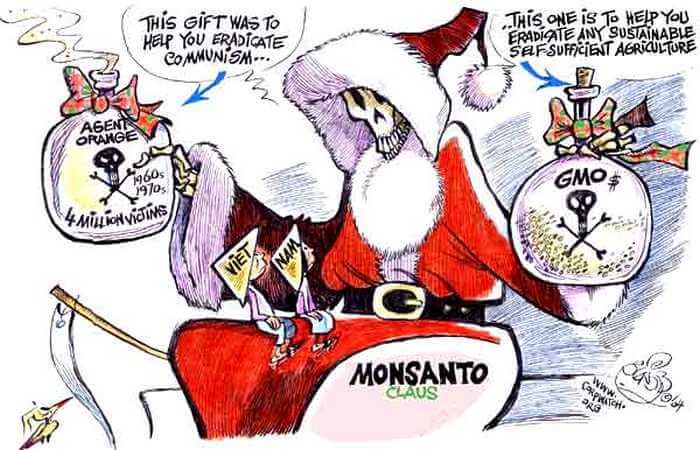
Bruce Lanphear, a professor in the faculty of health sciences at Simon Fraser University, said ghostwriting is “part of the playbook” of the pesticide industry.and the oil and gas, bitumen, coal, and frac industries.
Lanphear was invited in 2022 to co-chair Health Canada’s Pest Management Regulatory Agency. He said he accepted initially but had to pull out when he learned the committee was not allowed to ask questions.

- Lheidli T’enneh First Nation bans herbicide use across north-central B.C.
- Environmentalists raise concerns spraying forests with glyphosate makes them more vulnerable to wildfires
He pointed out that while Health Canada and the U.S. Environmental Protection Agency both have concluded that glyphosate is safe, the UN’s International Agency for Research on Cancer, a division of the World Health Organization, classified glyphosate as “probably carcinogenic to humans” in 2015.
“If this is a carcinogenic chemical, if it’s toxic, and three-quarters of the public are being exposed, that should be treated as a real, urgent problem,” he said.
Lanphear said the retraction is a good reason to review the latest science.
“Every time we learn something new of consequence — like exposure, like potential carcinogenicity — the regulatory agency should re-evaluate it,” he said.
Refer also to:
2025: Bravo! Courageous Ontario Chiefs to seek ban on aerial spraying of glyphosate
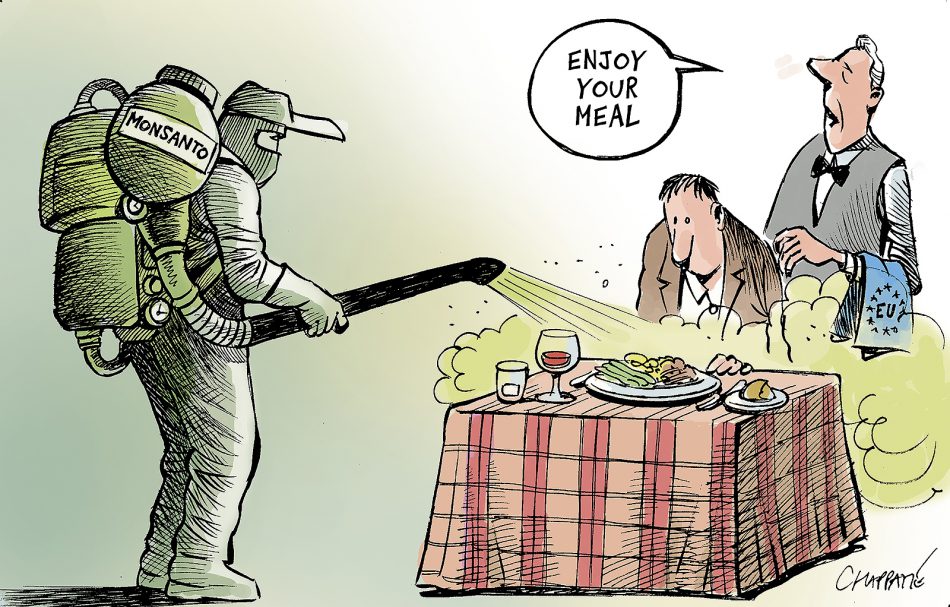
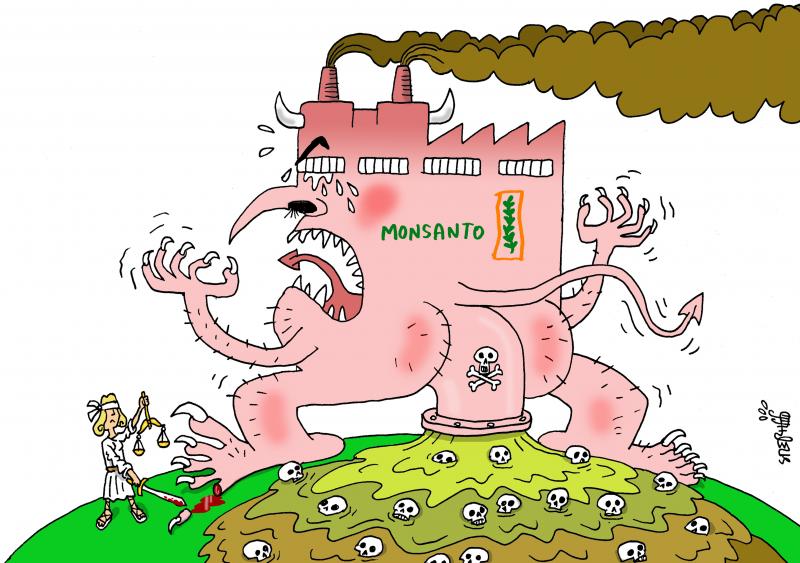
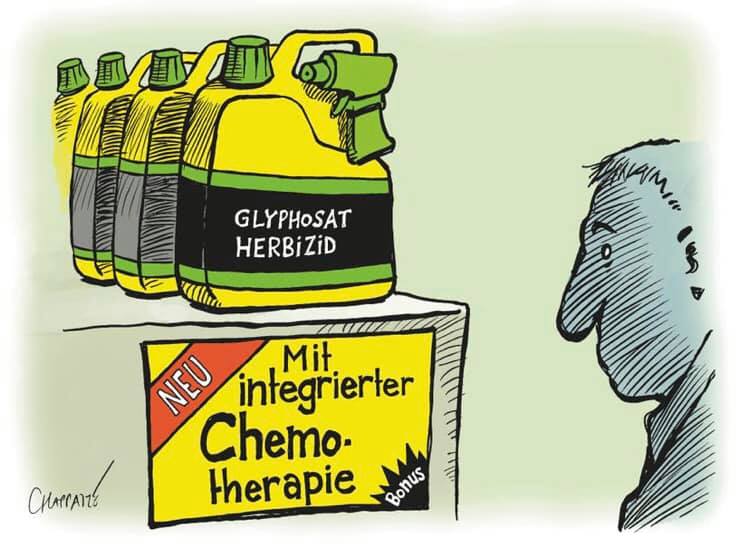
2021: Health Canada: Poisoning Canadians to please Monsanto/Bayer, the oil patch and frac’ers?