@ssteingraber1.bsky.social:
NEW STUDY: Parkinson’s disease is linked to exposure to a common solvent, trichloroethylene, formerly used as a dry cleaning fluid and as an anesthetic gas, and to degrease metal parts and which now contaminates up to 50% of US drinking water sources.
This work builds on the findings of an earlier study that found a greater risk of PD among those who had lived in Camp Lejeune, a military base in North Carolina with TCE-contaminated water, when compared with those living on a military base in California without TCE water contamination
Ambient Trichloroethylene Exposure and Parkinson Disease Risk in Medicare Beneficiaries by Brittany Krzyzanowski, Kassu Mehari Beyene, Jay R. Turner and Brad A. Racette, October 21, 2025, 105 (8)
https://doi.org/10.1212/WNL.0000000000214174
- Abstract
- Introduction
- Methods
- Results
- Discussion
- Glossary
- Study Funding
- Disclosure
- Publication History
- Footnote
- Supplementary Materials
- References
Abstract
Background and Objectives
Trichloroethylene (TCE) is an important environmental contaminant in the United States due to widespread use industrially. Epidemiologic studies suggest that occupational exposure to TCE and TCE-contaminated drinking water may increase the risk of Parkinson disease (PD). The aim of this study was to investigate the nationwide relationship between ambient TCE and PD risk.
Methods
We performed a nationwide, population-based, case-control study to investigate the association between incident PD in US Medicare beneficiaries aged 67 years and older in 2016–2018 and their residential exposure to ambient (outdoor) TCE in 2002. We assigned residence based on the latitude and longitude of Medicare beneficiaries’ zip + 4 center 2 years before diagnosis/reference. We assigned TCE exposure based on census tract–level data from the US Environmental Protection Agency’s (EPA’s) National Air Toxics Assessment program. We used logistic regression to estimate relative risk (RR) adjusted for age, sex, race, smoking, health care utilization, rural-urban commuting area (RUCA), and PM2.5. We also mapped the nationwide geospatial pattern of ambient TCE and then explored high-resolution local PD risk patterns using MapGAM for the 10-mile radius around the top 3 TCE-emitting facilities from the EPA’s Toxic Release Inventory in 2002.
Results
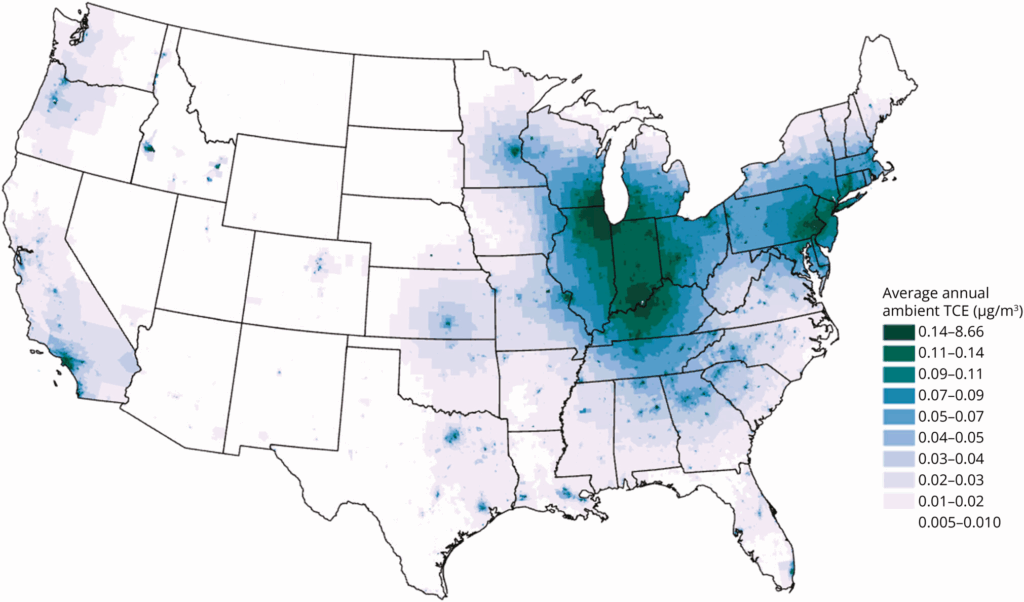
We identified 221,789 incident PD cases (median age 78.8 years; 45% female) and 1,132,765 matched controls (median age 75.7 years; 57% female). We found a dose-dependent positive association between ambient TCE concentrations and PD risk, wherein beneficiaries exposed to the top decile of ambient TCE levels (0.14–8.66 μg/m3) had an RR for PD of 1.10 (95% CI 1.08–1.13) compared with those exposed to the lowest decile of TCE (0.005–0.01 μg/m3). We observed high levels of ambient TCE in the rust belt region of the United States and several smaller areas throughout the nation. Our MapGAM results suggested greater PD risk in the area surrounding 2 of the 3 highest ambient TCE-emitting facilities, one of which demonstrated a marked decreasing gradient of risk with increasing distance from the facility.
Discussion
We identified a positive association between ambient TCE and PD risk, suggesting that TCE may contribute to PD. We identified relatively higher risk of PD near 2 TCE-emitting facilities. This study was limited to Medicare-aged individuals.
…
Figure 2 Ambient TCE, United States 2002
…
Refer also to: