How climate change and deforestation interact in the transformation of the Amazon rainforest by Marco A. Franco, Luciana V. Rizzo, Márcio J. Teixeira, Paulo Artaxo, Tasso Azevedo, Jos Lelieveld, Carlos A. Nobre, Christopher Pöhlker, Ulrich Pöschl, Julia Shimbo, Xiyan Xu & Luiz A. T. Machado , Sept 2, 2025, Nature Communications volume 16, Article number: 7944
Abstract
The Amazon rainforest is one of Earth’s most diverse ecosystems, playing a key role in maintaining regional and global climate stability. However, recent changes in land use, vegetation, and the climate have disrupted biosphere-atmosphere interactions, leading to significant alterations in the water, energy, and carbon cycles. These disturbances have far-reaching consequences for the entire Earth system. Here, we quantify the relative contributions of deforestation and global climate change to observed shifts in key Amazonian climate parameters. We analyzed long-term atmospheric and land cover change data across 29 areas in the Brazilian Legal Amazon from 1985 to 2020, using parametric statistical models to disentangle the effects of forest loss and alterations of temperature, precipitation, and greenhouse gas mixing ratios. While the rise in atmospheric methane (CH4) and carbon dioxide (CO2) mixing ratios is primarily driven by global emissions (>99%), deforestation has significantly increased surface air temperatures and reduced precipitation during the Amazonian dry season. Over the past 35 years, deforestation has accounted for approximately 74% of the ~ 21 mm dry season−1 decline and 16.5% of the 2°C rise in maximum surface air temperature. Understanding the interplay between global climate change and deforestation is essential for developing effective mitigation and adaptation strategies to preserve this vital ecosystem.
…
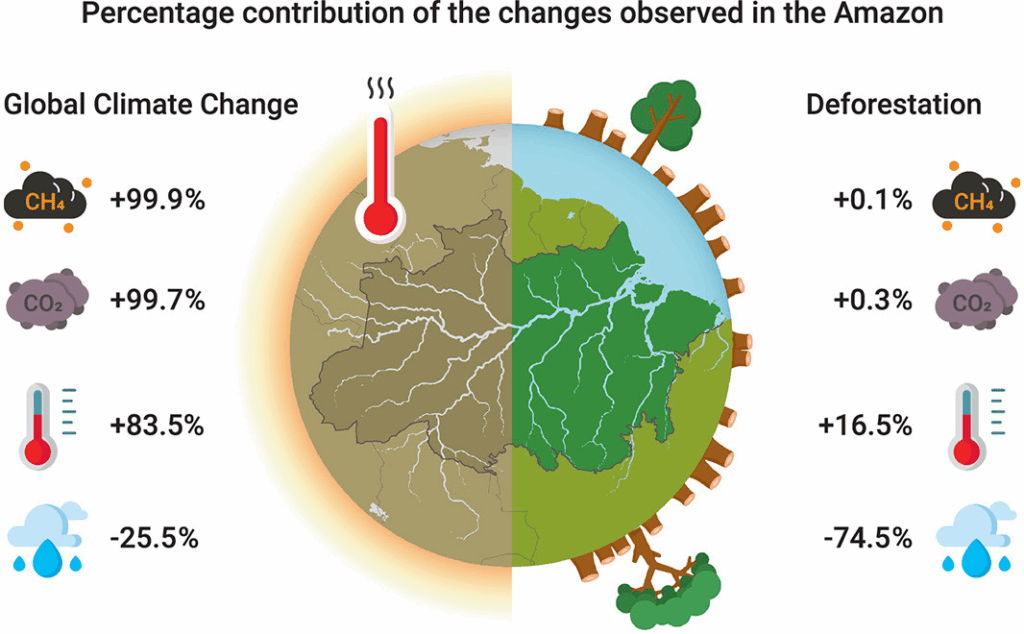
Figure 4 showing relative contributions of climate change and deforestation to the Amazonian climate.
…
Summary
In this study, we examined 35 years of environmental data to disentangle the effects of deforestation and global climate change on key atmospheric variables in the Brazilian Amazon. The analysis reveals that year-to-year variations exhibit a linear trend, while a logarithmic function accurately describes the effect of deforestation. Surface parametric equations considering both yearly and logarithmic variations as a function of deforestation were successfully derived from atmospheric parameters. These parametric equations enable the separation of the specific contributions of global climate change and deforestation extension to the observed changes over the 35-year period for each variable.
The dry season is when the impacts of deforestation are most pronounced, mainly on rainfall. The cumulative effects ultimately exacerbate the seasonality even further.
Over the entire 35-year period, there was an increase of around 87 ppm in the mixing ratio of CO2. About all of this increase can be attributed to global emission changes, with a small portion due to the extent of deforestation. A similar tendency was observed for CH4. This gas increased by around 167 ppb, of which 99.9% was attributed to global emission change. If the background mixing ratio is not considered, vegetation’s contribution to changes in gas mixing ratios is relatively much more important. The maximum surface air temperature exhibited a rise of approximately 2.0 °C, with global climate change and the deforestation effect contributing 83.6% and 16.5%, respectively. The total precipitation during the dry season showed a reduction of about 21 mm dry season−1, with deforestation contributing to a decrease of ~15.8 mm dry season−1 (74.5%) and global climate change leading to a decrease of ~5.2 mm dry season−1 (25.5%).
Overall, these findings highlight the intricate relationship between deforestation and global climate change in influencing rainfall patterns across the Amazon. This interaction contributes to nonlinear trends in precipitation, amplifying the impacts of ongoing climate change. The observed reduction in total precipitation during the dry season, combined with a significant increase in maximum surface temperature linked to deforestation, underscores the crucial role of forest cover in maintaining a stable regional water cycle and mitigating climate stress. If deforestation continues unabated, the extrapolation of our results suggests a further decline in total precipitation during the dry season and an increase in maximum surface temperature, factors that could push the Amazon ecosystem toward increasingly unstable states. Emerging evidence suggests that deforestation in the Amazon is already altering South American monsoon patterns, resulting in drier conditions that may compromise the long-term resilience of the rainforest47,54.
In addition, the results of this study suggest that Amazon is moving through a critical transition, potentially exacerbated by extreme events such as the unprecedented 2023 drought55,56. However, we remain cautious about defining a precise deforestation threshold that could trigger biome-scale dieback, particularly because our extrapolation does not fully account for the substantial uncertainties inherent in climate-vegetation interactions, which themselves remain subject to significant uncertainty57. Together, deforestation and climate change are driving substantial transformations across the region during the dry season, resulting in reduced rainfall, elevated temperatures, and increased atmospheric GHG levels. These findings underscore the importance of maintaining and restoring forest cover in the Amazon as a crucial strategy for mitigating climate change and ensuring the stability of ecosystems.
…
 Refer also to:
2025: LNG Developer Announces $15B Project Off Newfoundland, Says Carney Policy Changes Made It HappenMark Carney is a fraud, a fucking climate-destroying Harper Con earth-raping monster.
… In the wake of Hodgson’s announcements in Berlin, independent analysts cast serious doubt on Europe’s future need for LNG. They noted the EU relied on energy efficiency and accelerated renewable energy deployment to reduce gas demand 17% between 2021 and 2024, spurred on by Vladimir Putin’s invasion of Ukraine, and that the continent is continuing to electrify its energy use.
“In the medium and long term, we’re not anticipating an increase in gas demand, certainly not in Western Europe,” Pawel Czyzak, Europe programme director at the Ember energy think tank, said in an email. The continent “is already heavily oversupplied towards 2030,” and “that oversupply will get even more severe if the questionable fossil fuel imports from the EU-U.S. trade [and tariff deal] are implemented.” …
David Huntley:
Any politician who supports fossil fuels should be charged, convicted and jailed for a crime against humanity.
Terry Moore:
More evidence that fossil capitalists are prepared to extract and enable the burning of fossil carbon regardless of the impact on a liveable climate. Even in the face of increased wildfire and other climate driven damage to life and property they press on. This is ecocidal behaviour and it’s being enabled by the Carney’s government despite his apparent recognition that more fossil infrastructure is both dangerous and unnecessary in the face of renewable energy options. What happened to the alternative “Value(s)” Carney championed in his 2021 book by that name? Abandoned in the pursuit of power or just downed out by the louder voices? PP was just a fossil fox pure and simple. Carney came disguised in sheep’s clothing.
GetReal:
I appreciate the concern of environmentalists on this project, but pragmatically speaking LNG is an excellent lower carbon transition fuel to use while the massive amounts of renewable energy technologies and projects are developed over the next 30 or so years a full transition will take. Way lower emissions than oil and of course coal. Canada supplying LNG to Europe to replace Russian gas and then also from the West Coast to supply Asia to replace coal is a good win/win strategy all round.
Reply by Mitchell Beer:
That’s the argument we’ve been hearing from the gas industry.
But recent analysis has indicated that climate pollution from gas can be as bad as or worse than coal. And that’s not the only big issue the gas industry faces.
On environment and climate, the problem is that the primary component of natural gas is methane, a climate super-pollutant with 84 times the warming potential of CO2 over a 20-year span. (You’ll hear more modest numbers for a 100-year span, but it’s the next 20 that matter if we intend to get climate change under control.) Methane leaks at all stages in gas extraction and transport, and routine flaring of “waste” gas causes a whole host of other climate and environmental harms. And yet, while the IPCC and others have identified cost-effective methane controls as one of the quickest, cheapest ways to achieve the deepest emission reductions by 2030, the industry consistently under-reports its emissions and refuses to consistently take charge of them.
In Canada, fossil companies and their political allies are demanding that the federal government scale back a perfectly reasonable set of methane regulations.
So, yah, in theory…if these emissions were being taken seriously, gas could be part of the solution to climate change. But they aren’t being, and with deregulation all the rage now, it isn’t likely that they will be. Meanwhile, the recent buildout of LNG facilities world-wide means we’re going into a sustained supply glut, making it a lot less likely that new projects like Fermeuse will be viable. Market demand for gas is also being undercut by the dawning realization that renewables + storage are cheaper, deploy faster, and deliver more reliably — which means it’s a no-brainer to go with solar, wind, batteries, and energy efficiency, before even factoring in climate performance.