Vancouver is running out of water, and Herr Carney is forcing in massive data centres. Welcome to mass surveillance. The water loss, toxic air, water pollution, noise, incessant hum, ugliness, stress, illness, abuse are bonuses brought to you by billionaires and Alberta’s corrupt owned by the rich UCP and Canada’s corrupt worse than Harper Mark Carney. PS Data centres have a PFAS problem.
It will run its course, leaving the population to pick up the pieces and scavenge for parts when the power and water run out. One can hope that at long last, as children of the not too distant future wander the ruins of data centers, lessons will have been learned.Homo naziens refuse to learn.
They use pfas for cooling. What the hell. @ssteingraber1.bsky.social:
PFAS molecules are good at removing heat. The chips used in AI data centers generate extreme heat. @metamythics.bsky.social:
Yes but im sure they could have come up with better cooling systems, instead of using forever chemicals @ssteingraber1.bsky.social:
Agree! DC evaporative cooling systems consume huge amounts of drinking water and turn it into humidity. The problem of water depletion spurred closed loop and immersion cooling with PFAS. Except it can’t be endlessly recirculated and has to be dumped and it can also leak.
The potential negative impacts of data center expansion on carbon emissions, water usage, and electricity bills are relatively well documented. But their potential PFAS pollution, both direct and indirect, is less well known.
PFAS, also known as forever chemicals, are very durable and accumulate—in both the environment and the body—over time, posing real concerns for long-term human and ecological health.
Data centers host tens of thousands of servers that run 24/7 in order to keep virtual networks, cloud storage, and computing in operation. Such servers require semiconductors, cooling systems, and fire suppressants—all sources of PFAS forever chemicals.
Many emerging technologies hold promise in terms of destroying PFAS, but they are energy intensive and expensive. This brings up the ongoing debate over who should bear the cost of potential solutions.
As the use of artificial intelligence (AI) continues to rise across the country, data centers have expanded and multiplied in tandem to accommodate AI’s massive workload demands. These data centers host tens of thousands of servers that run 24/7 in order to keep virtual networks, cloud storage, and computing in operation. Such servers require cooling systems, semiconductors, and fire suppressants—all sources of PFAS forever chemicals.
Perfluoroalkyl and polyfluoroalkyl substances, commonly known as PFAS, form a group of more than 15,000 synthetic chemicals best known for their applications in non-stick, water- and grease-resistant, and firefighting products. The chemical structures that make them suitable for such uses, carbon-fluorine bonds, are among the strongest known chemical bonds and are therefore resistant to breaking down in the environment—a property that has earned PFAS the nickname “forever chemicals.” These forever chemicals are present in our air, soil, drinking water, and overall food chain.
Due to their durability, PFAS accumulate—in both the environment and the body—over time, posing real concerns for long-term human and ecological health. When these forever chemicals enter the body, they accumulate in human tissue instead of being metabolized by the body like other contaminants. This bioaccumulation has toxic effects especially for the liver, blood, and kidneys. Researchers have found that PFAS impact fetal growth, organ development, reproductive health, and other biological processes, and have been linked to high rates of cancer. Studies show that most Americans have some level of PFAS in their blood.
Data Centers and PFAS
The potential negative impacts of data center expansion on carbon emissions, water usage, and electricity bills are relatively well documented. But their potential PFAS pollution, both direct and indirect, is less well known.
Data centers primarily use PFAS to cool their servers and to suppress fires. Direct PFAS pollution from data centers is difficult to ascertain and likely limited because cooling systems generally run as closed loops. But manufacturing companies that produce the PFAS materials used in data centers have historically emitted PFAS, which harms communities and ecosystems near their facilities. Chemours is one of the largest global producers of PFAS and one of the biggest suppliers of PFAS materials for data center coolants and semiconductor production (semiconductors are used to make the microchips deployed in data centers in vast quantities). The company aims to expand production of its PFAS materials, in particular resin for semiconductor manufacturing, to accommodate the growth of data centers across the country. This will likely have repercussions on the environment. In North Carolina, airborne PFAS emissions from Chemours operations have contaminated more than 7,000 drinking water wells, according to researchers.
Another concern is the large amount of e-waste produced by data centers, due to the constant development of faster microchips. Discarded microchips and other electronic equipment often end up in landfills, where they can release chemicals, including PFAS, into the environment. Public and environmental health measures are needed to ensure that the disposal of these harmful chemicals does not affect surrounding environments.
Cooling Technology
Data center servers generate large amounts of heat as they operate. Coolants serve to prevent the equipment from overheating and breaking down. Historically, water has been the go-to coolant. But as 45% of data centers are sited in water-stressed regions, operators have increasingly been looking to alternative cooling solutions. Two-phase immersion cooling has become particularly popular for being cost effective and highly energy efficient. This technology, however, uses carbon and fluorine, the building blocks for several types of PFAS. These particular PFAS, furthermore, break down into trifluoroacetic acid, a toxic chemical linked to reproductive health risks.
Fire Suppression
Between the high heat radiating from servers and the sheer volume of electrical equipment inside them, data centers are ripe environments for fire risk. Analysis of fire outbreaks at data centers since 2021 has identified causes such as lithium-ion battery failure in semiconductors, water damage of electrical equipment, and other equipment failures. To mitigate risk, data centers require specialized fire suppression systems. Clean agent fire suppression systems are typically used over water-based systems due to their non-conductive, residue-free properties, whereas water-based systems can damage servers. FM-200 and Novec 1230 are common fire-suppressing clean agents—and scientists classify both as PFAS.
In 2022, the U.S.-based manufacturing conglomerate 3M announced that it would stop producing PFAS, including Novec 1230, by the end of 2025 (it has since confirmed that it has ended all PFAS manufacturing). This shift by a major industry leader towards alternative fire suppression solutions may signal the industry as a whole is pivoting to PFAS-free options.
Addressing Omnipresent PFAS Is a Challenge
Matt Dunn, a PFAS scientist at Tetra Tech, states that PFAS regulation represents a unique struggle due to how widespread the chemicals are. Since PFAS are in everyday products that are used by every American, from food to bath products, the question becomes: where do you draw the line? “Do you go after the user, or do you go after the manufacturer,” asks Dunn. “And understanding the difference there is very important.”
In 2021, Maine became the first state to progressively ban products containing PFAS with An Act to Stop Perfluoroalkyl and Polyfluoroalkyl Substances Pollution (Public Law 2021, c. 477). Maine prohibits the sale of PFAS products in numerous industries with effective dates from 2026 to 2040. While coolants containing PFAS will be banned starting in 2040, semiconductors and firefighting foam are not affected by this law.
Minnesota’s Amara’s Law (Minnesota Statute § 116.943) requires the state’s pollution control agency to regulate intentionally-added PFAS and to set standards for PFAS reporting in 2026. As of January 1, 2025, Minnesota prohibits the sale and distribution of 11 categories of industrial products containing intentionally-added PFAS. By 2032, the state will require a total ban on the sale of products containing PFAS chemicals unless they are deemed unavoidable.
Federal Action
Because of its ubiquity, PFAS pollution would probably be best addressed at the national level.
But as of 2026, there is no one direct and all-encompassing avenue for PFAS regulation at the federal level. Existing hallmark legislation such as the Clean Water Act, the Safe Drinking Water Act, the Comprehensive Environmental Response, Compensation, and Liability Act, and the Toxic Substances Control Act all offer opportunities to address PFAS contaminants at various stages and to varying degrees. The Trump Administration has focused on deregulation, however. The EPA announced in May 2025 that it proposes to push back the compliance deadline for the enforcement of PFAS standards in drinking water to 2031. In September 2025, EPA announced plans to fast-track the review process for chemicals used in data centers, with a goal of making the United States the “AI capital of the world.” In line with this initiative, President Trump issued an executive order directing the EPA, the Department of the Interior, the Department of Energy, and the Department of Commerce to expedite their respective permitting processes for data center materials and infrastructure—including coolants, semiconductors, and fire suppressants.
More recently, Congress has shown interest in addressing PFAS contamination through Congressional hearings, bill introductions, and funding appropriations. The 117th Congress designated $1 billion for the Clean Water State Revolving Fund and other programs to address PFAS in wastewater, via the Infrastructure Investment and Jobs Act (P.L. 117-58). The current 119th Congress has proposed bipartisan legislation such as the PFAS Research and Development Reauthorization Act of 2025 (H.R.6667), which would extend the authorization of appropriations for PFAS research and development under the Environmental Protection Agency (EPA), and the Clean Water Standards for PFAS Act of 2025 (H.R.6668), which would set standards and limitations for PFAS emissions under the Clean Water Act. Both frameworks could be applied to PFAS contamination from data centers.
Further Congressional action on PFAS regulation could take many forms, from national PFAS reporting standards to bans on PFAS products (following the lead of Maine and Minnesota). Congress could also support research into compounds that would serve as alternatives to PFAS without its significant human health risks.
Marnie Desjardins set down roots in Olds, Alta., a few years after moving to the town in 1986, eventually purchasing a home on the east side.
The mature trees, interesting architecture and friendly neighbours are just some of her favourite parts of living in the agricultural hub, which is home to about 10,000 residents.
But since January, her mostly quiet life has become upended, she said, after Synapse Data Center Inc. proposed a massive data centre project and accompanying natural gas plant right near her home.
Now, she feels life as she knows it is at stake.
“I really thought that I would be retiring here, and I certainly had a vision of what that was going to look like,” she said, choking up on her front lawn.
“But I’m not sure … if this were to go through at the scope and scale that it is being proposed at this point in time, I’m not sure if I would stay, which breaks my heart. It really, really does.”
Desjardins is one of several Olds residents who are deeply concerned about the health impacts that could come from living next to ten 100-megawatt data centres and a power plant with enough generating capacity to light up Edmonton.
A local group called the Olds Transparency Project has recently banded together to raise awareness of the data centre project and to stop it in its tracks. On April 28, the group held a town hall to discuss its potential health impacts.
Janae Johnson, an Olds resident, mother to three young children and a member of the group, teared up thinking about what her kids’ future might look like if the project goes ahead.
Health impacts are at the top of her list of concerns, she said, citing potential noise pollution and emissions.
Johnson said she’s never advocated on this scale — or spoken to political leaders or the media for that matter — but now feels she has to.
“I am a mom by day and a researcher and emailer by night,” she said. “There hasn’t been a lot of interaction with the town … and the provincial government. We’ve raised a lot of concerns, but there just hasn’t been much feedback.”
Documents, town halls and meetings
The town, province and residents have hosted several town halls and meetings to get people up-to-speed on the proposal and process.
That means people who have never had to think about a project like this are trying to wrap their heads around the science and operations of data centres while diving into the complex world of provincial and federal policy — much of which hasn’t caught up to this evolving technology.
“I know more about AI data centres now than I ever wanted to know,” said Karen Swanepoel, a resident who can see the site of the proposed data centre from her front yard.
“It’s not something that we set out to learn about, but it’s infuriating that a lot of people don’t understand why we don’t think the risk is fair.”
“It’s consuming my life. It really is, and I’m choosing that. I’m choosing that [because] it is important enough to me,” said Desjardins.
She thinks the timelines are moving too fast.
“I think there’s a lot of people that really don’t know how to have their voices heard. Not everybody uses computers. Not everybody is on Facebook,” she said.
The project was initially rejected by the Alberta Utilities Commission (AUC). Synapse is currently awaiting approval on its resubmission. The AUC will hold an information session later in May and give residents the opportunity to participate in a hearing later this year.
To address concerns about public consultation deficiencies, Synapse also launched a website answering questions about the project.
In a statement emailed to CBC News, Minister of Technology and Innovation Nate Glubish said Synapse’s first application to the Alberta Utilities Commission “was inadequate and thus did not proceed. This is evidence of the process working.”
He added that data centre projects “must also meet requirements related to water, emissions, noise, and land use through multiple process[es]. Albertans can participate in those regulatory consultations and have their say.”
Organizing to be heard
Bradley Lafortune, executive director of Public Interest Alberta, a non-profit organization that advocates for various issues, said he’s hearing from many people who are uncertain about data centre projects proposed near them.
“They don’t really know from the government or from companies that are planning to build them here what exactly they are and how much impact they will have on local communities,” he said.
“People are also wondering why is it that we’re charging ahead without any sort of AI or AI data centre legal framework in place. Alberta has no overarching legal framework for AI or AI data centres, nor does the federal government.”
Three other data centre proposals in Alberta (the Woodland Cree First Nation-led Mihta Askiy data centre and Beacon AI Centers’ Heartland Project and Indus Project) are also not required to complete impact assessments, as decided by the Impact Assessment Agency of Canada.
Having spoken to residents in Olds and across Alberta, as well as people in Saskatchewan where a development agreement was approved for Bell Canada’s 300-megawatt AI data centre, Lafortune said “provincial governments, so far, are not doing a diligent enough job in engaging with citizens and informing them about all of the aspects of these proposed projects.”
Regina residents have rallied against the proposed data centre project on the outskirts of the city.
On the east coast, residents of Lorneville, a rural Saint John community, have vocalized their disapproval of a data centre proposal from Calgary-based Beacon AI Centers and Volta Grid, which is based in Texas.
‘They stole our summer’
The plight of Olds residents fighting against the Synapse data centre project is familiar to Wayne Shuttleworth.
The farmer and landowner who lives in Rocky View County, just northeast of Calgary, plunged into documents and meetings last summer when an AI data centre was proposed right next to his property.
“It was … kind of like 100 per cent of our life for that whole summer,” he said, thinking back on that stressful time. “We had, like, documents of hundreds of pages deep, and as just a group of residents, we had only, like, 80 days to go through them.”
Shuttleworth said he’d wake up in the middle of the night just to jot down new points and build his case against the data centre.
“They stole our summer away from us dealing with this thing.”
At a Rocky View Council hearing on Sept. 9, Shuttleworth and dozens of residents presented their cases against the data centre, while less than a handful said they were in favour. The council voted 6-1 to reject the plan, citing concerns about the data centre’s proposed location and potential impacts on neighbouring farmers.
As an Albertan who succeeded in his fight against the data centre trying to move in next door, Shuttleworth had this advice for Olds residents: “Check your emotions at the door” and gather as much information as possible on the proposed development so that when the time comes, you have a strong case to make.
“I wouldn’t wish this on anybody.”
***
@txsalth2o:
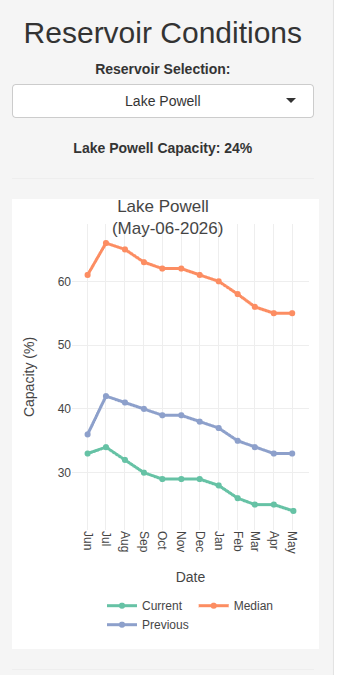
Utah is approaching the “If it’s yellow, let it mellow” stage of drought.
Lake Powell, our nation’s second-largest reservoir, is at 25% capacity.
What’s Utah doing about it?
Approved 4 new AI data centers to consume BILLIONS of gallons of water.
@AmericaFailed1:
24%.
@Sydney843:
Utah didnt actually approve that data center – 3 middle-aged rude old white, likely religiousmen with no experience handling multimillion dollar contracts approved that data center, even after they saw how angry people were.
@kdurant7:
The Mormons run Utah. They are selling out the land, they will reap what they sow!
@Hugo_Reckshaun:
Data center will get all manner of subsidies as you pay a premium for sludge to come through your shower head
This website stores cookies on your computer. These cookies are used to provide a more personalized experience and to track your whereabouts around our website in compliance with the European General Data Protection Regulation. If you decide to to opt-out of any future tracking, a cookie will be setup in your browser to remember this choice for one year.

Homo naziens refuse to learn.