Colorado is the first state to require cigarette-style health warnings on gas stoves. It’s already facing a lawsuit by Sam Brasch, Aug. 7, 2025, CPR News
Anyone shopping for a gas stove in Colorado might soon notice a yellow label warning them of the air quality risks.
That’s after a new first-in-the-nation state law took effect on Wednesday.
Signed by Gov. Jared Polis in May, the law requires retailers to display labels, in Spanish and English, encouraging potential buyers to investigate the health impacts of owning an indoor gas stove. The label must include a URL or QR code leading to a state webpage with information about the risks associated with the appliances.
Colorado is the first state to require a health warning label on gas stoves and cooktops, according to Nick Torres, an advocacy director for the American Lung Association covering Colorado, Wyoming and Utah. He said the labels will help shoppers make an informed decision.
“It’s a good approach to capture the need for quality, evidence-based information consumers could trust at the point of sale,” Torres said.
The law, however, is already facing a legal challenge seeking to stop its enforcement.  Is Trump and his Nazis financing this insane bullying legal challenge? I thought MAGAts were all about freedom?

The Association of Home Appliance Manufacturers filed a federal lawsuit on Wednesday claiming the labeling requirement violates the First Amendment by forcing manufacturers and retailers to direct consumers to “misleading” information about health risks linked to gas stoves. It further argues there’s no scientific consensus that cooking on a gas stove causes health issues.

Toxic Gas Stoves Reality Check:
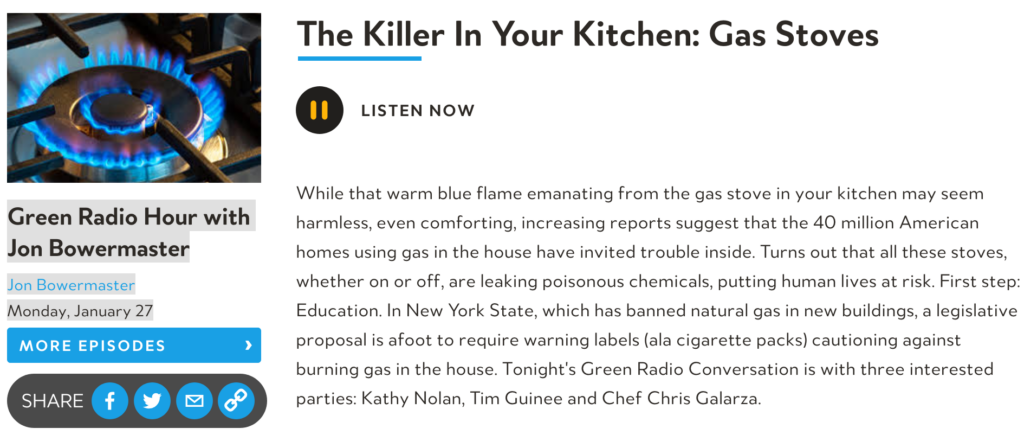
2025: The Killer in Your Kitchen: Gas Stoves. “Much of frac’d gas has radon in it.”Lots of frac’ing in Colorado, including crimes by illegal aquifer frac’er Encana/Ovintiv. Lisa Bracken and her dad were frac’d and poisoned by Encana

2022: New study on leaking, toxic unnatural gas stoves; leak badly – most when not in use.
2021: Here’s Why Your Gas Stove Is Killing You (and the frac-harmed)
2012: Methane from gas drilling: Manning family told, “Don’t use your kitchen stove”
End Toxic Gas Stoves Reality Check
The labeling law is one piece of a nationwide battle over whether households should continue burning fossil fuels indoors.The oil and gas industry owns Nazi Trump’s kid-raping ass; he’ll likely order electric stoves and heaters illegal, bellowing: “Breathing clean, safe, non radioactive air in American homes, schools and businesses ist verboten!”
By switching to all-electric appliances, health and climate advocates say consumers can breathe cleaner air while cutting their overall contribution to global warming. Meanwhile, the natural gas industry insists combustion represents a less significant source of indoor air pollution than cooking. Frying, for example, produces particulate matter.
Similar legislation failed in Illinois and New York last year. California lawmakers approved a bill requiring labels noting that gas stoves emit pollution “toxic to people and pets.” But Gavin Newsom vetoed the legislation in September 2024 due to concerns that language on the labels couldn’t be updated to reflect the latest science.what a pollution enabling sod; labels can be updated and stuck over old ones – if the facts get more gruesome about how deadly (un)natural gas is, notably frac’d.
Since then, New York lawmakers have revived their proposal to put warning labels on gas stoves. Massachusetts is now considering another version, which would require stickers warning that the cooking devices “release nitrogen dioxide and carbon monoxide inside homes.”
Colorado’s law doesn’t mandate stickers detailing air pollutants or potential health risks. It instead requires labels urging potential buyers to “understand the air quality implications of having an indoor gas stove,” and directs shoppers to a webpage for more information.
The page went live on the Colorado Department of Public Health and Environment website on Wednesday. It notes “there is evidence” gas stoves produce a wide range of air pollutants known to increase the risk of “chronic heart and lung diseases, asthma, impacts to the immune system, and some cancers.” It also provides a list of sources and peer-reviewed research and recommends using hoods to vent any emissions outdoors.
Natural gas utilities and a trade group representing retailers opposed the legislation at the Colorado Capitol. Tom Clark, the executive director of the Colorado Propane Gas Association, lobbied against the bill, saying it could give the state a platform to share inaccurate information about the health risks of cooking with fossil fuels.
“It leaves us open to an agency within the state to subjectively put whatever information they want without any oversight or regulation,”Oh hoooey boooey, poor terrified man Clark said. “We will monitor that to make sure there’s no misleading information.”Ugga Ugga, me fierce he-man!
Recent studies have found that gas stoves release indoor air pollution linked to a greater risk of respiratory conditions and certain cancers. One study, for example, found roughly 13% of childhood asthma cases can be attributed to gas stoves.
Another recent study from a team at Stanford University found that gas stove emissions often contain more cancer-causing benzene than secondhand smoke. Followup research measured air quality levels in 87 homes with gas stoves in Colorado and California, concluding the appliances significantly increase cancer risk for adults and children.
The study also found that using vent hoods or opening windows can limit benzene exposure, but ventilation alone doesn’t fully eliminate cancer risk.
Cooking indoors produces air pollution, no matter the energy source. By switching from a gas to an electric stove, however, a recent study led by Columbia University found that residents were able to significantly cut levels of nitrogen dioxide, a pollution known to increase the risk of childhood asthma.
It’s unclear if retailers have started affixing the warnings in brick-and-mortar showrooms and online stores. The labels weren’t displayed on appliances at a Home Depot in Denver on South Santa Fe Drive by Wednesday afternoon.
Under the legislation, any failure to properly label stoves counts as a deceptive trade practice under Colorado’s consumer laws. The Colorado Attorney General enforces state-level consumer protections.
A spokesperson for the Colorado Attorney General’s Office declined to comment on plans to enforce the law due to the pending litigation.
Credible, Evidence-Based Information on the Health Impacts of Gas-Fueled Stoves by Colorado Department of Public Health and Environment, (Finalized and posted August 4, 2025)
This information implements Section 25-5-1602(4), C.R.S., which requires the department to post on a public website credible, evidence-based information on the health impacts of gas-fueled stoves. Along with the cited sources of evidence-based information, the department also compared this content to the information provided by other state governments for consistency.
Learn about the health risks associated with the indoor use of gas-fueled stoves and the steps you can take to improve indoor air quality if using a gas-fueled stove.
Indoor Air Quality
- Gas stoves burn natural gas or propane to produce heat.
- There is evidence that particulate matter (PM), nitrogen dioxide, carbon monoxide, benzene, formaldehyde, and methane can be released into indoor air from gas stoves.1
- According to the U.S. Environmental Protection Agency, indoor air pollutants can build up to levels that may affect people’s health if the space is not properly ventilated.2
Health Risks from Indoor Air Pollution Associated with Gas Stoves
According to the Centers for Disease Control and Prevention (CDC), U.S. Environmental Protection Agency, and numerous studies, the risk to someone’s health depends on:
- The amount and type of pollutants in the air,
- How long and how often someone breathes polluted air, and
- Individual factors like age, health, and lifestyle.3
- People with underlying conditions such as asthma, young children, older adults, and people who are more sensitive to pollutants may be more likely to experience health impacts.4
Health Impacts from Indoor Air Pollution Associated with Gas Stoves
- Can include headaches, nausea, eye, nose, or throat irritation, respiratory symptoms, and worsening asthma symptoms.5
- Breathing high levels of indoor air pollution associated with gas stoves and other sources, breathing it more frequently, or over long periods of time, can increase the risk of developing chronic heart and lung diseases, asthma, impacts to the immune system, and some cancers, such as leukemia6 , or cancers of the nose and throat.7
Steps You Can Take to Improve Your Indoor Air Quality if You Use a Gas Stove
In the U.S. Environmental Protection Agency’s “The Inside Story: A Guide to Indoor Air Quality,”8 they recommend:
- Properly install and maintain your gas stove according to the manufacturer’s specifications.
- If you have one, turn on your stove hood while cooking to help remove pollutants from indoor air. Clean and replace the hood filters per the manufacturer’s instructions.
- Utilize hoods that vent to the outside to dilute indoor air pollution.
- Never use a gas stove to heat your home.
- When buying a new gas stove, consider a model with pilotless ignition. Pilotless gas stoves use less gas and release fewer pollutants into the air.
- Portable air cleaners, such as an air purifier, or furnace/HVAC filters, can help improve indoor air quality.
- Decrease pollution exposure by increasing the amount of outdoor air coming into your home – open windows and doors, and turn on ceiling fans.
ADDITIONAL INFORMATION
- For more information about gas stove use and indoor air pollution, contact CDPHE’s ToxCall line at 303-692-2606 or email hidden; JavaScript is required.
- To learn more about indoor air quality, visit the U.S. Environmental Protection Agency’s Indoor Air Quality website(opens in new window).
FOOTNOTES AND BIBLIOGRAPHY OF RELIED UPON CREDIBLE, EVIDENCE-BASED INFORMATION
FOOTNOTES
- See U.S. Environmental Protection Agency (EPA), Indoor Air Quality, “Introduction to Air Quality(opens in new window)”. See also bibliography. ↩︎
- See EPA, Indoor Air Quality, “The Inside Story: A Guide to Indoor Air Quality(opens in new window)”. See also bibliography. ↩︎
- See bibliography. ↩︎
- See bibliography. ↩︎
- See EPA, Indoor Air Quality, “Introduction to Indoor Air Quality(opens in new window)”. See also bibliography. ↩︎
- See bibliography. ↩︎ See also EPA “Benzene(opens in new window)”.
- See bibliography. ↩︎ See also Agency for Toxic Substances and Disease Registry (ATSDR), “Public Health Statement Formaldehyde(opens in new window)”.
- See EPA, Indoor Air Quality, “The Inside Story: A Guide to Indoor Air Quality(opens in new window)”. See also bibliography. ↩︎
BIBLIOGRAPHY
- U.S. Energy Information Administration, a semi-independent agency under the U.S. Department of Energy, “Residential Energy Consumption Survey(opens in new window)”.
- U.S. Government Accountability Office, “Gas Stoves: Risks and Safety Standards Related to Products and Ventilation(opens in new window),” (March 18, 2025, GAO-25-107514).
- U.S. Environmental Protection Agency (EPA), “Indoor Air Quality(opens in new window)”.
- American Chemical Society, Environmental Science & Technology, Energy and Climate, “Methane and NOx Emissions from Natural Gas Stoves, Cooktops, and Ovens in Residential Homes(opens in new window),” Eric D. Lebel, Colin J. Finnegan, Zutao Ouyand, and Robert B. Jackson, (Vol 56, Issue 4, January 27, 2022).
- National Institute of Health, National Library of Medicine, PublicMed Central, Environmental Health Perspectives, “Clearing the Air: Gas Stove Emissions and Direct Health Effects(opens in new window),” (February 18, 2024, 132(2):022001. doi: 10.1289/EHP14180).
- EPA “Sources of Combustion Products(opens in new window)”.
- Journal of Hazardous Materials, “Exposure and health risks of benzene from combustion by gas stoves: A modelling approach to U.S. homes(opens in new window),” (Vol 492, July 15, 2025, 137986).
- EPA, Indoor Air Quality, “Nitrogen Dioxide’s Impact on Indoor Air Quality(opens in new window)”.
- EPA, Indoor Air Quality, “Carbon Monoxide’s Impact on Indoor Air Quality(opens in new window)”.
- Centers for Disease Control and Prevention (CDC), Agency for Toxic Substances and Disease Registry, “Benzene ToxFAQs(opens in new window)”.
- EPA, Indoor Air Quality, “What should I know about formaldehyde and indoor air quality?(opens in new window)”.
- CDC “Benzene Chemical Fact Sheet(opens in new window)”.
- EPA, Indoor Air Quality, “Protect Your Family and Yourself from Carbon Monoxide Poisoning(opens in new window)”.
- EPA “Basic Information about NO2(opens in new window)”.
- EPA, Particle Pollution and Your Patients’ Health, “What is Particle Pollution(opens in new window)”.
- EPA, Particulate Matter Pollution, “Health and Environmental Effects of Particulate Matter(opens in new window)”.
- EPA, Indoor Air Quality, “Sources of Indoor Particulate Matter(opens in new window)”.
Other State Governments’ Information:
- Washington State Health Department, “Cooking Impacts of Indoor Air Quality, Health, and Climate(opens in new window)”.
- Minnesota Department of Health, “Residential Gas Stoves(opens in new window)”.
- California Air Resource Board (CARB), “Combustion Pollutants in Your Home – Guidelines(opens in new window)”.
- CARB, “Reducing Your Exposure to Indoor Air Pollution(opens in new window)”.
- Illinois Department of Public Health, “Air Quality in the Home(opens in new window)”.