
@jonturney.bsky.social:
when a story is somehow both shocking and completely unsurprising at the same time…
@vudu-yudu.bsky.social:
I don’t understand HOW though.
@emorwee.bsky.social:
The oil companies use Microsoft cloud computing to process seismic data, and then use machine learning and AI to analyze that data. The AI is able to tell them in minutes where big reserves are and where they should drill to get it. It massively reduces costs & increases the amount of oil produced
@emorwee.bsky.social:
Will Alpine co-wrote Microsoft’s manifesto on how AI will be a powerful force for good for climate change
In a new interview, Alpine disavows the manifesto, saying he believes Microsoft used his work to distract from the much larger climate harms the company enables through contracts with Big Oil
Microsoft claims that selling AI to Big Oil will ultimately help Big Oil transition to clean energy.
I asked Microsoft to provide me evidence that that’s true, since all available evidence says the AI is solely being used to drill more.
“Microsoft has nothing to share,” they responded.
As @yessfun.com has reported, the fossil fuel industry directly funds anti-trans panic because it distracts the public from “the very real and ongoing risks that climate change creates.”
He helped Microsoft build AI to help the climate. Then Microsoft sold it to Big Oil. A former Microsoft project manager reveals how the tech giant is using AI to help Big Oil drill—and how he and his partner are now pushing for change by Emily Atkin, Jul 17, 2025, Heated
Will Alpine had every reason to believe he was about to help save the planet.
The software engineer had just landed a job at Microsoft, the climate darling of the technology world. It was 2020, and months earlier, Microsoft made global headlines for its groundbreaking new commitment to not only become carbon negative by 2030, but to remove from the atmosphere all the climate pollution the company had ever emitted since its 1975 inception by the year 2050.
Will saw his new role at Microsoft as a way to help fulfill that pledge, and create a climate-friendly model for the rest of Big Tech. As a project manager working on the company’s artificial intelligence platform, he was tasked with developing tools to make it easier for customers to use Microsoft’s AI in an ethical and environmentally sustainable way.
“I thought it was just the most exciting thing in the world, building the cutting-edge tools and technology that could really help fight climate change,” he recalled. Both Will and Microsoft were adamant that this was the future of AI: to help society transition toward a cleaner, greener economy.
Will poured himself into the job. He created a group called Green AI, dedicated to reducing the carbon footprint of Microsoft’s AI development and operation. He helped build the CarbonAware SDK, a tool that enables software programs to perform larger processing tasks when electricity is coming from low-carbon sources, and smaller tasks when electricity is coming from fossil fuels. He met his now-wife, Holly Alpine, who was organizing nearly 10,000 Microsoft employees into a community to incorporate sustainability into their jobs.
“I’d say for about a year, year and a half, we were heads down doing good sustainability work,” he said. “Only then did I start to realize who was really using the AI that I was helping build.”
HEATED’s climate accountability journalism is 100 percent reader-funded—no fossil fuel ads, no greenwashing sponsors, no billionaires. Join our community of mindful readers today.
“Our paychecks were dripping in oil”
Holly, then a senior manager at Microsoft, first learned her employer was selling AI to Big Oil about a year before Will arrived. “It was this really secretive thing,” she recalls.
In 2019, a high-level employee who worked on climate told Holly about several contracts Microsoft had to help fossil fuel companies increase their production. These companies, she learned, were using Microsoft cloud computing to process seismic data, and then using Microsoft machine learning algorithms and AI to analyze that data, telling them where to drill.
One contract with ExxonMobil was going to help boost production in Texas and New Mexico by up to 50,000 barrels per day. Another deal with Chevron would use Microsoft AI to “dramatically accelerate the speed with which we can analyze data to generate new exploration opportunities.”
Word spread, and employees grew concerned that Microsoft was massively undermining its own climate efforts. After all, enabling Exxon to produce 50,000 more barrels of oil per day meant Exxon would produce 18.25 million more barrels of oil per year. That meant Exxon would release 6.4 million metric tons of carbon into the atmosphere per year—all because of Microsoft’s technology. (Microsoft had pledged to remove 1 million metric tons of carbon per year).
So in September 2019, employees confronted leadership in a company town hall meeting. In a transcript manually recorded by employees present at the time, Microsoft CEO Satya Nadella defended the deals, saying he believed that working with oil companies would ultimately help them transition to clean energy. “Give them that productivity boost so they can help themselves and help the world,” Nadella said. (HEATED did not obtain the transcripts from any named source in this story).
At another town hall in October, Nadella was pressed on the oil partnerships again. He was again adamant that Microsoft’s partnerships would help oil companies eventually transition away from fossil fuels.
“If we stop engagement, what’s the benefit? Who benefits? Nobody benefits,” Nadella said. “It’s not as if you can stop producing oil tomorrow, because the world would stop. The question is, how can we contribute to an energy transition plan?”
A few months later, Microsoft announced its aggressive climate goals—and employees were hopeful that this would be the end of oil partnerships. After all, Microsoft’s biggest competitor, Google, had just announced it would stop making AI tools for the oil and gas industry. Perhaps with its new climate goals, Microsoft would follow suit.
Subscribe to HEATED for 20% off
“We do not wish to be made complicit”
Will learned about Microsoft’s work with oil companies shortly after joining the company. But he was hopeful—resolute, even—that these contracts would not represent the future of AI.
To ensure that the technology would be used for positive planetary change, Will co-authored a white paper called “Accelerating Sustainability with AI,” which laid out all the climate-positive ways Microsoft’s AI toolkit could be used by third parties. He imagined the biggest customers would be renewable energy companies, low-carbon materials makers, and emergency managers.
In 2020 and 2021, however, Microsoft announced several new partnerships with oil companies designed to help boost production. At that point, the company had become the number one cloud provider for the fossil fuel industry.
So Holly and Will—who’d met serendipitously on a mountain in 2020—sprang into action. In 2021, they sent an 8-page memo to Microsoft’s leadership, alerting them of the profound climate impact of the company’s fossil fuel contracts.
Will and Holly eloped at Hidden Lake in Glacier National Park, where they met.
“The math is clear: many of our deals entirely negate our company’s emissions goals,” they wrote. In addition, Will and Holly noted that none of the 50 oil and gas companies Microsoft was working with publicly claimed to use Microsoft’s AI or cloud computing technology to transition away from fossil fuels, as Nadella had argued.
In fact, it was just the opposite. BP was using Microsoft AI technology to “invest in more oil and gas;” Chevron was using it for “new unconventional [fracking] wells,” and Exxon was using it to “improve exploration success.”
“Such clearly stated strategies are alarming in that they make Microsoft’s claims of enabling the transition to a clean economy materially misleading to both shareholders and employees,” they wrote. “We do not wish to be made complicit.”
A meeting with Microsoft’s leadership
In the memo, Will and Holly listed more than a dozen recommendations to help Microsoft align its AI business with its climate goals. Soon after, they presented those recommendations to Microsoft President Brad Smith and then-chief-environmental officer Lucas Joppa in and in-person meeting in December 2021.
Notably, Holly and Will didn’t recommend the company stop working with the fossil fuel industry entirely. Instead, they said Microsoft should “establish a principled approach” with oil and gas customers, and “account for the carbon impacts” the company’s technology enables. They also said the company should amend its Responsible AI Principles to include environmental impact.
“They agreed with us on almost all of the recommendations,” Holly recalled. “They made some promises to us, and we tried to work with them over the course of the next few years to ensure that those were fulfilled.”
But ultimately, Holly and Will say almost none of the promises made by leadership came to pass. Microsoft did eventually release a set of “energy principles” guiding its work with oil companies, but these only required that oil companies make a public commitment to reach net zero by 2050 if they wanted to work with Microsoft. They did not require oil and gas companies to include Scope 3 emissions in those goals, nor did they require oil companies to actually meet their net zero goals.
Notably, four years later, Microsoft’s Responsible AI principles still don’t include environmental impact.
For Holly, the final nail in the coffin was seeing a now-deleted LinkedIn post from Microsoft technical architect Azam Zaidi, which gushed over the company’s role in increasing fossil fuel production.
“These firms can unlock new reserves, optimize production, and reduce costs by leveraging Microsoft Azure’s AI, machine learning, and robotics capabilities,” Zaidi wrote. “With Azure, the future of oil and gas exploration and production is brighter than ever.”
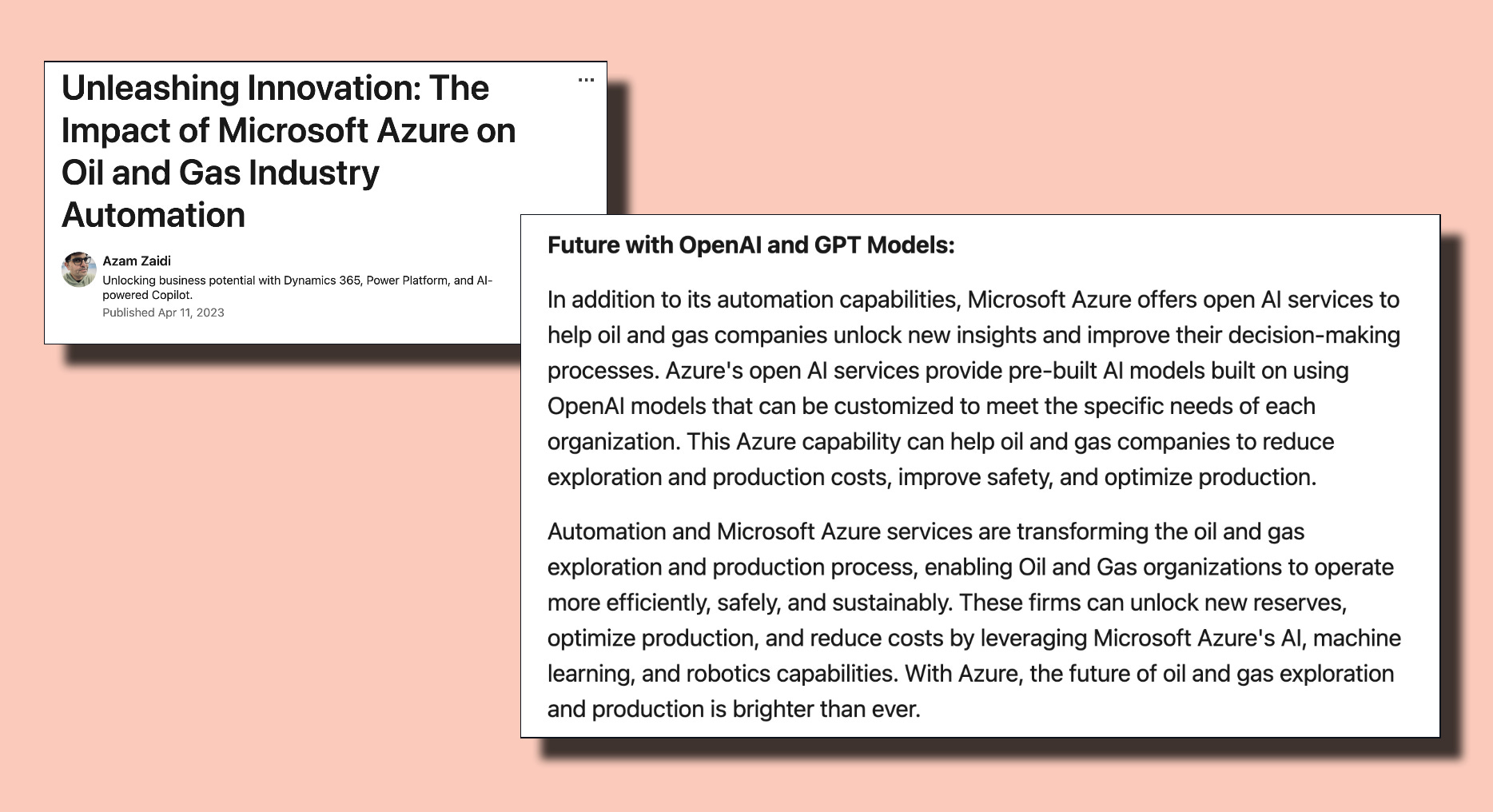
A now-deleted LinkedIn post from Microsoft technical architect Azam Zaidi describes how AI services can help oil and gas companies drill.
Drilling for oil is “one of the biggest use cases of AI today”
From the years Will and Holly spent trying to change Microsoft from the inside, they came to some painful realizations.
For Will, he came to believe that Microsoft was using his work on the climate-positive potential of AI to distract from the actual, systemic climate harms the company was enabling.
“From what I saw, I believe that finding and extracting more oil is one of the biggest use cases of AI today,” he said. He said he tried to find examples of customers using the climate-friendly AI tools he was making, but “it’s very difficult to find them, or at least ones that were operating at any significant scale.”
Holly said she was most surprised at Microsoft’s capacity for massive hypocrisy on climate. “We kept thinking we must be missing something,” she said. “But the more contracts we saw, the more we realized there’s just a part of Microsoft that just wants to make money, and this is where the money is, with no guardrails or accountability mechanisms in place.”
Another tough square to circle was that Microsoft is, in fact, doing a lot of “world-changing” things for the climate, as Holly described it. “I would not say it’s purely a propaganda machine,” she said. For example, the company’s massive investments in renewable energy and “unsexy projects like upgrading transmission lines” are impossible to ignore, she said.
“We just think you need to also address the other side of the equation,” she said. “You cannot only count one team’s points when you’re playing a game of basketball.”
And if Microsoft were playing a game of basketball wherein the benefits of their pro-climate actions were scored against the harms of their fossil fuel contracts, Will and Holly are confident which side would prevail.
Microsoft’s response
I reached out to Microsoft for comment after my interview with Will and Holly. I imagined that the company would want to respond to the pair’s allegations, and explain how its work with fossil fuel companies aligns with its climate goals.
Following a brief logistical discussion with spokesperson Kendra Folks—I explained the story and asked for a phone interview, she offered to respond to e-mail questions—I sent over a bullet-pointed list summarizing Holly and Will’s most significant claims about the company.
In addition, I sent some questions of my own. Most importantly, I wanted to know: Does Microsoft have any evidence that its work with fossil fuel companies is helping the industry decarbonize?
A few days later, I received my response.
“Microsoft has nothing to share.”
Turning angst into activism
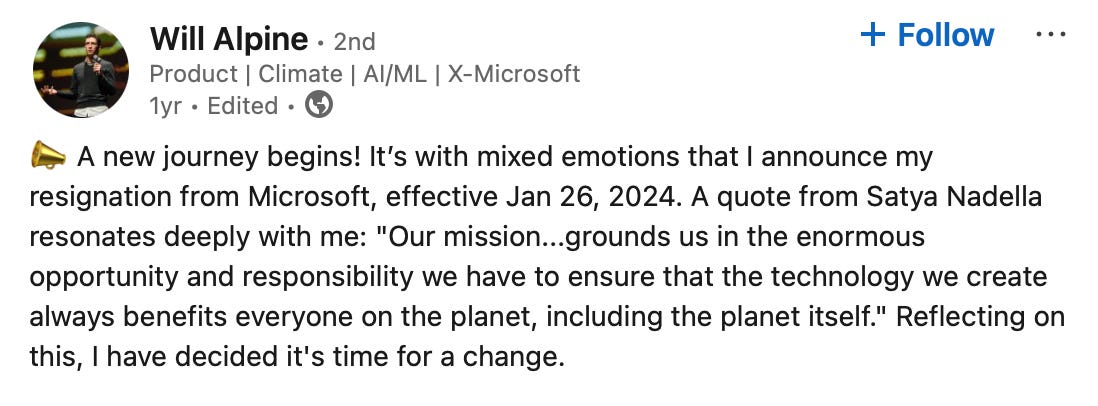
A screenshot from Will’s resignation post on LinkedIn.
The decision to quit Microsoft was painful for both Will and Holly, both financially and emotionally. “It was my dream job,” Holly said. “That’s why it was so devastating to learn that our paychecks were dripping in oil.”
The choice ultimately came down to where the pair believed they’d be able to make the most change. And after years of pushing Microsoft from the inside, they felt they’d reached a dead end.
They also realized that there was no outside activist group dedicated to holding Big Tech accountable for the climate impact of their work with fossil fuel companies. So after quitting in January 2024, they created Enabled Emissions.
Holly sees Enabled Emissions as complementary to groups like No Tech for Apartheid, which calls attention to Google and Amazon’s $1.2 billion AI and cloud computing contract with the Israeli military.
“You don’t get to call yourself the company of peace if you’re the number one cloud provider for Lockheed Martin,” she said. “And you don’t get to call yourself the company of climate action if you’re the number one cloud provider for the fossil fuel industry.”
One of Enabled Emissions’s goals is simply building awareness. Most people know about the direct environmental footprint of AI through data centers’ energy and water use. But AI’s “deliberate role helping oil companies significantly increase fossil fuel expansion—with staggering emissions—remains largely unaddressed,” the website reads.
Another goal is to put external pressure on Microsoft via bringing shareholder resolutions; encouraging Microsoft’s biggest customers to bring up the issue; and perhaps, in the future, organizing direct actions.
“It’s one of the hardest things we’ve ever done,” Will said. “But we would do it all over again.”
P.S. — Will did a great 5-minute TED-style talk at Ignite Seattle earlier this year. I recommend giving it a watch.
We’re Wrong About AI – Will Alpine by Ignite Seattle, Feb 24, 2025
P.P.S — Here’s some more info I couldn’t fit in the piece:
- A LinkedIn post with a bunch of concrete examples of how the fossil fuel industry uses Microsoft’s AI to increase production.
- A 2025 press release that shows Microsoft is selling AI to Saudi Arabia to “optimize operations” at Saudi Aramco, the state oil company.
- A 2024 post from energy market analysts at Argus Media describes how generative AI has “the potential to extend the shale era.”
Nancy Friel:
Fantastic reporting, please keep up this line of questioning. I have been wondering about the connections between big tech and big oil and gas. AI is being shoved down our throats as essential to our future, while the AI billionaires profit from MAGA authoritarianism, which is killing all climate policies that would save us. I feel like the focus on AI is giving cover to big fossil fuel companies, but I know they’re still doing evil in the background. I wonder if most, if not all, AI companies are profiting from and collaborating with evil fossil fuel CEOs.
***
 And, worse, our corrupt, fake liberal PM, Mark Harper Con Carney, is making us taxpayers pay for AI use in gov’t, which will destroy masses of Canadian jobs while profit raping billions more for Nazi tech companies! Instead of putting our money into Canadian companies and workers, traitor Carney plans to give long lucrative contracts to fucking already too rich, powerful and corrupt Amazon, Google, Microsoft, Meta — all of which I boycott because of their evil. Now, thanks to Canada-betraying Nazi Carney, my tax dollars will be stolen by him to give to some of the nastiest most disgusting harmful polluting companies on earth. Carney has already proven himself 100 times more Nazi, more evil and antiCanadian that Harper.
Canada should build public cloud infrastructure rather than relying on U.S. tech giants, Controlling our own digital infrastructure is a key part of national sovereignty in the 21st century July 8, 2025, by Paris Marx
During the 2025 election campaign, prime minister Mark Carney made a striking admission about Canada’s dependence on U.S. tech companies. The Canadian government was in the process of choosing a partner for a 25-year cloud computing contract for the federal government. The contract’s length should have set off red flags of its own, but the part that Carney drew attention to was the companies lined up to win it.
The shortlist had been narrowed down to four companies: Amazon, Google, Microsoft, and Oracle—all U.S. tech giants. At a time when the United States was threatening Canadian sovereignty and waging economic war on the country, the idea of further increasing Canada’s reliance on dominant U.S. tech companies couldn’t fly. Carney promised that if he was reelected, he would review the process. On April 28, the Liberal Party won another minority government.
Carney’s statement was easily overlooked given the flood of other news during the election period, but it was important for a number of reasons. Cloud infrastructure has become essential to the modern world and the digital technologies that power it, but it’s often hidden from view and easy to forget about.
The “cloud” refers to a series of warehouse-sized facilities around the world, filled with tens of thousands of servers and hard drives, that power the internet and many of the services we collectively rely on—our governments included.
But those hyperscale data centres are overwhelmingly controlled by those four major tech companies. As the United States becomes a less trustworthy partner, our dependence on them creates a serious vulnerability.
For the past several decades, since the internet’s privatization by the U.S. government in 1995, we’ve effectively allowed U.S. companies to dominate the digital economy. When you think about the digital services or devices you rely on today, few if any come from Canadian companies. That not only means our government has less power to protect Canadians’ rights and assert our values online, but also ensures the economic gains are exported to the United States. Its dominant tech companies are a big part of the reason the U.S. economy, and particularly its stock market, performs better than its peers.
Our European allies are also expressing increasing concern about their dependence on the U.S. cloud giants like Microsoft and Google.
In recent months, European media reported that Trump could cut off access to cloud services offered by U.S. tech companies in Europe to increase pressure on them as part of his trade war. The United States also passed a bill in 2018 called the CLOUD Act that allows the U.S. government to access data stored by U.S. companies, regardless of where in the world it’s held. That’s not an infrastructure any Canadian, and certainly not our government, should be relying on.
As Carney looks to reduce Canada’s dependence on the United States, we can’t ignore the extent of our technological dependence—and the cloud is a great place to start. Carney’s statement during the election suggested he would look to Canadian companies to supply more of the computation and storage needs of the federal government, but he should be far more ambitious.
Instead of simply encouraging the buildout of a private Canadian cloud, the government should invest in the expansion of a public cloud—built and run by a Crown corporation with public financing to serve government needs, but potentially to expand beyond that too. The government already has data centres of its own, but in recent decades it’s more often looked to the private sector to supply more of its computational needs instead of developing in-house capacities as it did with older forms of information technology.
The privatization of the internet corresponded with a political moment, often referred to as neoliberalism, when the public sector was in retreat and policymakers handed more power to the private sector. As a result, the new owners of online infrastructure made a strong push to erase any public role in shaping the internet or digital technology. We see the consequences of this privatization today, from the harms arising from social media to the broader degradation of the web so companies can maximize their profits. As we reject our ongoing dependence on U.S. tech companies, the notion that the management of digital technology should be left to the private sector should go along with it.
Public cloud infrastructure would escape the corporate need to maximize shareholder value and distorted incentives it creates for the companies that dominate the sector. Smaller firms have long complained about how aggressively cloud companies have raised prices over time and pushed additional services on them they did not need.
In recent years, we have also seen a rapid expansion of hyperscale data centres, with significant energy, water, and climate consequences. In part, this is to power generative AI technologies whose benefits remain dubious, but it also ensures the cloud businesses of those companies continue to grow at a rapid pace.
The government should not be subjecting itself to the corporate pressures to increase the amount of computation it requires and the number of AI tools it uses beyond what is necessary, all to serve the bottom lines of cloud companies. Developing its own infrastructure means the Canadian government can build what it needs and ensure it does appropriate assessment of new technologies to see if they will actually help the public service and benefit Canadians more broadly.
Over time, that infrastructure could serve as the foundation of a new set of digital services and platforms developed to serve the public good over private profit—without the need for extensive data collection to serve ad-targeting systems or the pressures to serve up extreme and misleading content to keep people engaged on exploitative platforms.
Handing the digital sphere to U.S. companies that don’t have our interests at heart was always a mistake. The time when they claimed to “do no evil,” as Google’s motto once led us to believe, is long gone. As we seek to reclaim our sovereignty, control over the technologies we depend on must be a central part of that effort. When we do regain that power, we must ensure the cloud infrastructure and other digital products we use instead are built to serve Canadians first and foremost—not shareholders with a very different set of motivations.
@christopher-french.bsky.social:
This is an unbelievably bad idea. Allow gov. Infrastructure to be held by a foreign hostile government??and controlled by some of the most inhumane anti life anti earth billionaires in existence. PS Carney doesn’t give a shit that the Nazi USA tech bros are more expensive – it’s our money he’s handing over, not his!
It’s not even cheaper!
@tryangregory.bsky.social:
So excited for Carney to replace public service employees with AI bots and to commit us to using Amazon/Microsoft/Google/Oracle cloud computing rather than building our own Canadian public resource.
@fuzzydillon.bsky.social:
These people will sell us out for pennies on the dollar as long as the investment class he represents gets a piece of it.
@cutbush.bsky.social:
There are so many unemployed middle-class people coming who voted against increased social safety nets.
The middle-class has been fooled into believing it’s the lower classes stealing from them and not the wealthy avoiding taxes. This will be an eye-opener for many.I doubt it. Carney’s base is a cult, just like Trumps’ MAGAts, except Carney’s base puts themselves at higher value in society because of their privilege.
@goonda13.bsky.social:
Not sure what the hell he’s thinking.Carney doesn’t work for Canadians, his tiny salary we pay him is nothing compared to the gravy he gets serving Nazi Zionist billionaires, the more Palestinians their tech has murdered for Israel, the better! If there isn’t a Canadian option, let’s create one. It’ll help give jobs to more Canadians at the same time.
@mzcoach160458.bsky.social:
Ffs tie us to an American company. Seriously! We have Canadians that are capable!! Fuuucckkkk this makes me mad!!every fucking thing Carney has said since he won the leadership long before the fed election disgusts and infuriates me. He’s happily destroying Canada for his own pockets and cruel bosses, Harper, Putin, the IDU, and Nazi-Zionist USA/Israel!
@nannikorak.bsky.social:
@mark-carney.bsky.social please find a Canadian company that can do this. Please!
@kaicable.bsky.social:
…yes, and who writes a 25 year contract?!
Much can change even within 1 year – just ask the US.
@TedDixon:
The Carney government is reportedly awarding a multi-decade cloud computing contract to big US Tech!
That means our data will be overseen by Donald Trump and JD Vance.And hideous bigot white supremacist cruel fucker Nazi, Elon Musk
CanadaStrong #CanadaDuped
When it comes to our data we must put #CanadaFirst
@TheDude30153742:
What happened to elbows up and buy Canadian?
Carney is asked why he is awarding 25 year contracts to 4 US companies for Cloud storage instead of Canadian companies. I wonder what division of Brookfield is invested in US Cloud storage.
Carney’s response is to promise to take a comprehensive review AFTER locking in to 25 year contracts. Isn’t that like promising to close the barn door after the horses have escaped?
Is he in bed with Trump?Yes, and with Putin who owns Trump, and with Israel master mass murderer, Netanyahu. Carney has already proven himself to be a cruel racist pro genocide Zionist fuck.
@CDN_Dimension:
Carney ran against Trump’s ‘Conservative buddies,’ then governed as their collaborator. Military spending hikes, Big Tech tax cuts, and anti-Indigenous bills reveal the truth: his base was always capital, not Canadians.and he’s a fucking hideous racist, perfectly supportive of Israel’s genocide. Unforgivable douche fucker
@dsimieritsch:
Carney is BUSINESS PARTNERS with TEAM TRUMP, WAKE THE HELL UP ALREADY