@trishpaton.bsky.social:
“Hi we’re the premiers and we’d like to give various ground dwelling rodents an excruciating death and also make sure we slaughter a wide selection of prairie predators. Raptors, owls, coyotes, foxes, corvids, snakes, badgers…and heck, we’ll even do dogs & cats lagniappe”
@ryankbrook.bsky.social:
So Scott Moe and Danielle Smith are asking the government to give Alberta and Saskatchewan two more years to use strychnine poison for pest control.
There is very likely no more painful and brutal way to die.
The Deadly History of Strychnine
https://www.youtube.com/watch?v=aawsSmaAdq4
Moe, Smith call on Carney to allow emergency use of strychnine by David Prisciak, Feb 17, 2026, CTV News
Premiers Scott Moe and Danielle Smith are asking Mark Carney to grant a three-year exemption for strychnine use, citing rising gopher populations.
Premier Scott Moe of Saskatchewan and Premier Danielle Smith of Alberta are again asking the federal government to temporarily allow strychnine use for pest control.
In a post to social media Tuesday morning, Moe revealed a letter addressed to Prime Minister Mark Carney, requesting a three-year exemption to the ban on two per cent liquid strychnine. The provinces are requesting access to the poison for use on Richardson ground squirrels, also known as gophers.
According to Moe, since the 2020 decision to deregister strychnine, the gopher population has increased “to the level where they have become a serious pest threat to agriculture, damaging a wide range of crops.”
The premier called Health Canada’s Pest Management Regulatory Agency (PMRA) decision to deny the provinces’ previous request for emergency use earlier this month “unreasonable.”
“The gopher population is out of control and requires, immediate, effective management to avoid further impacts to a multi-billion dollar per year industry,” he said in the letter.
“Existing alternatives have narrow application windows and require multiple treatments, creating unnecessary burdens for farmers and ranchers managing thousands of acres.”
Moe claimed the province’s submission fully addressed the agency’s concerns and included science-based mitigation measures, mandatory training and enhanced reporting requirements.
“It is concerning that PMRA has limited its focus to environmental risk, specifically secondary poisonings, despite extensive collaboration between our officials and PMRA on developing mitigation measures,” the letter read.
Strychnine was outlawed by the province in 2023 after a two-year phase-out, followed by a federal ban the following year.
Emergency use of banned strychnine needed to counter ‘exponential damage’ done by gophers, advocates say, Federal government recently rejected bid to unban controversial poison by Amir Said, CBC News, Feb 04, 2026

Proponents of strychnine in Alberta and Saskatchewan will continue to push for its use, following the federal government’s rejection of a bid to unban the substance.
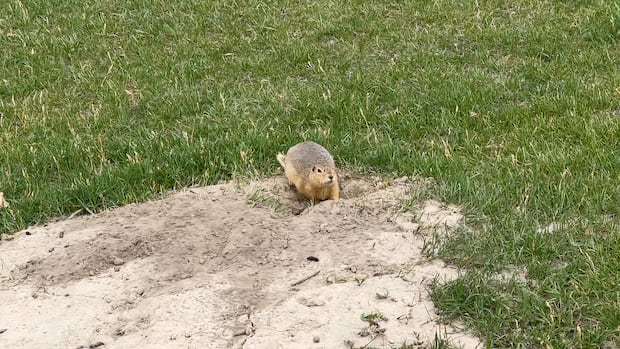
The request by the two provinces was aimed at having the controversial poison permitted for emergency use, to deal with what Alberta Agriculture Minister RJ Sigurdson called “significant challenges” faced by farmers when it comes to managing Richardson’s ground squirrels, colloquially known as gophers.
Strychnine, in two per cent liquid form, was the go-to gopher control solution on farms in the two provinces before the federal government began phasing out its use on Richardson’s ground squirrels in 2020. It then banned it outright in 2024 due to environmental risks posed by the poison.
In a statement, Sigurdson said “the loss of this effective control method is devastating for many across the agriculture sector.
“The annual risk to hay and native pastures exceeds $800 million, and the risk of this exploding [gopher] population is detrimental to farms and ranches across the country.”
- After watching their dog die ‘a painful death,’ owners want ban on strychnine used by Sask., Alta. farmers
- Dog’s death shows unintended consequences of poison on Alberta farms
Wade Nelson, a farmer near High River, Alta., is a strong proponent of strychnine use, saying he “had 170 acres of canola completely destroyed by gophers” three years ago.
“We’re hopefully coming out of a pretty terrible drought,” he said. “And that’s definitely given rise to a huge gopher population, the likes that I have never seen in my lifetime.”
LISTEN | Alberta farmer shares why he wants strychnine use permitted:
Calgary Eyeopener9:04Strychnine BanA bid to overturn a ban on a controversial poison used to control Richardson ground squirrels populations has been rejected. We hear from an Alberta farmer who would like to see Strychnine return.
Nelson thinks the recent spike in gopher numbers coincides with the ban on strychnine.
“It’s a really useful tool that farmers have used for a lot of years, and it’s very disappointing,” he said of the ban not being reversed.
Health Canada stands by decision
In a statement sent to CBC News, federal spokesperson Marie-Pier Burelle said Health Canada denied the strychnine use request by Alberta and Saskatchewan because, while concerns around crop losses and farm field damage were taken into consideration, “environmental and health safety requirements take priority.”
“This decision is consistent with the department’s 2020 cancellation of strychnine, which was implemented to protect non-target animals, including species at risk such as the swift fox and burrowing owl, from strychnine-related poisonings,” she said.

The provinces of Alberta and Saskatchewan presented risk mitigation strategies to Health Canada, but Burelle said those proposals “did not include new or effective measures to address the risks identified in 2020, and therefore the emergency use request could not be approved.”
Burelle pointed to other rodenticides on the market, like zinc phosphide, which has been touted by the Government of Saskatchewan as an effective alternative to strychnine.
But John Barlow, federal shadow minister for agriculture, says no other rodent control solution beats strychnine.
Barlow told CBC News the inability of farmers to use strychnine has resulted in many complaints from rural residents from his electoral district of Foothills, encompassing much of southern Alberta.
“We had a number of producers reaching out to us over the last year just talking about the exponential damage to cropland and grazing land, on the loss of crop yield,” he said.
“Without any competent alternative to strychnine, they were just unable to control the gopher population, and we were starting to see an impact.”
Nelson reiterated that, in his experience as a farmer, the substance was highly effective and tightly regulated.
“I couldn’t just go into Home Hardware and buy a bucket of strychnine,” Nelson said. “If I needed or wanted strychnine, I had to go there to the county and prove that I was a farmer, rancher and show them where I was going to use that product. And I could only take so much.”
WATCH | Alberta urges feds to reverse gopher poison ban, calls rodents a ‘destructive force’:
Province urges Ottawa to reverse gopher poison ban, calls rodents a ‘destructive force’
July 4, 2025|
Duration 2:13Health Canada started phasing out the use of strychnine in 2020 over concerns it harms other wildlife. Without the poison, the Alberta government said gophers are spreading “unchecked” across agricultural land and farmers can’t keep them under control.
Barlow, who joined Alberta and Saskatchewan last year in publicly calling for the federal government to reverse its ban on strychnine, said Ottawa’s refusal to unban the substance fails to take into account the economic and food security implications of gopher damage on crops.
Barlow said he and the two provinces will continue pushing for the emergency use of strychnine to counter the latest gopher population growth, not a permanent reversal of the ban.
 Refer also to:
Kyle MacLintock and Erika Schuurmans were hosting a barbecue in June 2017 on their rural acreage in a picturesque valley in Indian Head, Sask., when their dog Roo broke into seizures.
They rushed to an emergency vet — 70 kilometres west in Regina — and gave Roo CPR in the car, but it was too late.
“It was pretty horrendous just to have something die in your lap that you love so much,” said Schuurmans.
“I guess it would be easier to swallow if it had been a medical condition.… To have something like a poison be the cause of it and for it to be a painful death is even harder to accept.” Tests confirmed Roo died of strychnine poisoning — a registered pesticide that is only available in Saskatchewan and Alberta.My dog, Bandit (love of my life), went into a severe seizure one summer day. I rushed him to the vet, who, after much work, managed to save him. He made Bandit throw up and out came 3 ground squirrels. Bandit was mentally challenged and not a good hunter. I never saw him get live ground squirrels, he would have found the gophers he ate dead or dying.
Strychnine is used by farmers under provincial oversight in Alberta and Saskatchewan, there is no such thing as “provincial oversight.” Officials happily look the others way to control the ground squirrel and northern pocket gopher population, but Roo’s owners and others want provinces to ban strychnine for use on gophers due to the effect it has on other animals — something Health Canada is considering.
Casualties include foxes, owls
Species, such as the swift fox and burrowing owl, can be poisoned if they eat the bait or gophers that have ingested the pesticide.
For it to be a painful death is even harder to accept.- Erika Schuurmans, Roo’s dog owner
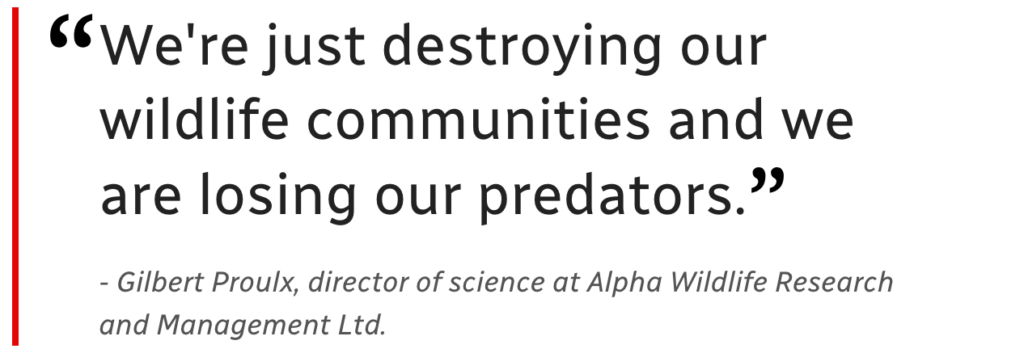
“Every year we have accidental kills,” said Gilbert Proulx, director of science at Alpha Wildlife Research and Management Ltd.
“We’re at a point now where farmers must start to listen to scientists, who have done the evaluation of those poisons, and come up with something better.”ya, but, Alberta and Saskatchewan farmers hate scientists
Provincial officials in Alberta are also authorized to use strychnine in specific circumstances to control large predators, such as coyotes, wolves and bearscausing horrific suffering, but seems the more religious, the greater the desire to kill, according to Health Canada.
But they can only use the pesticide when livestock and threatened wildlife populations, such as caribou, have been killed or there is risk to people.
In 2007, Proulx reassessed the product for the federal government.
He said he found it killed gophers when there were drought conditions, but the animals dismissed the baits for other food once it rained.
“The poison is not doing what it is supposed to do,” said Proulx. “We’re just destroying our wildlife communities and we are losing our predators.”
A balancing act
In an email statement sent to CBC News, Alberta’s Agriculture and Forestry Minister Oneil Carlier wrote his government is working with Ottawa to ensure farmers have a solution to deal with gophers without a disruption in operations.
He added his ministry is looking at ways to use existing alternatives to control gophers more effectively and to develop permanent solutions to manage gopher damage, including the development of an integrated pest management strategy.
Some of the alternatives farmers currently have include the use of other poisons, trapping, fumigation and shooting.
We’re just destroying our wildlife communities and we are losing our predators.- Gilbert Proulx, director of science at Alpha Wildlife Research and Management Ltd.
The Saskatchewan government maintains strychnine has limited environmental impact.of course they would. They’re as anti science and anti widlife as Alberta is, and both lie regularly
It warns the loss of the pesticide could cause millions of dollars in damages through crop losses, livestock injury and mortality and control costs, according to an email statement.
“It’s a difficult regulatory call,” said Dr. Barry Blakley, a veterinarian toxicologist at the Western College of Veterinary Medicine at the University of Saskatchewan.
“It would be nice to reduce the number of strychnine poisonings. But if they put too many restrictions, people will use products that are way too toxic and will cause more problems.”
The college sees roughly one dog poisoning due to strychnine every two months, according to Blakley. He said that translates to about six to seven cases each year, but they come in waves. There are more poisonings in the springtime when farmers are putting out strychnine baits for the first time after winter.Think of the wildlife suffering and deaths
Strychnine poisonings that Blakley sees are declining significantly, he said, because of the rise in use of other rodenticides, such as anticoagulant, which can cause bleeding in animals.
He said farmers are using strychnine less because they have to go through a lot of paperwork.
The Saskatchewan government is concerned about an increase in the reliance of anticoagulant rodenticides, which it said are more costly and labour intensive for farmers to use.
The college saw 250 cases of dog poisonings from anticoagulants over the past five years.
Jim Hipkins’s hayfields are littered with gopher holes in Lumsden, Sask., about 32 kilometres north of Regina.
“If people were to play golf here, they’d be losing their balls all the time,” Hipkins said.
“The gopher is a very cheeky animal. He stands up and grins at you, but he’s a real menace.”
‘Who’s going to win? The farmer or the gopher?’
His weapon of choice comes in the form of a bright pink liquid with a concentration of two per cent strychnine.
“It seems to be one of the few products that we can obtain to wage war with these gophers,” Hipkins said.
“In some cases, it becomes who’s going to win? The farmer or the gopher? And sometimes the gopher wins!”
The gopher is a very cheeky animal. He stands up and grins at you, but he’s a real menace.- Jim Hipkins, farmer
He bought five bottles this year from his rural municipality for $10 each.
“We want it to remain the same or even be a tiny bit more potent,” said Hipkins. “If it was more potent and we got a better kill off the bat, you may use less.”
Calls for more enforcement, training, interactive map
Health Canada’s public consultation about the use of strychnine on gophers is open until Sept. 27.
MacLintock and Schuurmans have already submitted their opinions.
They’re calling for mandatory strychnine training, more enforcement and an interactive online map to show where baits are placed.
Additionally, they don’t want to see the product available in a liquid form anymore. They want to see it sold pre-mixed with the proper concentration placed on oats or another bait specific to gophers.
They still don’t know who placed strychnine on their property so they’ve installed video surveillance to protect their new dog, Hercules.
“The hazard is real,” said MacLintock, who suspects another one of their dogs also died of strychnine poisoning in fall 2016. “It happened to affect us very much.”