Polar bear visits to human infrastructure increase with sea ice loss, not poor body condition by Danielle Rivet, Ryan Brook, Alex Crawford, Corey Kramer, Michel P. Laforge, Julienne Stroeve, and Douglas Andrew Clark, Jan 12, 2026, Arctic Science, Canadian Science Publishing
https://doi.org/10.1139/as-2025-0031
Abstract
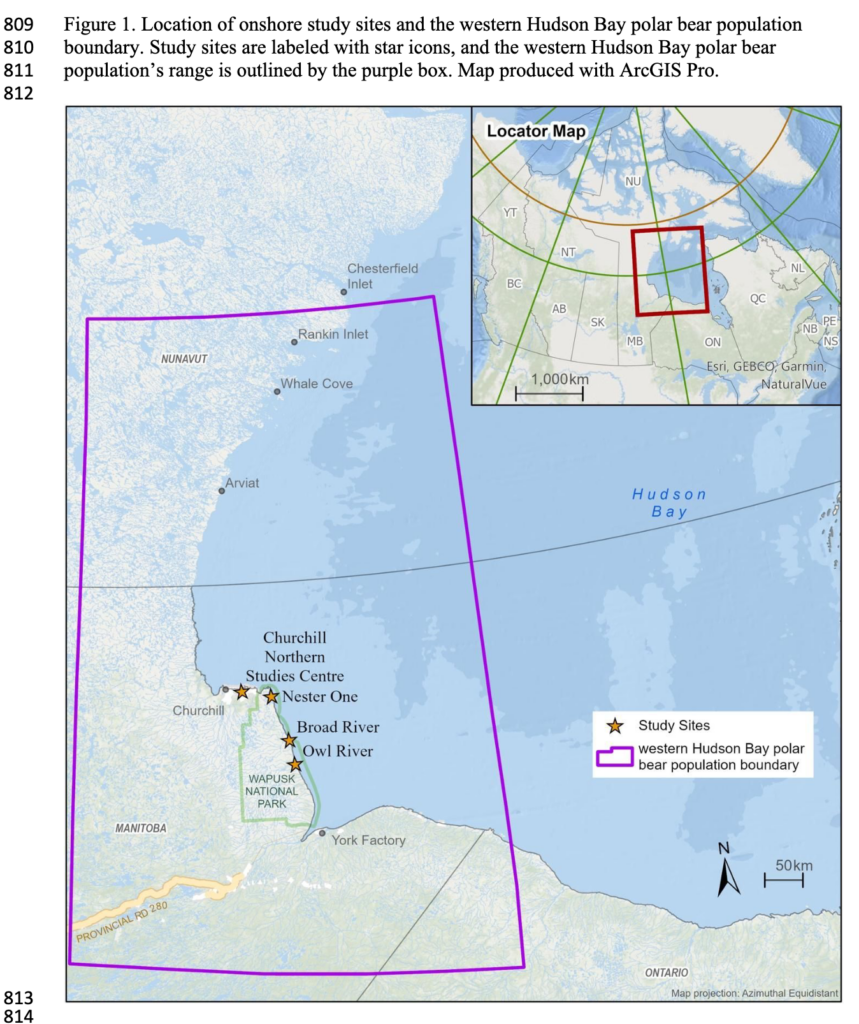
Climate warming has reduced Arctic sea ice, forcing some populations of polar bears (Ursus maritimus Phipps 1774) to spend more time on land and increasing the potential for encounters with humans. We recorded 580 polar bear visits to four sites along western Hudson Bay from 2011 to 2021 using remote cameras, assessing the influence of sea ice phenology, body condition, and human activity on visitation frequency. Our results show that the length of the ice-free season predicts polar bear visits to onshore infrastructure, while neither poor body condition nor human presence significantly affect the bears’ visitation rates. These findings suggest that sea ice loss governs the likelihood of polar bear-human interactions, but nutritional stress does not drive polar bears toward human sites. Consequently, we infer that body condition may influence whether interactions escalate into conflicts rather than their initial occurrence. Understanding these dynamics is crucial for managing risks to both bears and people amid ongoing Arctic environmental change. Agreement between our observations of bear demographics, and to a lesser extent body condition, with concurrent mark-recapture studies suggests that remote cameras may be useful for monitoring the ecology of polar bear sub-populations that spend time on land.
 Refer also to: