
*In my lawsuit, Encana refused to release the chemicals they injected into my drinking water supply, poisoning it, even though under Alberta Rules of Court they must disclose. Nice rule but there is no enforcer (I expect intentional to protect the rich fuckers that abuse and rape others).
The rule is useless without an enforcer. How does one frac’d citizen compel a monster oil and gas company to comply with a court rule when said company ignored all rules and laws in place to protect drinking water from frac’ers?
A curated geospatial dataset of chemicals used in hydraulic fracturing and their functions by Kristin K Isaacs, Antony J Williams, Katherine Phillips, Michael Jahne, and Sean Thimons, J Environ Qual. 2026 May-Jun;55(3):e70185.
- PMID: 42169502
- DOI: 10.1002/jeq2.70185
Abstract
Produced water (PW) is generated by the oil and gas industry as a byproduct of conventional extraction and hydraulic fracturing (HF) activities. Chemicals used in HF must be evaluated for risk to humans and ecological species when considering the conditions of PW reuse. FracFocus (FF) is a public database of chemicals used in HF where operators of wells report information either voluntarily or as mandated under specific state statutes. However, data reported to FF is standardized in terms of neither chemical identifier nor chemical function. Here, using cheminformatic methods, we develop a curated database of chemicals reported to FF, harmonized to chemical identifiers and function categories used by the US Environmental Protection Agency, facilitating linkage to toxicity and other data in its CompTox Chemicals Dashboard. The resulting dataset of over 5.7 million records reflects 1567 unique chemical substances and 45 unique functions. This dataset provides a resource to risk assessors and environmental programs when evaluating the potential impact of HF chemicals in PW reuse.
Plain language summary
Produced water (PW) is water generated by the oil and gas industry as a byproduct of conventional extraction and hydraulic fracturing (HF) (fracking) activities. Chemicals used in HF must be evaluated for risk to humans and ecological species when considering reuse of PW for other purposes. FracFocus (FF) is a public database of chemicals used in HF containing information reported by the oil and gas industry. However, the information in FF does not use standardized chemical names or standard categories describing why the chemical is present (its purpose or function in mining). Here, using automated methods and chemical information tools developed by the US Environmental Protection Agency (EPA), we develop a curated database of chemicals reported to FF, standardized to names and function categories used by EPA, allowing for these data to be connected to other information developed by the EPA such as toxicity data.
Published 2026. This article is a U.S. Government work and is in the public domain in the USA.
 Refer also to:
2013: Canada’s National Energy Board (NEB) to ask producers to use [Industry PR Scam] FracFocus website
2013: FracFocus has ‘serious flaws,’ Harvard study says
A study by a new Harvard University policy initiative says the FracFocus.org website has “serious flaws” as a means of disclosure for hydraulic fracturing chemicals used in oil and gas production, and state governments shouldn’t be relying on it. The study says FracFocus has a one-size-fits-all approach that doesn’t account for different state requirements, prevents many kinds of searching and gives drilling companies too much leeway to miss deadlines or withhold information as trade secrets.
…
Many of the aspects of FracFocus criticized by the Harvard study are supported by oil and gas industry groups.
…
The study says FracFocus “fails as a regulatory compliance tool” because government agencies that use it give up control to the website and the companies. … And, the study says, the site lets operators decide when to conceal chemical ingredients as trade secrets. …

FracFocus is just a fig leaf for the industry to be able to say they’re doing something in terms of disclosure
2013: Voluntary Fracking Reporting? Bloomberg: Chemicals Not Reported, Half of All Wells “Obscured”
2013: Legal loophole keeps fracturing mixes murky
2013: Alberta joins British Columbia in partial disclosure of frac chemicals, by Fracfocus.ca
Secrets permitted, e.g., for one of the 4 wells posted in Alberta so far, as of February 3, 2013:
Hydraulic Fracturing Fluid Chemicals, CAS#/MIRC# not provided
Dec 1 2012 – Dec 3 2012, 08-33-053-10W5, Artisan Energy:
CARRIER FLUID N2
CARRIER FLUID TG-740 Not Available
PROPPANT
ADDITIVE HB-4 Trican Breaker 0.46%
ADDITIVE HX-2W Trican Crosslinker 0.44%
ADDITIVE Hg-2 Trican Gelling Agent 0.46%
ADDITIVE S-12 Trican Surfactant 0.16%
2012: Alberta to start using FracFocus
2012: Alberta to start using FracFocus
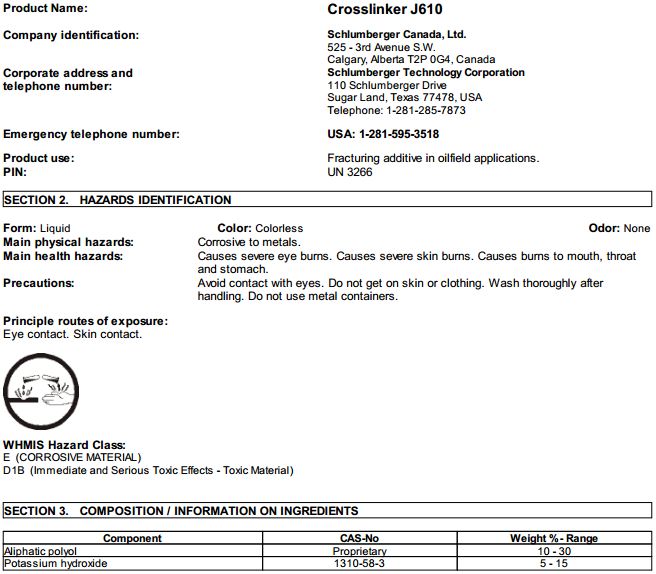
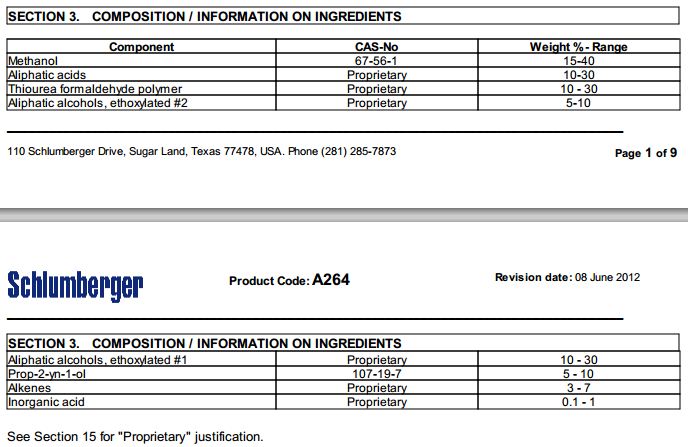
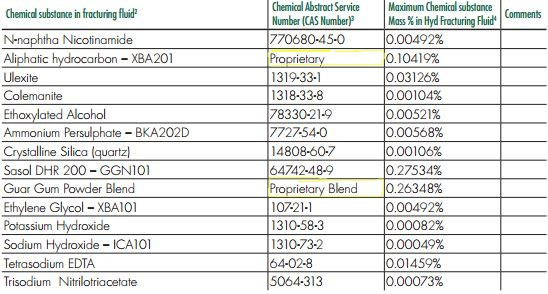
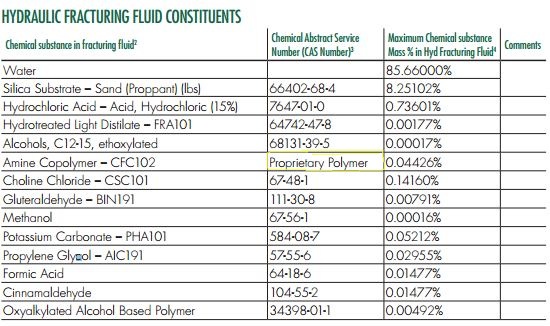
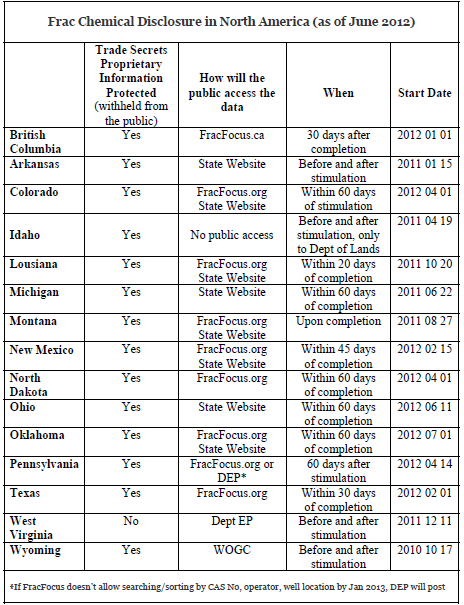
Adapted from the British Columbia Oil and Gas Commission’s FracFocus.ca (built and “conceived based on the companion site” FracFocus.org) and Vinson & Elkins’ Fluid Disclosure Requirements Chart
Appropriate baseline water testing requires complete chemical disclosure before fracing.
Stimulation = fracing = completion
2012: Sky Truth Fracking Chemical Database
…
However, many of the chemical components included in the reports are withheld by the operator as “trade secrets”. …
Unfortunately, the voluntary public disclosures available to us on the FracFocus website do not provide anything close to a complete disclosure data set. We do not have reports for all the wells that have been fracked, and in the reports that we do have, many chemical components are explicitly withheld.
We are currently researching the disclosure rate to try to estimate how much is missing. …
2010: Natural Gas Operations from a Public Health Perspective
For many years, drillers have insisted that they do not use toxic chemicals to drill for gas, only guar gum, mud, and sand. While much attention is being given to chemicals used during fracking, our findings indicate that drilling chemicals can be equally, if not more dangerous.