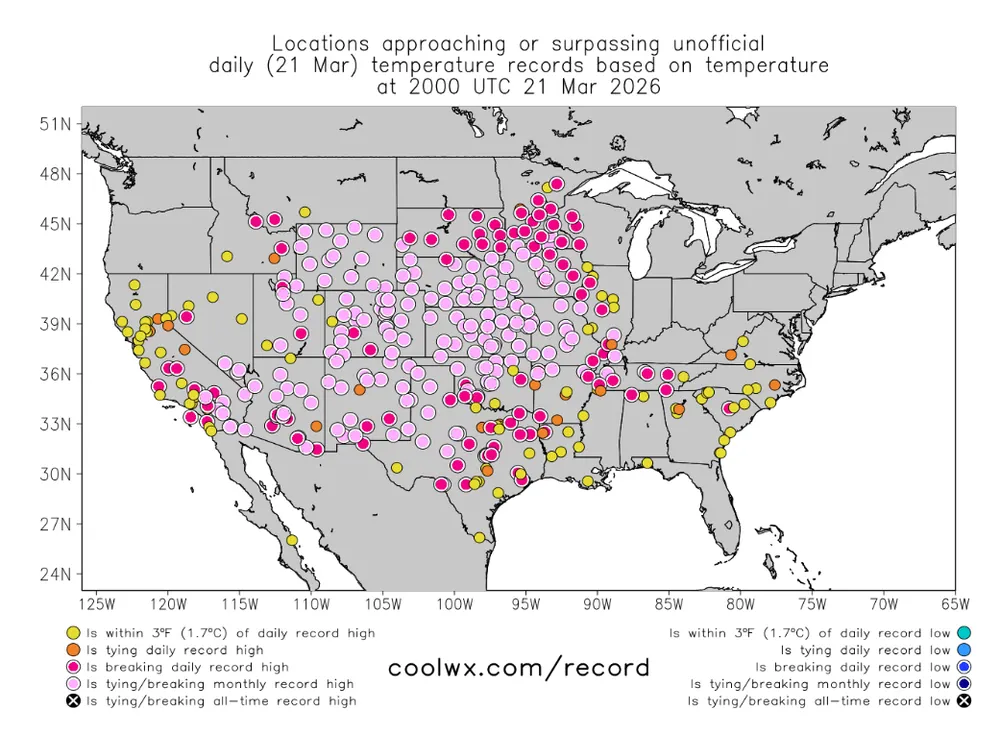
“Unofficially, there are currently 273 stations that have broken their daily high record, 40 that are tying it, and 91 that are near it.”

@Weather_West Dr. Daniel Swain:
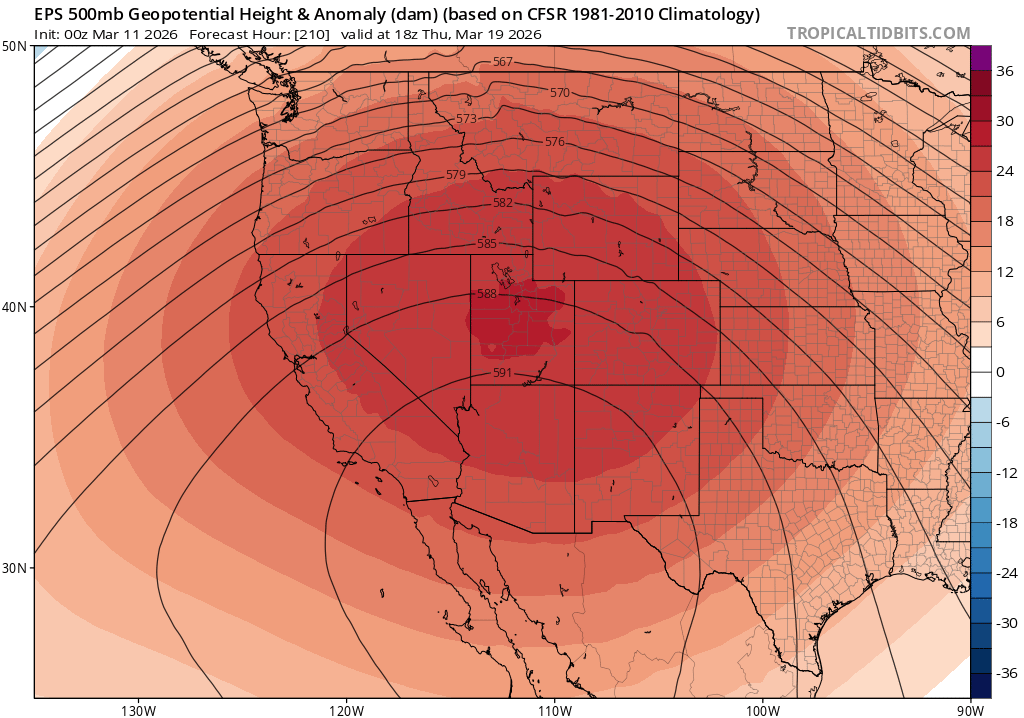
Weather West update on a prolonged and very likely record-breaking March heatwave in the western U.S. that will begin Thursday in some areas & actually not reach its peak for another 7-10 days in some spots. This forecast is truly extraordinary for March.
@2speedla.bsky.social:
It’s astonishing how ignorant humans are to the environment they live within, and how that environment directly impacts their health, lifespan, and food supply.
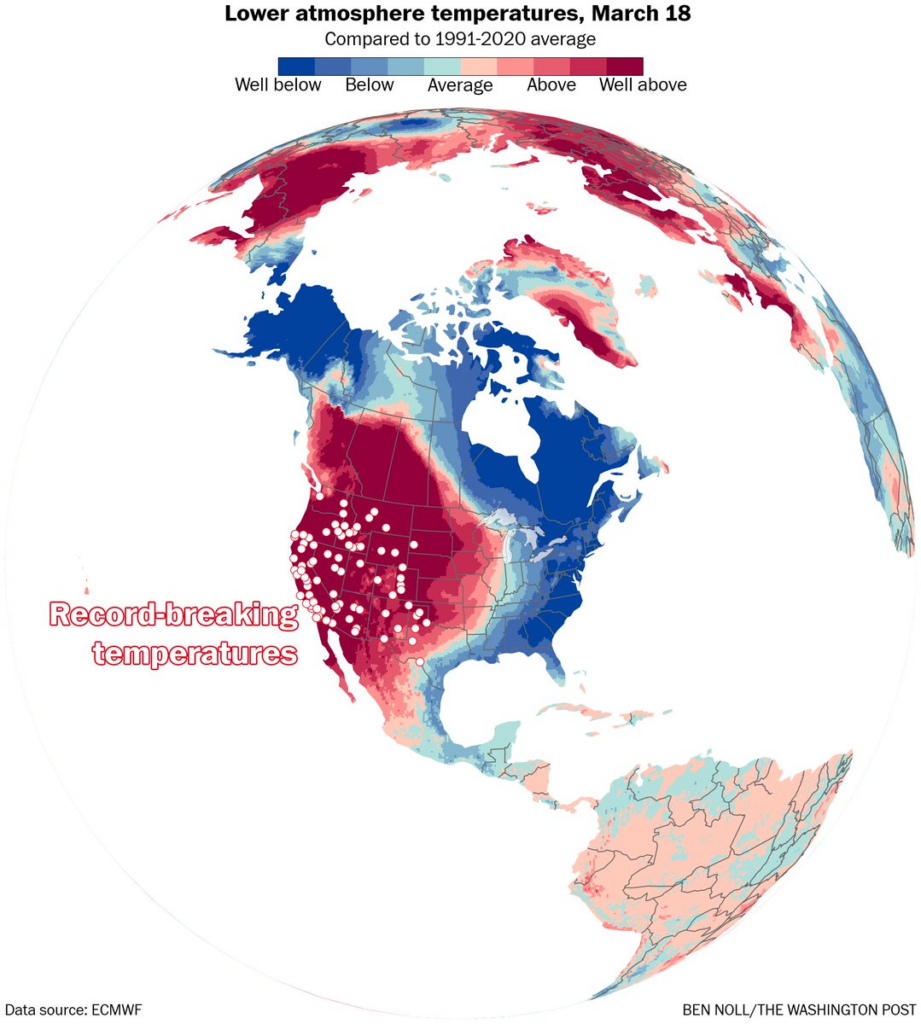
@BenNollWeather:
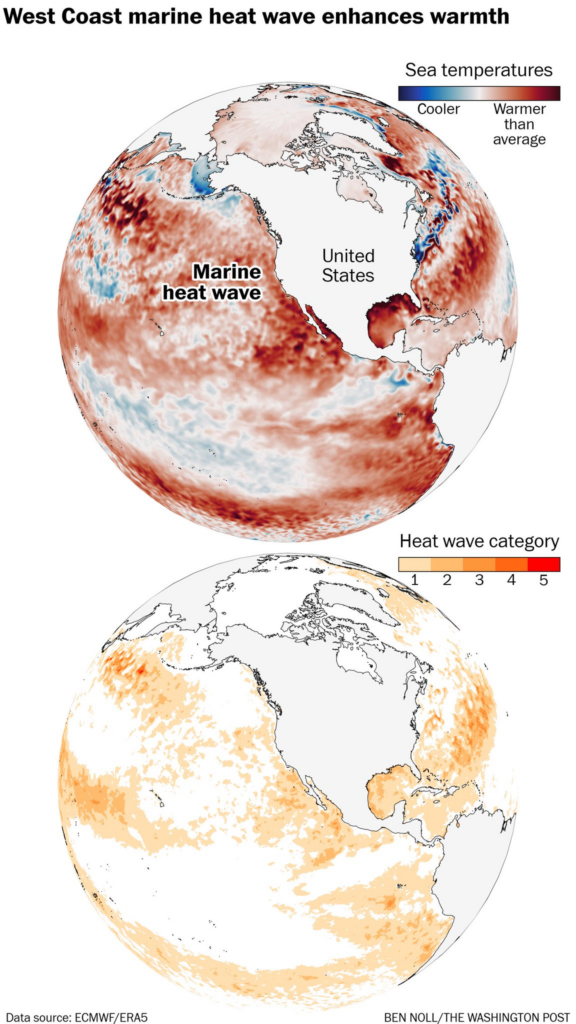
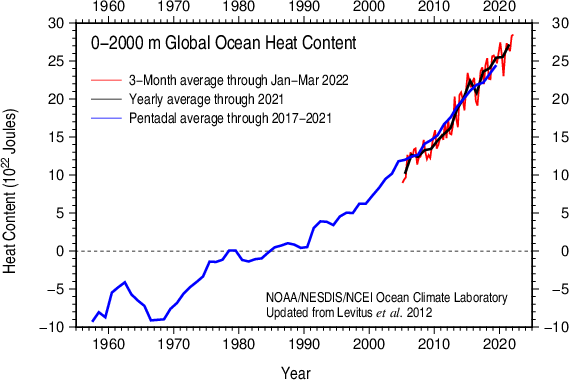
… A marine heat wave will strengthen near the West Coast because of this record-breaking heat dome.
An expansive area of well above-average sea temperatures will expand as summer-like warmth arrives and intensifies into next week.
This heat dome will contribute to worsening drought conditions across the Intermountain West.
“The knock-out punch comes in the form of Utah’s reservoirs, which are only at 40% of capacity right now,” Meyer said.
“Right now, every drop is going to count this year,” he said.
… The heat dome will also have a less obvious consequence: It could indirectly contribute to flooding rain in Hawaii.
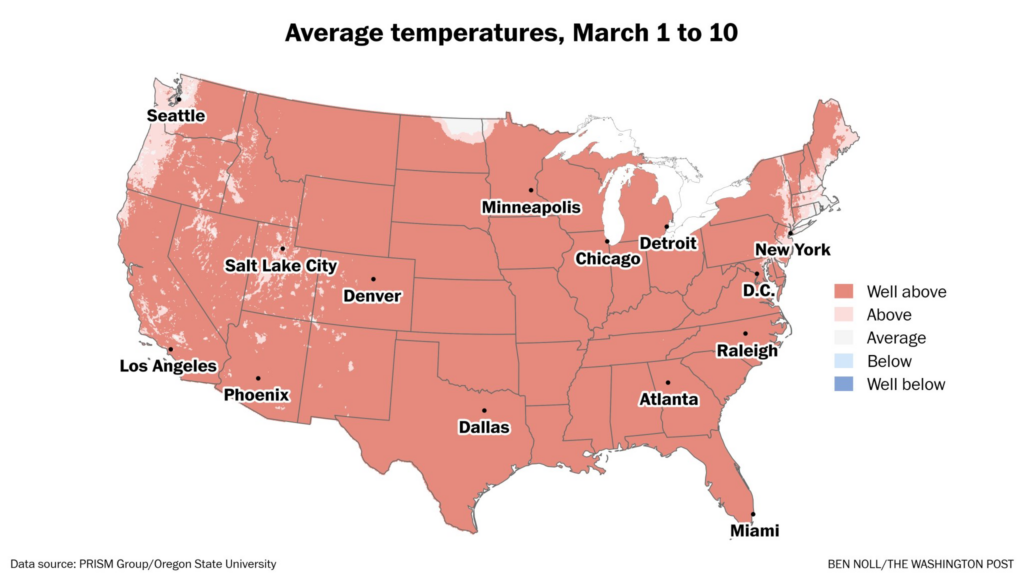
The United States has experienced its warmest start to March on record.
It’s difficult to fathom just how far this record heat wave could push the country’s departure from average this month.
It’s been the warmest start to March on record for the United States.
Temperatures have been 9.4 degrees above-average across the country as a whole during the first 10 days of the month.
In today’s @washingtonpost:
West Coast braces for record March heat wave. How hot will it get?
For millions of people, it will feel like summer during the final days of winter. That will worsen the region’s drought.
@Chris_Jones_77:
if it feels like summer at the end of winter…makes me wonder what summer’s gonna feel like
Jeff Berardelli @weatherprof.bsky.social March 11, 2026:
Absurd heat! Despite our best efforts, the monster heat dome is bound to be “undersold” by the meteorology community. Why? Because intensity like this is almost never seen. This thing has the potential to be Epic for Mid-March, and not in a good way…
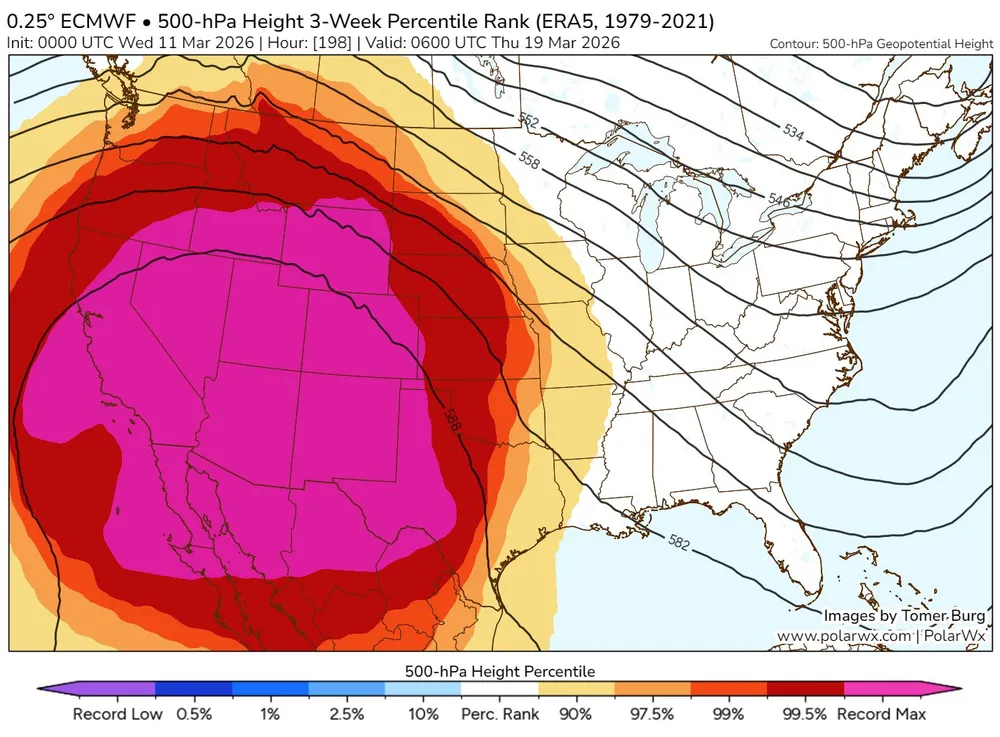
The magenta is where this ridge is forecast (Euro) to be the most intense on record for the day. It’s not the size of a city or a state, is literally the majority of the American West. The March record for Palm Springs is 104. For Phoenix it is 100…
The National Blend of models has numbers between 105-110 late next week for these two locations. If that happens, we break March surface temp records by absurd margins.
@mrgw.bsky.social:
Yikes…not a great start with an already historically low snow pack.
@thisbethlife.bsky.social:
I did wonder why the hell I saw 100s in my forecast for next week.
@zoesamuel.bsky.social:
Am in the pink bit and do not like.
@kehlkeh.bsky.social:
same
Blistering early-season heatwave threatens California and other western states
Records could be smashed in southern California as experts warn weather set to be ‘exceptional – and not in a good way’ by Gabrielle Canon in San Francisco, 12 Mar 2026 The Guardian
States across the US west are bracing for a brutal early-season heatwave threatening to cook several cities through the weekend and into next week. Forecasters warned temperatures will spike 20-30F above normal for several days.
Daily records could be shattered in southern California this week, the National Weather Service said, with a possibility that all-time records for March will be broken as well. Following the warmest winter on record across most of the region, the intense conditions are expected to eat into low snowpack levels, deepening drought concerns.
Caused by a large and persistent dome of pressure settling over a large swath of the west, the blasts of heat are expected to come in two waves, first hitting the west coast on Thursday and spreading east through California, Nevada, Arizona and New Mexico. Another, stronger round, is set to start on Monday, reaching into Utah, Colorado, Oregon, Idaho, and Wyoming.
By Tuesday next week, areas home to roughly 26.4 million people will be affected by moderate heat risks, the second level out of four designated by the NWS, affecting sensitive populations and those without access to cooling or hydration the most.
Tens of thousands may face extreme heat – the highest level – with no overnight relief.
Extreme heat so early in the year could pose higher public health dangers. “This time of year, the body isn’t used to dealing with this level of heat, so these highs are more impactful now than they would be in July,” NWS meteorologists in the San Francisco Bay Area warned in a Thursday social media post.
“The next 10-14 days look truly exceptional across the western US, and not in a good way,” climate scientist Daniel Swain wrote about the event on Wednesday. He said a ridge of high pressure among the strongest “ever observed in the south-western US in March” was expected to develop by Friday, but its records would not hold for long, as it “reorganizes into an even broader and stronger ridge next week”.
With a high likelihood for historic heat for early spring, some records might be broken for seven to 10 days consecutively, Swain said. Temperatures could climb past 100F (37.8C) in Los Angeles, up to 90F (32.2C) in the San Francisco Bay Area, and possibly up to 110F (43.3C) in the south-eastern deserts, thrusting the region into summer conditions months before they are typical.
The heat wave comes as water managers across the west nervously eye declining snowpacks, which are expected to shrink further. There had been hopes for another cold storm to bolster the depleted snow, relied upon for water supplies throughout the warmer months.
Heat also bakes more moisture out of landscapes, amplifying wildfire risks and extending the seasons when ignitions can quickly become infernos.
“During the upcoming period of exceptional and prolonged heat–which will bring t-shirt and shorts weather even into the higher mountains of the American West–snowmelt will accelerate dramatically,” Swain said.
The spring snowpack, measured on 1 April, “may well be the worst on record across many, if not most, western US watersheds”.
‘A sobering preview’: extreme heat now affects one in three people globally, study finds, Rising temperatures making it hard even for young, healthy people to safely do normal physical tasks in many regions by Jonathan Watts, 10 Mar 2026, The Guardian
Climate breakdown is shrinking the amount of time that people can safely go about their lives, according to a study that shows a third of the world’s population now resides in areas where heat severely limits activity.
Rising temperatures, driven by the continued burning of fossil fuels, are making it difficult even for many young, healthy adults to do basic physical activities, such as housework or walking up stairs during daylight hours at the height of the summer, the report warns. I’ll never understand why humans intentionally keep making babies when it’s so well known how horrific the heat deaths, disease and suffering already is, and will get fast much worse. People are pumping out kids that will suffer terribly. I knew in the 60’s it was unwise to have any kids. Never mind our species’ addiction to raping kids.
The limitations are greater for elderly people, who have less ability to sweat and thus control their body temperatures, according to the research, which combines physiological studies of heat tolerance with seven decades of global and regional data on population, temperatures and human development.
On average, the report finds that people over 65 now experience about 900 hours each year when heat severely restricts safe outdoor activity, compared with 600 hours in 1950. This is equivalent to more than a month of daytime hours.
Worst-affected are those in poorer countries or regions, even though they are far less responsible for climate breakdown than wealthy consumers whose lifestyles produce higher greenhouse gas emissions from the burning of gas, oil and coal. In some tropical and subtropical regions, heat restricts outdoor activity for older adults for between one-quarter and one-third of the year. The most severe challenges are found in south-west Asia (Bahrain, Qatar, Kuwait, the United Arab Emirates, Iraq, Oman), south Asia (Pakistan, Bangladesh, India) and parts of west Africa (Mauritania, Mali, Burkina Faso, Senegal, Djibouti and Niger).
Within countries there are huge variations according to geography, income group and types of work. In India, limitations are most pronounced across the Indo-Gangetic Plain and eastern lowlands, and least evident in the Western Ghats and the Himalayan foothills. Meanwhile, in South America, people in the Amazon basin are far more vulnerable than in the Andean highlands. In many Gulf states, wealthy people can ease risks with air conditioning, while poorer migrant workers are exposed to dangerous levels of solar radiation on construction sites and while doing other outdoor jobs.Grids can fail in extreme heat, they were never designed for our vulgar excesses and pollution caused global warming. Don’t count of AC to keep you alive.
The study, which was led by scientists from the Nature Conservancy and published in the journal Environmental Research: Health on Tuesday, goes further than previous research on global heat risks by examining the social and physiological capacity to adapt to heat.
The authors measure “liveability” in different temperatures in METs, a unit of equivalent to the average energy expenditure of a human at rest. A manageable temperature is one in which people below 65 can perform up to 3.3 METs of activity – for example, sweeping a floor or walking at a moderate pace – for an extended period without heat stress, which means they can regulate their core body temperature at a steady state. By contrast, “unliveable limitations’” are found at hot locations during hours when human activity is restricted to 1.5 METs, which are primarily sedentary activities, such as lying down or sitting.
To examine the vulnerability of different age groups, the researchers used measurements of sweat production and “skin wettedness” of individuals exposed for varying lengths of time in heat chambers.
They compared trends over time by comparing liveability limitations between the early (1950–1979) and later (1995–2024) periods of their datasets. This revealed that more and more people in an ever widening area of the world are suffering liveability limitations due to rising heat. By far the most severe restrictions came in the last year of the study, 2024.
The authors said the results showed the need for rapid action to reduce the primary sources of global heating: oil, gas and coal. with Putin wanting to bomb and invade his way to rule the world, and Trump and his side kick Carney ramping up production of fossil fuels and worse, massively deregulating to ensure the rich get fucking fatter and richer, it ain’t gonna happen. Humans are pumping out babies like fucking rats. Life on earth is going to be grim and or deadly for most.They also called policymakers to direct resources to the worst-affected communities, age-groups and regions.
“Hundreds of millions of people can no longer safely go about their daily lives outside during the hottest parts of the year,” said Luke Parsons, lead author of the paper. “And those people are overwhelmingly in countries that have contributed least to the problem.
Every fraction of a degree of additional warming will expand these impacts. 2024 gave us a sobering preview of what a 1.5C [above preindustrial levels] world could look like, and it should strengthen our collective resolve to avoid 2C or more.
“In the near term, investments in heat early warning systems, cooling infrastructure, and protections for older adults and outdoor workers in the most affected regions are urgent. However, these local investments are not substitutes for the fundamental need to limit global warming.”

@aintbeehaven.bsky.social · 3d:
I am really not OK with this. The flora and fauna are already doing late spring things. If we get a deep freeze after the horned lizards come out and they die, there will be tears….many tears.
@vegematic.bsky.social:
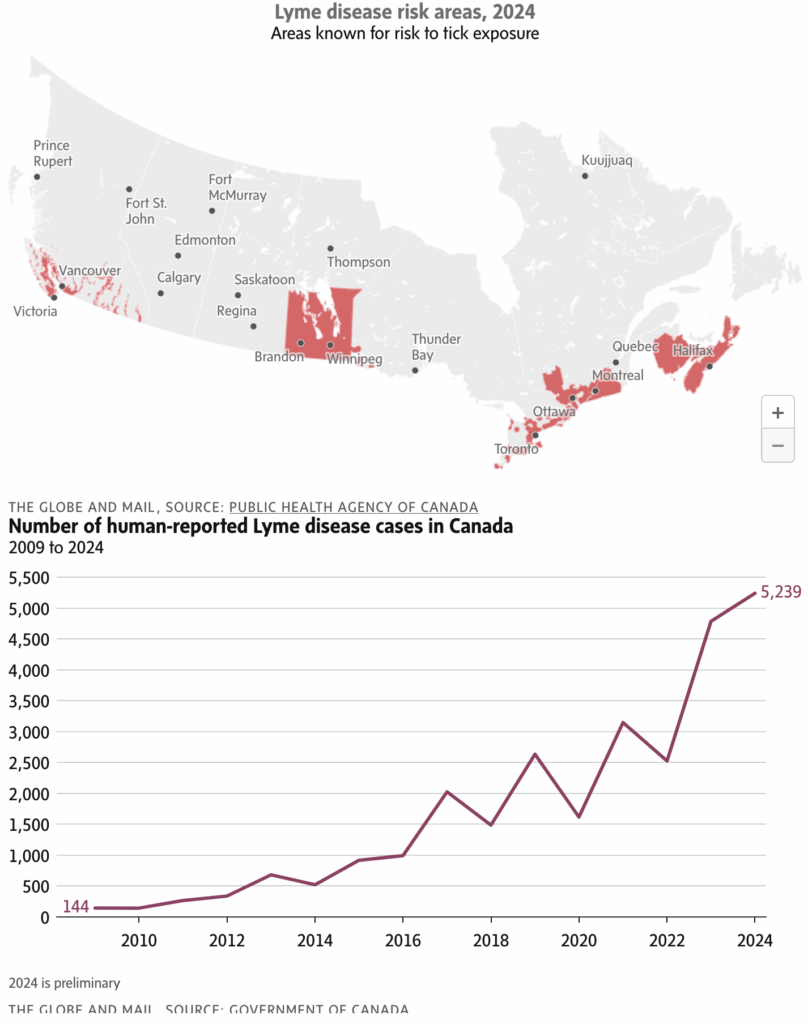
Just hit 21 degrees Celsius here in Ontario Canada. Totally normal. Nothing to worry about.