@sethdklein.bsky.social:
ICYMI, decided global folks needed a reality-check on how the struggle to confront the climate crisis is going in Canada. In short, the climate movement has found the last year disorienting – reeling from the disconnect between the promise and reality of Carney – but it’s getting its bearing back.
One year in, we’re letting go of the Carney mystique. I saw the real Carney before he won the election. Harper and his anti democracy IDU had Pee Pee and Carney play a terrible trick on Canadians, lying that he’s liberal when he’s more to the right than Harper or Pee Pee and much more evil of a man. There is no scenario in which these policy shifts do not increase both Canada’s domestic emissions and, even more, downstream carbon pollution elsewhere through the expansion of oil and gas exports.
A first for me today. Glad to have this piece in The Guardian. Figured it was time more of our international friends heard some hard truths about how things are going here in Canada:
https://www.theguardian.com/commentisfree/2026/may/21/mark-carney-climate-canada
@GrimReaperyudk:
… [Carney’s] a Zionist who worships money, and he fooled you all.
@jacqueline99.bsky.social:
The “it would be worse with PP” crowd needs a new slogan.
@sustainablesong.bsky.social:
Whether or not there is ever a private proponent blind enough to fund a pipeline in a global market moving away from fossil fuels, the real story here is that Carney putting carbon pricing into a coma for 15 years is murderous to the planet either way.
@sustainablesong.bsky.social:
The Carney government isn’t harming the environment reluctantly, or by accident, or because it’s somehow going to strengthen the economy. It’s been systematically undermining and dismantling climate policy until the sad vestige that’s left has been rendered impotent.
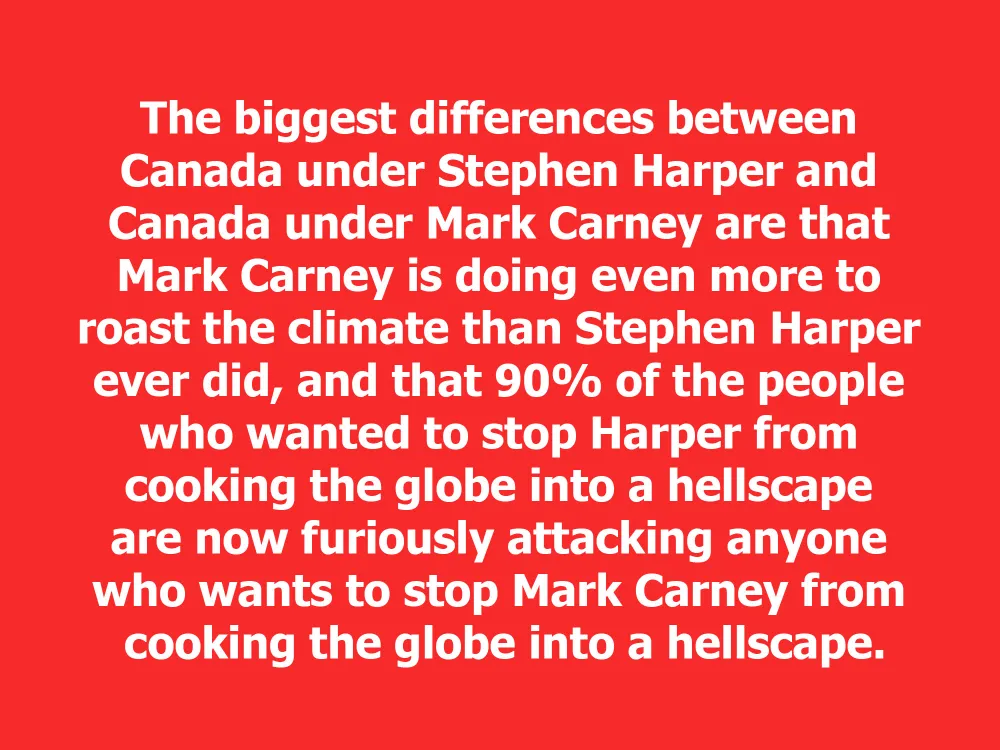
If absolutely any of the Carney government’s major policies were tabled by a Conservative Party of Canada federal government, there’d be riots in the streets. Instead, out of complacent critical-thinking-free lazy political tribalism, millions of Canadians cheer on colossal harms from our PMO.
@bhaggart.bsky.social:
Carney’s fundamental dishonesty regarding his economic agenda is something we‘ve never seen before in Canadian politics. It treats Canadians as chumps — say the right words and the suckers’ll buy anything — while robbing us of the opportunity to have an actual debate about the country’s future.
@woodsideful.bsky.social:
In just one year, Carney has wrecked a decade’s worth of progress. The old climate strategy wasn’t enough, but rather than strengthen it he dismantled every meaningful policy, stomped on the gas to deliver more fossil fuels, and concentrated power to run roughshod over opposition to his agenda.
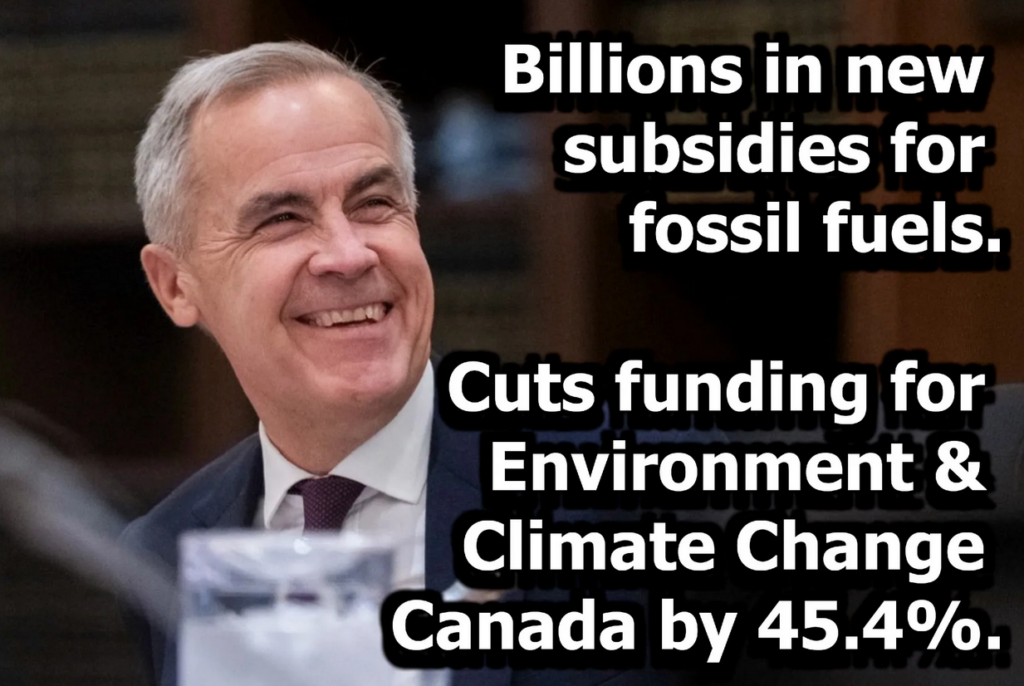
Sara Hastings-Simon May 15, 2026
Alright, lets do another live skeet react to the actual text in the Canada Alberta agreement: pm.gc.caCanada and Alberta strike agreement to diversify our exports, reduce emissions, and build a stronger economywww.pm.gc.ca
Yes it is. And yes that is what Canada can control. Not written but key to all of this – Canada can not control the global demand for oil.

First off – no this does not maintain a path to net-zero by 2050. This matters. If GoC wants to change its policies on climate that is of course within their elected right to do so. But they can’t change the policy to make it less stringent and then claim it is on a path to net zero.
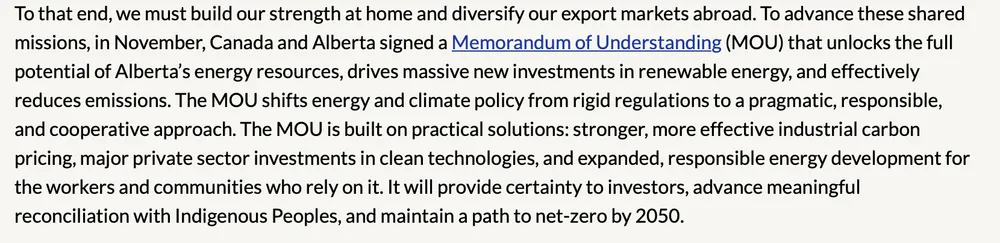
Well, I guess they can claim it’s still on a path to net zero, but I as a climate policy expert can then say that no they aren’t (I’m not a lawyer, I assume the whole greenwashing and making climate plans laws dont apply to governments? IDK. I’m sure @ablawg.bsky.social does).
“stronger, more effective industrial carbon pricing”
In 2021 the GoC published clear criteria that the effective price in an output based system like Alberta must be aligned with the headline price by 2023.
That means an effective price of $130 before 2028. Under the MOU it is $130 by 2040.
This is over 12 years later. This is not stronger or more effective.
Again the government can say we weren’t actually going to do what was written down and that this is stronger than doing nothing. But that is not the same thing
So $115 instead of $170 by 2030. But there is a lot of talk without much details about this TIER tightening and actually increasing the effective price before 2030. references to stridency rates and tightening and price floor but no specific details on how quickly
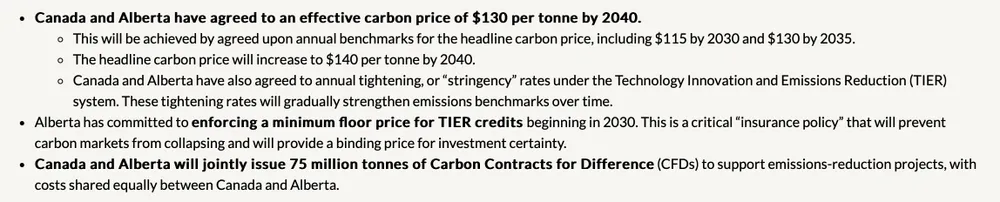
And the CFDs, which promise to pay a given price. What price? Close to the effective price? In which case not very strong signal? Or close to the headline price? In which case you are turning a carrot/stick carbon pricing policy into one that is just government pays directly for emission reductions.
On Electricity, a lot of talk (good things but again just talk). The only specific agreement is I guess Alberta will respect the courts?

ah yes – good point that I missed – not only is delay delay, because of inflation it actually means even lower effective prices. bsky.app
Jason R. Wang 05/15/26:
Accounting for inflation, $130/t in 2040 is likely to land near $100/t – basically where the headline price is today.
www.linkedin.com/feed/update/…
Energy security – yes sovereignty – yes “low-carbon energy” describing building bitumen pipelines – no
In a world that is increasingly electrifying it is really absurd to claim that even if (big if) you had full CCS on production, that oil is “low-carbon”.

Pathways is a “prerequisite” (L)
Construction of pipeline targets for 2027 (R)
How is this a prerequisite? Its a prerequisite that there is a promise that the carbon capture project will get built, actually work as designed, and actually be operated?

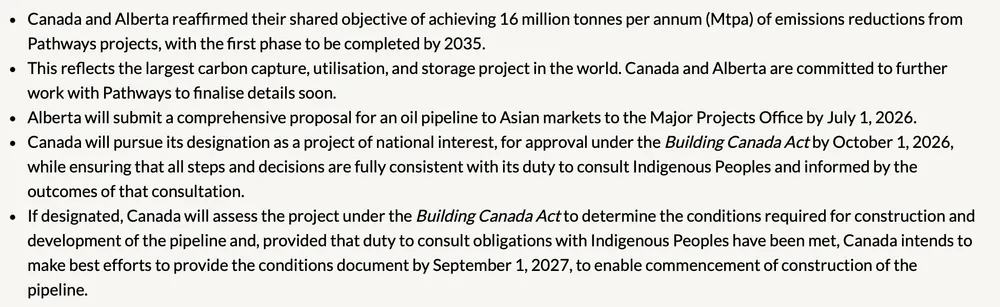
Thanks @pjpartington.bsky.social here are are the rates
Not a very impressive rate.
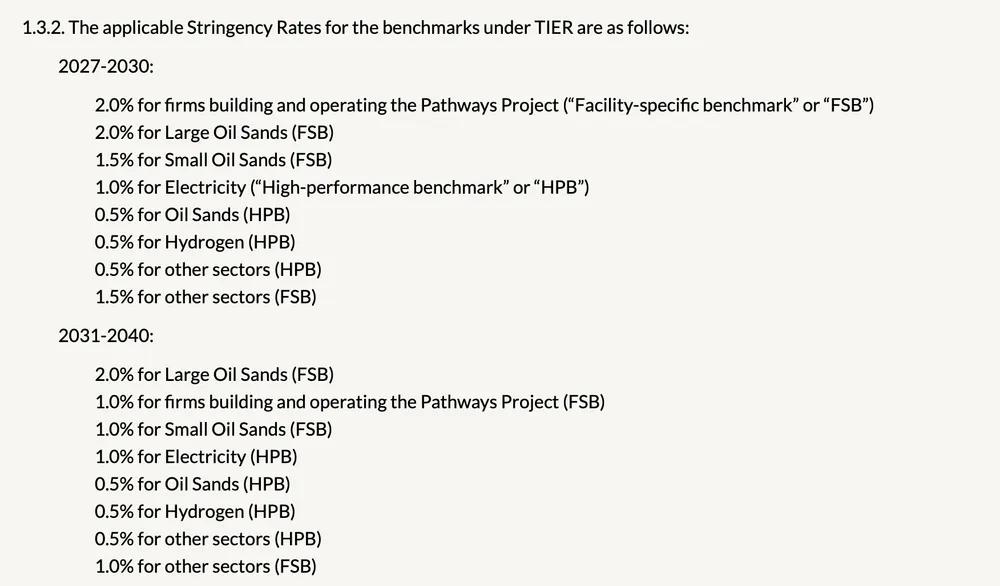
So $115 instead of $170 by 2030. But there is a lot of talk without much details about this TIER tightening and actually increasing the effective price before 2030. references to stridency rates and tightening and price floor but no specific details on how quickly
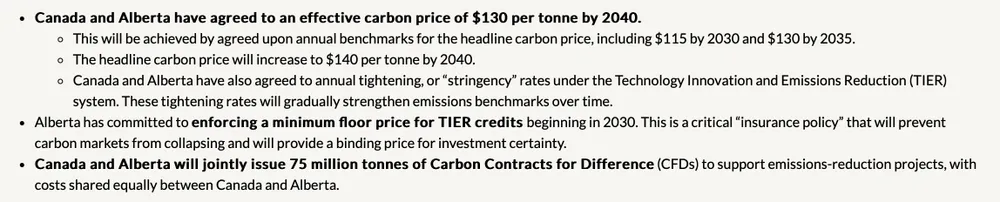
Back to the pipeline pre-req. The implementation agreement has a lot of language around a MOU and a lot of “reaffirming” of commitments, and various extra subsidies for CCS but nothing about any binding requirements or consequences. pm.gc.caImplementation Agreement for the Canada-Alberta Memorandum of Understanding of November 27, 2025www.pm.gc.ca
This part in the weeds means that builders and operators of CCS amounts to a direct subsidy for building, and getting credits for operating means a double counting of emissions reductions (they will already get credits for reducing emissions, then they get credits again for the money they spend)
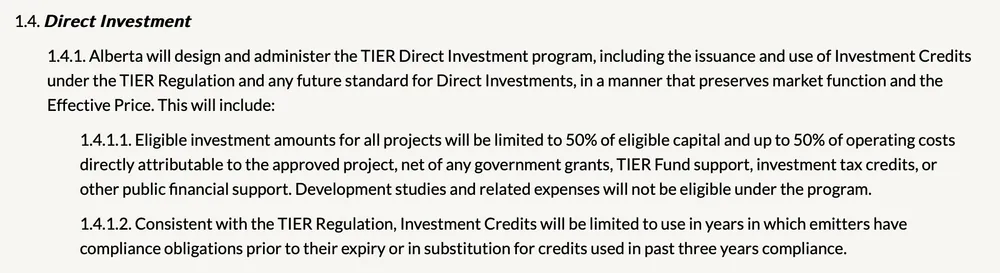
This is worth 2 skeets because it’s kind of wild. Lets assume company X has a CCS plant built and now we focus on the just the operating part:
They operate their CCS unit which costs say $100/t (this is just a rough number to make the math easy, it could be higher or low).
Now let’s say the floor price of 1t of carbon they capture which they can use or sell is $130. So their costs are $100 and they net $30 which can go towards paying off Capex.
But in addition to that they get 1/2 of their operating costs, or $50 as an additional credit under the system.
its like if I was a cookie baker and I sold my cookies to the government at a price for the cookies we agreed it was worth, but then I said I should get paid an additional payment for the eggs and butter I used in the cookies.
I could go on about this, but the main takeaway is we already see special subsidies going to CCS (direct payment offers, special higher clean tech tax credits, even for EOR projects), with more lined up. And more generally the point that carbon pricing is a policy that can hide many things.
This is too long already. The MOU: – greatly waters down climate policy – leaves bit of climate policy in place but not nearly enough for any reasonable pathway – seems to create a way for a pipeline to be built before CCS. or as @katharinehayhoe.com said it here:
@katharinehayhoe.com:
TLDR: this agreement does not maintain a path to net zero by 2050
Carney’s ecological betrayal by Paul Journet, May 16, 2026, La Presse
Mark Carney just pushed the final nail into the coffin in Canada’s green plan. There is almost nothing left, except the hollow slogans and those who still pretend to believe it.
Upon his arrival in politics, the former UN Special Envoy for Climate Finance was seen as the G20’s best hope for the ecological crisis. The injury is more painful. She has the aftertaste of betrayal.
Just a year ago, Canada was on track to reduce its greenhouse gas emissions by about 36% by 2030. For the first time, the target (-40%) was at hand. But in recent months, the measures have been dismantled one by one.
In the beginning, environmentalists were relativizing. The abandonment of carbon pricing was a necessary evil to avoid the election of conservatives, it was said. The important thing was to keep the rest of the plan. But the setbacks continued and accelerated.
To justify them, the Liberals are now clinging to a mirage: carbon neutrality. The important thing, they argue, would be to eliminate greenhouse gas (GHG) emissions by 2050. But with the current trajectory, it is an impossible mission.
Since 2005, GHG emissions have decreased by about 10%. Modelling for the suite has not been updated to reflect M’s setbacks. Carney. However, they are not so difficult to predict. If we do almost nothing, we won’t change much.
The evocation of carbon neutrality is like a vast collective session of hypnosis. It is a target carried to a distant, almost abstract horizon, to justify inaction.
What about Donald Trump? Yes, it exists. But that does not prevent the European Union from having reduced its emissions by almost 40% since 1990, and from wanting to reduce them even further. Canada wants to make more exchanges with this trading partner. However, Europe will impose the equivalent of a tax on high-carbon goods. Dunces like Canada will be at a disadvantage.
M. Carney pleads economic realism. The fossil fuels will not disappear tomorrow. It is better that the planet consumes those of Canada, he argues. But if this industry is so viable, why does it need public funds? Why remove it from the polluter pays principle and pass on the bill of its pollution to the citizens? And why do so little to encourage citizens to consume less, and better?
M. Carney started in the winter of 2025 with the abolition of carbon pricing for consumers. The cap on oil and gas emissions was killed in the egg. The tightening of the methane emissions regulations was postponed for five years.
This week, we planted the last two nails.
M. Carney has announced plans to weaken the Clean Electricity Regulations, which are expected to cap emissions from this sector from 2035. It had already been relaxed to accommodate the provinces that are heating themselves with gas. The Liberals would further dilute it, without saying how they will get equivalent GHG emission reductions.
Only certainty: there will be fewer incentives to develop renewable energies.
Friday, it was the turn of the industrial pricing of carbon, which was the backbone of the green plan. The price is lowered and its subsequent increase will be held back. Carbon capture and storage will be even less profitable. However, it was supposed to be the great compromise offered by the federal government to Alberta: a pipeline against a megaproject that would capture an indeterminate share of the GHGs.
Danielle Smith, Premier of Alberta, is right to smile. The federal government gives in, and in part, it gives… It is not a negotiation, it is a red carpet unrolled under his feet.
Federalism also emerges with a black eye.
M. Carney wants to appease the grunt of the Prairies. Rather, it rewards these provinces for their unfair competition. Alberta and Saskatchewan are not currently pricing industrial carbon at the federal floor. But the Carney government is doing nothing. Provinces such as Quebec and Ontario, which do more than their share, risk asking for compensation as well.
Let’s be charitable. There are a few drops of water left in the glass.
M. Carney wants to develop the pan-Canadian power grid. If it facilitates the exchange of electricity from east to west, it will be a feat. Quebec could finally benefit from it to reach its agreement with Newfoundland and Labrador in Churchill Falls.
Tax credits for clean technology are maintained. International funding for climate action has also been protected. And the goal of protecting 30% of the land and sea territory was adopted.
But the worst could be coming. The federal government will limit its environmental assessments to nuclear, offshore or interprovincial projects.
For the rest, it relies on the provinces, even if some of them have a deficient regime. Perhaps that is the purpose…
The protection of species at risk will also become optional. Ottawa will be able to derogate from it according to arbitrary criteria and hidden through ministerial secrecy.
At the beginning of the term, Mr. Carney has created a list of “nationally interested” projects for which environmental standards will be lightened. A pipeline is expected to be added by September, Mr. anticipates. Carney and Mrme . Smith. However, no private developer exists, much less an official route. Edmonton will drop it off. Still, the fossil fuel industry is chilly – this pipe would take office in the middle of the next decade and it is unclear where the oil market will be.
Ironically, this preferential treatment could become a poisoned gift. First Nations see this as an attack on their constitutional rights. Each project that is added to it becomes illegitimate for them, in principle.
For the Green Caucus of the Liberal Party of Canada, the defeat is total. The silence of its members allows them to avoid lying, but it is not honorable.
Only Steven Guilbeault speaks. The former Minister of the Environment must now reflect on his future. Her resignation would have a limited effect – she would attract attention for 48 hours, and then the federal government would move on. By staying with the Liberals, he hoped to influence his team. But obviously, his power is declining. For him, the decision may be based less on the calculation than on the honor. For this government, the environment has become a footnote.
@jameswsthomson.com:
A three-clause claim, and two are Orwellian falsehoods. Doubling down on a single export is not diversifying. Adding emissions is not reducing them.
@mark-carney.bsky.social:
Today’s agreement between Canada and Alberta will diversify our exports, reduce our emissions, and give investors the certainty they need to build.
Together, we’re building a stronger, more prosperous, and more sustainable future for all.
@tomgoldsmith.bsky.social:
I am constantly horrified by this government, and utterly bemused by people who think that Carney is better than Poilivere. They clearly haven’t been paying enough attention to what he is actually doing.
@althiaraj.bsky.social has been one of the few journalists honest and pointed about this.
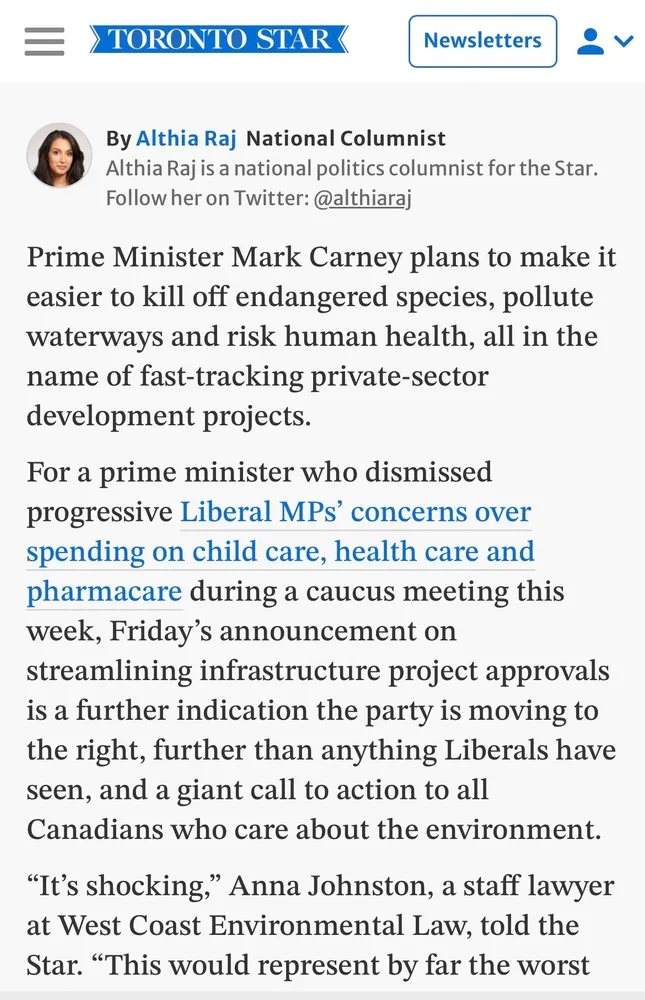
gift link to her full column: www.thestar.com/gift-redeem?…