@bellriots30.bsky.social:
WTF is Carney playing at?
@sobittersosweet.bsky.social:
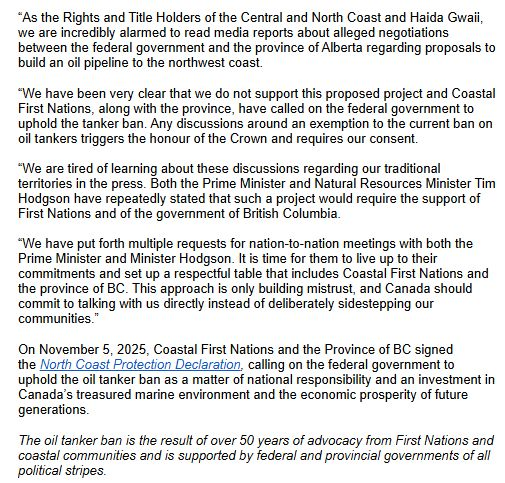
Coastal First Nations say the federal government hasn’t been talking to them about Alberta’s pipeline proposal, despite multiple requests for nation-to-nation meetings
“We are tired of learning about these discussions regarding our traditional territories in the press,” reads a press release
@tantalumhypercube.bsky.social:
just another day in the illegal and unjustified occupation of indian land.
Moe says Sask. involved in discussions about deal for potential B.C. pipeline, Moe told media on Wednesday he’s involved in the ongoing negotiations by Alexander Quon, CBC News, Nov 20, 2025
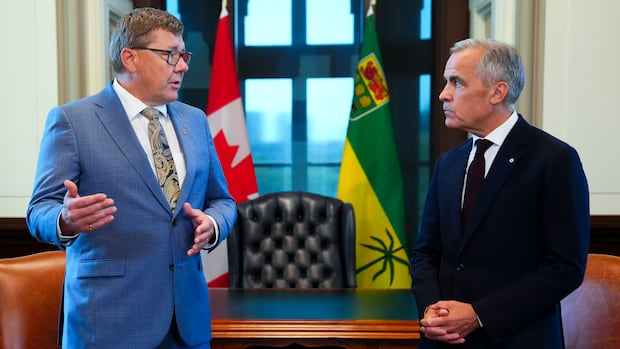
Saskatchewan Premier Scott Moe says his government is also involved in ongoing negotiations about a potential oil pipeline in northern B.C., and re-allowing oil tankers on the nation’s west coast.
A senior government official confirmed to CBC’s parliamentary bureau that Prime Minister Mark Carney and Alberta Premier Danielle Smith are personally brokering a deal on the future of Alberta’s energy sector.
That deal is likely to include some language about a path forward for an oil pipeline in northwest B.C. that Smith has long been an advocate for, as well as the granting of limited exemptions for oil tankers docking at ports on B.C.’s northern coast, the official said.
On Wednesday, Moe confirmed the Saskatchewan government has been included in those discussions. Dirty Douche Fucker Liar Liar Carney! Consults with Smith and Moe, but not the communities which will be harmed!
“[We’re] very supportive of Alberta’s position when it comes to that piece of infrastructure, very supportive of them being a proponent at these early stages,” Moe said.
He believes both measures would help support Saskatchewan’s goal of exporting more potash, expand the market for Saskatchewan oil and producing more agricultural products, he said.
He’s confident a private-sector proponent for an oil pipeline would emerge if regulations change, he said.To what? No regulations?
Moe said he is also supportive of changing the restriction on oil tankers off the northern coast of B.C.
He does not support a “free-for-all” on tankers, he said.
“It’s fully within reason to think that there will be work that will be done on specific laneways and things so that there is a minimal impact to the surrounding environment.”Impossible! Things?
Moe declined to provide a timeline for when a deal could be reached, saying more details will come when “it’s right.”
@tryangregory.bsky.social:
Carney and Smith are taking us backwards on climate and will end up making us weaker economically.
America is being left behind in this key area. Canada might be too if doesn’t stop following Trump by Gerald Butts, Peter Nicholson and Rick Smith Contributors, Nov 20, 2025, Toronto Star
Gerald Butts is vice-chairman of Eurasia Group. Peter Nicholson and Rick Smith are chair of the board and president of the Canadian Climate Institute.
The rest of the world is ramping up its transition to cleaner, more efficient, electric technologies, while the Trump administration is leading the United States down a dead-end street.
That’s one rather glaring conclusion from the world’s foremost energy authority, the International Energy Agency’s (IEA) in its latest World Energy Outlook.
Granted, the agency was not so impolitic as to state it that bluntly, but it’s hard not to reach that conclusion from a closer read of the IEA’s report.
Historians will look back on the U.S. raising the white flag on the energy transition as a catastrophic error, putting North America at risk of becoming an island of fossil fuels in an electrifying world.
Canada should take note and choose a better path.
So, what does the IEA report say? Under conservative assumptions about the world’s energy markets, global fossil fuel demand is set to peak around 2030 and clean energy will continue to skyrocket.
Based on the IEA’s “stated policies” scenario, coal is already close to its peak, oil is set to plateau around 2030 and gas is set to follow suit in 2035, declining slowly but steadily thereafter.
Renewable power will expand to deliver more than half of the electricity generated worldwide in the next decade, up from about one third of global generation today.
That should trigger flashing red lights and sirens in downtown Calgary, on Bay Street, and atop Parliament Hill.
And if this wasn’t enough warning for Canada’s future fossil fuel exports, this conservative IEA scenario is almost certainly too dour on the deployment of clean technologies like renewables and batteries, which it assumes will flatten out — a prospect that is already stale-dated.In reality, solar and battery costs have continued to crater and deployments are soaring. Fossil fuels in the power sector globally are expected to see no growth this year, as solar and wind have grown fast enough in the first three quarters to exceed rising electricity demand.
In the 10 years since the Paris agreement, the world has seen a 10-fold increase in solar power, making it the fastest growing source of electricity alongside wind power and well eclipsing the growth of gas and coal.
Living beside the United States, it can be easy to overlook these global trends. We see headlines about stalling electric vehicle sales in North America, with President Donald Trump rolling back supporting policies, but miss the fact that one-in-four cars sold this year globally will be electric.
Trump rips up permits for massive solar and wind projects. At the same time, the European Union commits to reducing its emissions 90 per cent by 2040 from 1990 levels. And member states are basically on track to meeting the 2030 target of 55 per cent cut.
What does it all mean for Canada?
The global energy transition is essentially splitting in two. Fossil fuels are proving stickier in the U.S. — thanks to retrograde action from the Trump administration — and decarbonization and electrification is accelerating virtually everywhere else.
Prime Minister Mark Carney has laudable goals. He’s committed to doubling Canada’s non-U.S. exports in the span of a decade, which means markets like the EU, United Kingdom, and Asia will be critical. Each of these jurisdictions are charging ahead on clean energy and climate policies.
His government has also released a climate competitiveness strategy and a couple of rounds of “nation-building projects.” There are a number of positive steps forward in this regard: a commitment to strengthen industrial carbon pricing, cut more methane from oil and gas, and build bigger, cleaner electricity systems, among other things.
These plans need to be tackled with clarity and urgency. Timelines need to be laid out. Policy details need to be confirmed.
Failing to do so will add costs and shrink markets for Canadian industries exporting into places like the EU and the U.K., which are putting carbon tariffs in place that penalize products not subject to sufficiently stringent carbon pricing. It will delay big investments in projects like critical minerals or other sectors looking for access to clean, reliable electricity.
History isn’t kind to those who fail to embrace technological transitions. Our American neighbours are trying to reverse the inevitable global energy transition. In order to take advantage of our significant opportunities, Canada must chart its own path forward.
Our policy advice is pretty simple: Clean up electricity and electrify everything possible. This is the nation-building project Canada needs and one that provides unprecedented opportunities for a new era of co-operative leadership between the federal and provincial levels.