@bryanpeeler.bsky.social:
This will upset John Carpay and Jay Cameron.
@wallykibler.bsky.social:
Nasty! A nice bonus!
@breakinprogress.bsky.social:
Will definitely rile the convoy (lawyer) crowd.
@amirattaran.bsky.social:
Pretty good choice! Alberta will scream that he’s from Manitoba, but so what.
@emmettmacfarlane.com:
I don’t understand why we’re persisting in calling SCC appointees “nominations”. There’s no nomination process, nor confirmation process. The government announces who it will appoint. Period. So Justice Joyal is not a ‘nominee’, he is simply the person the government intends to appoint.
Now, the reason the media keeps saying “nominee” or “nomination” is because that’s what the government erroneously calls it: www.pm.gc.ca/en/news/news…
But it is no less an incorrect term.
@holtscat.bsky.social:
Creeping Americanism… which Herr Carney is all for
@lawscribes.bsky.social:
Glenn D. Joyal to be ‘appointed’ to #SCC: Supreme Court Canada justices are appointed by Order in Council from the Governor General based on the prime minister’s advice. There is no ‘nomination’ its a straight up appointment. Anything else is courtesy only. PM release www.pm.gc.ca/en/news/news…
@67sound.bsky.social:
I am so grateful for our (mostly) apolitical appointments process. Joyal was named to his current post by a Conservative and now gets elevated by a Liberal.Carney is no Liberal. He’s more to the right than Steve Harper and Pee Pee combined His politics are mostly unknown and entirely irrelevant.
@emmettmacfarlane.com:
Hard to argue against this. Joyal is an extremely thoughtful, sharp jurist with expertise in constitutional and criminal law, and tremendous experience on the bench and judicial administration to boot.
Chief Justice Glenn Joyal nominated to the Supreme Court of Canada, Long-time member of the Manitoba bench described as a fair, open-minded, and nuanced thinker who will bring a sense of stability to the Court by Holly Lake with files from Dale Smith, 22 Jun. 2026, National Magazine
Prime Minister Mark Carney has nominated the Honourable Glenn Joyal to the Supreme Court of Canada.
A Manitoba judge for nearly three decades, Joyal has been chief justice of the Court of King’s Bench since 2011. He was first appointed as a judge of the Provincial Court of Manitoba in 1998 and joined the Court of Appeal of Manitoba in 2007.
“The Supreme Court of Canada is a pillar of our democracy, safeguarding the rule of law and the rights and freedoms that define our country,” Carney said in a statement Monday morning.
“Throughout his career, Chief Justice Joyal has demonstrated the integrity, experience, and sound judgment that service on our highest court demands. I am confident that he will serve Canadians with distinction.”
Federal Justice Minister Sean Fraser said Joyal has shown he has what the role demands.
“His work to improve access to justice, modernize court operations, and advance reconciliation reflects a deep commitment to the fair administration of justice. He is an outstanding nominee to serve on Canada’s highest court.”
A graduate of Simon Fraser University, the University of Manitoba, McGill, and Oxford, Joyal worked as a Crown attorney as well as in private practice, with expertise in criminal and constitutional law, before moving to the bench.
Gerard Kennedy, a law professor at the University of Alberta who researches the role of courts in society, says Joyal’s nomination is “not surprising and very on-brand” for the prime minister.
“This is a judge who has a lot of experience in public law and criminal law, which is the bread-and-butter of the Court’s work,” he says.
“He definitely is an institutionalist, and very much in the vein of Carney. He’s somewhat conservative, and I don’t mean that politically but dispositionally, when it comes to the value of institutions and institutional roles.”
Emmett Macfarlane, a political science professor at the University of Waterloo and author of “Governing from the Bench,” says Joyal is “far from an ideological appointment.”
“I don’t think you can pigeon-hole Joyal in the way you can pigeon-hole some other justices as progressives or conservatives. I think it’s impossible to view this as anything other than a highly-qualified appointment,” he says.
Joyal is a very nuanced thinker who will bring a sense of stability to the Court, Macfarlane says.
“I think his philosophy regarding the relationship and the role that the judiciary has in our system of government is a very sophisticated one. That’s demonstrated by the judicial questionnaire that they had candidates fill out.”
Kennedy notes that although Joyal isn’t a criminal law specialist like others who have spent time on the top court, including Justice Michael Moldaver, Justice Morris Fish, or Justice Louise Charron, “he has a significant criminal law background, so that is invaluable.”
Whether the Court will be at a critical mass of criminal justice expertise is a broader question, Macfarlane says, but he thinks Joyal brings much-needed experience in this area.
If he were serving in the chief justice role, we could talk more about his experience as the chief justice of Manitoba on administrative matters. But his background in that area has led him to do a lot of thinking about access to justice issues and other things that might inform jurisprudential considerations going forward,” Macfarlane says.
“There are things about the broader justice system, deep thinking, and expertise in areas that are broader than just criminal justice policy that the Court will benefit from.”
CBA President Bianca Kratt welcomed the nomination of Joyal, a judicial member of the CBA.
“His bilingualism, deep Manitoba roots, and longstanding engagement with the province’s legal, francophone, Indigenous, and access-to-justice communities will bring an important perspective to the Court,” she said in a statement.
“The Supreme Court is the guardian of our Constitution and the ultimate interpreter of our laws. We are confident that Justice Joyal will serve on it with independence, rigour and integrity.”
A biography released by the PMO noted Joyal’s efforts to advance reconciliation and strengthen the relationship between the justice system and Indigenous Peoples.
Last year, he told the CBA’s Verdicts and Voices podcast about how the Manitoba Court of King’s Bench has incorporated Indigenous practices such as the ceremonial use of the eagle feather, smudging, and jigging.
He also addressed concerns that if courts incorporate special cultural practices for Indigenous litigants, they will have to apply them to all litigants.
“The problem with that is it de-emphasizes what is unique and special and deserving of an asymmetrical approach when it comes to Indigenous law and traditions,” Joyal said.
“If we are moving, as I believe we are and should, to a tri-jural system, it’s not fair, and it’s not rational to try to compare so literally and so symmetrically the arguments about liberal neutrality with respect to what we owe our Indigenous community.”
He said Indigenous legal orders have a lot to teach us about resolving conflict, repairing harm, and restoring relationships.
“But to benefit from the teachings, we have to first recognize, and if I could put it this way, make space for Indigenous law and legal orders.”
John Borrows, the Loveland Chair in Indigenous Law at the Henry N.R. Jackman Law School at the University of Toronto, described Joyal as an excellent judge who has “wide and deep experience.”
“He is balanced, fair and open-minded.”
Given Joyal’s work on criminal justice policy and access-to-justice efforts, coupled with his experience with Indigenous litigants and defendants, Macfarlane hopes to see him bring some influence in that realm to the Court.
“He’ll be one of nine, but this is the sort of experience and expertise that is sorely needed at the Court.”
The CBA has long championed a transparent and merit-based appointment process, and Kratt noted those values are exemplified by the work of the eight-member Independent Advisory Board tasked with selecting the candidate to replace Justice Sheilah Martin, who retired last month.
Kratt expressed “profound gratitude” to Martin for her “enduring contribution to Canadian jurisprudence during her time on the bench.”
To get my confidence (any of it) in Canadian courts; 1) judges and or lawyers need to stop lying to the public, in court filings, in courts and in rulings; 2) clean up Canada’s law societies – licencing known convicted pedophiles is cruel and shits on the rule of law (judges are hatched from lawyers); and 3) Rosalie Abella’s smearing lie of me in her part of her part of the SCC’s ruling in Ernst vs AER needs to be corrected with a public apology issued to me by the court for knowingly allowing dishonesty and pettiness in their “judging.”
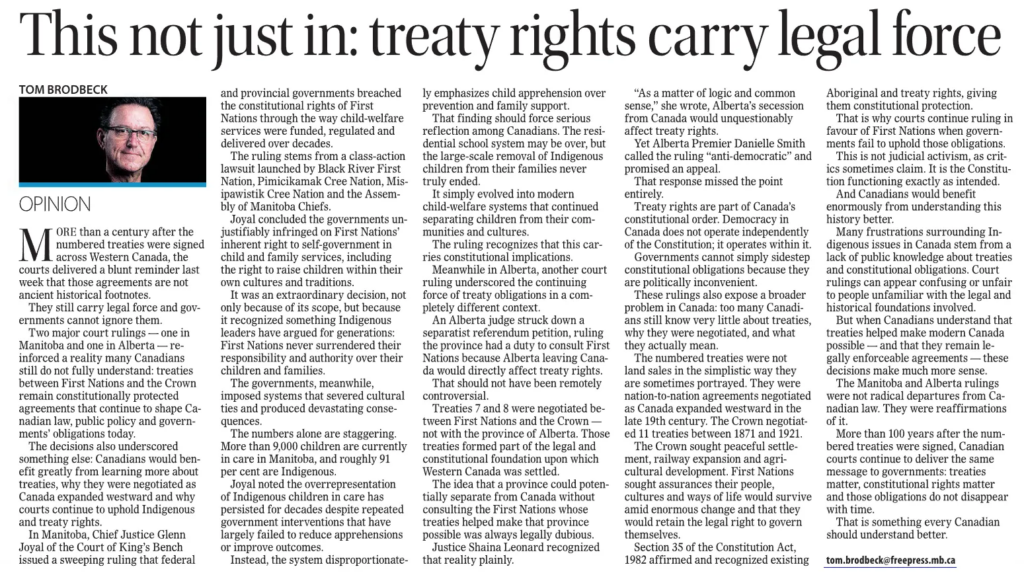
Three Intriguing Aspects of Chief Justice Joyal’s Judgment in the Chief Heidi Cook Case, Limiting Collective Religious Freedom, Overturning Van der Peet, and Establishing Constitutional Rights of Indigenous Self-Government by Dwight Newman, Jun 22, 2026
On May 11, Manitoba Court of King’s Bench Chief Justice Glenn Joyal released his 389-page judgment in the Chief Heidi Cook case (Chief Heidi Cook v Government of Manitoba, 2026 MBKB 65) concerning certification of a class action by First Nations in relation to the Manitoba child welfare system.
Today it was announced that Chief Justice Joyal is being appointed to the Supreme Court of Canada.
The judgment was interesting before and is all the more interesting now. It has some intriguing aspects commenting on contested, substantive legal matters amid a lengthier discussion engaged with some complex matters concerning a class action certification. I want to highlight three of the more intriguing aspects as we consider what indications the judgment might provide as to Chief Justice Joyal’s thinking about the law on the eve of his long-predicted ascendancy to the Supreme Court of Canada.
- First, to my surprise, the judgment shows a marked skepticism toward ideas of collective aspects of religious freedom. He interprets the Supreme Court of Canada’s case law as having rejected the idea thus far (paras 434-435), which, with respect, is a very narrow reading of developing case law that has at times seemed to recognize those rights. He references the minority reasoning in the Loyola High School case and then says that the majority of the Supreme Court of Canada did not adopt it in the TWU case (para 433), while seemingly overlooking that both the majority and minority opinions in Loyola had shown some recognition of collective aspects of religious freedom (with a divergence between the majority and minority on whether those aspects were held by communities or by institutions). And he ignores entirely latter cases like Wall and Aga that were suggesting more tendencies toward recognition of collective aspects of religious freedom and/or associational freedom in the context of religion (on which I have coauthored recently). To some degree, he repeats a trope that strangely appeared in the Supreme Court of Canada’s recent judgment in Dickson v. Vuntut Gwitchin that Charter rights are all individual and only section 35 rights collective (paras 420-21), something I exposed and challenged in a book chapter forthcoming in an edited collection on The Shape of Freedom – watch here for more details in due course). So, his ideas on this point may fit right in at the Court, but that involves the Court departing from years of its own jurisprudential development and strangely overlooking Charter rights like freedom of association and language rights that one would have thought to have undisputed collective aspects. Anyway, one area to watch.
- Second, the judgment sees Chief Justice Joyal taking up quite boldly the Bedford-Carter approach to overturning past precedents of the Supreme Court of Canada, even at a lower trial court (para 617), even after the Court had tried to rein in somewhat what it originally set out. Chief Justice Joyal takes up the Bedford authorization of overturning precedent in the context of determining that the Supreme Court of Canada’s long-established section 35 Aboriginal rights test in R v Van der Peet (1995) is in his view no longer valid law (para 618). In doing so, he cites to the 2023 Montour decision out of Quebec that remains under appeal (delayed by some negotiations) (para 678), seemingly following its reasoning that the adoption of the federal UNDRIP Act (or UNDRIPA) amounted to a change in the legal landscape that would justify overturning Van der Peet (para 678). I have previously critiqued that reasoning in Montour as allowing a federal statute to change constitutional interpretation. Chief Justice Joyal now seems to follow it, as have some other courts, even as yet other courts have rejected the Montour reasoning (see eg R v Plain, 2026 ONSC 63). Chief Justice Joyal’s limited comments on the shape of the Van der Peet test today do not strike me as setting out a test consistent with that urged by the trial judge in Montour, so they actually contribute to having yet more potential forms of the Van der Peet test. The Van der Peet test has of course received much thoughtful critique over the years, but it does not strike me as helpful to have various trial judges overturning the Supreme Court of Canada precedent and purporting to apply new versions of the section 35 Aboriginal rights test that now differ in different courtrooms (and that cause knock-on effects for the duty to consult) so hopefully these matters can somehow get to the Supreme Court of Canada sooner rather than later for clarification. In the meantime, I was surprised by this aspect of Chief Justice Joyal’s reasoning.
- Third, the judgment comes very close to recognizing a generalized constitutional right of Indigenous self-government in the context of child welfare and/or perhaps more generally as well. Such a step, while not out of line with directions in which some government policies have gone, is actually beyond anything the Supreme Court of Canada has said. Just what Chief Justice Joyal is saying on it is made complicated by issues of whether he is characterizing the potential claimants’ argument or whether he is saying something about the state of the law. But, for an example of something that does seem like the latter, note, for instance, para 618:[…] Parliament’s express recognition (in the preamble to the UNDRIP Act) of UNDRIPas a “source of interpretation for Canadian law,” allows this Court to recognize the plaintiffs’ right of self-government in the area of CFS without each of the three plaintiffs leading evidence regarding child rearing practices, traditions and customs (specific to each of them as First Nations) that existed pre-contact, and which continue to exist in modern form today. This is particularly so, given this particular self-government right has been recognized legislatively by both defendants, and the right claimed by the plaintiffs has been specifically conceded by Manitoba in these proceedings.The paragraph does seem to affirm a right of self-government, drawing upon interpretation based on the federal UNDRIPA as well as other legislation and concessions by Manitoba government lawyers. How some of these sources can lead to a constitutional right is subject to possible contestation. The legal reasoning will naturally be explained only so much in relation to points within the class certification discussion. But on such significant points of law, one might have hoped for more detailed reasoning and more contemplation of all of the consequences of seemingly engaging in a recognition of a constitutionalized right of Indigenous self-government (and if that is not what is meant by some of these passages, then there is a different problem related to clarity).The Chief Heidi Cook case involves a massively long judgment with a lot going on in it, but these three points stood out as surprising relative to what some might have anticipated. It will be interesting to see if similar ideas filter through Supreme Court of Canada Justice Joyal’s future jurisprudence, all the more significant in the context of his new role.
@peggyblair.bsky.social:
So reading your substack, it appears to me that he is making the test for proving a section 35 right a lot easier to prove, recognizing section 35 rights as collective rights (nothing new there), and potentially recognizing an inherent right to self-government. Is that correct?
Legal Affairs Canada @lawscribes.bsky.social:
The substack was written by law pro Dwight Newman who specializes in Indigenous law and is active on twitter. His comments are based on one Glenn Joyal MBKB decision that uses federal UNDRIP Act as an interpretation tool. But yes that’s what he wrote.
https://www.canlii.org/en/mb/mbkb/doc/2026/2026mbkb65/2026mbkb65.html
@peggyblair.bsky.social:
Interesting. I have a doctorate in indigenous law and worked in this area for over 30 years as counsel to First Nations and First Nations organizations. I remember when Van der Peet first came out.
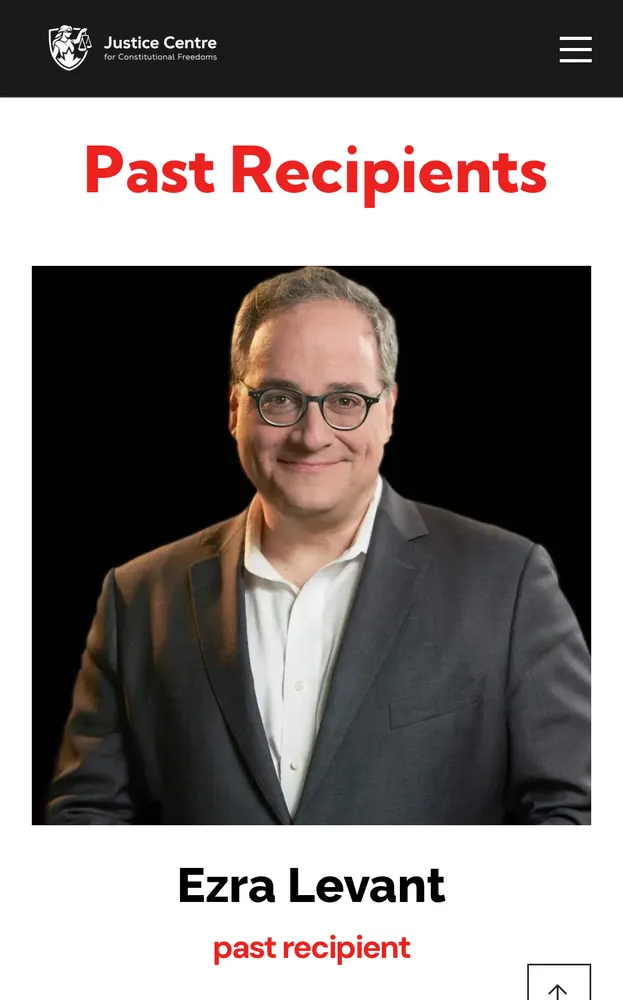
I just learned that Ezra Levant has me blocked on Twitter even though we’ve literally never interacted and I have never personally attacked him with the power of *checks notes* jokes. I feel all warm and fuzzy inside, happy Thursday y’all
@asskickerleague.bsky.social
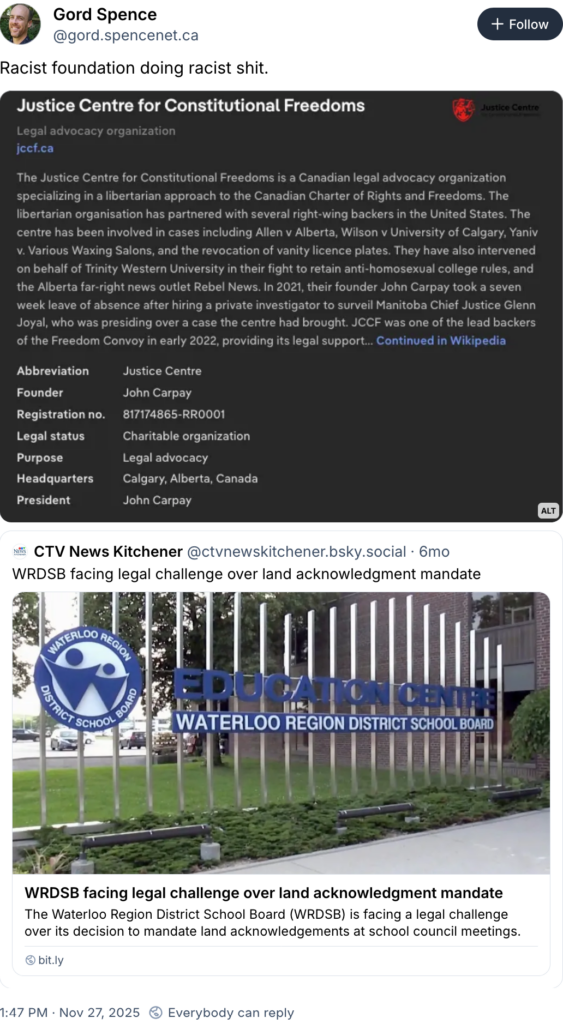
He blocked me after I made fun of his fake award from the (please don’t laugh) the Justice Centre for Constitutional Freedoms. The same JCCF whose president / founders were disbarred for spying on Manitoba Chief Justice Glenn Joyal LOL.
Refer also to:
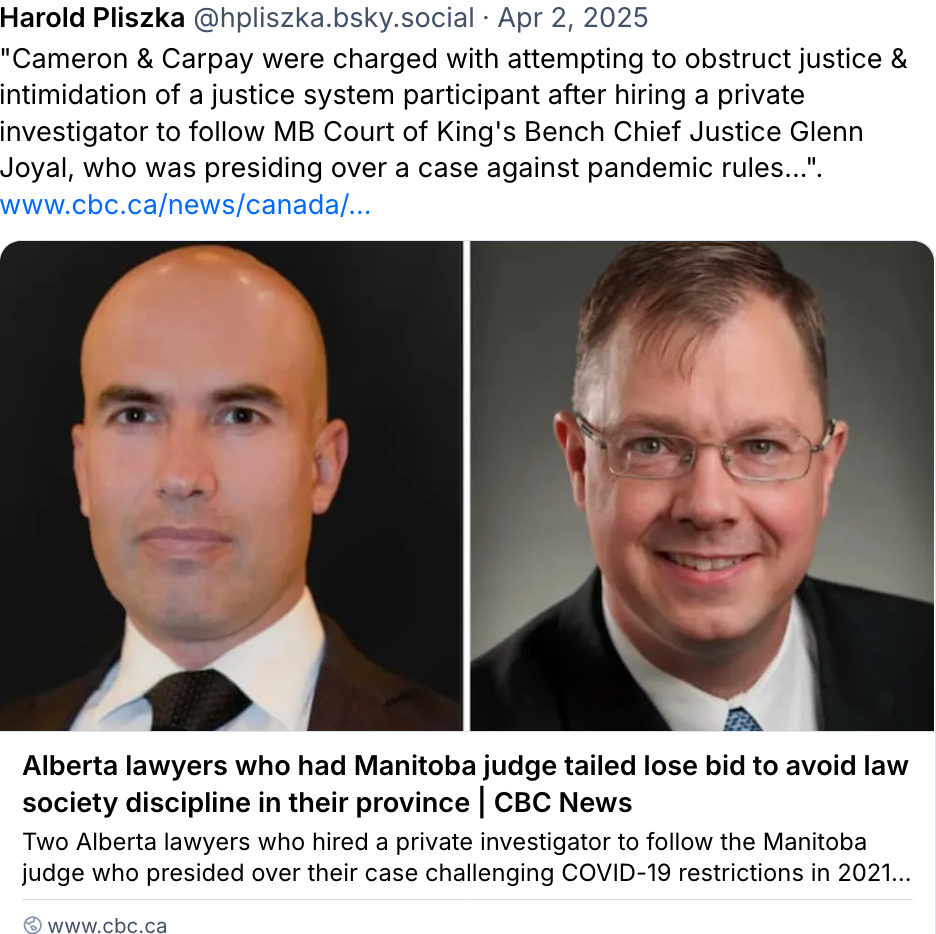
@dyckron.mstdn.ca.ap.brid.gy May 30, 2025:
Calgary lawyers who had Manitoba judge followed fight disbarment www.cbc.ca/news/canada/…
@canadiancynic.bsky.social 2025:
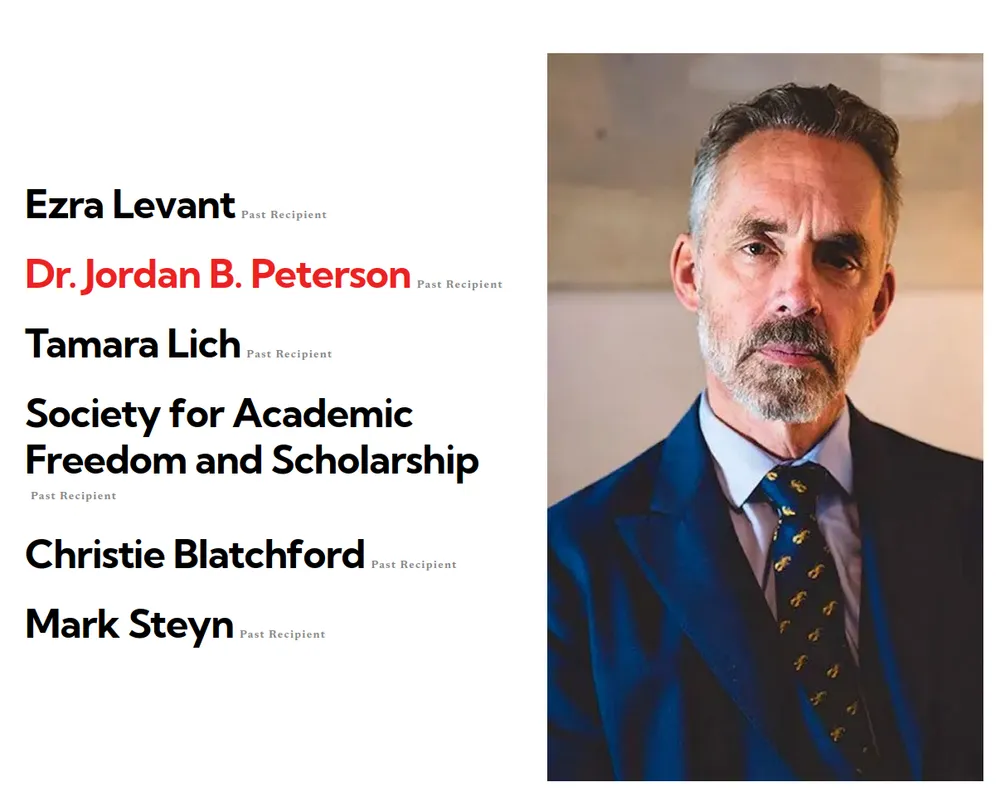
Given JCCF’s John Carpay being disbarred because of being an unprincipled, unethical, bottom-dwelling sleazebucket, it is amusing to peruse the past recipients of the JCCF’s “George Jonas Freedom Award,” a pathetic collection of racists, bigots, fascists, misogynists and anti-Semites as ever was.
Speaking of John Carpay, while he is whining and mewling about this being political persecution, it’s worth reading the entire report, particularly paragraph 37 and on, establishing how Carpay went out of his way to mislead the Court and the investigation. documents.lawsociety.ab.ca/wp-content/u…
Appreciate in particular how utter sleazebag Carpay insisted that Manitoba Chief Justice Glenn Joyal (“Joyal CJ”) was *not* targeted, when Carpay subsequently clarified that what he meant was that Joyal CJ was not *exclusively* targeted but was just one of *multiple* targets.
Alison Creekside @alisoncreekside.bsky.social:
In 2023 Manitoba Crown prosecutors stayed criminal charges against Carpay after he admitted wrongdoing in surveilling a judge, expressed contrition, and agreed to not practice law for 3 years. Carpay then used this stay of prosecution to raise money and proclaim it meant he’d done nothing wrong …