@race2extinct.bsky.social:
Day-zero droughts aren’t just about climate. They’re about demand. We treat overpopulation as unspeakable and act surprised when the water runs out.
@andybehr.bsky.social:
Overpopulation drives DEMAND: for water, for fuel, for natural resources. It will take generations for decreased demand to be realized, and longer for life (not just humans) to adapt to the changed/changing environment.
Overpopulation is THE most undiscussed concern facing the world.
My 4 grandparents, combined, had 11 children, and 60+ grandchildren. They’ve been dead for many years, but their current legacy is literally 100’s of human lives.
My wife and I have 2 kids and 3 grandkids. No more.
Yet my mom keeps asking for more great-grandchildren.
The rules we live by are derived from ideas 1,000’s of years old. They are incompatible with the current environment and human population.
I get why “overpopulation” is unspeakable. Every faith, every culture, every nation must come to grips with a new reality.
They are unable to do so.
In my professional career, I learned that ‘Management’ has a philosophy about problem solving: “It’s not a problem until it’s a problem.” Since corporate execs are becoming global leaders, this thought applies everywhere.
NO ONE will try to solve the problem, until they have no water to drink.
@lucasaurelius.bsky.social:
Asking eight and a half billion people to live like the poorest souls on the planet do now would still not be enough. Normie enviros have been fighting the FF vs renewables battle for so long that that is all they can see. Full renewables tomorrow would not make the world livable.
@race2extinct.bsky.social:
So true.
Where ‘day-zero droughts’ could happen as soon as this decade by Laura Paddison, Sept 23, 2025, CNN

Lake Mead in April 2023 had receded dramatically due to a megadrought and decades over overuse.Will Lanzoni/CNN
Many parts of the world are predicted to endure “day-zero droughts,” periods of extreme and unprecedented water scarcity, which could happen as soon as this decade in certain hotspots including parts of North America, the Mediterranean and southern Africa, according to a new study.
It’s well known that climate change, driven by burning fossil fuels, is throwing the global water cycle off balance and causing scarcity. What’s much less clear is when and where extreme water shortages will hit. The new research helps provide answers and some of them are surprising, said Christian Franzke, a climate scientist at Pusan National University in South Korea and an author of the study published Tuesday in Nature Communications.
The scientists used a large number of climate models to assess the timing and likelihood of day-zero droughts.
These are “unprecedented water scarcity events, events which haven’t occurred so far,” Franzke said. It’s when “you turn on your water tap and no water comes out,” he told CNN.
Day-zero droughts arise from the confluence of various factors, including a prolonged dearth of rain, low river levels and shrunken reservoirs, as well as rocketing water demand to supply people, farms and industries.
Nearly three-quarters of drought-prone regions, including those with major reservoirs, face a high risk of severe and persistent droughts by the end of the century if humans keep burning planet-heating fossil fuels, the study found.
More than a third of these regions, including the western United States, could face this situation as early as the 2020s or 2030s. The finding that day-zero droughts could happen so soon, at current levels of global warming, was “something that surprised us,” Franzke said, even though a few cities have already come perilously close.
Cape Town, South Africa, faced a dire crisis in 2017 and 2018 after one of its most severe multi-year droughts on record. It narrowly avoided disaster thanks to extreme water saving measures and above average rain in 2018.
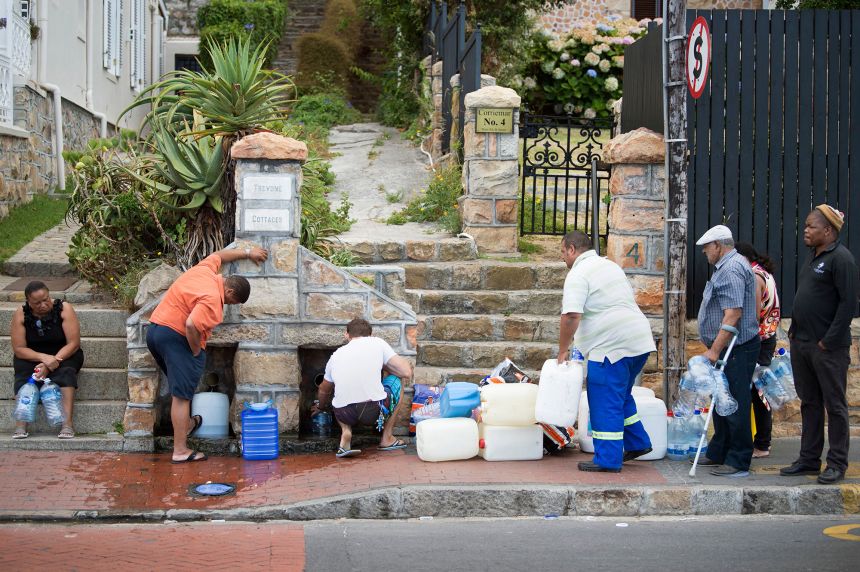
People collect drinking water from pipes fed by an underground spring, in Cape Town on January 19, 2018, as the city battled its worst drought in a century.Rodger Bosch/AFP/Getty Images
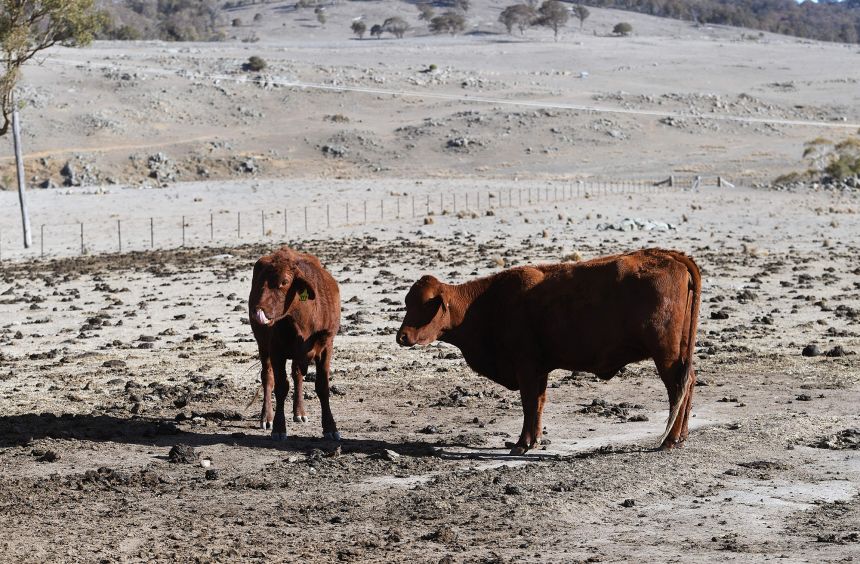
Cattle on a drought-affected farm in New South Wales, Australia, on August 26, 2019. An unprecedented water shortage meant more than a dozen small towns faced a “day zero.”William West/AFP/Getty Images
Chennai in southeastern India came very close to running out of water in 2019, as the monsoon rains failed and and reservoir levels plummeted. Water was trucked into neighborhoods with residents forced to line up for hours in the baking heat.
Many cities are currently battling to avoid day zero, from Tehran and Kabul to Mexico City and Los Angeles.
Cities are particularly at risk as booming populations increase demand on water resources already under pressure from climate change and mismanagement. Low-income communities are expected to be disproportionately affected, the study found.
Some parts of the world, including the Mediterranean, southern Africa, Asia and Australia, are projected to endure more prolonged day-zero drought events with less time between each one, limiting their ability to recover, the report found. This can have devastating effects on agriculture and ecosystems, and for some particularly badly affected areas, it throws into question “whether people might still be able to live there long term,” Franzke said.
The findings point to the clear need to speed up the clean energy transition, he said, as well as improve water management — huge amounts are wasted through leaky pipes, for example. and criminalize frac’ing!!!
The research should also guide industry, he added, pointing to the proliferation of water-guzzling semiconductor manufacturing and data centers in water-stressed areas such as Texas and Arizona.
One limitation with the study is that it doesn’t include groundwater resources in its calculations as they weren’t included in the models the scientists used, but Franzke said they have some measures in their analysis to help account for this.
Richard Allan, a professor of climate science at the University of Reading who was not involved in the research, said it was “important new evidence for how drought will emerge as climate warming combines with the demands for fresh water by societies.”
The research is a “guide rather than a perfect prediction,” Allan told CNN, but, it “paints a picture of an increasing attack on water resources from multiple fronts that is already emerging.”
Refer also to:
A proportion (25% to 100%) of the water used in hydraulic fracturing is not recovered, and consequently this water is lost permanently to re-use, which differs from some other water uses in which water can be recovered and processed for re-use.