The Vanishing Bear That Still Draws a Crowd to Canada, Black bears with white fur are elusive residents of British Columbia’s rainforest; ‘too cool to be real’ by Angela Owens, Aug. 4, 2025, The Wall Street Journal
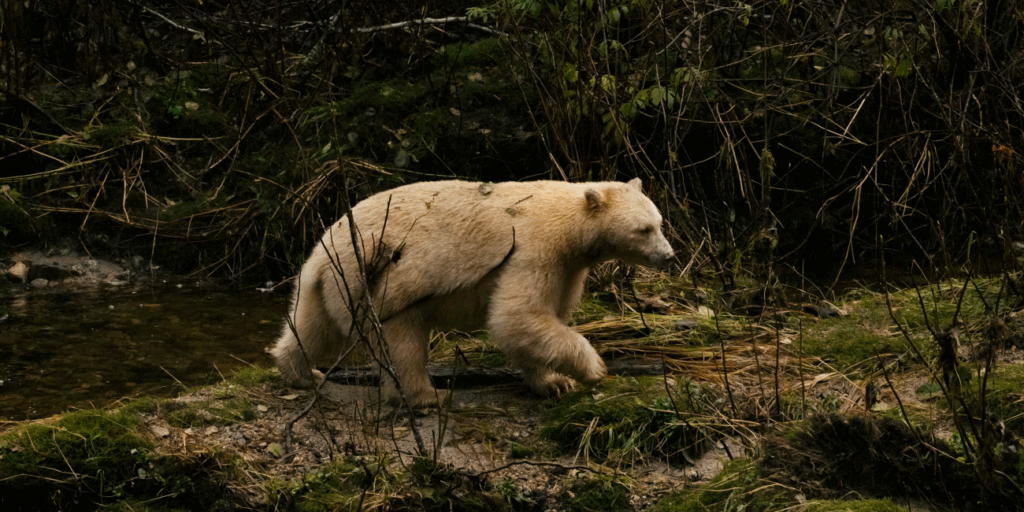
A spirit bear walks along a creek in the Great Bear Rainforest.
GREAT BEAR RAINFOREST, British Columbia—Every year, nature lovers from around the world come to see a ghostly creature that prowls the cloud-shrouded forests of the islands off Canada’s Pacific Coast.
The so-called spirit bears are black bears with a rare genetic mutation that gives them a creamy white coat. The creatures, unique to British Columbia, appear on posters and souvenirs throughout the province.
One small problem: The real thing rarely shows up.
A dwindling supply of salmon, their main meal, has driven the bears from the streams where tourists had the best shot to see them.
There might be 100 spirit bears in the region now, a fraction of previous estimates of 400, said Christina Service, a biologist at the University of Victoria. She studied the animals for two years before she saw one.
“There’s posters of spirit bears everywhere. It sort of gives you this impression that you just come up here and you’re going to see one in every corner,” Service said. “But in fact, it’s really hard to find them, and they’re very, very, very rare.”
That hasn’t dented the enthusiasm of tourists, who spend thousands of dollars to join tours timed to the salmon-spawning season between August and October.
Jake Davis, a wildlife filmmaker from Jackson, Wyo., spent four years trying to spot a spirit bear.
He started saving up money a few years before finally making his first trip in 2015. “It just seemed like the bear was too cool to be real,” he said.
Despite five days searching, Davis didn’t find a spirit bear on that trip, which cost about $5,000. He traveled to the Great Bear Rainforest two more times over the following three years.
A guide would take Davis by boat to different estuaries, where they would get out and walk upstream until they found a good spot to sit and wait. Again and again he came up empty.
“Those days are long—it’s cold, it’s rainy, and you’re just sitting all day,” Davis said. “You’re hopeful, but you tried for so long, so the odds seem low.”
His luck changed on his third trip.
On the final day of potential bear viewing, Davis saw a flash of white through the bushes above a steep cliff on the opposite side of a stream. A spirit bear stepped out of the brush and onto a fallen log that spanned the stream, spending a few hours fishing near its captive audience. “It was like something out of a storybook,” Davis said.
“I think about that place all the time and am itching to get back,” he said.
Not spotting a spirit bear isn’t a total loss. Whales and seals are plentiful in the surrounding waters. Grizzly bears are nearly guaranteed. Bald eagles are another consolation prize.
Spirit Bear Lodge, an indigenous-owned ecotourism company in the heart of the Great Bear Rainforest, advises guests they have a 50% chance of seeing a spirit bear during their four- or six-night stay.
The hope of spotting one still fuels much of the local tourism industry.
The Spirit Bear Lodge sees approximately 500 guests during the season.
Before trophy hunting was banned in their territory, the indigenous Kitasoo Xai’xais people kept their spirit bears a secret, said Sierra Hall, a research associate with the Kitasoo Xai’xais First Nation stewardship department.
“They’re so rare, and everybody wants the rare things in life,” Hall said.
Both parents must carry the recessive gene that gives about a 10th of cubs in the region their white coat. It stands out in the dark forest but helps bears blend in against a bright sky when fishing for salmon.
Biologists say climate change, logging and open-net salmon farms have decimated wild salmon populations off Canada’s coast.
Canada in 2016 protected most of the rainforest from logging, and open-net salmon farms are set to close by 2029. They had been set to close by this year but industry advocates lobbied for an extension. I bet the destructive polluting industry will keep getting extensions from our industry-controlled gov’t until the wild salmon are wiped out, which will then fabulously increase private farming profits which will consequently pollute the oceans more too. Most humans don’t give a shit about anything but their own wants: food, more food, sex, more sex and more sex, and endless instant gratification and distraction via fun and travel, oh ya, and heaps of money for nothing. Spirit Bears will be wiped out, along with Grizzlies, but rape and pillage by the tourism industry will continue polluting with hope, hope to see something rare, so rare, we humans wiped them out. Fucking insanity.
“The best way to start a bar fight in the town that I live in is to go and talk to a fisherman about salmon farms,” said Moira Le Patourel, a naturalist who guides wildlife-viewing tours.
Marven Robinson, a member of the indigenous Gitga’at First Nation who guides spirit bear tours from the village of Hartley Bay, recalled a time 30 years ago when he regularly saw three spirit bears at a time scooping salmon out of creeks.
“All the way down you’d see backs of fish, and I’ve never seen it like that since,” he said.
Last fall, a group of guests boarded a sailboat in the town of Kitimat for a nine-day journey south, eating and sleeping on the boat. They scanned the shoreline incessantly for a glimpse of white fur behind the blips of humpback whales breaching the surface.
On the third day, guests went to shore on a small island. A short hike beneath red alders and Sitka spruce led to the bank of a shallow creek, where they huddled under a tarp to shelter from the rain.
For those who do see the animals, the memory lingers. ‘It was like something out of a storybook,’ says Jake Davis.
As the precipitation tapered off, a lumbering white form emerged from a bend in the creek, climbing up the bank with a salmon carcass between its jaws.
It lingered along the water for just a few minutes, then disappeared into the forest.
@race2extinct.bsky.social:
Behind the spirit bears story is a quiet tragedy—collapsing salmon runs, logged forests, declining black bears. The article tells the truth, then buries it beneath a tourist brochure.
@izeknewt0n.bsky.social:
From the windows of a cancer center today, I watched logging trucks carrying out the “important” mission to thin the forest thereby abetting dry summer grasses in subsequent yrs that light easy & quickly climb the nearby canopy of remaining old growth forest already withering under global warming.
@race2extinct.bsky.social:
It’s anger-inducing the way the timber industry has duped the public.I know of no industry that has not duped the public, which is easy to dupe because humans mostly want what they want, and vehemently reject what’s required to save other species, or even earth’s livability. Ultra stupid vicious raping species.
@tkrause.bsky.social:
We won’t stop until it’s all gone will we.
@race2extinct.bsky.social:
Not a chance.
Ryan Katz-Rosene, PhD @ryankatzrosene:
This last sentence really guts me: “Australia has lobbied for years to keep the reef – which contributes A$6.4 billion ($4.2 billion) to the economy annually – off the endangered list, as it could damage tourism.”
@Reuters:
Australia’s Great Barrier Reef has suffered the largest decline in coral cover in two of its three regions over the last year, research showed, following a mass bleaching of its corals that was among the worst on record
Australia’s Great Barrier Reef suffers record coral decline following mass bleaching
Refer also to: